


%20--%3e%3c!DOCTYPE%20svg%20PUBLIC%20'-//W3C//DTD%20SVG%201.0//EN'%20'http://www.w3.org/TR/2001/REC-SVG-20010904/DTD/svg10.dtd'%3e%3csvg%20version='1.0'%20id='Layer_1'%20xmlns='http://www.w3.org/2000/svg'%20xmlns:xlink='http://www.w3.org/1999/xlink'%20x='0px'%20y='0px'%20width='64px'%20height='64px'%20viewBox='5.5%20-3.5%2064%2064'%20enable-background='new%205.5%20-3.5%2064%2064'%20xml:space='preserve'%3e%3cg%3e%3ccircle%20fill='%23FFFFFF'%20fill-opacity='0'%20cx='37.785'%20cy='28.501'%20r='28.836'/%3e%3cpath%20fill='%23595959'%20d='M37.441-3.5c8.951,0,16.572,3.125,22.857,9.372c3.008,3.009,5.295,6.448,6.857,10.314%20c1.561,3.867,2.344,7.971,2.344,12.314c0,4.381-0.773,8.486-2.314,12.313c-1.543,3.828-3.82,7.21-6.828,10.143%20c-3.123,3.085-6.666,5.448-10.629,7.086c-3.961,1.638-8.057,2.457-12.285,2.457s-8.276-0.808-12.143-2.429%20c-3.866-1.618-7.333-3.961-10.4-7.027c-3.067-3.066-5.4-6.524-7-10.372S5.5,32.767,5.5,28.5c0-4.229,0.809-8.295,2.428-12.2%20c1.619-3.905,3.972-7.4,7.057-10.486C21.08-0.394,28.565-3.5,37.441-3.5z%20M37.557,2.272c-7.314,0-13.467,2.553-18.458,7.657%20c-2.515,2.553-4.448,5.419-5.8,8.6c-1.354,3.181-2.029,6.505-2.029,9.972c0,3.429,0.675,6.734,2.029,9.913%20c1.353,3.183,3.285,6.021,5.8,8.516c2.514,2.496,5.351,4.399,8.515,5.715c3.161,1.314,6.476,1.971,9.943,1.971%20c3.428,0,6.75-0.665,9.973-1.999c3.219-1.335,6.121-3.257,8.713-5.771c4.99-4.876,7.484-10.99,7.484-18.344%20c0-3.543-0.648-6.895-1.943-10.057c-1.293-3.162-3.18-5.98-5.654-8.458C50.984,4.844,44.795,2.272,37.557,2.272z%20M37.156,23.187%20l-4.287,2.229c-0.458-0.951-1.019-1.619-1.685-2c-0.667-0.38-1.286-0.571-1.858-0.571c-2.856,0-4.286,1.885-4.286,5.657%20c0,1.714,0.362,3.084,1.085,4.113c0.724,1.029,1.791,1.544,3.201,1.544c1.867,0,3.181-0.915,3.944-2.743l3.942,2%20c-0.838,1.563-2,2.791-3.486,3.686c-1.484,0.896-3.123,1.343-4.914,1.343c-2.857,0-5.163-0.875-6.915-2.629%20c-1.752-1.752-2.628-4.19-2.628-7.313c0-3.048,0.886-5.466,2.657-7.257c1.771-1.79,4.009-2.686,6.715-2.686%20C32.604,18.558,35.441,20.101,37.156,23.187z%20M55.613,23.187l-4.229,2.229c-0.457-0.951-1.02-1.619-1.686-2%20c-0.668-0.38-1.307-0.571-1.914-0.571c-2.857,0-4.287,1.885-4.287,5.657c0,1.714,0.363,3.084,1.086,4.113%20c0.723,1.029,1.789,1.544,3.201,1.544c1.865,0,3.18-0.915,3.941-2.743l4,2c-0.875,1.563-2.057,2.791-3.541,3.686%20c-1.486,0.896-3.105,1.343-4.857,1.343c-2.896,0-5.209-0.875-6.941-2.629c-1.736-1.752-2.602-4.19-2.602-7.313%20c0-3.048,0.885-5.466,2.658-7.257c1.77-1.79,4.008-2.686,6.713-2.686C51.117,18.558,53.938,20.101,55.613,23.187z'/%3e%3c/g%3e%3c/svg%3e)
%20--%3e%3c!DOCTYPE%20svg%20PUBLIC%20'-//W3C//DTD%20SVG%201.0//EN'%20'http://www.w3.org/TR/2001/REC-SVG-20010904/DTD/svg10.dtd'%3e%3csvg%20version='1.0'%20id='Layer_1'%20xmlns='http://www.w3.org/2000/svg'%20xmlns:xlink='http://www.w3.org/1999/xlink'%20x='0px'%20y='0px'%20width='64px'%20height='64px'%20viewBox='5.5%20-3.5%2064%2064'%20enable-background='new%205.5%20-3.5%2064%2064'%20xml:space='preserve'%3e%3cg%3e%3ccircle%20fill='%23FFFFFF'%20fill-opacity='0'%20cx='37.637'%20cy='28.806'%20r='28.276'/%3e%3cg%3e%3cpath%20fill='%23595959'%20d='M37.443-3.5c8.988,0,16.57,3.085,22.742,9.257C66.393,11.967,69.5,19.548,69.5,28.5c0,8.991-3.049,16.476-9.145,22.456%20C53.879,57.319,46.242,60.5,37.443,60.5c-8.649,0-16.153-3.144-22.514-9.43C8.644,44.784,5.5,37.262,5.5,28.5%20c0-8.761,3.144-16.342,9.429-22.742C21.101-0.415,28.604-3.5,37.443-3.5z%20M37.557,2.272c-7.276,0-13.428,2.553-18.457,7.657%20c-5.22,5.334-7.829,11.525-7.829,18.572c0,7.086,2.59,13.22,7.77,18.398c5.181,5.182,11.352,7.771,18.514,7.771%20c7.123,0,13.334-2.607,18.629-7.828c5.029-4.838,7.543-10.952,7.543-18.343c0-7.276-2.553-13.465-7.656-18.571%20C50.967,4.824,44.795,2.272,37.557,2.272z%20M46.129,20.557v13.085h-3.656v15.542h-9.944V33.643h-3.656V20.557%20c0-0.572,0.2-1.057,0.599-1.457c0.401-0.399,0.887-0.6,1.457-0.6h13.144c0.533,0,1.01,0.2,1.428,0.6%20C45.918,19.5,46.129,19.986,46.129,20.557z%20M33.042,12.329c0-3.008,1.485-4.514,4.458-4.514s4.457,1.504,4.457,4.514%20c0,2.971-1.486,4.457-4.457,4.457S33.042,15.3,33.042,12.329z'/%3e%3c/g%3e%3c/g%3e%3c/svg%3e)
Introduction
Inherited and genetically mediated ventricular arrhythmia syndromes remain important causes of syncope, aborted cardiac arrest, appropriate implantable cardioverter-defibrillator therapy, and sudden cardiac death in children and young adults. Long QT syndrome and catecholaminergic polymorphic ventricular tachycardia are particularly dependent on adrenergic triggers. Contemporary management therefore relies on layered care: strict beta-blockade, phenotype-directed antiarrhythmic therapy, device protection in selected patients, exercise counselling, family education, and structured specialist follow-up. Reference Zeppenfeld, Tfelt-Hansen and de Riva1,Reference Priori, Wilde and Horie2
Cardiac sympathetic denervation is an established adjunctive treatment when residual adrenergically mediated risk remains clinically unacceptable despite standard therapy. The mature evidence base is strongest for left cardiac sympathetic denervation, which reduces cardiac events in high-risk long QT syndrome and catecholaminergic polymorphic ventricular tachycardia, although breakthrough events and device therapies can still occur. Reference Schwartz, Locati, Moss, Crampton, Trazzi and Ruberti3–Reference De Ferrari, Dusi and Spazzolini10 More recent reports have described selected monotherapy, paediatric bilateral denervation, and bilateral denervation for persistent risk, but young-cohort evidence remains limited and heterogeneous. Reference Niaz, Bos, Sorensen, Moir and Ackerman11–Reference Park, Lee, Lee, Jung and Cho17
The rationale for intended bilateral cardiac sympathetic denervation is not that bilateral surgery is universally superior to left-sided denervation. Rather, in selected high-risk patients, more complete sympathetic modulation may be preferred when the multidisciplinary arrhythmia team judges baseline risk to be severe or when a staged second operation is likely to be undesirable. This is a patient-centred question as much as a technical one: the relevant outcomes include survival, syncope, device therapies, medication adherence, perioperative burden, and the ability to maintain long-term care in a vulnerable paediatric population.
We report a consecutive single-centre experience of intended bilateral cardiac sympathetic denervation in children and young adults with severe adrenergically mediated ventricular arrhythmias. The objective was to evaluate patient selection, operative feasibility, procedure-attributable morbidity, follow-up ascertainment, medication and device management, malignant ventricular arrhythmia-free survival, and residual non-malignant rhythm burden. The study was designed to define a selected adjunctive strategy within multidisciplinary care, not to replace established medical or device-based treatment.
Materials and methods
This retrospective single-centre observational study included consecutive children and young adults who underwent intended bilateral cardiac sympathetic denervation between January 2015 and November 2025 at a tertiary referral centre. Care involved thoracic surgery, paediatric cardiology, electrophysiology, cardiovascular surgery, anaesthesia, and intensive care teams. Young adults were included when the arrhythmia syndrome was childhood-onset or follow-up remained within the paediatric electrophysiology programme.
The study was approved by the Hacettepe University Health Sciences Research Ethics Committee with decision number 2026/02-37 on January 20, 2026 and registered under research number SBA 26/066. The requirement for individual informed consent was waived because retrospectively collected deidentified archival clinical data were used. Thirty-seven operated patients were included in baseline, operative, and safety analyses. Thirty-six patients had evaluable post-discharge follow-up and were included in outcome and Kaplan–Meier analyses; one patient had only very early post-operative follow-up at data lock.
Patients were eligible when denervation was performed for prevention or reduction of severe adrenergically mediated ventricular arrhythmic risk. Refractory or high-risk status was defined clinically by sustained ventricular tachycardia or ventricular fibrillation, arrhythmic syncope, aborted cardiac arrest, recurrent appropriate implantable cardioverter-defibrillator therapy, persistent polymorphic ventricular arrhythmia or ventricular ectopy despite medication, or a severe inherited or cardiomyopathy-related arrhythmic phenotype despite ongoing treatment.
The decision to perform intended bilateral denervation was made by the multidisciplinary arrhythmia team. Left cardiac sympathetic denervation remains the established surgical reference strategy. In this cohort, bilateral denervation was selected upfront when residual adrenergically mediated risk was considered severe enough that more complete sympathetic modulation was preferred to a staged approach. Supporting factors included previous cardiac arrest, exertional or emotion-triggered syncope, device-treated malignant ventricular arrhythmia, refractory polymorphic ventricular arrhythmia or ectopy despite medication, severe family history or complex genotype–phenotype expression.
Bilateral denervation was not used as a replacement for medication or device therapy. Beta-blockers were continued or restarted unless temporarily limited by haemodynamic status. Flecainide, mexiletine, or other antiarrhythmic therapy was introduced, continued, or adjusted by paediatric electrophysiology when clinically indicated. Device management remained under cardiology supervision. No patient was included solely for quality-of-life symptoms; when autonomic or vasospastic symptoms were present, an underlying arrhythmic substrate had to independently justify denervation.
Final diagnosis groups were adjudicated with paediatric electrophysiology input and reported as mutually exclusive dominant categories: catecholaminergic polymorphic ventricular tachycardia, long QT syndrome, Jervell–Lange–Nielsen syndrome, arrhythmogenic right ventricular cardiomyopathy, or cardiomyopathy. Genotype and subtype details were retained descriptively when documented. Device-group status was defined pragmatically according to implantable cardioverter-defibrillator presence at the index denervation episode or management as a device patient during that episode.
Data were obtained from operative, anaesthetic, inpatient, intensive care, discharge, outpatient cardiology and electrophysiology, electrocardiography, Holter, exercise test, echocardiography, device interrogation, and medication records. Follow-up was ascertained through scheduled and unscheduled cardiology visits, 12-lead electrocardiography, ambulatory rhythm monitoring, exercise testing when indicated, inpatient telemetry, device interrogation, and final chart review.
The operative goal was bilateral denervation of the lower stellate component and upper thoracic sympathetic chain, usually including the second through fourth thoracic sympathetic levels when technically feasible. Accessory sympathetic fibres, including Kuntz fibres when identifiable, were cauterised or divided. Single-port video-assisted thoracoscopic access was preferred when exposure was adequate; multiport, hybrid, or limited open access was selected according to patient size, prior procedures, device-related surgery, adhesions, anatomical exposure, and safety.
The primary outcome was freedom from a primary malignant ventricular arrhythmic endpoint, defined as sustained ventricular tachycardia or ventricular fibrillation requiring intervention, appropriate device therapy, arrhythmic syncope, cardiac arrest, or arrhythmic death. Residual non-malignant rhythm burden included ventricular extrasystoles, mild or non-sustained ectopy, atrial rhythm burden, persistent repolarisation abnormality, or rhythm-related medication adjustment without the primary endpoint.
Continuous variables were summarised as mean with standard deviation or median with range; categorical variables are shown as counts and percentages. Kaplan–Meier analysis estimated malignant ventricular arrhythmia-free survival from index denervation to first primary endpoint or last follow-up. Because there were only four primary endpoint events and several small diagnosis groups, subgroup findings were descriptive only; no formal subgroup hypothesis testing or multivariable modelling was performed. Analyses used IBM SPSS Statistics version 32.0.0.0.
Results
In brief, intended bilateral cardiac sympathetic denervation was completed in 36 of 37 operated patients, and the median hospital stay was 4 days. Procedure-attributable morbidity was limited to two minor events. Among 36 patients with post-discharge follow-up, 32 remained free from the primary malignant ventricular arrhythmic endpoint, 28 had complete clinical response, 4 had residual non-malignant rhythm burden without a primary endpoint event, and no surviving patient met predefined criteria for clinical failure.
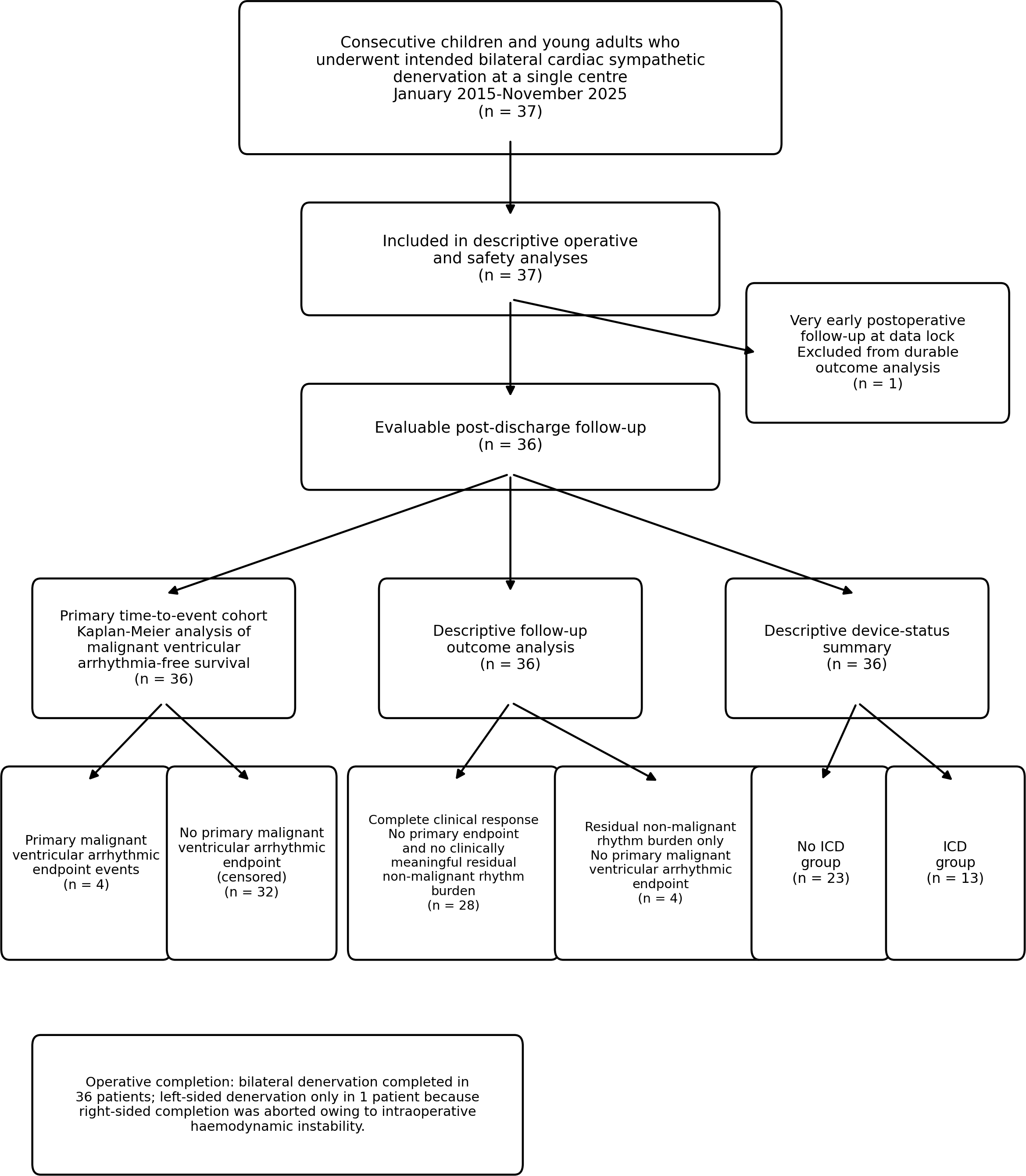
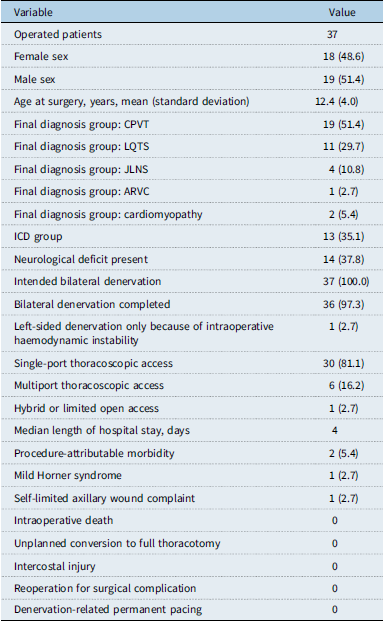
The study flow is shown in Figure 1. The cohort included 37 operated patients: 18 female and 19 male. Age at surgery ranged from 3.7 to 23.0 years, with a mean of 12.4 years. Final diagnosis was catecholaminergic polymorphic ventricular tachycardia in 19 patients, long QT syndrome in 11, Jervell–Lange–Nielsen syndrome in 4, arrhythmogenic right ventricular cardiomyopathy in 1, and cardiomyopathy in 2. Thirteen patients were analysed in the implantable cardioverter-defibrillator group. Fourteen had neurological deficit, mostly reflecting previous cardiac arrest and post-arrest morbidity. Baseline and operative characteristics are summarised in Table 1.
Flow diagram of the operated cohort and outcome analysis population. The diagram shows 37 operated patients who underwent intended bilateral cardiac sympathetic denervation, the 36 patients with evaluable post-discharge follow-up, the 1 patient excluded from durable outcome analysis because post-operative follow-up was very early at data lock, and the primary time-to-event, descriptive follow-up, and device-status analysis pathways.

Figure 1. Long description
Flow diagram showing 37 consecutive children and young adults who underwent intended bilateral cardiac sympathetic denervation between January 2015 and November 2025. All 37 patients were included in descriptive operative and safety analyses. One patient had very early postoperative follow-up and was excluded from durable outcome analysis. Thirty-six patients had evaluable post-discharge follow-up. The diagram then separates the primary time-to-event cohort, descriptive follow-up analysis and device-status summary, showing 4 primary endpoint events, 32 censored patients, 28 complete clinical responses, 4 residual non-malignant rhythm-burden cases, 23 patients without a device and 13 patients with an implantable cardioverter-defibrillator.
Baseline and operative characteristics of the cohort

Table 1. Long description
Description: Table 1 summarises the 37 operated patients, including sex, age at surgery, final diagnosis group, implantable cardioverter-defibrillator status, neurological deficit, bilateral completion, operative approach, median length of stay and procedure-attributable morbidity. It shows that bilateral denervation was completed in 36 patients, single-port access was used in 30 patients and procedure-attributable morbidity occurred in 2 patients.
ARVC = arrhythmogenic right ventricular cardiomyopathy; CPVT = catecholaminergic polymorphic ventricular tachycardia; ICD = implantable cardioverter-defibrillator; JLNS = Jervell–Lange–Nielsen syndrome; LQTS = long QT syndrome.
Values are n (%) unless otherwise stated.
Bilateral denervation was completed in 36 of 37 patients. One patient underwent left-sided denervation only because right-sided completion was aborted owing to intraoperative haemodynamic instability. Single-port thoracoscopic access was used in 30 patients, multiport thoracoscopic access in 6, and hybrid or limited open access in 1. No patient required unplanned conversion to full thoracotomy. There were no intraoperative deaths, intercostal injuries, or reoperations for surgical complications. All patients survived the index operation and were discharged. Median hospital stay was 4 days; longer hospitalisation mainly reflected post-arrest neurological, respiratory, infectious, nutritional, or device-related complexity rather than denervation-attributable morbidity.
Procedure-attributable morbidity was limited to one mild Horner syndrome and one self-limited axillary wound complaint. No patient required reoperation for bleeding, pneumothorax, prolonged air leak, wound failure, or another surgical complication. No patient required denervation-related permanent pacing.
Thirty-six patients had evaluable post-discharge follow-up. Surveillance used outpatient paediatric cardiology and electrophysiology visits, electrocardiography, Holter monitoring, exercise testing when indicated, inpatient telemetry during rehospitalisation, device interrogation in device patients, medication records, and final chart review. Beta-blocker therapy was continued or restarted unless temporarily limited by haemodynamic status; flecainide, mexiletine, or other antiarrhythmic therapy was introduced, continued, or adjusted when clinically indicated. Post-operative improvement was therefore interpreted as denervation integrated into continued multidisciplinary care.
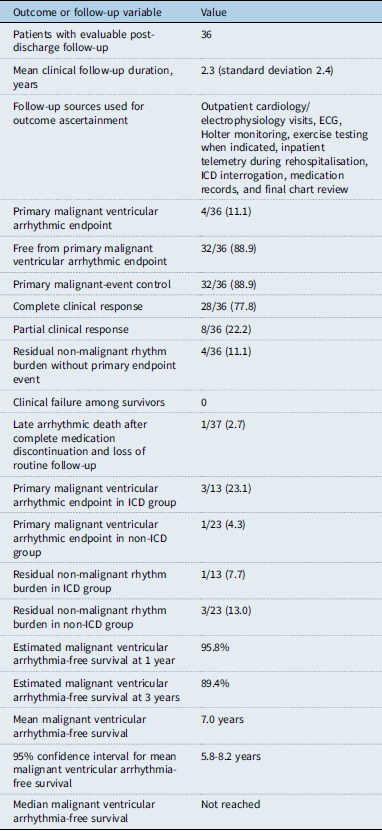
Among the 36 patients with evaluable follow-up, 32 remained free from the primary malignant ventricular arrhythmic endpoint and 4 met the endpoint. Twenty-eight patients achieved complete clinical response, defined as absence of both the primary endpoint and clinically meaningful residual non-malignant rhythm burden. Eight patients were partial clinical responders: four with a primary endpoint event and four with residual non-malignant rhythm burden without a primary endpoint event. One late arrhythmic death occurred after complete discontinuation of prescribed beta-blocker therapy and loss of routine follow-up; it was retained in the arrhythmic outcome analysis but was not considered procedure-attributable mortality.
Primary endpoint events occurred in 3 of 13 device patients and 1 of 23 patients without a device. These findings were interpreted descriptively because device status reflected baseline arrhythmic severity and treatment selection rather than randomised exposure. Residual non-malignant rhythm burden was observed in 1 of 13 device patients and 3 of 23 patients without a device.
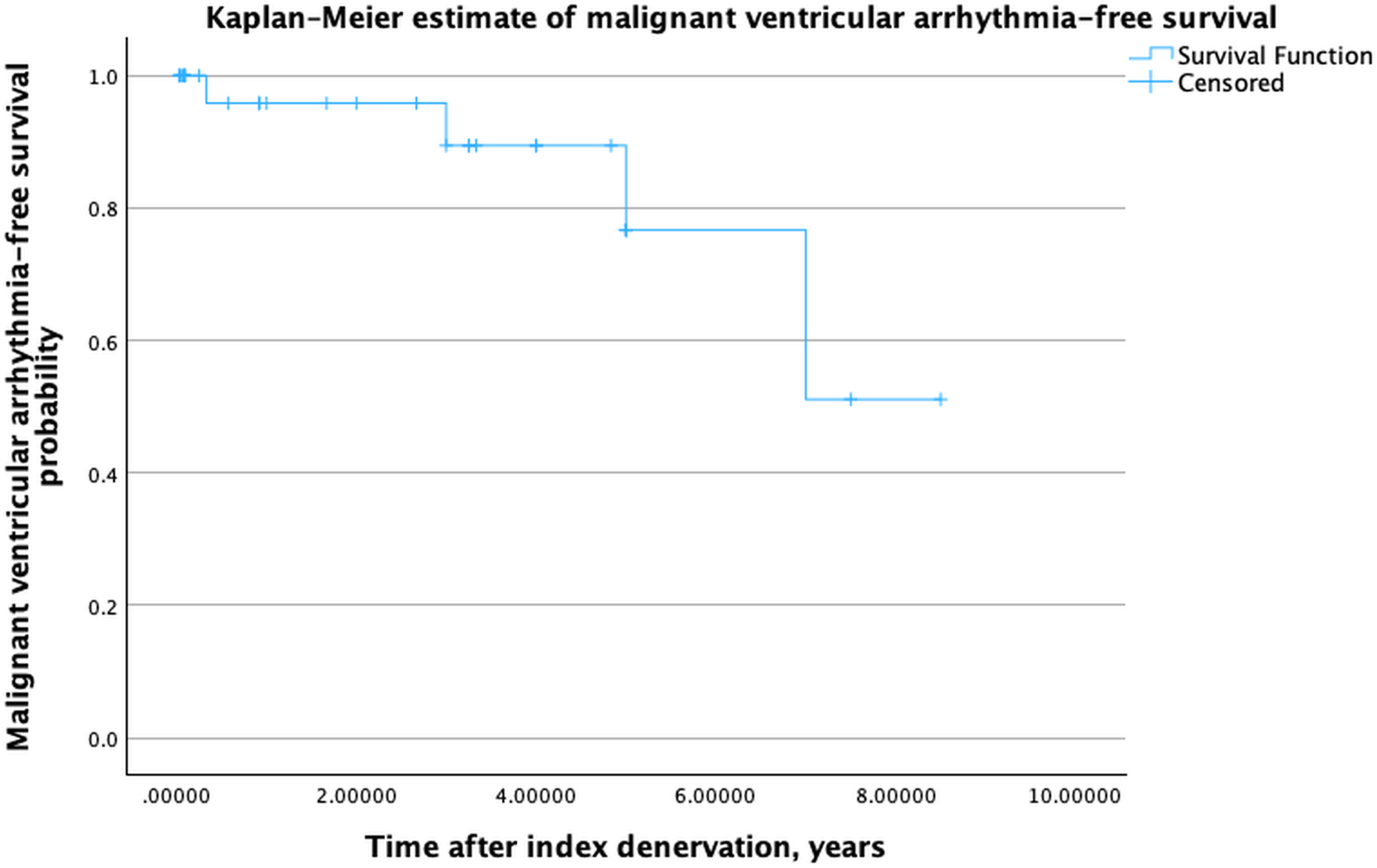
Kaplan–Meier analysis was performed in the 36 patients with evaluable follow-up. Estimated malignant ventricular arrhythmia-free survival was 95.8 per cent at 1 year and 89.4 per cent at 3 years. Mean malignant ventricular arrhythmia-free survival was 7.0 years, with a 95 per cent confidence interval of 5.8 to 8.2 years. Median survival was not reached. Later estimates were interpreted cautiously because few patients remained at risk beyond 5 years. Figure 2 shows the Kaplan–Meier curve, and follow-up and outcome summaries are presented in Table 2.
Kaplan–Meier estimate of malignant ventricular arrhythmia-free survival after intended bilateral cardiac sympathetic denervation. Events were defined as sustained ventricular tachycardia or ventricular fibrillation requiring intervention, appropriate implantable cardioverter-defibrillator therapy, arrhythmic syncope, cardiac arrest, or arrhythmic death. Patients without the primary endpoint were censored at last available clinical or device follow-up. Four primary endpoint events occurred, and 32 patients were censored. Estimated malignant ventricular arrhythmia-free survival was 95.8 per cent at 1 year and 89.4 per cent at 3 years. Mean malignant ventricular arrhythmia-free survival was 7.0 years, with a 95 per cent confidence interval of 5.8 to 8.2 years. Median malignant ventricular arrhythmia-free survival was not reached. Later estimates should be interpreted cautiously because few patients remained at risk. Number at risk at 0, 1, 2, 3, 4, 5, 6, 7, and 8 years: 36, 18, 16, 14, 9, 6, 3, 3, and 1, respectively.

Figure 2. Long description
Kaplan-Meier curve showing malignant ventricular arrhythmia-free survival among 36 patients with evaluable follow-up after intended bilateral cardiac sympathetic denervation. Four primary malignant ventricular arrhythmic endpoint events occurred. Estimated event-free survival was 95.8 per cent at 1 year and 89.4 per cent at 3 years. Mean malignant ventricular arrhythmia-free survival was 7.0 years, with a 95 per cent confidence interval of 5.8 to 8.2 years; median survival was not reached. Number at risk at 0 through 8 years was 36, 18, 16, 14, 9, 6, 3, 3 and 1.
Follow-up ascertainment and clinical outcomes after intended bilateral cardiac sympathetic denervation

Table 2. Long description
Description: Table 2 summarises follow-up sources and outcomes in the 36 patients with evaluable post-discharge follow-up. It reports the primary malignant ventricular arrhythmic endpoint, complete and partial clinical response, residual non-malignant rhythm burden, device-status descriptive outcomes and Kaplan-Meier summary estimates.
ECG = electrocardiography; ICD = implantable cardioverter-defibrillator.
Values are n/N (%) unless otherwise stated.
Discussion
This consecutive single-centre series suggests that intended bilateral cardiac sympathetic denervation can be performed with low procedure-attributable morbidity in selected children and young adults with severe adrenergically mediated ventricular arrhythmias. The central message is deliberately measured: bilateral denervation was not uniformly curative and should not replace beta-blockade, phenotype-directed antiarrhythmic therapy, device surveillance, or structured follow-up. Rather, in a high-risk cohort enriched for cardiac arrest, recurrent syncope, device-treated arrhythmia, and severe inherited arrhythmia phenotypes, most evaluable patients remained free from the primary malignant ventricular arrhythmic endpoint after denervation within continued multidisciplinary care.
The patient-centred importance of this finding is that the target was not only technical completion of an operation. The clinically meaningful outcomes were survival-related and quality-of-care-related: prevention of malignant arrhythmic events, reduction of instability, avoidance of procedure-attributable morbidity, short perioperative recovery in most patients, and continued cardiology-led follow-up after discharge. The series therefore describes a cardiology-surgical care pathway rather than a stand-alone thoracic procedure.
A key clinical learning point is the separation of malignant ventricular arrhythmic endpoints from lower-grade residual rhythm findings. A child with recurrent ventricular fibrillation or appropriate device therapy is clinically different from a child with isolated ventricular extrasystoles, persistent repolarisation abnormality, or medication adjustment. By restricting the primary endpoint to sustained ventricular tachycardia or ventricular fibrillation requiring intervention, appropriate device therapy, arrhythmic syncope, cardiac arrest, or arrhythmic death, and by tracking residual non-malignant rhythm burden separately, the revised framework avoids both under-reporting and overstatement of recurrence.
The strongest evidence for surgical sympathetic modulation remains left cardiac sympathetic denervation, which has shown durable event reduction in long QT syndrome and clinically important benefit in catecholaminergic polymorphic ventricular tachycardia. 3,4,5,6,7,8,9,10,15 Our data should therefore not be read as a rejection of left-sided denervation. They describe an institutional strategy of intended bilateral denervation in patients for whom the arrhythmia team judged that residual adrenergic risk was severe enough to justify more complete sympathetic modulation upfront. The study supports feasibility of this strategy but does not prove superiority over left-sided denervation; that question requires prospective comparative study.
The surgical findings are also relevant. In children, narrow intercostal spaces and small thoracic cavities may raise concern about exposure, intercostal morbidity, and hospital stay. In this cohort, single-port access usually allowed visualisation of the sympathetic chain and resection of the lower stellate component and upper thoracic chain, with attention to accessory fibres. No intercostal injury, clinically relevant port-site pain, unplanned full thoracotomy, or reoperation for surgical complications was recorded. Technical approach should nevertheless remain individualised according to patient size, adhesions, previous surgery, device-related procedures, and intraoperative safety.
Procedure-attributable morbidity was low but should be reported transparently. Mild Horner syndrome occurred in one patient, which is anatomically plausible during lower stellate dissection and should be discussed pre-operatively. One additional patient had a self-limited axillary wound complaint. Several patients had prolonged hospitalisation, but this largely reflected baseline post-arrest neurological injury, respiratory morbidity, infection, nutritional problems, or device-related complexity rather than surgical injury. Separating procedure-attributable morbidity from baseline critical illness is essential in this population.
Follow-up ascertainment also matters. Outcomes were not based on symptoms alone; they were drawn from clinical review, electrocardiography, Holter monitoring, exercise testing when indicated, inpatient telemetry, device interrogation, and medication records. Device patients and non-device patients declare recurrence through different pathways, so multiple sources are necessary in real-world inherited arrhythmia care. Device-group findings were descriptive only because device status reflected previous malignant arrhythmia, perceived risk, and treatment selection, not a comparable exposure group.
Medication changes after denervation require the same caution. In catecholaminergic polymorphic ventricular tachycardia and long QT syndrome, beta-blockade and phenotype-informed antiarrhythmic therapy remain central. Reference Zeppenfeld, Tfelt-Hansen and de Riva1,Reference Priori, Wilde and Horie2,Reference De Ferrari, Dusi and Spazzolini10,Reference Dusi, Pugliese and De Ferrari15 Denervation should therefore be understood as a surgical reduction of sympathetic input embedded within ongoing medical optimisation. The late arrhythmic death after complete medication discontinuation and loss of follow-up reinforces this point: denervation reduces adrenergic vulnerability, but it does not remove the underlying genetic or structural substrate. Long-term adherence, family education, device surveillance when indicated, and structured cardiology follow-up remain essential.
This study is limited by its retrospective, single-centre, non-randomised design; lack of a contemporaneous left-sided comparator; heterogeneous diagnoses; variable follow-up duration; and small number of primary endpoint events. Later Kaplan–Meier estimates should be interpreted cautiously because the number at risk decreased over time. Medication and device management were not protocolised but reflected specialist real-world care. Despite these limitations, the series provides one of the larger consecutive young cohorts of intended bilateral denervation and reports operative feasibility, procedure-attributable morbidity, malignant endpoints, residual rhythm burden, medication management, and device surveillance as related but distinct domains.
Future multicentre registries or prospective collaborative studies should define baseline risk, genotype-specific indications, medication status, device burden, operative laterality, follow-up schedule, and endpoints before surgery. The most important unanswered question is which high-risk patients benefit sufficiently from upfront bilateral denervation to justify choosing it over an initial left-sided strategy.
Conclusion
Intended bilateral cardiac sympathetic denervation was technically feasible in this selected cohort of children and young adults with severe adrenergically mediated ventricular arrhythmias and was associated with low procedure-attributable morbidity. Most evaluable patients remained free from the primary malignant ventricular arrhythmic endpoint during follow-up, while residual non-malignant rhythm burden was identifiable as a separate category. These findings support intended bilateral denervation as a selected adjunctive strategy within multidisciplinary arrhythmia care. Prospective multicentre studies are needed to define which patients benefit most from an upfront bilateral approach rather than staged left-sided denervation.
Supplementary material
The supplementary material for this article can be found at https://doi.org/10.1017/S1047951126124913.
Data availability statement
The data underlying this article are not publicly available because they contain deidentified but potentially sensitive clinical information from a rare paediatric and young-adult arrhythmia cohort. Reasonable requests for aggregated, non-identifiable data may be considered by the corresponding author, subject to institutional and ethical approval requirements.
Acknowledgements
The authors thank the paediatric cardiology, electrophysiology, thoracic surgery, cardiovascular surgery, anaesthesia, intensive care, and nursing teams involved in the multidisciplinary care of these patients.
Author contribution
Serkan Uysal contributed to study conception, surgical care, surgical strategy, study supervision, data interpretation, and critical manuscript revision. Ayse Ali Hasan contributed to data collection, data organisation, literature review, manuscript drafting, and revision. İlker Ertuğrul contributed to paediatric electrophysiology adjudication, multidisciplinary patient-selection assessment, arrhythmia interpretation, follow-up assessment, and critical revision. Tevfik Karagöz contributed to paediatric cardiology care, clinical interpretation, and critical revision. Mustafa Yılmaz contributed to surgical care, clinical interpretation, and critical revision. All authors reviewed and approved the final manuscript.
Financial support
This research received no specific grant from any funding agency, commercial entity, or not-for-profit organisation.
Competing interests
The authors declare none.
Ethical standard
The authors assert that all procedures contributing to this work comply with the ethical standards of the relevant national guidelines on human research and with the Declaration of Helsinki. This retrospective archive-based study was approved by the Hacettepe University Health Sciences Research Ethics Committee with decision number 2026/02-37 on January 20, 2026 and was registered under research number SBA 26/066. The requirement for individual informed consent was waived by the ethics committee because the study used retrospectively collected deidentified archival clinical data.
Artificial intelligence use declaration
ChatGPT by OpenAI was not used to generate, collect, extract, verify, analyse, or interpret clinical data. All clinical data, statistical analyses, interpretations, references, and final manuscript content were reviewed, verified, edited, and approved by the human authors, who take full responsibility for the accuracy, integrity, originality, and scientific content of the work.


 Open access

