Distribution of resources and what principles are used have always been an issue that has drawn attention in different areas of research. In the field of Child Development, this topic was originally studied by Piaget, through research that involved the use of clinical method (Piaget, 1965). Using hypothetical stories, Piaget observed that reasoning related to distributive justice involves a sequence in which, initially, younger children consider it fairer to benefit authority figures. However, between 8–10 years of age, children tend to affirm that the fairest way to distribute is using an egalitarian system, sharing the same amount for everyone involved in the distribution. Lastly, at around 11 years, children try to produce a more equitable distribution, considering the characteristics of each participant involved in the distributive context.
Studies in different countries (McGillicuddy-De Lisi, Daly, & Neal, Reference McGillicuddy-De Lisi, Daly and Neal2006; Sampaio, Camino, & Roazzi, Reference Sampaio, Camino and Roazzi2008; Tsutsu, Reference Tsutsu2010; Wong & Nunes; Reference Wong and Nunes2003) corroborate Piaget’s findings (Reference Piaget1932/1965) regarding the existence of changes in how children evaluate models of distribution as they get older. Despite this, studies that embrace the Piagetian approach have been criticized because they only investigate distributive judgments in hypothetical scenarios, without necessarily evaluating the relationship of moral reasoning and its influence on actual behavior.
In order to move forward and address the alleged methodological problems of Piaget’s approach, some authors have been investigating the distributive judgments of people using economic games. For example, dictatorial games have been used as an effective tool to investigate sharing behavior, both in children (Benenson Pascoe & Radmore , Reference Benenson, Pascoe and Radmore2007; Blake & Rand, Reference Blake and Rand2010; Smith, Blake, & Harris, Reference Smith, Blake and Harris2013) and adults (Ben-Ner & Kramer, Reference Ben-Ner and Kramer2011; Forgas & Tan, Reference Forgas and Tan2013; Ogawa, Takemoto, Takahashi, & Suzuki, Reference Ogawa, Takemoto, Takahashi and Suzuki2012). The dictator game (DG) was originally designed for studies involving economic standards, and in the simplest version of DG one participant (“the proposer”) receives a certain specified endowment (e.g. money) and is free to decide how to share it with another anonymous person (“the responder”), who is entirely passive (Engel, Reference Engel2011).
Studies using DG to investigate children’s sharing behavior has consistently showed that between 3 and 5 years of age increases in sharing is related to advances in age and emotional comprehension (Fehr, Bernhard, & Rockenbache, Reference Fehr, Bernhard and Rockenbach2008; Gummerum, Hanoch, Keller, Parsons, & Hummel, Reference Gummerum, Hanoch, Keller, Parsons and Hummel2010; Ongley & Malti, Reference Ongley and Malti2014), awareness of social norms pertaining to equity (Kogut, Reference Kogut2012) and higher socioeconomic status (Benenson et al., Reference Benenson, Pascoe and Radmore2007). Also, even in early childhood (12–18 months) there seems to be a rudimentary sense of fairness, as well as a preference for equity (Geraci & Sutian, Reference Geraci and Surian2011).
Recently, Smith et al. (Reference Smith, Blake and Harris2013) found that young children (3–8 years) expect that equal sharing be applied to both others and themselves, however failed to equitably distribute assets (stickers in that case) when given the authority to dictate quantities between themselves and another child. Furthermore, they observed a decreasing in terms of inconsistency between actual behavior and judgments as children aged, most notably at about eight years old.
In addition, Blake and McAuliffe (Reference Blake and McAuliffe2011) found that at about 8 years children tend to begin rejecting inequitable distributions more than younger children (3–5-year-olds). In this research, participants could accept or refuse three models of distribution of candies: egalitarian (1, 1), disadvantageous to oneself (1, 4) and advantageous to oneself (4, 1). Results indicated that children up to 7 years old could not resist allocating assets in a manner representative of the third model (4, 1). On the other hand, 8 year old children rejected both advantageous and disadvantageous divisions, with the majority preferring the egalitarian model, even though this would result in an obvious sacrifice for them.
In general, previous research demonstrated that at all ages of children recognize and are influenced by the rule of equality, but especially 3–5-year-olds who tend to hoard resources when they had an opportunity to dictate the distribution. Furthermore, cross-cultural studies have shown that specific contexts influence the decision to share (Camerer, Reference Camerer2003; Engel, Reference Engel2011), with clear differences between the way people share resources in hypothetical scenarios (Rochat et al., Reference Rochat, Dias, Guo, Broesch, Passos-Ferreira, Winning and Berg2009) versus situations in which they are directly affected by the outcomes produced as a result of the distribution (Henrich et al., 2003).
However, an important aspect of these results is the fact that participants always conducted their choices in the presence of their parents or other adults (e.g. researcher). Considering this point, it is reasonable to ask if children would keep rejecting advantageous distribution for themselves if they were given the opportunity to dictate distribution of the endowment in a private context, alone, rather than under observation.
Research on child moral development can shed some light on the prior question. For example, in order to evaluate children’s obedience to rules, Piazza, Bering, and Ingram (Reference Piazza, Bering and Ingram2011) conducted an experiment during which the participants had to perform a task in three experimental conditions. Results showed that children who were left alone in the experimental room were more likely to break the rules of the task than those who performed the assignment in the presence of an adult, or those who have reported to believe being in the presence of Princess Alice. Thus, the results demonstrated that children are more prone to follow social norms, thereby resisting the natural tendency to seek out decisions that are personally advantageous while in the presence of adults. Also, sensitivity to the moral balance of other people’s actions is highly influenced by development, leading older children to direct more generous behavior towards someone who demonstrates an intention to help rather than hinder others (Kenward & Dahl, Reference Kenward and Dahl2011).
Benenson et al. (Reference Benenson, Pascoe and Radmore2007) requested children participating in a dictatorial game to share stickers while the experimenter covered her eyes, indicating to the participants that their distribution decisions concerning the stickers would remain confidential. Results showed that children became more altruistic as age increased, and that participants of a lower socio-economic status tended to distribute more conservatively than those with a higher economic status.
In Blake and Rand’s research (Blake & Rand, Reference Blake and Rand2010) children participated in a dictatorial game using a “privacy box” (an opaque box) placed on a table. Results demonstrated a direct correlation between the proportionality of distribution and increase in participant’s ages. Also, the value that children gave to the stickers interfered with their decisions to share, because the most valuable stickers were more often kept by the decision maker.
Even though in the study conducted by Benenson et al. (Reference Benenson, Pascoe and Radmore2007) the researcher closed his eyes while participants shared the stickers, he remained in the room; likewise these conditions were followed in the research conducted by Blake and Rand (Reference Blake and Rand2010). Furthermore, in both studies the researcher did not leave the children alone in the room while they conducted the stickers’ distribution, and his presence might have had a strong influence on sharing behavior.
As referenced earlier, previous studies indicate that children’s behavior is influenced by the situational clues available in the context in which the decision making process occurs, and also by the presence of adults. However, none of these studies directly compared the effects of social context, and of the expectation of being observed by an adult on children’s sharing behavior. Thus, in the present study we aimed to test if the way children share resources is influenced by the presence of an adult. It was hypothesized that children would be more prone to share equally in a public context than in a private one. Also, it was expected that the influence of social context on sharing behavior would increase as the children became older.
Method
Participants
Sixty-three children (30 boys) ranging from 3 to 8 years old (M = 5.46; SD = 1.58) were recruited from two private schools (preschool to 4th grade) in the city of Petrolina (PE), Brazil, consisting of predominantly middle-class and white students. In both schools, participants were randomly assigned to one of the following experimental situations: sharing in a private context (n = 32), or sharing in a public context (n = 31).
Instruments
Disney characters stickers were used as an endowment in a dictator game. These stickers passed a valuation test with 30 participants prior to the research during which the children used a Likert graphic scale with five levels (1 = Very Sad and 5 = Very happy) to evaluate how happy they would be if they got four of these stickers. All reported that they would like to receive all four stickers; and 77% of the children said they would be very happy if they get all four stickers.
Two colored envelopes were used to segregate the number of stickers they would keep (green) from the ones that would be given to another child (orange). Finally, a blue envelope that supposedly belonged to a child who had played before with the researcher was used to evaluate participant’s expectations regarding other children’s sharing behavior.
Procedures
Data collection was conducted at the children’s school in a single session, individually, in a room that was suitable so disruptions would not occur. The assignment was initiated after the explanation and clarification of all questions.
In order to evaluate the influence of context on children’s sharing behavior, two experimental situations were elaborated in which the participants had the opportunity to distribute stickers between themselves and another child. In the first situations (private) the participant distributed the stickers alone in the room and was told that no one would know how many stickers he had shared. In addition, the researcher would leave the room after giving instructions. On the other hand, in the public situation, participants had to make the distribution in the presence of the researcher and they were informed that the stickers they had placed in the green and orange envelopes would be counted afterward.
Children who did the distribution in the private context received the following explanation:
“These stickers are all yours now; you will have the opportunity to share these stickers with another child who will come here later. If you wish to share 1, 2, 3 or 4 stickers with the other child, then they should be placed in this envelope (orange). I will not know or tell anyone how many stickers you decided to share. The child receiving the stickers will not know who you are either. Remember that these stickers are all yours and you can share them as you wish.”
After giving these instructions, the researcher left the room and returned only after the child said the task was completed.
Children who did the distribution in the public context received the following explanation:
“These stickers are all yours now; you will have the opportunity to share these stickers with another child who will come here later. If you want to share 1, 2, 3 or 4 stickers with the other child, then they should be placed in this envelope (orange). After you are done, I will count the number of stickers left in the orange envelope. But remember that these stickers are all yours and you can share them as you wish.”
In this situation the researcher remained in the room while the child performed the distribution.
Upon completion of the distribution, a blue envelope was shown to the participant who was told that it belonged to another child who had performed the exact same tasks before he arrived. He was then asked: “How many stickers do you think the other child who came to play with me before you should have left for you?”
Ethical Aspects
The research project was approved by an ethics committee before its presentation, and is registered under number 0006/180912 CEDEP/UNIVASF.
Results
In order to evaluate the effects of age in sharing behavior, two age groups were constituted during the analysis process: 3–5 year olds (n = 30; M = 4.30; SD = .78), and 6–8 year olds (n = 33; M e = 6.79; SD = .69).
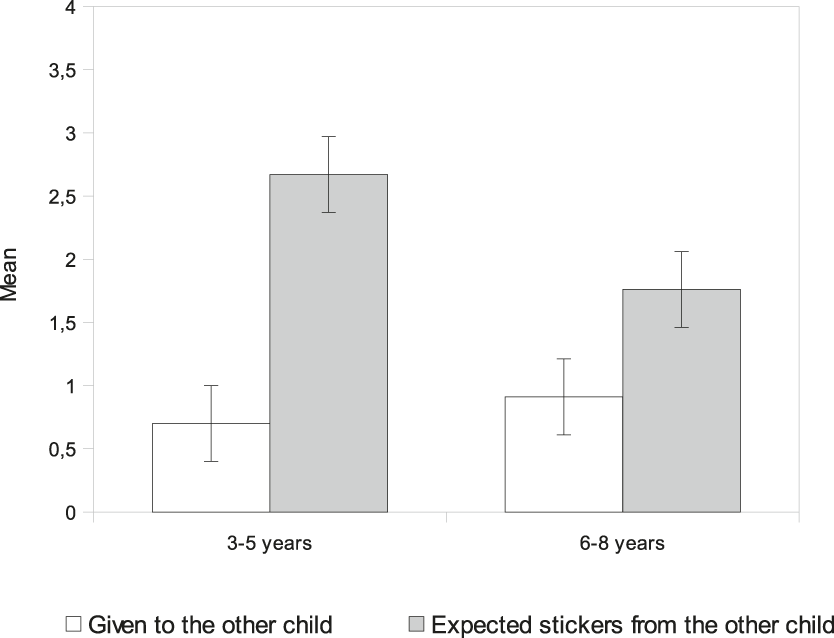
A paired-samples T-tests showed that participants, in general, expected that the previous child had left an average quantity of stickers (in the blue envelope) greater than (M = 2.19; SD = 1.35; p < .01) the amount which they themselves had left in the green envelope (M = 0.81; SD = 0.94). The discrepancy between actual sharing behavior and expectation of the other children’s behavior was significant in both age groups: 3–5 years (p < .001); 6–8 years (p = .002).
Average of stickers shared with other children and average expected to receive.

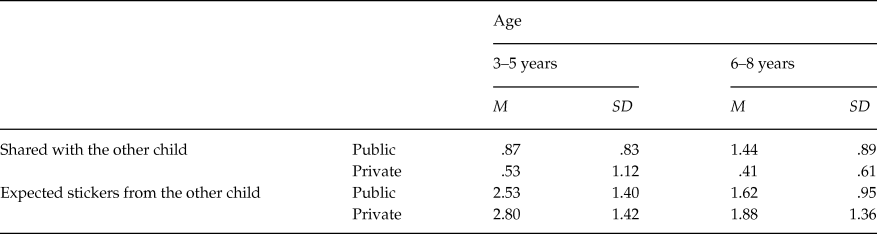
A Two-way ANOVA was used to compare distribution numbers as they related both in context (public or private) as well as age group. Results showed that the participants aged 3–5 years did not differ (p > .05) from the average amount of stickers allocated to another child regardless of context, whether it be in a private (M = 0.53; SD = 1.12) or public context (M = .87; SD = .83). On the other hand, those aged from 6–8 years showed a significant difference between the number of stickers allocated to themselves in both experimental conditions (public or private), F(1, 31) = 14.89, p = .001, ηp 2 = .30), with a tendency for participants to leave a larger quantity while under observation than when they were left alone (Table 1).
Average and standard deviation of stickers shared and expected in each context

For both age groups, there was no difference in the mean of stickers children expected to receive either in the public or in private context. In other words: children’s expectation of the other child’s sharing behavior remained consistent regardless of the presence or absence of an adult observer.
A T-test was used to compare the amount of stickers shared (placed in the orange envelope) and the amount that the children expected to receive (blue envelope) with the fixed value 2, which corresponds to an even split. It was observed that for both age groups, children shared significantly less than half of the stickers (3–5 years: M = .70; SD = .98; p < .001; 6–8 years: M = 0.91; SD = 0.91; p < .001). On the other hand, 3–5-year-olds expected to receive significantly more than half of the stickers (M = 2.67; SD = 1.39; p < .014). By contrast, the 6–8-year-olds’ expectations regarding the other child’s sharing behavior did not differ significantly from an equal split.
There were no significant difference between boys and girls (p > .05) regarding either the amount of stickers given to a colleague or the amount of stickers that was expected from another child who had played previously.
Discussion
Results of this research showed that in both groups participants believed that the other child who came before should have allocated a greater number of stickers than they actually shared when they had the opportunity to do that. This suggests that even younger children seem to apply to other people a norm of sharing based on equality, when formulating their expectations of others, before they are even able, in practice, to follow this norm by themselves, generating a discrepancy between their predictions about other people’s behavior and their actual behavior.
Confirming one of the main hypotheses, results suggests that as age advances children begin to worry more about their distributive behavior, especially when they act in the presence of an adult. This concern might stem from a need to maintain a moral reputation in front of others, leading the children to act in accordance with what they believe is socially approved. It is believed that this occurs because some socialization practices in Latino countries, such as in Brazil, tend to reinforce early behaviors based on cooperation and reciprocity (Levine, Norenzayan, & Philbrick, Reference Levine, Norenzayan and Philbrick2001; Rochat et al, Reference Rochat, Dias, Guo, Broesch, Passos-Ferreira, Winning and Berg2009), especially in regard to those related to sharing (Rochat et al, Reference Rochat, Dias, Guo, Broesch, Passos-Ferreira, Winning and Berg2009). Examples of these types of incentives are the orders given by parents to children to share equally, teaching them that one must share what they have with others who are less fortunate. In this case, the parents provide the children with verbal training on fairness standards, as noted in the study by Granlinski and Kopp (Reference Gralinski and Kopp1993).
This concern about a possible moral reputation seems to be the product of an evolution of socio-cognitive abilities from the age of 6, because the results showed 3–5-year-olds did not differ in the way they shared the stickers, either when they were being observed, or when they were left alone in the room. Thus, it seems that younger children kept the focus on their own wishes and behaved selfishly; “stocking up” the stickers they received (Blake & McAuliffe, Reference Blake and McAuliffe2011; Fehr et al., Reference Fehr, Bernhard and Rockenbach2008).
One explanation for this result can be found in the fact that young children have little opportunity to learn an egalitarian pattern from observing their peers because their colleagues are also likely to act unfairly during a sharing situation. Even though children are exposed early to verbal training on cooperation, it is only by the age of five that they start to associate negative reactions to inequality to explicit references to fairness standards, and this might be reinforced by the protest of their peers (Smith et al., Reference Smith, Blake and Harris2013).
Another hypothesis is that younger children have a greater difficulty in understanding other people’s perspectives, since according to Selman (Reference Selman1971) that ability evolves throughout development, exerting influence on moral development. Also, as Tagakishi, Kameshima, Shug, Koizumi, & Yamagishi (Reference Takagishi, Kameshima, Shug, Koizumi and Yamagishi2010) demonstrated, there is a clear relationship between sharing behavior and the development of socio-cognitive abilities, such as Theory of Mind. In this manner, children 3 to 5 years old might have not yet managed the ability to take other people’s perspectives, which led them to act only on their own behalf.
On the other hand, from the age of 6, participants demonstrated some concern about their distributive behavior when they were observed, and shared more stickers in the public context as compared to the private. As it was noted by Piazza et al. (Reference Piazza, Bering and Ingram2011), older children show more self-restraint in terms of breaking social norms to gain an advantage in the absence of adults. Thus, it is suggested that they sought to adjust their sharing behavior to a “socially desirable norm” of equality, but only when they were being observed, precisely because they wanted to look more righteous in the eyes of the researcher. According to Olson and Spelke (Reference Olson and Spelke2008), children are already able to adapt their behavior to the moral standards present in their peer group in the early years of development.
The tendency of children to conduct themselves in such a way as to follow the fairness standard only when they were observed may have occurred in order to obtain social rewards, such as: approval from others and compliments, as suggested by Batson et al. (Reference Batson, Lishner, Carpenter, Dulin, Harjusola-Webb, Stocks and Sampat2003). In this case, the motivation for a child to act morally, or in accordance with moral principles they have been taught, is something that is not yet fully consolidated until 8 years of age. However it may even occur automatically, through a heuristic process which regulates social behavior.
Although the data indicate that children from the age of six were already aware of the equality standard for distribution, by expecting the other children to have distributed equally, the results showed that the participants of both age groups, did not behave based on the standard of fairness. As in the research by Smith et al. (Reference Smith, Blake and Harris2013), participants tended to be more selfish than egalitarian when they had the opportunity to decide how to distribute the resources (stickers) available.
The pattern of results in which a discrepancy is observed between what the individual expects from other social agents and his own behavior points to the possibility that the norm of equality is interpreted in different ways, depending on whether the individual is involved or not in the situation. Brazilian researchers have been investigating the behavior of sharing in hypothetical situations (Dell’Aglio & Hutz, Reference Dell’Aglio and Hutz2001; Sales, Reference Sales2000; Sampaio et al., Reference Sampaio, Camino and Roazzi2008) and demonstrated that children tend to show greater consistency in the use of the principle of equality, whether they are targeted or not by the proposed distribution.
In the present study, it was noted that the standard of equality was only preserved when the distribution was made in a public context, because when participants had the expectation of maintaining confidentiality in their distribution, the adoption of a standard based on self-benefit was most prevalent.
In a certain sense, the classical approach in which participants are encouraged to make judgments about hypothetical situations allowed them to built theoretical models that explain how the distributional judgments are made and used by children. However, only through a method in which actual behavior is tested and compared with the verbal judgments could we empirically observe that the gap between judgment and moral behavior might be greater than originally hypothesized by Piaget (Piaget, Reference Piaget1932/1965).
In research by Blake and Rand (Reference Blake and Rand2010) and Benenson et al. (Reference Benenson, Pascoe and Radmore2007) the children performed their distribution without anyone observing, however the researchers did not retire from the experimental environment. Furthermore, participants had no opportunity to distribute their stickers in different contexts. In the present research, there was a change from previous studies, because in one of the experimental conditions used here, participants distributed their stickers in the total absence of another person.
It is suggested that future research investigate socio-cognitive factors that might be associated with the need to maintain a moral reputation in front of others. Among these factors, it is questionable whether the Theory of Mind and other perspective taking abilities can influence children’s sharing decision. We suppose that at the time of distribution they may worry about what the other social agents (especially adults) will think, leading them to conduct themselves in a way that would be more “socially” appropriate.
Finally, we highlight some limitations of the present study, the first being the demographic background of the participants in this study, since they all had a medium socio-economic status and studied in private schools. In this regard, it is suggested that future studies determine whether children who have a distinct economic status share resources differently in a situation similar to the one used here. Another limitation of the present research was the use of stickers. Thus it is suggested that future studies utilize resources that can be valued as much by children as by adults, such as the possibility to receive gift certificates and participants could choose the prizes they would like to receive. Finally, it is necessary to consider that the small sample size was an additional limitation that must be addressed in further research.