Introduction
Hippocampal abnormalities are commonly found in patients with schizophrenia spectrum disorders.Reference Dean, Orr and Bernard1 Anatomical alterations of hippocampal volume have been noted in subjects at high risk for developing psychosis and early in the development of schizophrenia.Reference Buehlmann, Berger and Aston2–Reference Bois, Levita and Ripp6 To this end, the strive for identifying a putative biomarker that predicts the onset of psychosis has been continuous. A large cross-sectional study from Vargas et al Reference Vargas, Dean and Osborne7 found that hippocampal abnormalities emerge before the onset of psychosis episode. A similar large-scale study looking at volumetric alteration in hippocampal subfield and first-psychotic episodes (FEP) found unusually low volumes of left hippocampal subfields in patients with FEP, suggesting a potential putative neural biomarker of psychosis onset.Reference Baglivo, Cao and Mwangi8 Other studies suggest a potential association of selective volume deficits subfields and early onset psychosis.Reference Ho, Holt and Cheung9 However, to this day, the literature examining the hippocampal alteration and illness onset trajectory remains sparse. Nonetheless, it remains unclear how these early changes coincide with the broader cognitive impairments that include attention, memory, and executive functioning.Reference Addington, Brooks and Addington10–Reference Bilder, Goldman and Robinson12 Specifically, the question of whether cognitive and structural impairments present before the onset of psychosis or are the consequence of the underlying episode remains highly debatable in today’s literature.Reference Watson, Bai and Barrett13
At the functional level, anatomical changes in first-episode schizophrenia broadly coincide with the alteration of the basal ganglia-thalamocortical circuit,Reference Ellison-Wright, Glahn, Laird, Thelen and Bullmore14 suggesting neuronal pathology in a well characterized pathway implicated in schizophrenia.Reference Gur, Keshavan and Lawrie15 Earlier published workReference Anvari, Friedman, Greenstein, Gochman, Gogtay and Rapoport3, Reference Ota, Obu, Sato and Asada16 suggests that abnormal hippocampal development in schizophrenia can be linked to deficits in global functioning, the presence of negative symptoms, and worsened functional outcomes. Studies of patients at extremely high risk for psychosis (defined by a mix of trait and state factors) have shown that cognitive impairments prior to first psychosis episode are less profound.Reference Brewer, Wood and Phillips17–Reference Lencz, Smith and McLaughlin19 Further, work from Mathew et al Reference Mathew, Gardin and Tandon20 shows that hippocampal alterations (a key node to the pathway of psychosis) were evident in psychosis patients. They show abnormalities on the subfields closely related with memory-associated processes, indicating that pattern separation and pattern completion might be abnormal in psychosis patients.Reference Mathew, Gardin and Tandon20
In another angle, genetic studies found that the combination of a subset of schizophrenia patients’ risk variants inversely relates to hippocampal volume.Reference Harrisberger, Smieskova and Vogler21, Reference Vassos, Di Forti and Coleman22 Additionally, the literature indicates plausible accumulated longitudinal epigenetic risks associated with pathophysiology of FPE. In this regard, it is highly possible that random factors that increase DNA methylation variability may contribute to the complex, heterogeneous pathophysiology of conversion to psychosis in patients with ultra-high risk of psychosis.Reference Kebir, Chaumette and Krebs23, Reference Kebir, Chaumette and Rivollier24
Given the above literature, which leaves the relationship of brain anatomical abnormalities and clinical course unsettled, we undertook a thorough evaluation of 3 patients who presented to our adolescent inpatient psychiatry service with cognitive impairments and new-onset psychosis. Interestingly, for the time of admission we observed a temporal relationship between cognitive performance and neuroanatomical changes in these patients.
Although limited, our findings suggest that volumetric reductions and/or alterations of the hippocampus may occur either concomitantly or closely following the development of early cognitive deficits in young patients with psychosis. Cognitive deficits are thought to progress if the disease is left untreated with uncertain effects on brain morphology.
Methods
The Structured Clinical Psychiatric Interview (SCID) was conducted by a trained psychology resident or an attending psychologist in the unit.Reference First, Spitzer, Gibbon and Williams25
The neuroimaging study involved non-contrast 3 Tesla (3T) magnetic resonance imaging (MRI) of the brain to rule out structural/anatomical abnormalities or other ongoing organic changes in the brain. We used the following technique: sagittal and axial T1-weighted images, axial flair images, axial gradient echo images, axial and coronal T2-weighted images, and axial diffusion weighted images of the brain were obtained. The MRI scans were conducted within the first 3 days of admission, with the aim of ruling underlying structural changes and potential masses in the brain.
Sleep-deprived electroencephalogram (EEG) tests
Patients were kept awake between 10 PM and 6 AM, with aim of detecting abnormal electrical activity in the brain such as: sharp waves, spike and slow-wave complexes, polyspike, and slow-wave complexes. These activities indicate epileptic seizures that are related to present underlying psychiatric disorders. The testing was done on a specialized epilepsy unit, at the Department of Neurology.
Psychological assessment
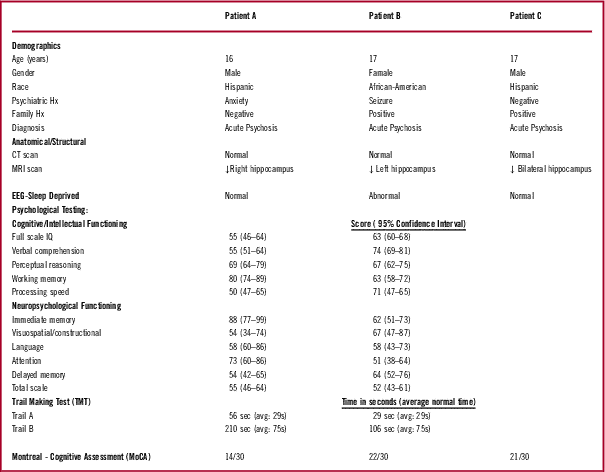
Comprehensive psychological testing performed included: cognitive/intellectual functioning, neuropsychological testing, and executive functions testing (see Table 1), as well as Montreal Cognitive Assessment (MoCA). The following instruments were conducted by trained psychology residents: Wechsler Intelligence Scale for Children – Fourth Edition (WISC-IV)Reference Wechsler, Engstrom, Alexander, Motto and Roulston26/Wechsler Adult Intelligence Scale – Fourth Edition (WAIS-IV)Reference Wechsler, Kaplan and Fein27, Reference Wechsler, Coalson and Raiford28; the Repeatable Battery for the Assessment of Neuropsychological Status (RBANS)Reference Randolph, Tierney, Mohr and Chase29, Reference Beatty, Mold and Gontkovsky30; Trails Making Test (TMT)Reference Reitan and Wolfson31; the Personality Assessment Inventory – Adolescent (PAI-A)Reference Morey32; and the Rorschach Inkblot Test.Reference Rorschach33
Demographics, Clinical Characteristics and Neuropsychological Testing

Results
Patient A
Patient A was a 16-year-old Hispanic male who presented with emotional and perceptual disturbances associated with generalized anxiety disorder and intermittent panic attacks.
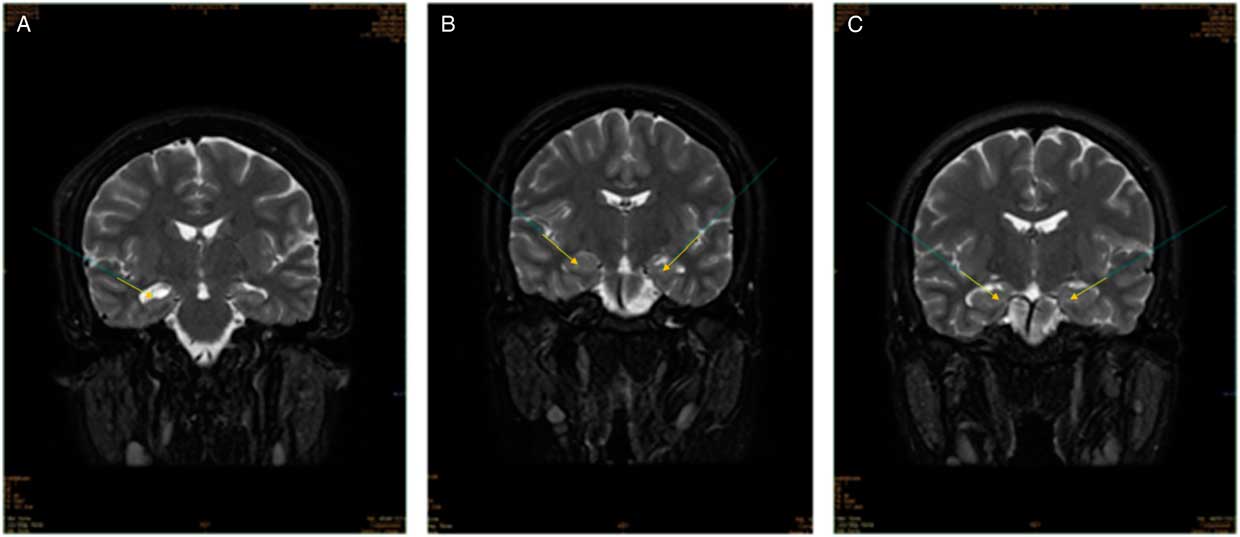
The non-contrast MRI of the brain showed decreased right hippocampal volume (Figure 1, panel A) but normal sleep-deprived EEG findings.
Patient A (panel A) shows non-contrast brain MRI of 16-year-old male with decreased right hippocampus volume; Patient B (panel B) is significant for bilateral increase of the hippocampal fissure size and smaller left hippocampus of a 17-year-old subject. Patient C (panel C) show the non-contrast structural brain MRI of the brain pertinent for bilateral prominence of hippocampal fissures.

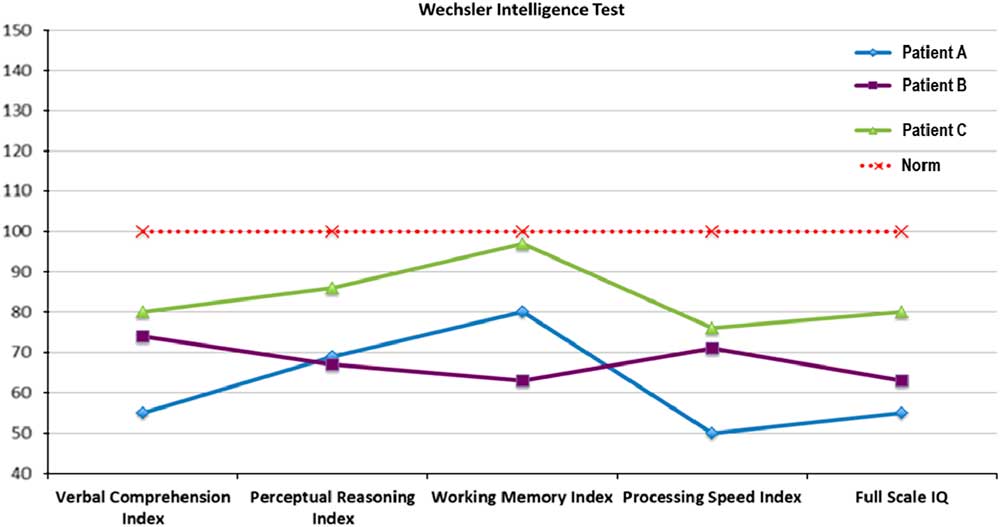
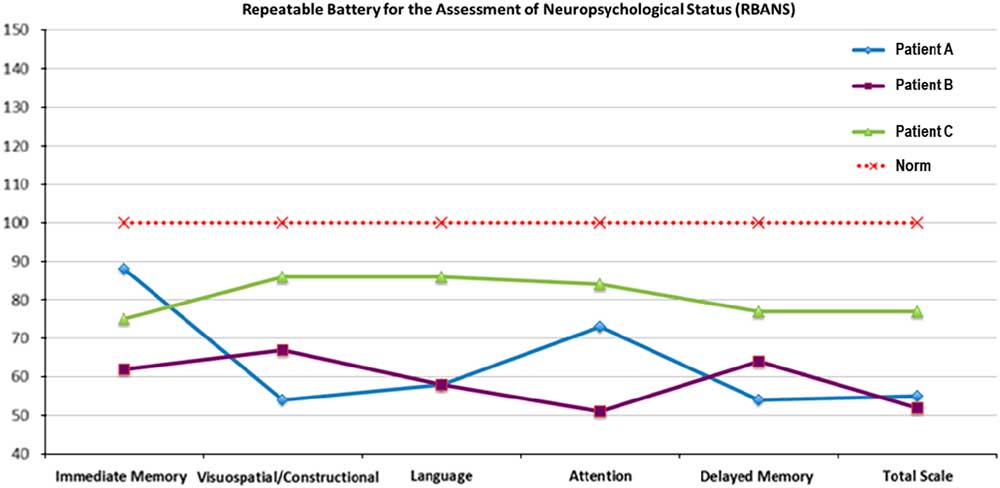
The psychological assessment revealed a Full-Scale IQ (FSIQ) of 55, but this finding was not considered to be an accurate estimate of his cognitive functioning given the variability across different domains of cognitive functioning. His performance on tasks measuring attention and ability to retain recently encoded information was in the low to average range, whereas his performance across domains of verbal comprehension perceptual reasoning, and processing speed were all in the extremely low range (Figure 2, patient A). This variability in performance was also evident on his performance on the RBANS (Figure 3, patient A), on which he performed in the low average range on immediate memory and in the extremely low range on all other functional domains. He had notable deficits in both verbal and nonverbal reasoning. The ability to retain verbal information in list form was limited to 6 items and did not benefit from repetition. Further, his verbal encoding did not appear to benefit from context, and the short-term recall was poor for both verbal and visual information. In fact, his spatial orientation and visual encoding were particularly impaired. The patient also struggled with executive functioning, as he scored in the impaired range on Part B of TMT, suggesting he had difficulty switching sets and inhibiting certain stimuli (see Table 1).
IQ scores are displayed as standard scores with means of 100 and a standard deviation of 15. Patient C performed relatively close to the average, but both patients A and B performed below average.

The RBANS scores are displayed as standard scores with means of 100 and a standard deviation of 15. Like the IQ scores in Figure 2, patient C performed relatively close to the normative sample, but both patients A and B performed below the normative sample.

Personality assessment revealed that the patient experienced significant anxiety and somatization. He tended to struggle with focusing his attention and would instead scan his environment in a hasty manner. He exhibited little in the way of psychological resources for managing stress and became easily overwhelmed. His reality testing appeared intact without overt symptoms of thought disorder.
There was no family history of diagnosed psychiatric disorders.
Patient B
Patient B was a 17-year-old African-American female who presented with frank psychotic symptoms, mood instability, intermittent catatonia, and a 4-year history of cannabis abuse.
The non-contrast brain MRI was notable for bilateral increase of hippocampal fissure size and a smaller left hippocampus (Figure 1, panel B). The clinical picture was further complicated by intermittent myoclonic seizure activity demonstrated on the sleep deprived EEG. Spontaneous bursts of generalized spikes and waves along with polyspike and wave discharges were consistent with an idiopathic generalized form of epilepsy.
The corresponding psychological assessment was pertinent for global deficits in cognitive functioning; she performed in the extremely low range on verbal reasoning, nonverbal reasoning, attention, and efficiency. Her poor performance on the WAIS-IV (Figure 2, patient B) was consistent with her performance on the RBANS, on which she also performed in the extremely low range across all cognitive domains (Figure 3, patient B). Of note, the TMT revealed no evidence of major limitations with executive functioning (see Table 1). Personality assessment was consistent with minimization of symptoms and poor insight and judgment. She tended to misperceive her environment, but no overt disorganized thinking was noted. She preferred to see her environment in a simplistic manner and hence was prone to feeling overwhelmed.
Patient family history was pertinent first degree relative with schizophrenia, depression, and learning disabilities.
Patient C
Patient C was a 17-year old Hispanic male who presented with frank paranoia, persecutory delusions, and auditory and visual hallucinations, coupled with increasing unprovoked agitated behavior in the context of substance intoxication and a history of extensive cannabis use.
The non-contrast MRI of the brain was pertinent for bilateral prominence of hippocampal fissures (Figure 1, panel C). Sleep-deprived EEG was normal. Psychological testing for Patient C demonstrated low average cognitive functioning on the WASI-IV (Figure B, patient C) and RBANS, with difficulty encoding verbal information, recalling visual information, and processing simple information efficiently (Figure 3, patient C). No problems with executive functioning were noted (see Table 1). Personality assessment showed a tendency to misperceive his environment but displayed no evidence of disorganized thinking. He preferred to see the world in an unsophisticated manner, tending to become easily overwhelmed. He had little awareness of his emotions and appeared to limit his emotions in evocative situations. Consistent with his psychiatric history, he reported that drug use had caused problems in multiple domains of his life. Of note, he expressed interest in making changes in his life and appeared open to treatment.
Family history was significant for a first degree relative with schizophrenia.
Diagnosis and Therapeutic Intervention
Patient A was diagnosed with atypical psychosis, generalized anxiety disorder, and panic attacks with agoraphobia. He was started on risperidone 0.5 mg oral twice a daily, gradually titrated to 1.5 mg oral twice daily. Initially, the anxiety and frequent panic attacks were managed with lorazepam 1 mg every 6 hours on an as needed basis, which gradually was tapered off while the antipsychotics were adjusted to a therapeutic dose. The patient responded well to intensive psychotherapeutic interventions offered by therapists on the unit.
Patient B was diagnosed with acute-psychosis episode (rule out psychotic disorder due to general medical condition) and cannabis use disorder. She was initially started on lorazepam 2 mg 2 to 3 times a day for significant catatonic symptoms until she exhibited a therapeutic benefit. She was then tapered off the benzodiazepines and cross-titrated to oral risperidone adjusted to 1 mg in the morning and 2 mg at nighttime for persistent psychotic symptoms.
Patient C was initially medicated several times emergently due to agitation and aggression secondary to synthetic drug use. He was started on quetiapine that was later cross-titrated to risperidone and adjusted to a required therapeutic dose of 2 mg twice a day. The symptoms of disorganized behavior, frank paranoia, and delusions gradually subsided and he was discharged to home on risperidone long-acting injection 25 mg every 2 weeks.
All 3 patients were stabilized within a period of 3–6 weeks; their symptoms were managed with atypical oral and/or long-acting antipsychotics and subsequently discharged to our outpatient facilities.
It is relevant to clarify that the medication treatment regimen was explicitly guided by therapeutic response, rather than hippocampal alterations described above.
Conclusions
Prospective and cross-sectional studies of adults with first-episode psychosis suggest a relationship between hippocampal volume reduction as detected by radiologically evaluated structural MRI, negative symptoms, and deficits in global cognitive functioning.Reference Anvari, Friedman, Greenstein, Gochman, Gogtay and Rapoport3, Reference Addington, Brooks and Addington10, Reference Bora, Lin, Wood, Yung, McGorry and Pantelis18, Reference Gur, Calkins and Satterthwaite34–Reference Lappin, Morgan and Chalavi36
Furthermore, it is well established that cognitive deficits are a core feature of schizophrenia.Reference Green37 The established presence of cognitive deficits supports the theory of converging neurophysiological and neuropsychological impairments during the first psychotic episode.Reference Wood, Brewer and Koutsouradis11, Reference Morales-Muñoz, Jurado-Barba and Fernández-Guinea38, Reference Lecardeur, Meunier-Cussac and Dollfus39 In addition, early treatment and recovery of hippocampal volume has been associated with better outcomes across clinical, functional, and cognitive domains.Reference Lappin, Morgan and Chalavi36
The hippocampus is a highly plastic region of the brain (or of the limbic system) that historically has been the focus of extensive studies in patients with first episode psychosis or schizophrenia; yet, the underlying etiologies of hippocampal alterations remain unclear. It is still uncertain whether these alterations result from early cognitive impairmentsReference Bora, Lin, Wood, Yung, McGorry and Pantelis18, Reference Morales-Muñoz, Jurado-Barba and Fernández-Guinea38, Reference Lecardeur, Meunier-Cussac and Dollfus39 that ultimately lead to disruption or arrest of normal neurodevelopment,Reference Hyza, Huttlova, Kerkovsky and Kasparek40–Reference Velakoulis, Wood and Wong43 or whether the anatomical alterations are epiphenomenal to cognitive changes.Reference Nelson, Saykin, Flashman and Riordan44 Clinical studies have shown that decreased time between the onset of psychosis and the initiation of appropriate treatment is associated with a greater chance of recoveryReference Perkins, Gu, Boteva and Lieberman45 and better functional outcomes.Reference Lecardeur, Meunier-Cussac and Dollfus39, Reference Bradford, Perkins and Lieberman46
Our clinical case-based review shows a remarkable coincidence between hippocampal alterations and neurocognitive deficits during the early course of psychosis. These findings are consistent with the hypothesis that preceding psychotic events are associated with an early disruption of the neurodevelopmental processes that may lead to brain changes and subsequent clinical manifestations of the illness. Alterations of gray matter in other brain areas including hippocampus, amygdala, and prefrontal cortex are likely to follow thereafter.Reference Nenadic, Dietzek and Schönfeld47, Reference Brent, Thermenos, Keshavan and Seidman48 The dynamic changes of brain morphology seem to parallel disease development, as hippocampal volume reduction was observed at the time of transition to psychosis with further progression in later stages of the illness.Reference Hyza, Huttlova, Kerkovsky and Kasparek40, Reference Velakoulis, Wood, McGorry and Pantelis42 However, hippocampal volume measures have not reproduced across different studies,Reference Stone, Day and Tsagaraki49 and their reliability as biomarkers of disease progression or prodrome in schizophrenia is questionable at the current stage; hence we should be cautious when deriving conclusions from the current state of the literature.
Additionally, when evaluating patients with FPE one should cautiously ruling-out epileptic seizures due to high concordance with psychosis, specifically temporal lobe seizures, as it may mimic psychotic presentation.Reference Clancy, Clarke, Connor, Cannon and Cotter50 Our patients in the report all had sleep deprived EEG, and findings were normal with the exception of patient B, who had abnormal EEG consistent with idiopathic generalized form of epilepsy.
The authors are aware of pitfalls inherent in cross-sectional case reports such as those described in this article, mainly due to the inability to fully evaluate the temporal relationship of hippocampal changes to neurocognitive deficits. To better substantiate questions about the sequential and causative relationships would require studies of larger cohorts and a longitudinal approach design. In addition, future studies should include functional neuroimaging analyses coupled with higher resolution structural techniques. Nonetheless, despite the limitations, these findings have important implications for future neurobiological studies of psychotic disorders and emphasize the importance of longitudinal studies that examine patients before and after the onset of a psychotic illness.
Disclosures
The authors have nothing to disclose.