



Obesity and diet-related non-communicable diseases are recognised to be a major public health problem and represent an important challenge in both developed and developing countries. The burden imposed by these diseases undermines social and economic development and increases inequalities(Reference Ng, Feming and Robinson1–3). As a result, this issue has been frequently addressed in international organisation agendas such as the United Nations’ Sustainable Development Goals and Decade of Action on Nutrition(4,5) and national governments have been called to action. Nonetheless, although a variety of interventions have been widely recommended, efforts to address the problem have been insufficient.
Brazil was the first country to formally agree to engage within the United Nations’ Decade of Action on Nutrition framework in 2017. The Brazilian Ministry of Health established SMART commitments, which included quite ambitious goals that could only be achieved if concrete actions were taken, especially by the Federal government(6).
Stopping the growth of the adult obesity rate and reducing by at least 30 % the consumption of sugar-sweetened beverages among adults by 2019 were among the SMART commitments taken on by the Ministry of Health(6). Because higher intakes of energy-dense and nutrient-poor ultra-processed foods have been related to increased rates of obesity and diet-related non-communicable diseases, frequently recommended measures include regulating the activities of the ultra-processed food industry(Reference Novak and Brownell7–Reference Monteiro and Cannon9). Such interventions, however, are likely to impact the practices and profits of the companies that produce and distribute them. Therefore, they face strong opposition and usually require governments to enact legislation(Reference Roberto, Swinburn and Hawkes10–Reference Swinburn, Sacks and Hall12).
In this paper, we assess efforts of the Brazilian legislature to address the main recommendations to regulate food industry practices to tackle obesity and diet-related non-communicable diseases by identifying and assessing the legislative process of bills under consideration during the first 4 years of the United Nation’s Decade of Action on Nutrition (2016–2025).
Methods
We examined bills under consideration in the Brazilian legislature between 2016 and December 2019 which aimed at regulating the practices of ultra-processed food industries, following the main recommendations articulated in documents such as the WHO’s Global Strategy on Diet, Physical Activity and Health and the Report of the Commission on Ending Childhood Obesity(3,13) , as well as the United Nations’ Political Declaration of the High-level Meeting of the General Assembly on the Prevention and Control of Non-communicable Diseases(14), as follows:
-
1) interventions to limit salt (Na), added sugars and total and saturated fat content and to eliminate the use of trans fats in industrialised products;
-
2) adoption of responsible marketing practices (including marketing, advertising, sponsorship and promotion) for unhealthy foods and drinks, especially protecting children;
-
3) adoption of a food-labelling system that allows consumers to access accurate, standardised and clear nutrition information of industrialised food products and make healthier choices;
-
4) taxation of unhealthy products, especially sugary drinks;
-
5) general policies that improve food environments by restricting the availability of unhealthy foods and drinks.
Brazil has a bicameral system for the lawmaking process, so searches were carried out in the internal databases of both legislative houses (Chamber of Deputies and Federal Senate). Searches were done using keywords (in Portuguese) related to these regulatory recommendations, such as: obesity, calories, nutrition information, nutrition facts, food labeling, industrialized foods, food products, sodas, sugary drinks, sugar, sodium, salt, fat, and vegetable oil.
All bills that addressed at least one of the recommendations were selected, regardless of whether explicitly regulating ultra-processed food industry practices or authorising the Ministry of Health or the Brazilian Health Regulatory Agency (Anvisa) to introduce regulations. Bills aimed at introducing menu labels were also considered because such measure would also include ultra-processed fast-food restaurants.
We excluded the bills that proposed:
-
1) policies that addressed obesity and diet-related non-communicable diseases but did not include specific measures relating to the regulation of ultra-processed food industry practices;
-
2) implementation of broad nutrition education campaigns;
-
3) subsidies on processed and ultra-processed foods with reduced critical nutrients content, for its approval could negatively impact the intake of unprocessed and minimally processed foods;
-
4) food labelling rules related to allergens, phenylalanine and lactose;
-
5) regulation of artificially sweetened beverages;
-
6) regulation of ultra-processed food practices following international recommendations but which represented a setback in relation to current regulation practices in Brazil.
Bills that fulfilled the inclusion criteria were organised and analysed using NVivo 12(15). Information on the legislative process of the bills is publicly available and was collected from the Chamber of Deputies and Federal Senate official websites. Descriptive analyses of the results are presented narratively and in tables.
Results and discussion
Eighty-four bills under consideration in the period were identified. Of those, 51 % were introduced prior to the United Nations’ Decade of Action on Nutrition (n 43). Content analysis of the bills shows that all five main regulatory recommendations have been addressed (Table 1). It should be noted that both categories and subcategories are not mutually exclusive, for a single bill might address multiple regulatory recommendations. These results suggest there is growing interest from some members of Congress in the regulation of ultra-processed food industry activities and practices that impact obesity and diet-related non-communicable diseases.
Proposed measures in the Brazilian Legislature to regulate food industry activities between 2016 and December 2019
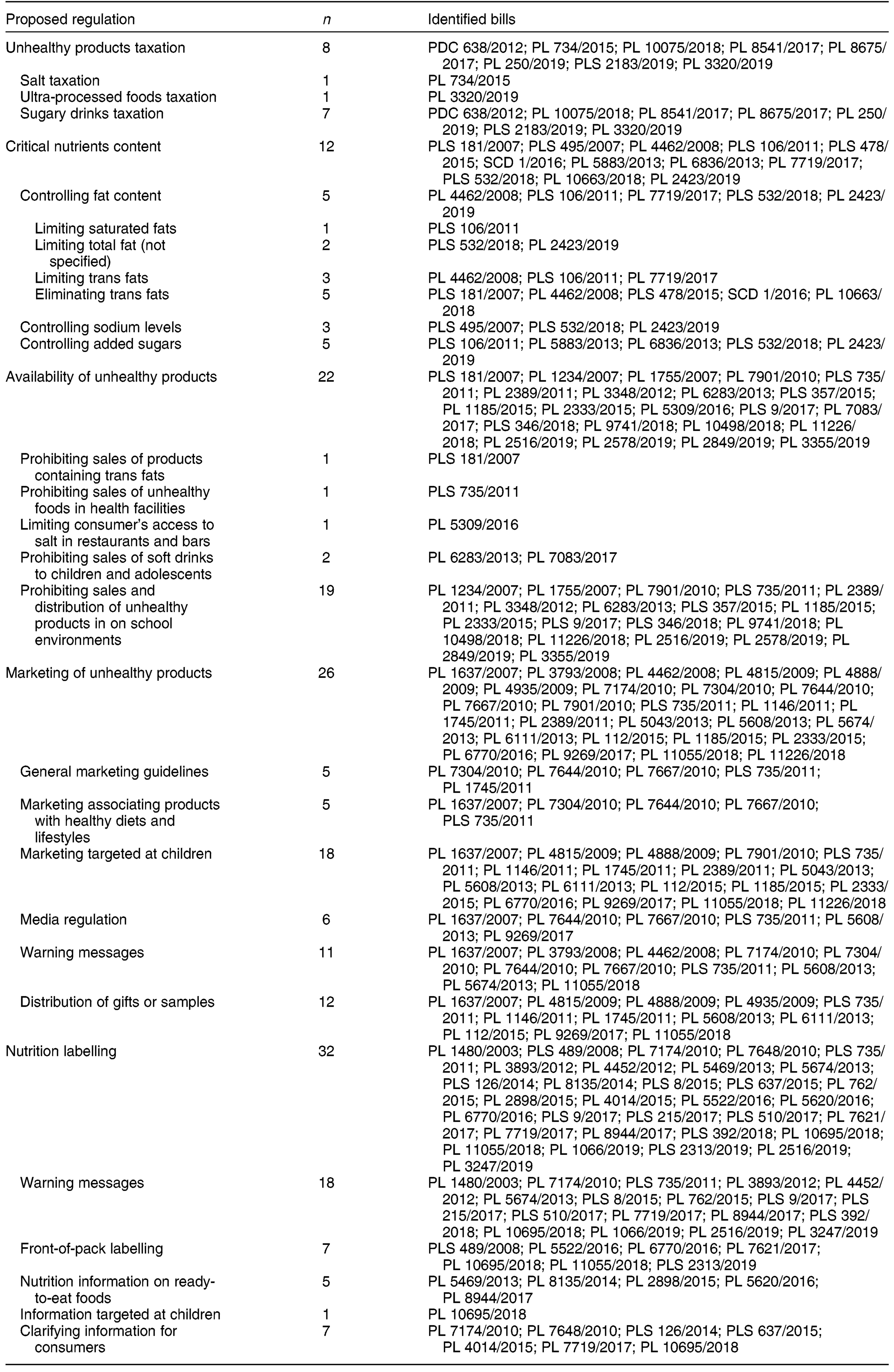
The most frequently proposed regulation topic was nutrition labelling (38·1 % of the bills; n 32), followed by marketing of unhealthy products (30·9 % of the bills; n 26), access to unhealthy products (26·2 % of the bills; n 22) and critical nutrients content (14·3 % of the bills; n 12). We suggest two explanations for the finding that the least frequently addressed recommendation was the taxation of unhealthy products (only 9·5 % of bills have proposed it; n 8). First, although fiscal measures such as sugar-sweetened drinks taxation have long been recommended as a policy intervention to reduce the consumption of this type of product, only recently have they been introduced and their impact assessed: i.e. Mexico was the first country to implement such taxes, in 2014(Reference Colchero, Popkin and Rivera16,Reference Niebylski, Redburn and Duhaney17) . Second, since fiscal measures are probably more likely to face opposition from prominent industry players and create policy conflict or disagreement in the legislature, it is possible that fewer members of Congress are willing to propose them.
A deeper analysis of each of the five main regulatory recommendations shows that among bills that addressed nutrition labelling, 56·2 % aim at introducing warning messages in unhealthy products (n 18) and 21·8 % propose the adoption of a type of front-of-pack label (n 7). There is a clear concern with respect to the protection of children and adolescents: 69·2 % of bills related to the marketing of unhealthy products (n 18) aim at regulating marketing targeted at children and 86·4 % of bills related to access to unhealthy products (n 19) aim at prohibiting sales and distribution of unhealthy products in school environments. Regarding critical nutrients regulation, most of the bills have proposed eliminating trans fats and controlling the amount of added sugars (41·7 %; n 5 for each topic). In relation to fiscal measures to reduce the consumption of unhealthy products, 87·5 % of the bills have proposed sugary drinks taxation (n 7).
Before presenting and discussing the results regarding the legislative process of the bills, the general procedures for enacting ordinary laws (which is the case of all bills identified) should be briefly explained. The Brazilian legislature is bicameral, composed by the Federal Senate and the Chamber of Deputies. Thus, both houses participate in the lawmaking process. After a bill is passed in the House where it was introduced, it must be reviewed by the other. Once the reviewing House approves it, it is sent to the President of Brazil for sanction or veto. If the bill is rejected in the reviewing house, it must be archived. Whenever amendments are made to the bill, it must return to the House that initiated the process for consideration(18). More detailed information in English on the legislative process in Brazil can be found in Hiroi and Renno(Reference Hiroi and Renno19).
By the end of 2019, none of the 84 bills had been enacted. Three of them have been rejected; one was archived because it aimed to repeal an act by the executive branch that was already revoked; and nine were archived at the end of the 55th Congress (2015–2019). Among the remaining seventy-one bills under consideration, only three have been passed in the Federal Senate and are currently being examined in the Chamber of Deputies. This means that sixty-eight bills are still being examined in the legislative house they were introduced (Table 2).
Current status of bills regulating ultra-processed food industry activities under consideration in the Brazilian legislature between 2016 and December 2019
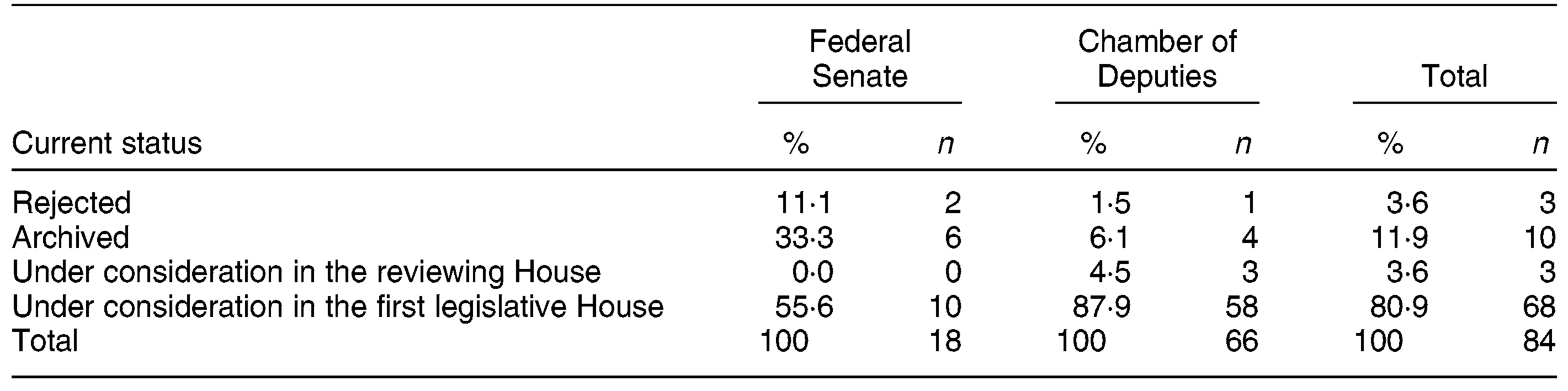
In addition, we must draw attention to the fact that 53·5 % of the bills under consideration (n 45; eight in the Federal Senate and thirty-seven in the Chamber of Deputies) have not been voted in any of the Committees of the first legislative house yet. There is also a great chance that none of these will have been passed by 2025: the legislative process in Brazil is usually very sluggish due to constitutional legislative prerogatives that favour proposals authored by the executive branch and constitutional amendments. Moreover, the duration of the legislative process in coalitional presidential systems such as Brazil can be influenced by a variety of reasons which include political conflict, policy disagreement and indifference or neglect(Reference Hiroi and Renno19). It is also likely that our Congress lacks political will to address questions related to obesity and non-communicable diet-related diseases, especially because powerful private economic interests are involved. Unfortunately, despite so many proposals and the intense debate promoted in the Brazilian legislature, our country seems to be missing important opportunities to adopt measures proven to be effective to tackle obesity and diet-related non-communicable diseases.
Finally, it is worth mentioning that from this standpoint, it is not possible to assess the merit of the proposals: that would only be possible by conducting deeper analyses of the bills individually, which is not the aim of this study. Indeed, those bills that are currently under consideration might undergo significant changes (for better or worse) through amendments before passing into law – should that ever happen. Furthermore, some bills which were introduced many years ago might not represent what is now understood to be the best approach to address the problem of its scope. This is the case, for instance, of PLS 498/2008. It was proposed over 10 years ago, when the traffic light labelling system was believed to be satisfactory for helping consumers make better choices. However, the warning labelling system has later been show to be superior to that(Reference Khandpur, Sato and Mais20,Reference Sato, Mais and Khandpur21) . Another situation relates to lenient regulatory proposals that, if ever adopted, could, in fact, represent a setback in relation to current international recommendations. An example is PL 7719/2017, which establishes quite elevated limits for the presence of trans fats in industrialised food products and was proposed as a substitute for PLS 478/2015, which follows the WHO’s REPLACE recommendation to ban the use of trans fats(22).
Conclusions
To the best of our knowledge, this is the first study to address legislative initiatives to regulate ultra-processed food industry activities related to obesity and diet-related non-communicable diseases at a national level. Although Brazil was the first country to formally commit to the United Nations’ Decade of Action on Nutrition, efforts have been insufficient as none of the goals related to adult obesity rates and sugar-sweetened beverages intake established by the Ministry of Health were achieved by the end of 2019. Regarding the Brazilian legislature, despite many bills having been introduced, none of the proposed regulations of ultra-processed food industry practices has been enacted by 2020.
Brazil seems to be missing plenty of opportunities. Positive changes on population health and nutrition are not likely to happen by the end of the United Nation’s Decade of Action on Nutrition if new laws to regulate the ultra-processed food industry are not passed and the existing regulations are not implemented effectively.
Acknowledgements
Acknowledgements: We thank Gabriel Siqueira Ortiz Dias, from Serviço de Pesquisas Legislativas (SEPEL) of the Federal Senate, and Ana Paula Oliveira Teles Deusdará, from Seção de Indexação de Matérias Legislativas of the Chamber of Deputies, for kindly assisting us with internal databases searches. Financial support: None. Conflict of interest: The authors have no conflicts of interest to disclose. Authorship: This manuscript was designed and written by A.B.M. A.P.B.M. critically reviewed the analysis and text, providing significant inputs. Ethics of human subject participation: Not applicable.



