Introduction
Stencils are among the most prolific signifiers of the people who inhabited the rock-shelters and Stone Country of western Arnhem Land for thousands of years. The most common form of stencil is a person's hand, a type of art production that is also found in many other rock-art provinces (e.g. Aubert et al. Reference Aubert, Brumm and Ramli2014; Bahn Reference Bahn1998, 151; Taçon et al. Reference Taçon, Langley, May, Lamilami, Brennan and Guse2010, 419). Perhaps uniquely, in Australia, people also created stencils of material culture objects that not only document the things they used in the past, but also provide insights into the meaningful associations people had with these objects. The everyday making and use of artefacts is a basic form of association, but making them into iconic emblems, as permanent stencils, suggests those objects chosen to be stencilled had symbolic and metaphysical aspects attributed to them.
In this paper we document the range and types of material culture stencils recorded during an archaeological survey of rock-art sites in Mirarr Country, Northern Territory. These 84 stencils were recorded as part of the Mirarr Gunwarddebim project and include different types of boomerangs, bags and baskets, as well as more unique examples such as a headdress, a spearthrower, a hooked stick and necklets. We argue that the impetus for the act of material culture stencilling signifies the status of the object through memorialization (Yates Reference Yates1966; Yilmaz Reference Yilmaz2010) as well as reflecting the complex entangled relationship (e.g. Goldhahn Reference Goldhahn2014; Thomas Reference Thomas1991) that people had, and still have, with material culture. Indeed, this assemblage suggests something other than a common or ongoing cultural practice of stencilling objects used in everyday life. Instead, we suggest that these stencils represent an entirely different function in rock art through a process of memorialization that was rare, opportunistic and highly selective.
Memorializing an object
The method of rock-art stencilling is, in many ways, similar to contemporary stencilling practices, in that paint is sprayed to form either a positive or a negative image of an object. In positive stencilling, a practice less typical in rock-art production, sprayed paint is applied to a template with a cut-out shape, leaving this shape when the stencil is removed (i.e. Gunn et al. Reference Gunn, Douglas and Whear2012; Walsh Reference Walsh1999, 52–3). Conversely, and more typically in rock-art production, a hand, other body part or an object (including small animals or animal body parts: e.g. Taçon et al. Reference Taçon, Langley, May, Lamilami, Brennan and Guse2010) is placed against the rock and liquid pigment is sprayed from the mouth around the outside of this template, resulting in the shape of the form being displayed as a negative shape of the original (see also Morley Reference Morley, Renfrew and Morley2007, 71–4). Both positive and negative stencils produce an image, or index, of the original that records elements of its shape and size.
The motivation to stencil one's hand, foot or object onto a rock surface is likely to have been varied and contextually dependent (Moore Reference Moore and Ucko1977, 324). Robert-Lamblin (Reference Robert-Lamblin and Clottes2003, 203) associates hand stencils with a notion of ‘par excellence’ and argues that hunter-gathers understood hands as among their most important tools or assets (see also Morley Reference Morley, Renfrew and Morley2007, 72). In Australia, various, but more focused, interpretations of the purpose and meaning(s) of stencils and stencilling have been proposed from anthropological and ethnographic studies, as rock art continued to be produced until very recent times in some areas in western Arnhem Land. A number of researchers have compared hand stencils to signatures or markers of individuals based on discussions with artists and their families (Chaloupka Reference Chaloupka1993; Macintosh Reference Macintosh1952, 266; Reference Macintosh and Ucko1977, 191; Moore Reference Moore and Ucko1977; Rosenfeld Reference Rosenfeld, Smith, Spriggs and Fankhauser1993; Smith et al. Reference Smith, Domingo Sanz and Jackson2016, 1613; Taçon et al. Reference Taçon, Langley, May, Lamilami, Brennan and Guse2010, 424). The motivations described for stencils include a personalization of the place by recording one's visit or connection to the site (Taçon Reference Taçon1994, 123), or done in a spirit of fun (Taylor Reference Taylor1996, 19), or as a form of ‘self-referencing’ or ‘signing the land’ (Ross & Davidson Reference Ross and Davidson2006, 332–3), or as memorials for deceased individuals (Elkin Reference Elkin1952, 245–6; Moore Reference Moore and Ucko1977, 318). Some stencils made with different coloured ochres were used to emphasise individuality or possibly moiety, and painted designs within the stencil form were used to represent clan identity or to honour particular individuals (Taçon Reference Taçon1989, 138). Forge (Reference Forge, Bahn and Rosenfeld1991) argued that hand stencils in rock art belong to nature rather than culture, that they are a form of individual mechanical reproduction and may not even be considered art with social value. Dobrez (Reference Dobrez2013, 303) disagrees with this, arguing instead that ‘a hand mark is uniquely “proprio-performative”, combining inscription of individuality with direct address’ (Dobrez Reference Dobrez2013, 273) and that hand stencils and prints ‘bring into focus what human beings have in common with one another’ (Dobrez Reference Dobrez2013, 316).
Material culture stencils, like hand stencils, are indices of both the human action of making the image and the object itself (Ross & Davidson Reference Ross and Davidson2006, 333). Semiotically they are indexical signs in that they signify ‘we were here’ and ‘we had these objects’. However, they can go beyond being basic formal signs, as the makers of the stencil often joined stencil shapes to make unusual new forms (e.g. Walsh Reference Walsh1983; Reference Walsh2000), or placed the stencil at almost impossible to reach places on the rock face. In these cases, the stencilling is a vehicle for artistic creativity and ambiguity.
For archaeologists, stencils can provide an opportunity to examine and scrutinize material culture objects that do not normally survive in excavated contexts. Unlike their painted counterparts, stencils are significantly less subjected to interpretation by the viewer and display less distortion than those painted by the artist's hand (cf. Gunn Reference Gunn2007). Furthermore, ancient depictions of human figures with material culture in rock art illustrate objects from the real world, such as spears and headdresses, usually constructed of organic materials that are likely to have been destroyed by taphonomic processes and are rarely recovered from excavated contexts. Stencils of organic material culture objects are, therefore, an unparalleled archaeological record of the objects owned by people and have the potential to provide etic and emic perspectives for understanding people of the past and the archaeological record.
In this context, material culture stencils could be considered an act of immortalizing the object, as the stencil invariably outlasts the actual object and the owners or creators of that object. Yet why are certain object types chosen for stencilling and others not? Drawing from the range of sources available to researchers in northern Australia, we explore if there is evidence for items having specific cultural or social significance, making them targets for the memorializing process, a process that not only immortalizes the object but also imbues it and the site with memory and cultural knowledge (Kelly Reference Kelly2015; Yates Reference Yates1966; Yilmaz Reference Yilmaz2010).
Stencils in rock-art research
Hand stencils have been recorded in many of the rock-art provinces of the world, including Europe, across Africa, South America, Southeast Asia and Australia (see García-Diez Reference García-Diez, Garrido, Hoffmann, Pettitt, Pike and Zilhão2015; Lorblanchet Reference Lorblanchet1980; Morley Reference Morley, Renfrew and Morley2007, 71; Taçon et al. Reference Taçon, Tan and O'Connor2014). As well as occurring across the world, hand stencils are known sometimes to have great antiquity and constitute among the earliest forms of rock-art production in the world (see Aubert et al. Reference Aubert, Brumm and Ramli2014; Chaloupka Reference Chaloupka1993; Morley Reference Morley, Renfrew and Morley2007, 74; Taçon et al. Reference Taçon, Tan and O'Connor2014). Studies have focused on different aspects of the motifs including: hand size (Gunn Reference Gunn2006), handedness (Gunn Reference Gunn2007; see also Morley Reference Morley, Renfrew and Morley2007), variation (Wright Reference Wright1985), as a ritual act (Ross & Davidson Reference Ross and Davidson2006) and shape masking (Gunn et al. Reference Gunn, Douglas and Whear2012). In Australia, apart from typical hand stencils, more complex forms of stencilling involved replicating the shape of a kangaroo foot by placing the three middle fingers together (3MF) (see Chaloupka Reference Chaloupka1993, 110; Lewis Reference Lewis1988, 57, 110; Walsh Reference Walsh1999, 52–3); other variations include a range of different finger placements, or even suggestions of hand mutilation or finger amputation, by folding the finger down while blowing (Layton Reference Layton1992, 139; Walsh Reference Walsh1979; for beyond Australia, see Lorblanchet Reference Lorblanchet1980). Documentation of actual animal stencils are not as common, but Taçon (Reference Taçon1989, 153) has recorded emu foot stencils in Kakadu and reported on bird stencils from the Wellington Range of Arnhem Land (Taçon et al. Reference Taçon, Langley, May, Lamilami, Brennan and Guse2010); Lewis (Reference Lewis1988, 205) has recorded whole and part animal stencils from western Arnhem Land; and Wade et al. (Reference Wade, Wallis and Corporation2011, 72) recorded occurrences of dingo paws, bird feet and snakes in north Queensland.
The practice of using artefacts as the subject of stencils does not appear to have been common and we have not seen a report of the practice beyond Australia; if the practice is found to be more widespread, we would posit it does not have the same frequency as in northern Australia. Even so, material culture stencils are still rare in Australia. Taçon's (Reference Taçon1989, 152) analysis of stencils from seven regions in western Arnhem Land reveals that, of the stencils he recorded, only 2.1 per cent were of material culture and all of those are from the northern sections of the region. In the Koolburra Plateau of Queensland, boomerang stencils make up only 1 per cent of all stencils and dilly bags even less at 0.2 per cent (Flood Reference Flood1987, 103). Material culture stencils at the Yengo 1 site near the Sydney Basin, however, feature a little more prominently by constituting 4.3 per cent of all stencils (McDonald Reference McDonald2008, 74), whereas in the Northern Queensland Gregory Range complex of sites, object stencils make up 1.9 per cent of all stencils recorded (Wade et al. Reference Wade, Wallis and Corporation2011, 26). The types of object stencils from Australia include boomerangs on the Cape York peninsula (Flood Reference Flood1983, 246) and a range of material culture stencils from sites near the Sydney Basin, including metal axes, boomerangs, clubs and digging sticks (McDonald Reference McDonald2008, 137, 212, 230). Wade et al. (Reference Wade, Wallis and Corporation2011, 25) have also reported stencils of boomerangs, spearthrowers, stone axes, digging sticks, spearheads and shields from the north Queensland Highland Province.
In western Arnhem Land, material culture stencils have been recorded by a number of researchers. Brandl (Reference Brandl1988, 167) was the first to observe a connection between stencils, particularly specific hand and boomerang stencils, and certain rock-art styles within the western Arnhem Land rock-art sequence. He argued that material culture stencils and 3MF hand forms were related to early Mimi figures, now called Dynamic Figures (Brandl Reference Brandl1988, 167). Dynamic Figure rock art is found in western Arnhem Land and is argued to be the earliest style in the region where humans are explicitly depicted, and are generally assumed to be over 10,000 years of age (May et al. Reference May, Johnston, Taçon, Domingo Sanz and Goldhahn2018). Revisions of the rock-art sequence initially confirmed this relationship (see Chaloupka Reference Chaloupka1984; Reference Chaloupka1993; Chippindale & Taçon Reference Chippindale, Taçon, Chippindale and Taçon1998; Lewis Reference Lewis1988; Taçon & Chippindale Reference Taçon, Chippindale and Helskog2001). For instance, Lewis, who developed a chronology based upon technological depictions in rock art, argued that stencils formed a significant part of the early boomerang period, a period in which he places Dynamic Figure art. He concluded that not all stencils related to this period, but argued that the type of stencilled material culture demonstrates a significant connection between material culture stencils and Dynamic Figures (Lewis Reference Lewis1988, 57). Furthermore, ongoing investigations by us in various parts of Arnhem Land indicate 3MFs and other forms of hand stencils often pre-date Dynamic Figures.
Even though boomerang stencils are strongly connected to early rock-art styles, there is as yet little evidence to indicate whether boomerang stencilling continued as an ongoing convention, or was sporadic. Stencils of other material culture objects recorded by others and ourselves indicate that the practice of stencilling objects has been used in more recent times. For example, Lewis (Reference Lewis1988, 398) has recorded two long-notched lath spearthrowers, a spearthrower type associated with recent rock-art types, as well as referring to objects imported by Macassans and Europeans as having been stencilled (Lewis Reference Lewis1988, 56). Likewise, May et al. (Reference May, Taçon, Wesley and Travers2010, 63) reported on numerous contact-period stencils in the Wellington Range, including tobacco tins and large metal knives.
The Mirarr object stencils
Since 2011, our team has been working with Mirarr Aboriginal Traditional Owners to document rock-art sites as part of the Mirarr Gunwarddebim project. Our results stem from this work that included the documentation of almost 700 sites between 2011 and 2015 (e.g. Hayward Reference Hayward2016a,b; Reference Hayward, David, Taçon, Delannoy and Geneste2017a,b; Johnston Reference Johnston2017; Johnston et al. Reference Johnston, Goldhahn, May, David, Taçon, Delannoy and Geneste2017; Jones & May Reference Jones and May2017; May et al. Reference May, Johnston, Taçon, Domingo Sanz and Goldhahn2017; Reference May, Johnston, Taçon, Domingo Sanz and Goldhahn2018; Miller Reference Miller2016; Wright et al. Reference Wright, May, Taçon and Stephenson2014; Reference Wright, Langley, May, Johnston and Allen2016). This area is renowned for its rich rock-art and archaeological heritage, with recent excavations in Mirarr Country dating occupation back to over 65,000 years bp (Clarkson et al. Reference Clarkson, Jacobs and Marwick2017).
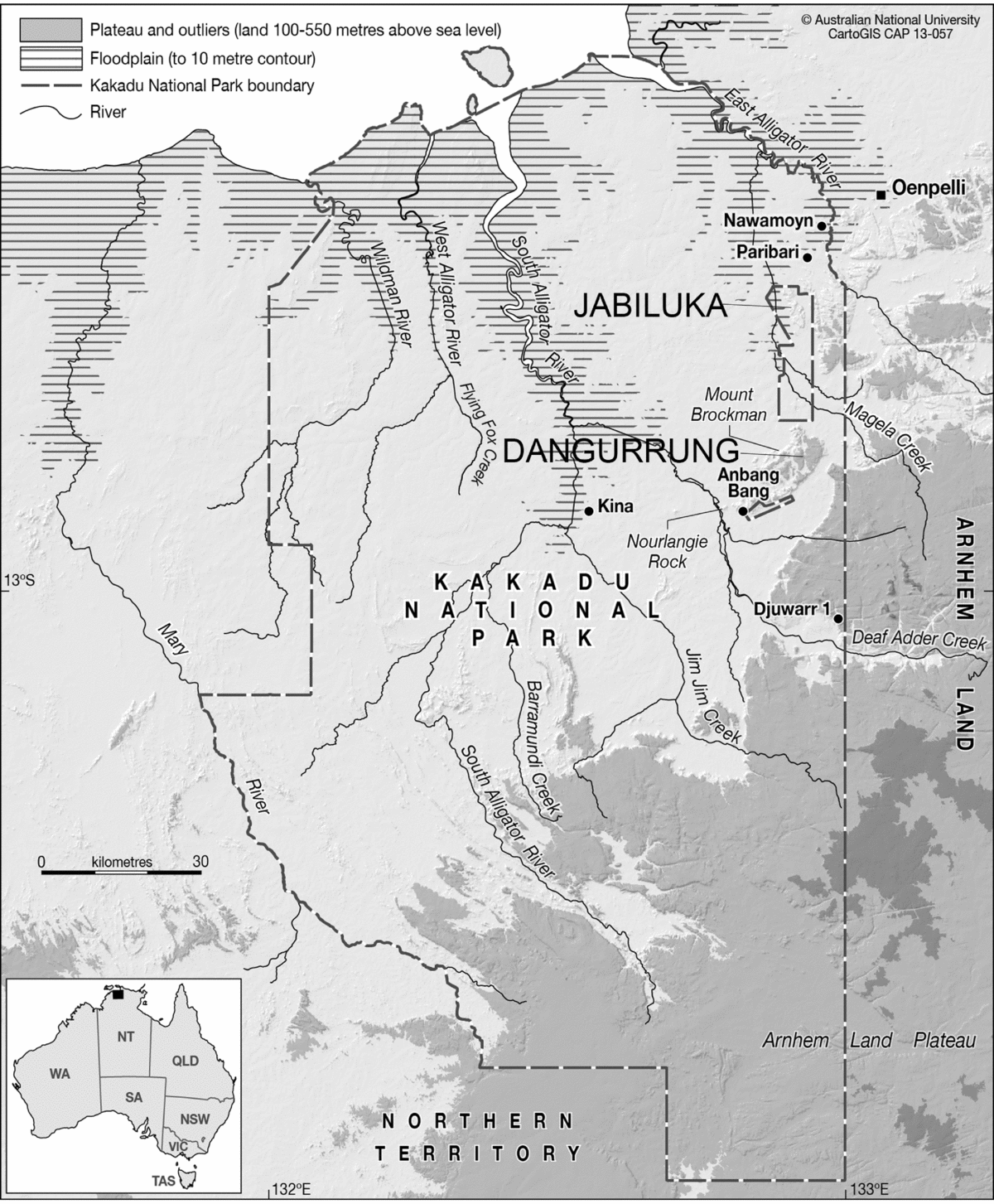
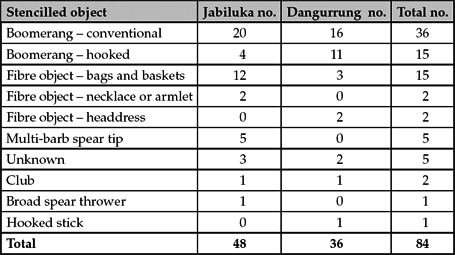
For the Mirarr Gunwarddebim project, we surveyed the Jabiluka Leasehold area within Mirarr Country and, during 2015, we also surveyed further south in the central valley of Dangurrung (Mount Brockman) (Fig. 1). Within Jabiluka, we recorded 528 cultural sites in and around the Djawumbu-Madjawarrnja Massif complex and 157 sites in the Dangurrung region, although we are aware of more as yet unrecorded sites in the latter region. The statistics for Jabiluka show that of the 528 sites recorded, 20 sites (4 per cent) have a total of 48 material culture stencils, of which 24 (50 per cent) are boomerangs (Table 1). A count of all stencils, including hand stencils, has not yet been done for the survey, so no comparative counts can be given. However, from our observations, it appears that material culture stencils are not encountered as often as hand stencils. It is not unusual for sites to have dozens of individual hands stencils in this region.
Map showing the study area, including Jabiluka and Kakadu National Park.

Documented material culture stencils from Mirarr Country.

Material culture stencils make up a very small component of the overall rock-art assemblage of Mirarr Country. However, 84 individual examples still provide a large enough sample size from which to explore selectivity and motivation. As illustrated in Table 1, and highlighted by previous researchers (Chaloupka Reference Chaloupka1993, 122; Lewis Reference Lewis1988, 93), boomerangs dominate stencilled object rock art, but the large number of stencilled bags and baskets was somewhat of a surprise, given the lack of attention they have received in previous literature (for an exception to this, see Miller Reference Miller2016).
Material culture stencil types
Boomerangs
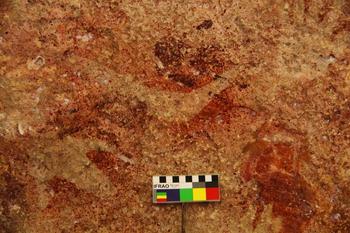
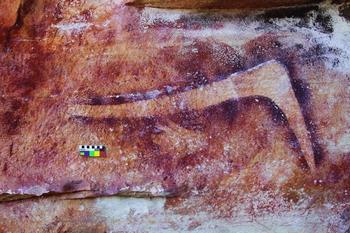
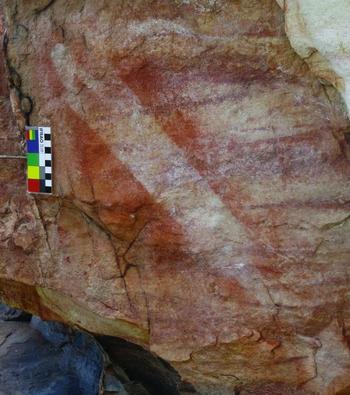
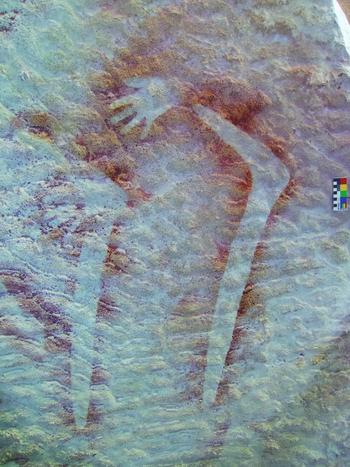
Two types of boomerang stencils were recorded: conventional, the classic, even curved boomerang form (Fig. 2); and hooked, sometimes described as a number 7 boomerang because of the shape (Fig. 3). Conventional boomerangs ranged from long, often less curved, forms, to small, almost right-angled examples. Hooked boomerangs were never depicted alone, but in pairs, with one exception. A few of the conventional boomerang stencils appear to be quite small compared to our sampled museum collections and could have been either a child's toy or percussive musical instruments.
An even curved boomerang stencil with hand stencils including a 3MF, Jabiluka, site I1 0032. (Photograph: I.G. Johnston.)

A hooked boomerang stencil with associated hand stencils, Jabiluka, site I3 0030. (Photograph: P.S.C Taçon.)

Fibre object: bags and baskets
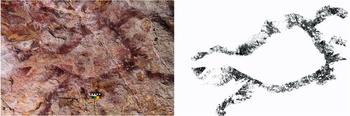
The second most frequent artefact stencil type consists of bags and baskets. Bags are differentiated from baskets by their mode of construction, with bags categorized as being generally flat in form with a flat or straight bottom; having an open weave of either a looped or knotted technique; being made of a bast fibre string from the banyan tree (Hodgson Reference Hodgson1995, 105; Miller Reference Miller2016); and having a handle that goes from one side to the other. Baskets are categorized as being generally round and solid in form with a rounded bottom; having a close or closed mesh construction; having the handle on one side. Contemporary equivalents are made from pandanus leaves, grasses or vine. Most of the Mirarr stencilled fibre objects are bags. Some have defined handle shapes and they come in a range of sizes, with the longest measuring 114×32 cm and the smallest measuring 27×18 cm. One large site contained material culture stencils, including a variety of different-shaped boomerangs and four bag stencils, as well as 3MFs and open-hand stencils. Furthermore, each of these four bag stencils was a composite, that is, each bag had a hand stencil emerging from it (Fig. 4). This hand stencil type, being generally associated with Dynamic Figure art and earlier, suggests that the bag also dates to a very early period (Chaloupka Reference Chaloupka1984, viii; Reference Chaloupka1993, 114; Jones et al. Reference Jones, Levchenko, King, Troitzsch, Wesley, Williams and Nayingull2017; May et al. Reference May, Johnston, Taçon, Domingo Sanz and Goldhahn2018). The bags at this site varied from long, thin tube shapes to round, bulbous shapes. However, some of these bags may have been of a loose construction, with the ability to be shaped before stencilling.
Photograph (left) and digital tracing (right) of a stencil of a bag with a hand shape at the top of the bag from the Jabiluka–Djawumbu Madjawarrnja Massif, site I1 0032. (Photograph: P.S.C. Taçon; tracing: I.G. Johnston.)

Fibre object: necklets and headdresses
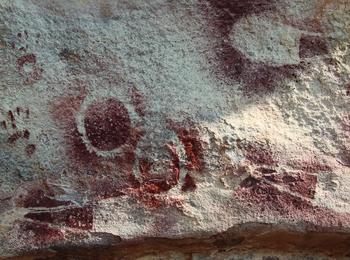
At one elevated site in Jabiluka there are a number of material culture stencils including two fuzzy outlined circular objects (Fig. 5), along with bags and spear points. These two circular objects have an internal diameter of approximately 15 cm and their fuzzy outline suggests a fibrous, feathered or hair-like material was used to construct the object. These objects have been interpreted as armlets or necklaces, assuming that they would be untied at a particular point and then wrapped around neck or arm and fastened (see also Chaloupka Reference Chaloupka1984, 29).
Stencilled armlets or necklaces with dilly bags and hand prints, Jabiluka, site I3 0033. (Photograph: P.S.C Taçon.)

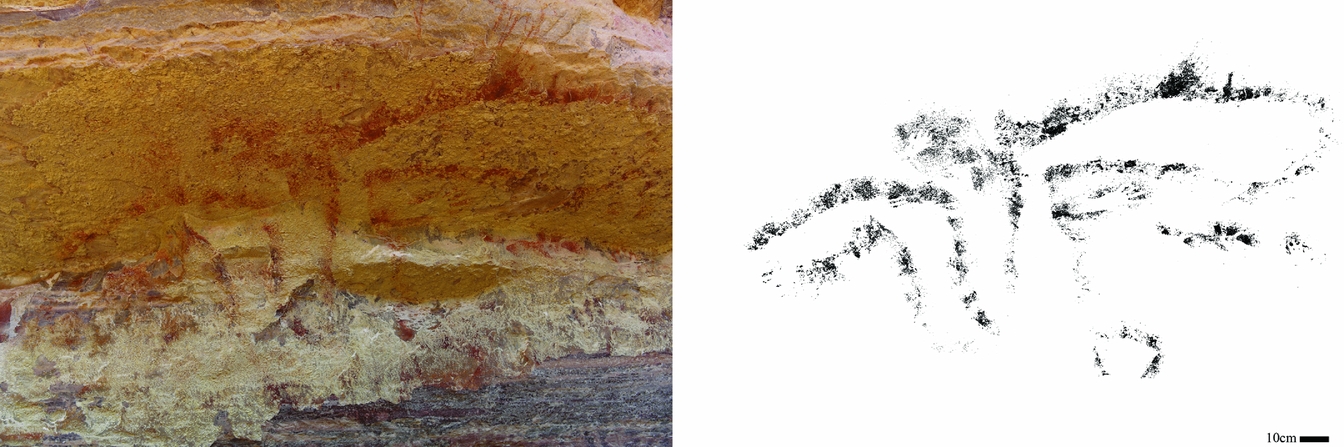
Other fibre object stencils also recorded as a pair included two elongated oval shapes previously recorded at Dangurrung by Chaloupka (Reference Chaloupka1984, 94), who interpreted these objects as headdresses (Fig. 6). The stencils form a rough L-shaped, or right-angled, tube and have a bulbous-shaped proximal end to accommodate the wearer's head. The larger stencil measured 115 cm and the smaller 89 cm in length. These stencilled headdresses resemble those often seen depicted being worn in Dynamic Figure rock art.
Photograph (left) and digital tracing (right) of a stencil of a pair of headdresses, Dangurrung, site I1 0125. (Photograph: P.S.C. Taçon; tracing: I.G. Johnston.)

Spearthrowers and hooked sticks
Spearthrower stencils are rare, with only one found during the Mirarr Gunwarddebim survey and only two recorded by Lewis in the 1980s (Lewis Reference Lewis1988, 398). The single spearthrower stencil we recorded at the southwest end of Jabiluka was identified as a broad spearthrower (Hayward Reference Hayward2016a, 323) (Fig. 7). It was made with orange-red sprayed pigment and the object had straight sides that narrow towards the handle with a wider distal end and large hook for spear articulation. It is 38.5 cm long by 8.5 cm at the widest point. The hooked end is unusually large and disproportionate to the overall size of the spearthrower. The hook does not articulate well with the body and it is, therefore, speculated that this stencil was done in two stages with the hook sprayed separately, and possibly over the body of the artefact, resulting in the overall length being truncated. The other possibility is that this is two objects sprayed to look as though they are one. This spearthrower has morphological similarities to some seen in paintings from the region's recent period (Chippindale & Taçon Reference Chippindale, Taçon, Chippindale and Taçon1998, 107), as well as artefacts held in the Museum Victoria ethnographic collection.
A stencil of a broad spearthrower, Jabiluka, site I3 0110. (Photograph: J. Hayward.)

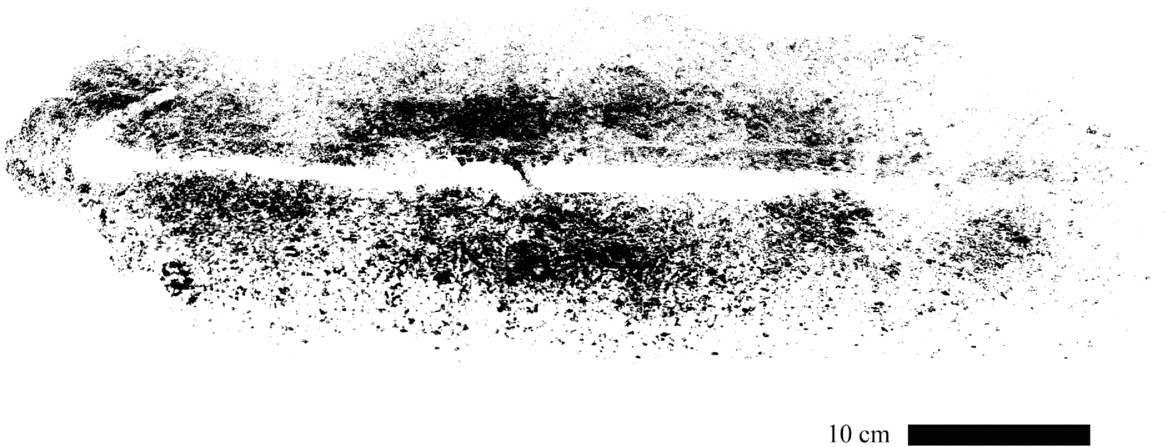
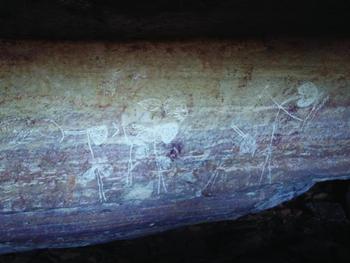
The other stencil, recorded in the Dangurrung area, resembles an implement often depicted with human figures, termed a ‘hooked stick’ (see Lewis Reference Lewis1988, 27–9). There is contention as to the specific form and function of hooked sticks and this stencil provides key diagnostic features pertinent to this discussion (Chaloupka Reference Chaloupka1993, 130; Lewis Reference Lewis1988, 27; Reference Lewis1996, 17). Lewis’ (Reference Lewis1988, 39) initial contention was that hooked sticks, not directly associated with spears, were depictions of fighting sticks, but he later reconsidered his position (Lewis Reference Lewis1996, 17) by stating that he now thought all of the hooked sticks associated with boomerangs represented prototype spearthrowers (cf. Chaloupka Reference Chaloupka1993, 130). The hooked-stick stencil we recorded was made with a white pigment and is approximately 56 cm long and 10 cm from shaft to hook at the distal end (Fig. 8). The object is of composite construction, as the joint between the longer shaft and the hook has a rounded ball shape, which is likely to have been a ball of resin for attaching the hook to the shaft. The site where this stencil was found was once a large stone quarry and has a number of white pigment paintings of Simple Figures holding boomerangs, spears and hooked sticks on an adjoining panel (Fig. 9).
A digital tracing from a photograph of a hooked stick implement stencil, site R1 0075. (Tracing: I.G. Johnston.)

Rock paintings in the ‘Simple Figure’ style holding boomerangs, spears and hooked stick implements from the same shelter as Figure 8, site R1 0075. (Photograph: I.G. Johnston.)

Spears
Spear stencils are not very common, but we have recorded five spear tips at three sites in the Jabiluka region. Chaloupka has recorded one full-length spear that was a single-piece barbed type with a length of 210 cm (Chaloupka Reference Chaloupka1984, 11). This spear was recorded at a site several kilometres northeast of Jabiluka and was depicted with a boomerang stencil and a 3MF hand stencil, and also with Dynamic Figure art. The spear-tip stencils recorded for this study appear to be from single-piece (unhafted) spears, forms that are associated with older painting types such as Dynamic Figures and Simple Figures. One site has an array of three spear-tip stencils made from red pigment; the bottom one shows the transition from tip to shaft with no hafting (Fig. 10).
Spear-tip stencils from Jabiluka, site I3 0033. (Photograph: P.S.C. Taçon.)

Clubs
Club stencils were recorded in minimal numbers in both Jabiluka and Dangurrung; only one and possibly one, respectively. Our initial parameters for identifying a club were that the stencil should consist of a thin handle and larger shape at one end representing the weighted end. Within Jabiluka, only one object conformed to this definition, and none within Dangurrung. However, a stencil in Dangurrung interpreted as a club did not fit the initial parameters, as it had a less well defined weighted section running half way down the shaft. This may have been a tree limb or a uniquely carved object. Its shape suggests it is a club, although it is not one we have seen depicted or ethnographically recorded. Clubs are very infrequent as material culture stencils anywhere in Australia and from our surveys are also quite rarely depicted with human figures throughout the rock-art sequence.
Unknown objects
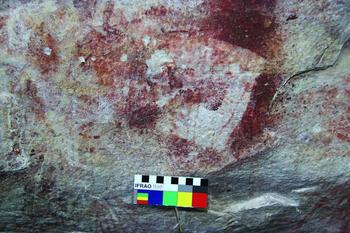
There are a number of object stencils recorded for this study that we could not identify (see, for example, Figure 11). They could have been modified objects or manuports ascribed enough significance to prompt stencilling. At one site in Jabiluka the stencils were made from half-moon-shaped objects (possibly large shells), and at another site, the object may have been a large leaf (see Gunn et al. Reference Gunn, Douglas and Whear2012, 241 for an example of leaf stencilling), or a very small fibre bag.
Unidentified stencilled object, Jabiluka, site I1 0113. (Photograph: J. Hayward.)

Discussion
We focus our discussion here on the two most common object stencils—boomerangs and bags/baskets—and speculate upon the significance these stencils may have had for past people's behaviour. We rely upon rock art as the principle source of evidence for specific types of image-making practices and also upon ethnographic accounts and museum collections to support our argument for the range of possible factors that could have prompted artists to make material culture stencils. Whilst we are aware that artistic intention can never be determined for ancient rock art and is as individual as the artists themselves, we consider some of the cultural influences that may have prompted the stencil making of specific objects. These influences were most likely intertwined and would have changed between groups over time, place and even artefact type. Consequently, we use ethnographic accounts integrated with contemporary material culture studies and rock-art chronologies as frameworks to analyse stencils and rock-art images.
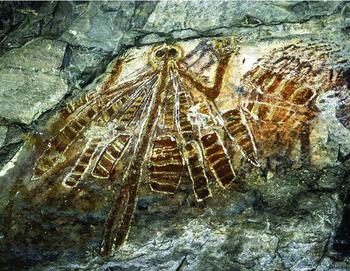
Western Arnhem Land rock-art depictions of human figures engaged in ritual activities have been discussed previously (e.g. May & Domingo Reference May and Domingo Sanz2010; May et al. Reference May, Johnston, Taçon, Domingo Sanz and Goldhahn2018; Taçon & Chippindale Reference Taçon and Chippindale1994; Welch Reference Welch1997). However, the role that artefact stencils may have played within this context has not previously been explored. All of the types of material culture stencils that we identified have significant ceremonial functions, according to ethnographic accounts. For instance, baskets and bags have strong cultural and ceremonial significance in Aboriginal culture of the wider Arnhem Land region. The first bags are said to have been made by the Ancestral Creation Beings. One of the most important, the ‘Mother’ spirit, is said to have emerged from the sea in Malay Bay in the Coburg Peninsula to embark upon her journey that brought life and sustenance to this region (Berndt & Berndt Reference Berndt and Berndt1970, 117; see Figure 12). She is said to have worn a plaited head-ring from which hung baskets full of yams and other edible plants (May & Murphy Reference May, Murphy and Hamby2005, 44). During her journey she carried the children who populated the land, gave them language, planted the yam tubers that nourished them and gave them Dreaming places where she laid down her empty bags (Chaloupka & Giuliani Reference Chaloupka, Giuliani and Hamby2005, 5; Taçon Reference Taçon1989, 239–42). Berndt and Berndt (Reference Berndt and Berndt1970, 117–18) recount further details of this story told to them by an Aboriginal woman known as old Ngalmidul:
She made our feet, cut fingers for us, made our eyes for seeing with, made our heads, made anger and peace for us, made our belly/intestines, gave us energy to move about—made us people. Ngalgulerg [a mythical woman] gave us women the digging stick and the basket we hang from our foreheads, and Gulubar Kangaroo gave men the spear-thrower.
Rock painting from Injalak Hill of the ‘Mother’ spirit showing the bags she carried as she travelled across the region. (Photograph: S.K. May.)

In short, bags and baskets feature as key elements in the most important Ancestral stories of this region. They are a key means to understanding Aboriginal cosmology from the region.
Likewise, ethnographic records suggest certain types of bags and baskets had particular significance, while others were mainly for carrying food and tools. For example, in western Arnhem Land, the ‘biting bag’ or ‘power bag’ was used by men to hold certain objects that are believed to give power and strength to the wearer (Hamby Reference Hamby2010; Reference Hamby2011). Likewise, Hayward (Reference Hayward2016a) and Miller (Reference Miller2016) have both developed typologies of bags and baskets in the rock art of Mirarr country and provide clear evidence that some types of baskets and bags painted in rock-art scenes were more clearly associated with ritual behaviour and one or other gender.
In parallel with painted scenes that memorialized ceremonies, so too the containers used in, or to carry objects involved in, ceremonies may have been stencilled. The ceremonial significance of these bags may have been the impetus for artists using them as stencils to acknowledge, immortalize and/or memorialize them and their associated actions. Similar ceremonial associations have been noted by others, such as Warner (Reference Warner1958, 258, 263, 293, 320) and Welch (Reference Welch1997, 95,104) for spearthrowers, spears, hooked sticks, and by Thomson (Reference Thomson1949, 47) and Warner (Reference Warner1958, 327) for other fibre objects, including headdresses. If key material culture objects are best understood as having both mundane and at times ceremonial functions in ethnographic times, then the stencilling of some in more ancient times is not surprising. The question then becomes, how does the frequency of specific stencils reflect Aboriginal society and culture in the past?
We consider now the role of trade and exchange in the material culture stencils of Arnhem Land. In recent times, many of the objects acquired by people, such as spears, spearthrowers, boomerangs and a wide range of other items, were obtained through the trade and exchange of objects (i.e. Thomson Reference Thomson1949). Through this system, which Thomson (Reference Thomson1949) described as the ceremonial exchange system, objects would travel long distances, being passed on from person to person and place to place, and in the process they become imbued with enhanced cultural value (Thomson Reference Thomson1949, 37, 57, 80). These particular objects were considered to ‘greatly advance value in the eyes of those who receive them’ (Thomson Reference Thomson1949, 80). Some spears, for example, that originated from regions renowned for particular blade types would have been considered as having great value due purely to their provenance, rather than how well made or effective they were. Hafted stone blades called leilira or djaperi, from quarry sites in northeast Arnhem Land such as Ngilipji, were particularly revered due to the Ancestral significance of the place from which the stone came (Allen Reference Allen, McConvell and Evans1997, 357; Murgatroyd Reference Murgatroyd1991, 20–22; Taçon Reference Taçon1991; Thomson Reference Thomson1935, 49).
A number of different types of boomerangs were manufactured by the Jawoyn (Djauwany) tribe from around Katherine (Thomson Reference Thomson1949, 70), and hooked boomerangs, in particular, were indigenous to north-central Australia and thought to have originated in the Tennant Creek region (Jones Reference Jones2004, 66). These items were part of the elaborate trade and exchange system that connected regions both economically and socially (Hodgson Reference Hodgson1995; Murgatroyd Reference Murgatroyd1991; Thomson Reference Thomson1949). In recent times hooked boomerangs were often traded in pairs to the Kimberley and Arnhem Land, where they were regarded as sacred objects (Jones Reference Jones2004, 66). Indeed, some of the boomerangs in Mirarr country are stencilled in pairs, perhaps reflecting their original usage.
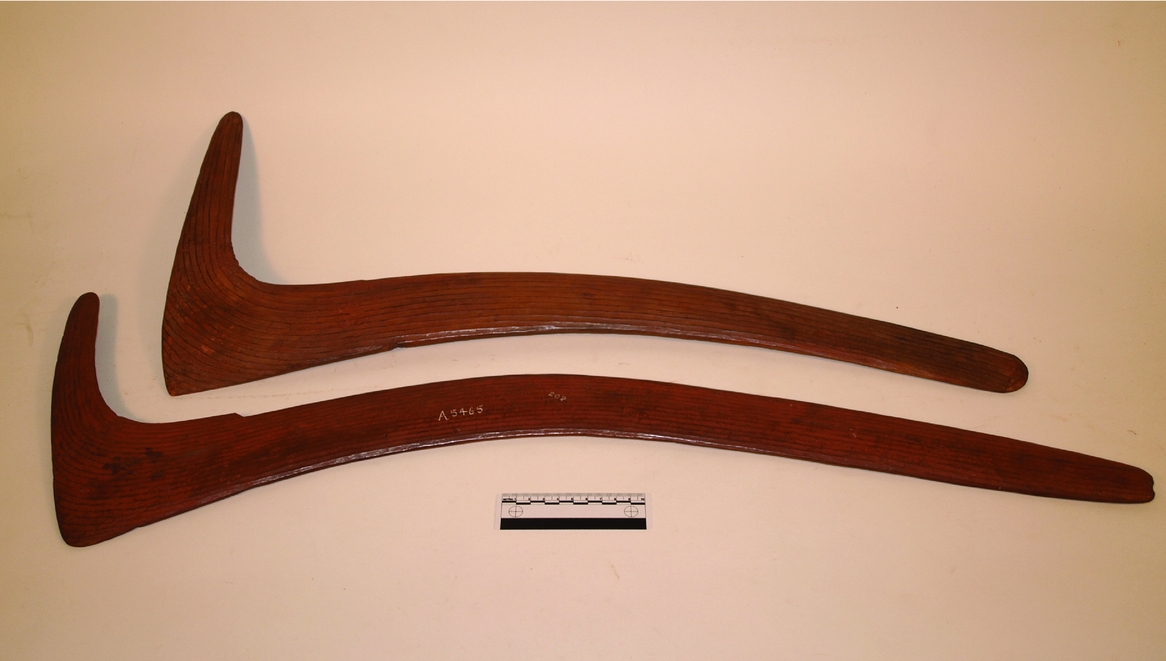
Boomerangs of differing types form a large proportion of objects housed in ethnographic collections. The South Australian Museum, for example, has 569 boomerangs collected from the Northern Territory, or northern Australia, many of which originated from the central desert region, including some with painted designs and others with carved fluting (Figs. 13 & 14). This account from Jones (Reference Jones1996, 149) records a late nineteenth-century event when two hooked boomerangs were acquired for the collection:
In his Horn Expedition Report, Edward Stirling mentioned the acquisition of two hooked boomerangs collected by Carrington: ‘The first specimens of this peculiar weapon which reached the South Australian Museum were discovered in 1884 by Captain Carrington of the S.S. Palmerston, in a cave in a sandstone hill on the western shores of the Gulf of Carpentaria, and were afterwards presented to the Museum by F.J. Sanderson, Esq’. The locality indicates that the boomerangs had been traded into the Arnhem Land area from well south and were probably cached for ceremonial use as part of an exchange cycle later documented by Donald Thomson.
A pair of stencilled boomerangs and associated hand stencils from Dangurrung, site R1 0075. (Photograph: I.G. Johnston.)

Two hooked boomerangs from the South Australian Museum ethnographic collection (S.A. Museum A5465 and A77669). (Photograph: J. Hayward.)

At the time of European contact it was observed by Thomson (Reference Thomson1949, 64) that boomerangs were no longer used as weapons for fighting or hunting, but primarily as ceremonial percussive instruments. Thomson also stated that these implements were not made locally but imported from some distance away. Boomerangs are certainly more prevalent in the early painting styles in the region, such as Dynamic Figure art and Simple Figures (with boomerangs), nevertheless, there are few explicit depictions of boomerangs being used for hunting or fighting in either of these early painting types (Chaloupka Reference Chaloupka1984; Taçon & Chippindale Reference Taçon and Chippindale1994). More often when Dynamic Figures were painted as if hunting they are shown using spears (cf. Chaloupka Reference Chaloupka1984; Taçon & Chippindale Reference Taçon and Chippindale1994). There is a general consensus, however, that Dynamic Figure scenes principally depict rituals as well as conveying the artists’ esoteric understandings of themselves (e.g. Brandl Reference Brandl1988, 172; Johnston Reference Johnston2017; May et al. Reference May, Johnston, Taçon, Domingo Sanz and Goldhahn2018).
In the Simple Figure style, human figures are often depicted holding both hooked sticks and boomerangs in what could be interpreted as choreographed fights (Taçon & Chippindale Reference Taçon and Chippindale1994), but are argued by others as more likely to have been depictions of rituals (Welch Reference Welch1997). We do not suggest that the absence of hunting scenes with boomerangs means that they were never used for hunting, but that they had a strong ceremonial significance already during the earliest times of rock-art production.
One theory employed by rock-art researchers to explain the predominance of boomerangs in older art forms over more recent art is that boomerangs were a part of the everyday artefacts of early people in the region, but that changing environmental conditions of the early to mid-Holocene made their use as a hunting weapon impractical (Taçon & Brockwell Reference Taçon and Brockwell1995, 689). Chaloupka (Reference Chaloupka1993, 123) even argues that boomerangs possibly originated in the greater Arnhem Land–New Guinea region when they were connected by land bridges thousands of years ago (and see Arifin & Delangue Reference Arifin and Delanghe2004, 67–71, 89–91, 153, fig. 69). Others, such as Lewis (Reference Lewis1988, 101), believe that the disappearance of the boomerang in both the Kimberley and Arnhem Land later rock-art sequence was due to the social pressures of rising sea levels affecting the extensive trade networks of the regions. If this were the case, the exchange of a range of material culture items, including boomerangs, would have been impacted.
We argue that a key reason that objects such as bags and boomerangs were chosen for stencilling is because at times they attained special significance either as ceremonial or traded objects, or both, and could be memorialized through stencilling. The reason why people might have used art to memorialize things is linked to mnemonics and the need to remember the past and the knowledge associated with those objects, people and places (Yilmaz Reference Yilmaz2010). Cultures that were non-literate used a range of mnemonic devices in order to memorize the learning that had been built up and transmitted over millennia through oral, performance and visual traditions (see, for example, Kelly Reference Kelly2015; Morphy Reference Morphy1991). Yates (Reference Yates1966, 17) has also stressed that the most important devices for the retention of memory are places and images, and that ‘the image of things will denote the things themselves’. The use of ’Songlines’, or ‘Dreaming Tracks’, by Aboriginal Australians have been essential means for the dissemination and transmission of traditional memories and knowledge for many thousands of years (Kelly Reference Kelly2015; Morphy Reference Morphy1991). The addition of ceremony and visual images at particular places reinforced the memory and its transmission through generations (Kelly Reference Kelly2015; Morphy Reference Morphy1991). By memorializing the object in the form of a stencil, the knowledge entangled in the object could be passed on across generations.
Conclusion
While many objects in Aboriginal life have deep ceremonial associations, we have explored the ways that stencilling practices in rock art provide insights into how these connections were articulated in the past and how they may relate to ethnographically recorded ceremonial and trade activities. The fact that not all ceremonial or traded objects were given this treatment indicates that the practice, albeit a cultural norm, was also highly individualized. We argue that the significance attributed to particular objects could have conceivably been an impetus for stencilling that object, and in so doing memorializing its status and importance. The memorializing process would have been an essential component of the transmission and dissemination of traditional knowledge in which the memories and stories of a culture were held.
Acknowledgements
We would like to thank the Mirarr people for their ongoing collaboration and friendship. We also thank the staff and board of the Gundjeihmi Aboriginal Corporation in Jabiru for setting up the Mirarr Gunwarrdebim project with us in 2011 and for their ongoing support. Many people participated in fieldwork for this project and we thank all of them for their contributions. Special thanks to Melissa Marshall, Gabrielle O'Loughlin, Ines Domingo Sanz, Steve Skitmore, Janet Davill and Phil Davill. We are grateful to the Northern Land Council and Parks Australia for permits and Energy Resources of Australia for access to the Jabiluka leasehold area. Ben Gunn and Joakim Goldhahn kindly provided feedback on drafts of this paper. The Australian National University and Griffith University are also thanked for supporting this research since 2011 and for providing platforms for ongoing analysis and publication.