It was thanks to Sir William Herschel's (1738–1822) innovations with regard to the use of large specula cased in giant telescopes that research into the nebulae and star clusters could begin in earnest. However, due to the character of astronomical work done in the eighteenth century, which was focused primarily on round objects within our solar system and the positional aspects of stars outside of it, Herschel's pioneering work remained exotic for many, and outright ludicrous for some. Though Herschel had already catalogued nearly 2500 nebulae and star-clusters, these cloudy and ambiguous patches of light, and the many mysteries and problems surrounding them, were in the end bequeathed to nineteenth-century astronomers. Foremost among them was William Herschel's only child, Sir John F. W. Herschel (1792–1871). After a long and illustrious career in science, and after many years of observing the nebulae, in 1864 the latter catalogued nearly 5000 clusters and nebulae – they had become veritable scientific phenomena, and nineteenth-century ones at that.Footnote 1
However many questions remained: What were nebulae made up of? Were they a dense collection of average-sized stars very distant from us? At the same time, there were good reasons to believe that the nebulae were not made up of stars but rather another kind of material altogether, an imponderable, self-luminous fluid – something analogous, it was thought, to the aurora borealis, zodiacal light, or the material making up a comet's tail. Closely connected to the problem of constitution, was the determination of change or motion in the nebulae. For one thing, some kind of motion detected might reveal whether the object was made up of stars or self-luminous fluid – in the first case the movement would be much slower than in the case of the latter. The detection of motion – its rate and direction – could also help astronomers to determine the distance of these deep sky objects from the earth, and to begin applying the basics of classical celestial mechanics to these apparently complicated systems. In fact, research into these kinds of questions helped to promote the development of astrophysics and cosmology by the end of the century.
Answers to these questions had more than just scientific interest; they were directly connected to public controversies of a much wider appeal about the plurality of worlds and the nebular hypothesis. In the one case, the constitution of the nebulae and their distance were used by the likes of William Whewell to argue against the possibility of life analogous to our own in other distant systems. Others, like David Brewster, vehemently disagreed.Footnote 2 There was also what Whewell had earlier coined the nebular hypothesis, which linked two different theories of celestial development, one about the gradual evolution of star-clusters from out of extensive nebulae, and the other about the development of our solar system and its peculiar arrangement from out of a revolving and expansive nebulous material. William Herschel advanced the first hypothesis, and Pierre-Simon Laplace (1749–1827) formulated the latter. In either case, the stakes were high not only for science, but also for its relationship to religion, politics, and society (Schaffer Reference Schaffer and Moore1989; Brush Reference Brush1996). At the forefront of these arguments and relationships were numerous pictorial representations of the nebulae and clusters made by some of the leading astronomers of the time, which were being printed in scientific journals and widely read periodicals.
Answers to the above questions were therefore in high demand, but how were they to be found? Compiling and reading the catalogues of nebulae and clusters was not enough. The catalogues contained an object's identity number, its possible classification, its coordinates on the celestial sphere, and a set of abbreviated descriptions of what to expect when an object was found using a telescope. The catalogues, in other words, were used to help an observer find and identify an object. The questions posed above about the nature of the nebulae, however, could not be so answered. So how did astronomers attempt to answer these questions? It might be thought that all an astronomer had to do was to look through a sufficiently powerful telescope at an object, and draw conclusions about what he saw. If in this immediate and one-time view the astronomer saw tiny stars, then the object was made up of tiny stars, and if he saw the object filled with a milky or a vaporous look, then it was made up of such. And perhaps if an astronomer looked long enough and hard enough at an object, he might end up seeing some kind of change or motion. However, this is not how astronomers worked at the telescope.
For one thing, all objects seen on the celestial sphere – whether stars, planets, or nebulae – are moving, due to the earth's own rotation, from east to west at a steady rate of 15 degrees per hour. And the place on earth from which an object is seen, lower on the horizon or higher up, from below the equator or above it, will determine the period of time the object will remain visible in the skies. One of the challenges, therefore, of making astronomical observations was to find a way to steadily and constantly hold an object in a telescope's field of view, as it moved through the sky. This challenge was made all the more complicated and difficult to overcome when it came to faint, delicate deep sky objects such as the nebulae. This was particularly the case for the nebulae, because their observation required the use of the largest and bulkiest telescopes ever built in the nineteenth century. With wooden or iron tubes ranging from more than 20 feet to a full 57 feet long, many of which often remained without protection from weather and elements, observers accessed eyepieces that were awkwardly and dangerously set at the top of the tube. On top of that, many of these large Newtonian reflectors were mounted in the altazimuth manner, where the telescope was constantly and simultaneously moved by hand on a vertical and a horizontal axis all at a steady rate so that a target object could be followed. And whether it was due to a slight failure of tempo, and/or muscle power on the part of the mechanic who turned the telescope on its two axes by pulling chains or pushing wooden frames, or whether it was due to a slip on the part of the viewer, when an object was lost it was often very difficult to recover. In addition, the size of the reflecting telescopes and their corresponding speculae were determined by the desire to capture as much light as was emitted from these faint nebulae. Depending on the focal length of the telescope and the eyepiece used, the object's image could be greatly magnified and its details examined. However, the more one magnified the image of an object the more one would concomitantly decrease the size of the field of view for that object, and thus the quicker the object would leave the field of view. Thus the challenge of holding a nebulae in view for a period long enough to be studied was a vexing practical problem.
Returning to the question of how astronomers attempted to answer questions about the nature of the nebulae, we now see that there was more to observation than just pointing and looking. But even when an object could be held in view, it was necessary that some record be made; otherwise the observation itself would come to naught. It was thus in conjunction with looking through large enough telescopes, that astronomers made a series of continuous records of observations. Since a written description was considered inadequate in the face of the virtually indescribable, and since the means of making fine measurements of these faint and indistinct objects was seriously limited, the most important form of record was visual; that is, sketches made by hand. These tentative sketches would go on to inform and govern the production of more elaborate drawings of the nebulae that could then be used in the attempt to answer the questions posed above. The pictorial representation was fundamental for astronomical and physical research into the nebulae.Footnote 3
Given what some might presume to be the nature of scientific observation, it may be thought that the ideal was to take a snapshot of what was seen through the telescope and then to have it immediately printed for others to see, to check, and to use for theoretical purposes; in other words, the more immediate the results of observation the better. It is this presumption that might inform the supposition, for instance, that the hundreds of published pictorial representations engraved and printed of the nebulae in the nineteenth century were just the visual results of a night or two of looking and drawing. However, in practice this was not the case at all, nor was it even the ideal for any of the observers of the nebulae of the nineteenth century. Close scrutiny of many observers’ notebooks shows that they rather preferred to create multiple mediating steps between an initial sketch made at the telescope and what ultimately would appear in print. That this was so was not due to some kind of compromise on the part of the observers to the limitations of reproduction technologies available to them in that century. Rather, in direct opposition to the snapshot view of observation, what one finds in the notebooks of the observers are multiple layers of self-imposed mediatory steps. So much so that any theory of the notebook that regards the different kinds of traces to be found therein to be in essence mere tools in aid of memory will not be able to explain the variety of self-imposed, regulatory and mediating steps to be found in the observing books of some nineteenth-century astronomers. In fact, how numbers, descriptions, but above all, sketches – or what I prefer to call, working images – were entered and ordered, arranged and processed, actually played an important part in astronomical observation itself.
As I have argued in greater detail elsewhere, the visual traces left behind not only serviced memory, but perhaps more importantly, helped observers to actually see more, to discern and make out features, and to help them stabilize a final pictorial representation of these barely visible phenomena. The working images found in an observer's notebooks or in a series of loose sheets of ordered and filed paper also contributed to the direction of future observations. Although I will touch on some of these aspects in what follows, my principle focus will be on another key feature of some of the procedures used in observing and drawing; namely, the extension of time spent with an object not otherwise practically available with certain kinds of telescopes.
How certain kinds of select information – whether numerical, descriptive, or visual, or some combination thereof – were entered, ordered, supplemented, and processed on a series of bound or unbound paper, is what I shall be calling the procedure. It is the self-imposed rhythm and systematic routine of sketch-making or note-taking done on paper with some sort of stylus. The procedure is a set of mediating factors that facilitate data extraction, processing, analysis, and synthesis in such a way as to finally be publishable and consumable by the scientific gaze. In fact, each observational program had its own strategically selected procedure, and each had its own manner of extending the time spent with any given object. What I wish to show in what follows is that the combination of paper and stylus more than just accompanied observers at the telescope, but actually supplemented and overcame their temporal handicaps. By examining the nebular research programs of Sir John Herschel (section one) and the third Earl of Rosse (section two), I will present two cases in which the procedural interaction-time was extended in order to make up for the relatively short telescopic interaction-time with the nebulae. With the temporal limitations of the telescope and with the constant temptation to hurry a night's observations in order to collect as much as possible, the observational gaze of the astronomer was supposed to be slowed down and extended by the procedures involved. An implication of our examination will be to regard the procedures, and the working images employed within them – and thus the systematic use of paper and stylus – as proper and legitimate astronomical instruments in their own right.
Furthermore, a case in which instrumental hindrances to an extended duration of observation with an object at the telescope are technically overcome would thus result in a truncated procedural interaction-time with the same object, and thus provide corroboration for my thesis. This is exactly what we find in the case of the amateur astronomer and professional brewer, William Lassell (section three). Lassell (1799–1880) was one of the very first to have employed an equatorial mount for large Newtonian reflectors, rather than the typical altazimuth mount, which resulted in an easier and more convenient tracking, and thus allowed for a practically longer, sustained gaze of an object at the telescope. It is no wonder, then, that when we turn to Lassell's unpublished notebooks we find that the procedures of observation employed therein are dramatically shortened relative to the prolonged procedures employed by Herschel and Rosse.Footnote 4
I
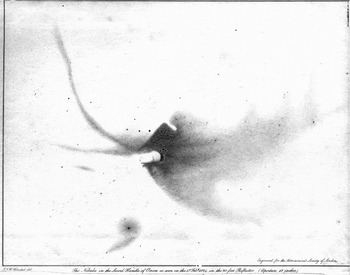
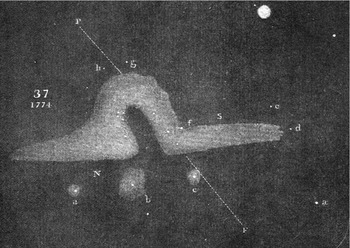
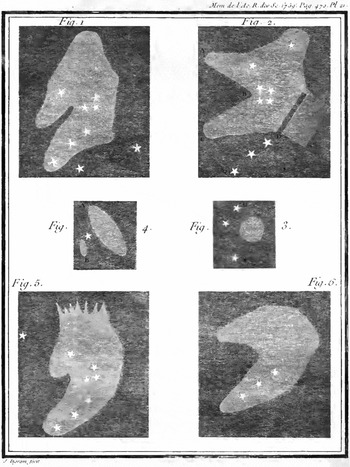
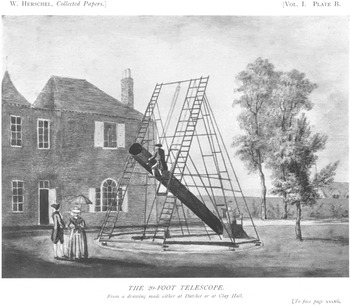
John Herschel's first publication dedicated to the nebulae saw the light of day in 1826, and was primarily focused on only two nebulae: the one in Orion (M42), and “the nebula in the Girdle of Andromeda” (M31) – only the former was pictorially figured, along with a separate figure for its map (fig. 1).Footnote 5 The kind of focus given by Herschel to the individual nebula drawn was different not only from his own father's earlier drawing of the same object (fig. 2), but also from even earlier, sporadic and rudimentary attempts made by previous astronomers in depicting the same (fig. 3). When one compares some of these earlier prints made of the nebula in Orion to what John Herschel produced, one is struck by just how little detail they contain. Indeed, John's figure is of an entirely different visual character from theirs. At least with regard to the figure of Orion produced by his father, one cannot simply explain away the radical differences in the visual productions by an appeal to the superior power of the telescope used; for, in fact, John used the same 20-foot reflector that his father had used to make his observations and drawings (fig. 4).
John Herschel's 1826 figure of the nebula in Orion. Taken from “An Account of the Actual State of the Great Nebula in Orion Compared with Those of Former Astronomers,” Memoirs of the Astronomical Society of London, 1826, 2:487–95.

William Herschel's figure for the nebula in Orion, fig. 37, Plate III, in The Scientific Papers of Sir William Herschel, volume 2, 1912.


William Herschel's most productive telescope, the 20-foot reflector.

Moreover, it is not that earlier observers’ of the nebulae such as Christian Huygens, Jean-Jacques d'Ortours de Marian (1678–1771), Jean Picard (1620–1682), Guillaume Le Gentil (1725–1792), and William Herschel were all just incompetent draughtsmen. But, rather, some preferred to visually represent what was observed in order to give an impression of a general type, rather than of an individual token, so that even when a particular nebula was figured, the image was designed to represent a whole class of objects in general. John Herschel was quite conscious that what he had produced and presented was drastically different. The difference lay not just in the telescope used or in skill, but also in how the observations and drawings were made and for what purpose. Herschel goes on in the same 1826 piece to make many detailed comparisons of what past observers of Orion included or excluded in their drawings in relation to his own figure of the same, only to conclude that what earlier draftsmen of the nebulae depicted went to show that they “contented themselves with very general and hasty sketches” (Herschel Reference Herschel1826, 489). To be sure, many evidently made their drawings, meant for publication, on a single night. This is in contrast to Herschel's own production, namely, one that attempted to eschew haste and the general by extending its view of an object over many nights (and even days), thanks to the procedural use of paper and stylus. Thus, one may read Herschel's 1826 paper as an introduction to slowing down the procedures of observation. The amount of detail entered into the drawings, therefore, is partly a reflection of this slowness and focus. But it is also a reflection of Herschel's aim to begin using collections of drawings of the same object in order to determine any kind of change – local or global – in it.
Herschel introduces his own figure of the nebula in Orion as “a careful and correct representation of its actual state,” which resulted from a distinctive and protracted procedure of observation and image production. He briefly describes this procedure as involving a final drawing “made from a set of drawings and notes taken in several nights’ [sic] of observations in the 20-foot reflector with its full aperture in favourable nights” (Herschel Reference Herschel1826, 489). Instead of a hasty and perhaps a one-time and on-the-spot sketch of a nebula – as it seems to have been the practice of the earlier draftsmen of the nebulae – Herschel informs us that he was engaged for more than two years on one drawing for one object, which was made up from a set of sketches and notes that he made on different nights, compared and corrected on other nights, sometimes with the help of another fellow observer's judgment, namely the celebrated telescope maker John Ramage.
Generally speaking, it was from each sketch done on a particular night, along with corresponding notes, that one could return to the telescope to view the object again and again in order to ascertain certain aspects noticed and recorded, or to make queries about what must be attended to in the next set of observations. In this way sketches moved forward and helped to determine what came next, what was attended to, what one looked for, and how the object was seen. What was drawn, moreover, was not simply put to paper in the same manner – sketches varied according to what was theoretically, operationally, or practically sought. Sometimes an object was roughly drawn as an outline, at other times it was more elaborate including more pictorial and measured aspects, and yet at other times sketches were used to focus on and magnify specific features of an object – it is from a collection of all such sketches, or working images, and the information and visibility that they afforded, that something like a final drawing was made for transfer to an engraver's plate. Not only then was this a slowing down of the act of drawing at the telescope but it was also a slowing down of the accumulation of a detailed final pictorial representation – an image that was a collection, a composite of information derived on many different nights and days of work. The slowing down in the procedures of observation, thus, resulted in an extended, protracted, and continuous gaze on a faint, barely visible object.
The procedure of observation used by John Herschel was meant to facilitate a composition of an image of a nebula from a kind of qualitative averaging based on multiple notes and drawings. It was only in this way, thought Herschel, that astronomers can “procure authentic evidence of such changes in the form, brightness, or physical condition of any particular nebula, as to establish the fact of its transition from one state to another, and to show an advance to a condition of greater maturity, or compression, to have really taken place” (ibid, 488; emphasis added). This meant that observers begin to make detailed drawings of particular, individual nebulae, with as much pictorial minutiae and measurement as possible, so that these mimetic and pictorial drawings may be compared to other drawings of the same object made at a prior or later date in order to ascertain some kind of directed change. For the most part this becomes the overall collective project of many nebular observers for the remainder of nineteenth century. Such a collective empiricism automatically, then, extends each particular published record of a nebula into the future.
Seven years later, in his next publication on the nebulae, Herschel was even more explicit about employing a procedure that, as he explained, took into account that a “methodological calmness and regularity is necessary” (Herschel Reference Herschel1833, 360). This was especially so for the observation of nebulae which, unlike any other branch of astronomy, according to Herschel, “has a greater tendency to create a sense of hurry, of all things the most fatal to exact observation” (ibid, 361; emphasis added). One basic reason for this hurry was that with the kind of telescopes that were available to Herschel for such observations at the time, namely, large altazimuth mounted reflector telescopes, a nebula could only be held in view for a limited amount of time on a fine, clear, moonless, cloudless, and atmospherically stable night. Needless to say, these perfect nights occurred infrequently in England, which only further affected the amount of time one could spend following an object. Whatever the temporal conditions, one was expected to take systematic measurements and notes on what one saw, draw as much as one could of what was in view or what was of interest at the moment, hold the object in the telescope's field of view, and count time so that one may also be prepared for the next viewing, all while juggling between different notebooks and pieces of paper to compare what one saw. Compromises had to be made.
It was not that Herschel gave up the production of detailed pictorial reproductions of the nebulae – just the opposite. He in fact dramatically increased their number for his 1833 catalogue of observations. There are eight plates with a total of 91 individually figured nebulae and clusters, each framed and boxed-in separately from the other. However, these pictorial representations of the nebulae stand out for their lack of precise measurement and make no pretence of being visual images numerically imbibed. “I am rather disposed to apologize,” writes Herschel, “for the incorrectness than to vaunt the accuracy [of the figures]. General resemblance, however, I can vouch for” (Herschel Reference Herschel1833, 361). Herschel's detailed drawings were made so as to capture the gradations of light, anomalies, shape and form, and the arrangement of stars in relation to one another and to conspicuous features of the object. This focus should come as no surprise, however, after all these figures were meant to be a part of a catalogue of thousands of objects, and therefore played a part in the classification and identification of objects. I will refer to such pictorial representation as portraits.
Making measurements of a nebula was a major challenge for any large and lumbering altazimuth reflecting telescope of the kind Herschel used. Without definite boundaries, and the countless number of bright spots and patches, some being stars and others gaseous patches, it was nearly impossible to measure the extent of some of these objects with the instrumental means available. Indeed, it seems to have been quite common at the time to regard the nebulae as numerically resistant. In the few cases that measurements were made of some nebulae the procedures were extensive and demanding, employing measurements from different telescopes (either Herschel's small seven-foot equatorial or from information obtained from another observer's measurements) on a number of nights, which had to factor in many possible sources of error, known and unknown. Pictorial details with a few eye-measurements, meant to provide a proportional and general impression of the object, was then the hallmark of many such published portraits.
The challenge of measuring the nebulae, however, had to be confronted, and it was from within the procedures he had already developed that Herschel began to formulate an even more extensive, protracted, and novel procedure. At the end of 1833, that is, when he moved his telescope and family to the Cape of Good Hope, Herschel's procedure of observing and drawing the nebulae were slowed down even further.Footnote 6 The aim of the new procedure of nebular imagining and observing was clear: to harmoniously combine both pictorial and descriptive details with exact numerical and geometric aspects, so badly required in getting an image conducive to measurement and thus useful for future detection of directed, measureable change. I call the visual results of this new procedure, descriptive maps, which are distinct from portraits. Herschel's new procedure was developed and first employed for observations taken from the southern vantage point at the Cape of Good Hope. Although he continued his extensive sweeps, a third of the nearly four years of observations were spent employing the new procedures in order to draw visually descriptive but yet numerically imbibed figures of some nebulae and clusters. Out of the fifty-nine figures in his so-called Cape Results (1847), published almost ten years after Herschel's return from the Cape, eight are produced as descriptive maps, the others are portraits.
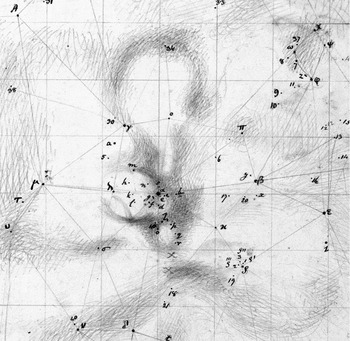
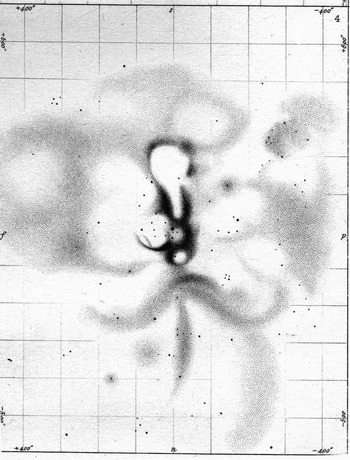
I have gone into much more detail elsewhere concerning the production of these descriptive maps by Herschel (Nasim Reference Nasim2011), so here I will give only some of the more relevant aspects of the procedure. There are two main aspects that need to be noted. The first is that the final published descriptive maps were what Herschel believed could be used to “read-off” the approximate location of their main stars and most conspicuous parts. And secondly, that the procedure was used to trace extensive details in a focused and controlled fashion – paralleling the way in which an engraver utilizes squares to control the tracing of the original. Herschel's procedures were also directly inspired by land-surveyors, who employed a series of triangles connected into chains in order to trigonometrically derive, from some known and actually measured base, the distances and precise locations of other points, many unknown, from an indefinitely large area. Using a chain of triangles, that is, Herschel was able to derive or estimate the relative distances of fainter stars apparently in and around a nebula. Even before any nebulous appearance was drawn-in, Herschel established on paper what he called “working skeletons” based on a few directly measured positions of stars. Once he settled on one or two efficacious working skeletons, Herschel then began to fill them in with both stars that were much too faint to be measured or approximated by other means, and the cloudy or nebulous material, apparently self-luminous by many degrees brightness and intermixed suddenly with dark patches here and there (fig. 5). This process was continued on different nights for the same working skeleton of one object, or for a number of different working skeletons employed for the same object (in some cases there are as many as eighteen working skeletons made for just one object). Finally, as the object's image was moved from one working skeleton to another, it was added to and eventually advanced into a more polished form, preserving the proportions and scale each time using a measured grid. In the final finished drawings one instantly notices the loss of triangles, circles, and other aids used in the procedure. The published figure, then, is displayed with only a faint square grid lying behind a nebula that emerges above and beyond it (fig. 6). The route to the final image, meant for the engraver's plate, was greatly extended, therefore, compared to the route taken in Herschel's earlier procedures. This extension allows for a meticulous scrutiny of the object from many different vantage points, but it also painfully slows down the procedures of observation.
A detail from John Herschel's working skeleton for the object 30 Doradus (or what is now referred to as the Tarantula Nebula), Monograph 30 Doradus, John Herschel Papers, RAS: JH 3/6.

The published descriptive map of 30 Doradus (Tarantula Nebula), Plate II, fig. 4, from John Herschel Cape Results (1847).

A working skeleton's deliberate dots, lines, triangles, and circles were crucial in helping the observer to focus attention on very particular areas of the nebulae and to demarcate onto a paper in a controlled manner where one inserted faint stars and nebulosity. These working skeletons were also explicitly used as maps in order to ascertain accurate relative distances and positions of difficult stars by simply “reading off the skeleton” (Herschel Reference Herschel1847, 27) already constructed using a few directly measured stars. Thus we have a final image that is well proportioned, with distinctly measured and measureable aspects, scalable to different sizes, and filled-in with as much pictorial detail as is possible with a pencil. One may notice, moreover, that it was not just that the observer was able to draw more thanks to such a procedure, but that he was also thereby enabled to see more, and see more precisely. This was so not only because of the focus granted by the preparations on paper, but also because of the combination of eye and hand that was at play. The procedure was thus quite tactile, where one felt, traced, and saw one's way through a network of arranged dots and measured triangles and squares. The time that it took, night and day, to construct the maps, measure and configure the skeletons, catalogue the stars, fill-in bit by bit a delicate nebula, checking and rechecking against the object as it presented itself through the eye-piece and on a series of loose papers, all contributed to slowing down and extending Herschel's time with a nebulous object.
Still, this does not capture the amount of energy and time that went into the procedures of just one out of eight individual objects imaged and published by Herschel. The measuring and plotting of the 150 stars in and around the nebula in Orion alone required nearly fifteen nights spanning three to four years. While the nebulae surrounding the star then known as η-Argus (now called Eta Carinae) required the measurement and plotting of 1203 stars. In the otherwise cautious prose that makes up the Cape Results, Herschel goes as far as to exclaim with regard to the production of the descriptive map for η-Argus that “frequently, while working at the telescope on these skeletons, a sensation of despair would arise of even being able to transfer to paper, with even tolerable correctness, their endless details” (Herschel Reference Herschel1847, 37). In order to avoid the sense of hurry that can so easily conquer an observer using a large reflector telescope, such procedures were meant to slow down and extend the observation of the object, sometimes even to the brink of despair.
Initially Herschel had devised his procedures of observation to overcome what he saw as the limitations of some of the earlier observers of the nebulae, including his own father. But his procedures were further developed and refined internally over time and were conditioned by demands made upon him by the sorts of objects he was dealing with, his large reflecting telescope and its limits, and the specific aims he had in mind, such as the detection of change through measurement and pictorial detail. In short, as Herschel gained more familiarity with the phenomena and his instruments, his procedures became longer and more mediated.
II
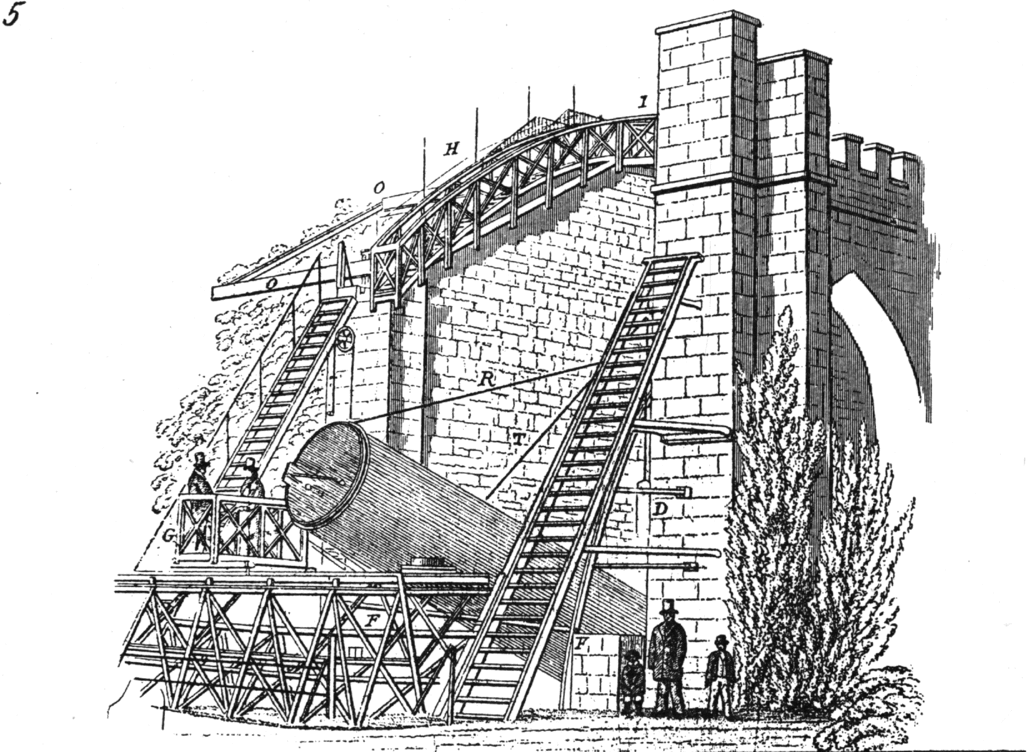
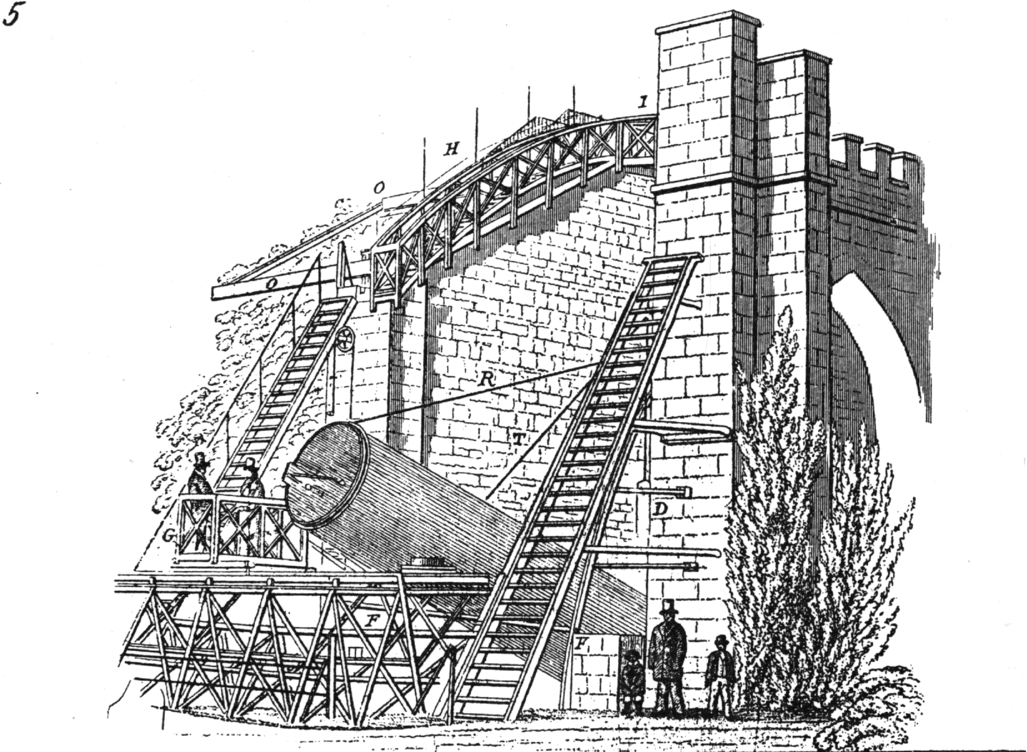
Nearly three years before Herschel's exquisite Cape Results were finally published, William Parsons (third Earl of Rosse) had completed building the world's largest reflector telescope. It was an instrument with a 6-foot (72-inch) aperture and a 54-foot focal length (fig. 7). Immediately after its first use at the beginning of 1845 the 6-foot reflector revealed for the first time a distinct spiral form among the nebulae (M51), a form never before seen in the heavens.Footnote 7 A drawing made by Rosse was exhibited in the summer of the same year at the BAAS meeting in Cambridge, where Herschel was also present. In a report from the meeting we are told that upon seeing the results of Rosse's telescope,
Sir John Herschel declared that he could not explain to the section the strong feelings and emotion with which he saw this old and familiar acquaintance (M51) in the very new dress in which the more powerful instrument of Lord Rosse presented it. He then sketched on a piece of paper the appearance under which he had been accustomed to see it . . . He felt a delight he could not express when he contemplated the achievements likely to be performed by this splendid telescope and, he had no doubt, by opening up new scenes of the grandeur of the creation. (Quoted in Anonymous 1850, 42:598)
It was not only Herschel who had such high expectations. The entire scientific community in fact was brimming with them. Observational research into the nebulae had long demanded powerful telescopes, and now one was finally built for this very purpose. While there were some observations made and recorded in 1846, Rosse's project, however, did not begin in earnest until around 1848. It was in 1850 that the results of the giant six-foot telescope were first published, where a new image of M51 was engraved along with another spiral object (M99). The next publication in 1861 was structured as a catalogue of nebulae and clusters observed and described, and with accompanying engraved and printed plates. The final efforts of the third Earl of Rosse and his team, which by this time included his son Lawrence Parsons who became the fourth Earl of Rosse after his father's death in 1867, were not published until 1868, and were the result of observations of the nebula in Orion. Since I have already examined in some detail the nature of Rosse's procedure in a few other places (Nasim Reference Nasim and Hoffmann2008; Reference Nasim2010a; and Reference Nasim, Nasim and Krauthausen2010b), I will only instance a few interesting and relevant aspects of them here, all the while stressing the procedure's temporal features in extending the observer's gaze, from one night to many years.
Engraving of Lord Rosse's Giant Telescope.
In conjunction with the examination of the nebulae into either resolvable or non-resolvable objects, one of the chief aims of the Rosse project was also to re-examine the objects of Herschel's 1833 catalogue of nebulae and clusters. As a matter of fact, the Ledgers implicated in Rosse's procedure were ordered according to the Herschel object numbers, arranged according to their right ascension, into which textual, numerical, and pictorial records were inserted. Generally speaking, like Herschel's procedure, Rosse's was also meant to drastically slow down the observations, in that, night after night, drawings and descriptions were made of the same object, over and over again. It is clear that the procedure was fundamentally meant to aid the observer to see more, and to make out details, and the procedure was also used to generally familiarize oneself over time with these difficult objects (Nasim Reference Nasim2010a; Reference Nasim, Nasim and Krauthausen2010b). Such provisions had to be taken because the objects were extremely faint, difficult to discern, and barely visible with a simple momentary observation, not to mention the many sources of known and unknown errors involved. The procedure was also intended to lengthen one's time with the object that could only be continuously followed by the telescope on a fine night for up to an hour. This short window of time was primarily due to the two huge walls that restricted the motion of the tube, and to the practice of tracking an object when it first arrived at the meridian line, where the telescope would be waiting. It is surprising therefore that they accomplished as much as they did and with as much detail, especially if they normally closed up before eleven o'clock (Rosse Reference Rosse1861, 681). There is no question that the temptation to hurry was a factor here.
Furthermore, Rosse's procedure must be understood in light of the fact that many different hands were involved in drawing, describing, and sometimes measuring. Though Herschel made his first drawing of the nebula in Orion with the help of Ramage's judgment, for the rest of his career Herschel preferred to observe the nebulae alone.Footnote 8 Lord Rosse however preferred to hire many observers to assist in the observational program. The Rosse project began with a three-foot telescope in the late 1830s and came to a halt sometime at the end of the nineteenth century. Just between 1845 and 1868 the project had gone through at least seven assistants, not to mention the involvement of the Earl and his son, and all those who briefly worked at the telescope only to quickly leave, finding the work too demanding. Each assistant had his own preferences, idiosyncrasies, and style, but these were governed and directed by pre-established protocols of the procedure, which involved a series of different notebooks wherein an object was entered, copied, and recopied to advance until it was finally ready to be re-drawn in its polished form for printing. The distinctive feature of the Rosse procedure was the movement of a sketch or a set of sketches of one object from an Observing Book, where an initial drawing and description was made at the telescope on a particular night, to two Ledgers that collected all the drawings, sketches, and descriptions from all the Observing Books. One Ledger remained in Rosse's office where it was used to process information for publications. But it was also recopied and updated into another Ledger (of identical dimensions and make) that was used at the telescopes, to prepare for a night's observations or during the observation itself. After a collection of pictorial, numerical, and written information was accumulated, sometimes spanning a few years, these were all to some extent or other utilized in the final drawing of an object, designed to be transferrable to an engraver's plate. Sometimes more than one polished drawing was made, and these were checked in conjunction with what was contained in the Ledgers and the telescopic object itself. These drawings were then pasted into a large Album of “Astronomical Drawings.”
The Observing Books, with their individuality, were the place in which an observer attempted to directly make out what was seen. This was sometimes done by making sketches while the object was in the telescope's field of view, and by making a number of sketches over different nights. Thus one finds that despite written descriptions such as, “no use of looking except on a very fine night,” that sometimes a few drawings were nevertheless annexed; which suggests that the drawings were employed in order to “make out” features of what was barely visible. The working images accumulated throughout the Observing Books and were used in an attempt, over a period of time, to consolidate and reconcile the differences, and to aid in the production of a final figure – a process that was made possible by the Ledgers.
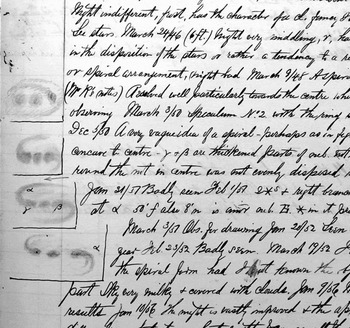
The Ledgers were used to collect different drawings made of the same object over some period of time. Here in fig. 8 we have the records for the object h 604, taken from a Ledger. It contains entries beginning with one from 1846 and end with observations from 1861. On the two pages dedicated for this object in this Ledger, there are ten sketches, some in pencil others in pen – the figure only shows a portion of these. A polished pictorial representation of h 604 was published in 1850, and immediately afterwards it was re-observed and redrawn by Bindon Stoney in 1851, a drawing that was not printed until the final publication on the nebulae in 1878. A wood-engraving was also printed in the 1861 catalogue, but this kind of published image played a role different from the standard copper or steel plate engravings, or later lithographs. Over all, then, the Ledger presents in this case (and for the vast majority of the other objects too) many years of work and drawings all on a page or two, accessible to a single glance. This not only brings an observer up-to-speed with regard to an object and all that has been done by other eyes and hands before, but it also informs him about what must be focused on or attended to in the next set of observations, and what not. A single page of the Ledger consolidates many hands and eyes, and it lengthens an observer's time with an object, backward and forward in time. Finally, one also notices the way in which a published final figure was never really “final” but was continuously revisited and revised.
Object h 604 in Lord Rosse's Ledger (Birr Scientific Heritage Foundation, Rosse Papers, L/2·2).

Rosse's procedure contains little in the way of systematic measurement, especially if one compares it to Herschel's working skeletons. While some more focused measurements were sometimes made, the norm was to make rough eye-measurements to be incorporated into the sketches and drawings. By and large, the Rosse procedure was thus more qualitatively and descriptively oriented than numerically and geometrically invested. The majority of Rosse's published engravings of the nebulae and clusters are thus portraits, rather than descriptive maps. Nonetheless, Rosse's procedures were to be deliberately slowed down even more. There are indications already in Rosse's 1861 publication that while interpreting, consolidating, and synthesizing information for some nebulae, an aspect came to light that was not given as much priority before, namely, the detection of change within a nebula. Rosse is pretty explicit about this when qualifying one of his assistant's 25 published figures that were made without a micrometer, and thus without measurement. “I now rather regret it,” says Rosse, “as several cases of suspect change have recently been brought to light in arranging the materials of this paper. The fault, however, was mine. It appeared to me so highly improbable that any change would be detected, that I requested Mr. Mitchell to press on and not spend time on the micrometer” (Rosse Reference Rosse1861, 704). For the next publication, which was to be solely dedicated to the nebula in Orion, Rosse's team of assistants were entirely sensitive to the question of directed change based on the visual information relayed by the images. The result was published as a magnificent descriptive map of the nebula, using techniques similar – but not quite the same – as those utilized for Herschel's descriptive maps. When tallied together – seven years of measurements, using at least three different telescopes, with at least four assistants, not to mention the involvement of the third Earl and his son Lawrence Parsons – the sheer scale of the project's methods and means reveals the unbelievable amount of paper, energy, and time that was necessary for the completion, or more accurately, the construction of this one final hand drawing of M42. The continuity provided between the observers of the Rosse project was no longer made possible by Ledgers, as had been the case before. Rather, a scaled grid and the groundwork of stars itself, guided and coordinated the placement of the many parts of the nebula onto paper, making it easier and more exact for others to find, identify, and place new pictorial and measured aspects consistently, no matter when or by whom.
III
It is clear that whatever high expectations Herschel had expressed in Lord Rosse's six-foot telescope in the summer of 1845, when the newly discovered spiral form of M51 was displayed, those expectations were much lowered by the early 1860s. In light of Herschel's descriptive maps that attempted to combine pictorial and measured aspects in a harmonious way, Herschel's disappointment with Rosse's techniques not only extended to the positional aspects, but also to the drawings. It is no wonder, therefore, that Herschel responded to William Lassell's growing worries about the viability of the determination of change from a collection of visual images by claiming, at least in the case of one of Rosse's figures of a nebula that “If it were permitted to breathe a doubt as to the graphical exactness of the draftsman who executed the figure to which you refer I should be apt to fancy it was done rather dashingly.”Footnote 9
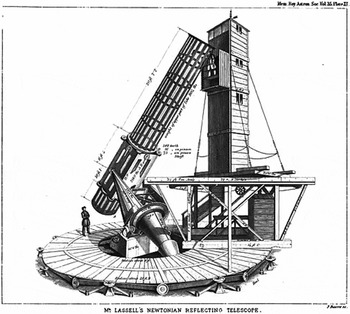
I will focus in this section on some aspects of Lassell's procedure, especially the way they reflect the telescopes he had used in his observations of the nebulae and clusters. Unlike Herschel's and Rosse's altazimuth reflectors, which were practically and temporally limited in their nightly relation to an object, Lassell mounted his large Newtonian reflectors on equatorial mounts, which meant that ideally he could easily follow – on just one axis and thus with one continuous and smooth motion – an object for a much longer time than could the other two observers (fig. 9). If what I have been arguing for so far, that is that Herschel's and Rosse's procedures of observation were strategically established partly in order to make-up for the limits of their large restricting telescopes, and partly to extend and slow down observations of target objects that required long spans of time to become acquainted with, then it would seem that Lassell's paperwork would reflect the increased amount of time his innovative instruments permitted him to interact with an object. And this is precisely what we find: a shorter process in his procedures, especially en route to a final drawing.
William Lassell's largest telescope, a Newtonian reflector equatorially mounted, plate XI, Memoirs of the Royal Astronomical Society, Volume 36, 1867.

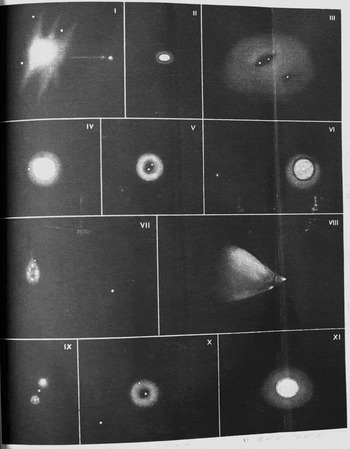
As early as 1839, Lassell had built a Newtonian reflector with a 9-inch aperture that was mounted equatorially, which was a major innovation in its own right.Footnote 10 After visiting Lord Rosse in 1843, and making extensive notes on Rosse's 3-foot reflector and his practice of polishing specula, Lassell set to work on building his 24-inch (aperture) with a 20-foot focal length, and with a reflector that was also equatorially mounted. It was with this latter instrument that he began to work on the nebulae and clusters. It was also with the 20-foot reflector that Lassell first set out to Malta in 1852, spending only a year there, under relatively perfect southern skies. The results of these observations were published in the annals of the Memoirs of the Royal Astronomical Society as two articles in 1854, one being an examination with a figure of the nebula in Orion (Plate I of Lassell Reference Lassell1854a), and the other being “Miscellaneous Observations” of some nebulae and clusters, annexed with one engraved plate (fig. 10) with eleven figures (Plate II of Lassell Reference Lassell1854b). In contrast to the common practice, one of the most notable things about these figures is that they are done in the positive, that is, the objects are white on a black background. No justification is given for his choice, but by Lassell's next publication on the nebulae the figures resume their standard appearance, that is, in the negative. But it may be said that his choice of the positive image for the figures is indicative of his explorative approach to the visual imaging of the nebulae. For instance, Lassell preferred to have the nebula in Orion painted in oils by his friend, painter and astronomer John Hippisley. Of course, Lassell assures his readers, he superintended the whole process from over Hippisley's shoulder, and considered it his main, standard pictorial representation of the nebula. However exquisite and authoritative the oil painting was, which was presented to the Royal Astronomical Society (RAS) and hung in its rooms, it was much too big to be printed, so a smaller copy was made in its stead for publication in 1854 (cf. Lassell Reference Lassell1854a, 56).
Eleven positive images of nebulae from Lassell's first trip to Malta, Plate II in William Lassell Reference Lassell1854b.

Despite Lassell's explorative approach to the depiction of the nebulae, we cannot fully appreciate how they were produced unless we turn to his archive and examine his notebooks for the procedure used. The so-called “Miscellaneous Observations” contain information describing about fifteen nebulae and clusters, eleven of which are figured, and two stars. The observations for all these are originally taken from entries found in an observing book labeled, “Astronomical Observations: commencing 18th Oct. 1852 to March 1853.” The figures published are the result of observations that span only a three-month period, with two made in December 1852, five from January 1853, and four from March 1853. Three of the nebulae are re-examined, revised, and confirmed on another date. When one looks to the original notebook for these observations, one also notices that they are interspersed with wonderful drawings of Saturn, other planets and their moons, and further nebulae not included in the published plate. Most of the drawings and notes are done in pencil and appear quite rough. Sometimes India ink is used for inserting stars. One also notices that already in the original notebook, sometimes a drawing is determined to be final with statements like “cannot be improved,” or “nothing to be added.”Footnote 11 Finally, no real systematic effort is made to make exhaustive and detailed measurements. While Lassell is sensitive to the proportions represented in the drawings, the figures published are pictorial.
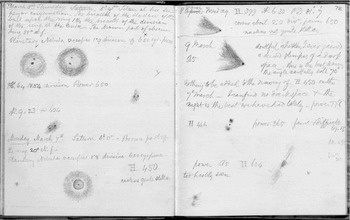
These “fieldnotes” and sketches form the basis for another set of more detailed descriptions in another of Lassell's, succeeding, notebooks.Footnote 12 Into this second notebook the same objects from the same nights of observation as the first observing book are re-drawn by pencil, and it contains much additional information as detailed notes and descriptions, which are done in a fluent pen. These additional notes might be descriptions of the objects that Lassell entered in later, the next morning, or soon thereafter. But whenever they might have been entered, they may correctly be described as “headnotes” or notes from memory, to use an ethnographer's helpful term in order to distinguish them from fieldnotes (Sanjek Reference Sanjek and Sanjek1990, 92–95). It is from this second notebook that many of the detailed descriptions are taken, reordered, and lightly edited for publication into Lassell's “Miscellaneous Observations” of 1854. The drawings that are used for engraving, however, seem to come directly from the original observing book (fig. 11), even though some are copied into the second notebook. While the engraved plate is done in the positive, the original drawings are made in the negative – with pencil on an off-white ground provided by the page. So visual translations had to be made, which makes it difficult to precisely ascertain the exact level of resemblance between the two – the original and the print.
Two Pages from William Lassell's Observing Book. Courtesy of the Royal Astronomical Society, “Astronomical Observations, 1852–1852,” Lassell Papers L 17.2, p. 77–78.

All in all, what must be emphasized is the relative swiftness of Lassell's procedure. We have moved from an original observing book to a second record book, and then its publication in only a few steps and in a relatively short period of time. The drawings move along this short procedure, and are published pretty much as they figure in the notebooks. There are sometimes two or three sketches made of the same object in the record books, to be sure, but each basically develops from where the last left-off until Lassell concludes “this is the best drawing . . . nothing to be added.”Footnote 13 While the same sort of build-up, construction, or composite occurred in the procedures of Herschel and Rosse, it took them a few years to be satisfied by a drawing for it to be then made into a final polished drawing of the object for publication. It is not that Lassell was simply satisfied by one night's worth of observations for a drawing of an object, however. But it did take Lassell only a few observations over a few months, and a number of drawings and notes to be content with the results.
It must also be mentioned that rarely, if ever, did such a close visual resemblance occur between the printed figure and a sketch of the same object found in the observing books of Lord Rosse or Herschel. Though Rosse too had a place for such swift observational sketches in his publications, which were small wood-cuts inserted into his 1861 catalogue directly next to an object's record and description. Compared to his other published figures, both portraits and a descriptive map, these small wood-cuts played a minor role in Rosse's record of observations – they were meant to give a glimpse into his team's observational practices (cf. Rosse Reference Rosse1861, 704). Lassell, on the other hand, treats the figures presented here in his 1854 publication as portraits, on par with those made by Rosse and Herschel; in fact he compares them to one another. Provided we understand the status of Lassell's portraits as being more representative and fundamental for nebular research than Rosse's wood-cuts, though both arise from relatively swift observations, we may conclude that Lassell's procedures in the production of descriptions and drawings reflect his telescope's ability to follow an object for a much longer period of time than either Rosse's or Herschel's altazimuth mounted reflectors. In other words, because he could hold and see an object for a much longer time, his procedures were relatively much shorter.
By 1858 Lassell had completed an even larger reflector that was also equatorially mounted. It was an instrument with a 48-inch mirror and a focal length of 37 feet. It was with this telescope that he returned to Malta between 1861 and 1865. The outcome of this second and extended trip to Malta was Lassell's most important and last publication on the nebulae of 1867. Lassell also sent many interesting letters from Malta to the members of the RAS and to Herschel, some of which were published. Many of these letters were accompanied by pencil drawings of nebulae, traced directly from his notebooks. Due to considerations of space, I cannot go into the details of the procedures used in Malta with the 48-inch reflector, but we can notice a few differences and developments. Apart from the fact that many aspects of Lassell's procedures remain the same, especially its shortened, rather than prolonged, path from original observation to the publication, one of the most important differences is that the sketches are typically made within circles that represent a specific field of view that are also included in the printed figures (instead of being framed in by boxes, as in his earlier work). Each circle's diameter is measured in order to represent a field-of-view of a particular eyepiece used at the telescope. What is intriguing about this is that more than one eyepiece was used during any one observation of an object, so that different focal planes with different powers of magnification are sometimes represented in one and the same drawing. This not only means that what is represented as a visual figure of an object is given a peculiar depth, thanks to the different focal planes being included in one drawing, but it also means that the drawings show a particularity and dependence on a specific telescope, its eyepieces, and procedures. Despite being individual figures of specific objects, Herschel's 1847 printed descriptive maps, on the one hand, barely show any signs of the amount of work that actually went into their preparations and omit labels, fields of view, and the numerous intricate chains of triangles that went into their construction. The nebulae seem to float above a grid, which vanishes as it nears the ambiguous boundaries of the objects. In fact, the particularities of the procedure and telescope used seem to be transcended. Lassell, on the other hand, has moved us even closer to particularity and imminence by making us distinctly aware at every glance that what we are seeing is an object through a particular set of eyepieces that are attached to a specific telescope. This level of particularity was possible thanks to the amount of time he was able to spend at the telescope with an object in one night, which translated itself into procedures with less temporal layers, resulting in images which flaunt the specifics of his telescope. Instead, optical and spatial layers are contained in the focal depths of the drawings themselves.Footnote 14
Conclusion
We may conclude this paper with a few observations. The first is that the “management of time” (Griesemer and Yamashita Reference Griesemer, Yamashita and Schmidgen2005) plays itself out at different levels. In fact, one may distinguish three layers of time in any scientific research program: phenomena-time, investigator-time, and the time of study. If we apply these helpful distinctions to the cases examined above we see that the time spent observing an object at the telescope (phenomena-time) may actually be temporally extended or slowed down using some procedures of observation (study-time). Phenomena-time in the case of the nebulae is conditioned not only by the large number of duties one was expected to accomplish at the telescope each night, but is also conditioned by the specs of the telescope used. John Herschel's procedures enabled him to manage his time between many different aims, projects, and objects, but they also helped him to focus on an object in a manner that acted as an antidote to the inadvertent inducement of haste in phenomena-time. Herschel's descriptive maps, which were the result of extensively extended and slowed down procedures, exhibit the appearance of an object in a manner that cannot be seen on any given night, but rather display an object with what might be regarded as a temporal thickness. Such temporality in a figure corresponded, at the same time, with the spatial density of the paperwork of the procedures involved. The peculiar result of these procedures, however, was that the more Herschel tried to capture the particularities and individuality of each specific nebula, the further he seemed to move from an object's most basic momentary, phenomena-time at the telescope.
Lord Rosse's procedures, on the other hand, focused primarily on the movement of working images in study-time, with a particular emphasis on the time spent recopying, retracing, and revisiting each object, even after its “final” drawing had been printed or after an investigator's time had ended (i.e., upon the death of the third Earl of Rosse, or the departure of an assistant from the project). A treatment of space also played a role in the Rosse procedures, but unlike Herschel's working skeletons, it was employed by way of a series of different notebooks. But like Herschel's, Rosse's final published images were individual objects that were at the same time a collection of many processed viewings of the object at the telescope, from within the landscape of notebooks, and from formerly published figures. Most importantly, however, for the purposes of this paper, Rosse's procedures allowed observers to slow down their interaction time with target objects and thereby permitted them an extended gaze. This was certainly necessary, as we have seen, considering the serious time constraints occasioned by the telescope and its mounting, and by the many duties and actions attempted at the telescope.
Both Herschel and Rosse used state of the art telescopes for observing the nebulae. But both also faced major challenges due to a their respective telescopes’ abilities to follow an object on the celestial sphere – in one case for practical reasons and in the other for physical reasons – which thus limited phenomena-time. It was therefore by way of their respective procedures that each attempted to compensate for these sorts of time limitations. I have introduced the case of William Lassell to indirectly strengthen this point. Lassell pioneered the equatorial mount for large reflector telescopes, which permitted him the convenience of much more phenomena-time than either Rosse or Herschel. The fruit of this direct temporal relationship with the objects at the telescope is reflected in the shortened (rather than extended) procedures of observation used, moving from observations to publication through a much shorter route than the others without giving in to the kind of haste Herschel warned against.
Finally, like Rosse's and Herschel's procedures, Lassell's also have their own history of development, adjustment, and refinement. Generally speaking, due to a change in aim, or due to a growing acquaintance with the objects or the procedures used, each developed their procedures to meet the demands of object, instrument, and information. The more phenomena-time was extended, either thanks to telescope or procedure, or both, the more note-taking and sketch-making practices evolved to accommodate precision and measurement of time and space into pictorial representations. The layers in the history of procedures examined in this paper have shown that there is a close link or relationship between phenomena-time and study-time – in fact, one may be used to adjust the other.