Mary Heath died in December 1824, but she remained a presence to her grieving sister. Anna Eliza Heath was not an adherent of séance Spiritualism; that movement would begin in 1848. Rather, Anna was one of thousands of early nineteenth-century, middle-class American Protestants—mostly women—who believed that the dead were close at hand, active agents in the world of the living. In this view, the dead could bring solace, protect loved ones from danger, and even be addressed in spoken or mental communication. A devout Protestant, Anna regularly attended services at the liberal Congregational church in Brookline, Massachusetts. She did not see her mainstream faith in conflict with the postmortem relationship she maintained with Mary.
Anna was deeply bereaved by her twenty-year-old sister's death; perhaps she was especially pained owing to a sense of guilt. “I was not near to witness her quiet exit,” she lamented in her diary. Eight years Mary's senior, Anna regretted that she had been unable to offer comfort and counsel as her sister lay dying. More problematically, from the perspective of the dominant Protestant model of proper mourning, she also could not fully accept God's will: “How much I wished, I still wish, for christian resignation.”Footnote 1
Her faith tested, Anna directed her devotional fervor toward a figure less inscrutable than God: her sister Mary. Anna Heath did not cease to worship God; she continued to do so, with vigor. But in addition to God, a new supernatural being existed, not for Anna to worship but to speak to, pray to, and beg for comfort. This connection between the living and dead even manifested itself in church. In April 1825, four months after Mary died, Anna rode to Boston with her aunt and uncle to hear a fast-day sermon. Their destination was New South Church, also known as Sixth Congregational. This was the first time Anna had been to worship in Boston since Mary died, and she struggled to reconcile her grief with the cultural script of moderate mourning.
I gave all my attention to the services as long as I had any command of myself, that I might not cherish sorrow by thinking of her, but at length my feelings got the upper hand, and knowing Mr. Howe [her sixty-year-old uncle] would disapprove such weakness, I strove so violently to repress emotion, that the conflict almost overpowered me.
In this agitated state, surrounded by judgmental male authority figures including her uncle, her minister, and her God, Anna turned to a more sympathetic being: “Almost, & I believe the very last time I was there, Mary accompanied me to Church; & she seemed to be present with me now.”Footnote 2
Two weeks later, Anna again gained comfort from Mary, this time at home. On a day when she was “weighed down by depression,” Anna apologized to her dead sister for missing her final hours: “Oh Mary, Mary! how could I leave you so unthinkingly!” To console herself, Anna told Mary about the relationship they maintained. “You are ever present to my thoughts . . . . In solitude I commune with you, in the social circle you are near.” And then she articulated the principal article of faith of those who believed in continuing relationships with the dead: “It is a delightful idea, that departed spirits are commissioned by God to execute purposes of mercy on earth; & that you are present with us tho’ invisible, active in accomplishing errands of love.”Footnote 3
The dead are “present with us tho’ invisible.” Anna Heath and others insisted that God “commissioned” departed spirits to visit their loved ones and provide guidance, protection, and comfort. But this was a concept that people almost never heard from the pulpit in Sunday sermons or read about in devotional classics. As Samuel Whelpley, a Presbyterian clergyman in Morristown, New Jersey, phrased the standard ministerial line in 1807, “at death, we drop all converse with those we leave behind us.”Footnote 4 Or in the 1817 words of Henry Holcombe, pastor of the First Baptist Church in Philadelphia, a dead person “neither can, nor if permitted, would, return to us.”Footnote 5 According to these ministers, postmortem interaction between the living and dead was impossible. By contrast, lay women and men generated the idea that the dead are present though invisible, combining mainstream Protestant tenets about heaven and God's omnipotence with popular belief in a permeable boundary between this world and the next.
In other words, Anna Heath and her ilk offer historians an opportunity to test Robert Orsi's recent contention in History and Presence that the definition of religion should include “all the special suprahuman beings with whom humans have been in relationship in different times and places.” Anna Heath undoubtedly believed that Mary was a “suprahuman being”: her spirit could return to earth to perform “errands of love;” Anna could communicate with her soul. Heath's Protestant religion therefore offered her and others the “presence” Orsi insists is at the core of religious experience. This may surprise some readers, however, because of Orsi's formulation that “Catholics = presence, Protestants = absence.” Such surprise is unwarranted. Orsi makes clear that those simple equations were “a caricature and polemical overstatement already in early modernity.”Footnote 6 His point is that Protestantism has been conceived of (not least by Protestant propagandists) as a religion of absence, not that it is such a religion.
Such subtlety runs the risk of misinterpretation; indeed, scholars have already misread Orsi on this point. As part of a widely circulated review forum on History and Presence commissioned by H-AmRel, the H-Net discussion list on the history of American religion, one writer worries that “if Protestantism is a religion of absence, then the study of Protestantism seems off limits to a presence-oriented theory of religion.”Footnote 7 The reviewer errs in stating that Orsi maintains that “Protestantism is a religion of absence.” Building on a more accurate reading of Orsi, my case study uses continuing relationships between mourners and the dead in the northeastern United States—before the advent of séance Spiritualism in 1848—to demonstrate the ample presence of suprahuman beings in the lived religion of antebellum Protestants.
Historians have long known that nineteenth-century Americans were fascinated by death, but they have overlooked their continuing relationships with the dead.Footnote 8 The distinction is crucial, because laypeople's desires to experience the presence of the dead drove important changes in Protestant belief and practice. The beliefs outside mainstream Protestant theology that some mourners embraced in the nineteenth century were 1) corpses deserved adoration, 2) departed souls turned into angels, 3) souls frequently returned to earth as guardian angels, 4) graveyards were numinous spaces harboring spirits of the dead, and 5) praying to the dead was a legitimate form of religious communion.Footnote 9 This article focuses on guardian angels and graveyards.
Two types of sources document such beliefs: diaries and popular sentimental literature. Both have strengths and limitations. Diaries provide unparalleled insight into the lived religion of antebellum Protestants, as many women—and a few men—described their efforts to maintain relationships with the dead through mental communication and graveyard visitations. These documents were generated by people with sufficient time and education to keep detailed diaries: members of the comfortable middle class. The diary keepers this article examines, moreover, were all Euro-Americans. African Americans and Amerindians had their own traditions of spirit communication, but those deserve separate consideration.Footnote 10
Imaginative literature, especially poems and short fictions in magazines aimed at a largely female audience, offers a valuable complement to the diaries.Footnote 11 The popularity of sentimental literature, with some cherished pieces reprinted dozens of time, demonstrates the widespread interest in these beliefs. In fact, a reciprocal relationship existed between lived religion and imaginative literature, with each influencing the other. People's private expressions of belief were shaped by what they read in magazines and books; authors wrote about what they believed and experienced. To allow for an in-depth examination of these primary sources, this article focuses on the northeastern United States. In that region, among Euro-American Protestants, there was a pervasive belief that the beloved dead were present though invisible. Overlooked by historians, this belief long predated séance Spiritualism and was a key factor in that movement's rapid growth after 1848.
I. Guardian Angels
Guardian angels are older than Christianity itself. In fact, early Christians inherited the idea of personal, protective angels from Judaism and other religions of the ancient eastern Mediterranean. As angels became increasingly central to both learned and popular Catholicism during the Middle Ages, guardian angels received ever more attention. Theologians such as Aquinas and Bonaventure debated key issues such as whether God assigned each person an evil, fallen angel (demon) in addition to a good angel.Footnote 12 But interest in guardian angels was hardly limited to theologians. By the thirteenth century, the Catholic liturgy included a prayer to one's guardian angel, and in the fifteenth century some books of hours used by the laity were devoted entirely to these protective beings.Footnote 13 One such book contained this intimate prayer for people to offer:
In short, guardian angels played an active role in medieval Catholic piety and theology.
One might think that the Protestant Reformation would have inspired efforts to do away with these figures of Catholic veneration. But Protestants could not overlook the biblical foundation of such beliefs. As one English reformer pointed out, the Bible mentions angels more than two hundred sixty times.Footnote 15 And Protestants conventionally understood several of those texts to describe the existence of guardian angels. In his epistle to the Hebrews, for example, Paul asks rhetorically about angels, “Are they not all ministering spirits, sent forth to minister for them who shall be heirs of salvation?” (Hebrews 1:14). Christians, in other words, have angels who care for them on earth.
What remained an open question for Protestants was whether God assigned a particular guardian angel to each person, or whether a person received the aid of a changing cast of angelic characters over the course of one's life. The danger of the particular guardian angel, reformers feared, was that it could lead to the type of veneration that should be reserved only for God. After all, Catholic prayers to specific guardian angels were not unlike prayers to saints and the Virgin Mary. Starting with Calvin, most reformers took a position of studied agnosticism on the question of particular guardian angels, in light of scripture's opacity on the topic. As Calvin put it in his Institutes (1536), “whether or not each believer has a single angel assigned to him for his defense, I dare not positively affirm.”Footnote 16 Underlying Calvin's attitude was a fear that too much focus on guardian angels would lead people to worship them.
In seventeenth- and eighteenth-century England and its American colonies, ministers generally followed Calvin's lead. In sermons such as John Bayly's The Angell Guardian (1630) and in theological treatises such as Richard Baxter's The Protestant Religion (1692), English ministers agreed that good angels protected believers from evil, but they hedged on the issue of particular guardian angels.Footnote 17 And even though one scholar flatly states that “angels were scarce in Calvinist New England,” the reality was otherwise.Footnote 18 Ministers such as Increase Mather, Cotton Mather, and Samuel Willard published tracts and delivered sermons about protective angels, and dying laypeople sometimes witnessed guardian angels around their deathbeds, readying to escort their souls to heaven.Footnote 19
Ministers and laypeople, however, diverged on one crucial issue: the origin of guardian angels. Protestant theologians through the eighteenth century were unanimous in their opinion that angels and the souls of the deceased were distinct entities.Footnote 20 Human souls did not become angels. God created angels before time; the souls of the dead became the “spirits of just men made perfect” in heaven (Hebrews 12:23). Ministers such as Jonathan Edwards always maintained the distinction between “angels” and “saints.” In the Works of Jonathan Edwards Online, the Northampton minister uses the phrase “angels and saints” twenty-eight times, “saints and angels” one hundred thirteen times.Footnote 21 They were separate suprahuman beings.
By contrast, some lay Protestants began in the eighteenth century to assert that the souls of the dead could return to earth as guardian angels. This necessarily implied that human souls became angels in heaven, contrary to mainstream Protestant theology. Evidence for this belief is fragmentary and scattered in the eighteenth century, so much so that historians have entirely missed this development. The only scholars who discuss the conflation of angels and souls, Peter Marshall and Alexandra Walsham, see it as a part of “modern popular culture” and consider it an “indirect consequence” of Emanuel Swedenborg's writings.Footnote 22 Swedenborg was a Swedish mystic who communicated with angels from 1744 until his death in 1772. He published numerous volumes about what he learned from his heavenly interlocutors, including that the souls of deserving humans become angels after death.Footnote 23
There are two problems with the argument of Marshall and Walsham. First, the idea that souls become angels emerged long before the twentieth century. Second, Swedenborg was not the ultimate source for this belief. Several examples predate Swedenborg's publications, and others date to the second half of the eighteenth century when Swedenborg remained largely unknown. As late as 1840, Swedenborgian churches claimed only eight hundred fifty members in the United States.Footnote 24 It is more accurate to say that Swedenborg tapped into an inchoate lay Protestant interest in maintaining connections with the dead, an interest that occasionally expressed itself as the belief that souls become angels, which allows the dead to return as guardian angels.
The oldest example I have found dates to 1697. It comes from the pen of the English author Elizabeth Singer Rowe, whose enormously popular collection of fictionalized letters from the dead to the living, Friendship in Death (1728), was a transatlantic sensation. Rowe asked her brother-in-law to posthumously publish her letters and previously unpublished poems. That collection includes a series of letters from Elizabeth Rowe to her close friend and patron, Grace Thynne. In a 1697 letter, Rowe informed Thynne that she was desperately ill. Thinking about the relationship between this world and the next, Rowe asserted the permeability of that boundary:
I can hold up my head no longer, but yet, Madam, I'll stay to tell you (for perhaps I may never write to you more) that the cold embraces of death shall never freeze up the kindness I have for you: No, the sacred flame shall glow in my breast to eternity. I'll be your guardian angel, and leave paradise to converse with you.Footnote 25
Thirty years before she published Friendship in Death, Rowe believed a dead person's soul could return to earth as a guardian angel and “converse” with the living. Rowe's avowal of this belief is not at all “literary” or imaginary, and certainly not ironic. It is an earnest statement of fact. Readers sensed Rowe's sincerity in Friendship in Death, which helped account for the book's popularity. Though the letters in the 1728 collection were indeed imagined, they reflected beliefs that united author and audience. And one of those beliefs included the dead returning as guardian angels. As a young man writes to his sister from heaven, “I have often, since I left the World, had the Priviledge to supply the Place of your Guardian Angel. I have been an invisible Witness of your Tears for my Death; and to allay the Excess of your Grief for me, I have been at last permitted to let you know that I am happy.”Footnote 26 Rowe almost certainly did not invent the idea that deceased loved ones return as guardian angels. More likely, she put to paper an emerging belief; pre-1697 examples probably remain to be found. At the very least, in more than fifty English and five American editions before 1800, Friendship in Death exposed readers to an idea that was gaining traction within an ever-widening circle of women and men.Footnote 27 Rowe's personal beliefs shaped her imaginative literature, which went on to influence the ideas of countless readers.
Belief in guardian angels—in the presence of suprahuman beings—found occasional expression in fiction and elegiac verse through the rest of the eighteenth century. As the Philadelphia Quaker poet Hannah Griffitts wrote in an unpublished elegy addressed to her mother on the ninth anniversary of her death, “Oh, still attend, my Guardian-Angel Thou, / Watch o'er my steps, direct me where to tread.”Footnote 28 Or consider a scene in the anonymously authored English novel The History of Clorana (1737) that portrays the deathbed of Bellmont. The dying man comforts his beloved Amelia with these words: “if I have one Thought upon Earth, ’tis center'd in Amelia, and I could with Pleasure receive the Almighty's Commands to be Amelia's Guardian Angel, to hover perpetually round her, to prevent the Evils of the Day, and the Dangers of the Night.”Footnote 29 Like many other expressions of this desire, this one includes the suggestion that it is only at God's command that a person's soul could return to earth as a guardian angel.
In the nineteenth century, the expression of these beliefs in print became only more widespread. Monima; or, The Beggar Girl (1802), the “widely read” novel by Martha Meredith Read of Philadelphia, features a title character who does not merely hope for a guardian angel to protect her. Twice she actually calls down her mother's spirit from heaven. In the first instance, Monima is shaken after her father has nearly died from exposure to cold. “Dread and melancholy, were the predominant sensations of her harrassed [sic] soul. She invoked the spirit of her mother, to hover over, and bestow a nerve on her nerveless mind.” In the second, the villain De Noix is trying to force Monima to yield to his sordid propositions. Monima cries out, “Oh! gentle spirit of my mother, hover over and guard your ill fated child!”Footnote 30 These were not empty, ritualized expressions. Rather, Monima's words gained force by drawing on the increasing practice of maintaining relationships between heaven and earth.
Deceased parents were not the only ones who could protect the living. Numerous poems and essays asserted that deceased infants and young children would return to serve as their parents’ guardian angels. One poem, “Addressed to a Mother, on the Death of Two Infants” (1807), proved very popular among pious readers: it was reprinted in American magazines at least a dozen times before 1850. The poem presents itself as an authentic expression of consolation for a real mother, whose children died on September 19, 1803, and December 19, 1806. The speaker comforts the bereaved woman by assuring her that her children's souls “oft” return as guardian angels:
The anonymous author's explicit reason for penning these lines is to help the mother reach a state of Christian resignation: do not cry, your children remain near. Implicitly, the author demonstrates just how thin was the veil between this world and the next.
Again and again, poems in antebellum magazines make similar claims.Footnote 32 But whereas the previous examples demonstrate certainty that the dead could return as guardian angels, others express this belief with some diffidence, phrased either as a question, or a statement preceded by the poetic “methinks.” In a short fiction by Ann S. Stephens, editor of The Ladies’ Companion literary magazine, the protagonist learns via a letter that her sister is dead, and yet she senses her sister's presence in the room. This leads her to ask, “Who shall affirm that this was all a phantasy, or that the dead may not sometimes linger about the living, to guard and to bless them? May they not, come and hover about us in seasons of sorrow and trial, to breathe the music and purity of another world within the soul?”Footnote 33 Or as the speaker of a poem in the abolitionist Liberator says to a dead brother, “Thou art not here, and yet/Methinks thy presence is around us still!”Footnote 34 These lay authors were attracted to the idea of guardian angels but, perhaps influenced by ministerial discomfort with those figures, had reservations about embracing their presence.
Still, most representations of guardian angels in sentimental literature unflinchingly asserted the existence of such suprahuman beings.Footnote 35 The strongest evidence, however, for guardian angels’ importance to lay Protestants comes from the diaries and letters of women (and a few men). A dialectical relationship existed between imaginative literature and lived religion: many people yearned for continuing relations with the dead; some came to believe their loved ones would return as guardian angels; a few of those wrote fiction and poetry about those beliefs; others read those ideas; the circle widened. For a demonstration of this mutually reinforcing relationship one need look no further than Anna Heath, who believed that her sister Mary was “present with us tho’ invisible.” Immediately after penning that phrase, Heath copied from a Unitarian magazine lines in which a man tells his dying beloved he expects her to return as a guardian angel: “The force of virtue lasts beyond the grave, / Still shalt thou watch, console me, guide & save!”Footnote 36 Thus, imaginative literature about guardian angels had real consequences for lived religion, and vice versa.
In the decades before séance Spiritualism, numerous mourners wrote in their diaries and letters that they felt or hoped to feel their loved ones’ spirits near them. Some, like Mary White, believed themselves to be on the verge of sensing the deceased's presence. Ten days after her daughter Fannie died in 1844, the sounds of other children singing hymns caused White to write, “I . . . seem to feel that she will soon again be here & mingle her voice with those who are sad without her.”Footnote 37 In her grief, White was uncertain about what she was experiencing; she “seemed” to feel that her daughter's spirit would soon return. Other mourners, perhaps hoping to emulate models from popular sentimental literature, tried to will themselves into a belief that their loved ones would return as guardian angels. A Congregationalist from West Baldwin, Maine, Mary Richardson Walker was working as a missionary to the Indians in Oregon Territory when she learned of her mother's death. “May I believe her spirit does indeed hover over her sorrowing child,” Walker wrote.Footnote 38 With this petition the bereaved woman demonstrated how strongly she wanted to believe in the presence of the dead.
Still others felt that their loved ones had returned as suprahuman beings, but they were concerned about whether their impressions could be fully trusted. When Anne M. Cary of Chelsea, Massachusetts, wrote to her brother in 1825, describing their mother's recent death, she admitted her uncertainty about what she was experiencing: “What the connection with departed friends may be must always remain a mystery, but I feel as if she was nearer to each one of us.”Footnote 39 Adelia Lamb also wondered about the authenticity of her sense that her mother was her guardian angel: “I have the impression that her sainted spirit is always near me; guiding me in whispers in the path of duty, be it so, if it is only a vision of my fancy it is a happy vision.”Footnote 40 And a year after eleven-year-old Louisa Jane Trumbull's brother Johnny died, she too found herself hoping that his spirit remained near. “Some persons think that the spirits of departed friends hover around us. I know not why we should not indulge the thought as it is pleasant and I do not think it will do any harm to indulge the thought. . . . . .”Footnote 41 The six dots at the end of Trumbull's sentence suggest her ambivalence. She had learned from conversations and reading that some people believed the deceased could return as guardian angels. She had also, evidently, received the message—perhaps from her parents or minister—that such a belief was problematic. Thus her defensive stance that it would not do any harm to “indulge the thought.”
But many mourners expressed no such concerns. In 1837, after the death of her fourteen-month-old daughter, Mary Wilder Foote wrote a cathartic letter to a friend. Foote described the actions that she and her husband were taking to ensure that the infant girl would remain their guardian angel: “We both realize her nearness to us, and, in our strong efforts to keep our lives pure enough for her ever to encamp about us, we may realize a better blessing than her presence with us on earth could have been.”Footnote 42 This was a path to Christian resignation that was, to put it mildly, a long way from what Protestant ministers encouraged. Similarly, when Mary Ware Allen of Northborough, Massachusetts, was nineteen years old, her aunt died. No distant relation, her aunt was like a “second mother” to Mary. Thus it is not surprising that Mary maintained a relationship with her after death. “I love to think of her, in her home of perfect happiness. I love to think that her pure spirit is near me, to guide and to cheer, and to whisper of hope and of perfect love . . . . I think of her with purer and deeper pleasure than even while she was here.” Appropriately enough, the family had her buried “in the shades of Mt. Auburn,” a fine place to contemplate the woman's presence as a guardian angel: “her pure spirit was indeed there.”Footnote 43
Although women made up the large majority of those who believed in the presence of suprahuman beings, men were not without their representatives. Louisa Adams Park of Newburyport, Massachusetts, kept a journal in which she deeply lamented the death of her infant son in 1801. The extant diary, however, is not in Louisa Park's hand; her husband transcribed it in 1848, thirty-five years after she died, because it was falling apart from being read so much. For Dr. John Park, transcribing the journal was an act of communion with his dead wife, whose spirit kept watch over him so many years after her death. At the end of the diary Dr. Park addressed his dead wife directly. “Spirit of my departed Louisa! Hast thou not been near me, in my silent and retired room, while I have been transcribing the record of thy pure and devoted attachment? . . . It seemed to me thou wert present.”Footnote 44
This was a high standard of postmortem contact to meet. When mourners described their continuing relationships with the deceased in print and letters and conversations, they created the expectation among others that they too would be able to experience such communion. This was the hope of Sarah Brown Ruggles of Providence, whose daughter Alice died soon after her seventh birthday. The day that Alice died, Ruggles signaled her interest in maintaining a connection with her child by addressing her soul directly. “My sweet Alice!” she exclaimed in her diary. “How can I ever accustom myself to your absence!” Almost daily, Ruggles wrote about her grief, but her experiences did not meet the standard she had internalized: “one month ago my darling resigned her holy spirit to Him who gave it. Oh that I could more sensibly feel her guardian spirit among us!”Footnote 45 Whereas Anna Heath felt that her dead sister was nearby, “accomplishing errands of love,” and Mary Allen could confidently assert that her aunt's “pure spirit is near me,” Sarah Ruggles yearned for a stronger sense that Alice had become her guardian angel. But for those who did experience that sensation, guardian angels were an important—though hardly the only—means by which some antebellum Protestants conceptualized a continuing relationship with the dead. One of the places people most often experienced the presence of suprahuman beings, imagined either as guardian angels or simply as spirits, was in graveyards.
II. Presence in the Cemetery
Scholarly discussions of antebellum burial grounds have been dominated by rural cemeteries: the large, exquisitely landscaped, nondenominational cemeteries, such as Cambridge's Mount Auburn (1831) and its many imitators. But even before the rural cemetery movement, mourners in village churchyards throughout the northern United States expanded earlier English and American ideas of graveyards as places of communion with the dead. One scholar sees rural cemeteries creating “new rituals of memorial visiting.”Footnote 46 In fact, such rituals emerged toward the end of the eighteenth century, fifty years before the rural cemetery movement.
Historians generally portray rural cemeteries as secularized departures from earlier churchyards based on several factors. Gravestones with willow-and-urn and neoclassical motifs replaced earlier death's heads and cherubs. Rural cemeteries were nondenominational, which supposedly indicated a diminished attachment to religion. And urban residents, before the advent of municipal park systems, turned to rural cemeteries as “pleasure grounds” where they could promenade, picnic, enjoy nature, and engage in courting rituals.Footnote 47
Without denying that pleasure-seekers used graveyards for secular purposes, this section builds upon the smaller number of historians who insist on rural cemeteries’ predominantly religious character. These scholars show that symbols such as crosses and Bibles abounded in rural cemeteries. And they demonstrate that the nondenominational character of rural cemeteries reflected Protestant unity more than lack of religious attachment.Footnote 48 Going beyond that, I maintain that antebellum graveyards were places for communion with the dead. As the English poet Felicia Hemans represents a parent speaking to a dead child, “Thy grave shall be a blessed shrine.”Footnote 49 Many mourners considered cemeteries to be sites of immanence: spaces that offered access to suprahuman beings. The belief in graveyards as places of communion with the dead predated the rural cemetery movement—indeed, helped inspire that movement—and then further flowered alongside the spread of rural cemeteries.
As with guardian angels, beliefs about graveyards evolved in tandem with representations in imaginative literature. The first important belles-lettristic influence was the Graveyard School of English poetry and prose, as exemplified by Edward Young's Night Thoughts (1742–1745), Robert Blair's The Grave (1743), James Hervey's Meditations among the Tombs (1746–1747), and, most influentially, Thomas Gray's “Elegy Written in a Country Churchyard” (1751). By having the reader contemplate death and decay, these works produced a “pleasurable melancholy” in the reader, provoking deep feelings that, ideally, encouraged the reader to accept Christian teachings and to express sympathy with the living and dead.Footnote 50
Graveyard poetry of the mid-eighteenth century contains macabre images of the sort that would soon fill the pages of Gothic fiction. The Grave, for example, features a “new-made Widow” crawling “o'er the prostrate Dead,” weeping as she clings to the grass on his grave, where “she thinks / She sees him.”Footnote 51 In Young's Night Thoughts, a graveyard throbs with the presence of spirits:
Burial grounds hum with activity—of the living and dead—in Graveyard School works.
The same theme of suprahuman presence later animates the many Gothic fictions that portray the living speaking with the dead in burial grounds. These pieces, largely written by female authors and appealing to female readers, appeared in numerous American magazines and anthologies in the eighteenth century's final decade. To cite just one example, consider a 1792 fictional “fragment” originally published in New York's Weekly Museum, a literary magazine aimed at women. A graveyard's peaceful, rural setting contrasts with the protagonist's agitation. In the trees “little songsters of the grove” sing merrily; in the vales lambs bleat contentedly. But Amelia grieves because her beloved Philander is dead. With a nod to Gothic sensibilities, the narrator thinks about the deceased's corpse: “cold are the clods which cover his once faithful breast.” In this state Amelia addresses a long speech to her dead lover. Gazing at his tombstone, she asks him, “is this white stone an emblem of thy innocence, the only momento [sic] of thy lovely youth;—no, tho[u] livest in the soul of Amelia.” Because he continues to live in her soul, she vows to plant willows and strew the grave with flowers. “Nightly will I visit thy grave,” she promises.Footnote 53
Amelia, like Anna Heath and others, then voices a belief that the spirits of the dead remain around their loved ones. “If the spirits of the just watch round their surviving friends,” Amelia says, “surely thou art my guardian angel.” She addresses his soul directly: “Dear shade thou knowest the anguish of my soul.”Footnote 54 These statements are worth lingering over. At first, Amelia indicates that she is not sure whether to believe in the presence of the dead: her declarations are preceded by the conditional “if.” If the souls of saints in heaven “watch round” the living, then “surely” he is hovering near her. Amelia's hesitation likely reflects an intellectual climate in which many ministers considered guardian angels to be theologically suspect. But her subsequent direct address of the dead undermines the “if;” she speaks to the dead because she wants to believe that Philander's spirit is there. That is why she will visit the grave every night. Even though this “fragment” is a fictional vignette, it derived its power from being a plausible representation of lay Protestant beliefs about the dead's presence. Along with many similar stories, it predated and helped pave the way for the rural cemetery movement.
Another antecedent to Mount Auburn was the “reformed cemetery.” Like rural cemeteries, reformed cemeteries were nondenominational, larger than typical churchyards, and situated outside the center of town. The first was New Haven's New Burying Ground (1796). Family ties were at the heart of the New Burying Ground's most important innovation. James Hillhouse gridded his six-acre tract into plots that families could purchase and hold in perpetuity. Before New Haven, families had no expectations that their loved ones’ corpses would forever remain untouched. Even burials marked with stones might be disturbed during future interments. By the turn of the nineteenth century, however, many began to find this intolerable. Mourners viewed grave violation—whether by anatomists seeking cadavers or sextons trying to find room for new burials—with increasing disgust. Hillhouse's solution was a cemetery organized as a corporation with numerous owners to guarantee the organization's enduring existence. It was to be, in Hillhouse's words, a “sacred and inviolable” site.Footnote 55
With the rise of the middle-class companionate family toward the end of the eighteenth century, it seemed only natural for Hillhouse to organize his cemetery by family plots.Footnote 56 Whereas medieval and early modern Catholics craved burial ad sanctos—“near the saints” and thus inside the church and close to the relics—nineteenth-century Protestants wanted nothing more than burial ad familiares, “near the family.”Footnote 57 I have coined this phrase to suggest the religious fervor with which families sought union in death. The use of family plots became highly popular, imitated in other reformed cemeteries such as Buffalo's Franklin Square Cemetery (1804), Syracuse's First Ward Cemetery (1819), and Philadelphia Cemetery (1827). The designer of Philadelphia Cemetery made clear that his graveyard was meant to sustain continuing relations between the living and dead: the site allowed mourners “to cherish those tender feelings that connect the living with their deceased friends.” Burial ad familiares subsequently became a central feature of Mount Auburn and the other rural cemeteries founded in the 1830s and 1840s.Footnote 58
But even outside rural cemeteries, some mourners experienced the presence of suprahuman beings in burial grounds. In New Haven's reformed cemetery, for example, fourteen-year-old Elizabeth Jocelyn visited her recently deceased younger brother and imagined him as something other than inert matter: “it seemed almost cruel, to leave him there, and go home without him.”Footnote 59 Many others shared the desire to visit family plots as a way to commune with the dead. Catherine Henshaw of Leicester, Massachusetts, was in her early twenties when her sister's husband died. One Sabbath evening in April 1805 she and several others made a pilgrimage to the dead man's grave: “Towards night all took a walk down to the grave yard to see, perhaps for the last time, the small spot of ground that now contains the relics of our late friend and brother, who, one short year ago was cheerfull and gay, whose countenance wore a pleasing aspect, but now lies numbered with the dead.”Footnote 60 Here Henshaw used the term “relics” to mean “remains,” but the solemnity of the account suggests the reverence with which the group contemplated the young man's “pleasing” face, now visible in imagination only.
What Henshaw implied Hannah Syng Bunting of Philadelphia made explicit. In April 1827 the young Methodist woman wrote, “the scenes of eternity were brought very near this afternoon on visiting the sad, solitary spot where the sacred relics of my cousin, D[aniel] Ellis, lie.” The proximity of her beloved cousin's “sacred” corpse was powerful: “various emotions swelled my bosom.” The location's beauty was also important. “I could scarce imagine,” she wrote, “a more lovely picture: the sun just declining; a river murmuring slowly by the mansions of the silent dead.” Several years later Bunting described visiting the remains of a female friend. “I went with Hannah to gaze on the hallowed spot where our dear D. sleeps in sweet repose.”Footnote 61 The language is sentimental and also religious: the corpse's location is “hallowed.” Thus, before the rural cemetery movement, mourners—especially women—generated demand for beautiful, holy sites where they could contemplate the remains of the dead.
Sarah Connell Ayer likewise communed with the dead long before rural cemeteries existed. In 1808, she and her cousin John had something resembling a supernatural encounter during an evening visit to a cemetery that held several family members. “The Moon cast a pale light on the surrounding tombs, and I expected almost to see the spectre of some departed fellow Mortal.” She did not quite anticipate seeing a ghost; she “almost” expected it, indulging some Gothic thoughts. But she and her cousin also had a more pointed purpose: “We sought and found the grave of his departed Mother, and watered her graves with tears of love.” For mourners such as Ayer, graveyard visits were central to their piety. As she later wrote when she had to move to Eastport, Maine, “I shall leave Portland with regret. Here I have spent the first ten years of my married life, ’tis the birth-place of my children, four of which lie in the grave-yard, a spot to which I love to resort.”Footnote 62 The children were buried ad familiares; the move to Eastport threatened the family's postmortem continuity.
As Ayer's sentimental language of watering graves with tears suggests, mourners’ ideas about graveyards were influenced by the poetry, short fiction, and essays that filled antebellum magazines. These pieces traced their roots back to the Graveyard School and to turn-of-the-century English and American Romanticism. Mourners’ desires, in turn, shaped that literature: ordinary middle-class readers, not some distant literary elite, contributed most of the sentimental pieces to American magazines. One example of this large body of writing is an anonymous 1820 essay written for the Club-Room, a Boston literary journal. “The Village Grave-Yard” starts realistically, describing a visit to a churchyard one fine October evening on a trip to an unfamiliar town. The narrator seeks out the burial ground, attracted to the graveyard's blurring of the boundary between life and death: “something human is there.” As the sun sets, the protagonist dozes. Suddenly, the ground shakes and “subterraneous cries and groans issued from every part of the grave-yard.” Still in a dream-like state, the narrator sees “human figures of every age, and clad in the garments of death,” rising from the ground and standing next to their graves. An angel appears, urges the narrator to behold the power of heaven, and banishes the dead back to their graves.Footnote 63
We know that this story resonated with women and men, not only because it was reprinted or excerpted a half-dozen times in other publications, and not only because teachers read it to their female students, but also because at least one middle-class reader of the Club-Room copied a long passage into her commonplace book.Footnote 64 Anna Eliza Heath read “The Village Grave-Yard” in the early 1820s and was moved by its sentimental descriptions of the burial ground. Calling her excerpt “The Grave,” Heath found especially memorable a passage that begins, “I never shun a grave-yard—the thoughtful melancholy which it inspires, is grateful rather than disagreeable to me,” and includes the assertion that “something human is there.” Indeed, Heath acted on this belief that something human—or, perhaps better, suprahuman—resided in burial grounds. In March 1825, just three months after her sister Mary died, Heath traveled to the city. “As I went to Boston, I passed the tombs.” Heath's proximity to the graveyard inspired her to pray to her dead sister: “Mary, we shall never see you again.” Heath noted that winter's gloom was giving way to spring's beauty, but it was happening, she told her deceased sister, “while thou art silently returning to dust.”Footnote 65 Thus did literature like “The Village Grave-Yard” cater to women and men who, before rural cemeteries, communed with the dead in burial grounds.
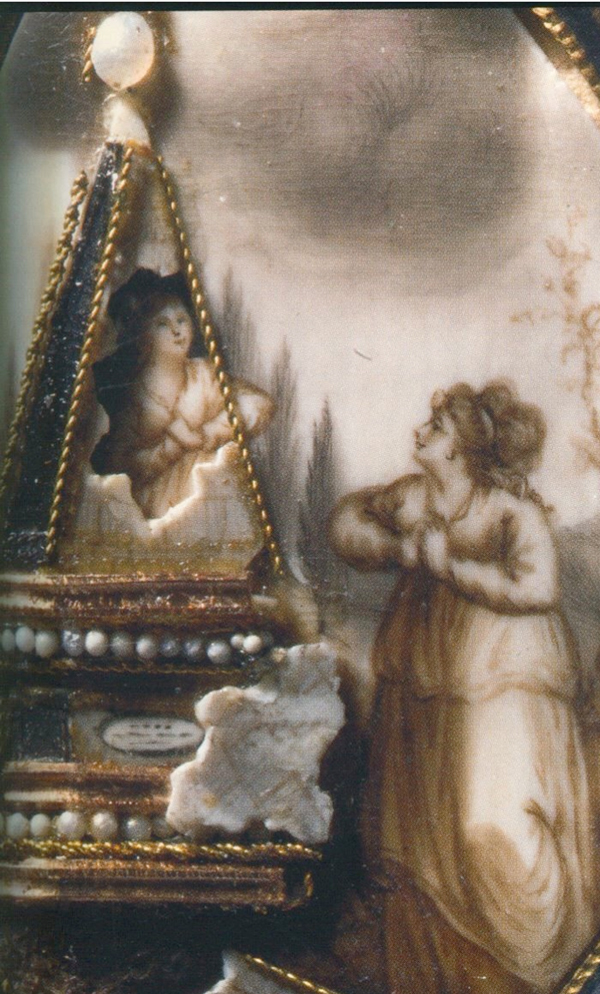
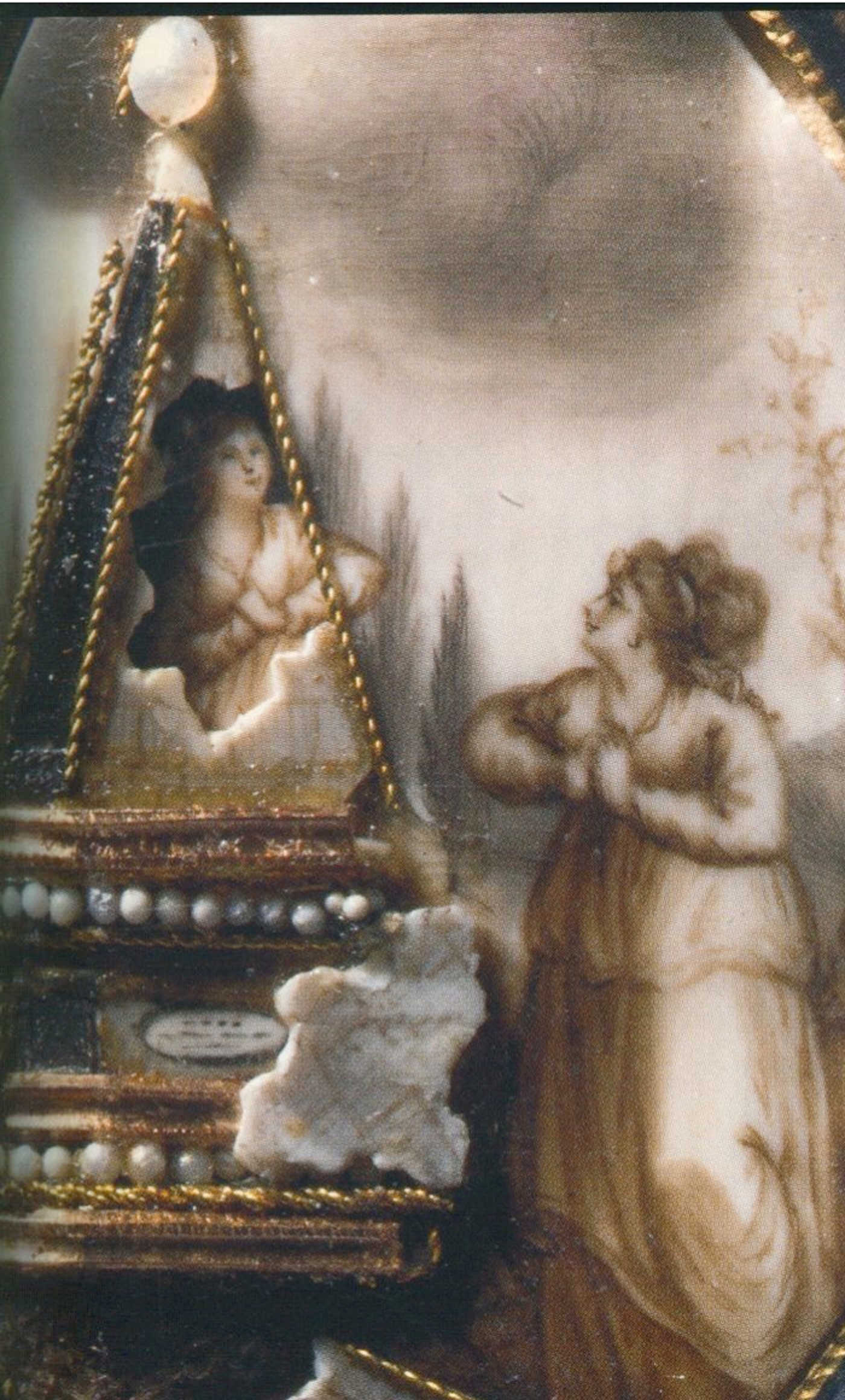
The belief that it was possible to do so also found expression in the material culture of upper-middle-class women. At the turn of the century some fashionable mourners commissioned jewelry that represented graveyard visitors experiencing the presence of the dead. At just over an inch in length, a mourning pin in memory of a nineteen-year-old woman captivates the viewer with a bold sense of movement and narrative (Figure 1). The dead woman bursts forth from her grave marker to greet her grieving mother; the artist even affixed a tiny piece of ivory broken off from the obelisk to show how eagerly the deceased wants to maintain contact with the living. Crafted in 1789, the pin includes chopped hair—presumably from the dead woman—in the paint. When the grieving mother wore the object, she kept close to her heart both the physical remains and the painted image of her daughter.Footnote 66 Similar designs also appeared on rings, brooches, and lockets.Footnote 67
Memorial for S. C. Washington, c.1789 (detail). Watercolor, chopped hair, gold wire, and pearls on ivory; 1 1/16” x 11/16.” Yale University Art Gallery.
The common practice of visiting the dead that these objects depicted was one of the factors that helped generate the rural cemetery movement, as mourners desired sites whose solemn beauty would reinforce the sensations of presence experienced there. Another important consideration was health concerns. In the early nineteenth century, most American men of science believed in the miasma theory of disease transmission, which held that rotting flesh and other organic matter released disease-bearing particles into the atmosphere. In other words: if something smelled bad, it was probably spreading disease. Officials in New York, Boston, and elsewhere therefore suspected that the foul odors emanating from crowded urban graveyards were to blame for epidemics of yellow fever and cholera in the 1820s. Rural cemeteries, with their spacious grounds located at a city's periphery, helped alleviate concerns of graveyards as vectors of disease.Footnote 68
Equally important, though, was the desire to create a place away from the urban maelstrom that would allow the living to commune with the dead. Proponents of rural cemeteries frequently cited this in their arguments. In an 1826 Boston News-Letter article, Abel Bowen advocated for a “delightful burying ground” outside the city. There, city residents could pass their “most pleasant and improving hours in ‘converse with the departed,’” visiting often to learn “the lesson of our own mortality; and, that, from those we love, even death itself cannot separate us.”Footnote 69 At the 1831 “consecration” of Mount Auburn, Judge Joseph Story made a similar argument for the intense relationship between living and dead that physical proximity to human remains facilitated: “As we sit down by their graves, we seem to hear the tones of their affection whispering in our ears. We listen to the voice of their wisdom, speaking in the depths of our souls . . . . We feel ourselves purer, and better, and wiser, for this communion with the dead.”Footnote 70 Likewise, in the Albany Evening Journal in 1840, a local resident urged his fellow citizens to create a rural cemetery. His arguments echoed those of Bowen and Story: “Indeed the dead seem almost to live again in their quiet, rural communities . . . . [These places] appear like the happy homes of friends with whose beatified spirits memory is permitted to commune.”Footnote 71 Both Judge Story and the Albany resident wrote that the dead “seem” present in cemeteries, hedging their bets as to whether the deceased's spirits were actually there.
But after Mount Auburn's founding, the already robust genre of graveyard poetry and prose exploded in American magazines, and most of these works insisted that the spirits of the dead were truly present in cemeteries. With titles such as “Our Parents Sleep There,” “My Mother,” and “My Mother's Grave,” poems and essays explored how burial grounds could help the living maintain relationships with the dead. As one man wrote in Godey's Magazine and Lady's Book, America's highest-circulation magazine in the 1840s:
The dead were not distant and unreachable but immediately present around their graves, insisted numerous poets. For example, an anonymous writer in the New-York Mirror describes a man standing beside his mother's grave. The speaker asks the dead woman, “Wilt thou not hover round my path, and bless thy suppliant child, / And guide me while I yet may roam the world's unfriendly wild?” He answers his own question definitively: “I know thou wilt!”Footnote 73
Considering only the poems and essays inspired by Philadelphia's rural cemetery, Laurel Hill, one finds dozens of examples in the late 1830s and 1840s, most asserting the site's religious power. These pieces appeared in outlets ranging from Mechanics’ Magazine to Godey's, from the working-class Subterranean to the Episcopal Recorder. Some of these poems and essays merely described a sense of religious solemnity in Laurel Hill, but many others insisted that communion with the dead took place there. Authors of the latter were certain that visitors to rural cemeteries could experience the presence of the dead. In one poem the speaker says that a person can interact with the spirits of the dead there: “Here may you sit, secluded from the world, / And commune with the shades.”Footnote 74 Another writer, taken by Laurel Hill's natural beauty, asks the reader why burial grounds are so gloomy. “Ought we not, rather, to inquire, how may the living be most pleasingly invited to hold communion with the dead?” The answer: go to a place of “delightful seclusion” like Laurel Hill.Footnote 75 No wonder that when an upper-middle-class tourist such as Sarah Brown Ruggles arrived in Philadelphia, she, like many others, “hired a carriage” and visited Laurel Hill.Footnote 76
In diaries such as Ruggles's, written by middle-class girls and women in the 1830s and 1840s, one finds evidence of intense graveyard encounters with suprahuman beings. Sometimes the presence of a loved one's corpse stimulated a powerful desire to connect with God. Three years before Ruggles visited Laurel Hill, she had experiences of a very different sort in her local graveyard after her husband died. In 1834 she wrote in her diary that she took “my children to visit their father's Grave, their father's Grave! . . . Oh how fervently, kneeling upon his ashes, did I pray for a resigned & submissive spirit!” Proximity to his remains intensified her desire to commune with God.
Adelia Lamb of Berlin, Connecticut, likewise found that graveyards helped connect her with the divine. In 1842, while visiting family in Brattleboro, Vermont, Lamb spent a day in the town's burial ground. She described the site as “a lofty and beautiful eminence overlooking a large portion of the village.” This was likely Prospect Hill: not a rural cemetery but a regular graveyard that opened in 1796. The presence of the “ashes of hundreds of children of earth” led Lamb into a religious reverie. As she reported in her diary, “I felt for a moment rivited [sic] to the spot, and a voice seemed to whisper to me, [‘]pause mortal! you stand here, a living, thinking soul among the silent dead. Yet but a few short fleeting years, perhaps days, at most and you will be added to the numbers that rest unconsciously beneath your feet.[’]” Lamb responded to God. “My Father why is it thus? I exclaimd. Again a voice seemd to say, ‘be still and know that I am God’ . . . My murmerings were hush'd and my heart responded ‘Thy will Oh God be done.’”Footnote 77 God was not audible to Lamb; his voice “seemed” to address her. Nonetheless, she experienced this as a powerful religious encounter.
In other graveyard visits, the suprahuman being was the spirit of the departed. Such was the case with Sarah Ruggles. Several months after her husband died, his remains—like a magnet—drew her again and again to the cemetery. This earned her a rebuke from her physician, who feared her grief endangered her health. But going to the graveyard allowed Ruggles to speak to her deceased husband. As she wrote, “unable to go to Church, but ride to the Burying Ground, with cousin Susan & my boy. There is a loadstone [sic] to draw me there, that I know not how to resist, tho the Dr. warns me to avoid it. Oh! my George, my husband! thy grave, thy grave!”Footnote 78 How could she resist, when a cemetery visit promised an experience of George's presence?
When the suprahuman being in a graveyard was the deceased's spirit, it could worry the mourner, raising concerns that her experience was heterodox. This was the situation with young Louisa Jane Trumbull, who thought she might have felt her deceased brother's presence at his funeral, but then reconsidered: “It snowed all day until Johnny's coffin, was let down into the ground, when the sun broke through the clouds, and everything looked beautifully. Perhaps it was Johnny's happy little spirit so bright.”Footnote 79 Trumbull evidently felt she should not believe that her brother's spirit was there in the graveyard to brighten the proceedings.
Others expressed no such ambivalence. In 1831, Eliza M. Spencer taught school in Sandisfield, in western Massachusetts. She was twenty-eight years old and engaged to Chauncey Hawley from Norfolk, Connecticut. Against all of Spencer's expectations, her fiancé sickened and died. Spencer never married, throwing herself into teaching, religion, and a lifelong interaction with Hawley's spirit and memory. She could not, however, visit his grave as often as she wished; Norfolk was a fifteen-mile horse ride from Sandisfield and required an overnight stay to make the trip worthwhile. Therefore, when she did visit Hawley's remains her experiences were especially powerful. A year after his death, she recorded one such visit in her diary: “Last Friday rode to N[orfolk] and Saturday went to visit the grave of C[hauncey].” She had little desire to join her friends in their ramble around diminutive Pond Town Cemetery. “While my companions wander from stone to stone, I felt irresistibly chained to one little spot. O how strong the tie that binds the mourner to the clods of the burial sod.” Lying on the ground above her lover's corpse, she thought of Jesus and Hawley: “While reclining upon the grave of my friend musing upon life's broken dreams, many, many a mournful sweet remembrance rushed upon my mind and I felt that I had at least one example which I was not afraid to follow, by indulging the swelling grief. ‘Jesus wept.’” Either while she lay atop his grave or when she returned home, she composed a poem addressed to his spirit:
As in a prayer to Jesus, the speaker in Spencer's poem addresses Hawley as “O spirit blest.” She has a “secret wish” for him to return, all inspired by his corpse.
The following year, Spencer made another Friday ride to Norfolk for a Saturday visit to the graveyard. This time she ditched her lighthearted companions. Again she lay on top of the grave, separated from Hawley's corpse by only a few feet of soil, and now she wrote explicitly about the impact of his presence: “The conscious proximity of that dear friend who slept beneath the turf on which I was reclining made everything seem familiar, and completely banished from my bosom that undefinable and unpleasant trepidation which almost invariably pervades it, when treading the soil ‘where human skulls are lodged below.’”Footnote 81 Here Spencer made a literary allusion worthy of a Massachusetts school mistress. The quotation is from a classic of the Graveyard School, James Hervey's “Contemplations on Night,” in a passage where Hervey gently chides those who fear ghosts but who do not fear God. If a school boy has to “cross the spot where human skulls are lodged below,” he “scarce touches the ground” as he speeds through the allegedly haunted acre.Footnote 82 The feeling that a graveyard might be haunted is what explains Spencer's “undefinable and unpleasant trepidation” when she entered a burial ground, even if she agreed with Hervey that one should pay more attention to God than ghosts. Ironically, it is the “conscious proximity” of her lover's corpse that brought her to that realization.
Another believer in the deceased as suprahuman beings was Adelia Lamb, who remained childless through her long marriage. She never lacked for family connections, though, maintaining close relations with siblings and parents, living and dead. For Lamb, a graveyard was a holy space for cultivating those relationships, the “blessed shrine” that the poet Felicia Hemans described. Lamb agreed with Eliza Spencer about the character of the typical burial ground: “if it is gloomy it is also sacred,” because it was a place to commune with the dead.Footnote 83
It was also sacred because it was a site of burial ad familiares. The Beckley (or Beckley Quarter) Cemetery in Berlin, Connecticut, is a small burial ground that by the 1830s held just shy of one hundred Beckley burials.Footnote 84 Adelia (Beckley) Lamb thus was surrounded by family when she visited the graveyard. As she noted one Sabbath evening in 1836 after a visit to the holy site, “We have just returned from the graveyard, the spot where all my fore-fathers are inter'd, the spot made dear and sacred, to me, by the remains of my dear Father, and two lovely brothers.” After her mother died two years later, she felt an even stronger connection to the spot. In March 1840, Lamb composed some reflections on the coming change of season. “Oh I long, for the sweet month of May that I may visit the sacred spot where repose the ashes of my Parents, and brothers.” The spot was “sacred” because her mother's departed spirit seemed to remain there, just above the grave. As she wrote after another Sabbath evening visit, “The grave of a Mother, oh! what a spot for a child to visit and reflect. Oh how many, many, thoughts of the past come home to my heart. I could linger all night by her side, it seemed as if her pure spirit was hovering around me while I sat weeping on the green turff.”Footnote 85
Like other believers in the deceased as suprahuman beings, Adelia Lamb was a pious Protestant. She may have been more open to religious experimentation than some of her contemporaries; her diary records attendance at Presbyterian, Baptist, and Unitarian services. But there is no evidence that she got her ideas about graveyard interactions with departed spirits from Emanuel Swedenborg, the source scholars usually cite for belief in communication with the dead.Footnote 86 Lamb never mentioned Swedenborg or his writings in her diary. Rather, a century of Graveyard School poetry, many decades of sentimental and Gothic literature, and a long history of popular belief in graveyards as sites of immanence had prepared the way for Adelia Lamb to think of Beckley Cemetery as a place where her mother's “pure spirit” seemed to hover around her.
III. Conclusion
Among early modern European Catholics, the dead were so present in people's physical and mental worlds that they formed, in one historian's words, “a kind of ‘age group’ to put alongside the children, the youth, the married, and the old.”Footnote 87 The Protestant Reformation was supposed to change all that. By abolishing purgatory and the veneration of saints, reformers sought to end relationships between the living and dead.Footnote 88 John Calvin and countless others worked tirelessly to get people to worship only the majestic, omnipotent Protestant God. Many scholars have insisted that Protestants were successful in this endeavor. As one recent, comprehensive history of the Reformation puts it, “Protestantism stripped religion of mediation and intimacy with the dead.”Footnote 89 Historians of early American Protestantism have reinforced this view; even works on death do not discuss relations with the dead. Other scholars, mostly historians of early modern England, have traced the continuing interest in the returned dead—that is, ghosts—among laypeople and some ministers through the eighteenth century.Footnote 90
The suprahuman beings who hovered around many nineteenth-century Protestants, however, were not ghosts. To use Samuel Johnson's eighteenth-century definition, a ghost was “a spirit appearing after death.”Footnote 91 Ghosts were visible, they often engaged in two-way communication with the living, and their unpredictable behavior frequently frightened people. By contrast, nineteenth-century mourners more often imagined suprahuman beings to be the souls of deceased loved ones, returned either as guardian angels or simply as disembodied spirits. They could not be seen, they did not answer questions, and they brought only comfort. Numerous mourners wished for their presence and sought out locations such as graveyards where they were most likely to be found. The bereaved communicated with the dead, telling them of their grief and their hopes for a reunion in heaven. When the Fox Sisters insisted in 1848 that they could communicate with the dead through a system of knocks and raps, the preexisting belief in suprahuman beings made their claim plausible to many and helped pave the way for hundreds of thousands—perhaps millions—to participate in séance Spiritualism by the end of the 1850s.Footnote 92 But before that, mourners demonstrated that antebellum Protestantism was a religion of presence when, like Anna Eliza Heath, they whispered to their deceased loved ones, “you are present with us tho’ invisible.”