Introduction
Until most recently, genera within the Graphidaceae with lirellate ascomata were distinguished based on ascospore pigment and septation (hyaline versus grey-brown, transversely septate versus muriform), as well as ascoma organization [solitary versus (pseudo-)stromatic] into eight genera: Graphis, Phaeographis, Graphina, Phaeographina, Glyphis, Medusulina, Sarcographa and Sarcographina (Zahlbruckner Reference Zahlbruckner1923; Wirth & Hale Reference Wirth and Hale1963, Reference Wirth and Hale1978). Staiger (Reference Staiger2002) challenged this highly artificial concept and provided new genus circumscriptions based on a combination of morphological, anatomical, and chemical features, distinguishing 22 genera. This concept was subsequently refined and tested with molecular data (Kalb et al. Reference Kalb, Staiger and Elix2004; Archer Reference Archer2006, Reference Archer2009; Staiger et al. Reference Staiger, Kalb and Grube2006; Lücking Reference Lücking2007; Lücking et al. Reference Lücking, Kalb, Staiger and Mcneill2007; Lücking & Rivas Plata Reference Lücking and Rivas Plata2008; Mangold et al. Reference Mangold, Martín, Lücking and Lumbsch2008). These studies confirmed many of the taxa proposed by Staiger (Reference Staiger2002) but challenged others, such as Graphis, which actually contains two unrelated lineages, and Hemithecium, which splits up into at least four separate lineages (Rivas Plata et al. Reference Rivas Plata, Hernández, Lücking, Staiger, Kalb and Cáceres2011). One species, Hemithecium plicosum (Meissn.) Lücking & Aptroot (syn. Graphina malmei Redinger), did not cluster with either Graphis or Hemithecium but fell within the clade containing Phaeographis and other grey-brown-spored genera (Rivas Plata et al. Reference Rivas Plata, Hernández, Lücking, Staiger, Kalb and Cáceres2011), even if its ascospores are persistently hyaline. This species (as Graphina malmei) was said to have uncertain affinities by Staiger (Reference Staiger2002), but was subsequently included in Hemithecium by Lücking et al. (Reference Lücking, Chaves, Sipman, Umaña and Aptroot2008).
Here, we present a more detailed study of the Phaeographis clade to elucidate the exact position of Hemithecium plicosum and, based on our findings, introduce the new genus Malmographina for this taxon.
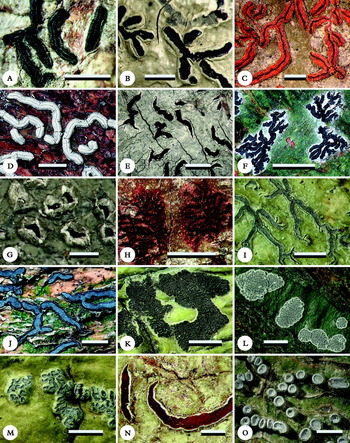
Taxa of the Phaeographis clade analyzed for this study. A, Halegrapha chimaera (holotype); B, Leiorreuma exaltatum (Dominica, Imshaug 32934); C, Malmographina plicosa (Peru, Rivas Plata FM-09); D, Pallidogramme chrysenteron (Costa Rica, Lücking 15287t); E, Phaeographis dendritica (Argentina, Ferraro s.n.); F, Phaeographis intricans (Costa Rica, Lücking 15252e); G, Phaeographis kalbii (Costa Rica, Trest 1584i); H, Phaeographis leprieurii (Brazil, Cáceres s.n.); I, Phaeographis scalpturata (Brazil, Cáceres 523); J, Platygramme caesiopruinosa (Costa Rica, Lücking 15060k); K, Sarcographa fenicis (Brazil, Cáceres 12); L, Sarcographa labyrinthica (Brazil, Cáceres 21); M, Sarcographina glyphiza (Philippines, Merrill 9045); N, Thecaria montagnei (Trinidad and Tobago, Imshaug 32437); O, Thecaria quassicola (Florida, Lücking 26626).

Material and Methods
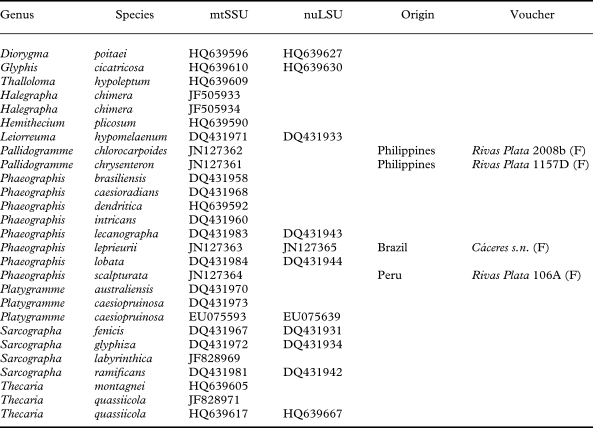
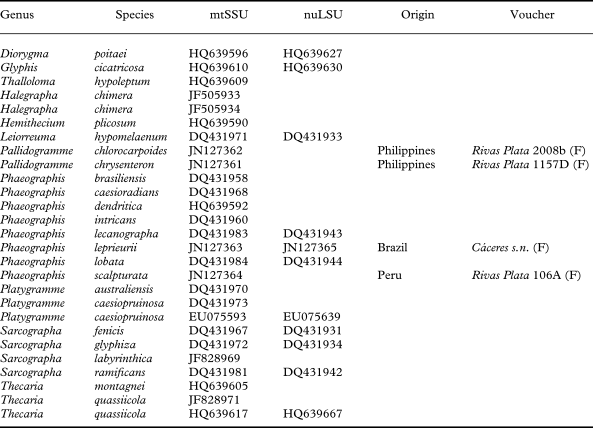
To elucidate the phylogenetic position of Hemithecium plicosum, we assembled a dataset consisting of the small subunit of the mitochondrial ribosomal DNA (mtSSU) and the large subunit of the nuclear ribosomal DNA (nuLSU) of selected species of the Phaeographis clade (Fig. 1), with Diorygma poitaei, Glyphis cicatricosa and Thalloloma hypoleptum as outgroup taxa (Table 1). Most sequences were downloaded from Genbank, but five sequences (see Table 1) were newly generated following the protocol outlined in Rivas Plata et al. (Reference Rivas Plata, Hernández, Lücking, Staiger, Kalb and Cáceres2011). The sequences were aligned using MAFFT (Katoh & Toh Reference Katoh and Toh2005) and the alignment was subjected to maximum likelihood search using RAxML 7.2.6 (Stamatakis et al. Reference Stamatakis, Ludwig and Meier2005; Stamatakis Reference Stamatakis2006), with parametric bootstrapping using 1000 replicates under the GTRGAMMA model.
GenBank accession numbers and voucher information (for newly generated sequences) for taxa used in this study.
Malmographina Cáceres, Rivas Plata & Lücking gen. nov
MycoBank No: MB 563384
Genus novum familiae Graphidacearum. Thallus laevigatus, viridis. Lirellae proeminentes, striatae, aurantiacae. Excipulum crenatum, non-carbonizatum. Hymenium non inspersum. Ascosporae muriformes, hyalinae, leviter amyloideae. Acidi lichenum desunt sed lirellae antraquinonae continentes.
Typus: Malmographina plicosa (Meissn.) Cáceres, Rivas Plata & Lücking, comb. nov. [Mycobank MB 563385].— Opegrapha plicosa Meissn., Bot. Zeitung 13: 422 (1855);—Hemithecium plicosum (Meissn.) Lücking & Aptroot, Fieldiana, Botany 46: 65 (2008); lectotype (fide Lücking et al. Reference Lücking, Chaves, Sipman, Umaña and Aptroot2008: 65): Surinam, Kegel 1419 (L!). = Graphina malmei Redinger, Ark. Bot. 26A(1): 49 (1933) [holotypus—Brazil, Malme 3508 (S!)].
(Fig. 1C)
Thallus smooth, olive-green (becoming yellowish in the herbarium), in section with dense, prosoplectenchymatous cortex and irregular photobiont layer intermingled with scattered clusters of calcium-oxalate crystals.
Lirellae erumpent to prominent, finely but distinctly striate, with orange to cinnabar-red pigment. Disc concealed. Excipulum distinctly crenate, orange-brown and becoming dark brown to carbonized in inner apical parts; old, compressed layers of hymenia between the excipular striae becoming dark brown to almost carbonized as well. Hymenium clear; epithecium with clusters of dark brown to blackish granules. Ascospores muriform, hyaline, non-amyloid.
Chemistry. No lichen substances detected in the thallus but lirellae with anthraquinones (tetrahydroxyanthrachinon-1,3,6,8 and other, unidentified pigments). For a more detailed description, see Staiger (Reference Staiger2002: 452, as Graphina malmei).
Notes. Staiger (Reference Staiger2002) discussed the systematic position of Graphina malmei as uncertain. Lücking et al. (Reference Lücking, Chaves, Sipman, Umaña and Aptroot2008) subsequently found an earlier name for this species, Opegrapha plicosa Meissn., and proposed the combination Hemithecium plicosum (syn. Graphina malmei), because of the prominent lirellae with well-developed labia and uncarbonized excipulum, and the hyaline ascospores. In a molecular phylogenetic analysis, however, Hemithecium was shown to be polyphyletic: one group including H. implicatum (Fée) Staiger clustered with Graphis Adans. s. str., another group including H. chlorocarpum (Fée) Trevis. clustered with Allographa Chevall., a segregate of Graphis, while H. rufopallidum (Vain.) Staiger and H. plicosum formed separate lineages (Rivas Plata et al. Reference Rivas Plata, Hernández, Lücking, Staiger, Kalb and Cáceres2011). Surprisingly, in spite of the hyaline ascospores, Hemithecium plicosum fell within a clade formed by Phaeographis and allied genera, all characterized by grey-brown ascospores and a usually inspersed hymenium with inspersion of the Phaeographis type (Lücking Reference Lücking2009). Within that clade, Hemithecium plicosum is morphologically most similar to species of Pallidogramme, which also have Hemithecium-like, prominent, striate lirellae (and were included in Hemithecium by Staiger Reference Staiger2002) but differ in the grey-brown ascospores and usually inspersed hymenium (Staiger Reference Staiger2002; Lücking et al. Reference Lücking, Chaves, Sipman, Umaña and Aptroot2008).
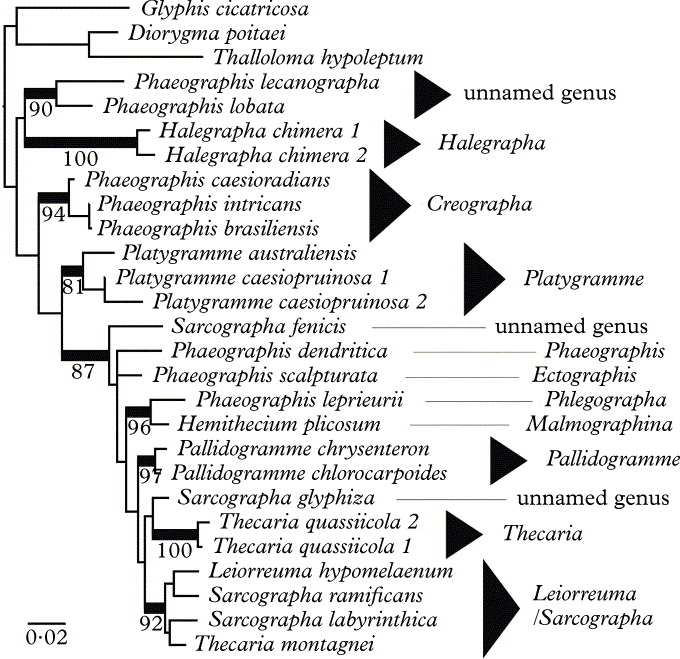
Our emended phylogenetic analysis of the Phaeographis clade (Fig. 2), although preliminary since only few species of this clade have been sequenced so far, confirms several of the genera distinguished by Staiger (Reference Staiger2002) and in subsequent studies (Lücking et al. Reference Lücking, Chaves, Sipman, Umaña and Aptroot2008, Reference Lücking, Rivas Plata, Kalb, Common, Barcenas Peña and Duya2011), such as Halegrapha, Pallidogramme, Platygramme, and Thecaria s. str., as independent, monophyletic lineages. Phaeographis as circumscribed by Staiger (Reference Staiger2002) is polyphyletic and forms several clades that are morphologically well distinguished: the P. lecanographa clade with Chapsa-like ascomata, the P. intricans clade (Creographa) with pseudostromatic ascomata and clear hymenium, the P. leprieurii clade (Phlegographa) including Glyphis-like species with nearly stromatic, heavily carbonized ascomata, the P. scalpturata clade (Ectographis) which contains the bulk of corticate species with pruinose disc, and Phaeographis s. str., a small clade characterized by ecorticate, whitish thalli and ascomata with chocolate-brown disc. Other oddball taxa within the Phaeographis clade also form separate lineages: Sarcographa fenicis with completely flattened, stromatic ascomata, Sarcographa glyphiza, whose generic position has been unclear, and Hemithecium plicosum, for which the new genus Malmographina is established here. The phylogeny also suggests that Leiorreuma and Sarcographa should be merged, but must await molecular analysis of the type species of Sarcographa, S. cinchonarum, before further conclusions can be drawn, as this species differs from the bulk of Sarcographa species centred around the common S. labyrinthica. It should also be noted that Thecaria montagnei clusters with the Leiorreuma-Sarcographa clade and not with T. quassiicola. This is not surprising as T. quassiicola is a morphologically unique species somewhat resembling Glyphis scyphulifera, whereas T. montagnei is very similar to Leiorreuma species except for the muriform ascospores and pigmented disc and hymenium.
Phylogeny of the Phaeographis clade derived by RAxML maximum likelihood analysis of a combined mtSSU-nuLSU dataset, using Diorygma poitaei, Glyphis cicatricosa, and Thalloloma hypoleptum as outgroup. Numbers below branches indicate bootstrap values.
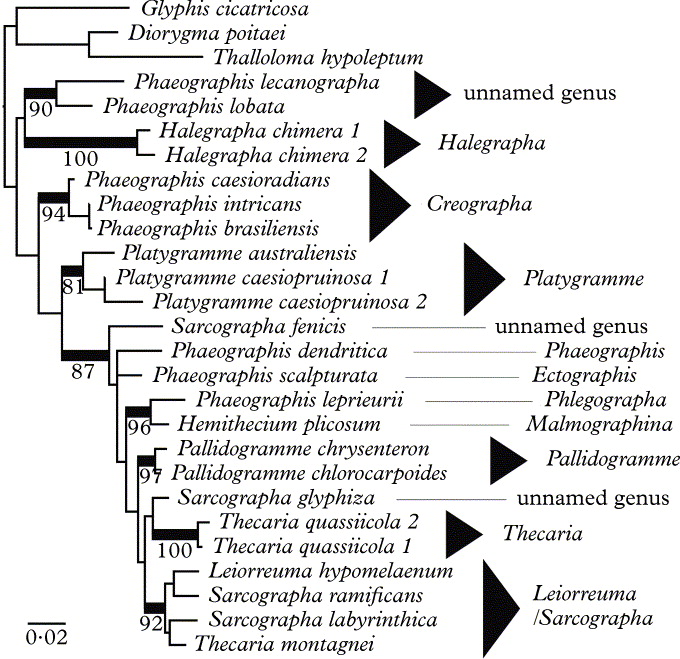
Based on our results, it is appropriate to introduce a new genus, Malmographina, for Opegrapha plicosa (syn. Graphina malmei). Malmographina is distinguished from all other genera of Graphidaceae by the combination of Hemithecium-like (prominent, striate, uncarbonized) but pigmented lirellae, a clear hymenium, and hyaline, non-amyloid ascospores. Critical revision of the characters found in Malmographina suggests that the placement within the clade including Phaeographis and allied genera might not be that surprising after all. Lack of inspersion is found in a few lineages within this clade, including the Phaeographis intricans group and even a species of Pallidogramme, P. chapadana (Redinger) Staiger, Kalb & Lücking (Staiger Reference Staiger2002). In species of Phaeographis and other genera with large, muriform ascospores, the ascospores often remain hyaline for a long time but eventually become at least pale grey-brown. In species of Pallidogramme with striate excipulum, such as P. chrysenteron (Mont.) Staiger, Kalb & Lücking, mature ascospores become light gold-brown but the compressed, old hymenia between the excipular striae become very dark brown due to heavy pigmentation of collapsed, dead ascospores (Staiger Reference Staiger2002). We can therefore assume that Malmographina plicosa, which also shows heavy dark brown pigmentation of compressed old hymenia, has the potential to produce ascospore pigment but this only becomes expressed in postmature, collapsed and dead ascospores within excipular remnants. This is supported by the lack of iodine reaction of the ascospores which is more similar to that found in Phaeographis and allies than that typical of Graphis and Hemithecium.
Malmographina plicosa appears to be restricted to the Amazon basin. It is thus far known from Surinam (type of Opegrapha plicosa), Amazonian Peru (several collections from Madre de Dios province by Rivas Plata), Amazonian Brazil (several collections from Rondônia by Cáceres), and adjacent Mato Grosso (the type of Graphina malmei and collections made by Kalb). It prefers semi-exposed to exposed microsites mostly on bark of larger trees, where it can be found associated with other lichens having similar preferences, such as Glyphis spp., Phaeographis spp., and Trypetheliaceae.
The first author thanks CNPq – Conselho Nacional de Desenvolvimento Científico e Tecnológico (Edital Universal 2007 process no. 481884/2007-6 ) for supporting the study of crustose lichens in the Amazon and the Atlantic rain forest. This study was otherwise made possible by three grants provided by the United States National Science Foundation (NSF) to The Field Museum: “Phylogeny and Taxonomy of Ostropalean Fungi” (DEB 0516116; PI Lumbsch, Co-PI Lücking); “Neotropical Epiphytic Microlichens” (DEB 0715660; PI Lücking); and “ATM – Assembling a taxonomic monograph: The lichen family Graphidaceae” (DEB 1025861; PI Lumbsch, Co-PI Lücking).