

1. Introduction
How can governments credibly commit to sustainable fiscal policies? Taxation and spending patterns that are sustainable can be time-inconsistent (Kydland and Prescott, Reference Kydland and Prescott1977). Anticipating this, individuals may rationally respond in ways that harm both public finance and private economic activity. Governments must signal an intent to pursue sustainable patterns and be able to credibly commit to them (Chari et al., Reference Chari, Kehoe, Prescott and Barro1989).
In this context, the lack of a third-party enforcer is problematic (Aguiar and Amador, Reference Aguiar, Amador, Gopinath, Helpman and Rogoff2014). Creditors’ last resort for enforcement is government. When supplying funds to government, that last resort is the debtor itself. This necessitates commitments at the constitutional level. By a constitution we mean the framework of rules constraining policymakers and other political agents. We employ data from 19th-century US states to estimate the role of constitutional design in making those commitments credible.
Constitutions can include constraints both de jure (i.e. legally codified) and de facto (i.e. implied by agents’ incentives). As an example of the latter, North and Weingast (Reference North and Weingast1989) argue that the Glorious Revolution shifted the balance of power away from the English crown and toward Parliament, decreasing the probability of default and repudiation.Footnote 1 This shift was embodied in political bargains between Parliament and William of Orange.Footnote 2 Those bargains were self-enforcing, because holders of wealth were heavily represented within Parliament.Footnote 3 This provided Parliament with incentives and means to check the monarch.
Codification can also play a role in making constraints binding. It can provide “a focal solution … so that citizens gain the ability to act in concert and police their government” (Weingast, Reference Weingast2005: 105; also Weingast, Reference Weingast1997).Footnote 4 This makes collective action against transgressions less costly. Codification may involve pre-existing conventions or novel elements around which citizens can coordinate.Footnote 5 Both cases suggest that constitutional design can play a role in achieving sustainable fiscal policy. Consistent with this, Dove (Reference Dove2012) finds that 19th-century US states that adopted fiscal amendments faced lower borrowing costs. Beach (Reference Beach2017) finds a similar effect for reforming states that previously defaulted.Footnote 6
Along with Dove (Reference Dove2012) and Beach (Reference Beach2017), we study constitutional design (a concept meaningful only for de jure elements). While there is an extensive theoretical literature on constitutional design – see Ginsburg (Reference Ginsburg, Farber and O'Connell2010b) – the empirical literature relating it to economic outcomes is modest. Most studies focus on specific constitutional rules.Footnote 7 Studies linking those rules to government size and deficits are relevant to our present work. For example, parliamentary forms of government have been linked to higher expenditures and deficits (Blume et al., Reference Blume, Müller and Voigt2009; Persson and Tabellini, Reference Persson and Tabellini2003, Reference Persson and Tabellini2004).Footnote 8
Rather than specific rules, we estimate the effect of general dimensions of constitutional design on the likelihood of default. Two alternative models of constitutional design – entrenched/spare versus unentrenched/specific – motivate our choice of dimensions considered (Versteeg and Zackin, Reference Versteeg and Zackin2016).
The entrenched/spare model of constitutional design suggests that good governance arises within a framework of relatively few, widely agreed-to, durable constraints (Buchanan and Tullock, Reference Buchanan and Tullock1962). Political agents have leeway to pursue protective and productive governance, but not predation and redistribution (Buchanan, Reference Buchanan1975). As Versteeg and Zackin (Reference Versteeg and Zackin2016: 658) observe:
Entrenched constitutions are typically constructed as spare frameworks, rather than detailed policy directives, since highly specific documents are unlikely to remain relevant over long time horizons (Hammons Reference Hammons1999). As a result, along with rigidity, “generality and abstraction” are also widely considered to be defining features of written constitutions (Marmor 2007, 91–4).Footnote 9
Alternatively, in the unentrenched/specific model the constitution aims at “limiting the latitude within which agents operate (through specificity) and relaxing the rigidity of the constitutional boundaries (increasing flexibility) to accommodate … increased scope and detail” (Versteeg and Zackin, Reference Versteeg and Zackin2016: 658).
The entrenched versus unentrenched and spare versus specific dimensions are, on the one hand, distinct. (Many specific provisions can be entrenched; alternatively, spare frameworks can be frequently revised.) On the other hand, they are related. A spare constitution is more likely to be entrenched than a specific one for two reasons. First, a spare constitution includes relatively few, widely agreed-to constraints. Wide agreement implies, all else equal, a low likelihood that citizens subsequently demand amendment/replacement.Footnote 10 Second, highly detailed provisions are more likely to become unsuitable over time with changing circumstances.Footnote 11
These models offer different solutions to the same principal–agent problem (Versteeg and Zackin, Reference Versteeg and Zackin2016: 658). The unentrenched/specific model allows the governed to provide political agents with “ongoing constitutional micromanagement” (p. 660); this through numerous, specific directives that change frequently in response to the changing circumstances. Alternatively, the entrenched/spare model is concerned primarily with preventing political agents from amending a constitution in their own interests (Aghion and Bolton, Reference Aghion and Bolton2003; Buchanan and Tullock, Reference Buchanan and Tullock1962; Ginsburg and Posner, Reference Ginsburg and Posner2010; Persson et al., Reference Persson, Roland and Tabellini1997). A fundamental tradeoff is between costs of agents capturing the rules and benefits of principals having greater use of the rules.
Both models have implications for the ability of a government to credibly commit to some goal (e.g. sustainable fiscal policy). On the one hand, the governed may issue directives that fail to constrain political agents’ actions toward the goal. Priors may then need to be updated and new directives issued; these may be effective or may themselves have to be revisited, etc. In that case, being able to “micromanage” the constitution may be essential. On the other hand, micromanagement (flexibility) invites time-inconsistency. Without strong and durable rules, political agents may have incentives to renege on long-run commitments to obtain short-run gains.
These tradeoffs are evident in the debates of the 1787 US Constitutional Convention. The Madisonian view was one of creating a loose and broad framework that would endure through future governments. Alternatively, the Jeffersonian view favored shorter-lived rules that would grant future generations (who had no say in the original document) more autonomy over governance. The Madisonian view ultimately won the day and constitutional economists today emphasize the importance of entrenchment. However, most constitutions actually last less than 20 years (Elkins et al., Reference Elkins and Ginsburg2009).Footnote 12
In this paper, we estimate the extent to which an entrenched/spare constitution increases a government's ability to make credible commitments. In the 19th century, US state governments faced debt crises rooted in ill-advised fiscal policies. We employ 1841–1884 (the years of actual defaults) panel data to estimate the roles of constitutional entrenchment and specificity on the likelihood of default.
We contribute to the small literature on empirical links between constitutional design and economic outcomes. Montenegro (Reference Montenegro1995) argues that the length (specificity) of a country's constitution reflects individuals’ distrust of political agents; he finds that length is negatively related to GDP per capita.Footnote 13 Tsebelis and Nardi (Reference Tsebelis and Nardi2016) also report that longer constitutions are associated with lower per capita GDP and also higher levels of corruption in OECD countries. Tsebelis (Reference Tsebelis2017) corroborates this for a larger sample of countries. To our knowledge, we are the first to estimate the effect of constitutional design on government default.
We proceed as follows. Section 2 discusses the political economy of government debt. Section 3 provides a historical backdrop to 19th-century US states. Section 4 describes the data and empirical model. Results are in section 5. Section 6 concludes.
2. Debt and default; commitment and credibility
We are concerned with constitutional design and its relationship to a government's commitments to time-consistent policies (Frye, Reference Frye2004; Frye and Shleifer, Reference Frye and Shleifer1997; Kydland and Prescott, Reference Kydland and Prescott1977; North, Reference North1991; North and Weingast, Reference North and Weingast1989; Weingast, Reference Weingast1993, Reference Weingast1995). Time-consistency describes a situation where an agent has incentives to commit to certain future actions and no incentives to renege when that future arrives. (Otherwise, there is time-inconsistency.)
The issue of time-consistency is important because a society can benefit from sustainable debt policies. A government presently committing to sustainable policies may find, viewed from a future decision-making point, that it has incentives to renege. Prescott (Reference Prescott1977) provides the example of a government that can finance a decrease in distortionary taxes by defaulting. Given the cost of defaulting on existing debt, the government may find it desirable to default and cut taxes. However, if creditors anticipate default, then issuing the debt in the first place will be costlier. In the long run, a no-default policy is better.
How does a government achieve time-consistent fiscal policy? Scholars have offered possible solutions, including reliance on a government's reputation, the creation of political institutions characterized by multiple veto points, and delegation of authority via bureaucracies (Stasavage, Reference Stasavage2002). Establishing an effective reputation through repeated interactions is unlikely (Bulow and Rogoff, Reference Bulow and Rogoff1989). Alternatively, North and Weingast (Reference North and Weingast1989) argue that, following the Glorious Revolution, Parliament's control of the fisc and the Bank of England's establishment provided credible commitments to property rights and sustainable fiscal policies. This involved both political institutions and bureaucratic delegation.
We focus on dimensions of constitutional design (entrenchment and specificity). These fit within the political institutions category. Constitutions define the institutions through which governance is provided (Ginsburg, Reference Ginsburg, Sajo and Utz2010a: 70). These institutions embody the relevant veto points in the processes of determining how governance is provided. The explicit constraints that are enumerated in a constitution are also, in and of themselves, political institutions.
Entrenchment and specificity are too general to be indicative of specific veto points. Yet they do speak to what sort of solutions are applied generally to agency problems between the governed and political agents. Our prior is that the entrenched/spare model is more conducive to credible commitments. First, the veto points defined by a constitution are more meaningful when entrenched. Demonstrated durability makes the implicit constraints more credible.
Second, the entrenched/spare model favors relatively few, widely agreed-to and durable constraints. These tend to be more credible than a larger number of frequently revisited/revised constraints. Credibility arises from durability – the expectation that a constraint will remain in effect tomorrow as well as today. In turn, to the extent that a constraint is widely agreed-to, it is likely to be durable. Alternatively, an unentrenched/specific constitution may allow for greater opportunity to tailor constraints but the resulting constraints will be less credible.
Entrenchment and specificity can be relevant to credibility regarding government debt specifically; even if a constitution does not specifically address debt. This is because of reputational effects. Notwithstanding Bulow and Rogoff (Reference Bulow and Rogoff1989), once credibility is established in a specific range of commitments, it can foster a reputation for credibility generally.
Alternatively, Versteeg and Zackin (Reference Versteeg and Zackin2016: 664–665) actually point to 19th-century US states as evidence that the unentrenched/specific model is conducive to credible commitments.
The original impetus to include detailed policy instructions in state constitutions is often traced to the economic crisis of 1839, which revealed the fiscal blunders that many state legislatures had made, and motivated a wave of constitutional change designed to prevent legislatures from repeating these mistakes[.]
Dove's (Reference Dove2012) work does suggest that specific constitutional amendments lowered borrowing costs. Our take from this is twofold. First, the question of which model is more conducive to credible commitments is empirical. Second, it is critical to control for specific amendments regarding debt.
Standard models of government debt suggest additional variables to control for in our analysis.Footnote 14 First, these models predict that governments borrow during economic stagnation and repay during expansion. When there is uncertainty about economic conditions, however, an unexpected sequence of negative shocks can lead to default. Models incorporating uncertainty predict countercyclical defaults (Aguiar and Gopinath, Reference Aguiar and Gopinath2006; Rochet, Reference Rochet2006). As such, we control for recessions.
Relatedly, Eaton and Gersovitz (Reference Eaton and Gersovitz1981) provide a model where economic volatility is a determinant of default. The qualitative prediction of their model is ambiguous.Footnote 15 Still, controlling for volatility is desirable. The recession control helps. However, in lieu of good 19th-century US state-level data on volatility, we also control for agricultural employment and urban population shares. Given common macroeconomic shocks, these variables can help account for variation in cross-state volatility (e.g. a larger agricultural sector is likely to be associated with greater volatility).
We also control for existing debt levels. If a government borrows excessively, small shocks can lead to default (Panizza et al., Reference Panizza, Sturzenegger and Zettelmeyer2009: 669). Consistent with this, studies typically report a positive relationship between debt and default (Panizza et al., Reference Panizza, Sturzenegger and Zettelmeyer2009: 670; studies cited in footnote 28).Footnote 16
Standard models of government debt suggest factors that can, for political agents, increase the perceived short-run benefits and/or costs of issuing excessive debt and/or defaulting on existing debt. These benefits and costs are weighed against the long-run benefits of access to more and/or cheaper credit. Alternatively, the long-run benefits stem from creditors not anticipating the excessive debt and default; so they are increased by credible government commitments. Holding other factors from models of government debt constant, we then expect an entrenched/spare constitution to lower the likelihood of default.
3. Historical background
Nineteenth-century US state governments sought to finance public works (dubbed “internal improvements”) and investments in private banks (Wallis and Weingast, Reference Wallis, Weingast, Garrett, Graddy and Jackson2008). New York led the way, having made bank investments that by the 1820s generated dividend payments of more than $100,000 annually (Wallis et al., Reference Wallis, Sylla and Grinath2004). It also financed construction of the Erie Canal through a policy of “taxless finance”: borrowing and then using premium sales to pay interest due (Wallis, Reference Wallis2005).Footnote 17 The rationale was that an investment or improvement would create a dividend or revenue stream to cover servicing and repayment. In the best case, the dividends/revenue could actually reduce future tax burdens.
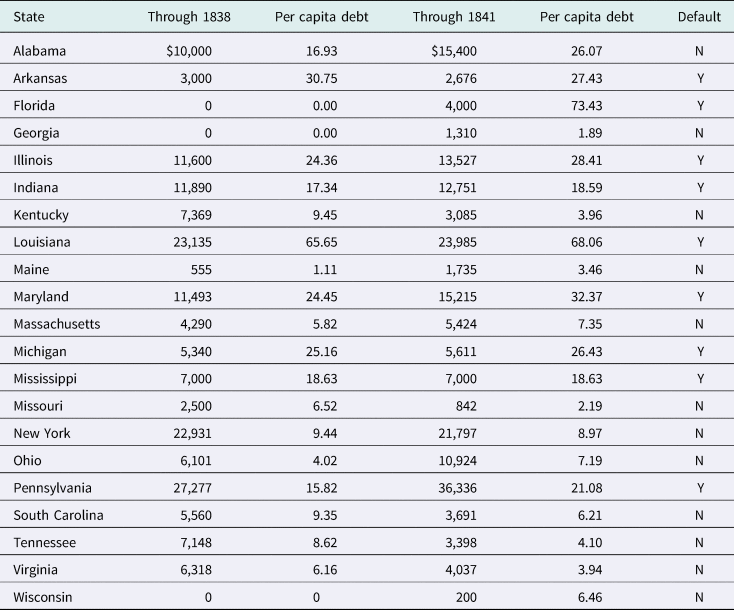
States in the Midwest were especially active in canal and railroad investments; states in the South invested more heavily in banking. Table 1 reports states’ outstanding debts through 1838 and then 1841. Large increases are evident in many cases.

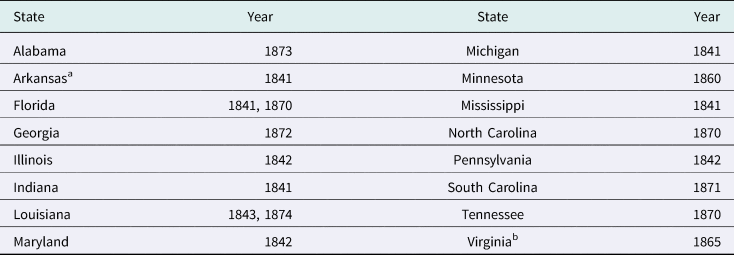
Taxless finance appeared effective during good times. However, the Panic of 1839 culminated in debt crises for many states (Wallis, Reference Wallis2001). Many completed projects and investments failed to generate revenues; those that did fell short of servicing debts. Furthermore, many uncompleted projects were abandoned. This left many states unable to meet outstanding obligations. When they turned to taxation, citizens often called for default and/or repudiation. Eight states and one territory ultimately defaulted; five of them partially or fully repudiated. Table 2 lists the years of default for both the antebellum period and the Reconstruction period (discussed below).
List of defaults by State

Sources: Ratchford (Reference Ratchford1941); McGrane (Reference McGrane1935); Scott (1898).
aArkansas defaulted on a series of bonds in 1841, with final settlement over those bonds resulting in repudiation in 1884.
bThe Virginia debt question resulted from the creation of West Virginia in 1863. Virginia claimed that West Virginia was responsible for one-third of all outstanding debt, which West Virginia disputed. This resulted in the non-payment of this disputed debt until the issue was settled in 1902.
In the aftermath, there were numerous attempts to impose constraints on fiscal irresponsibility. These included the expansion of general incorporation and free banking laws; also, popularly elected judiciaries with shortened terms.Footnote 18 Many states adopted constitutional amendments in order to commit to sustainable debts. These included prohibitions on a government lending its credit on behalf of private interests and purchasing stock; and also included debt limits.Footnote 19
A second bout of defaults came following the Civil War. Southern states were in dire straits both economically and politically. State coffers were nearly empty and total property values had plummeted from roughly $4.4 billion before the war to $1.6 billion (Ratchford, Reference Ratchford1941). State governments struggled to provide basic services and repair infrastructure.
Politically, states grappled with how best to reintegrate with the Union. Processes were laid out in both Presidential and Congressional Reconstruction plans, each with different readmission requirements. Although the 1865 Presidential Reconstruction initially readmitted of a number of states, Congressional Reconstruction (Act of March 2, 1867) resulted in all Southern states falling under military rule until they met its requirements. As a result, Republicans increasingly came to dominate the political landscape. Several Southern states held constitutional conventions to address the requirements. These included ratification of the 14th Amendment to the US Constitution and repudiation of Confederate war debt.
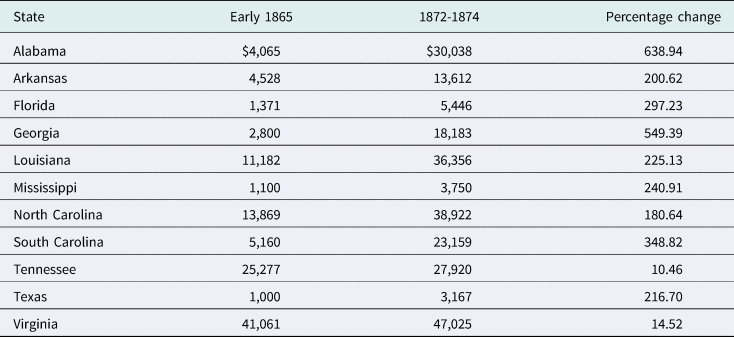
During Reconstruction, an important concern was revitalization of the Southern economy. Many believed that railroad development was critical. Many also believed that private financing (especially from Northern financiers) would be insufficient. The predominant view was that funding by the states would be necessary (Summers, Reference Summers1984). Between 1865 and 1867, state funding and other assistance to private railroad projects were enacted. For example, Alabama passed legislation granting $12,000 in state aid (which was subsequently increased to $16,000) per mile of track laid after 20 miles of line had been completed (Summers, Reference Summers1984). Georgia pursued a similar policy; other states provided substantial tax incentives and land grants. Many new Southern constitutions included explicit stipulations for aid to railroads.Footnote 20 Ultimately, Southern state indebtedness increased markedly (Table 3).
Southern state debts through reconstruction

Support for these policies began to wane in the 1870s (Dobbin, Reference Dobbin1994) and then came the Panic of 1873. There was a banking panic and a rash of railroad failures. In 1871 three railroads entered receivership; 12 in 1872 and then another 35 followed in 1873; by 1874 nearly 25% of all railroads had defaulted (Swain, Reference Swain1898). Nearly every Southern state over this period defaulted and repudiated a portion of its debts (Summers, Reference Summers1984).
As in the case of antebellum defaults, political backlash subsequently led to attempts to constrain state governments from unsustainable policies, including constitutional amendments.
4. Data and model specification
We employ 1841–1884 annual data from US states. Our dependent variable is an indicator of whether a state was actively in default (1 if yes; 0 otherwise). This information comes from several sources including Ratchford (Reference Ratchford1941), McGrane (Reference McGrane1935), and Scott (Reference Scott1893). Our controls of primary interest are measures of constitutional entrenchment and specificity. These variables are drawn from Versteeg and Zackin (Reference Versteeg and Zackin2016).
Entrenchment is measured as the number of years that a given polity (in this case a state) has existed divided by the number of years that the polity experienced a constitutional change (either amendment or replacement). This entrenchment measure is an imperfect one. We employ it to indicate the strength and durability of constraints on political agents. This is consistent with Versteeg and Zackin's (Reference Versteeg and Zackin2016: 657) conceptualization of the term: “establishing constraints durable enough to bind across generations.” While the measure directly speaks to the durability of de jure provisions, we are left to assume that those provisions de facto bind. However, de jure provisions can fall passively into disuse and/or be superseded actively by convention (Albert, Reference Albert2014). Whether or not a durable constitutional document corresponds to an entrenched de facto constitution is not always clear.
Notwithstanding the above, a preferable measure of de facto constitutional entrenchment is unavailable. Also, a large number of scholars have sought to account for variation in the amendment rates of de jure constitutions. Their work is of interest because amendment rates have been linked to important economic outcomes (Tsebelis, Reference Tsebelis2017; Tsebelis and Nardi, Reference Tsebelis and Nardi2016). Furthermore, recent work suggests that culture, rather than de jure amendment procedures, accounts for a large part of their variation (Ginsburg and Melton, Reference Ginsburg and Melton2015; Tarabar and Young, Reference Tarabar and Young2019).Footnote 21 This work is based on cross-country comparisons. Given the relative cultural homogeneity across US states, it is likely that variation in de jure constitutional change largely reflects de facto change. Still, controlling for other determinants of default that may be correlated with de facto entrenchment is important.
In certain cases, observations for the entrenchment measure were missing from the Versteeg and Zackin data. We have filled in these observations using both the National Bureau of Economic Research (NBER) State Constitutions Database and hand collection from state constitutions (where the NBER data were incomplete).Footnote 22 Thus, the current study employs two separate entrenchment series: the original from Versteeg and Zackin (Reference Versteeg and Zackin2016) and our own expanded set.
Along with these measures, we use the specificity, scope, and detail measures from Versteeg and Zackin (Reference Versteeg and Zackin2016). These are important to consider because another criticism of the entrenchment measure is that it is measured as an outcome and only imperfectly reflects features of constitutional design. Indeed, Ginsburg and Melton (Reference Ginsburg and Melton2015) and Tarabar and Young (Reference Tarabar and Young2019) imply that this outcome may be a function of both the supply side (constitutional design) and the demand for constitutional changes. Alternatively, the specificity, scope, and detail measures are straightforward characteristics of a constitution's design.Footnote 23
Constitutional specificity is measured as the total number of words in a state's constitution. However, specificity is a less straightforward concept than entrenchment. In the context of the unentrenched/spare model, it indicates a “relaxing [of] the rigidity of the constitutional boundaries (increasing flexibility) to accommodate … increased scope and detail” (Versteeg and Zackin, Reference Versteeg and Zackin2016: 658). The total number of words is likely a meaningful indicator of both scope and detail. However, we also employ separate measures. Scope is the total number of unique words in a constitution and is meant to capture the breadth of topics covered. Detail is the total word count divided by the total number of unique words; it aims to capture the extent to which particular topics are discussed (see Versteeg and Zackin, Reference Versteeg and Zackin2016: 661).Footnote 24
Given the nature of these data, we employ a probit model:

where i = 1, 2 …, 33 and t = 1841, 1801 …, 1884; ConScore it represents a constitutional design measure; $Z_{it}^{\prime}$ represents a vector of other factors that might influence the likelihood of default; and μ t is a set of year dummies.Footnote 25
In some specifications, we employ lagged (t – 1, t – 5, or t – 10) rather than contemporaneous values of constitutional design variables. This is for two reasons. First, an amendment or replacement can change the contemporaneous values of these variables meaningfully. The contemporaneous value, therefore, may not always be indicative of a state's recent constitutional history; the lagged value may be more relevant for the contemporaneous probability of default.
Second, endogeneity is a concern. Bias could arise from reverse causality. During the time period studied here, state constitutional reforms were often a reaction to default. It is important, then, to explore whether a state's recent constitutional history – not including contemporaneous events caused directly by fiscal developments – is significantly related to default. We find that results are not sensitive to using lagged rather than contemporaneous values of design variables. Omitted variables are also a concern. We include a large number of controls. Some of these are motivated by standard theories of government default (section 2) and others are introduced below.
While we aim to estimate the effects of constitutional design, we control for more specific constitutional features that were often responses to debt crises. We control for whether public debt was prohibited above a certain threshold, whether the purchase of private debt with public funds was prohibited, and whether there was a property tax limit. We also control for whether a state had a free banking law.
Here we would expect debt restrictions and the existence of a free banking law to be negatively associated with default, and property tax limits to be positively associated. Wallis (Reference Wallis2005) notes that free banking laws were explicitly meant to curb corruption. More corrupt states are associated with lower credit ratings and higher borrowing costs (Depken and LaFountain, Reference Depken and LaFountain2006). Evidence also suggests that debt restrictions resulted in lower borrowing costs for state and local governments (Dove, Reference Dove2012, Reference Dove2014) and lower rates of municipal default, while property tax limits are positively associated with municipal default (Dove, Reference Dove2016) and borrowing costs (Maher et al., Reference Maher, Deller and Stallmann2016).
We also include a number of institutional and political controls. These include dummies for whether a state's governor was a Democrat, whether the governor was a Southern Democrat, and whether a state was under a Reconstruction government; also the DW-NOMINATE score for each state's delegation to the US House of Representatives. The Democratic Party tended to be more fiscally conservative, and fiscal mismanagement obviously played into the likelihood of default. The DW-NOMINATE scores control for voter preferences and ideology. Defaults usually corresponded to citizen demand to do so (Hillhouse, Reference Hillhouse1936).
We additionally control for a US economy recession dummy, a Civil War dummy, and state per capita debt.Footnote 26 We also control for a number of variables accounting for state-level economic activity. These include population density, the urban population share, the agricultural employment share, the age of the state, and whether or not a state is landlocked (1 if yes; 0 if no). These first three variables are taken from the US Census Bureau and are linearly interpolated between decennial years.Footnote 27
Given the nature of the entrenchment measure, it is important that we control for years of statehood. A brand new state with a brand new constitution (e.g. Minnesota, statehood granted in 1858) will have the highest entrenchment score. If new states were more likely to default, this can bias our results toward identifying entrenchment with greater likelihood of default. Controlling for years of statehood helps to ensure that we independently account for a possible young state effect.
Finally, we include dummies for a state's legal origins (Berkowitz and Clay, Reference Berkowitz and Clay2005). Legal origins may influence the security of property rights, which may impact the incidence of public sector default. Using Berkowitz and Clay's (Reference Berkowitz and Clay2005) data, we include Southern civil law, Northern civil law, Southern common law, and Northern common law dummies.
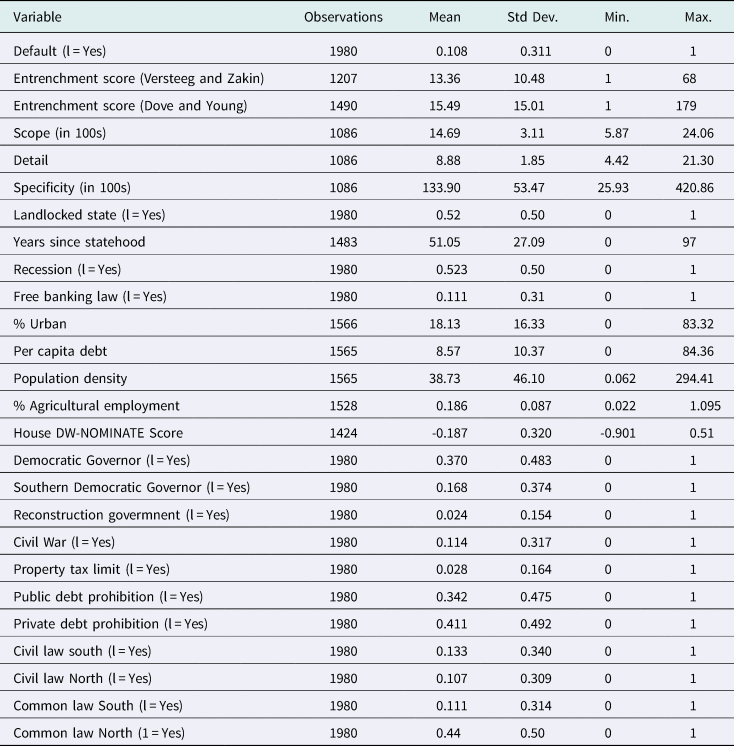
Table 4 provides summary statistics.Footnote 28
Summary Statistics

5. Results, interpretation, and discussion
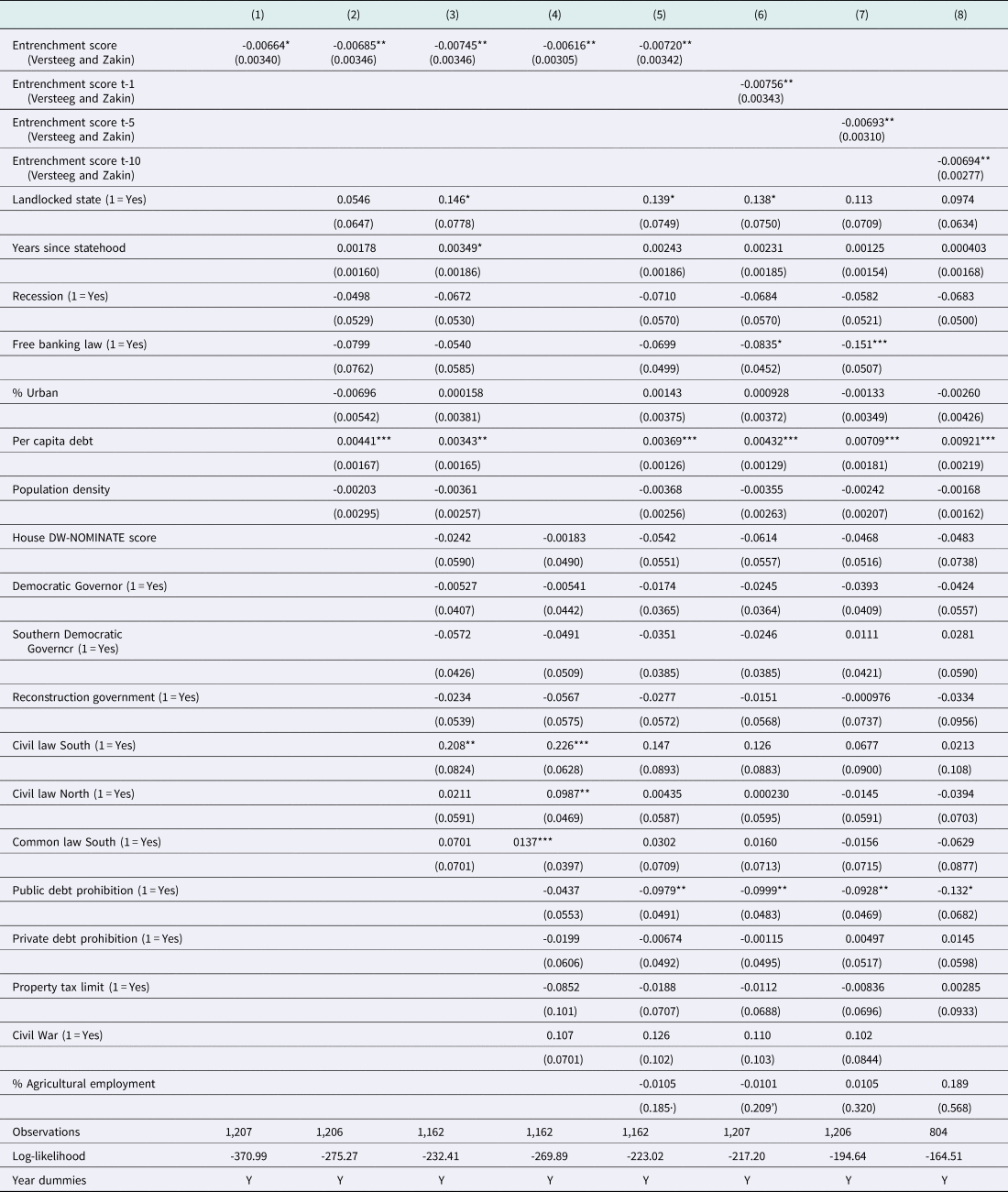
Table 5 reports results for Versteeg and Zackin's (Reference Versteeg and Zackin2016) constitutional entrenchment scores. Column 1 reports bivariate estimations (including a constant). We then introduce socio-economic controls (column 2); then institutional controls as well (column 3); next, institutional, political, and fiscal constraint controls along with the Civil War dummy (column 4); and then all of the previously mentioned controls plus the agricultural employment share (column 5). Columns 6, 7, and 8 employ, respectively, the one-year, five-year, and ten-year lagged entrenchment scores. (We report marginal effects rather than coefficient estimates.)
Constitutional entrenchment (Versteeg and Zackin) and default dependent variable = state default (1 = Yes)

Standard errors clustered by state in parentheses. Due to the loss of observations in column 8, both the ‘free banking ’ and ‘Civil War’ variables fell out of the model.
*** p < 0.01, ** p < 0.05, * p < 0.1
The correlations between entrenchment and default are all negative and statistically significant (10% level in column 1; 5% otherwise). The more entrenched a constitution, all else equal, the less likely is default. Point estimates indicate that a one-point increase in a state's entrenchment score lowers the likelihood of default by 0.66 to 0.72 percentage points. Not surprisingly, state per capita debt (columns 2, 3, and 5) enters positively and significantly.
A standard deviation increase in entrenchment (10.48) is associated with a decrease in default likelihood of about 6.9 to 7.6 percentage points. Relative to the mean value of the default dummy in our sample (0.108), that is an increase of over 65%. (This estimated effect is similar for lagged entrenchment values.)
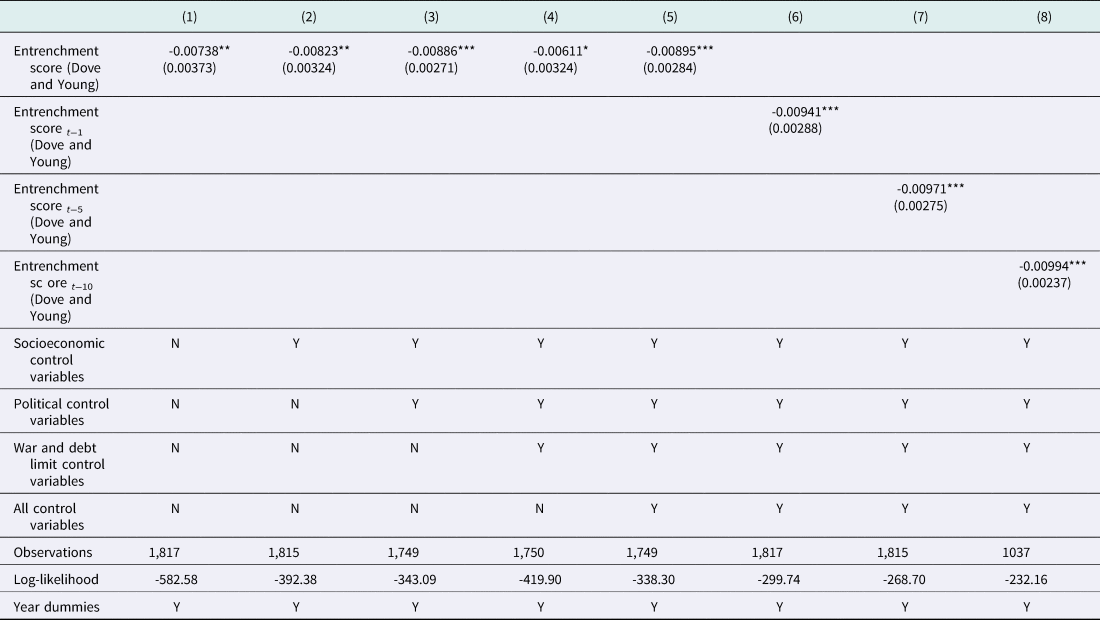
Table 6 results are based on our recalculated entrenchment scores (accounting for missing observations). (In this and subsequent tables, the columns correspond to the same control variable sets as in Table 5.Footnote 29) These results are similar. Entrenchment always enters negatively and significantly. A one-unit increase in the entrenchment score reduces default likelihood by 0.61 to 0.90 percentage points. The standard deviation increase of our recalculated entrenchment variable is a bit higher (15.01 versus 10.48) so it is associated with a decrease in default likelihood of 9.2 to 13.5 percentage points.
Constitutional entrenchment (Dove and Young) and default dependent variable = state default (1 = Yes)

Standard errors clustered by state in parentheses. Socioeconomic control variables include “Landlocked state,” “Years since statehood,” “Recession,” “Free banking law,” “%Urban,” “Per capita debt,” and “Population density.” Political control variables include “DW-NOMINATE,” “Democratic Governor,” “Southern Democratic Governor,” “Reconstruction Government,” “Civil law South,” “Civil law North,” and “Common law South.” War and debt limit controls includes “Public debt prohibition,” “Private debt prohibition,” “Property tax limit,” and “Civil War.” Finally, all controls adds “% Agricultural employment.” These results are available upon request. Due to the loss of observations in column 8, both the “Free banking” and “Civil War” variables fell out of the model.
*** p < 0.01, ** p < 0.05, * p < 0.1
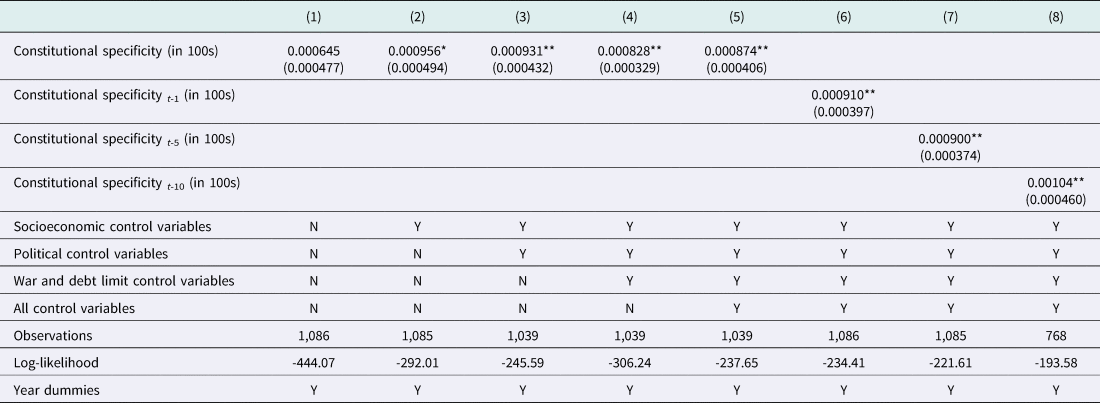
In Table 7 we consider specificity. Greater specificity is associated with greater default likelihood. In all but one specification (column 1; the bivariate case) the estimated effect is statistically significant. Point estimates indicate that an additional 100 words is associated with a 0.065 to 0.096 percentage point increase in default likelihood. A standard deviation increase in specificity (5,347 words) is associated with a 3.5 to 5.1 percentage point increase in that likelihood. Results using lagged values of specificity are similar.
Constitutional specificity and default dependent variable = state default (1 = Yes)

Standard errors clustered by state in parentheses. Socioeconomic control variables include “Landlocked state,” “Years since statehood,” “Recession,” “Free banking law,” “% Urban,” “Per capita debt,” and “Population density.” Political control variables include “DW-NOMINATE,” “Democratic Governor,” “Southern Democratic Governor,” “Reconstruction government,” “Civil law South,” “Civil law North,” and “Common law South.” War and debt limit controls includes “Public debt prohibition,” “Private debt prohibition,” “Property tax limit,” and “Civil War.” Finally, all controls adds “% Agricultural employment.” These results are available upon request. Due to the loss of observations in column 8, both the “Free banking” and “Civil War” variables fell out of the model.
*** p < 0.01, ** p < 0.05, * p < 0.1
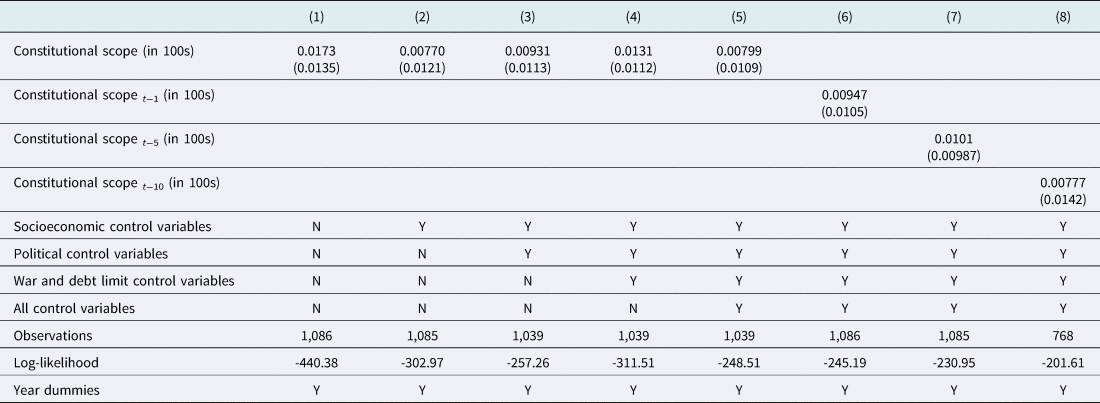
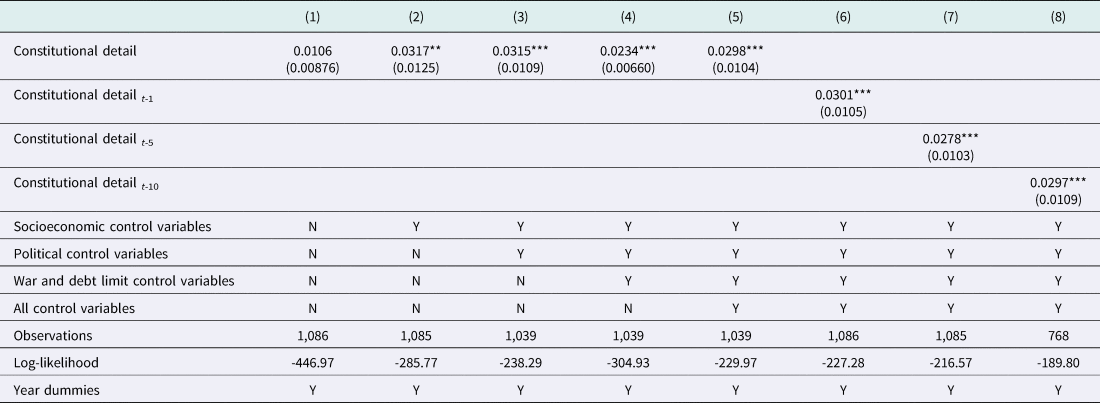
Specificity can be broken down conceptually into the scope and detail. The scope measure is the total number of unique words. Alternatively, the detail measure is total words divided by the total unique words. We find no statistically significant link between scope and the likelihood of default (Table 8). However, detail is significantly and positively associated with default (except, again, in the column 1 bivariate case; Table 9). A one-unit change in detail is associated with a 2.3 to 3.2 percentage point increase in default likelihood. A standard deviation increase in detail (1.85) is associated with a 4.3 to 5.9 percentage point increase.
Constitutional scope and default dependent variable = state default (1 = Yes)

Standard errors clustered by state in parentheses. Socioeconomic control variables include “Landlocked state,” “Years since statehood,” “Recession,” “Free banking law,” “% Urban,” “Per capita debt,” and “Population density.” Political control variables include “DW-NOMINATE,” “Democratic Governor,” “Southern Democratic Governor,” “Reconstruction government,” “Civil law South,” “Civil law North,” and “Commcn law South.” War and debt limit controls includes “Public debt prohibition,” “Private debt prohibition,” “Property Tax Limit,” and “Civil War.” Finally, all controls adds “% Agricultural employment.” These results are available upon request. Due to the loss of observations in column 8, both the “Free banking” and “Civil War” variables fell out of the model.
*** p < 0.01, ** p < 0.05, * p < 0.1
Constitutional detail and default dependent variable = state default (1 = Yes)

Standard errors clustered by state in parentheses. Socioeconomic control variables include “Landlocked state,” “Years since statehood,” “Recession,” “Free banking law,” “% Urban,” “Per capita debt,” and “Population density.” Political control variables include “DW-NOMINATE,” “Democratic Governor,” “Southern Democratic Governor,” “Reconstruction government,” “Civil law South,” “Civil law North,” and “Commcn law South.” War and debt limit controls includes “Public debt prohibition,” “Private debt prohibition,” “Property tax limit,” and “Civil War.” Finally, all controls adds “% Agricultural employment.” These results are available upon request. Due to the loss of observations in column 8, both the “Free banking” and “Civil War” variables fell out of the model.
*** p < 0.01, ** p < 0.05, * p < 0.1
To summarize: results generally support the entrenched/spare model of constitutional design as conducive to fiscal sustainability. We have considered the entrenchment and specificity dimensions separately and found them to be, respectively, negatively and positively related to the likelihood of default. In terms of specificity, the level of constitutional detail seems most relevant.
6. Conclusion
North and Weingast (Reference North and Weingast1989) call attention to the role of constitutional factors for a government credibly committing to sustainable fiscal policies. We have built upon their insight by estimating the relationship between formal dimensions of constitutional design and default using data from 19th-century US states.
These dimensions we consider are entrenchment and specificity. Are these dimensions determinants of a government's credibility? Does a sparse framework of broad constraints correspond to creditworthiness, or is creditworthiness gained via “micromanagement” of political agents? Our study speaks to these questions.
Variation in constitutional design across US states, and the fact that several of them defaulted on their debts, provides an opportunity to evaluate the links between entrenchment and specificity and the likelihood of default. We find that more entrenched (specific) constitutions are associated with a lower (higher) default likelihood.
Our study joins a handful of others in exploring relationships between constitutional design and economic outcomes. Being focused on the experience of 19th-century US states, our research is clearly only a starting point. Future research would benefit from cross-country analyses (as well as analysis of the US during different periods) to see if results generalize.
Acknowledgments
We thank three anonymous referees for helpful comments and Mila Versteeg and Emily Zakin for generously sharing their data with us.