Strategies for supporting playful aggressive behaviour in early childhood
A play-based approach to learning cohesively supports the inclusion of multiple developmental domains, which are stimulated because children are active participants in their learning. Research has supported play as the most effective method for fostering the progression of normative child development (Parten, Reference Parten1932; Piaget, Reference Piaget1951). Research further supports pretend play as a novel curricular component suggesting that play, particularly sociodramatic play, is a critical component in early childhood education programmes (Bredekamp, Reference Bredekamp, Zigler, Singer and Bishop-Jose2004; Clements, Reference Clements2004; DiPietro, Reference DiPietro1981; Jarvis, Reference Jarvis2007; Logue & Detour, Reference Logue and Detour2011; Parten, Reference Parten1932; Pellegrini, Reference Pellegrini1987; Pellis & Pellis, Reference Pellis and Pellis2007; Piaget, Reference Piaget1951; Smilansky, Reference Smilansky, Klugman and Smilansky1990; Sutton-Smith, Reference Sutton-Smith1975).
Play-based pedagogy allows teachers to implement cross-curricular learning activities that cater to multiple learning domains rather than focus on isolated skill development. However, in an effort to give young children in America a head start and ensure academic excellence contemporary public educational programmes have become work-driven to the demise of play (Elkind, Reference Elkind, Klugman and Smilansky1990). National efforts to improve the quality of early childhood programmes and education emphasise the importance of play; however, national curricula frameworks such as Australia's Early Years Learning Framework (Department of Education, Employment and Workplace Relations, 2009) and The United States' Common Core State Standards (National Governors Association Center for Best Practices, Council of Chief State School Officers, 2010) provide only broad terminology regarding various types of play; leaving state and community educational authorities to implement their own interpretation of the guiding principles. Therefore, the value of playful aggressive behaviour is neither recognised nor supported.
While there are external threats to play based learning, academic literature has recognised play as the most natural, efficient and effective way for children to learn (Bredekamp, Reference Bredekamp, Zigler, Singer and Bishop-Jose2004; Parten, Reference Parten1932, Piaget, Reference Piaget1951; Smilansky, Reference Smilansky, Klugman and Smilansky1990; Vygotsky, Reference Vygotsky1966). Play is an important venue for developing self-regulation and promoting language, cognition and social competence. Play also appears to promote school success by supporting the abilities that underlie children's learning (NAEYC, 2009).
In developmentally appropriate practice (NAEYC, 2009) play promotes the progression of normative child development and is recognised as essential for the development of young children's self-regulation, language, cognition and social competence. Research suggests that play, particularly sociodramatic play, is a critical component in early childhood education programmes because of its powerful influence on social, emotional, physical, cognitive and communicative development (Bauer & Dettore, Reference Bauer and Dettore1997; Bredekamp, Reference Bredekamp, Zigler, Singer and Bishop-Jose2004; Calabrese, Reference Calabrese2003; Jarvis, Reference Jarvis2007; Logue & Harvey, Reference Logue and Harvey2010; NAEYC, 2009; Pellegrini, Reference Pellegrini1988; Pellis & Pellis, Reference Pellis and Pellis2007; Scott & Panksepp, Reference Scott and Panksepp2003; Smilansky, Reference Smilansky, Klugman and Smilansky1990). Modern preschool curriculums (i.e., The Creative Curriculum, HighScope, HighReach) have made efforts to include child-directed sociodramatic play opportunities in centre-based early childhood programmes. However, despite current literature, the promotion of developmentally appropriate practice, and advocating for the optimal education and development of children worldwide as set forth by organisations such as The National Association for the Education of Young Children (NAEYC), The Association for Childhood Education International (ACEI), the National Association of Early Childhood Teacher Educators (NAECTE), and the National Institute for Early Education Research (NIEER), teachers are continually pressured to disregard the benefits of aggressive sociodramatic play by banning its various forms; particularly play fighting (Carlson, Reference Carlson2011; Logue & Harvey, Reference Logue and Harvey2010).
The elimination of aggressive sociodramatic play, such as play fighting, may have a significant impact on academic performance. Research suggests that the optimal education and development of young children, particularly boys, is not being met when playful aggressive tendencies are forbidden (DiPietro, Reference DiPietro1981; Jarvis, Reference Jarvis2007; Logue & Harvey, Reference Logue and Harvey2010; Pellegrini, 2010). Sutton-Smith (Reference Sutton-Smith1975) suggests that any educational programme that restricts play types will foster play deficits, which inadvertently will leave children unprepared for future experiences. He argues that children must be prepared to appropriately react to a world of constant information explosions and role shifting. Information explosions and role shifting, key elements in sociodramatic play, are prevalent as children cooperatively exchange assigned roles and continuously react to the new information as play progresses. Further, by omitting playful aggressive sociodramatic play, teachers limit the extent of development in young children. However, without a full understanding of the distinct difference between serious and symbolic aggression teachers may react with concern and send conflicting messages to young children regarding the appropriateness and rules of engaging in aggressive sociodramatic play.
Aggression
Understandably, educators often voice concern over displays of aggressive behaviour in early childhood settings. However, aggression can be considered within a normative developmental framework through consideration of theories of child development.
Social Learning Theory and Aggression
Bandura's (Reference Bandura1978) Social Learning Theory suggests that children learn to be aggressive through direct or indirect (e.g., observation) experiences. Bandura states that nearly all knowledge resulting from direct experience may also be learned vicariously, such as by watching television or observing the behaviour of others. Through indirect learning children have the opportunity to obtain behaviour patterns without directly constructing knowledge. Family members, subculture and mass media are three sources that Bandura identifies for observing and learning aggressive behaviour. Children observe their parents' and society's methods for resolving conflict. Modeling and reinforcement work in tandem in a child's acquisition of an aggressive skill set (Burgess & Akers, Reference Burgess and Akers1966). Various styles of aggression may be learned through modeling and reinforced practice. Daily aggressive encounters, for example, may include a verbal dispute between family members and media footage of national and international affairs (e.g., civil war or violent protests). When considering aggressive television shows or movies, Bandura (Reference Bandura1978) identifies four effects of viewing: 1) children learn aggressive styles of conduct, 2) children's restraint on aggressive behaviour is altered, 3) children become desensitised to violence, and 4) it shapes children's images of reality, which influences their actions. Researchers have identified common contextual components and various types of serious aggression, which has evolved into a cohesive definition of the behaviour.
Serious Aggression Defined
Serious aggression is defined as behaviour that explicitly intends to injure or destroy (Bandura, Reference Bandura1978), behaviour directed towards another with the intent to harm (Roberton, Daffern, & Bucks, Reference Roberton, Daffern and Bucks2011), or any behaviour directed toward another person with immediate intent to cause harm (Anderson & Bushman, Reference Anderson and Bushman2002). Each definition is founded on one clear guideline; intent to harm is evident in all types of serious aggression. This foundation of intent to harm serves to distinguish serious aggression from playful aggression because the two are distinctly different in their motivation (Fry, Reference Fry1987). In playful aggression there is no intent to harm participants.
Aggressive sociodramatic play lacks intent to harm. Participants may sustain injuries, but they are due to the nature of play, any play, and not its purpose. This is an important distinction. For example, rough-and-tumble play involves a risk of injury because of the contextual factors (i.e., chasing, wrestling, pushing and play fighting); however, it should not be considered serious aggression because it does not involve pretence and the players do not intend to harm one another (Pellegrini, Reference Pellegrini1987). As with playful aggression, serious aggression continues to be studied and its various dimensions categorised.
Playful Symbolic Aggression
Sociodramatic Play Theory
Research supports dramatic and sociodramatic play as important to child development (Bauer & Dettore, Reference Bauer and Dettore1997; Parsons & Howe, Reference Parsons and Howe2006; Smilansky, Reference Smilansky, Klugman and Smilansky1990). Dramatic play, a form of solitary play, encompasses role-playing in which children pretend to be someone or something else. Dramatic play that involves cooperation among two or more children is considered sociodramatic play. Six elements of dramatic and sociodramatic play have been identified in the literature as: 1) role play by imitation, 2) make-believe with objects, 3) make-believe with actions and situations, 4) persistence in the role play, 5) interaction, and 6) verbal communication (Smilansky, Reference Smilansky, Klugman and Smilansky1990). For play to be considered sociodramatic (as opposed to merely dramatic play), Smilansky emphasises the importance of interaction and verbal communication. Children use their imagination to engage in unrealistic situations, which is commonly observed during sociodramatic play such as superhero play (Bauer & Dettore, Reference Bauer and Dettore1997) and ‘bad guy’ play (Logue & Detour, Reference Logue and Detour2011).
Symbolic Aggressive Behaviour in Sociodramatic Play
By focusing on behavioural indicators of relaxed muscle tone, smiling faces and restrained body movements, rough-and-tumble can be distinguished from the serious aggression it emulates (Jarvis, Reference Jarvis2007). Nevertheless, teachers typically perceive symbolically aggressive play, including rough and tumble play, as serious, dangerous and inappropriate because of the misconception that all aggressive actions, serious or symbolic, are dangerous and lead to violence. This overgeneralisation of aggressive play may be misguided. For example, Fry (Reference Fry1987) noted that play fighting and serious fighting can be categorised into separate types of behaviour in young children. Additionally, in their study of play and aggression in kindergarten children, Hellendoorn and Harinck (Reference Hellendoorn and Harinck1997) differentiated play fighting as make-believe-aggression and rough-and-tumble since playful aggression is not real aggression. These researchers further classify fantasy aggression, imitation of aggression and rough-and-tumble as three distinct types of playful aggression. Real aggression contained behaviour such as bodily threat, physical assault, verbal aggression, intentionally damaging play material and snatching a toy away. This suggests that teachers may discourage or ban such play because they perceive it as detrimental to child development rather than beneficial, as supported by researchers (Logue & Detour, Reference Logue and Detour2011; Logue & Harvey, Reference Logue and Harvey2010; Tannock, Reference Tannock2008).
Defining Symbolic Aggression
Researchers recognise the importance of sociodramatic play for child development, yet types of sociodramatic play that include playful aggressive behaviour are typically not permitted by teachers and parents because they are interpreted to be inappropriate, anti-social or dangerous (Bauer & Dettore, Reference Bauer and Dettore1997; Clements, Reference Clements2004; Jarvis, Reference Jarvis2007; Little, Wyver, & Gibson, Reference Little, Wyver and Gibson2011; Logue & Harvey, Reference Logue and Harvey2010; Parsons & Howe, Reference Parsons and Howe2006; Pellegrini, Reference Pellegrini1989; Pellis & Pellis, Reference Pellis and Pellis2007; Sandseter, Reference Sandseter2009; Tannock, Reference Tannock2008). Playful aggressive behaviour is often discouraged and young children who engage in aggressive play will likely experience consequences that range from redirection to school suspension.
Several play types reside in the category of dramatic or sociodramatic playful aggressive behaviour including superhero play (Bauer & Dettore, Reference Bauer and Dettore1997), ‘bad guy’ play (Logue & Detour, Reference Logue and Detour2011), active pretend play (Logue & Harvey, Reference Logue and Harvey2010), play fighting (Pellis & Pellis, Reference Pellis and Pellis2007), physically active and imaginative play (Parsons & Howe, Reference Parsons and Howe2006), and rough-and-tumble play (Jarvis, Reference Jarvis2007; Pellegrini, Reference Pellegrini1987; Tannock, Reference Tannock2008). The terms of these play types are sometimes used interchangeably because of their common contextual components. For example, Jarvis (Reference Jarvis2007) defines rough-and-tumble as a set of enjoyable, physically, vigorous, and reciprocal behaviours that include chasing, jumping and play fighting. Alternatively, Pellis and Pellis (Reference Pellis and Pellis2007) describe rough-and-tumble play as play fighting; while Logue and Harvey (Reference Logue and Detour2011) define it as active pretend play that encompasses rough-and-tumble, superhero play, play fighting, chase games and protect/rescue games. Still Sandseter (Reference Sandseter2009, Reference Sandseter2007) classifies rough-and-tumble play as risky play, defined as a thrilling and exciting form of play that involves the risk of physical harm. Finally, Smilansky (Reference Smilansky, Klugman and Smilansky1990) suggests sociodramatic play involves the cooperative interaction of at least two children, who act out roles both verbally and physically, with two key elements: imitation and make-believe.
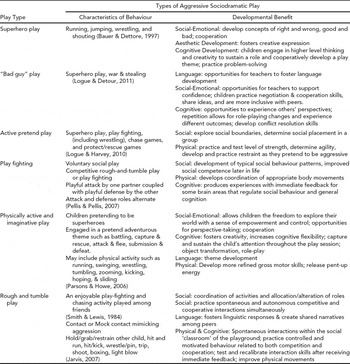
For the purposes of this article aggressive sociodramatic play is defined as verbally and physically cooperative play behaviour involving at least two children, where all participants enjoyably and voluntarily engage in reciprocal role-playing that includes aggressive make-believe themes, actions and words; yet lacks intent to harm either emotionally or physically. The lack of an agreed upon definition of playful aggressive behaviour and its role in early childhood education contribute to teachers’ struggle to recognise its benefits and support children's engagement in aggressive sociodramatic play. Table 1 provides support for educators seeking understanding through the differentiation of the characteristics of serious aggressive behaviour from playful aggressive behaviour (aggressive sociodramatic play). Table 2 provides an overview of the various aggressive play types and their corresponding behavioural characteristics as described by researchers. Both Table 1 and Table 3 serve as guides for teachers to better understand and identify the behavioural characteristics and developmental benefits of aggressive sociodramatic play. The tables are valuable resources to include in staff training and parent handbooks. They provide a basis for teachers to communicate to staff and families the importance of not only tolerating aggressive sociodramatic play, but also supporting it in early childhood programmes.
Differentiating serious aggression from symbolic aggression.

Benefits of symbolic aggression.

Strategies for supporting symbolic aggression.

Benefits of Playful Aggressive Behaviour
Parents and teachers believe play to be a natural part of childhood (Clements, Reference Clements2004), yet they do not view all play as equally beneficial to child development (Bauer & Dettore, Reference Bauer and Dettore1997; Clements, Reference Clements2004; Jarvis, Reference Jarvis2007; Little, Wyver, & Gibson, Reference Little, Wyver and Gibson2011; Logue & Detour, Reference Logue and Detour2011; Logue & Harvey, Reference Logue and Harvey2010; Parsons & Howe, Reference Parsons and Howe2006; Pellegrini, Reference Pellegrini1989, Reference Pellegrini1988; Pellis, Reference Pellis and Pellis2007; Sandseter, Reference Sandseter2009; Tannock, Reference Tannock2008). Parents and teachers often misinterpret, or are uncomfortable with, playful aggression, for example rough-and-tumble play and superhero play, due to its resemblance to serious aggression and an inability to recognise subtle differences between the two (Logue & Detour, Reference Logue and Detour2011; Pellegrini, Reference Pellegrini1987). Playful aggression is a common component in sociodramatic play – typically among boys (DiPietro, Reference DiPietro1981; Humphreys & Smith, Reference Humphreys and Smith1987; Jarvis, Reference Jarvis2007; Pellegrini, Reference Pellegrini1989) – and if supported is highly beneficial to child development (Logue & Detour, Reference Logue and Detour2011).
Supporting sociodramatic play fosters emotional, social and cognitive development in young children (Smilansky, Reference Smilansky, Klugman and Smilansky1990), which are skills kindergarten teachers deem necessary for school readiness (a set of skills acquired by a young child prior to entering kindergarten) (Bredekamp, Reference Bredekamp, Zigler, Singer and Bishop-Jose2004). Kindergarten teachers perceive language skills, enthusiasm for learning and behaviour self-regulation as skills that highly influence school readiness (Bredekamp, Reference Bredekamp, Zigler, Singer and Bishop-Jose2004). Sociodramatic play offers young children opportunities to practice and master these skills. As outlined in Table 2 the benefits of sociodramatic play are clear, yet additional guidance is needed as outlined in Table 3 to provide teachers, and parents, with clear strategies for supporting playful aggression.
Supporting Playful Aggressive Behaviour
Although there is abundant literature supporting sociodramatic play that is commonly perceived as appropriate (i.e., housekeeping, community helpers) little is known of how to support aggressive sociodramatic play such as superhero play (Bauer & Dettore, Reference Bauer and Dettore1997), ‘bad guy’ play (Logue & Detour, Reference Logue and Detour2011), active pretend play (Logue & Harvey, Reference Logue and Harvey2010), play fighting (Pellis & Pellis, Reference Pellis and Pellis2007), physically active and imaginative play (Parson & Howe, Reference Parsons and Howe2006), and rough-and-tumble play (Jarvis, Reference Jarvis2007; Pellegrini, Reference Pellegrini1987; Tannock, Reference Tannock2008). Research findings support the inclusion of aggressive sociodramatic play in early childhood education, yet minimal practical guidance for teachers is offered to thoroughly support children's playful aggression.
In their study of superhero toys and imaginative play, Parsons and Howe (Reference Parsons and Howe2006) provide strategies that offer a starting point for teachers’ inclusion of aggressive sociodramatic play. Including superhero play allows children the freedom to explore their world through their imagination, while fostering their creativity, empowerment and control (Parsons & Howe, Reference Parsons and Howe2006). In support of children's interest in superhero play the researchers’ recommendations include incorporating superhero toys and props in a specific area of the classroom (i.e., capes and masks), encouraging collaboration for constructing structures related to superheros (i.e., a cave for Batman), and extending superhero play to outdoors. They further recommend the development of specific guidelines, rules and supervision regarding superhero play. Finally, Parsons and Howe argue that encouraging superhero play in a safe environment ensures positive and rewarding experiences for the participating children.
In their study of superhero play, Bauer and Dettore (Reference Bauer and Dettore1997) recognised children's increased exposure to violence and aggression with superhero television programmes being a significant contributor to aggressive behaviour. They suggest superhero play has developmental benefits and teachers who support it encounter numerous teaching opportunities to redirect antisocial behaviour by modeling prosocial behaviour. In Bauer and Dettore's study, reference to superheros was used to help young children develop concepts of right and wrong or good and bad, develop cooperation, model specific behaviours, encourage creative expression and experiment with various role playing. Of most importance in their view is the teacher's role of assisting children in developing strategies for conflict resolution as an alternative to aggression and violence. It is also necessary for the teacher to prepare the environment to eliminate excessive conflicts due to overcrowding and inadvertent contact.
A common subtle strategy across rough-and-tumble literature suggests that children be provided a space conducive to the behaviour. Playful aggressive behaviour, specifically rough-and-tumble, predominantly occurs in spacious environments with soft surfaces and minimal adult interference (Humphreys & Smith, Reference Humphreys and Smith1987; Pellegrini, Reference Pellegrini1987). Typically, free-play opportunities in outdoor grassy areas encourage playful aggressive behaviour. It is also typical for teachers to provide more unstructured play or free-play experiences in outdoor environments rather than the classroom. Unstructured environments provide children the opportunity to participate in play activities that include rough-and-tumble play (Scott & Panksepp, Reference Scott and Panksepp2003). However, the literature does not elaborate, leaving teachers uncertain of how to support playful aggressive behaviour.
With ten guidelines for creating quality sociodramatic play, Calabrese (Reference Calabrese2003) offers the most extensive support strategies: 1) choose themes of interest to children (e.g., hospital), 2) ensure the availability of a variety of distinct roles (e.g., nurse, doctor, and patient), 3) create a print rich environment (e.g., label clothing and objects used in play), 4) design a safe, attractive and inviting centre (e.g. create a doorway with a painted cardboard box and label it ‘Hospital’), 5) provide a variety of realistic manipulatives and imaginative possibilities (e.g., toy medical supply kit, Band-aids, athletic bandages, lab coat and scrubs), 6) rotate materials and roles on a regular basis (e.g., exchange doctor and nurse materials for emergency medical team supplies and exchange the hospital doorway for an ambulance), 7) do not interfere in the story (i.e., observe from a distance), 8) introduce vocabulary in the centre in a variety of ways such as storybooks or songs pertaining to the play theme (e.g., hospital), 9) create rules or guidelines (e.g., place a limit for the amount of children that may play in the centre at one time) and 10) have a grand opening for the centre such as a ribbon cutting or inviting a special guest (i.e., the preschool director). These guidelines exclude sociodramatic play that involves large motor physical activity, which is the essence of rough-and-tumble play, symbolic aggressive play and active play. Two of the guidelines recommend choosing themes that are of interest and familiarity to children, and provide a variety of manipulatives in the centre. Both recommendations coincide with the suggestions of Parsons and Howe (Reference Parsons and Howe2006) for educators to incorporate a variety of play toys and props to encourage children's social dramatic play creativity.
However, teachers’ perceptions of appropriate themes and props usually exclude those used in aggressive sociodramatic play such as superhero toys and props as recommended by Parsons and Howe (Reference Parsons and Howe2006). Calabrese's guidelines are valuable for developing early childhood sociodramatic play centres, yet fail to address the environmental needs and the role of the teacher in supporting aggressive sociodramatic play. In contrast to Calabrese (Reference Calabrese2003), Parsons and Howe (Reference Parsons and Howe2006) recommend that educators intervene in children's sociodramatic play to expand and elaborate the play in an effort to encourage young children's divergent thinking and foster communication skills among peers. Research has demonstrated the importance of playful aggressive behaviour in early childhood education by delineating its differences to serious aggression (Anderson & Bushman, Reference Anderson and Bushman2002; Bandura, Reference Bandura1978; Fry, Reference Fry1987; Gomes, Reference Gomes2007; Hellendoorn & Harinck, Reference Hellendoorn and Harinck1997; Humphreys & Smith, 1984; Pellegrini, Reference Pellegrini1987; Pellis & Pellis, Reference Pellegrini1987; Roberton, Daffer, & Bucks, Reference Roberton, Daffern and Bucks2011; Scott & Panksepp, Reference Scott and Panksepp2003; Smilansky, Reference Smilansky, Klugman and Smilansky1990; Tannock, Reference Tannock2008) and demonstrating its benefits to all developmental domains (Bauer & Dettore, Reference Bauer and Dettore1997; Jarvis, Reference Jarvis2007; Logue & Detour, Reference Logue and Detour2011; Logue & Harvey, Reference Logue and Harvey2010; Parsons & Howe, Reference Parsons and Howe2006; Pellis & Pellis, Reference Pellis and Pellis2007; Smith & Lewis, Reference Smith and Lewis1984). Yet, despite its numerous benefits to child development and school readiness skills, research lacks the detailed components necessary for its acceptance and inclusion. With such limited and generalised support strategies it remains unclear as to how and when an adult should interact and intervene, when confronted with aggressive sociodramatic play. Table 3 provides specific teaching and support strategies for promoting prosocial behaviour during aggressive play within both indoor and outdoor early childhood educational environments.
Play space
Teachers must first prepare an environment conducive to the various types of aggressive sociodramatic play. Rough-and-tumble play requires a large space with soft flooring and free from interruption. Pellegini (2010) recommends a minimum of 25 square feet. Superhero play (Bauer & Dettore, Reference Bauer and Dettore1997), ‘bad guy’ play (Logue & Detour, Reference Logue and Detour2011), active pretend play (Logue & Harvey, Reference Logue and Harvey2010), play fighting (Pellis & Pellis, Reference Pellis and Pellis2007), physically active and imaginative play (Parsons & Howe, Reference Parsons and Howe2006), and rough-and-tumble play (Jarvis, Reference Jarvis2007; Pellegrini, Reference Pellegrini1987; Tannock, Reference Tannock2008) require ample space for children to run, jump, kick, punch, wrestle and perform other pretend actions typical of symbolic aggression. Pretend centres may be created both indoors and outdoors. Teachers can define an outdoor pretend centre in a large grassy area or by placing several tumbling mats together. Placing orange cones on the perimeter of the play area defines the space and optimises safety and supervision. Indoors, a teacher may create the pretend centre by placing at least two tumbling mats in an area away from the flow of other children. Applying a label such as pretend centre may serve as a reminder to teachers and children of appropriate behaviour during aggressive sociodramatic play.
Play supervision
Constant supervision is necessary to maintain a safe climate for all participating children. The supervising teacher is encouraged to continually redirect inappropriate behaviour (i.e., ‘Ellis, you may hold his shoulder, not his neck’.) and reinforce acceptable behaviour (i.e., ‘Good, Josilynn! You kept him safe by pushing lightly’.). One key indicator of the intent of the play is the facial expression of the children. Those who are smiling, laughing and have an open body position are enjoying their experiences. In contrast, children who are scowling and verbalising fear or anger require teacher intervention to stop the play.
Play accessories
Play accessories pertaining to children's play themes may be included in both the indoor and outdoor pretend centre. Capes, masks, wands, small beanbags, throw pillows, foam swords and shields, plastic handcuffs, and a set of two-way radios are examples of accessories that support symbolic aggressive play. These accessories may be used to play good guys and bad guys, superheros, pillow fights, cops and robbers, and witches and wizards. The inclusion of aggressive play accessories supports playful aggressive behaviour, which, in turn, supports child development.
Play group size
The size of the group is an important social and safety aspect of aggressive sociodramatic play. As play matures into cooperative play (Parten, Reference Parten1932) young children's aggressive sociodramatic play may be better supported with a single partner rather than in a small group. Teachers find it beneficial to foster the establishment of children's social competence and adherence to the pretend centre rules between pairs of young children before allowing small group participation. As with other learning activities it is important for teachers to individualise instruction and progress and monitor aggressive sociodramatic play to ensure normative development among participants.
It is important to note that some children will not engage in aggressive sociodramatic play, perhaps due to the nature of the play. Because young children have different interests and play preferences aggressive play may or may not be a part of their play repertoire. Aggressive play is typically described as a high-energy, fast-paced and active play that is observed predominantly in young boys; therefore, children with passive personalities may decline to participate.
Children's rights
It is important to recognise that children have the right to play. As set forth by the United Nation's Convention on the Rights of the Child (CRC) the best interest of the child must be the primary focus in making decisions that may affect them (UN General Assembly, 1989). Too often, educational policies and practices are developed solely from the perspectives of adults without consideration to the rights of the child. Article 29 of the CRC framework states that education should develop each child's personality, talents and mental and physical abilities to their fullest, while Article 31 states that children have the right to engage in play (UN General Assembly, 1989). Given the adoption of such principles by numerous countries – such as New Zealand, Australia, United Kingdom, Canada, Ireland and Iran – worldwide support for the inclusion of playful aggression into early childhood pedagogy and policy should be commonplace. Because children learn and benefit from various experiences teachers need to advocate young children's right and choice to engage in aggressive sociodramatic play for the optimal development of young children worldwide. In support of playful aggression teachers should collaborate with children to determine what actions constitute playful aggression and serious aggression by creating a chart that lists the behaviours under two headings: play vs. non-play. This chart will serve as a premise to developing play safety rules.
Play safety rules
The establishment of rules is necessary for consistency among participants and supervising teachers. Rules serve as the foundation for building trusting and safe relationships among children. Rules also assist children and adults with deciphering differences between pretend aggression and serious aggression because rules establish acceptable behaviour. Rules give children a voice, when the play becomes uncomfortable. For example a participating child may say, ‘Stop! You're pushing me too hard!’ This signals to the child's peer that a rule is being broken and the play is no longer enjoyable. Through repeated engagement children learn that aggressive sociodramatic play styles vary among participants as relationships strengthen or weaken. When children follow the rules, effectively communicate, enjoy playing together, and trust one another, their relationship strengthens. However, when a participant consistently ignores the rules of playful aggression or violates the personal preferences of their peers their relationships may be negatively affected by resulting in decreased trust. Children will recognise acceptable actions, preferred play themes, levels of trust, and assigned roles that vary among participants.
When indoor and outdoor pretend centres are utilised, teachers experience a decrease in students’ serious aggression, behaviour challenges and energy level. In turn, peers’ and teachers’ behaviour is positively affected because the classroom climate improves with children being more cooperative, peaceful and attentive. Less time dedicated to behaviour management results in more opportunities for teachers to engage children with learning opportunities. Teachers who support aggressive play will experience an increase in positive behaviour within their students, and will provide a more effective and efficient learning environment.
Conclusion
Research demonstrates distinct differences between serious aggressive behaviour and playful aggressive behaviour with intent to harm being the major factor of serious aggression. Research further demonstrates playful aggressive behaviour as a neglected, yet important element of sociodramatic play, especially for young boys. By implementing support strategies early childhood programme curricula can include varied types of playful aggressive sociodramatic play including superhero play, ‘bad guy’ play, active pretend play, play fighting, physically active and imaginative play, and rough-and-tumble play.
The key component for supporting aggressive play is adult supervision. As with learning to cut with scissors, writing with a sharp pencil and climbing on playground equipment, young children need clear directions, the establishment of rules, and reinforcement or redirection from teachers to ensure their developmental growth and safety. This article provides early childhood teachers with specific strategies to manage aggressive play as it relates to space, supervision, accessories, group size and rules. These strategies serve as a starting point for early childhood programmes; therefore, teachers are encouraged to make strategy and support adjustments based on their specific learning environment and student population. Aggressive play support strategies offer early childhood teachers a foundation for including indoor and outdoor pretend centres which will afford young children, particularly young boys, valuable experiences for growth and development in all domains of learning.