‘Pithecanthropus and Sinanthropus seem to some people more real than Hitler or Mussolini. Anything is believed, however absurd, if it hangs all its weight on the missing link between men and animals', lamented G.K. Chesterton in his column in the 2 December 1933 edition of the Illustrated London News.Footnote 1 This was possibly an exaggeration, but not by much. In the early twentieth century, human evolution was one of the most dramatic and best-publicized fields of scientific research. Evocative accounts of expeditions to distant regions to ‘hunt for man's ancestors' worked within wider interest in exploration, adventure and exoticism. The specimens unearthed were no less striking. A series of ancient types were deduced from fragments of bones and teeth, and given the scientific names of Pithecanthropus and Eoanthropus and individual identities as the Old Man of La Chapelle aux Saints and the Taung Baby, or formed into combinations of anatomy and site: Neanderthal, Java, Rhodesia and Sussex Man, the Piltdown Skull and the Mauer Jaw. Rebuilt as strange, shambling ape-like creatures, they were debated across scientific networks and the public media. The entwined discourse raised significant questions. How could scientists know and uncover these lost forms, and how reliable was their authority? Were these long-dead creatures human ancestors, lost relatives or doomed aberrations? And what did their lives and fates reveal about the fundamentals of human nature?
The history of palaeoanthropology is ideally suited to examine numerous issues in the modern history of science.Footnote 2 As Murray Goodrum has argued, human-origins research depends on linkages between ‘natural sciences’ such as palaeontology, geology and evolutionary biology, and ‘human sciences’, particularly anthropology and archaeology, thereby connecting these two often ahistorically separated domains.Footnote 3 It also depends on wide international networks, defined by hierarchies of scientific authority, empire and money.Footnote 4 Fossils of human ancestors were searched for throughout the globe, with regions such as Africa and Asia postulated as key theatres of human development. This locked the discipline within international frameworks, as scholars in established centres of authority (particularly Europe and the United States) were essential to authenticate specimens, but also less established scholars with control over particular important fossils and sites could attempt to assert their own authority and importance. Finally, the public resonance of the field's finds, unveiling key episodes in the origin and formation of fundamental human capacities, ensured that it depended on interactions between science and the public. In a current historiographical context, where ideas of circulation and ‘knowledge in transit’ are fast becoming key organizing principles in the history of science,Footnote 5 the history of human-origins research offers a strong way of linking up numerous research agendas.
The discovery and dissemination of the ‘Peking Man’ fossils in the interwar period offers an extremely interesting and productive case study within this framework. The story of Peking Man is well known, having become part of the disciplinary mythology of palaeoanthropology itself.Footnote 6 In the 1920s and 1930s, an international team of scientific investigators discovered one of the most extensive Homo erectus sites ever, in a cave named Zhoukoudian outside Beijing, with over a dozen crania, evidence of tool use and fire, and a vast array of palaeontological remains – classing these as belonging to a new human ancestor, Sinanthropus pekinensis. The fossils mysteriously vanished during the Second World War, which has added to the drama, but ensured that most studies have revolved around the mystery – where is Peking Man? While there has been growing interest in perceptions of Peking Man in twentieth-century China (particularly around issues of scientific nationalism and popular science),Footnote 7 the contemporary international impact of Sinanthropus – as it became hailed as ‘The most valuable skull in the world’Footnote 8 and ‘Possibly the lowest man known to science’Footnote 9 – has been less investigated.Footnote 10 However, here it is potentially of great interest. Recent work by Fa-ti Fan, Grace Shen and others has examined science in Republican China in terms of the extent, but also the ambiguities, of international scientific work in the early twentieth century. As argued by Fa-ti Fan, ‘Republican China … allows one to examine how the institutions of modern science functioned and how scientific knowledge was produced locally and yet aimed to speak globally.’Footnote 11 The unearthing of Peking Man, one of the most extensive scientific projects of the Republican period, and working within a discipline where the local and the international were fundamentally interconnected, throws these issues into relief.
This paper specifically examines how the excavation and presentation of Sinanthropus interacted with developments in one national context, that of metropolitan Britain. This is, of course, not to argue that British scholars and public audiences were the only ones involved in this research. Indeed, an important issue being traced is the relative (and often diminishing) position of British scientists and institutions in comparison to their counterparts in other areas, particularly the United States, France, Sweden and Germany. However, a close study of this corner within a broader set of international relationships – as well as being necessary to maintain manageability in a complex and multifaceted set of processes – allows an investigation of important issues within this specific metropolitan context. The reception and discussion of Peking Man in Britain (and human-origins research more widely), connects with important areas of modern British historiography. It is now widely acknowledged that scientific ‘values’ were crucial within the society and culture of interwar Britain. However, this is often presented as quite confusing and multi-headed. Science was simultaneously interpreted as offering regeneration to a nation fraught by war and economic trauma, feeding into a prevalent ‘morbid culture’, inspiring awe and trepidation at new technology, causing fears of ‘moral lags’ between technological advancement and human consciousness, or bolstering a ‘common context’ valuing stable development.Footnote 12 While it is certainly the case that ‘any history of national life that fails to work through the manifold ways natural science was part of the culture … fails to engage with the expression of central values of the age’,Footnote 13 the tensions here, simultaneously offering optimistic images of progress and pessimistic ones of danger and decline, remain important to investigate.
This paper will follow the interaction between these two areas. First, it will examine the place of palaeoanthropology in British science and public culture, illustrating how it was involved in questions of scientific authority and human development. It will then move to the development of Chinese geology and palaeoanthropology, and particularly its interaction with institutions beyond China. The next two sections investigate the presentation of key finds at Zhoukoudian: the major discoveries between 1929 and 1935, first of skeletal material, and then of evidence of fire and tool use, which were discussed in terms of the capacities of human ancestors and networks of international authority. The final section turns to the tense period between 1935 and 1939, when a series of personal changes at the site, and a destabilizing international context, seemed to give a more pessimistic and conflict-ridden tone to the discussion of Peking Man. Across this, the paper will show how discussions of Sinanthropus engaged with ambiguities over the place of science within society; the nature of international networks; and broader concepts of human nature, progress and development. The excavation and analysis of Sinanthropus seemed to show that human development had in at least some respects been a story of evolutionary advancement, and that science could be an exciting, dynamic and improving force. However, this constantly interacted with the uneasy – and potentially horrific – implications which seemed to be unveiled about the original state of humanity, and doubts over the abilities of science to actually further the progress which it claimed. This interplay of optimism and pessimism, and certainty and uncertainty, played out continuously as Sinanthropus and human origins were discussed.
Palaeoanthropology in Britain
By the 1900s, the idea of human antiquity and evolution from lower primates was scientifically well established. Human evolution – a respectable scientific field offering sensational images of cave-dwelling man-apes living alongside prehistoric beasts – was also of great public interest: cavemen and dinosaurs entered the cinema in a highly successful adaptation of Arthur Conan Doyle's The Lost World in 1925; a reconstructed family of Neanderthals were exhibited in Madame Tussauds in the late 1920s and reported as ‘Our ugly ancestors’ in the Daily Mirror;Footnote 14 and the 1936 Chelsea Arts Club Ball had a ‘prehistoric’ theme, with Stone Age dioramas alongside centaurs and ancient Egyptians. This was a period when ‘cave-men joined monkeys, apes, and other missing links in a crowded symbolic vocabulary’, becoming tied to meditations on humanity's animalistic origins and the progress of culture and intelligence.Footnote 15 Human-origins research was particularly widely reported in the press.Footnote 16 It was not only scientific journals like Nature or the developing ‘popular-science’ media which reported on new finds, but also established broadsheets such as The Times and The Guardian, and the burgeoning tabloid press, including the Daily Mirror and the Daily Mail. The weekly Illustrated London News was particularly active, producing numerous evocative reconstructions of prehistoric life from the 1890s onwards.Footnote 17
Peter Bowler's statement that it ‘was easy to generate public interest in this topic, and the regular discovery of new hominid fossils ensured that there was always a peg upon which to hang another account of the factors that might have shaped human nature’,Footnote 18 is certainly accurate. However, this interest coexisted with significant uncertainties, which can be shown through a quick discussion of the principal known prehistoric forms. The first, ‘Neanderthal Man’, had been discovered in 1859 and (after slow acceptance) became the most emblematic and best-studied primitive human. Yet while almost fifty Neanderthal specimens had been discovered by 1930, debates still raged over whether they were degenerate offshoots unrelated to modern humans or primitive evolutionary precursors, causing a ‘pendular movement between humanity and bestiality, between recognition and exclusion’,Footnote 19 moving in and out of ancestral status.
Neanderthals were controversial, but too recent to be regarded as the deepest possible ancestor. For this, there were two primary (yet problematic) contenders, dating to the beginning of the Pleistocene. Eugene Dubois's skullcap and femur of Pithecanthropus erectus, discovered in 1891 in Java, was initially interpreted as an early human-like creature, upright if rather bow-legged, with a 950 cm3 cranial capacity (midway between chimpanzees and modern humans) and scowling brow ridges. However, controversy over the find caused Dubois to retract his Haeckelian ‘upright ape-man’, reinterpreting it as a unique form distinct from both anthropoid apes and human ancestors, before locking the bones away in his house. This made further studies difficult – even as scientific discussions of Pithecanthropus slowly became more amenable to its hominin status. While lack of access made Pithecanthropus problematic, the opposite issue marked Eoanthropus dawsoni, or ‘Piltdown Man’, discovered in Sussex in 1912. While primarily known today as one of the most famous scientific forgeries ever, Piltdown Man was an important specimen in the interwar period. Its primitive ape-like jaw and modern human cranium gave credence to brain-centred views of evolution and a possible British seat of early humanity.Footnote 20 However, Piltdown Man was also significant for being the first widely publicized media hominin, making the front page of the Illustrated London News,Footnote 21 and driving a lively discussion in the press.
The fragmentary records and lack of accurate dating techniques beyond relative geological chronologies ensured that conclusions were often tentative and debates heated.Footnote 22 Public reactions to this lack of certainty could be mistrusting and frustrated. The ‘By the way’ funnies section in the Daily Express, reporting on the 1926 meeting of the British Association, noted,
I have been wondering how long the British Association at Oxford would be able to carry on its discussions without bringing in our dear old friend the Skull, and all the jum-jum stuff about Neanderthal man. ‘One cannot speak definitely, of course, about his age.’ Aha! The old story. Then, for heaven's sake, don't let us speak about its age at all, and don't let us start all the solemn nonsense of pretending we know all about it, and reproducing pictures of hairy men at random.Footnote 23
The press was far from fawning over the scientific expert, who was as likely to be regarded as a pompous and obscurantist charlatan as an authoritative master of knowledge.
Accounts of human origins depended on balancing appealing novelty and mystery, mixing authoritative rhetoric with links to familiar assumptions. Those who managed this gained authority to speak not only on human ancestors, but also on wider issues of race, culture and humanity. The means of building a public career in palaeoanthropological expertise are best shown by the two dominant figures of this generation: Arthur Keith and Grafton Elliot Smith – who will play a key role in the discussion of the Sinanthropus. Arthur Keith is probably the best known, with assessments tending to highlight his harsh racial views.Footnote 24 An anatomist by training, who rode the publicity around the Piltdown specimens to become the point man for the press whenever they required a digestible discussion of new fossils and human evolution, ‘Sir Arthur’ (knighted in 1921) used this position to promote his ideological mix of biologist materialism and conservative pessimism. For Keith, studying human ancestry drew researchers ‘not to a single sunlit idyllic glade, as in former descriptions, but to dank and dark caves’,Footnote 25 and showed murky, primeval forces in human nature. Humans were evolutionarily conditioned towards tribal affiliation based on blood, territory and descent, and antagonism towards rival groups. While Keith's precise definitions of the ‘race-building’ which resulted from this shifted over his career, a narrative core persisted: in the dank and dark Pleistocene past, humans were divided into innumerable races, who exterminated one another until only a few remained. This continued into the present, where nations were races in embryo, struggling over resources and space (and the ‘New Nations’ of post-war Europe and the National Socialist regime in Germany showed this was still an active process). Dark forces permeated human society, and could not be eradicated. Science at best offered a chance of managing these, ensuring fitness and health and, in the modern world with its destructive warfare, potentially restraining them.
Grafton Elliot Smith, meanwhile, followed a different track.Footnote 26 Born in New South Wales, he pursued an imperial career to become professor of anatomy first at Cairo, then at Manchester and finally at University College London, where he wrote and lectured for general audiences on neurology, psychiatry, anthropology and palaeoanthropology. Elliot Smith merged these interests into an idiosyncratic, but coherent, vision of human development, which was almost the opposite of Keith's. While Elliot Smith also saw humans as imprinted by biological evolution (and early prehistory with similar exterminatory racial warfare), language and culture led to a unique position. These evolved capacities permitted the mastery of nature and the creation of new social worlds. This enabled early humanity to live as ‘the genial and happy child of Nature’, free of wants and violence.Footnote 27 However, the development of civilization, and especially the theocratic irrigation states of the ancient Middle East, ended this carefree existence, teaching men to work, to be violent and to submit to authority. As ‘Man began to devise Civilization, he became entangled in the shackles of the theory of the State, which he himself had forged’. It was only with the Greek city states that new ideas of individual liberty could spread. The struggle was then on, as ‘the history of the world has been a conflict between the rationalism of Hellas and the superstition of Egypt. It depends upon the human population of the world themselves which will win’.Footnote 28
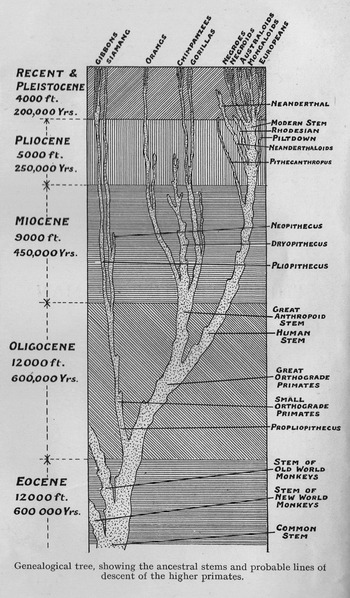
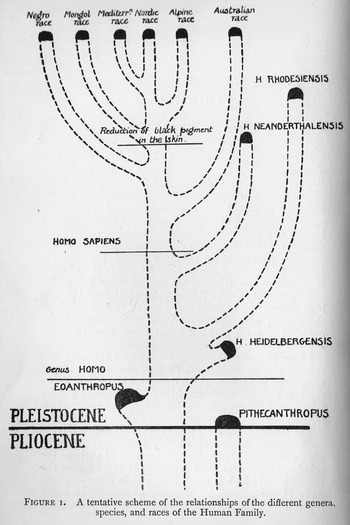
Given their starkly different ideological positions, extended contrasts between Elliot Smith and Keith have become almost obligatory in studies of human-origins research and racial theorizing in interwar Britain.Footnote 29 However, it is important to note that beneath their often public disagreements and political differences, they shared a common vision of the structure of human development. Both were part of a move away from the formerly dominant linear notions – promoted by earlier authorities like William Sollas, John Lubbock and Gabriel de Mortillet – which presented physical, mental, cultural and racial characteristics moving in unison up a ladder of evolutionary perfectibility.Footnote 30 By the 1920s, faced by the increasing variety of fossil specimens and wider shifts to models of cultural pluralism, evolutionists ‘had to give up the single-stemmed family tree and substitute for it one with rather a shrub-like outline’.Footnote 31 A common imagery developed of trees of human life, showing the hominin stems branching from the other primates, and continuing to diverge into modern racial forms.Footnote 32 However, as has been noted by authors such as Constance Areson Clark and Robert Foley, linear and unitary notions died hard, in both popular presentations and the assumptions underlying many scientific models of human evolution.Footnote 33 These branching notions still mixed with ideas that evolution presented a largely directional story and that the growth of the tree of human evolution represented progress and improvement, culminating in modern humans, and culture, tool use, intelligence and consciousness. As such, this budding imagery mixed ideas of progress with misdirected development. The branch leading to modern humans could (and often was) presented as a continuous story of improvement, marked by loss of primitive features and the balanced development of the brain and cultural capacities. However, extinct types, like Neanderthals and pithecanthropoids, were shown as doomed dead ends on isolated sub-branches.Footnote 34 Likewise, the invariable inclusion of modern ‘racial groupings' at the culmination of these models tied palaeoanthropology to contemporary controversies over race. On the one hand, this seemed to demonstrate that the differences between them were nowhere near as great as between modern humans and extinct hominins. Yet it also implied that modern racial types were engaged in the same process of divergence and struggle as had characterized the Pleistocene. Uncertainty over dating also meant that the divergence of racial types could be chronologically placed to either accentuate or minimize the variation between them: Elliot Smith preferred a relatively recent differentiation of human races in the mid-Pleistocene, while Keith, promoting a sharper racialist view, placed their origins much earlier, at the end of the Pliocene. In this way, scientific authority over evolutionism was directly used to define race and human development. Old views of evolutionary progress and hierarchies of types were retained as potential features of human development, but these could be stopped or curtailed or could follow the wrong track, rather than being inevitable.
Arthur Keith, The Antiquity of Man, vol. 2, London: Williams & Norgate, 1925, frontispiece (author's collection).

Grafton Elliot Smith, Evolution of Man, London: Humphrey Milford, 1924 (author's collection).

Scientific connections between Britain and China
Palaeoanthropology was becoming a strong part of intellectual and public life in early twentieth-century Britain. However, this was part of a wider international phenomenon, as the wide spread of finds – in Asia and Africa as well as Europe – inspired a broad perspective. It is therefore essential to ask why ‘the eyes of the world turned to China’ in the 1920s, and how pre-existing scientific and political linkages impinged upon this. British relations with China in this period were complex and shifting in an awkward manner, as positions built up over the nineteenth century slowly unravelled. There was a long tradition of British naturalist activity in China, frequently tied to informal empire and commercial dominance.Footnote 35 British scientists and scholars continued this into the early twentieth century, particularly around such institutions as the Royal Asiatic Society and the Shanghai Museum of Natural History. However, in many respects, their position reflected British influence in China more generally: still in place, but declining from a formerly dominant position in the face of foreign rivals and a dynamic local context.
Most significant was a new generation of Chinese scientists. Young, usually Western-educated, intellectuals within the Republican movement aimed to ‘to save China through science and democracy’, rejuvenating a country which was seen to have suffered through a century of wars, political instability and humiliation, and speaking on both the national and the international stage.Footnote 36 As Grace Shen has recently shown, a central role was played by geology.Footnote 37 This was a science which combined eminent economic benefits (being essential for mining, quarrying and railway building); physical exertion (with geological sites only reachable through arduous walking in difficult terrain); and connections with other disciplines, particularly palaeontology, natural history and archaeology. It also allowed Chinese scientists to make a unique international contribution, as the geological and palaeontological records of East Asia were largely unstudied. The Chinese Geological Survey of 1917 and the Geological Society of China in 1923 were among the first scientific bodies established consisting primarily of Chinese scholars. They went out of their way to connect to international networks, in which Britain was an important destination. Ding Wengxiang, the first director of the Geological Survey, had studied in Britain, although he dropped out of Cambridge, finding it too classically orientated, to gain a more practical education in Glasgow.Footnote 38 However, this was not the only international route: Wong Wenhao, director of the survey from 1926, was educated in Louvain in Belgium, and the palaeontologist Yang Zhongjian gained his doctorate in Munich. Likewise, for field collaboration, Swedes, Germans and long-term émigrés were preferred: Johan Gunnar Andersson, a Swedish geologist with strong interests in archaeology, was employed in various capacities from 1914;Footnote 39 and Amadeus Grabau, former professor of geology at Columbia before being forced out over apparent German sympathies during the First World War, was hired by Peking University in 1919 to educate geologists within China.Footnote 40
The rise of American institutions was significant too. The most prominent, the Rockefeller Foundation, also sought to ‘save China through science’, using more paternalistic medical institutions.Footnote 41 Its crown jewel was the Peking Union Medical College, one of the largest and best-equipped medical schools in Asia. While it had a very clear remit for medical research and training Chinese doctors, it offered resources which could be coopted by those with specialist interests – such as its Canadian head of anatomy, Davidson Black, who had studied with Grafton Elliot Smith at Manchester and worked with Arthur Keith at the Piltdown site.Footnote 42 Black used his ‘extracurricular’ interests in physical anthropology and connections with networks around the Geological Society to divert resources from the Rockefeller Foundation. Not only was he the local expert for the analysis of human remains found in excavations, but he also produced a long article on ‘Asia and the dispersal of primates’ in 1925,Footnote 43 offering a research statement for the Geological Society's growing interest in human origins. This utilized American works such as William Diller Matthew's Climate and Evolution and Grabau's idiosyncratic theories of continental movement to argue that Central Asia was the centre of dispersal for the major primate groups, and the prime area to search for human origins – something which significantly furthered the international importance of Chinese science. The importance of this work was highlighted in a grant application to the Rockefeller Foundation for a trip to Thailand in 1922:
Reflections upon human origin and evolution have ever been of profound interest to thoughtful men in all walks of life, but particularly does this problem interest the medical world and it should be the duty and privilege of workers favourably placed in the East as we are to do their utmost to advance our knowledge in this field …
We must look more and more to the Chinese themselves if we are to expect real advances to be made on the fundamental problems involved in the investigation of man's early physical records and in the working out of his family tree – questions which are of practical importance to the whole world. But unless an example be set which will fire the imagination and capture the interest of our student body we may expect to look in vain for the type of workers needed in this field.Footnote 44
Human evolution was a locus of scientific cooperation and a means to ‘fire the imagination’ towards science, building networks across disciplinary, institutional, cultural and national boundaries.
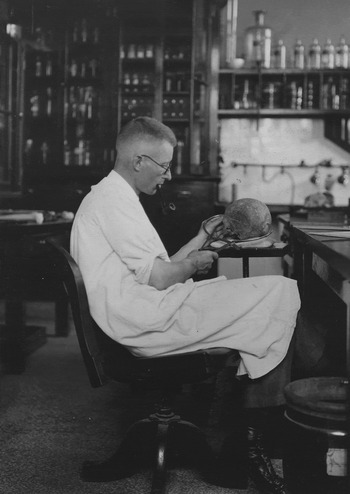
Davidson Black (1884–1934), courtesy of Rockefeller Archives Centre, Sleepy Hollow.

Yet while Chinese geologists and expatriate scholars were working within discourses of internationalism and modernization, they also interacted with entrenched stereotypes. The contemporary British press in particular, while intensely occupied with Chinese affairs, operated within set formulae: reports from China frequently pandered to expectations of dirt, the ‘yellow peril’, cruelty, backwardness and the inscrutable oriental.Footnote 45 However, these presentations coexisted with other subjects, such as appreciations of the country's struggles to overcome ‘traditional backwardness’ and build a progressive national community, or (conversely) the development of exoticist interest in traditional Chinese culture. The accounts from China in the 1920s oscillated between tales of banditry, political instability and the atrocious lives of the leading warlords; evaluations of local drives towards modernization; and picturesque accounts of a ‘mystic East’. These motifs simultaneously conditioned the way in which scientific research in China was presented, but also acted as a spur to scholars on the ground to overcome these stereotypes.
The interaction of these motifs can be demonstrated in a practice which made (and still often makes) its way into all narratives of palaeontological work in China: the long tradition in Chinese medicine of grinding and ingesting the fossilized remains of Pleistocene mammals under the name of ‘dragon bones’ and ‘dragon teeth’.Footnote 46 Not only did this draw oppositions between progressive modern science and traditionalist ignorance (which led to the literal consumption of scientific objects), but it also had significant implications for research. From the 1900s, numerous Western investigators purchased ‘dragon bones’ from Chinese apothecaries, and by the 1920s these same scholars were unearthing dragon-bone sites themselves, invariably with Chinese assistance. One locality, Zhoukoudian in the Western Hills near Peking, was excavated by Andersson and his Austrian colleague Otto Zdansky in 1921, turning up a range of early Pleistocene remains, including rhinoceroses, hyena and deer. This was largely forgotten, until a carefully choreographed symposium held on 26 October 1926 in honour of the Crown prince of Sweden's visit to China, attended by representatives of the local scientific and press institutions. At the close of the meeting, Andersson revealed a human-like tooth, discovered by Zdansky in the earlier dig.Footnote 47 The remains of the animals demonstrated it was from the earliest period that any human specimens had yet been found – only Piltdown Man and Pithecanthropus were of comparable antiquity. Davidson Black classed the tooth as human, and distinct enough from known forms to constitute an entirely new genus – named (on Grabau's suggestion) Sinanthropus pekinensis.
This was potentially a major stir, although the international reaction was cautious. Reading ‘the hieroglyphs of teeth’Footnote 48 was a long-standing feature of palaeoanthropological research, owing to the durability and distinctiveness of human dentition. However, it was also problematic. Dental analyses were contestable, and constructing a new genus on the basis of a single tooth was risky. Additionally, faith in scientific ability to make such pronouncements had been considerably deflated by an even better-publicized tooth from North America, judged by Henry Fairfield Osborn of the American Museum of Natural History as providing evidence for Hesperopithecus, or ‘Nebraska Man’. The Illustrated London News devoted a double-page spread to this ‘Ape man of the western world’, alongside a fairly credulous article by Grafton Elliot Smith.Footnote 49 However, in 1927, Osborn publicly retracted the find: The Times of London ran the story ‘Hesperopithecus dethroned: only a wild pig’, as the tooth was revealed to be that of an ancient peccary.Footnote 50 The idea that clever scientists could reconstruct entire creatures from small fragments was dealt a major blow.
The claims for the tooth were a major gamble. However, they successfully drew in the international networks and attracted sponsors. There were initial plans for a research expedition to the Tarim Basin, to be funded by a Swedish research consortium, the Rockefeller Foundation and the Chinese Geological Survey (pursuing the idea that Central Asia, rather than north-east China, was the most promising region to search for human ancestors). However, when the Swedish component dropped out of the agreement (funding an expedition by Sven Hedin instead), the Rockefeller Foundation and the Geological Survey agreed to organize more limited – but focused and concerted – excavations at Zhoukoudian itself, with laboratory support from the Peking Union Medical College. This was carefully managed from the outset. While the bulk of the funding came from the Rockefeller Foundation, the initial contract stated that ‘all the specimens, including the anthropoid material are to be the property of the Geological Survey and to remain in China’,Footnote 51 and that any findings would appear first in the journals of the Geological Survey and Society. This ensured that Chinese publications could gain new international importance, and that reports to the international press could be timed effectively, with information only released when it had clearly been established. This was crucial owing to the controversial nature of the finds, the contested state of the field, and the relative standing of Chinese institutions within the international scholarly community. Discoveries needed to be presented as tightly and cogently as possible.
This internal discipline was combined with a strong international defence. While Zhoukoudian was being excavated, Black undertook a tour of Europe and North America, cultivating supporters.Footnote 52 Expectedly, an important role was played by his mentors, Grafton Elliot Smith and Arthur Keith. Both defended not only the tooth's authenticity, but also the problematic issue of the genus. They in turn benefited from access to news and reports. Black wrote how Arthur Keith
was convinced after my demonstration in London that Sinanthropus was a real guy, still this new stuff was just what was needed to convince the ‘unbelieving Devils’. He wanted to know if I could let him have advance information and pictures so he could incorporate the dope in the new volume of the Antiquity of Man he is getting out. I have spoken to Ting and Wong about this and both agree it is a God-given opportunity to advertise so I am going ahead on this idea.Footnote 53
In this way, release of information to privileged supporters could build a cohesive front against opponents of the new discoveries.
While the site was worked by a team of sixty Chinese workers, supervised by Birger Bohlin, a Swedish overseer, Black's ‘advertising’ was largely confined to the scientific networks. To reach larger audiences, more substantial remains were needed. The significant developments occurred in late 1929. First, in September, a jaw was discovered, resulting in much press attention. The Peking correspondent of the Manchester Guardian, Harold John Timperley, featured a self-defined ‘dramatic account’ around Bohlin, conspicuously failing to take account of the Chinese workers at the site:
Dr. Bohlin had worked alone at his excavations for six months without finding a single trace of the human remains he was seeking. Civil war was in progress not far away, and the rumble of artillery could be heard above the noise of the picks. Soldiers roamed over the countryside in search of loot, and Dr. Bohlin had been instructed by the Survey authorities to give up and return to his base at Peking.
But the young Swedish scientist was not to be beaten … his doggedness was rewarded by the finding of the tooth which since has made him famous in the scientific world. Time and again during the long 25-mile rickshaw ride back to Peking curious soldiers stopped him and asked what he was carrying, but he got through at last with the precious fragment, delivering it personally to Dr. Davidson Black at the Rockefeller hospital.Footnote 54
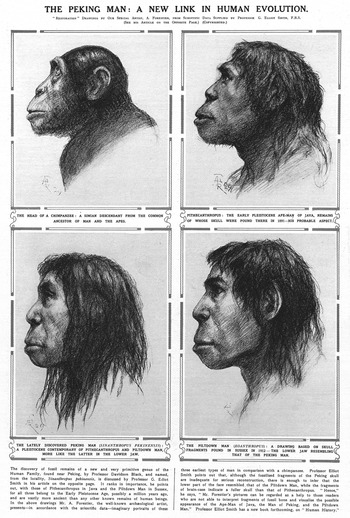
Science was linked with dedication, risk and ingenuity, as the Western scholar overcame danger and dispiriting work. The find itself was no less dramatic. Some well-established specimens, such as Heidelberg Man, were known only from a single mandible, and interpretations of the Piltdown specimen depended on its ‘ape-like’ jaw. Jaws were also important indices of development: one of the prime posited trajectories of human evolution was that the jaw receded as the growing brain pushed it backwards, and implements took the place of biting teeth. This jaw did not disappoint, being classed as primitive, but not as strongly developed as the Piltdown specimen. Therefore it was a convincing precursor within contemporary evolutionary theory. The Illustrated London News used this to reconstruct a full head of Sinanthropus as a ‘New link in human evolution’, third in line alongside a chimpanzee, Pithecanthropus, and Piltdown Man.Footnote 55
The only thing more exciting and indicative than a jawbone was ‘our friend the skull’, and one was found in December by Pei Wenzhong, a Chinese fieldworker at the site. The publicity did not initially run too smoothly: news was leaked a week ahead of schedule to The Guardian,Footnote 56 and Nature managed to garble the story by reporting that ten headless individuals had been discovered rather than a single cranium.Footnote 57 However, this was largely forgotten when the skullcap was officially announced at another public symposium in Peking on December 31. The presentation of an exciting find was mixed with suspense and mystery over what it would reveal once it was fully extracted. The Times reported that it was ‘still largely embedded in hard travertine, which will require a couple of months of difficult and delicate work to remove’.Footnote 58The Guardian continued with stories of diligent expertise: ‘the removal of the rock in which the skull is embedded is a delicate task calling for the skill and dexterity of a dentist’.Footnote 59 Fossil preparation, far from being dull and technical, was a suspenseful and meticulous process of unveiling, particularly when combined with Black's knowledge of cranial anatomy:
Interviewed in his ‘workshop,’ as he terms the Cenozoic Research Laboratory … Dr. Black drew attention to the evident frontal bulges, which suggest that Peking Man distinctly had the advantage of his Java neighbour in the matter of intelligence. There is every reason to suppose, Dr. Black feels, that Peking Man possessed that capacity for reflection which sets man apart from the rest of the animals, further speculation as to his mental development must be postponed until the inside of the skull has been examined and the brain content actually measured.Footnote 60
Technical care, expert knowledge and (moderated) interpretation of the mysteries of the brain all shone from this work, which promised to offer unprecedented insight into primitive humanity.
Illustrated London News, 29 October 1929, copyright Illustrated London News Ltd/Mary Evans.

The importance of the skull was emphasized when Grafton Elliot Smith travelled to China in 1930 to lend his authority to the site and the specimens. The Daily Express went so far as to feature a portrait of Elliot Smith flanked by a Chinese temple and a reconstructed Neanderthal, under the evocative title ‘Quest for the missing link’,Footnote 61 casting UCL's aged professor of anatomy as a dashing global adventurer. On his return overland across America, ‘carrying the flaming cross for the [Chinese Geological] Survey and Sinanthropus’,Footnote 62 he delivered lectures in Chicago, New York, London, Manchester and Edinburgh, proudly displaying his cast of the skull and recounting his ‘mission of ancestor worship in China’. He praised
the organising ability and tact of Dr Wong Wen-hao, the Director of the Geological Survey, who in the face of immense difficulties, which were intensified by the economic and political circumstances in China, has maintained the work in the field and in the laboratories and secured prompt publication of the results …
and spelt out the significance of the research:
The brain-case found by Mr W C Pei at Chou Kou Tien … is the most significant and illuminating relic of primitive man ever recovered … As all these fossils belong to the same geological epoch, the Lower Pleistocene, there can be no doubt of the age of Sinanthropus … the discoveries in China were due not to the happy chance of one inspired individual finding a fossil and appreciating its significance. Sinanthropus has been made known to us as the outcome of a comprehensive search extending over several years, in which a team of investigators of different nationalities participated.Footnote 63
Elliot Smith's characterizations and the united front at the site were aimed at both the scientific community and the broader public to forestall any criticisms of method, to emphasize the role of local scientific organization, and to frame these in the most dramatic terms possible. This not only gave the discoveries credibility, but provided an optimistic and exciting image of scientific activity, presented in comprehensible terms as methodical, international and adventurous, driven by dynamic individuals overcoming adversity. The science of human evolution presented a sensational narrative which ‘reads like a detective story – a story in which a large army of detectives set themselves to track down from inadequate clues a non-existent criminal’,Footnote 64 and not the speculative ‘jum-jum’ of the greybeards at the British Association. These narratives, however, maintained and drew from established hierarchies. Not only were the principal researchers Western – with Chinese workers only presented in subordinate excavatory and organizational roles – but stereotypes of traditional Chinese culture and local warfare remained crucial to the presentation (and, indeed, were part of the problems that the dynamic scientist needed to overcome). As such, the very act of creating the narrative around the excavation had the effect of washing out some of its main participants.
The significance of Peking Man
The excavations could be represented as exciting, modern, cooperative science. However, the interpretation of the unearthed specimens raised different implications and questions, namely what did Sinanthropus himself (or, less frequently, herself) represent? Was it human, an ancestor, ‘the missing link’, or yet another ‘failed experiment’? As was always the case in human evolutionary studies, the answers operated within set motifs. A sophisticated literature has developed on the mythic implications underpinning palaeoanthropological models. Wiktor Stoczkowski and Misia Landau have shown the prevalence of conventional narratives of triumph over the environment through technology and ‘hero's journeys’ through bipedality, leaving the trees, tool use and sociability, all with connotations of golden ages and natural innocence, or (conversely) innate savagery and violence.Footnote 65 In the accounts of Sinanthropus, these motifs can often be seen, but were subject to uncertainty and general reflection on human nature. The specimens, and their placement alongside other hominins and modern humans, seemed to raise more questions than they answered, and it was their mysterious character which seems to have generated interest, rather than any ability to present myths of origin.
The broad interpretation of the remains were: human teeth set in a primitive jaw, heavy brow ridges, thick skull bones and a braincase of around 1,000 cm3 – above that of Pithecanthropus, and just below the lower limits of modern humans. In the initial reports, Black compared Sinanthropus with a range of specimens (although notably not the Piltdown skull), identifying similarities with Pithecanthropus, but noting that the larger brain and more developed teeth showed it as ‘the much more generalised and progressive type’. He classified it as ‘pre-Neanderthaloid’, owing to the thick bones and large brow ridges. Given the wide knowledge of Neanderthals, this was the least-controversial possible interpretation. Yet placing the creature on the Neanderthal ‘stem’ had other implications, when coupled with the continued ‘pendular’ interpretation of Neanderthals, with Keith and Elliot Smith in particular regarding them as brutish, shambling extinctions. While Sinanthropus ‘could not have been far removed from the type of hominid from which evolved both the extinct Neanderthaler and the modern Homo sapiens’,Footnote 66 it was still likely to be on a branch which did not lead to modern humans.
This raises the point that – after the gamble of the tooth – the scientists in China tended to be cautious. Black, the international face of the excavations, was willing to publicize the specimen and receive the appropriate accolades: Royal Society election was engineered by Keith and Elliot Smith in 1932, and he delivered the society's Croonian Lecture in 1934 on Peking Man. However, he was always moderate in interpretation. He wrote to his superiors,
Yes, Sinanthropus is growing like a bally weed. I never realized how great an advertising medium primitive man (or woman) was till this skull turned up. Now everybody is crowding round to gaze that can get the least excuse to do so and it gets embarrassing at times. Being front page stuff is a new sensation and encourages a guarded manner of speech!Footnote 67
The scholars in China were aware of the significance of their discovery and the level of interest it could generate, but became reluctant to make grand claims. Their primary strategy was to build authority and credibility through the productivity of the site; the management of news and material; and control over access, information and specimens, rather than making huge interpretative judgements on human origins. That they were operating on what was still defined as the international scientific periphery also ensured that evidence needed to be presented in as watertight a manner as possible, to offset any criticisms of their expertise.
However, this was not the case with many scholars outside China. When presented with casts of teeth and skullcaps, they worked these into their preformed narratives of human development. British journals continued to feature critical foreign authorities, such as Aleš Hrdlička and Eugene Dubois, who argued that Sinanthropus was a dwarf Neanderthal.Footnote 68 However, most reporting tended to rely on direct news from the site or on national experts, particularly Keith and Elliot Smith – who both took advantage of the attention. Elliot Smith produced a cheap volume on The Search for Man's Ancestors in 1931, ‘dedicated to Davidson Black, in whose genial society the author first visited the three sites [Piltdown, Java, and Peking] with which this book is concerned’.Footnote 69 He saw Sinanthropus as an intermediary between the ‘degenerate’ Pithecanthropus and the later Piltdown Man, thereby filling a crucial gap in the evolutionary record, and bolstering ideas that human evolution depended on the steady growth of the brain. Keith, meanwhile, in New Discoveries Relating to the Antiquity of Man, heralded the discovery as ‘one of the most important events which have marked the opening-up of man's early history’.Footnote 70 He placed Sinanthropus at an important basal position within his bushy outline of human evolution, ‘already human in size of brain but showing a strange mix of characters, both old and new, in jaw and tooth’.Footnote 71
More popular reports tended to present Peking Man in more mysterious terms. Much grew from the persistent lack of clarity over the time and place of human origins. The geological era – the early Pleistocene – meant little to the broader public, and suggested dates varied between 100,000 and two million years. This allowed picturesque details to colour the reporting, with speculation that Sinanthropus was a ‘desirable tit-bit for his neighbours the hyena and sabre-toothed tiger, who in those days made the Western Hills less attractive as a summer residence than they are to-day’,Footnote 72 and jokey contrasts that the cave-dwelling Sinanthropus had not ‘reached at that time the “bungaloid” stage of existence’.Footnote 73 Yet more importantly, it allowed Sinanthropus to be presented as contemporary with the other earliest specimens, Piltdown Man and Pithecanthropus. This linked to one of the key problems in palaeoanthropology: the location of early human evolution. Throughout the discussion, no one suggested that Peking Man proved a Chinese origin for humanity. Sinanthropus was presented as too advanced to be the earliest possible human precursor, and the wide spread of other specimens placed their common origin further afield. Elliot Smith, placing Peking, Java and Piltdown man together, wrote,
The discovery of three such contrasted types at the beginning of the Pleistocene period on the extreme fringes, east, south, and west, of the vast domain of man suggests two reflections. Their common human ancestor must have lived long before them, in the Pliocene Period, to allow time for such profound contrasts to be developed. A variety of experimental types of the human family, grotesque caricatures of mankind, must have been roaming about in the heart of the great continent, working out the destiny of man, at the time when Nature was throwing the jetsam and flotsam of her failures into Java, Sussex and China.Footnote 74
Arthur Keith also noted that these types differed ‘far more than the negro now does from the Chinaman’, which gave credence to his own idea of the ‘extraordinary diversity of the races, species, genera of mankind which populated the world in Pleistocene times’.Footnote 75 Human development stretched into deeper eras, and the true site of human evolution must have been elsewhere. It was still Central Asia or, for Elliot Smith, the Middle East which retained the greatest hold. On some levels this was down to the dispersal of finds. References and maps abounded of Piltdown Man in Sussex, Rhodesia Man and the contentious Taung skull in southern Africa (both discovered in the early 1920s), Java Man in South East Asia, and Peking Man in China, seeming to demonstrate that their common point of origin must be in the middle. However, this also drew off long-standing traditions of centres of dispersal, and inner Asia as the ‘Garden of Eden’ for mankind – as had been presented in Black's depiction.
Despite these evocations of a multi-species human past, much of the public debate revolved around Sinanthropus's possible status as ‘the missing link’, drawing off wide interest in this cultural motif.Footnote 76 In many respects, the story of linear progression through tree-dwelling chimpanzee, shambling Pithecanthropus, generalized Sinanthropus and large-brained Piltdown Man was the more graspable and resonant narrative that many wanted to be told. However, while featuring frequently in media depictions, this was something which scientists and the more respectable press often sought to correct: Elliot Smith wrote that ‘it is premature to claim him as our ancestor or to apply to him the misleading term “missing link”’,Footnote 77 and The Times stated that ‘although not the “missing link” in the popular sense, the Peking man has been described by scientists here as a cousin to the dawn ancestor of man’.Footnote 78 Yet the fine differentiations of ‘closer to the original type’ were continually occluded. Not only did scientific uncertainty over the phylogenetic relationships between Pithecanthropus, Neanderthals, Piltdown Man, Sinanthropus, the new African fossils and modern humans prevent definitive statements (thereby making it unclear exactly what the ‘original type’ was), but the models of Keith, Elliot Smith, Black and others still saw the growth of the brain and loss of bestial features as the key trend in human evolution. Despite the bushy trees of human existence and doubts placed on the term ‘missing link’, ideas of progress on a clearly runged ladder persisted.
Debates on human evolution spread out more widely. The BBC, following its contemporary commitment to education and improvement,Footnote 79 featured Peking Man in several radio broadcasts. In 1932, the biologist and anthropologist John Randal Baker gave a history of the find, discussing the germination of the research with Davidson Black, the ‘momentous discovery’ of the uncrushed skull by ‘a Chinese geologist, Mr. Pei’, and its publicization by ‘Sir Elliot Smith’ (who needed no introduction). Not only were the Java, Piltdown and Peking skulls connected as ‘the three missing-link skulls, though the term is, of course, no longer suitable’,Footnote 80 but a degree of audience participation was encouraged. Casts of the skulls were viewable in museums around the country, and the listener was also told,
If you put a finger on your head just above your ear, and move it across the top of your skull and down to the other ear, you will find that your skull is smoothly curved. The Peking skull is not smoothly curved like that. It has a distinct bump on each side opposite the part of the brain which is used for understanding spoken words, and another bump opposite the part concerned in using hand and eye together. This seems extremely significant. It looks as though man was just beginning to speak and use tools. As his brain swelled in the appropriate places, so his brain-case enlarged unevenly.Footnote 81
This exercise in practical evolutionary neurology drove home how similar Sinanthropus was in brain structure and capacities, but also how unfinished and rough it was. The brain was fully formed in the self-enlightening radio listener, but still struggling and raging in the early Pleistocene, swelling unevenly to reach true humanity. Further contributions in this idiom were made by Ernest Barnes, the Bishop of Birmingham, who gave a sermon which was equivocal on the status of Sinanthropus, but not on what characterized humanity:
Had Peking Man moral instincts? Did he strive to live by an Inner Light, however dim? If so, he was on the side of the immortals. If so, though the sub-species to which he belonged had passed from the earth, it was not unrepresented in the realm of God where nothing of value was ever wasted.Footnote 82
The question – where humanity arose – was unanswerable. However, it did imply what humanity was: thinking, spiritual and progressive. The common thread was not a search for a primeval ‘golden age’, but the earliest glimmerings of human potential.
The next dramatic discovery at Zhoukoudian was in late 1931: evidence of tools and fire. Prior accounts had been careful to note that ‘though thousands of cubic meters of material from this deposit have been examined, no artifacts of any nature have yet been encountered nor has any trace of the usage of fire been observed’.Footnote 83 This was important. These were crucial indicators of mastery over the natural world and capacities for technology, building into the long-standing notion of Homo faber – ‘man the tool-maker’.Footnote 84 Yet Sinanthropus had already been established as an ancient creature, living ‘prior to the Ice Ages’ in a low, almost half-ape, state. The chipped quartz flakes were so potentially controversial that they required the backing of an international authority – although in this case French rather than British, taking advantage of links in personnel and the long-standing French predominance in prehistoric archaeology. Pierre Teilhard de Chardin, a Jesuit working at the site, took several pieces to Henri Breuil in Paris, a world-renowned expert in palaeolithic artefacts, who, like Elliot Smith, visited China in 1931.Footnote 85
Once ‘the famous French palaeontologist’ had publicly authenticated the stone tools, they were again reported throughout the press.Footnote 86 For supporters of Sinanthropus, the tools demonstrated that it was ‘truly human’. Black aligned them with recently discovered collar and wrist bones to indicate that Sinanthropus was ‘fully capable in view of his mental and physical organisation of being the sole artificer of the cultural debris associated with his skeletal remains’.Footnote 87 The endocranial cast showed how ‘the brain of this form was in all essentials a typically human one. It is further probable that Sinanthropus was right handed and had evolved the nervous mechanism for the elaboration of articulate speech’.Footnote 88 Elliot Smith reinforced this in The Times:
It is no longer justifiable to regard Sinanthropus or Pithecanthropus as subhuman, nor to assume that they lacked the attributes of vision and skill which are distinctive of the status of true men. The shaping of pieces of quartz to make tools bears witness to their manual skill, as the making of fire does to their intelligence and inventiveness.Footnote 89
The prime markers of humanity were therefore language, intelligence and creativity, and had developed deep in the evolutionary past.
There was some resistance to these finds, although more relativizing than controverting them. Arthur Smith-Woodward wrote how this gave credence to burned flints which had been discovered at Piltdown, and how ‘the beginning of human arts, indeed, dates back to immense antiquity, before man had assumed his present form’.Footnote 90 The archaeologist James Reid Moir (a long proponent of a deep human prehistory into the Tertiary) drew attention to his own discoveries of apparently much older artefacts in East Anglia, which indicated that ‘at Chou Kou-tien there existed a people in a state of culture long superseded in other parts of the world, and that, even in those far distant times, there were “backward” races even as there are to-day’.Footnote 91 This was not a general position, with Moir's own findings being rather contentious, but a more significant issue was that the tools had not changed throughout the long habitation of the site. This showed that a more important aspect of human culture – progress – was not present: Sinanthropus ‘lived in his cave for hundreds, perhaps thousands of years, with no sign of progression in knowledge or skill’.Footnote 92 Peking Man may have been a tool-maker, but he was not going to advance towards civilization, and was thus yet another dead end in the trail to modern humanity, which was classified more through society and complexity than through the simple chipping of stone.
Devaluations of the capacities of Sinanthropus were matched by the continuing uphill struggle in highlighting the Chinese contribution to the project. Bohlin had left in 1930, leaving the excavation entirely in Chinese hands (supervised by Pei Wenzhong and Yang Zhongjian). While Rockefeller organs presented this as an indicator of Chinese scientific adaptability, this only unevenly made its way into the British press, where reports always presented Chinese workers in a subordinate (and often anonymized) role. The Guardian reported rather patronizingly that ‘the Chinese geologists and anatomists … control a large number of cheery and intelligent Chinese labourers, whose manner of life in this strange, bare country, we could study on the cinema screen to-day’.Footnote 93 And as late as August 1937, one Lieutenant-Colonel H. Smallwood (Retired) wrote a rather aggrieved letter to The Times:
you credit Mr. Pei, of the Geological Survey of China, with the discovery of the Peking man, probably the earliest form of homo sapiens [sic] yet discovered. While anxious to give any credit that is due to Chinese scientists, I must point out that the Peking man was discovered by a Canadian, the late Dr. Davidson Black … Dr. Black's romantic discovery was described by him in London when he gave his lecture on the subject to the Royal Society. I think I may say that his election as a fellow of that most learned of all societies was a recognition of his work in connexion with the discovery of the Peking man.Footnote 94
When Pei's discovery was acknowledged, it was often sidelined compared to the scientific work conducted on it. The Daily Mail noted that ‘although it was Mr. Pei who actually found the skull, the man who first revealed the tremendous importance of it was Dr. Davidson Black’.Footnote 95 Through the necessity of cooperating and building links with the Western networks, the Chinese contribution was obscured. Science still needed Western expertise and backing by the ‘most learned’ societies of the metropolis to be accepted, and while Chinese workers could be picturesque additions, the ‘romantic’ narrative required a Western hero.
Shifts and splits
Discussions continued in the following years, but were marked by major changes in personnel, when Davidson Black died suddenly and unexpectedly of a heart attack in March 1934. The accounts were evocative. Elliot Smith wrote the obituary in The Times, stating, ‘one's feelings are apt to be swamped by the sense of personal loss of a man of exceptional generosity and loyalty. It is no exaggeration to say that he has done more for human palaeontology than anyone else’.Footnote 96 The Rockefeller Foundation lost no time searching for a replacement, sending representatives from their Paris office to Keith and Elliot Smith, as the two most qualified experts to offer recommendations. After a series of proposals, including Solly Zuckerman, George Gaylord Simpson and Frederick Wood-Jones, the position went to Franz Weidenreich, formerly professor of anatomy at Frankfurt, who had been forced out due to his Jewish origin following the Nazi takeover. While the initial plans had only called for someone to ‘to clean up work already started, rather than for a man whose primary interest would be in opening up new work’,Footnote 97 further discoveries provided momentum to continue: fourteen significant pieces of Sinanthropus skull had been discovered by 1937,Footnote 98 which presented an unprecedented collection of specimens. An oft-repeated sound bite from Weidenreich called this ‘the richest and most complete collection of human fossils ever recorded, unique in every respect’.Footnote 99
However, connections with Britain became problematic. Weidenreich had been socialized within the German liberal tradition of physical anthropology of the 1890s and 1900s, and the debates he engaged with – Ranke's theory of human pygmoid origins, constitutional body types and complete rejection of Piltdown Man – were divorced from the British context.Footnote 100 The scientific reports from Zhoukoudian therefore became less penetrable for British researchers. The networks were further disrupted when Elliot Smith died in 1936. So striking had been his role that obituaries were headlined ‘Death of “Peking Man” expert’ and ‘Peking Man inquiry made him famous’.Footnote 101 While this led to a brief upsurge in reporting on Zhoukoudian, it ensured that the supply of casts and stories to Britain – as had been such a feature of the Black period – dried up. The field researchers likewise built wider links: Weidenreich preferred to work with American institutions and other German expatriates, and when Pei Wenzhong went to Europe for his doctorate, he studied in Paris under Breuil,Footnote 102 although he visited Britain and continued corresponding with Keith.
When news did appear, it was presented in highly charged terms, and the evolutionary story connected to growing debates on human brutality and racial differences. Any valuations of Peking Man as an early tool user needed to be contextualized alongside more grisly details: more and more skulls were discovered, but very few other bones were found. Many were also cracked and broken, and had apparently been fossilized in this condition. That ‘we had found Peking man at home’ was now becoming rather unseemly. The first long bone, a femur discovered in 1938, was described by Weidenreich as having been broken ‘to extract the marrow, proving the practice of cannibalism by Peking Man, which was first suspected when it was noticed that all the skulls found had been broken as if to extract the brain’.Footnote 103 The question – human ancestors: masters of quartz and fire or disgusting cannibals? – seemed to ring out.
But there was not necessarily a contradiction here. Elliot Smith's models of essential human goodness were becoming less convincing in the light of a destabilizing international context. ‘Baby-eating “Pekin Man”’Footnote 104 had lived in a harsh, cold, dangerous environment, beset by sabre-toothed cats and hyenas, and huddled in a dark cave for thousands of years, indiscriminately eating bison, horses, rhinoceroses and its own fellows while filth and refuse collected around. It was the slow move out of bestial conditions and onset of progress which was the characteristic of humanity, rather than inevitable steps forward. The developmental leaps – bipedality, language, fire, tools and settled habitation – all seemed to have been developed far back in time. Yet human morality required more sustained progress, and was separate from technical mastery over nature.
While ascertaining cultural and moral linkages from the time of Sinanthropus was difficult, biological connections actually became more frequently asserted. This was part of sharpening debates on race, as the rise of National Socialism and disputes over eugenics led scientists to take sides, formally and publicly, in intense politicized disputes.Footnote 105 Palaeoanthropology, which had long claimed authority to define the origin and differences between racial types, was strongly involved in this discussion, and Sinanthropus was marshalled for various positions. In contrast to earlier characterizations of Sinanthropus as a doomed extinction, Weidenreich emphasized ancestry. Morphological links between Sinanthropus and modern Asian populations (particularly that both were seen to share ‘the shovel-shaped incisor’) indicated racial continuity from this deep past. A further important discovery was made at Zhoukoudian's ‘Upper Cave’ in 1933: a later series of skulls of anatomically modern humans from the Upper Palaeolithic, accompanied by decorative items of teeth and shell, and stone and bone implements. Two features were marked out. First, they were judged by Weidenreich to represent a variety of racial types – Ainu, Melanesian and Eskimo. Second, they all seemed to have died violently. The Times reported the story under the lurid headline ‘Stone Age massacre’:
All seven people must have met violent deaths, for their skulls were clearly damaged by both blunt and pointed weapons, while the scalp still covered the bone … Undoubtedly, says Dr. Franz Weidenreich, who is the authority on the Peking Man, Chinese existed in this area at that time, and these seven people may have met their deaths at their hands.Footnote 106
As well as presenting the find in the sensational idiom of the crime scene, this account emphasized primitive racial warfare. Yet Weidenreich actually sought to minimize the importance of the racial differences he had uncovered. The links between Sinanthropus and modern Asians did imply that human types had developed in particular locations. However, if peoples as diverse as Native Americans and Melanesians lived together in Asia at the time of the Upper Cave, this indicated that movement and mixture were also deep-rooted processes, and races had continually mingled down the ages. The differences between modern humans were therefore only differences in proportion of mixing, rather than radical differences in quality – a continuation of the models Weidenreich had developed in the 1920s, yet now presented to an international audience and directed against the harder racialism in Germany itself.Footnote 107
Back in Britain, Arthur Keith agreed with these details, but interpreted them rather differently: similarities between Sinanthropus and modern Chinese populations, and between Pithecanthropus and Australasian skulls, indicated that the differences between racial groups stretched far deeper into the evolutionary past than had previously been thought. From the late 1930s, he argued that the five current ‘divisions of mankind … Australasian, African, Indoasian, Sinasian and Caucasian’, had diverged and followed parallel courses of development from the beginning of the Pliocene, a provisional seven million years ago.Footnote 108 Dismissing ideas of dispersal from a common centre as ‘little more than a modified version of the account in Genesis of “Shem, Ham, and Japheth,”’Footnote 109 Keith deployed a multiregional perspective to argue that human races did not have common origins, but were dispersed breeds which underwent ‘independent transmutations of simian markings’ to reach common ‘sapiens’ status.Footnote 110 Key developments, particularly in the brain and endocrine systems, had occurred separately and potentially highly divergently. Palaeoanthropology could therefore sharpen notions of racial difference, and posit essential distinctiveness.
Racial analyses were not the only things which were embroiled in the increasingly tense atmosphere. The figure of the caveman became more prominent from the mid-1930s, becoming used to further question ideas of progress. A reflection in the Daily Mirror, coinciding with the British Association meeting of 1935, poignantly asked,
Poor dawn man, learning to walk erect and look at the stars in wonderment. What was he really like; how did he think and live?
All that is left of him is a bone or two to mystify the professors of anthropology.
And so they ponder and argue and theorise, put the dawn man into a catalogue and try to give him a date.
From our immense height of knowledge and power, we look down on our primitive forerunners against their background of remorseless nature.
What progress we have made. Nature has been tamed. Every day we discover some secret of the universe.
We possess enough intelligence and sufficient machinery to make our age a golden one.
What will the anthropologists say, ten thousand years hence, over the discoverable relics of our extraordinary time?
What, indeed, will be the verdict on our civilisation?
Have we but slightly emerged from the position of dawn man, or are we as an experiment at the point of twilight?
The professors prattle on about our inscrutable forebears. A Senator has been shot in America, three hundred turrets of death have been erected in France, an Italian Dictator is preparing to march into Africa, still more people have been butchered on the roads.
We are getting on nicely, thank you, but not quite as quickly as the dawn man probably hoped.Footnote 111
Doubt was being cast on the issues raised by human evolutionary studies, particularly whether humans had actually advanced beyond the condition of their low but hopeful ancestors, whether civilization since then continued to be viable, and if the very interest in human origins was anything other than a vain pursuit. Growing scepticism was mixed with evolutionary ideas of ‘failed experiments’, raising doubts as to exactly how progressive and beneficial modern society really was. Progress and humanity were not simply steps on an evolutionary road, but more mysterious forces which were difficult to judge without deep reflection.
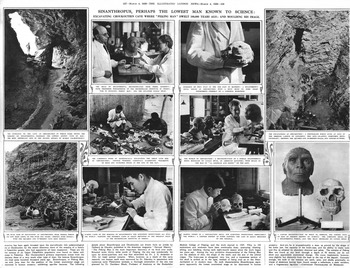
The Illustrated London News attempted to keep an optimistic message, with a double-page spread in March 1939 depicting work on Sinanthropus, showing diligent workers excavating the site, studying fossil material, and reconstructing the skull.Footnote 112 Yet by then, the Sino-Japanese War had forced the suspension of excavation, even if laboratory work continued in Peking until Weidenreich's departure for the United States in 1940. Media reports became increasing troubled, persistently referring to the dangerous situation. The Daily Express wrote how
shells aimed at the Chinese concentrations near Choukoutien, are falling near the cave of the Peking Man – the oldest habitation of man on earth … A direct hit by a single shell would wipe out the world's most promising site for revealing secrets concerning the life of man's ancestors. American archaeologists have been excavating there.Footnote 113
Reports were tinged with pessimism and violence, quite a contrast from the exciting detective stories and evocative mysteries of earlier years. The outbreak of the war between the Allied powers and Japan put an end to the research – and to the specimens themselves, which disappeared in the chaos. When reports refocused on Sinanthropus in the post-war period, they were presented in new terms, with American soldiers hunting the bones in Japanese museums, Western scholars engaging in furious disputes with Chinese Communists, and suggestions that the specimens had been ground into medicine by superstitious peasants. While casts of the lost skulls remained in British, American and Chinese museums, the direct connections were broken.
Illustrated London News, 4 March 1939, copyright Illustrated London News Ltd/Mary Evans.

Conclusion
This paper has traced a number of strands to illustrate how an international scientific find was debated and promoted within a particular national context, where it was worked into debates on the importance of science in the modern world; the elaboration of formerly unknown areas of the past; and meditations on progress, racial difference and human nature. It can be seen that public scientific debate in interwar Britain constantly needed to be translated into familiar motifs. Credibility and authority were expected alongside dynamism and excitement. This aided the presentation of the research, yet conditioned the ways it was interpreted. The discussion of the excavations, involving the collection of large numbers of specimens by a local team of scientists linked to major metropolitan scholars, was used to build credibility. The work and its organization were a key aspect of this, but the personas adopted by the scientists were also crucial, varying between the detective, the self-sacrificing adventurer, the heroic explorer and the metropolitan patrician. While this directed individuals and reports to adopt particular strategies, it also occluded certain aspects of the research – most notably the Chinese involvement, which was often either glossed over or unacknowledged, despite the efforts of the scientists on the ground.
The interpretation of human origins followed a similar course. In some respects, mythic themes can be identified, particularly in the models of major scholars, such as Keith, Weidenreich and Elliot Smith. Yet the discussion of Peking Man itself revolved more around the mystery of how human status and origins could be defined than around the construction of clear genealogies and easily graspable myths. Debates on the character of the bones and artefacts attempted to slot Sinanthropus into pre-existing conceptual categories, as either one or a combination of ‘missing link’, ‘grotesque caricature of mankind’, ‘cannibal murderer’, ‘distant ancestor’, ‘lost relative’ or ‘generalised and progressive type’. Yet despite these variations, common models existed across both scientific and popular contexts. Human development depended on latent progressive capacities, whether these be moral, technological or neurological, yet stopped and started in an uneven manner. It was widely assumed that advancement should be part of this process. However, this was not guaranteed. The ways this evolutionary progress had occurred and which early types were included within humanity were unclear. This uncertainty was built across – and to some extent drove – the discussions.
This does not mean that this leaves a confused picture, as this very uncertainty was key to the debates. Common across the discussion of both the role of science in the modern world and the deep evolutionary descent were prolonged meditations on progress and the fundamentals of humanity. Human endeavour – from the depths of the Pleistocene to the science of the modern world – required exertion, striving and mastery over adversity, yet was constantly threatened by confusion, ignorance, warfare and instability. The potential for progress was always present, but this was not an optimistic story of inevitable improvement. It was something which needed management, cultivation and effort to be achieved. Alongside the tales of heroic scientists working against adversity and giving meaning to skulls and tools to show the early advancement of human capacities were the parallel stories of invariable war and conflict, obscurantist pomposity and primeval savagery. What was natural, what was not, what had been surpassed in the dark Pleistocene past and what still remained constant were major issues of debate. While this could feed into a common context of improvement and stability, it also showed how it could be disrupted. Science – in action and in its discoveries – was intrinsically bound with both sides.