Introduction
Companies formulate strategies to achieve a variety of objectives, such as to counter different forces exerted on them, grasp new opportunities, overcome significant problems, fulfil stakeholders expectations (Johnson, Scholes, & Whittington, Reference Johnson, Scholes and Whittington2008), gain advantage over competitors (Hill & Jones, Reference Hill and Jones2010; Porter, Reference Porter1980) and for developing firm's resources and competences (Hamel & Prahalad, Reference Hamel and Prahalad1994). This importance of strategy formulation has captured the attention of managers, consultants, management thinkers and researchers tempting them to look for new approaches to formulate strategies. This has resulted in several approaches to strategy formulation (Ulwick, Reference Ulwick1999).
In the context of strategy formulation, literature provides evidences establishing a connection between the process of strategy formulation and strategy definition. Ulwick (Reference Ulwick1999) stated, ‘many definitions of strategy not only attempt to define what a strategy is, but they also contain information or provide insight as to how a strategy is created’ (p. 3). He further added that authors ‘do not define what a strategy is rather they define the process of strategy formulation’. Parthasarathy (Reference Parthasarathy2008) also had a similar opinion when he analysed Ansoff (Reference Ansoff1965)'s definition of strategy stated as ‘deliberately designed plan to achieve firm's end’ or Andrews (Reference Andrews1980)'s definition stated as ‘decision and actions that align a firm's strengths to industry opportunities and threats’. In both the definitions, the authors defined strategy as a formulation process. Similarly, Porter (Reference Porter1996: 68) stated ‘strategy is the creation of a unique and valuable position, involving a different set of activities’. Here, the word ‘creation’ implies a process (Casadesus-Masanell & Ricart, Reference Casadesus-Masanell and Ricart2009) of strategy formulation.
In some cases, the strategy has been defined as ‘adapting to change’, and in some other situations, it is defined as ‘matching the internal and external forces’. In both the definitions, a process aspect of the strategy is discerned clearly from the keywords adapting and matching. Hill and Jones (Reference Hill and Jones2010), referring to works of Ansoff (Reference Ansoff1965), Andrews (Reference Andrews1971), Hofer and Schendel (Reference Hofer and Schendel1978), Brews and Hunt (Reference Brews and Hunt1999), and Grant (Reference Grant2003), have said that strategy making is a formal process.
From the above discussions, it is obvious that strategy has been defined as a process of formulation. Therefore, an analysis of a diverse set of definitions can bring insight into the existence of various approaches to strategy formulation.
Some authors have analysed multiple definitions provided by other authors. For example, Xavier (Reference Xavier1993) stated that strategy can be used in four different ways – to achieve long-term objectives of the organisation (Chandler, Reference Chandler1962); finding a match between organisational resources and opportunities in the external environment (Mintzberg, Reference Mintzberg1979); as a vehicle for achieving competitive advantage (Porter, Reference Porter1985); or a mechanism for coping with turbulent environment. Xavier, thus, highlighted four approaches to strategy, namely the Planning approach, the Fit approach, the Positioning approach and the Emergent or dynamic adaptation approach, respectively, all emphasizing a process while defining strategy.
Bracker (Reference Bracker1980, Table 1) analysed 17 definitions and concluded that strategy formulation involves the determination of a firm's posture through environmental analysis followed by the realisation of goals through appropriate use of resources. He was referring both to the formulation process and the actual implementation of strategy.
Definitions published in different periods

Ronda-Pupo and Guerras-Martin (Reference Ronda-Pupo and Guerras-Martin2012) analysed 91 definitions published between 1962 and 2008 using Content analysis. They discussed how the structure of strategy definitions has shaped new research areas during the development of Strategic Management. Their study hitherto is the most exhaustive work using strategy definitions. While the research objectives of their work are on studying the evolution of research in the strategy field, the present study is based on identifying the different approaches to strategy formulation. Further, the sample size of the current study is quite large.
Though some other authors like Chaffee (Reference Chaffee1985), Karlöf (Reference Karlöf1987), Mintzberg, Ahlstrand, and Lampel (Reference Mintzberg, Ahlstrand and Lampel1998), Gilbert, Hartman, Mauriel, and Freeman (Reference Gilbert, Hartman, Mauriel and Freeman1988), Whittington (Reference Whittington1993), Elfring and Volberda (Reference Elfring and Volberda1994), De Wit and Meyer (Reference De Wit and Meyer1994), Näsi (Reference Näsi1995), McKiernan (Reference McKiernan1997) and Luoma (Reference Luoma2014) had not used definitions for analysis, their works had made significant contributions in the field of strategy formulation. In their works, they used different terminology such as schools of thought, perspectives, frameworks, models to indicate the term strategy formulations. However, the conclusions drawn from their studies were mostly fragmented (may be in view of their study objectives). Apart from Mintzberg, Ahlstrand, and Lampel (Reference Mintzberg, Ahlstrand and Lampel1998), though the authors had given the impression of one or other approaches to strategy formulation, they neither had given the whole picture nor provided insights on the relative importance of the different approaches.
The studies discussed above point to the existence of the following gaps in literature: (1) studies on strategic approaches are generally qualitative and not a single one has been empirical in nature; (2) there is hardly any study which dealt comprehensively with different approaches to strategy formulation; (3) studies investigating life cycle of approaches are almost absent; (4) studies on relative importance or dominance of such approaches are totally nonexistent.
The current research provides an empirical investigation on the development of different approaches to the formulation of strategy between 1938 and 2015. Such a study may provide insights on how approaches to strategy formulation changed their direction in different periods and determine the ex post facto priorities of authors on different approaches. The emergence and development of different strategic approaches over the periods may provide insights to practitioners in their search for sources and reasons underlying a firm's competitive advantage in different periods.
This paper covers 273 definitions of the strategy published during 1938–2015 using Content analysis. By extracting nouns appearing in these definitions and by analysing them, the paper offers to provide evidence on three aspects: interpretation of different approaches to strategy formulation from the definitions, their life cycle and finally, the dominance of approaches in different periods. In a way, it attempts to shed light on emphasis attached by authors and researchers to different approaches in different periods. Accordingly, the objectives of the paper are: (1) to find out based on the literature survey, if there are specific approaches to strategy formulation identifiable from the definitions; (2) to find out the life cycle of these approaches; and (3) to find out any approach to strategy formulation that has been more dominant than the other approaches.
To achieve these objectives, the 273 definitions were analysed to identify strategic approaches expressed in them. The period 1938–2015 was divided into seven subperiods. The definitions were deconstructed to separate nouns present in them. The analysis of these nouns gave conceptual elements of an approach to strategy. This was followed by segregating nouns with similar meaning into different categories called ‘word families’. The frequency of occurrence of these word families in different periods showed the approaches followed in those periods, their life cycles and dominance of certain approaches over others.
Review of Literature
Authors in strategy have provided a few hundred definitions of strategy over the last seven decades and each of these definitions is relevant in certain contexts (Mintzberg & Lampel, Reference Mintzberg and Lampel1999). Though the definitions discussed in the previous section provide insight as to how strategies are formulated, such an aspect is not reflected in others. For example, the process aspect in strategy is not reflected in Tilles's (Reference Tilles1963) definition who defined strategy as ‘a set of goals and major policies’. Similar interpretations can be made from Cummings's (Reference Cummings1993) definition which stated strategy as ‘knowing the business you propose to carry out’ or from Paul's (Reference Paul1983) definition given as ‘the set of long term choices the programme leaders make in terms of goals, services, policies and action plans’. However, on preliminary analysis of several definitions, it was observed that a vast majority of them had suggested the process of strategy formulation. In view of this, strategy definitions were used here to identify different approaches to strategy formulation.
In this section, literature has been reviewed in two aspects. The first aspect identifies different approaches as interpreted by authors from the definitions and the second involves identification of important periods in which the approaches originated, continued and decayed. The first aspect is dealt in the following subsection.
Category of definitions of strategy
Authors such as Mintzberg (Reference Mintzberg1978), Litschert and Bonham (Reference Litschert and Bonham1978), Hax and Majluf (Reference Hax and Majluf1988), Chaffee (Reference Chaffee1985), Rajapakshe (Reference Rajapakshe2002) have analysed definitions to understand the central themes or key characteristics of strategy. Based on the similarity of characteristics, definitions have been categorised into separate groups (or strategic approaches) in the remaining part of this section.
Further, it is found that each definition has a central theme – a view endorsed by Mintzberg (Reference Mintzberg1978). Therefore, if the definitions having the same central theme or key characteristics are put together, they can form a category based on such a theme. Thus, there can be several categories or approaches to formulate strategies depending on the similarity of themes or focus. These are explained below.
Planning approach
In planning approach, strategy basically results from a conscious, controlled and sequential process of planning (Mintzberg, Ahlstrand, & Lampel, Reference Mintzberg, Ahlstrand and Lampel1998) for achieving future and long-term objectives of the organisation (Chaffee, Reference Chaffee1985; Richardson, Reference Richardson1994).
In this category, one of the most widely used definition of strategy has been provided by Chandler (Reference Chandler1962: 13) who defined it as ‘the determination of the basic long-term goals and objectives of an enterprise, and the adoption of courses of action and the allocation of resources necessary for carrying out these goals’. This definition, according to Chaffee (Reference Chaffee1985), emphasises on developing the strategy in a systematic, methodical manner following well-directed or sequential actions intended to achieve long-term goals. This highlights the process aspects of strategy formulation through planning approach. Mintzberg (Reference Mintzberg1978) had a similar opinion with Chandler's definition when he said that the definition explains the strategy as developed consciously, purposefully and made in advance and therefore entail the characteristics of planning approach to strategy. Similarly, Hax and Majluf (Reference Hax and Majluf1988) viewed that making a long-term ‘plan’ was the key aspect emphasised in Chandler's definition and therefore fits perfectly with Planning approach.
According to Newman and Logan (Reference Newman and Logan1971: 70), strategies ‘are forward-looking plans that anticipate change and initiate actions to take advantage of opportunities that are integrated into the concept or mission of the company’. In this definition, the strategy has been used to shape the future direction of the firm and therefore the definition suggests the Planning approach to formulate a strategy (Hax & Majluf, Reference Hax and Majluf1988).
The following three definitions emphasise formulating a strategy as a ‘preplan’ as asserted by Rajapakshe (Reference Rajapakshe2002).
• Byars (Reference Byars1984: 122) defined strategy as ‘the determination and evaluation of alternative paths to achieve an organization's objective and mission and eventually, a choice of the alternative that is to be adopted’.
• Bartol and Martin (Reference Bartol and Martin1993: 168) defined strategies as ‘large scale action plans for interacting with the environment in order to achieve long-term goals’.
• Bateman and Zeithaml (Reference Bateman and Zeithaml1990: 179) defined it as ‘a pattern of actions and resource allocations designed to achieve the goals of the organization’.
The central theme observed in each of the above definitions involved making long-term plans, and therefore, these are grouped under the category Planning approach to strategy.
Fit approach
In Fit approach, strategy making focuses on ‘matching’ or ‘aligning’ the internal strengths and weaknesses of an organisation with that of environmental opportunities and threats (Venkatraman & Camillus, Reference Venkatraman and Camillus1984). This view can be observed in the following definitions.
Argyris (Reference Argyris1985: 1) states that strategy is ‘a process of formulation and implementation in identifying opportunities and threats in the organization's environment, evaluating the strengths and weaknesses of the organization, designing structures, defining roles, hiring appropriate people, and developing appropriate rewards to keep those people motivated to make contributions’. In Mintzberg's (Reference Mintzberg1979: 25) view, strategy acts as ‘a mediating force between the organization and its environment: consistent patterns of streams of organizational decisions to deal with the environment’. Formulation of strategy in these definitions has been reflected as a way of acting in response to the opportunities and threats posed by the external environment with organisations emphasizing on the need to obtain a viable match with its environment (Hax & Majluf, Reference Hax and Majluf1988).
Aligning internal factors with external ones can be interpreted from Kay's (Reference Kay1993) definition where he defines strategy as ‘a match between its internal capabilities and its external relationships’. Similarly, Cook (Reference Cook1975: 52) defines strategy ‘as the means by which the firm develops and fully utilizes its competencies and resources to take advantage of environmental opportunities or reduce the impact of externally imposed threats’. In these definitions, Litschert and Bonham (Reference Litschert and Bonham1978) claimed that strategy has been used as a mediating or matching variable with the intention of establishing a relationship between the organisation and its environment.
Another definition worth mentioning here is stated by Hofer (Reference Hofer1973: 3). He defined strategy ‘concerned with the development of a viable match between the opportunities and risks present in the external environment and the organization's capabilities and resources for exploiting these opportunities’.
In all the above definitions, the focus of strategy making has been to create a close fit between ‘strengths and weaknesses’ – the internal factors of the firm with the ‘opportunities and strengths’ – the environmental factors and hence these are categorised into the Fit approach to strategy.
Emergent strategy (or dynamic adaptation) approach
In contrast to the above views, some authors are of the opinion that strategy cannot be formulated in a planned or in a deliberate manner. Mintzberg (Reference Mintzberg1987) argues that strategy can occur by chance or appear unexpectedly or accidentally in organisations and it can be understood by analysing past decisions and studying emerging patterns (Mishra, Mohanty, & Mohanty, Reference Mishra, Mohanty and Mohanty2015). This type of strategy is called emergent strategy and has been defined as a ‘pattern in a stream of decisions’ (Mintzberg, Reference Mintzberg1978: 935). The process of formulating such a strategy is called Emergent approach.
The emergent aspect arises out of the fact that the environment is ever changing where strategy formulation involves adapting continuously to these changes. In the process of adaptation, a planned strategy undergoes several changes resulting in the realisation of emergent strategy. The core of this strategy is continuous or dynamic adaptation (Mishra, Mohanty, & Mohanty, Reference Mishra, Mohanty and Mohanty2015). The following discussions are on key aspects of Emergent approach from definitions.
Hambrick (Reference Hambrick1983: 5) defined strategy as ‘a pattern in a stream of decisions (past or intended) that (a) guides the organization's on-going alignment with its environment and (b) shapes internal policies and procedures’. In this definition, strategy formulation is perceived dynamically to the changing environment (Freeman & Boeker, Reference Freeman and Boeker1984). Another definition advocating the dynamic adaptation characteristics in strategy is given by Andrews (Reference Andrews1980). He defined strategy as ‘a process in which a firm continuously adapts to external conditions so as to be the fittest for its environment’.
In the definitions discussed above, strategy making seems to possess both dynamic and adaptability features and hence they are grouped under Emergent approach.
Positioning approach
Another approach that significantly influenced the strategy thinkers as it brought in the concept of competition into business and educating companies on how to deal with it is called the Positioning approach. Many authors have modelled their definitions on this approach.
Porter, who introduced the positioning approach, defined strategy as ‘deliberately choosing a different set of activities to deliver a unique mix of value’ (Reference Porter1996: 64). The definition guides the firm to occupy an effective position in the market suggesting the positioning aspects of strategy (Nickols, Reference Nickols2012).
Andrews (Reference Andrews1980: 18) defined business strategy as ‘the determination of how a company will compete in a given business and position itself among its competitors’. Here, Andrews directly speaks of strategy as positioning.
Similarly, Galbraith and Schendel (Reference Galbraith and Schendel1983: 156) defined strategy as ‘a consistent pattern or combination of managerial controllable or decision components representing scope, resource deployments, and competitive advantages; and the direction in which these components are shifting over time, which characterize the way businesses tend to compete’. Galbraith and Schendel viewed that this definition strives to answer the question ‘how should a business position itself among its rivals to achieve its competitive advantage?’. Thus, it propounds the positioning aspect of strategy.
The above definitions reflecting the key idea behind positioning are categorised into Positioning approach.
Resource-based approach
According to Barney (Reference Barney1991), the resource-based view (RBV) conceptualises the firm as a bundle of resources which includes all assets, including capability, organisational processes, firm attributes, information, knowledge, etc. Strategy formulation in Resource-based approach involves acquisition or development of resources and their effective utilisation through firm capabilities.
Similarly, Cooper and Schendel (Reference Cooper and Schendel1971: 5) defined strategy as ‘the basic goals and objectives of the organization, the major programs of actions chosen to reach these goals and objectives, and the major patterns of resource allocation used to relate the organization to its environment’. Prahalad (Reference Prahalad1993: 6) likewise defined strategy ‘as more than just fit and allocation of resources. It is stretch and leveraging of resources’.
The overriding theme observed in the above definitions is allocation and utilisation of resources, and thus these are categorised into the Resource-based approach.
Stakeholders' approach
Many authors of strategy who hold classical views tend to argue exclusively in favour of maximizing the interests of the stockholders, ignoring the interests of others such as employees, suppliers, customers, activists and communities. The stakeholders' approach formally recognises that the recipients of the firm's actions are a wide constituency of its stakeholders. Fulfilment of their interest is to be given due consideration while formulating strategy (Freeman & McVea, Reference Freeman, McVea, Hitt, Harrison and Freeman2001; Melé & Guillén Parra, Reference Melé and Guillén Parra2006; Mishra, Mohanty, & Mohanty, Reference Mishra, Mohanty and Mohanty2015).
The idea of including the stakeholders' interests in strategy formulation has been captured by Chaffee (Reference Chaffee1985: 4) who defines strategy as ‘orienting “metaphors” or frames of reference that allow the organization and its environment to be understood by organizational stakeholders. On this basis, stakeholders are motivated to believe and to act in ways that are expected to produce favourable results for the organisation’.
Similarly, Andrews's (1980: 18) definition explicitly incorporates the importance of stakeholders' and is stated as ‘the pattern of decisions in a company that determines and reveals its objectives, purposes, or goals, produces the principal policies and plans for achieving those goals, and defines the range of businesses the company is to pursue, the kind of economic and human organization it is or intends to be, and the nature of the economic and noneconomic contribution it intends to make to its shareholders, employees, customers, and communities’.
Hax and Majluf (Reference Hax and Majluf1988) felt that strategy formulations in the above two definitions attempt to reinforce the importance of the stakeholders by addressing their benefits. Hence, these definitions are included in the Stakeholders' approach.
Findings from the category of definitions
In the foregoing discussions, the definitions were grouped into six categories and each of which involved an approach to strategy, namely Planning, Fit, Positioning, Resource-based, Emergent strategy and finally, Stakeholders' approaches. It is pertinent to note that the definition and the category to which it falls to have been based on the judgement on best possibilities. However, it cannot be ruled out that the others could have a different opinion. Further, it is a fact that a definition may express more than one approach to strategy formulations, and in such a case, an attempt has been made to find the most important logic in the definition based on which the definition is categorised.
Later in the ‘Research method’ section, important words associated with each approach will be identified from the definitions. The frequency of occurrence of such words in the definitions will be the basis to test empirically the prevalence of the approaches.
After identifying the approaches as above, discussions in the following subsection will be on the different stages in the historical development of the approaches.
Tracking the important periods in the evolution of strategic approaches
In the history of Strategic Management, several theories, concepts or frameworks, etc., on the concept of strategy have evolved. Karki (Reference Karki2004) has outlined four major corporate strategy frameworks – ‘SWOT’ during the 1960s, ‘Strategic Planning Matrix’ in the 1970s, ‘Competitiveness’ in the 1980s and ‘Core Competency’ in the 1990s. These frameworks received high attention for their impact on research, learning and practice of Strategic Management. These frameworks reinforced the importance of the Fit, Planning, Positioning and Resource-based approaches during the 1960s, 1970s, 1980s and 1990s, respectively.
In a similar way, Melé and Guillén Parra (Reference Melé and Guillén Parra2006, Table 1) highlighted some important or influential themes, theories and frameworks in the field in each decade between 1960 and 2000 (see Table in Appendix 1). The table highlights the emergence and popularity of Planning, Positioning and Resource-based approaches to strategy formulation during the 1960s, 1980s and 1990s, respectively.
This paper argues that just like the evolution, dominance and decline of some of the theories or frameworks in the field, it is expected that various strategic approaches also have evolved in different periods and followed different life cycles. An elaborate compilation of important periods in the evolution of different approaches to formulate the strategies is presented here.
Life cycle of the Planning approach
The Planning approach was the first strategic approach believed to have evolved in business strategy (David, Reference David2011; Xavier, Reference Xavier1993). Although David observed its emergence during the 1950s, Mintzberg, Ahlstrand, and Lampel (Reference Mintzberg, Ahlstrand and Lampel1998) and Xavier (Reference Xavier1993) and many others observed its advent during the 1960s.
The approach gained significant attention both in research and practice during the 1960s (David, Reference David2011; Horwitch, Reference Horwitch1987; Karki, Reference Karki2004; O'Shannassy, Reference O'Shannassy2003; Segal-Horn, Reference Segal-Horn2004), and therefore, the period was named as ‘Golden Age of Strategic Planning’ by Horwitch (Reference Horwitch1987). However, the popularity of the approach plummeted from the 1980s (David, Reference David2011; Horwitch, Reference Horwitch1987; Nickols, Reference Nickols2012; O'Shannassy, Reference O'Shannassy2003) onwards.
It may be inferred from the above that formulation of strategy through Planning approach emerged in the 1960s, remained dominant till the 1980s and declined post 1980s.
Life cycle of the Fit approach
Mintzberg, Ahlstrand, and Lampel (Reference Mintzberg, Ahlstrand and Lampel1998) observed overlapping in the origin of both ‘planning’ and ‘fit’ approaches during the 1960s. Though the academicians had introduced the concepts of matching the strengths and weaknesses of the firm with the opportunities and threats in the environment – the building blocks of Fit approach in the 50s and 60s (Ghemawat, Reference Ghemawat2002; Segal-Horn, Reference Segal-Horn2004), the concept got real recognition only after the publication of the book Business Policy: Text and Cases by Learned, Christensen, Andrews, and Guth (Reference Learned, Christensen, Andrews and Guth1965). However, the approach gained popularity during the 1970s, after Andrews proposed the SWOT framework in 1971, which is based on the Fit approach.
Life cycle of the Emergent strategy (or dynamic adaptation) approach
The concept of Emergent approach to strategy was proposed by Mintzberg (Reference Mintzberg1978) and Brown; Eisenhardt (Reference Brown and Eisenhardt1998) and Stacey (Reference Stacey1992) further emphasised the concept. However, this approach was not as successful as other approaches (Lynch, Reference Lynch2000; Mintzberg, Reference Mintzberg1991). Further, not a single author had touched upon its life cycle. Whittington (Reference Whittington1993) was the only author who pointed out that this approach was dominant in the 1970s.
Life cycle of the Positioning approach
A strategy involving creating a position for a company such that it provides a competitive advantage over others was proposed by Porter (Reference Porter1980) and is known as positioning strategy. To apply this strategy, Porter proposed the five forces model and generic strategies. These were readily used by business enterprise leading to its wide spread use in the 1980s (Guerras-Martín, Madhok, & Montoro-Sánchez, Reference Guerras-Martín, Madhok and Montoro-Sánchez2014; Karki, Reference Karki2004; Melé & Guillén Parra, Reference Melé and Guillén Parra2006; Stonehouse & Snowdon, Reference Stonehouse and Snowdon2007; Teece, Pisano, & Shuen, Reference Teece, Pisano and Shuen1997; Xavier, Reference Xavier1993). In terms of the impact on strategy formulation, the approach has outperformed all other approaches. However, excepting Stonehouse and Snowdon (Reference Stonehouse and Snowdon2007), who claimed its decline towards the end of 90s, no other study discussed the period of decline of formulation of strategy through Positioning approach.
Life cycle of the Resource-based approach
According to Hoskisson, Hitt, Wan, and Yiu (Reference Hoskisson, Hitt, Wan and Yiu1999), the footprints of Resource-based approach can be traced to the works of Barnard (Reference Barnard1938), Selznick (Reference Selznick1957) and Penrose (Reference Penrose1959), but it remained relatively dormant till the early 1980s. It was only after the publication of the works particularly of Wernerfelt (Reference Wernerfelt1984), Rumelt (Reference Rumelt and Lamb1984) and Barney (Reference Barney1991), the concepts of RBV gained importance in the 1990s (Guerras-Martín, Madhok, & Montoro-Sánchez, Reference Guerras-Martín, Madhok and Montoro-Sánchez2014).
But the real momentum to the concept was given by Prahalad and Hamel (Reference Prahalad and Hamel1990) when they proposed the concept of core competences leading to the powerful emergence of RBV in the 1990s (Bowman & Toms, Reference Bowman and Toms2010; Collis & Montgomery, Reference Collis and Montgomery2008; McKiernan, Reference McKiernan1997; Stonehouse & Snowdon, Reference Stonehouse and Snowdon2007). In a recent study, Guerras-Martin et al. claimed the approach continues to maintain a significant presence in research until 2014.
Life cycle of the Stakeholders' approach
The Stakeholders approach seems to have first appeared in the works by Rhenman (Reference Rhenman1964) and Rehnman and Stymne (Reference Rehnman and Stymne1965); however, it was Freeman (Reference Freeman1984) who for the first time tried to connect the stakeholders' concept to Strategic Management (Melé & Guillén Parra, Reference Melé and Guillén Parra2006), and brought it to limelight (Brännback, Reference Brännback1996). Thus, the approach may be considered to have surfaced in the 1980s. Such a view is endorsed by Näsi (Reference Näsi1995), Freeman and McVea (Reference Freeman, McVea, Hitt, Harrison and Freeman2001) and Melé and Guillén Parra (Reference Melé and Guillén Parra2006). The literature on the period of decline of the approach could not be traced.
Observations from the life cycle of strategic approaches
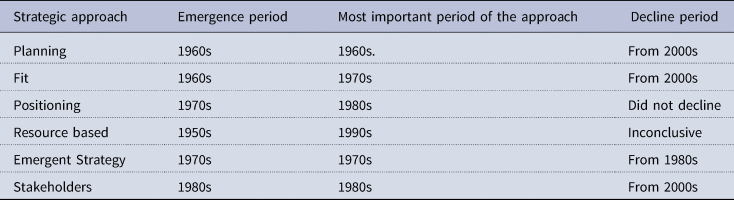
It was observed that there are basically six approaches to strategy formulation which have emerged in the history of Strategic Management. The first one, the Planning approach, emerged in the 1960s and its dominance was quite palpable during the period between the 1960s and 1970s and its decline discerned post 1980s. The origin of the Fit approach overlapped with that of the Planning approach in the 1960s and its use gained momentum during the 1970s. The third one, the Positioning approach, evolved in the year 1980, gained its importance garnered by research in industrial economics from the 1980s onwards. The next one, the Resource-based approach was found emerging in the 1950s, remained somewhat quiescent till the 1980s while its use proliferated in the 1990s and later. The other two strategic approaches were no doubt important approaches, but they did not receive much attention. While the 1980s saw an upsurge in research theme on the stakeholders' influence on firms, the advent and growth in the importance of the emergent approach were discerned in the 1970s. The literature on the rise and fall of these two approaches in different periods could not be obtained.
Research Method
Content analysis as research method
Content analysis as a research method has been chosen here as it is one of the well-accepted and widely used techniques for textual data analysis (Krippendorff, Reference Krippendorff2004). The method provides a means for objective, systematic and quantitative evaluation of any written communication (Furrer, Thomas, & Goussevskaia, Reference Furrer, Thomas and Goussevskaia2008).
Operationally, the method determines the presence of certain words or concepts within texts. The text is first coded or broken down into manageable categories on a variety of levels – word, phrase, sentence, paragraphs or theme – and then examined. The frequency count of these words provides deeper insight into the central theme of the text or sentence and the inferences about the intended message of the sender can be drawn and analysed (Weber, Reference Weber1985).
The method used here involves three essential stages: (i) sample and period of study, (ii) deconstruction of definitions, (iii) coding or creation of word families.
Sample and period of study
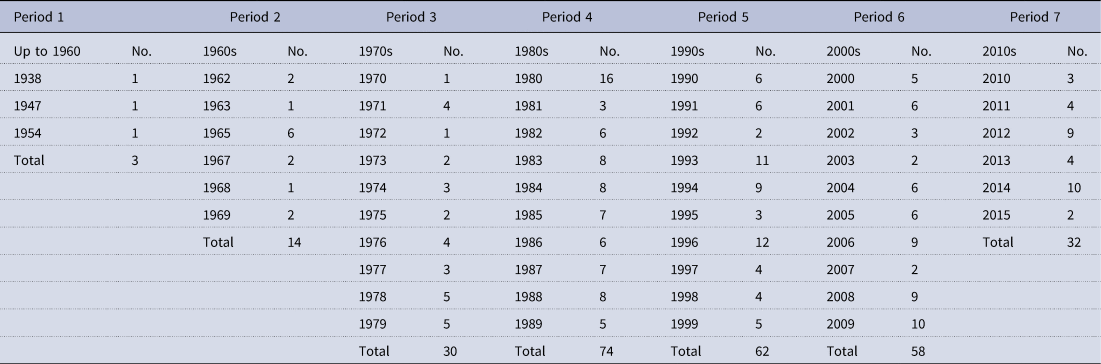
For the purpose of this study, 273 definitions of strategy or explanatory definitions were selected from books, journals and other sources. In order to make a suitable selection of definitions, two important aspects were taken into account (i) the time period of the study and (ii) the criteria for inclusion of the definitions analysed.
Study period
Past works using definitions for analysis differed in the choice of the time period. Mainardes, Ferreira, and Raposo (Reference Mainardes, Ferreira and Raposo2014) used 39 definitions published between 1938 and 2001. Similarly, Ronda-Pupo and Guerras-Martin (Reference Ronda-Pupo and Guerras-Martin2012) used 91 definitions published in a period from 1962 to 2008. Bracker (Reference Bracker1980) examined 17 definitions published between 1947 and 1979 and Hax and Majluf based their work on 13 definitions over a period 1962–1985. In a similar way, Nag, Hambrick, and Chen (Reference Nag, Hambrick and Chen2007) used 11 definitions published between 1965 and 2002.
For the purpose of this study, the time frame was chosen from 1938 to 2015. The reason primarily was to cover the entire history of the field and to include all past works using the definitions of strategy as a unit of analysis. The entire period from 1938 to 2015 was divided into seven consecutive subperiods. Excepting the first and seventh periods, the other periods were of 10 years duration. The periods from 1938 to 1959 and 2000 to 2015 were not considered for detailed analysis as they were not amenable for decadal comparison. A detailed analysis was made from the 1960s as 1960 is considered the birth of Strategic Management as an independent discipline (Karki, Reference Karki2004; Segal-Horn, Reference Segal-Horn2004).
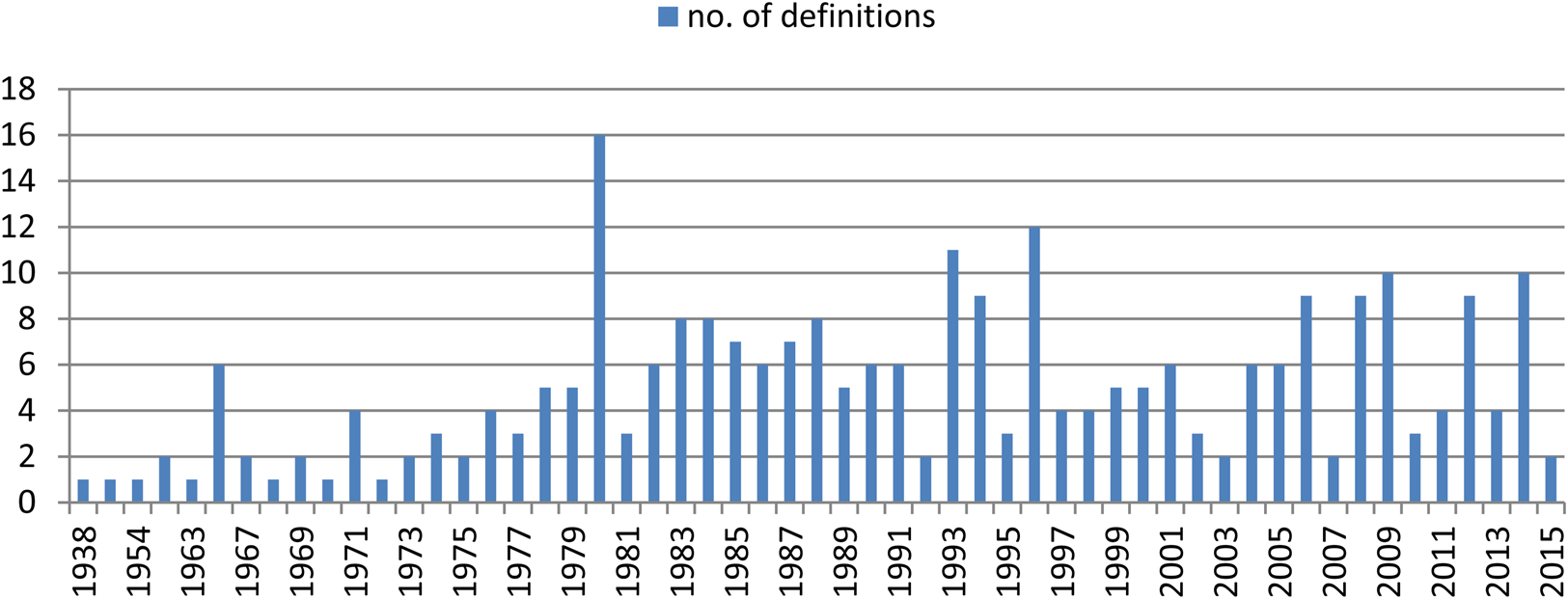
This 10 years range was considered suitable since it represents a significant segment of time that has witnessed the stages of growth of an academic discipline. Further, the 10-year clustering is not an arbitrary choice as many researchers (Grant, Reference Grant2010; Karki, Reference Karki2004; Luoma, Reference Luoma2014; McKiernan, Reference McKiernan2006; Melé & Guillén Parra, Reference Melé and Guillén Parra2006) have made their categorisation chronologically with a decadal gap (one such work is given in Appendix 1). Table 1 and Figure 1 show the details of the 273 definitions chosen in this study.
Year wise definitions

This paper differs from past studies mentioned above in that (1) a longer time frame 77 years is used (i.e., from 1938 to 2015), (2) more definitions (273) are analysed, and (3) method and technique employed are quantitative.
Criteria for choosing the definitions for the study
Only those definitions fulfilling the criteria given below were considered.
• Definitions which explicitly referred to Business studies and were available in library databases of articles and recognised text books were selected. Additionally, statements which answered the questions like ‘what is strategy’ in such documents were also included. Incidentally, a similar procedure was followed by Ronda-Pupo and Guerras-Martin (Reference Ronda-Pupo and Guerras-Martin2012).
• Some definitions on corporate strategy conveying the idea of business strategy were also included.
The definitions exclusively referring to corporate strategy or having unusual contexts such as military and nonbusiness were not included.
Deconstruction of definitions
The purpose of deconstructing the strategy definitions is to extract the important words used by authors to express the essence of strategy and thereby understanding a type of formulation of strategy. This is on the assumption that the analysis of such words could help to trace the development of the approaches in the time frame chosen.
Content analysis has been used by researchers in strategy and related areas. Ronda-Pupo and Guerras-Martin (Reference Ronda-Pupo and Guerras-Martin2012) deconstructed 91 strategy definitions into nouns, verbs and adjectives to study the emergence of new research areas in Strategic Management. Similarly, Chen (Reference Chen2013) deconstructed keywords from 721 articles and used them in Co-word analysis to find prominent research topics in the field of education management informatisation in China.
The present study preferred using only the nouns, because they play an important role in conveying the essence of any sentence compared to verbs and adjectives. Even the verbs (planning, positioning, endeavour, etc.) used as nouns in the definitions have been included to bring out the process aspects of strategy wherever possible. Thus, the words in the sample include nouns and to some extent verbs used as nouns. Using adjectives, adverbs, etc., would have added analytical tracking complexity and therefore were avoided.
Not only for the above reason, but also the preference for nouns over words to other forms is evident in many other studies. For example, Nag, Hambrick, and Chen (Reference Nag, Hambrick and Chen2007), Furrer, Thomas, and Goussevskaia (Reference Furrer, Thomas and Goussevskaia2008), Chen (Reference Chen2013), Wang, Liu, and Sheng (Reference Wang, Liu and Sheng2014) and many others have used keywords or important words selected from the articles published in leading journals. Most of these keywords indicate that these are basically nouns.
The definitions went through a process of word normalisation through which words used in plural forms were converted to a singular form. This was followed by obtaining distinct words from the 273 definitions using open source software available at www.wordcounttools.com. From these words, 553 distinct nouns were identified.
Coding or creation of word families
To facilitate analysis, nouns picked from the deconstruction were grouped into families of words, termed as ‘word families’. A word family contains a set of nouns which either are of similar meaning or can be logically associated with each other. The creation of such a list was necessary because of the presence of a large number of different and idiosyncratic terms used by authors in definitions.
Further, from the 553 nouns retrieved from the definitions, a majority was found being used less than five times. Such words would have posed difficulty in analysis, and besides the large number of such words appearing less frequently in a large set of definitions would have reduced the reliability in the analysis.
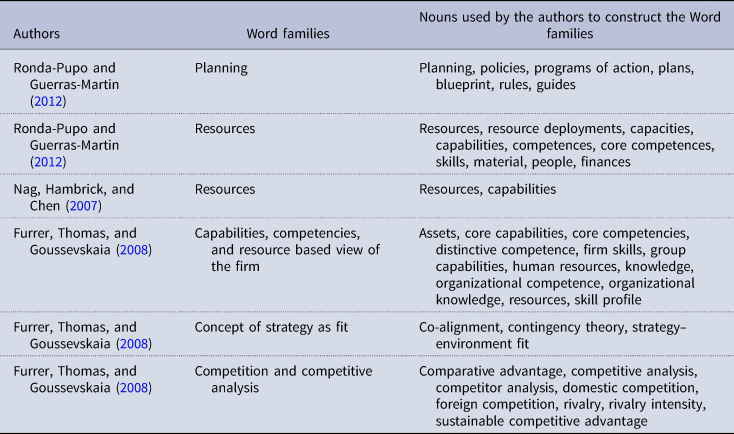
The methods followed for the construction of word families were similar to those of Ding, Chowdhury, and Foo (Reference Ding, Chowdhury and Foo2001), Nag, Hambrick, and Chen (Reference Nag, Hambrick and Chen2007), Furrer, Thomas, and Goussevskaia (Reference Furrer, Thomas and Goussevskaia2008) and Ronda-Pupo and Guerras-Martin (Reference Ronda-Pupo and Guerras-Martin2012). The set of words and their corresponding word families as used by these authors are given in Table 2. The criteria taken into account for constructing word families are discussed below.
Formation of word families by different authors

From the list of nouns, highly synonymous nouns such as company, corporate, firm, organisation, considering the context of use, were merged to form the word family ‘company’. Similarly, the nouns such as goals, mission, vision, aims, pursuits, purpose, ends, intent, intention, etc., were merged with the word family ‘objective’, because they either are synonymous or can be logically associated. The nouns for word families such as ‘planning’, ‘action’, ‘performance’, ‘process formulation’, ‘resource’ were chosen in the way as done by Ronda-Pupo and Guerras-Martin (Reference Ronda-Pupo and Guerras-Martin2012) and Furrer, Thomas, and Goussevskaia (Reference Furrer, Thomas and Goussevskaia2008).
Based on earlier discussions, nouns such as strengths, weakness, opportunities and threats were included in the word family ‘fit’. Further, the inclusion of words such as match, alignment or co-alignment, synergy and mediating-force into fit was based on Furrer, Thomas, and Goussevskaia (Reference Furrer, Thomas and Goussevskaia2008).
In some cases, the context in which a noun is used in the definition was taken into consideration for the formation of some word families. For example, nouns or phrases such as competitive forces, competitive advantage, opponents, counter, etc., were found to be used to suggest competition in the definitions. So, these nouns were merged with the word family ‘competition’. Later, ‘competition’ was merged with ‘positioning’, since the positioning approach deals with competition.
Based on the views of Porter (Reference Porter1985) and Stonehouse and Snowdon (Reference Stonehouse and Snowdon2007), nouns or phrases such as positioning, differentiation, different, differentiator, low cost and best cost, features, focus, unique, niche, etc., were included in the word family ‘positioning’. Similarly, based on the views of Doyle (Reference Doyle1983) and Aaker and Shansby (Reference Aaker and Shansby1982), noun phrases such as product market segment, market segment, segment and market segmentation were merged with ‘positioning’.
Inclusion of the term ‘pattern’ into the word family ‘emergent’ was based on the definition of emergent strategy which is a ‘pattern in a stream of decisions’. Nouns such as dynamic and adaptation were obvious choices to be included in ‘emergent’ as emergent strategy is concerned with continuous adaptation.
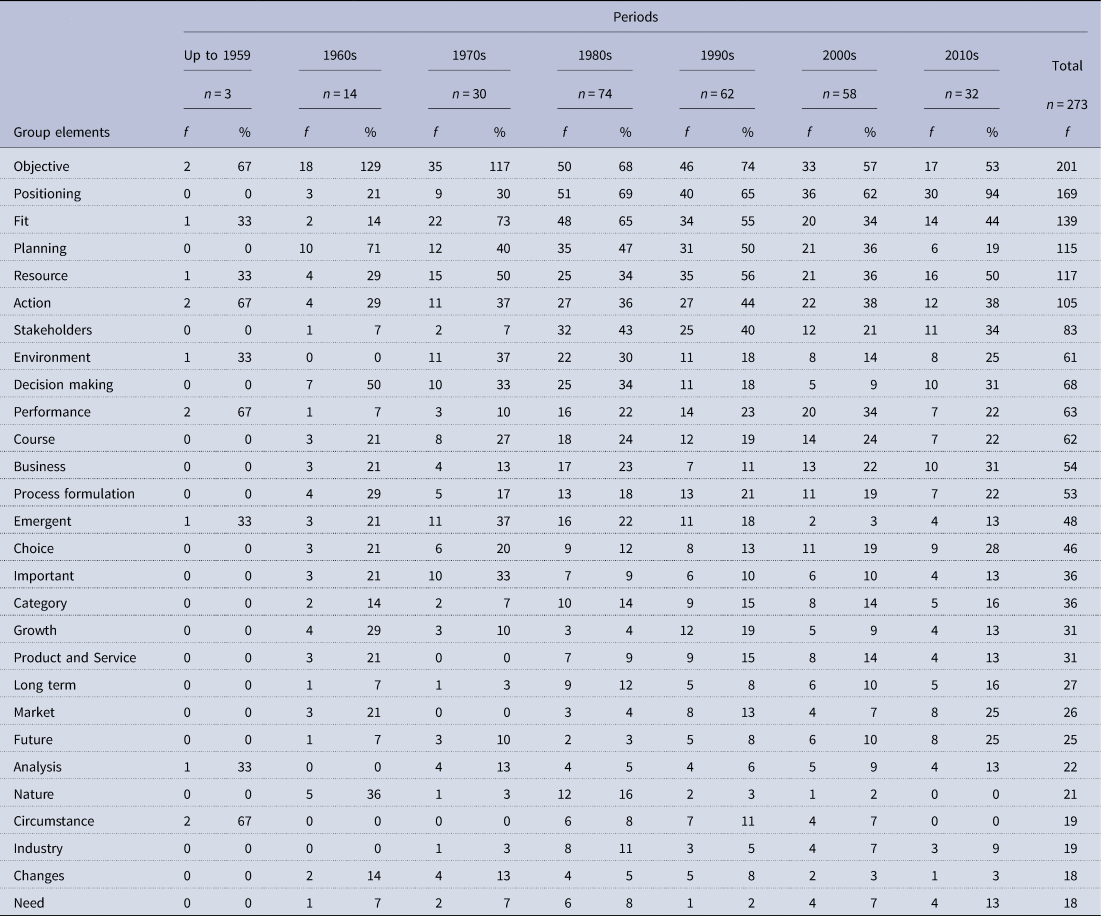
Similar methods were followed to form other word families. Finally, 54 word families were formed from 553 nouns. The frequencies of occurrences of these word families in the seven periods were obtained using the software http://www.wordcounttools.com. It was observed that the frequencies of many word families were low and therefore would not have contributed much in the detailed analysis. Therefore, 28 word families each having a frequency more than ‘18’ were chosen to establish the association between the word families and strategic approaches.
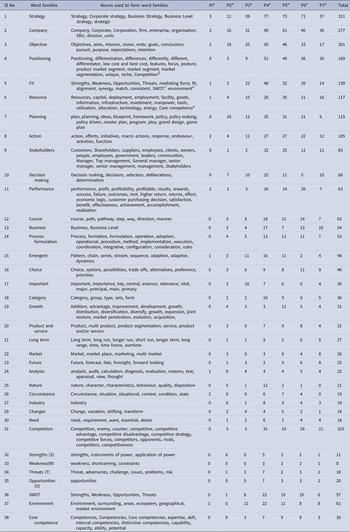
Some common word families such as ‘strategy’ and ‘company’ which are expected to appear in any definitions were not considered for further analysis. The word families, the individual nouns they contain and their frequency of occurrence and their percentage of appearance are shown in Appendix 2 and Table 3, respectively.
Showing word families in terms of their fluctuations and trends over seven periods

n = no. of definitions in different periods; f = no. of times each group element appear in each period; % = (f/n) × 100.
It may be noted that the appearance of the same word family more than once in a definition cannot be ruled out. In such a case, saturation of the word family can be more than 100%. This has been the case for the word family ‘objective’ with a saturation of 129%.
Each word family was then examined by two coders, who reviwed the 553 nouns and their corresponding 54 word families. To ensure that all word nouns are allocated to appropriate word families, a two-step procedure was followed. First, based on the criteria of the construction of the word familes as stated above, the two coders independetly verified their inclusion. Second, the two coders solved their disagreements through discussion. If disagreement persisted, it was resolved by referring to Thesaurus of Ms-word. The inter-rater reliability was assessed using Perreault and Leigh (Reference Perreault and Leigh1989) index which gave a satisfactory value of 0.86.
Analysis
Trend analysis of the word families
The purpose of this section is to study the evolution patterns of different strategy formulations in different periods by analysing the frequencies of occurrences of the word families appearing in the definitions.
Out of the 28 word families shown in Table 3, ‘objective’ appeared the highest number of times, that is, 201 in 273 definitions. It indicates achieving goals or objectives is given highest emphasis by authors while formulating a strategy. Similarly, the second term appearing more number of times is ‘positioning’. It suggests that the second important factor influencing the strategy formulation is dealing with competition or competitive forces.
Table 3 shows that the frequency of some word families such as performance is increasing, whereas for many others (such as objective, fit, planning, stakeholders, emergent, environment, decision making), it is decreasing between the 1960s and 2000s. For some, the increase has been consistent (positioning). It shows, over the 50 years of strategy research, the interests in the strategy making through Planning, Fit, Stakeholders or Emergent modes are declining, whereas strategy formulation through Positioning or competitive aspects has a stable rise.
Further, it is observed that the frequency of ‘objective’ has decreased from 129% in the 1960s to 57% in the 2000s, whereas the frequency of ‘performance’ has increased from 7% to 34% in the same period. It indicates that the central focus of strategy has changed, over the years, from achieving the firm's objectives, goals or mission to improving the performance. Furrer, Thomas, and Goussevskaia (Reference Furrer, Thomas and Goussevskaia2008) and Ronda-Pupo and Guerras-Martin (Reference Ronda-Pupo and Guerras-Martin2012) had also obtained similar results.
The rise of the term ‘environment’ reached its peak (37%) in the 1970s. Incidentally, the term did not figure in any definition in the 1960s. Such results show that there is an abrupt rise in environmental concerns. However, it is strange that the frequency of occurrence of the word family in the subsequent periods gradually went down. There were talks of global warming and its impact from eminent scientists and also at global political levels; however, such a concern was not so discernible with strategy researchers and authors.
The following few paragraphs provide insights into the life cycles of the types of strategy formulations during the period from the 1960s to 2000s.
Observations related to Planning approach
From Table 3, it is observed that the term ‘planning’ appeared for the first time in the 1960s and its frequency of occurrence during the period is high (71%). It suggests the advent of Planning approach in the 1960s. This result corresponds to the views of Steiner (Reference Steiner1979), Horwitch (Reference Horwitch1987) and Grant (Reference Grant2010) who observed the emergence of strategic planning during the 1960s.
Compared to the other periods, the percentage of occurrence of ‘planning’ is highest in the 1960s. It reinforces the view that Planning approach to strategy formulation was most influential during the period. The authors with a similar opinion are Whittington (Reference Whittington2001), Horwitch (Reference Horwitch1987), Xavier (Reference Xavier1993), King (Reference King1988), O'Shannassy (Reference O'Shannassy2003), Karki (Reference Karki2004), Segal-Horn (Reference Segal-Horn2004).
The occurrence of the term ‘planning’ declined after the 1960s, but compared to other word families, its frequency remained relatively high. This shows that planning continued to be an important approach with the researchers and authors. Only after the 2000s, a decline of the approach is observed. The finding contradicts with the views of authors like Mintzberg (Reference Mintzberg1972), Steiner (Reference Steiner1979) and Johnson, Scholes, and Whittington (Reference Johnson, Scholes and Whittington2008) who were of the opinion of failure of planning models after the 1980s.
In conclusion, it may be stated that the Strategic Management field witnessed its first approach to formulate a strategy called planning approach in the 1960s. It received high attention in this period. Though its importance showed a decline after the 60s, a real decline was observed in the post 2000s period.
Observations related to Fit approach
A shift in focus in strategy making is noticed during the 1970s in Table 3. It is observed that the prominence of strategies based on formal plans in the 1960s had declined, being taken over by strategies focusing on aligning the strengths and weaknesses of firms to external opportunities and threats in the 70s. Such a phenomenon is clearly noticeable with an abrupt drop of ‘planning’ from 71% in the 1960s to 40% in the 1970s and a sharp rise of ‘fit’ from 14% to 73% during the same period. Though a very low percentage (14%) of appearance of ‘fit’ is observed in the pre-1970s period, the review of definitions during this period indicate the emergence of Fit approach to formulate a strategy in the 1960s.
The findings suggest that Fit approach was conceived and received wide acceptance in the 1970s. Such a view is backed by Zott and Amit (Reference Zott and Amit2008). The results show strategy formulation through the fit approach plummeting in the 2000s and after.
Observations related to Emergent strategy approach
A sharp decline in ‘planning’ in the 1970s not only indicated the failure to a reasonable extent in strategy formulation through planning mode, but also the evolution of two new approaches in the 70s.
One is the Emergent approach and the other one is the Positioning approach (to be discussed latter). Compared to other periods, the frequency of occurrence of ‘emergent’ in the 1970s (see Table 3) is a bit high (37%). It suggests an increase in the practice of formulating strategies through this approach in this period.
Low occurrence of the term ‘emergent’ during the first and second periods, and analysis of the definitions appearing in those periods did not provide a conclusive view about the origin of the approach prior to the 1970s. Hence, it may be considered that the approach surfaced in the 1970s.
The decline in its frequency in subsequent periods indicates that the approach did not capture high attention from the strategy makers.
Observations related to Positioning approach
The period 1980s witnessed another shift in the process of strategy making. The focus of strategy makers on Planning, Fit or Emergent approaches was somewhat eclipsed by Positioning approach in the 1980s. The high percentage (69%) of the term ‘positioning’ during the 1980s confirms such an observation.
Only three occurrences of ‘positioning’ in the 1960s indicate a weak emergence of the approach in that period. The results in the table indicate the emergence of the approach during the 1970s and dominance in the 1980s. This coincides with Porter's advocacy of competitive strategy.
The high frequency of occurrence of ‘positioning’ post 1980s seems to reject the view on the waning popularity of the approach in any of the periods.
Observations related to Resource-based approach
Along with the development of approaches discussed above, strategy formulations through the resource-based approach (RBV) had also made its presence felt in all the periods. The approach focused on the firm's resources and capabilities as the basis for building strategies. Table 3 shows that the appearance of the term ‘resource’ prior to the 1960s is low. However, the analysis of the definition ‘strategy is analysing the present situation and changing it whenever necessary, incorporated within this is finding out what one's resources are or what they should be’ stated by Drucker (Reference Drucker1954: 17) clearly indicates that researchers had already conceived the formulation of strategies based on the resource prior to the 1960s. A relatively high percentage of occurrence of the term in each period from the 1960s to 1980s differed with the opinion of many authors who claimed the approach remained somewhat quiescent till the 1990s.
The importance of RBV theory receiving high attention in the 1990s is easily verifiable from the highest occurrence (56%) of the term ‘resource’ during the period. The study found only two periods of minor decline between the 1960s and 2000s for the term ‘resource’. Hence, a conclusive view of its period of decline could not be established.
Observations related to Stakeholders' approach
Table 3 shows that the formulation of strategies aimed at fulfilling the interests of stakeholders did not get much attention from the strategy makers. A substantially low occurrence of the term ‘stakeholders’ in the pre-1980s did not provide enough evidence of the evolution of the approach prior to the 1980s. The approach, it seems, came to light during the 1980s. Its high percentage of occurrence in the 1980s corresponds to the view of researchers that the strategy formulation through stakeholders' approach gained momentum after the publication of work by Freeman in 1983. The results show declining importance of the approach from the 2000s onwards.
A summary of the life cycle of strategic approaches is provided in Table 4.
Life cycle of strategic approaches

Dominance of strategic approaches in each period
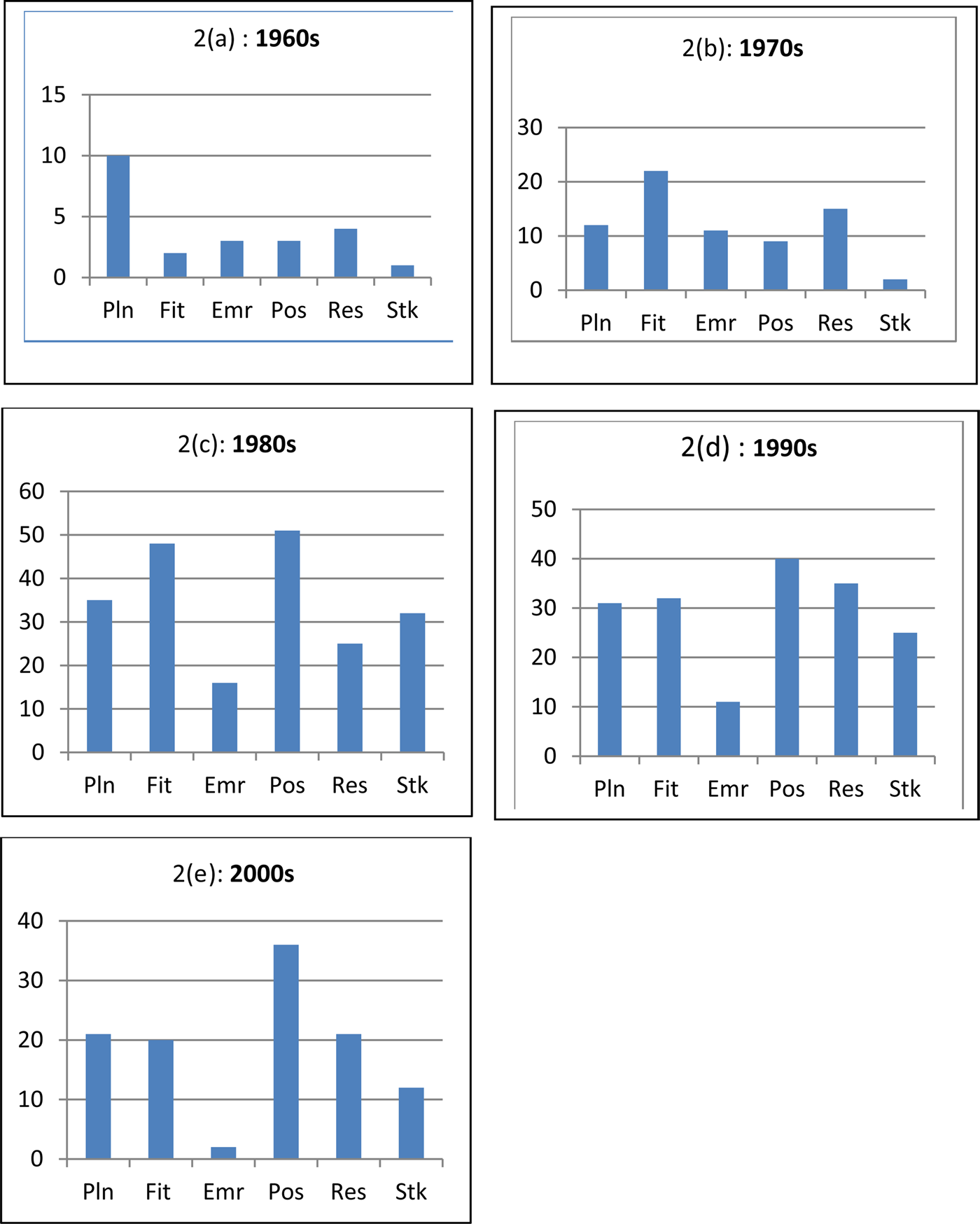
Figures 2(a)–2(e) depict the growth of the strategic approaches in different periods.
(a)–(e) Dominant strategic approaches from the 1960s to 2000s. Note: Frequencies of occurrences of word families. Pln = Planning; Emr = Emergent; Pos = Positioning; Res = Resource; Stk = Stakeholders

It is apparent from Figure 2(a) that amongst all the strategic approaches, the strategies developed through a formal planning process captured the highest attention during the 1960s. Soon, the attention shifted and formulation of strategies focusing on linking the firm with the environment or the Fit approach which took the centre stage in the 1970s. Figure 2(b) shows the popularity of the approach.
A new perspective on strategy evolved in the 1980s. In contrast to strategy seen as a rational planning process or aligning firm to the environment, the focus of strategy development revolved around countering the competitive forces through positioning. Figures 2(c)–2(e) show that the Positioning approach or the role of competition and competitive forces were major determinants for strategy formulation from the 1980s onwards. In terms of importance, the Fit and Resource-based approaches followed closely the Positioning approach in the 1980s and in the 1990s, respectively (see Figures 2(c) and 2(d)). Similarly, Figure 2(e) shows Resource-based, Fit and Planning approaches following the Positioning approach in the 2000s. Almost a negligible occurrence of Emergent approach can be noticed during the 2000s (see Figure 2(e)). The probability of complete demise of the strategy formulation through Emergent approach from this period may not be ruled out.
Discussion
Strategic Management has sought to answer the fundamental question of how firms formulate strategy. In this quest, the field has witnessed the evolution of several approaches to strategy formulation. The article tracked the historical developments of the approaches by examining 273 definitions published between 1938 and 2015. The procedure followed was to extract nouns from definitions and analyse them from three perspectives: (1) to interpret different approaches to formulate the strategies from the definitions, (2) to study the life cycles of the approaches, and (3) to study the dominance of strategic approaches in different periods. Six different ways of strategy formulation were identified, namely, Planning, Fit, Emergent, Positioning, Resource-based and Stakeholders' approaches.
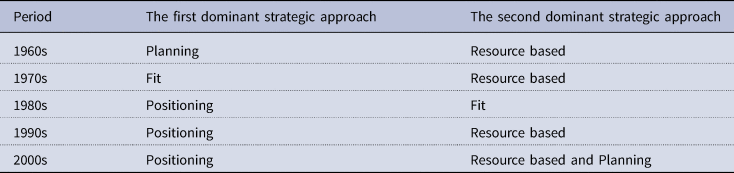
The results of this research correspond to past works with respect to the period in which each of the strategic approaches evolved. The results also correspond to literature which observed the dominance of the formulation of strategy through Planning approach during the 1960s, Fit approach during the 1970s and Positioning approach during the 1980s. Out of the six approaches, two approaches which received high attention in each period between the 1960s and 2000s are provided in Table 5.
Two most dominant approaches in each period

It is evident that four approaches, namely, Planning, Fit, Positioning and Resource-based approaches are the dominant ones. Though Resource-based approach did not get the highest score in any period, it secured the second position in terms of dominance in the second, third, fifth and sixth periods thereby making it unique vis-à-vis other approaches.
The persistence of the strategy formulation through Positioning approach securing the first position in three periods, followed by the Resource-based approach scoring the second position in four periods, indicates that researchers considered both the internal and external factors of the organisation more or less at the same level. They undoubtedly have given high importance to the competitive forces in the external environment they have also given similar emphasis on resource, competence or capability development in the internal environment.
The formulation of strategy through Positioning approach remaining most prevalent in the last four decades followed by the Resource-based approach from the 1960s onwards shows that the research streams are converging into some theoretical base which previous studies had not proposed. Therefore, a combination of these two can provide a strong foundation of formulation of strategy and these two together can provide a basis for convergence towards a robust theory.
It may be argued that the research topic of this article is over-researched as pointed out by Galvin and Arndt (Reference Galvin and Arndt2014), Bentley (Reference Bentley2015), O'Shannassy (Reference O'Shannassy2015) and Furrer, Thomas, and Goussevskaia (Reference Furrer, Thomas and Goussevskaia2008). However, the research streams indicated here such as positioning and resources-based views are still relevant in the contexts of strategy formulation even today. Further, the study has added more value by applying an objective and accurate method, namely Content analysis, which no one attempted earlier.
Most of the past studies (on the formulation of strategy) are logically proposed and are neither empirically supported nor validated. This article to a reasonable extent seeks to accomplish this. The analysis made here is based on the quantitative tracking of different ways of strategy formulation. In a separate study, Mishra, Mohanty, and Mohanty (Reference Mishra, Mohanty and Mohanty2015) have clinically examined 25 Indian companies and validated the findings of this study. Therefore, the findings of the research can very well be connected to practice. However, both types of studies are valuable and complementary, and therefore the results of the present study may be used to validate or invalidate previous interpretations.
The research conducted here is the first ever study on the systematic conceptualisation of strategic approaches. Further, no previous studies attempted to track a relative importance of different approaches to formulate strategies in different periods. Besides, past studies are not comprehensive on evolution and life cycles of strategic approaches which this study provides. Thus, this study can be a step forward for developing an integrated theory on strategic approaches.
Here nouns (word families) from the definitions have been used for tracing the strategic approaches. These word families may be tracked in the annual reports and other company documents to understand the type of strategy a company has followed. Such a study of the annual reports of a company over a longer period will indicate the type of strategy followed by the company over a period. This way the managers can understand the type of strategy the company has predominantly formulated and followed. If the company has changed from one approach to another in different periods, the contexts under which such change has been made can be better appreciated. The top management may use such words to communicate the strategy followed by the company to various stakeholders. By tracing these words in the documents of the competitors, the company can interpret the strategy the competitor is following. This can provide significant managerial insight.
One of the innovative aspects of this study is the use of Content analysis for the study of the strategy formulation. The methodology adopted here is unique for empirical demonstration of prevalence of the approaches and probably it is the first ever study in the field of Strategic Management, particularly in relation to strategy formulation. The same methodology may be used to study the evolution of concepts in other disciplines.
Instead of using definitions as a sample, research in future may be conducted using keywords from articles from leading Strategic Management journals chosen over a long period. Such a study can test the prevalence of the different approaches to formulate strategies and track their life cycles. This can lead to the validation of the findings of the present study. Further research can be done from the Director's reports or Chairman's statements of companies using Content analysis with the same word families used in this study. This will show more dominant or more prevalent approaches in corporate. This may show either convergence or divergence between what academicians perceive as important and what practitioners actually plan and execute.
Though to some extent, the study has opened the criticism regarding the use of nouns in the study, still the findings derived from the use of nouns cannot be underemphasised. This is because nouns show the essence of any sentence. It would also be interesting to complement this work with an extended analysis of the definitions by including verbs and adjectives.
Conclusion
In the history of Strategic Management, the key concept ‘strategy’ has undergone many changes. These changes have been captured by different authors in different definitions proposed at different times, and the process still continues. This paper is based on 273 different definitions of the strategy published during 1938–2015. By extracting nouns appearing in these definitions and analysing these nouns, it was found that six approaches to formulate strategies, namely Planning, Fit, Emergent, Positioning, Resource-based and Stakeholders are more prevalent. These approaches received different levels of attention in different periods. In other words, apart from the identification of different approaches to strategy formulation, the key focus here was to find the relative dominance of these approaches.
Out of these approaches, the Positioning approach to formulate a strategy was the most dominant, followed by RBV, strategic Fit and Planning approach in that order. The remaining two, namely the Stakeholders' and the Emergent approaches did not receive similar attention as the other four.
The life cycle of each approach to formulate a strategy was studied. It was found that the strategic approaches originated and dominated in different periods. The results of the study correspond to the findings of several research studies which had found Planning approach dominating in the 1960s, Fit approach in the 1970s and Positioning approach in the 1980s. It was also found that amongst all the approaches, the Positioning approach to formulate a strategy dominated the strategy-making process in the minds of the researchers in each period from the 1980s onwards.
Similarly, about the decline in the usage of the approaches, the literature suggests that the Planning approach declined in the 1980s, Fit approach lost its importance in the 1980s and Positioning approach in the 1990s. Literature did not provide any declining trend for Resource, Emergent and Stakeholders' approaches. The findings from this study are not consistent with the literature with regard to the declining trends of the approaches. Finally, it was found that the researchers have ceased to lay emphasis on formulating a strategy using Emergent approach.
Past studies on strategy research are fragmented which has compelled scholars to look at the strategy formulation process through different lenses. Even Mintzberg et al. (Reference Mintzberg, Otis, Shamsie, Waters and Grant1988) have stated that strategy is like six blind men viewing an elephant advocating there is neither convergence nor integration in the field. However, this study observed certain symptoms of stability around few research themes like Positioning approach (from the 1980s onwards) followed by Resource-based approach (from the 1960s onwards). It shows that the Positioning approach is the most prevalent approach and the next dominant one is the Resource-based approach. Such a finding shows that the research streams are converging into some theoretical base.
Though past research studies have hypothesised several approaches to formulate the strategies, the methods followed by them have been generally qualitative. This study can be considered more precise as it tracked the evolution pattern of the strategic approaches quantitatively over a substantially large period with a more accurate method called Content analysis. To the best knowledge of the authors, use of definitions and Content analysis, as samples and method, respectively, has not been attempted earlier by any author – neither together nor separately. In these respects, this study is different from the previous studies by others.
Appendix 1

Appendix 2