INTRODUCTION
Parasites may negatively impact host fitness by using resources which may have otherwise been allocated to growth, dispersal or energy storage (Møller, Reference Møller1990; Hawley and Altizer, Reference Hawley and Altizer2011). For many mammals the risk of acquiring or transmitting parasites or pathogens is mediated by host behaviour (Hart, Reference Hart1992; Hawley et al. Reference Hawley, Etienne, Ezenwa and Jolles2011). Coloniality is one such behaviour, where exposure and susceptibility to parasites and pathogens increases as host density and group size increase (Côté and Poulin, Reference Côté and Poulin1995; Altizer et al. Reference Altizer, Nunn, Thrall, Gittleman, Antonovics, Cunningham, Dobson, Ezenwa, Jones, Pederson, Poss and Pulliam2003). Despite increased risk of parasitism, coloniality may result in a variety of benefits from cooperative foraging (e.g. Creel and Creel, Reference Creel and Creel1995), predator vigilance (e.g. Lingle, Reference Lingle2001) or social thermoregulation (e.g. Willis and Brigham, Reference Willis and Brigham2007). Thus, tradeoffs associated with group living could lead many species to minimize costs by aggregating seasonally when energetic and predator-avoidance gains of coloniality will be most important.
Predictably, seasonal aggregations are reservoirs for parasites and pathogens in many colonial species (e.g. Ezenwa, Reference Ezenwa2004; Altizer et al. Reference Altizer, Dobson, Hosseini, Hudson, Pascual and Pejman2006). For example, outbreaks of phocine distemper virus in harbour seals (Phoca vitulina) coincided with seasonal on-shore aggregations when adults ‘haul out’ for mating (Swinton et al. Reference Swinton, Harwood, Grenfell and Gilligan1998). In group-living adult European rabbits (Oryctolagus cuniculus) intestinal nematode intensity increased with conspecific association during autumn breeding (Cattadori et al. Reference Cattadori, Boag, Bjørnstad, Cornell and Hudson2005). In both cases, seasonal variation in host density and close contact among conspecifics led to an increased risk of acquiring parasites or pathogens.
Parasitism can also be affected by intrinsic host factors such as sex and age, often because of demographic differences in host behaviour and ecology (Zuk and McKean, Reference Zuk and McKean1996; Klein, Reference Klein2000). In many mammalian species, males tend to be more heavily parasitized than females (Schalk and Forbes, Reference Schalk and Forbes1997; Moore and Wilson, Reference Moore and Wilson2002; but see Klein, Reference Klein2000). Male cape ground squirrels (Xerus inauris), which have more extensive daily movements and larger home ranges than females, hosted more ectoparasites than females (Hillegass et al. Reference Hillegass, Waterman and Roth2008). In desert gerbils (Gerbillus andersoni) flea infestation was higher for adults compared with juveniles partially because juveniles aggregated in larger groups, which presumably facilitated transmission (Hawlena et al. Reference Hawlena, Abramsky and Krasnov2006). Thus, demographic variation in host ecological and social tendencies may help explain variation in parasite dynamics.
In many insect-eating, temperate bats, males and females differ in their social tendencies during the active season and segregate during spring and early summer (e.g. Senior et al. Reference Senior, Butlin and Altringham2005; but see Kunz and Lumsden, Reference Kunz, Lumsden, Kunz and Fenton2003). Adult males tend to roost alone or in small groups (Kunz and Lumsden, Reference Kunz, Lumsden, Kunz and Fenton2003) and social contacts are likely infrequent during this period, potentially reducing the risk of ectoparasite exposure (Luçan, Reference Luçan2006; Christe et al. Reference Christe, Glaizot, Evanno, Bruyndonckx, Devevey, Yannic, Patthey, Maeder, Vogel and Arlettaz2007). Although males of some temperate bat species form male-only social aggregations (Safi, Reference Safi2008) or occasionally join female maternity colonies (e.g. Entwistle et al. Reference Entwistle, Racey and Speakman2000), male little brown bats (Myotis lucifugus) tend to roost solitarily or in much smaller sex-segregated groups than females prior to autumn swarming (see Methods; Fenton and Barclay, Reference Fenton and Barclay1980). In contrast, females often form large maternity colonies where they communally rear their pups in warm microclimates (Kunz and Lumsden, Reference Kunz, Lumsden, Kunz and Fenton2003). Low roost temperatures can delay pup development and maternity colonies likely provide critical thermoregulatory benefits (Willis and Brigham, Reference Willis and Brigham2007).
Despite energetic benefits of maternity colonies, they are also associated with an increased risk of ectoparasitism (Lewis, Reference Lewis1995). Infected pregnant or lactating females may face decreased available energy for reproduction as energy is reallocated to immune function and/or increased grooming (Møller, Reference Møller1993; Christe et al. Reference Christe, Arlettaz and Vogel2000). Once pups are born, vertical transmission of ectoparasites from adult females to pups (Christe et al. Reference Christe, Arlettaz and Vogel2000) could slow juvenile growth and potentially impact fitness (Lochmiller and Deerenberg, Reference Lochmiller and Deerenberg2000). Within most maternity colonies, young of the year (YOY, i.e. an individual born that year) tend to be more heavily parasitized than adult females (Luçan, Reference Luçan2006; Zhang et al. Reference Zhang, Parsons, Daszak, Wei, Zhu and Zhang2010). During late summer and autumn, male and female bats aggregate in large numbers outside hibernacula, where they mate, and possibly familiarize YOY with potential hibernation sites, a behaviour known as swarming (Fenton, Reference Fenton1969; Thomas et al. Reference Thomas, Fenton and Barclay1979). Swarming sites provide a unique opportunity for ectoparasite transmission as females and YOY transport ectoparasites from maternity colonies (Luçan, Reference Luçan2006). Large numbers of adult males with relatively low ectoparasite prevalence come in contact with adult females during promiscuous mating and potentially during communal roosting. However, few studies have used these patterns to assess the influence of demographics and seasonal variation in social aggregation on parasite dynamics in social bats (e.g. Zahn and Rupp, Reference Zahn and Rupp2004; Zhang et al. Reference Zhang, Parsons, Daszak, Wei, Zhu and Zhang2010). Studies of bat–parasite interactions could be useful for understanding the ecology of host–parasite systems in general, and for understanding dynamics of host–parasite systems with conservation or public health significance.
We used a large dataset on little brown bats captured during the autumn swarm period in central Canada to test two hypotheses. First, we hypothesized that seasonal and sex-based variation in levels of sociality and reproductive energetics would affect ectoparasite prevalence and intensity for adults. We predicted that ectoparasite prevalence and intensity would: (1) be higher for adult females compared with adult males because of reproductive female coloniality; (2) increase for adult males throughout the swarm period because of increasing contact rates with females and YOY; and (3) decrease for adult females throughout swarming because of reduced coloniality in day roosts and transmission of individual parasites to males. Second, we hypothesized that ectoparasite dynamics for YOY are driven by vertical transmission from adult females in maternity colonies. We predicted that ectoparasite prevalence and intensity would: (1) be higher for YOY compared with adult males, but similar to adult females because of vertical transmission of ectoparasites in maternity colonies and presumed communal roosting of YOY and adult females; (2) be similar for male and female YOY because rates of vertical transmission from adult females would be the same for YOY males and females; and (3) decline for YOY throughout swarming because of declining coloniality in day roosts combined with improved grooming ability.
METHODS
Study sites and capture
All procedures were approved by The University of Winnipeg Animal Care Committee, conducted in compliance with guidelines of the Canadian Council on Animal Care and approved under Manitoba Conservation Wildlife Scientific Permit number WB0612. We caught little brown bats at two sites in Manitoba between 17 July and 15 September in 2011, 2012 and 2014. One site, St. George Bat Cave, a hibernaculum located near Fisher River, Manitoba (51°43′N 97°24′W), houses approximately 11 000 hibernating bats (C.K.R. Willis, unpublished data). Three hibernacula at the other site, near Grand Rapids, Manitoba (53°12′N 99°19′W), house 50 to 250 hibernating bats each winter (C.K.R. Willis, unpublished data). We pooled data from Lake St. George and Grand Rapids for statistical analyses because the little brown bats in Manitoba exhibit high rates of movement and considerable gene flow between these swarming sites (Norquay et al. Reference Norquay, Martinez-Nuñez, Dubois, Monson and Willis2013; Davy et al. Reference Davy, Martinez-Nuñez, Willis and Good2015). All sites were negative for Pseudogymnoascus destructans (formerly Geomyces destructans: Minnis and Lindner, Reference Minnis and Lindner2013), the fungal pathogen that causes white-nose syndrome, but we followed US Fish and Wildlife service guidelines for decontamination by researchers (United States Fish and Wildlife Service, 2012).
All capture sites were caves actively used during late summer and autumn as swarming sites and as hibernacula during winter. Males and females vary in the timing of their emergence from hibernation (Norquay and Willis, Reference Norquay and Willis2014) and, upon emergence, show clear patterns of sexual segregation. Females emerge first during a narrow window from mid-April to early May, whereas males emerge beginning in early-May over a longer time period that can last well into June (Norquay and Willis, Reference Norquay and Willis2014). Females migrate to maternity colonies following emergence while males likely roost alone or in small groups (Fenton and Barclay, Reference Fenton and Barclay1980; Kunz and Lumsden, Reference Kunz, Lumsden, Kunz and Fenton2003). Between 2008 and 2012, as part of a range of other studies, we have captured little brown bats at 15 maternity colonies on nights between early June and late July (i.e. the maternity season) throughout central Canada. Of 506 captures, only one was an adult male (0·2% of overall captures: C.K.R. Willis, unpublished data) highlighting the sexual segregation of male and female little brown bats during the maternity season. Mating does not begin for little brown bats until mid-August at fall swarms (Thomas et al. Reference Thomas, Fenton and Barclay1979; McGuire et al. Reference McGuire, Fenton and Guglielmo2009) and male–female contact rates should increase dramatically during this period with implications for ectoparasite risk.
Contact patterns affecting ectoparasite dynamics will also change dramatically for YOY bats as they become volant, maternity colonies disband, and mothers and YOY migrate to fall swarms. The timing of this shift could vary depending on variation in rates of development for YOY but this variation is likely small for our study population. Fenton and Barclay (Reference Fenton and Barclay1980) reviewed a number of studies showing that parturition typically occurs over a 3-week period and Krochmal and Sparks (Reference Krochmal and Sparks2007) found that a large majority of births in their study from Indiana, USA occurred within the first 2 weeks of June. Bats in our study area (1800 km north of the Indiana site) face a shorter reproductive season which could constrain reproductive timing into an even narrower time frame. Thus, most YOY from our study area likely exhibit a pronounced change in their patterns of aggregation and social contacts during a relatively short time period between volancy and swarming.
We caught bats using harp traps placed near entrances to hibernacula. Upon capture, bats were held in disposable paper bags until processing. Ectoparasites were sampled (see below) and individuals were sexed, weighed to the nearest 0·1 g (Model HH 320, Ohaus Corporation, USA), and aged (adult or YOY) based on degree of ossification in the 5th metacarpal–phalangeal joint (Thomas et al. Reference Thomas, Fenton and Barclay1979). We measured forearm length (±0·1 mm) and used the residuals of a linear regression between mass and forearm length as a body condition index (BCI: Schulte-Hostedde et al. Reference Schulte-Hostedde, Millar and Hickling2001), a method that has previously been used for bats (e.g. McGuire et al. Reference McGuire, Fenton and Guglielmo2009).
Ectoparasites
Bats were systematically surveyed for ectoparasites following Czenze and Broders (Reference Czenze and Broders2011). First, the base and length of the internal and external pinna were examined, followed by the tragus. Ectoparasites on the exposed skin of the pinna or tragus could be easily identified and enumerated. Second, each side of the wing and tail membranes were extended and examined and, again, ectoparasites were readily obvious on the exposed skin of the flight membranes. Third, the fur was examined by gently blowing on the dorsal and ventral surfaces of the torso, which disturbed ectoparasites making them readily obvious.
We identified five types of ectoparasites, all of which are bat specialists and have been reported on other hibernating bat species in North America (e.g. Eptesicus fuscus, Dick et al. Reference Dick, Gannon, Little and Patrick2003; Myotis septentrionalis, Czenze and Broders, Reference Czenze and Broders2011). Bat fleas (Myodopsylla insignis) were observed crawling through the fur on the ventral and dorsal torso of the infected bats. M. insignis is widespread throughout North America (Smith and Clay, Reference Smith and Clay1988) and is likely the only ectoparasitic flea of little brown bats in our study region (Buckner, Reference Buckner1964). Only adult M. insignis are parasitic. Females lay eggs on the host, which subsequently fall to the floor of the roost allowing larvae and pupae to develop on bat guano (Smith and Clay, Reference Smith and Clay1988). Wing mites (Spinturnix americanus) and body mites (Macronyssus crosbyi) were observed crawling on, or attached to, the wing and/or tail membranes. Field identification of mites was confirmed using diagnostic keys (Rudnick, Reference Rudnick1960; Radovsky, Reference Radovsky1967). S. americanus were identified by the presence of posterodorsal setae on the III and IV femora, a distinguishing characteristic of this species (Rudnick, Reference Rudnick1960). M. crosbyi are the most widespread North American Macronyssus species and the only species of the genus known to parasitize little brown bats (Radovsky, Reference Radovsky1967; Whitaker et al. Reference Whitaker, Walters, Castor and Ritzi2007). All life-stages of S. americanus are haematophagus. Larval stages are endoparasitic, whereas adults are ectoparasitic. M. crosbyi are monoxenous blood-feeding mites (Reisen et al. Reference Reisen, Kennedy and Reisen1976) with a suppressed deuteronymph stage that does not feed, and a parasitic, mobile adult stage (Radovsky, Reference Radovsky and Houck1994). Chiggers (Leptotrombidium myotis) were observed securely attached to the pinna, tragus, and in some cases the forearm. Chiggers represent the larval stage of a trombiculid mite (Shatrov and Kudryashova, Reference Shatrov, Kudryashova, Morand and Poulin2006). Successive stages (i.e. nymphal and adult) leave the host and move to the soil where they feed primarily on arthropods (Poissant and Broders, Reference Poissant and Broders2008). Bat bugs are distinctive hemipteran ectoparasites which attach to the forearm or tragus, and in our study area both Cimex adjunctus and Cimex pilosellus have been observed (Wilson and Galloway, Reference Wilson and Galloway2002). Adult bat bugs are large, mobile, blood-feeding ectoparasites that are only occasionally found on bats away from maternity colonies and tend to be more prevalent on substrates and bats in maternity roosts (Marshall, Reference Marshall and Kunz1982). Therefore, because they tend to be associated only with maternity roosts, and due to low overall prevalence (0·3% of bats we sampled), we did not identify bat bugs to species and omitted bat bug parasitism from our analyses (see below).
In our study area, little brown bats represent >96% of the hibernating bat population, while <4% of captures are M. septentrionalis (n = 10 777 captures from 2009 to 2014: M. Collis and C.K.R. Willis, unpublished results). Although E. fuscus may occur in our study area, they have never been captured or directly observed at any site in Manitoba to our knowledge. Thus, little brown bats overwhelmingly dominate our study system and transmission via contact with other bat species is unlikely.
Statistical analyses
All statistical analyses were conducted using R (version 2.15·0 GUI 1·51, R Development Core Team, 2012). Ectoparasite intensity was non-normally distributed so we used a Kruskal–Wallis test with post hoc Mann–Whitney U-tests adjusted for multiple comparisons to examine differences in overall intensity for each demographic combination (e.g. adult males vs adult females). We also used chi-square tests to test for differences in ectoparasite prevalence. We found significant differences in ectoparasite prevalence and intensity between demographics (see Results), so for all analyses we assessed effects of our predictor variables (i.e. date and body condition) on prevalence and intensity of ectoparasites for each demographic separately (i.e. adult male, adult female, YOY male and YOY female). We conducted one analysis of effects of our predictor variables on prevalence and intensity for all ectoparasites combined, as well as separate analyses on prevalence and intensity for each of fleas, wing mites and body mites (hereafter, ectoparasite groups).
We used zero-inflated mixture models (R function zeroinfl) to assess the effect of candidate variables on ectoparasite intensity (Zuur et al. Reference Zuur, Ieno, Walker, Saveliev and Smith2009). Zero-inflated mixture models can accommodate large numbers of zeroes, which are typical of parasite datasets, and model count data (i.e. ectoparasite intensity) as a function of desired explanatory variables (see below) based on specified distribution parameters (Wilson et al. Reference Wilson, Bjørnstad, Dobson, Merler, Poglayen, Randolph, Read, Skorping, Hudson, Rizzoli, Grenfell, Heesterbeck and Dobson2002). We selected distribution parameters by comparing models generated with either zero-inflated Poisson (ZIP) or zero-inflated negative binomial (ZINB) distributions (Zuur et al. Reference Zuur, Ieno, Walker, Saveliev and Smith2009). We used Akaike's Information Criterion (AIC) and likelihood ratio tests to compare models and selected the distribution (ZIP or ZINB) which minimized AIC. We assigned the ZINB distribution for all demographics and tested the effect of date and BCI on overall ectoparasite intensity of little brown bats. We used backwards-stepwise elimination to remove the least significant term (α = 0·05) from each model and re-evaluated models until either only significant terms, or no terms, remained.
In addition to using zero-inflated mixture models to assess ectoparasite intensity (i.e. counts) we used a logistic regression (R function glm, family = binomial) to identify predictors of ectoparasite prevalence. Again, we used date and BCI as predictor variables in our logistic regression models of prevalence and assessed models using backwards-stepwise elimination (α = 0·05). All values reported are the mean ± standard deviation unless otherwise specified.
RESULTS
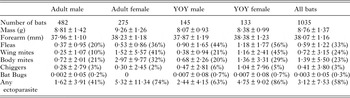
We identified ectoparasites from 1035 little brown bats (n = 482 adult males; 275 adult females; 145 YOY males; 133 YOY females) during summer and autumn of 2011 (n = 65 bats), 2012 (n = 609) and 2014 (n = 361). Mean ectoparasite intensity was 3·12 ± 7·53 and 58·7% (608/1035) of bats hosted at least one ectoparasite (Table 1). Fleas, wing mites and body mites parasitized the greatest number of bats, while chiggers and bat bugs were less prevalent (Table 1).
Summary of morphometric data (i.e. mass and forearm length) and mean infection intensity (± s.d.), with prevalence in parentheses, for each of the five ectoparasites we found on each little brown bat demographic

We found significant effects of demographic on ectoparasite prevalence (χ 2 = 131·3, d.f. = 3, P < 0·001) and intensity (W = 128·5, d.f. = 3, P < 0·001). Overall ectoparasite intensity, and intensity of each ectoparasite group individually, were significantly lower for adult males compared with all other demographics (Table 2; Supplementary Table S1). There was no difference in overall ectoparasite intensity or wing and body mite intensity between adult and YOY females (Table 2) but adult females had lower flea intensity compared with YOY females (Supplementary Table S1). In contrast, there was no difference in flea intensity between adult females and YOY males but adult females had significantly higher wing and body mite intensity compared with YOY males (Supplementary Table S1). As opposed to our prediction, overall ectoparasite intensity, as well as intensity of each ectoparasite group individually, was significantly lower for YOY males than YOY females (Table 2; Supplementary Table S1).
Pairwise comparisons of overall ectoparasite intensity between little brown bat demographics using Wilcoxon rank sum tests with adjusted P-values for multiple comparisons

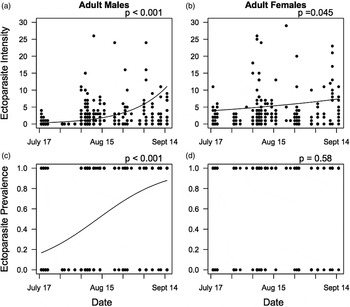
Intensity (Table 3) and prevalence (Table 4) for all ectoparasites combined, and for each parasite group individually, increased significantly for adult males as the summer progressed (Fig. 1). Intensity of all ectoparasites combined also increased significantly for adult females as the summer progressed, but we did not detect this effect for adult females when we separated the analysis by ectoparasite group (Fig. 1; Table 3). There was no effect of date on overall ectoparasite prevalence for adult females (Fig. 1), but body mite prevalence increased as the summer progressed (Table 4).
Predicted effect of date on ectoparasite intensity using zero-inflated mixture models for adult males (A) and adult females (B). Predicted effect of date on ectoparasite prevalence using logistic regression models for adult males (C) and adult females (D).

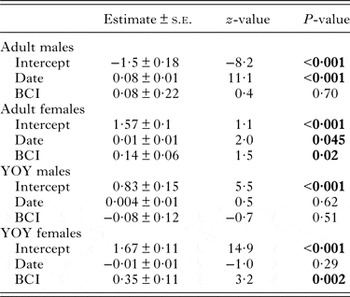
Summary of zero-inflated models assessing the effect of date and BCI on overall ectoparasite intensity for little brown bat demographics. Significant predictors are bolded

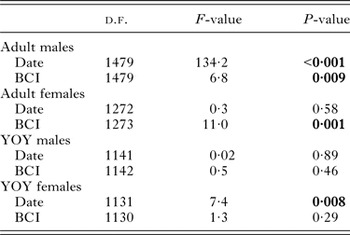
Summary of logistic regression models assessing the effect of date and BCI on overall ectoparasite prevalence for little brown bat demographics. Significant predictors are bolded

For YOY females, flea and wing mite intensity and prevalence decreased significantly as summer progressed (Supplementary Tables S2 and S3) although there was no effect of date on overall ectoparasite intensity (Table 3). Overall ectoparasite prevalence for YOY females decreased, driven by a decline in flea and wing mite prevalence with no change in prevalence of body mites (Table 4; Supplementary Table S3). For YOY males there was no relationship between date and ectoparasite intensity (Table 3) or prevalence (Table 4).
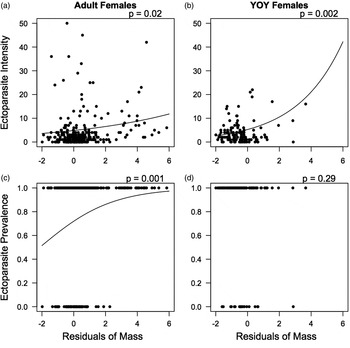
We also found evidence for relationships between body condition and ectoparasite prevalence and intensity. For adult females we found that individuals with higher BCI had higher overall ectoparasite intensity and prevalence (Fig. 2; Tables 3 and 4). Similarly, for YOY females, we found that individuals with higher BCI had higher ectoparasite intensity, but there was no effect of BCI on prevalence (Fig. 2; Table 4). For adult and YOY males there was no effect of BCI on ectoparasite intensity (Table 3) or prevalence (Table 4).
Predicted effect of residuals of mass (BCI) on ectoparasite intensity using zero-inflated mixture models for adult males (A) and adult females (B). Predicted effect of residuals of mass (BCI) on ectoparasite prevalence using logistic regression models for adult males (C) and adult females (D).

DISCUSSION
Our results support the hypothesis that variation in levels of sociality and reproductive energetics affect ectoparasite risk for bats. When accounting for demographic we found that ectoparasite prevalence and intensity changed as summer progressed to autumn with a relationship between body condition and ectoparasite intensity in some, but not all demographics. Our findings suggest that ectoparasite dynamics are mediated by seasonal and demographic variation in host social tendencies associated with reproductive energetics (i.e. colonial roosting and capital breeding by females). These findings are important for understanding ectoparasite dynamics in social species but could also be important for predicting seasonal patterns of microparasite intensity or prevalence for bat pathogens of concern for conservation or public health (e.g. George et al. Reference George, Webb, Farnsworth, O'Shea, Bowen, Smith, Stanley, Ellison and Rupprecht2011; Plowright et al. Reference Plowright, Foley, Field, Dobson, Foley, Eby and Daszak2011; Langwig et al. Reference Langwig, Frick, Reynolds, Parise, Drees, Hoyt, Cheng, Kunz, Foster and Kilpatrick2015).
Our results were consistent with our first prediction that adult males would host fewer ectoparasites than adult females. Presumably this reflects the fact that adult males have reduced energetic demands during summer compared with reproductive females and, thus, roost solitarily to benefit from reduced exposure to ectoparasites (Kunz and Lumsden, Reference Kunz, Lumsden, Kunz and Fenton2003; Czenze and Broders, Reference Czenze and Broders2011). Although adult males increase contact rates via promiscuous mating and possibly colonial roosting as summer progresses (see below), they still hosted the smallest ectoparasite load compared with adult females and YOY.
We found strong support for our second prediction that, for adult males, prevalence and intensity of ectoparasites would increase during the swarming period. Adult males are relatively solitary during spring and early summer and heightened gregariousness during swarming appears to increase their ectoparasite risk. During summer and early autumn, adult male bats are highly promiscuous, presumably mating with numerous females each night while potentially coming in contact with conspecifics during day roosting (McCracken and Wilkinson, Reference McCracken, Wilkinson, Crichton and Krutzsch2000). For males during the mating season, heightened levels of androgens could also reduce immune capacity and increase susceptibility to parasites and pathogens (Zuk and McKean, Reference Zuk and McKean1996). Our results for adult males are consistent with theoretical and empirical evidence suggesting ectoparasites take advantage of sexually active adult males that may have reduced immune capacity (Klein, Reference Klein2000; Moore and Wilson, Reference Moore and Wilson2002). However, in contrast to most mammals studied to date, avoiding coloniality for much of the active season appears to allow male bats to avoid ectoparasites compared with females and YOY.
We found no support for our prediction that prevalence and intensity of any ectoparasite species on adult females would decrease throughout the swarming period as maternity colonies disperse and ectoparasites are transferred to males during mating or are removed by grooming. In fact, when all ectoparasites were pooled together for analysis, intensity actually increased throughout the swarming period for adult females. Our results are contrary to those observed for European Daubenton's bats (Myotis daubentonii) where prevalence of wing mites on adult females peaked in early swarming before subsequently decreasing throughout late swarming (Encarnação et al. Reference Encarnaçąo, Baulechner and Becker2012). One explanation could be that cold ambient conditions during swarming (i.e. sub-zero temperatures in late August and September in Central Canada), in combination with the need for large pre-hibernation fat reserves to survive a long winter (e.g. Jonasson and Willis, Reference Jonasson and Willis2011; Norquay and Willis, Reference Norquay and Willis2014), requires females to rely more heavily on social thermoregulation throughout the swarming period. This could be especially important for adult females because they are capital breeders, depending on fat stored prior to hibernation in autumn, to initiate reproduction the following spring. Thus, if communal roosting behaviour persists in adult females late into the swarming period, the opportunity for ectoparasite exposure could remain high until they enter hibernation.
We found mixed support for our prediction that prevalence and intensity of ectoparasites would decrease for male and female YOY during swarming. As predicted, flea and wing mite parasitism did decline for YOY females but there was no effect of date for YOY males. This difference could reflect sex differences in the onset of sexual maturity (see below). We also found that YOY males hosted fewer ectoparasites of each group than both YOY females and adult females, and that there was no difference in wing and body mite intensity between YOY and adult females. Interestingly, adult females had significantly higher wing and body mite intensity compared with YOY males, but there was no difference in flea intensity. In general, mites are thought to be easier to groom than fleas because of their high host affinity and relative immobility (Czenze and Broders, Reference Czenze and Broders2011). Therefore, the pattern we observed could at least partially reflect reduced overall grooming by adult females, who must allocate time and energy to mating and/or fat accumulation to support spring reproduction (Jonasson and Willis, Reference Jonasson and Willis2011), combined with improved grooming ability of YOY males which may be effective enough to reduce mite intensity but not yet effective for flea removal. Consistent with this hypothesis are the intermediate rates of mite intensity we observed for YOY females. Reproductive YOY females may behave like adult females (i.e. colonial roosting, investment in fattening over grooming; see below), while some non-reproductive individuals could behave more like YOY and adult males (i.e. less colonial, greater investment in grooming) leading to intermediate rates of mite intensity.
Differences in rates of sexual maturation for male and female YOY could have pronounced implications for their pre-hibernation parasite risk especially if YOY begin behaving more like adults of the same sex before their first winter (Webber et al. Reference Webber, McGuire, Smith and Willis2015). Males do not mate in their first year but some YOY females may be capable of mating (Thomas et al. Reference Thomas, Fenton and Barclay1979). Therefore, YOY males may roost alone or in small groups during the swarming period, decreasing their likelihood of encountering ectoparasites. On the other hand, sexually mature YOY females could maintain a more gregarious lifestyle to reduce energetic costs and help accumulate a large fat store to support both hibernation and spring reproduction, increasing their likelihood of ectoparasite acquisition during the swarm period. In addition, if YOY females allocate significant energy to mating in their first year, they may not have sufficient energy to mount a behavioural (i.e. grooming: Giorgi et al. Reference Giorgi, Arlettaz, Christe and Vogel2001) or immunological response to higher ectoparasite loads (Lilley et al. Reference Lilley, Stauffer, Kanerva and Eeva2014). Immune function can vary seasonally (Martin et al. Reference Martin, Weil and Nelson2008) and for potentially reproductive females, energy may first be allocated towards future reproduction. With no reproductive constraint in their first year, YOY males may have more energy to allocate towards behavioural and immunological parasite defence. Our results highlight the need for more data on age and sex-specific variation in adaptive responses of temperate bats to pathogens and parasites. Age-specific variation in social and roosting behaviour of little brown bats appears to at least partially mediate ectoparasite prevalence and intensity.
Interestingly, we found that BCI and overall ectoparasite intensity were positively correlated for adult and YOY females which differ from many previous studies showing that poor condition and high parasite loads tend to be correlated (e.g. Neuhaus, Reference Neuhaus2003; Zahn and Rupp, Reference Zahn and Rupp2004). In some species, however, individuals in better condition host more ectoparasites because of differences in overall body size (Møller, Reference Møller2000). For instance, in female red squirrels (Tamiasciurus hudsonicus) flea infection was positively correlated with body size presumably because larger hosts had greater resource availability and were more attractive to parasites (Gorrell and Schulte-Hostedde, Reference Gorrell and Schulte-Hostedde2008). For female bats, the relationship between parasitism and body condition could reflect a trade-off between costs of ectoparasites and benefits of colonial roosting. Prior to hibernation, female bats have higher body condition than males (Jonasson and Willis, Reference Jonasson and Willis2011) and females in the best autumn condition emerge earliest in spring and are best equipped to cope with potentially cold spring weather (Norquay and Willis, Reference Norquay and Willis2014). Although it is often assumed that maternity colonies ‘disband’ prior to swarming, females may continue to rely more heavily than males on social thermoregulation during fall to accumulate a large fat store and support reproduction the following spring. One explanation for the pattern we observed is that females relying most heavily on social thermoregulation might acquire the largest fat reserves but may also face higher risk of acquiring ectoparasites. Hibernation may last up to 235 days for females in our study area (Norquay and Willis, Reference Norquay and Willis2014). Our results suggest that female bats may incur the cost of higher ectoparasitism during pre-hibernation, in anticipation of an energetic benefit to be realized nearly 8 months in the future. We suggest future studies assess the influence of pre-hibernation ectoparasite loads and social thermoregulation on fat accumulation (e.g. McGuire et al. Reference McGuire, Fenton and Guglielmo2009), spring emergence phenology (e.g. Norquay and Willis, Reference Norquay and Willis2014; Czenze and Willis, Reference Czenze and Willis2015) and physiological (e.g. metabolic rate: Khoklova et al. Reference Khoklova, Krasnov, Kam, Burdelova and Degen2002) and/or immunological (e.g. blood antioxidant defence levels: Lilley et al. Reference Lilley, Stauffer, Kanerva and Eeva2014) measures.
Our results may be useful in light of growing appreciation for the role of bats as hosts for infectious pathogens with human health or conservation implications (e.g. Frick et al. Reference Frick, Pollock, Hicks, Langwig, Reynolds, Turner, Butchkoski and Kunz2010; Luis et al. Reference Luis, Hayman, O'Shea, Cryan, Gilbert, Pulliam, Mills, Timonin, Willis, Cunningham, Fooks, Rupprecht, Wood and Webb2013). Ectoparasites can be much more easily and inexpensively quantified than microparasites and could provide insights into host–pathogen dynamics for microparasites. We found that variation in coloniality among demographics of bats is associated with temporal and demographic variation in ectoparasite prevalence and intensity. These patterns appear to reflect a trade-off between energetic benefits of colonial roosting both for female bats in maternity colonies but also, potentially for adult and YOY female bats during the cooler autumn swarming period. Female bats may trade-off the costs of ectoparasitism against the benefits of colonial roosting in autumn to accumulate as large a fat store as possible in support of reproduction the following spring. Most studies of sociality, parasite dynamics, or any other aspect of the biology of temperate-zone bats focus on maternity colonies or, to a lesser extent, aggregations of hibernating bats (e.g. Webber et al. Reference Webber, McGuire, Smith and Willis2015; Langwig et al. Reference Langwig, Frick, Reynolds, Parise, Drees, Hoyt, Cheng, Kunz, Foster and Kilpatrick2015). Much less is known about bat social behaviour and its implications for parasite and pathogen transmission during spring and fall, and how host behaviour during these seasons may subsequently affect parasite dynamics throughout the year. We recommend that future studies of bats better quantify age- and sex-related variation in sociality during spring emergence and fall swarming.
SUPPLEMENTARY MATERIAL
To view supplementary material for this article, please visit http://dx.doi.org/S0031182015000542.
ACKNOWLEDGEMENTS
We thank D. Baloun, N. Wall, K. Muise, H. Mayberry and E. Low for help with fieldwork, L. McGuire and Q. Fletcher for advice on statistical analysis and M.B. Fenton and an anonymous reviewer for critical feedback on an earlier version of this manuscript. We also thank the residents of Fisher River, MB and Misipawistik Cree Nation for the opportunity to study bats on their traditional territory and Manitoba Conservation for logistical support and lodging in the field.
FINANCIAL SUPPORT
QMRW was funded through a Manitoba Graduate Scholarship. Funding for fieldwork was provided by grants to CKRW from the Natural Sciences and Engineering Research Council (NSERC, Canada) and the Forest Enhancement Program of Manitoba Hydro.