The influence of time on human motivation and behavior has been receiving increasing attention from research. One reason for such interest results from the association between time perspective, which comprises a process through which individual experiences are framed in time (Zimbardo & Boyd, Reference Zimbardo and Boyd1999), and the way that individuals organize and derive meaning from experiences in different contexts throughout their life cycles. In the case of adolescence, for example, the development of future time perspectives may be considered especially relevant, inasmuch as this is a significant period for personal discovery and for the constructions of career and life projects (Guichard, Reference Guichard2011; Savickas, Reference Savickas, Brown and Lent2005).
Within the framework of time perspective study, research has focused on the concept of future time perspective (FTP) and its adaptive role to individuals. FTP refers to an individual orientation towards future objectives and is described as a representation, in temporal terms, of a specific life domain, such as a career or social relations (Bembenutty & Karabenick, Reference Bembenutty and Karabenick2004; Peetsma, Hascher, & van der Veen, Reference Peetsma, Hascher and van der Veen2005; Simons, Vansteenkiste, Lens, & Lacante, Reference Simons, Vansteenkiste, Lens and Lacante2004). FTP involves the degree and manner in which the future is integrated into present life by a process of defining objectives and projects (Husman & Lens, Reference Husman and Lens1999), as well as having the disposition to value them, even though they will only be achieved in a distant future (Lens & Tsuzuki, Reference Lens and Tsuzuki2007). These characteristics make it possible for FTP to be conceptualized or understood within the context of personality development and the different levels that characterize it – personality traits/dimensions, motivational dimensions/characteristic adaptations, life stories (see McAdams, Reference McAdams1995, Reference McAdams, Hogan, Johnson and Briggs1997, McAdams & Olson, Reference McAdams and Olson2010) – such as the overall capacity to foresee, shape and structure the future, which in turn includes the cognitive structuring of projects and a degree of concern regarding the future and its planning (Husman & Lens, Reference Husman and Lens1999).
Research describes FTP as having cognitive and affective-motivational components (Husman & Lens, Reference Husman and Lens1999; Lens, Paixão, Herrera, & Grobler, Reference Lens, Paixão, Herrera and Grobler2012). The cognitive domain refers to ideas and representations regarding the future (Peetsma, Reference Peetsma2000), including the content of future perspectives and their degree of structuring, namely the extension, density, realism, and explicitness of the content. The affective and motivational component of FTP, on the other hand, reflects the emotional value attributed to future objectives, which has a determining impact on the motivation and stimulation of behavior, in other words, on the motivational impulses to achieve those objectives (Nuttin & Lens, Reference Nuttin and Lens1985).
FTP and Adaptive Behavior
Literature has shown that both, past events and insight into the future, influence the way individuals think and consequently act in the present (Nuttin & Lens, Reference Nuttin and Lens1985). This capacity of FTP for stimulating behavior illustrates the role that objectives and prospective thinking have on human motivation and on personality development, seeing that individuals guide their actions according to expected future events (Janeiro, Reference Janeiro2010). Various studies in the domain of education and health emphasize the importance of FTP and its impact on present behavior (Carvalho, Pocinho, & Silva, Reference Carvalho, Pocinho and Silva2010). In an educational context, which is the focus of the present investigation, those students who are focused on the future have a greater probability for adaptive behavior, such as dedication and commitment at school, delay of gratification and resistance to distraction, as well as the definition of long term objectives (Bembenutty & Karabenick, Reference Bembenutty and Karabenick2004; Peetsma, Reference Peetsma2000; Peetsma & van der Veen, Reference Peetsma and van der Veen2011; Simons et al., Reference Simons, Vansteenkiste, Lens and Lacante2004; Walker & Tracey, Reference Walker and Tracey2012). At the same time, these behaviors create favorable conditions for more positive results in the life of the students, namely, greater success at school, less involvement in risk taking behavior or even the possibility of attaining higher sociocultural levels in the long term (Zimbardo & Boyd, Reference Zimbardo and Boyd1999).
The individual differences in FTP are thus related to distinct degrees of learning motivation, investment in school and involvement and persistence in tasks, even when these are not entirely satisfactory for each student (Simons et al., Reference Simons, Vansteenkiste, Lens and Lacante2004). In fact, further to participating in satisfactory and interest generating activities, individuals that are oriented towards the future tend to assign some kind of meaning or value to the less interesting activities (McInerney, Reference McInerney2004). According to Lens and Tsuzuki (Reference Lens and Tsuzuki2007), those students with a broader FTP foresee the implications of their present educational activities in a more distant future and develop plans or projects that increase the instrumental value of the activities in which they are taking part. Individual differences in FTP have thus significant motivational implications, which are related to different standards of adaptation within various normative contexts, as is school.
In light of the relevance of FTP to positive school careers and considering its behavior stimulating capacity, the intent of this study is to evaluate if FTP, as a motivational dimension within the personality organization framework (McAdams & Olson, Reference McAdams and Olson2010), can influence the relationship between the more stable personality characteristics, namely the structural dimensions (traits), and the manner how adolescents live their school lives. In fact, personality traits have increasingly been identified as relevant to the variability of behavioral patterns in various contexts, namely social, academic or professional contexts (see Barrick, Mount, & Judge, Reference Barrick, Mount and Judge2001; Carvalho & Novo, Reference Carvalho and Novo2014; Poropat, Reference Poropat2009). Research emphasizes the importance of structural characteristics, especially within the school context and during adolescence, at the level of impulse control and positive emotionality, not only concerning academic performance, but also for a broader set of adaptation indicators (Carvalho, Reference Carvalho2012). For example, within the scope of the big five personality traits model (Costa & McCrae, Reference Costa and McCrae1992), Conscientiousness has a significant association to academic performance (Poropat, Reference Poropat2009). Other studies compete on one hand for this association between impulse management capabilities and positive emotionality and, on the other, a lower probability for engaging in risk taking behavior, of behavioral problems, as well as interpersonal relationship difficulties (e.g., Caspi & Shiner, Reference Caspi, Shiner and Eisenberg2006; Hill, Reference Hill2002; Miller & Lynam, Reference Miller and Lynam2001; Vollrath & Torgersen, Reference Vollrath and Torgersen2008; Zuckerman & Kuhlman, Reference Zuckerman and Kuhlman2000).
In brief, the objective is to evaluate the potential mediating role of planning and guidance for the future within such a relationship, in other words, establish if structural personality characteristics influence behavior in school by influence of future time perspective. It was considered that the results of this study may provide relevant indicators as to the indirect effects that FTP takes on, more specifically, the mediating role it plays on the influence of other psychological dimensions, such as personality traits, on human behavior.
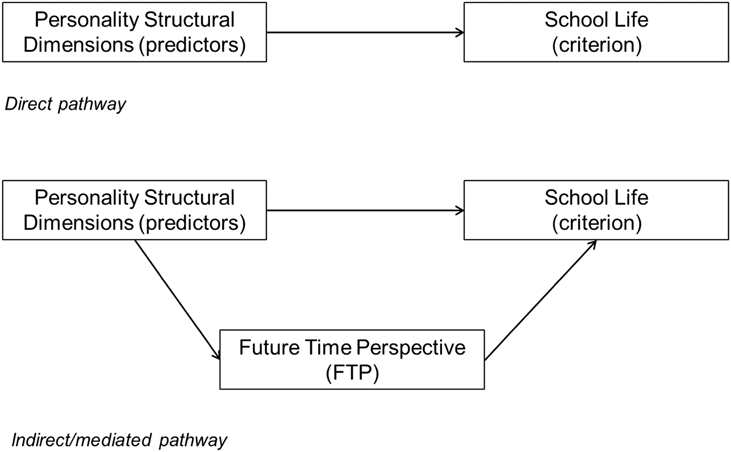
The general assumption was that FTP plays a mediating role in the influence of personality traits on behavior in a school context, as illustrated in Figure 1. More specifically, it was considered that FTP mediates the influence that traits connected with impulse control, introversion, low positive emotionality and aggressiveness – traits that have been identified as being more directly associated with behavior in a school context – have on performance and integration at school and, consequently, on satisfaction with the school career (Carvalho & Novo, Reference Carvalho and Novo2014).
Trajectories considered for the study.

In order to test these hypotheses, separate analyses were carried out for different mediation models, for which the PSY-5 dimensions of the Minnesota Multiphasic Personality Inventory – Adolescent (MMPI-A; Butcher et al., Reference Butcher, Williams, Graham, Archer, Tellegen, Ben-Porath and Kaemmer1992) were selected as independent variables (IV), namely Disconstraint, Introversion, Psychoticism, Aggressiveness and Neuroticism, which are described in the section Instruments. In light of the exploratory nature of this study, and considering that these dimensions contribute in differentiated and diverse ways towards explaining behavioral variability in a school context (Carvalho & Novo, Reference Carvalho and Novo2014), specific hypotheses were defined for each of the IV's. As such, it was hypothesized that FTP plays a mediating role on the following relationships:
H1. The influence of Disconstraint (which globally involves impulse control difficulties) on performance at school, risk taking and integration in school life.
H2. The influence of Introversion (low drive, social disconnection) on performance at school, satisfaction with school life, in interpersonal relationships and participation in school activities.
H3. The influence of Neuroticism (negative emotionality) on the feeling of satisfaction with school life and the adaptation to transitions at school.
H4. The influence of Psychoticism (bizarre behavior, social reality alienation, suspiciousness) on the satisfaction with school life, interpersonal relationships and behavioral problems.
H5. The influence of Aggressiveness (hostility, pugnacity) on satisfaction with school life, performance, behavioral problems and in interpersonal relationships.
Method
Participants
The sample included 351 students (212 female, which corresponds to around 60% of the sample), ranging from the 9th to 12th grades. Most of the students reside in rural areas (n = 223, around 64%) and their ages ranged between 14 and 18 years (M Age = 16 years; SD = 1.43). Based on a preliminary analysis, independence was verified between age and gender, χ²(4, N = 351) = 7.17, p = .127, age and area of residence, χ²(4, N = 351) = 0.81, p = .127, and gender and area of residence, χ²(1, N = 351) = 0.09, p = .766. The parents of almost half of the participants (n =167) had concluded compulsory education (and/or at least one of the parents had secondary education), by which the sample was considered to be mainly made up of youths from medium-low sociocultural status families (Carvalho & Novo, Reference Carvalho and Novo2012).
Instruments
Structural Dimensions of Personality.
The Portuguese version of the Minnesota Multiphasic Personality Inventory – Adolescent (MMPI-A; Butcher et al., Reference Butcher, Williams, Graham, Archer, Tellegen, Ben-Porath and Kaemmer1992; Silva, Novo; Prazeres, & Pires, Reference Silva, Novo, Prazeres and Pires2006), was used, a personality and psychopathological evaluation self-reporting inventory, made up of 478 items. Specifically, the PSY-5 dimensions were used (McNulty, Harkness, Ben-Porath, & Williams, Reference McNulty, Harkness, Ben-Porath and Williams1997), a mainly descriptive and dimensional model, based on a conceptual system of five big factors, which emphasize personality traits or specific dispositional characteristics. These five dimensions are listed next, as well as their number of items and the Cronbach alpha values obtained from the results of this sample. The Aggressiveness dimension (20 items; α = .73) reflects a tendency to experience anger and hostile and pugnacious behavior, with emphasis being placed on physical and instrumental aggression. It also involves feelings of grandeur and a desire for power over others. The Psychoticism dimension (21 items; α = .73) characterizes the nature of being in touch with reality and the precision of the cognitive models with regards to the world, which are created by the individual, as well as the experience of unusual sensory and perceptory phenomena, and interpersonal mistrust. The Disconstraint dimension (24 items; α = .72) relates to the tendency for impulsive action, self-control difficulties, non-traditional morals and a difficulty in adhering to the rules. The Neuroticism dimension (22 items; α = .74) corresponds to an affective disposition to experience negative emotions, such as anxiety, nervousness, feelings of guilt and concern, which lead to internal suffering. And lastly, the Introversion dimension (22 items; α = .74) reflects low positive emotionality and an absence of energy to take part in activities (low drive), as well as a general tendency not to like or seek out social experiences, which results in social isolation, alienation and weak communication. The option of which instrument to use was based on whether that instrument was capable of characterizing structural dimensions of personality and behavior, while allowing the adaptive or maladaptive expression of such characteristics to be known. The existence of validity scales also constitutes an argument in favor of using the inventory, seeing that it allows answer attitudes and tendencies that may lead to a possible invalidation of the protocol to be objectivised (e.g.: faking good or faking bad instructions).
Future Time Perspective.
The questionnaire “Eu e o meu futuro” [Me and my future] (QEMF; Carvalho, Reference Carvalho2012), consisting of 26 items (α = .832 for this sample), was used to evaluate the general future time perspective of adolescents. The QEMF questionnaire is based on some of the proposals made by Lens and Tsuzuki (Reference Lens and Tsuzuki2005) and Stouthard and Peetsma (Reference Stouthard and Peetsma1999) that defend the existence of various dimensions that characterize FTP. The item content of the questionnaire was formulated taking into account the degree of orientation regarding the future, the valuing and integration of present experience as being important for the future, and the existence of future projects and plans relating to different fields such as career, leisure and interpersonal relationships, as well as a greater or lesser degree of projection for the future. Some examples include, “9. I hope to explore my capabilities and talent in my future life”, “11. I am not very worried about my life in a few years” (scored inversely), “17. I usually think about my future as a student or employee”, “19. I like to think about the friends I will have a few years from now”, “25. My education has great value for my future work”, “26. I am already thinking and planning what I will be doing once this school year is over”. Future Time Perspective is analyzed as a quantitative variable and is expressed by the average of the results of all items in the scale, in which higher values represent a greater FTP range by the adolescent, in other words, a greater individual orientation towards objectives, representations and future personal projects. Adolescents with higher scores have thus broader perspectives, they integrate and attribute greater value to their present experience according to the expectation of future objectives.
School Life.
In order to obtain a broader range of information regarding the school life of adolescents, we developed a self-reporting questionnaire that focuses on various dimensions of school life, namely achievement, which includes the perception adolescents have regarding their work, progression in school, study methods and accomplishment of school tasks (8 items; α = .74); adaptation to transitions at school, in other words, the adaptation to changes at school and transition between years (6 items; α = .84); behavioral problems, namely disruptive behavior, resorting to violence and indiscipline (10 items; α = .85); risk taking behavior, including risky sexual behavior, substance abuse and dietary behavior problems (11 items; α = .76); interpersonal difficulties, including conflict, perception of the lack of social support, social isolation (11 items; α = .73); participation in extracurricular activities (7 itens; α = .84); and general satisfaction with school life, which corresponded to a general subjective evaluation regarding the evolution of school life and to a feeling of accomplishment or success (9 items; α = .75).
Procedures
The instruments were applied on two different occasions and in a classroom context, once informed consent from the adolescents and their respective legal guardians had been obtained. The time perspective and school life questionnaires were applied during the first session and the MMPI-A (booklet form) during the second. Once the data had been collected, the MMPI-A protocols were scanned into a SPSS database, which was later completed with the data of the remaining questionnaires. The MMPI-A protocols were evaluated and examined with regard to validity indicators and answer consistency. No cases of psychopathologies were previously identified in the sample.
According to the hypotheses, the potential effects of FTP mediation on the influence the PSY-5 personality dimensions have on school life behavior, were tested. The choice to evaluate different models resulted from the diversity of variables relating to school life and the fact that different structural dimensions of personality contribute towards the explanation of their variability. Taking into account the existence of an IV and various DV's in each model, path analysis was undertaken. As referred by Marôco (Reference Maroco2010), the significance of regression coefficients was assessed after the estimation of the maximum likelihood model parameters were implemented in the AMOS (v.22) software. The existence of outliers was evaluated by the Mahalanobis distance squared (D 2) and the normality of the variables was evaluated by asymmetry coefficients (sk) and uni and multivariate kurtosis (ku). The significance of the direct and indirect and total effects was evaluated by χ2 tests. The effects with p < .05 are considered statistically significant. The significance of the effects of mediation was evaluated by the Sobel test.
Results
The results underscore various FTP mediation effects on the influence the PSY-5 dimensions have on most of the school variables, which generally confirms the hypotheses. The exception to this norm is the model associated to Neuroticism, in which, notwithstanding the statistical significance of various trajectories, the requirement for the mediation test is not complied with, namely the ‘FTP → Neuroticism’ trajectory not being significant (p = .921). In some specific relationships, as will be mentioned next, no significant effects of mediation are verified.
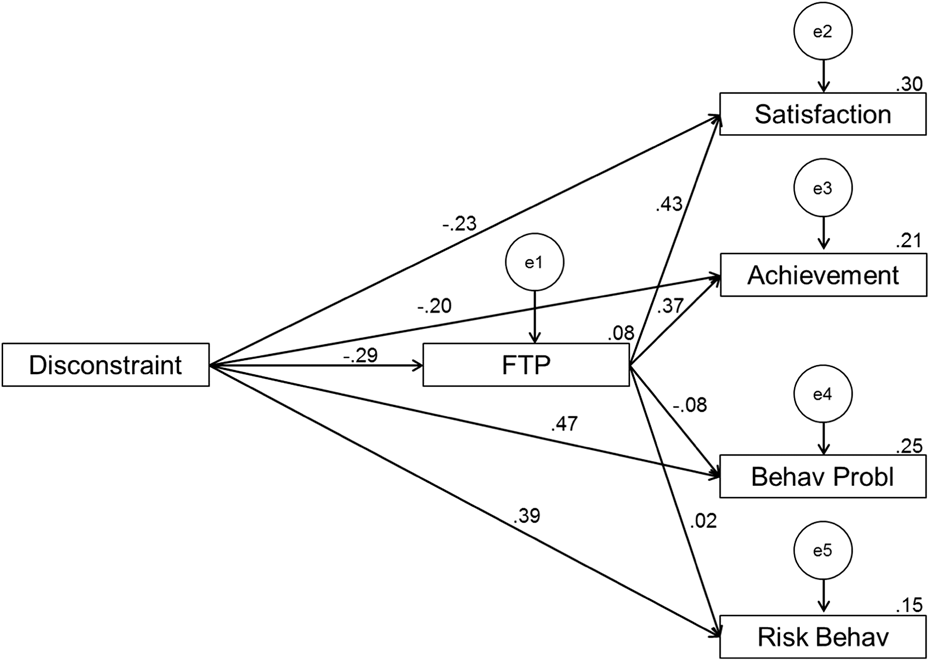
Thus, concerning the influence of Disconstraint on behavior in a school context, significant mediation effects may be verified in the case of two of the dependent variables (DV): satisfaction with school life and school achievement. Concerning the first variable, the adjusted model accounts for 30% of Disconstraint variability influence on that particular school variable. There is a significant standardized direct effect, β DiscSatisf = –.226, p < .001, as well as an indirect effect β DiscSatisf | FTP = –.125, p < .001. By means of the Sobel test, it was verified that these mediation effects are significant, Z = –4.94, p < .001. Regarding school achievement, there is a significant direct standardized effect, β DiscAchieve = –.195, p < .001, as well as a FTP mediation effect, β DiscAchieve | FTP = –.106, p < .001. The adjusted model accounts for 21% of Disconstraint influence variability on performance at school. Mediation effects are also significant, Z = – 4.60, p < .001.
Mediation of FTP on the influence of Disconstraint on the variables relative to school life. The trajectories FTP → Behavioral Problems and FTP → Risk behaviors are not significant (respectively, p = .106 and p = .695).

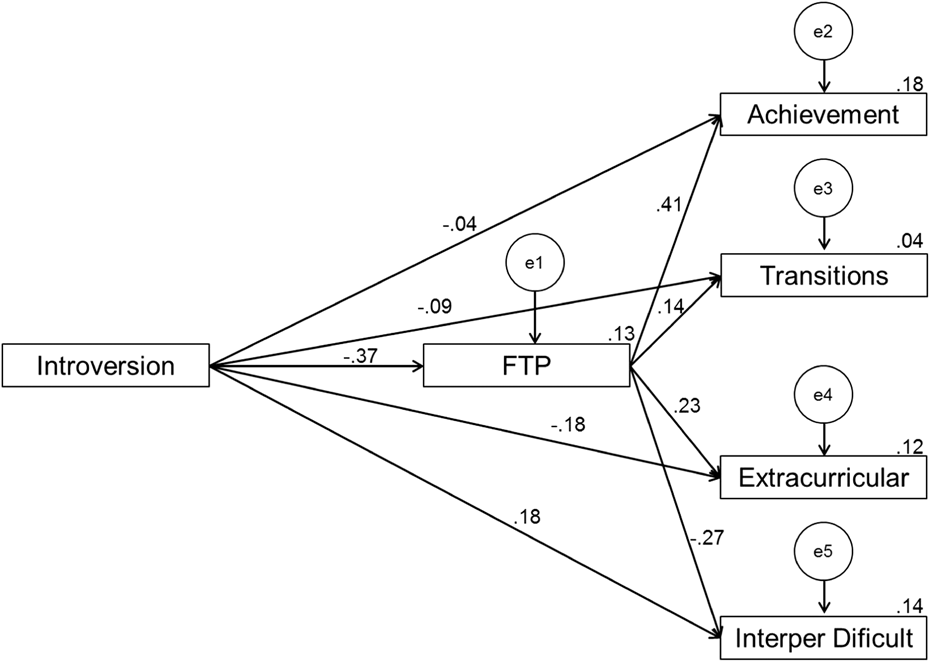
In the model involving Introversion, significant mediation effects can be verified in the case of the interpersonal difficulties and extracurricular activities DVs. Concerning interpersonal difficulties, the standardized direct effect is β IntrovInterpers = .184, p < .001, and the adjusted model accounts for 14% of variability. As expected, a FTP mediation effect exists, β IntrovInterpers | FTP = .099, p < .001, in a significant model, Z = 3.33, p < .001. In the case of participation in extracurricular activities, the adjusted model accounts for 12% of Introversion variability influence for that DV. Significant (p < .001) direct, β IntrovExtracurric = –.184 and indirect, β IntrovExtracurric | FTP = –.085, standardized effects can be verified, with the FTP mediation model being significant, Z = –3.73, p < .001.
Mediation of FTP on the influence of Introversion on the variables relative to school life. The trajectories Introversion → Interpersonal Difficulties and Introversion → Extracurricular are significant (p < .001). The trajectories Introversion → Transitions (p = .113) and Introversion → Achievement (p = .42). are not significant.

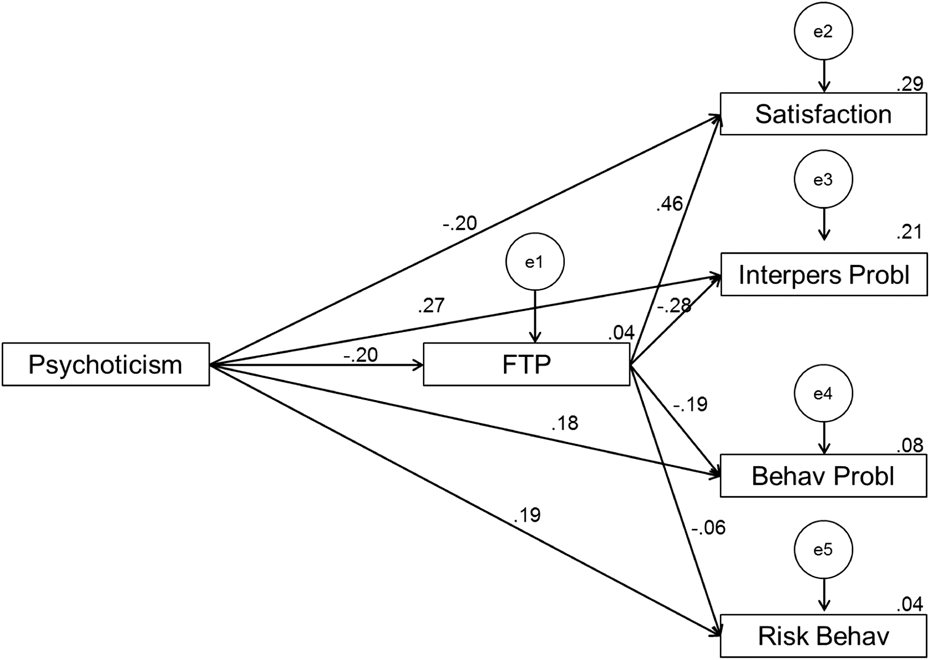
Concerning Psychoticism, significant mediation effects can be verified in the case of general satisfaction with school life, interpersonal difficulties and behavioral problems. As far as general satisfaction with school life goes, the standardized direct effect is β PsychoSatisf = –.196, p < .001, with the adjusted model accounting for 29% of variability. As expected, a mediation effect exists, β PsychoSatisf | FTP = –.094, p < .001, which is significant, Z = –3.61, p < .001. Concerning interpersonal difficulties, the standardized direct effect of Psychoticism is β PsychoInterpers = .273, p < .001, and the adjusted model accounts for 19% of variability. The mediation effect is significant, β PsychoInterpers | FTP = .057, p < .001, Sobel's Z = 3.16, p < .001. Concerning behavioral problems, the standardized direct effect of Psychoticism is β PsychoInterpers = .027, p < .001, and the adjusted model accounts for 8% of variability. The indirect FTP effect is β PsychoBehav | FTP = .037, p < .001, in a model that is also significant, Z = 2.61, p < .001.
Mediation of FTP on the influence of Psychoticism on the variables relative to school life. All trajectories are significant (p < .001), except for the Psychoticism trajectory → Risk Taking Behavior (p = .246).

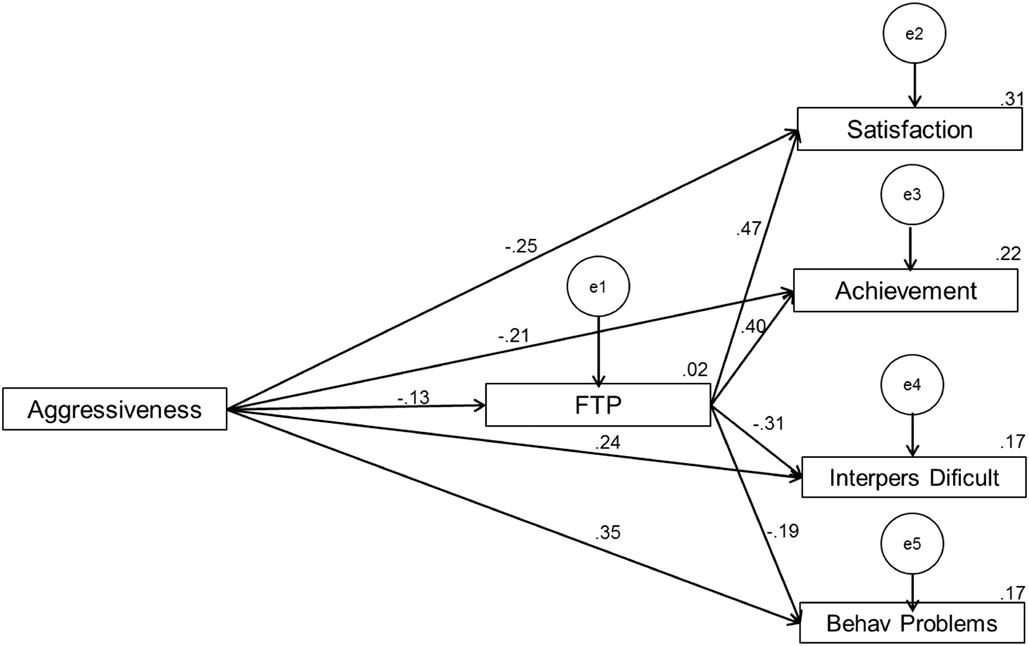
Lastly, regarding FTP mediation on the influence of Aggressiveness on behavior at school, significant effects with the satisfaction of school life, interpersonal difficulties, behavioral problems, and achievement, were found. In the case of satisfaction with school life, the standardized effect of Aggressiveness is β AgressSatisf = –.251, p < .001, in a model where 31% of variability is accounted for. An indirect effect is verified, β AgressSatisf | FTP = -.061, p < .001, in a significant model, Z = –2.50, p < .001. In interpersonal difficulties, a direct effect occurs, β AgressInterpers = .239, p < .001, with 17% of variability accounted for. An indirect effect is verified, β AgressInterpers | FTP = .040, p < .001, in a model that is also significant, Z = 2.38, p < .001. In school achievement, a standardized direct effect of Aggressiveness can be identified, β AgressAchieve = –.206, p < .001, with 22% of variability accounted for. An indirect mediation effect exists, β AgressAchieve | FTP = .052, p < .001, in a significant model, Z = –2.46, p < .001. Lastly, concerning behavioral problems, both, a standardized direct effect, β AgressBehav = .346, p < .001 (22% of variability accounted for), and an indirect effect, β AgressBehav| FTP = .023, p <. 001, Sobel's Z = 2.08, p < .01 are verified.
Mediation of FTP on the influence of Aggressiveness on the variables relative to school life. All trajectories are significant for p < .001, except for the Aggressiveness trajectory → PTF, which is significant at α = .01 level.

Discussion
In this study, the role FTP plays in the influence of structural dimensions of personality on the way adolescents live out their school careers was evaluated. By adopting an exploratory approach and taking into consideration the diversity of dimensions that describe the school context and the respective predictors, various trajectories were evaluated in order to collect interaction effect indicators between personality dimensions at different levels and, especially, if personality dimensions influence FTP, and if FTP, in turn, influences behavior. Notwithstanding the testing of various models, seeing that different predictor and criteria variables were also identified, the pattern of results proved to be consistent by demonstrating that FTP plays a significant role in school life in adolescence, not only in a direct way, expressed, for example, in the correlation between FTP and the variables relating to life at school, but also in an indirect manner, through its partial mediation of the relationship between other personality dimensions and school variables.
In fact, relevant indicators were identified that suggest that more impulsive adolescents who show signs of difficulties with self-regulation (hypothesis 1, regarding disconstraint), may be more successful and present higher levels of satisfaction with school life if, although they present with these personality characteristics at structural level, they develop projects, define objectives and value their future. In other words, FTP is decisive in the expression of those characteristics associated with disconstraint. Nonetheless, hypothesis 1 was partially confirmed, seeing that the effects relating to risk taking behavior and behavioral problems were not significant. In the same way, it was verified that those characteristics associated with FTP mediate the relationships between introversion and taking part in extracurricular activities and interpersonal relationships between adolescents. The pattern of results suggests that students that are oriented towards the future, although introverted, in other words, with low positive emotionality, less dynamism or desire for social involvement, may however relate in a more significant manner with their peers and become involved in extracurricular activities. These results partially confirm hypothesis 2, seeing that no mediation effects were found in the case of adaptation to transitions at school and performance.
It was also verified that the development of plans and representations for the future correspond with significant characteristics in the way less favorable starting characteristics are expressed, namely at the level of psychoticism (hypothesis 4) and aggressiveness (hypothesis 5). In other words, if we consider that psychoticism generally involves alienation and interpersonal suspicion, as well as bizarre behavior, and that aggression involves a tendency to be hostile, pugnacity and a desire to control others, the presence of characteristics that define FTP constitutes a protective element in light of the maladaptive expression of those traits in normative contexts such as school. Finally, as was observed, hypothesis 3, regarding neuroticism, was not confirmed, seeing that the necessary condition for the existence of a possible mediation effect was not verified, more specifically, a significant relation between that specific personality trait and FTP. This result, although it may suggest that neuroticism does not have a linear relationship with FTP, possibly contrary to other dimensions, deserves to be clarified and studied in more detail in future studies.
The results of this study, although exploratory in nature, allow for certain lines of debate to be identified, namely on a theoretical and practical level and for future research. At a theoretical level, it points to the role of personality development in the adaptation of individuals to their life contexts. In fact, the percentages of variability of the results of school life dimensions that are explained by the PSY-5 dimensions are nonetheless remarkable, especially in conjunction with FTP. Although percentage variations exist, as can be seen by the referred variable, this pattern underscores the importance of personality on the different aspects of behavior in adolescents within a school context (Carvalho & Novo, Reference Carvalho and Novo2014). At the same time, the analysis of the results leads to the interrelationship between personality dimensions situated on different levels. In effect, by using the McAdams model (1995, 1997), which foresees the existence of three levels of dimensions – trait or dispositional dimensions, characteristic adaptation or motivational dimensions, and narrative identity – it was considered that the present study identifies some indicators that reveal not only the potential ways in which these dimensions relate, but it also contradicts deterministic perspectives regarding the direct or cause-effect influence of personality traits on behavior (McAdams & Olson, Reference McAdams and Olson2010).
On the other hand, considering that, from a certain level of expression and strictness, the characteristics subjacent to the PSY-5 dimensions correspond to psychopathological indicators and difficulties in integration (McNulty et al., Reference McNulty, Harkness, Ben-Porath and Williams1997), it would be useful to understand to what point personality dimensions of other natures, such as FTP, at a motivational level, may play a role in the expression of more maladaptive functioning dimensions. Even though no psychopathological cases were referred, or identified in the results, as existing in the sample of this study, this reference is considered as useful, inasmuch as it allows for reflection on what factors may be considered in the attenuation of characteristics with disfunctional and maladaptive value.
On the other hand, by demonstrating a relationship between FTP and the adaptation to school life, the present study confirms the results of previous research regarding the positive role of FTP in a school context (Bembenutty & Karabenick, Reference Bembenutty and Karabenick2004; Lens et al., Reference Lens, Paixão, Herrera and Grobler2012; Peetsma et al., Reference Peetsma, Hascher and van der Veen2005; Peetsma & van der Veen, Reference Peetsma and van der Veen2011). Inasmuch as FTP involves greater integration and valuing of experience and a more prominent involvement in activities at school, it may be considered as a protective characteristic and a facilitating element for adaptation to development challenges associated with progression in school. In other words, the existence of medium and long term objectives, the valuing of present experience to achieve them, and the existence of a sense of direction with regards to the future in general, correspond to favorable characteristics for social integration and even, as demonstrated in the present study, to the reduction of the impact of personality traits that are potential generators of vulnerability, such as those related to Disconstraint, Introversion, Psychoticism or Aggressiveness.
At an intervention and professional practice level, it was considered that these results underscore the importance of the development of representations, objectives and projects for the future during adolescence, and encourage the implementation of strategies within a school context focused on the promotion of personal development of the students, on self-awareness and the definition of objectives for the future. One example to be valued in order to achieve those objectives corresponds with vocational interventions within a school context and during the school career. In other words, interventions not only at predetermined times but according to a predetermined logic during the school career, and united, either by career educational activities (Carvalho, 2015, in press) or counseling (Savickas, Reference Savickas2012), which stimulates the exploration of the environment and construction of the self, the construction of future life representations, the reflexion on reality and personal experience and its integration and valuing.
Lastly, we point out that the present study presents some limitations, which should be taken into consideration, both, in the analysis of the results and for future research. Among these, the cross-sectional character of the sample is highlighted as well as the fact that data collection was exclusively carried using of self-reporting measures. From our perspective, it will be essential to undertake more comprehensive analyses in the future that involve longitudinal samples and using different sources of information not limited to the individual and his perception. Furthermore, it will be important in the future to consider the importance of variables of a sociodemographic and educational nature in the variability of the results, highlighting, for example, the role of sex, sociocultural status or school grade. With regards to the evaluation of FTP, seeing that in the present study a general measure was applied, it will be important to develop new studies in which not only more specific factors are identified, within the scope of that general measure, but also in which other instruments within the scope of time perspective are used, which, among others, allow for the comparison of results at a national and international level. On the other hand, it should be mentioned that the work carried out was methodologically limited to a trajectory analysis strategy. In spite of the complexity of school life making it difficult to test models that simultaneously include all variables, it was considered relevant to undertake research that may integrate these dimensions into more comprehensive models, in which the role played by the structural and motivational personality dimensions may be better described.