





No CrossRef data available.
Article contents
- Abstract
- 1. INTRODUCTION
- 2. A DYNAMIC PROGRAMMING MODEL
- 3. OPTIMAL AIRCRAFT ROUTING AS DYNAMIC PROGRAMMING PROBLEM
- 4. MONOTONICITY PROPERTIES OF OPTIMAL POLICIES
- 5. WHEN IS JOIN-THE-LEAST-LOAD OPTIMAL?
- 6. THE CASE OF COMPLETE INFORMATION: A COUNTEREXAMPLE
- 7. THE MONOTONICITY OF s [map ] Δn(s)
- 8. CONCLUSION
- Acknowledgment
- References
ROUTING OF AIRPLANES TO TWO RUNWAYS: MONOTONICITY OF OPTIMAL CONTROLS
Published online by Cambridge University Press: 01 October 2004
Article contents
- Abstract
- 1. INTRODUCTION
- 2. A DYNAMIC PROGRAMMING MODEL
- 3. OPTIMAL AIRCRAFT ROUTING AS DYNAMIC PROGRAMMING PROBLEM
- 4. MONOTONICITY PROPERTIES OF OPTIMAL POLICIES
- 5. WHEN IS JOIN-THE-LEAST-LOAD OPTIMAL?
- 6. THE CASE OF COMPLETE INFORMATION: A COUNTEREXAMPLE
- 7. THE MONOTONICITY OF s [map ] Δn(s)
- 8. CONCLUSION
- Acknowledgment
- References
Abstract
We consider the problem of routing incoming airplanes to two runways of an airport. Due to air turbulence, the necessary separation time between two successive landing operations depends on the type of airplane. When viewed as a queuing problem, this means that we have dependent service times. The aim is to minimize the waiting times of aircrafts. We consider here a model in which arrivals form a stochastic process and the decision-maker does not know anything about future arrivals. We formulate this as a problem of stochastic dynamic programming and investigate the monotonicity of optimal routing strategies with respect to the workload of the runways, for example. We show that an optimal strategy is monotone (i.e., of switching type) only in a restricted case where decisions depend on the state of the runways only and not on the type of the arriving aircraft. Surprisingly, in the more realistic case where this type is also known to the decision-maker, monotonicity need not hold.
Information
- Type
- Research Article
- Information
- Probability in the Engineering and Informational Sciences , Volume 18 , Issue 4 , October 2004 , pp. 533 - 560
- Copyright
- © 2004 Cambridge University Press
1. INTRODUCTION
In modern air traffic, the efficient use of the available runway capacity is of growing importance, at least for major airports. Airplanes are often queued when waiting for a free runway on which to land. While queuing and during the landing operations, the airplanes have to keep a large enough distance between each other to avoid air turbulence from aircrafts flying ahead. These separation times depend on the weight (more generally, type) of the airplanes involved. Typically, the necessary separation between a light aircraft trailing a heavy one will be larger than between the same types if the light one is flying in front. Hence, one can expect to increase the throughput of the runways by an efficient routing of arriving airplanes to runways.
The general problem is quite involved, as many side constraints and airport specific rules have to be considered. We restrict ourselves to a particular scenario, which can be viewed as a step toward more realistic models that we cannot analyze completely at present.
First, we assume that the arrival times of the aircrafts form a stochastic renewal process. This is in accordance with, for example, [6,8]. There, it is assumed that the scheduled arrival times are highly disturbed (e.g., by varying flight conditions, delays on connecting flights, or technical problems) such that, in practice, the arrival times might well be approximated by a Poisson process.
We further assume that the routing decision has to be made at the arrival instance of the airplane at the airport (or at a certain threshold). The decision-maker might use information on the state of the runways and the type of the presently arriving aircraft but does not know anything about future arrivals. Once an aircraft has been assigned to a runway, it must stay in the queue of that runway. The queues are served on a first-come first-served basis. The aim is to find a rule that assigns an incoming aircraft to a runway given the state of the system and the type of arriving aircraft, such that the long-term expected waiting times are minimized.
We formulate a stochastic dynamic programming model for this problem with the total expected discounted waiting time of the aircrafts as the target function. We investigate monotonicity properties of optimal routing strategies (policies) in this model. Monotonicity here means, for example, that when the observed workload u on runway I increases while everything else is kept fixed, then an assignment of an arriving plane to runway I will only be made for u up to a certain level l. For u > l, the aircraft will then be assigned to runway II. Such policies are also called “switching policies,” as they are completely determined by switching levels l. This will be made more precise by defining a partial order on the state space of the dynamic programming model and by proving monotonicity of optimal routing policies with respect to this ordering.
The following are our main findings: Optimal policies are monotone only if we restrict ourselves to decisions that depend solely on the state of the runway and not on the type of the presently arriving aircraft. This result also yields conditions under which a simple join-the-least-load strategy (JLL) is optimal. We give a rough bound on the error made when using JLL in the general case, where it is not optimal. Surprisingly, monotonicity with respect to workloads need not hold in the more realistic model, where decisions might depend on the state of the runways as well as on the type of the arriving airplane. We show by a counterexample based on realistic data that, in this case, it might be optimal to route to runway II for a small workload u on runway I and to route to runway I for a larger workload u′. This somewhat unexpected result could be explained by the fact that in the first restricted case, we use a cost function (see definition (3.5)) where the dependency of waiting times from the next arriving aircraft is “averaged out,” whereas in the second case, we use as cost function the actual waiting time (see (6.2)), leading to a more sensitive criterion.
The proof of the main monotonicity result is based on the approach in [1]. Nevertheless, our model does not fit into the framework of [1]. We had to change the conditions at a minute but decisive point and to prove that the main assertions of [1] still hold under the modified assumptions.
Optimal routing of airplanes has been treated, for example, in [3], where also a survey over different approaches is given. Deterministic models as in [3] often assume that a set of airplanes to be scheduled and routed is given. This allows one to take into account more than one arrival, and optimal schedules for a whole set of aircrafts are obtained by mixed linear optimization. The stochastic queuing models in [6,8] do not take into account the dependency of the separation times from the two types involved. In [2], M/SM/1 queuing models are used to deal with this dependency. In a somewhat complementary way to the present article, strategies that use only the type of the arriving aircrafts are considered. There, it is also shown that neglecting the dependencies might lead to a strongly biased estimation of waiting times under heavy traffic. The general literature on the routing of parallel queues (see, e.g., [12] or [7]) seems to be restricted to the case of independent service times only. Queues with dependent service times are treated, for example, in [9], but without any reference to routing.
The article is organized as follows. In Section 2, we collect a few results from stochastic dynamic programming—in particular, about the optimality equations and value iteration. In Section 3, we use the dynamic programming framework to formalize the restricted model, where decisions depend on the state of the runways alone. Here, we also define the load of a runway and the ordering of the state space and give the main monotonicity results. We start with this restricted model, as it takes most of the article to prove these results. The rather technical proof is given in Section 7. A number of corollaries about JLL policies are collected in Section 5. The model of Section 3 is then enlarged in Section 6 to include the type of arriving airplane and a counterexample shows that the monotonicity property no longer holds. In Section 8, we address the potential benefit of our results for the practical solution of the problem and topics of our future research.
2. A DYNAMIC PROGRAMMING MODEL
We will first collect a few definitions and results from Markovian dynamic programming (see, e.g., [4,10,11] for a general discussion of dynamic programming). Here, we present only a simple type of dynamic programming model sufficient to cover the aircraft routing problem formulated in Section 3.
The model describes a system that is observed at discrete points of time (stages) n = 1,2,…. At each stage, the system is observed to be in a state s ∈ S. Then, an action a ∈ A is taken and the system moves to a new state s′ = g(s,a,z) ∈ S to be observed at the next stage. Here,

is an external event (disturbance) and

is the state transition function. The state–action pair (s,a) causes costs c(s,a), where

is the cost function. Let (Zn)n≥1 be an independent and identically distributed (i.i.d.) sequence of external random variables with values in

and with a known distribution.
We will leave aside questions of measurability and assume, in particular, that the action space A is finite.
If we observe the system for a finite number N of stages (finite-horizon case), actions are chosen according to a policy δ = (fN,…,f1), where fn : S → A is the decision rule for the (N − n + 1)st stage. The reverse numbering of the decision rules simplifies the description of the induction below. Given a starting state X1 = s from S and a policy δ, the sequence of states X2,…,XN is then defined recursively by

With An := fN−n+1(Xn), for a measurable set B ⊂ S, we obtain the simple Markovian dependency

The total expected discounted costs for policy δ = (fN,…,f1) and starting state s ∈ S are given by

where β ∈ (0,1] is a given discount factor. As our cost function is nonnegative and the action space is finite, it is well known (see, e.g., [11]) that an optimal policy exists; that is, a policy δ*, with

In fact, the min can be taken over a much larger class of policies than defined above. For (measurable) functions

, we define the one-stage cost operator L by

Problem (2.4) can be solved recursively with the help of the so-called optimality equation for dynamic programs, which in the finite-horizon case reads

We assume throughout that V0 ≡ 0. A policy δ* = (fN*,…,f1*) is optimal iff fn*(s) selects a minimizing action in (2.6) for s ∈ S,1 ≤ n ≤ N (see, e.g., [11, Cor. 6.2]).
In the infinite-horizon case, we only consider stationary policies δ = (fn)n≥1 with fn ≡ f,n ≥ 1, and we write δ = f for short. With Ak = f (Xk),k ≥ 1, we define the total expected discounted costs by

Again, δ* is called optimal if

It is shown in [11] that there exists an optimal stationary policy that can be obtained from the infinite-horizon optimality equation

f* forms an optimal stationary policy iff f*(·) is a minimizer of (2.9). Moreover, value iteration holds; that is,

For the remainder of the article, we use (2.6) to derive properties for the finite-horizon case with arbitrary horizon N using inductive arguments. These properties then carry over to the infinite horizon case using (2.10).
3. OPTIMAL AIRCRAFT ROUTING AS DYNAMIC PROGRAMMING PROBLEM
We will now specify the elements of the dynamic programming model such that we can deal with the problem of optimal aircraft routing.
We start with the external events Zn. Let Sn,n ≥ 1, denote the arrival times of airplanes at the airport. We assume that the interarrival times Tn := Sn − Sn−1 ≥ 0 for n ≥ 1, with S0 := 0 are i.i.d.; that is, the arrivals form a renewal process with some distribution F. Let J be the finite set of possible types of airplane and denote by Jn the type of the nth arriving plane. We assume that the Jn,n ≥ 1, are i.i.d. and independent of the arrival process, with

Then,

taking on values in

, describes the type of the nth arriving aircraft and the following interarrival time. (Zn)n≥1 is an i.i.d. sequence; it is the external source of randomness in our model.
We assume that if an aircraft of type j is to land immediately behind an aircraft of type i on the same runway, then there must be a safety distance given as separation time b(i,j) ≥ 0, i,j ∈ J. This means that the beginning of the two landing operations (touchdowns) must be b(i,j) time units apart.
In our model, routing decisions have to be made at the arrival instances Sn of airplanes which define our decision epochs. Let A := {I,II}, where action a = I (a = II) means routing the present airplane to runway I (II). Once an airplane has been routed to a queue, it has to wait there for its service. The queues work on a first-come first-served basis.
To define the “state” of our system, we first consider a single runway, say runway I. Of course, things are completely analogous on runway II. Let ζnI denote the type of airplane that is at the tail of the queue of runway I immediately before the nth arrival takes place. If queue I is empty at that time, then ζnI is the type of the last airplane that landed on I. With ζ1I := i0 (an arbitrary type), the formal definition of ζnI is

For n ≥ 2, ζnI is the type of plane that the nth plane will see as its predecessor if it is routed to runway I. Note that the index n counts arrivals to the airport, not to the particular runway.
Let UnI denote the workload on runway I immediately before the arrival of the nth airplane. UnI is the time that the last plane at the tail of the queue has to wait until the beginning of its landing operation. If the queue is empty at that time, then UnI < 0 denotes the time that has passed since the last plane began its landing on runway I.
Let b* := maxi,j∈J b(i,j). With U1I := −b*, the formal definition of the workload is given by

Note that

is the waiting time of the nth plane if it is routed to I. Here, b(ζnI,Jn) can be regarded as the service time of this plane. The definitions of ζ1I and U1I guarantee that the first aircrafts on each runway have waiting time 0. In Figure 3.1 the load on runway a is shown at the arrival instance of the nth aircraft of type j4 when two aircrafts of types j2 and j3 are already waiting. The black triangles indicate the time at which the landing operation of the aircraft begins. Type j1 has already landed, but j2 still has to wait.

The load on runway a when aircrafts of types j1,…,j4 are present.
The state of runway I at the arrival instance of the nth plane is the pair (ζnI,UnI) taking on values in

. Note that it is possible to bound the workload from below, as we need not keep track of negative loads that are larger than b* = maxi,j∈J b(i,j).
The state of the second runway is defined in a completely analogous way and the state of the system at the nth arrival instance is then defined as

taking on values in the state space

.
Note that, in this model, the presently arriving type Jn is not part of the state but part of the external event Zn = (Jn,Tn+1) that drives the system. This follows from our particular restriction that the type Jn is not known to the decision-maker. In Section 6, in the case where Jn is known, we will use (Jn+1,Tn+1) as the external event driving the system.
From (3.2) and (3.3), we now see how the state transition function

must be defined. For

, let

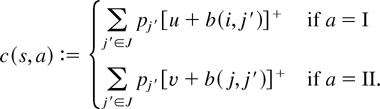
As one-stage cost function

we define for s = (i,u,j,v) ∈ S,
If we denote by

the waiting time of the nth airplane, then we have

Note that c((i,u,j,v),a) depends only on the state of runway a [e.g., on (i,u) for a = I]. The total discounted expected costs now read
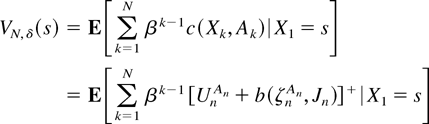
and similarly for the infinite horizon. Starting in an empty system means to have X1 = s0 := (i0,−b*,i0,−b*). As we have only two actions, the optimality equations (2.6) and (2.9) have a particularly simple structure:

Also, (2.5) becomes

where F is the distribution of the interarrival times.
4. MONOTONICITY PROPERTIES OF OPTIMAL POLICIES
In this section, we show that optimal routing policies are monotone with respect to a particular (partial) ordering of the state space. As usual, “increasing” and “decreasing” are used in the nonstrict sense.
Let us first define a partial ordering on the set of types J. For i,j ∈ J, define

In the aircraft setting, i [pr ]J j could indicate that j is a heavier plane that requires more separation than i. We do not make any assumptions on the ordering of the separation times; hence, in the extreme case, it could happen that i [pr ]J j only holds for i = j.
Now, let s = (i,u,j,v) and s = (i,u,j,v) ∈ S; then, we define

If s [pr ] s holds, then, in state s, the load on runway I is at least as high as in state s, and at its tail, there is an aircraft that requires at least as much separation time as in s. For runway II, the opposite relation holds. Hence, the balance of the two queues is more favorable for I in state s than it is in s.
A function f : S → M, where (M, ≤) is a (partially) ordered set, is called s-increasing if s [pr ] s implies f (s) ≤ f (s). For fn : S → A, we define the order “≤” on A by I ≤ II. Note that

is s-increasing if and only if

Here, monotonicity in i and j is defined w.r.t. the ordering (4.1), whereas monotonicity in u and v is w.r.t. the usual ordering on

.
The following theorem is the main result of this section. It shows that optimal policies are monotone w.r.t. to the ordering (4.2) of the state space. Some implications are described below.
Theorem 4.1:
(a) (finite-horizon case) For any horizon N, there is an optimal policy δ = (fN,…,f1) such that s [map ] fn(s) is s-increasing for n = 1,…,N.
(b) (infinite-horizon case) There is an optimal stationary policy δ = f such that s [map ] f (s) is s-increasing.
In fact, any optimal policy is monotone in this sense if we agree to choose the smaller action I in cases where both actions are minimizing the optimality equations. Theorem 4.1 states that if it is optimal to route the next airplane to runway II in a state s = (i,u,j,v), then we should do the same in all states s with s [pr ] s.
Note that fn is s-increasing if and only if there exists a “level” function

with i [map ] ln(i,j,v) decreasing and j,v [map ] ln(i,j,v) increasing such that for s = (i,u,j,v) ∈ S,
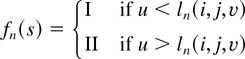
(for the “only if” part, put ln(i,j,v) := inf{u| fn(i,u,j,v) = II}). In this sense, an s-increasing policy is a “switching policy.”
The proof of Theorem 4.1 is quite lengthy and only its main steps are given here; the remainder is split into several technical lemmata given in Section 7.
Proof:
(a) For the finite-horizon case, define

From the optimality equation (2.6), it follows that (fN,fN−1,…,f1), with

forms an optimal policy for the N-stage problem. In Lemma 7.3, it is shown that s [map ] Δn(s) is s-increasing; hence, it follows that s [map ] fn(s) is s-increasing as well.
(b) For the infinite horizon, we conclude from the value iteration (2.10) that if s [map ] Δn(s) is s-increasing for all n ≥ 1, then

is an s-increasing function, too. Here, limn→∞ LIVn = LIV is shown in [11, Thm.4.4]. Now, part (b) follows as in part (a). █
5. WHEN IS JOIN-THE-LEAST-LOAD OPTIMAL?
A natural simple policy would be to route the next arriving airplane to the runway with the least load; that is, for s = (i,u,j,v), to decide according to δ = (fN,…,f1), where

However, due to the structure of the service times b(i,j), one cannot expect this policy to be optimal in general. We now examine some special cases where JLL is optimal. First, we state a simple consequence of the symmetry of the two runways.
Lemma 5.1: Let s := (i,u,j,v) ∈ S and s := (j,v,i,u); then, we have

For finite and infinite horizon it holds that action I is optimal in state s iff action II is optimal in state s.
Proof: From (3.5), we see that c(s,I) = c(s,II). Starting with V0 ≡ 0, we obtain inductively, using (3.4),

hence,

The corresponding results for the infinite horizon follow from (2.10) and (2.9). █
The following theorem is a direct consequence of Theorem 4.1 and the symmetry of the runways. It shows, in particular, that it is optimal to use JLL in states where both runways have identical types waiting at their tails. Note that we use the ordering defined by (4.1) on the set J of types.
Theorem 5.2:
(a) Let s = (i,u,j,v) ∈ S. If u ≤ v and i [pr ]J j, then it is optimal to use action I, and if u ≥ v and i [sc ]J j, then it is optimal to use action II.
(b) For any state s = (i,u,i,v) ∈ S, it is optimal to choose a = I if and only if u ≤ v.
(c) For any state s = (i,u,j,u) ∈ S, it is optimal to choose a = I if i [pr ]J j and a = II if j [pr ]J i.
These statements hold for the finite-horizon as well as for the infinite-horizon problem.
Proof: (a) Let s := (j,v,i,u); then, using Lemma 5.1, we have

The assumptions u ≤ v and i [pr ]J j imply s [pr ] s, and from Lemma 7.3, we obtain Δn(s) ≤ Δn(s) = −Δn(s). Hence, Δn(s) ≤ 0 (i.e., action I is optimal). An analogous argument holds for the infinite-horizon case. The assertion concerning action II follows from symmetry.
Parts (b) and (c) follow from part (a). █
A degenerate special case is obtained if the separation times do not depend on the leading aircraft [i.e., b(i,j) ≡ d(j) for all i,j ∈ J]. In this situation, it is unnecessary to keep track of the type of the last airplanes on the runways and the state space of the problem could be reduced to the load (u,v) on the two runways. Theorem 4.1 then implies that the JLL policy δ is optimal.
Corollary 5.3: If b(i,j) ≡ d(j) for all i,j ∈ J, then it is always optimal to route the next airplane to the runway with least load (for finite as well as infinite horizons).
Proof: We have for all i,j ∈ J,

hence, all types in J are equal with respect to the ordering given by (4.1). However, then the assertion follows from Theorem 5.2b. █
Finally, we give a crude error bound on how much the waiting times under policy JLL can deviate from the optimum in the general model. With b* = maxi,j∈J b(i,j) as earlier and b* := mini,j∈J b(i,j), let

be the span of separation times.
Theorem 5.4: Let δ be the JLL policy as defined in (5.1). For all s ∈ S, it holds that

and for the infinite horizon and β < 1,

For the proof, we have to consider auxiliary systems with the only difference being modified separation times

. Note that, in these systems, we not only have a different cost function

(related to the separation times as given by (3.5)) but also a different transition function

and a different state process

The value functions for the modified system are denoted by

and so on.
Lemma 5.5:

Proof: (a) The proof is done by induction on N. For N = 0, the statement is trivially true. Now, suppose it holds for

; that is,

is valid for all s ∈ S. We know that

and similarly for

. From our assumptions and the induction hypothesis, we obtain (note that s [map ] Vn(s) is obviously increasing in u and v, which can be shown by induction)

and similarly

, which implies the result.
(b) Let

be the kth action under the JLL policy in the original model and in the hat model. Note that we may have

and that

We first prove

Again, for k = 1, nothing has to be shown. Now, assume that (5.5) holds for some k, we have

We see that (5.6) also holds if the outer min is replaced by max; hence, (5.5) is proven. From this, we obtain for all k,

which, in turn, implies

To complete the proof of part (b), we have to show that

Similar to (5.6), we first show that

which, as in (5.7), implies

and, hence, (5.9) follows. To prove (5.10), we first observe that for k = 1, nothing has to be shown. Now, assume (5.10) holds for some k; then,

Again, the same inequalities hold when the outer min is replaced by max. Hence, (5.10) holds and the proof of the lemma is complete for finite horizons. The infinite-horizon case again follows from (2.10). █
For the proof of Theorem 5.4, we consider first an auxiliary system with

whose value function will be denoted by *VN(s). Similarly, the system with

has value function *VN(s). From Corollary 5.3, we know that JLL is optimal in these systems; hence, from Lemma 5.5, we see

Now, we apply Lemma 5.5b to the two value functions *VNδ and *VNδ with fixed separation times. We obtain

which, together with (5.12), implies the assertion of Theorem 5.4 for the finite horizon; the infinite-horizon case again follows from (2.10).
6. THE CASE OF COMPLETE INFORMATION: A COUNTEREXAMPLE
In this section, we assume that the controller knows the type of the airplane that has to be routed, in addition to the state of the runways. In this case, the control problem is much more complicated. A simple switching policy as in Section 4 need not be optimal any longer, as we will show by a counterexample.
6.1. The Model
To model the new situation, the type of the newly arrived airplane is now included in the state space; that is, we put

where a state

is denoted by

. k gives the type of the newly arrived airplane and i, u, j, and v are as earlier. As in Section 3, we have an external event z = (l,t), but now l is the type of the airplane to arrive after the next interarrival time t [i.e., Zn = (Jn+1,Tn+1)]. Using the notation of Section 3, we can write the transition function

for

as

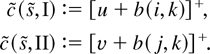
For the cost function

, we now take the (deterministic) waiting time of the newly arrived airplane when routed to runway a; that is,
As in the model of Section 3, the optimality equation of the finite-horizon dynamic program is given by

where for

,

and

6.2. A Counterexample
The following example shows that a monotonicity result similar to that of Theorem 4.1 cannot hold in the present scenario. More precisely, if routing the airplane to runway I in state

is optimal, then it need not be optimal to route the airplane to runway I in a state s = (k,i,u,j,v), where u < u. Hence, with respect to any (partial) ordering “[pr ]” of

, which has

for the above states, monotonicity as in Theorem 4.1 need not hold. As a consequence, Theorem 5.2, Corollary 5.3, and Theorem 5.4 are no longer valid, although Lemmas 5.1 and 5.5 hold.
The counterexample has a very small u < 0; that is, the last touchdown on runway I was a long time ago. Then, if the current airplane needs only a small safety distance to the preceding one, it might be better to save runway I for a future airplane that needs a larger separation time.
Example: We assume that there are three types of aircraft, J = {1,2,3}, and that the matrix of separation times is as given in [6]:

Let F(t) := 1 − e−t; that is, we assume that the arrivals form a Poisson stream with rate λ = 1.
For a planning horizon of 2 (i.e., N = 2), we obtain from (6.3) and (6.4) for the difference of the expected cost between routing to I and routing to II in state


Now, assume that we are in state

. Then, we have

, and from (6.5), singling out type 3,

for a constant C1 not depending on p3. For p3 large enough, we therefore have

; that is, it is optimal to route to runway I.
Now, let s := (1,1,−144,2,−72); then, u = −144 < −96 = u, but
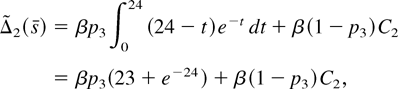
again for a constant C2 not depending on p3. This time we have

for p3 large enough; that is, in state s, it is optimal to route to II. Hence, for any ordering [pr ] on

where u < u implies

need not be s-increasing.
7. THE MONOTONICITY OF s [map ] Δn(s)
In this section, we complete the proof of Theorem 4.1. We are using the model of Section 3; that is, s = (i,u,j,k) and Zn = (Jn,Tn+1).
Let us first introduce some notation that allows one to describe the behavior of the system under fixed sequences of actions and external events. For k ≥ 0, let

be defined by
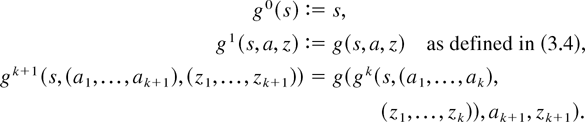
Let

. We denote the components of the state gk(s,a,z) in the following way:

gk(s,a,z) is the state after k stages, starting in state s ∈ S, applying actions a ∈ Ak, and given that the external events

were observed. Then, for example, hIk = hIk(s,a,z) denotes the load on runway I and τIIk = τIIk(s,a,z) is the type of airplane at the tail of queue II at that time.
We make extensive use of ideas from [1]. In [1], a more general state transition mechanism is considered. There, the transition function g depends on the action a only via an additional random event y whose distribution qa is controlled by a. Our approach is the special case where qI and qII are distinct one-point measures (cf. Lemma 2.3(i) in [1]). In [1] it is shown inductively that s [map ] Δn(s) is increasing with respect to some partial order on S under a number of conditions. Translated into our context the following conditions are used:
C.1. s [map ] c(s,I) − c(s,II) is s-increasing.
C.2. s [map ] g(s,a,z) is s-increasing.
C.3. g2(s,I,II,z,z′) ≥ g2(s,II,I,z,z′) for all

.
C.4. s [map ] [c(s,I) + βc(g(s,I,z),II) − c(s,II) − βc(g(s,II,z),I)] is s-increasing for all

.
C.5. s [map ] [c(gk(g2(s,I,II,z,z′),a,z),a) − c(gk(g2(s,II,I,z,z′),a,z),a)] is s-increasing for all

.
Note that conditions C.3 and C.5 examine the permutation of actions I and II in the first two stages, with the rest of the actions and all external events fixed.
It turns out that these assumptions do not hold in our context. Instead, we need slightly modified conditions C.3–C.5 which differ from the above only in that we permute the two first actions as well as the two first external events. We therefore use C.1, C.2, and the following:
C.3*. g2(s,I,II,z,z′) ≥ g2(s,II,I,z′,z) for all

.
C.4*. s [map ] [c(s,I) + βc(g(s,I,z),II) − c(s,II) − βc(g(s,II,z′),I)] is s-increasing for all

.
C.5*. s [map ] [c(gk(g2(s,I,II,z,z′),a,z),a) − c(gk(g2(s,II,I,z′,z),a,z),a)] is s-increasing for all

.
We will refer to the set {C.1, C.2, C.3*, C.4*, C.5*} of modified conditions as (C*). We now have to show (a) that the conditions (C*) hold in our model and (b) that the conclusions of [1], namely that s [map ] Δn(s) is s-increasing, hold under (C*).
7.1. Verifying the Conditions (C*)
We start with a lemma.
Lemma 7.1: With the preceding notation, we have for s = (i,u,j,v) ∈ S and for any

, the following:
(a) i [map ] τIk(s,a,z) is increasing (with respect to the ordering defined in (4.1)), τIk does not depend on u, j, and v.
(b) i,u [map ] hIk(s,a,z) are increasing; hIk does not depend on j and v.
(c) j [map ] τIIk(s,a,z) is increasing (with respect to the ordering defined in (4.1)); τIIk does not depend on i, u, and v.
(d) j,v [map ] hIIk(s,a,z) are increasing; hIIk does not depend on i and u.
Note that u [map ] hIk(s,a,z) and v [map ] hIIk(s,a,z) are also convex.
Proof: (a) With s = (i,u,j,v), we have τI0(s,a,z) = i, and for k ≥ 1,

Hence, i [map ] τIk is increasing and independent of u, j, and v for fixed a and z.
To prove part (b), we proceed by induction on k ≥ 0. Let k = 0. We put

Then, u,b [map ] H(u,b,t,a) are increasing and convex functions, and with zk+1 = (lk+1,tk+1), we see from (7.1) and (3.4) that

Assume that part (a) holds for k. Then, u,i [map ] hik and u,i [map ] b(τIk(s,a,z),lk+1) are increasing mappings that do not depend on j,v. From (7.3), it is then obvious that part (b) holds for k + 1.
Parts (c) and (d) follow in the same way. █
Now we can show that conditions (C*) hold in our model.
Lemma 7.2:

Proof:
(a) We have that u,i [map ] [u + b(i,j′)]+ are increasing for all j′ ∈ J; hence, from (4.3),

is s-increasing.
(b) This follows from Lemma 7.1.
(c) To prove part (c), we look at the components of g2(s,I,II,z,z′) and g2(s,II,I,z′,z). With z = (l,t) and z′ = (l′,t′), we have τI2 = l and τII2 = l′ in both cases, and as [x]+ − t ≤ [x − t]+, we obtain
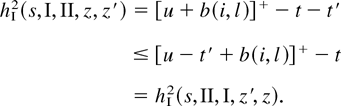
In the same way, one shows hII2(s,I,II,z,z′) ≥ hII2(s,II,I,z′,z). Hence, part (c) (i.e., C.3*) follows. Note that hI2(s,II,I,z,z′) = [u − t + b(i,l′)]+ − t′, which we cannot relate to hI2(s,I,II,z,z′) without serious restrictions on the separation times b(i,·). Hence, the original condition C.3 as used in [1] need not hold in our model.
(d) From the definition of the one-stage cost function in (3.5), we have for s = (i,u,j,v), z = (l,t), z′ = (l′,t′),

It is not difficult to see that an expression of the form x [map ] r(x) − βr(x − t) with r increasing and convex and 0 < β ≤ 1 is increasing in x. As u,i [map ] u + b(i,j′) and v,j [map ] v + b(j,j′) are increasing, we see from (4.3) that part (d) holds.
(e) Fix

. Define
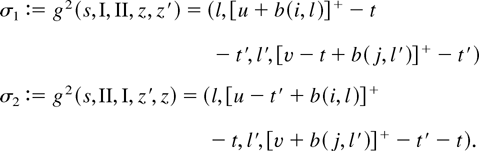
Let us assume that a = I. From Lemma 7.1b, we see that

is increasing in the first two coordinates of σ1 and does not depend on the last two; hence, it is increasing in i and u and does not depend on j and v. Similarly, hIk(σ2,a,z) is increasing in i and u and is independent of j and v. Using Lemma 7.1a, we therefore have

It is not difficult to show that if

is an increasing function and

, then

is increasing. With x = u + b(i,l), we obtain that (7.5) is increasing in i and u and independent of j and v, hence, it is s-increasing. Similarly, for a = II, we see that

is independent of i and u and decreasing in j and v, hence s-increasing. █
7.2. Monotonicity of s [map ] Δn(s) Under Conditions (C*)
We now show that Δn(s) is s-increasing under our modified conditions. For the sake of completeness, we give a streamlined version of the proofs of [1] here.
Lemma 7.3: Let (C*) hold. For any s ∈ S,n ≥ 0,

Proof: We proceed by induction on n ≥ 0. For n = 0, we have with V0 ≡ 0 and s = (i,u,j,v)

which is s-increasing by condition C.1. Now, assume that s [map ] Δk(s) is s-increasing for all k ≤ n − 1. We will show that the same holds for Δn(s). Note that for any

, we have

where we denote

We now obtain for any s ∈ S,n ≥ 1,

From the induction hypotheses and condition C.2, we now infer that s [map ] Δn−1(g(s,a,z)) is s-increasing. As [·]+ and [·]− are monotone functions, we obtain that

is s-increasing. For the proof of the lemma, it is therefore sufficient to show that the remainder of (7.10) is s-increasing; that is,

where ξ is defined in (7.12).
Note that in the second equation of (7.11), we have exchanged Z1 and Z2, which is possible because they are i.i.d.. This is a minor change from the derivation in [1] and allows one to use conditions C.3*–C.5*. As Z1 and Z2 are also independent of the rest, the monotonicity of (7.11) follows if s [map ] ξ(s,z1,z2) is s-increasing for all

, which is shown in the next lemma. █
Lemma 7.4: If s [map ] Δk(s) is s-increasing for all k ≤ n, then the following expression is s-increasing for all

:

For the proof of this lemma, we need the following definition: Let R0(s) := 0, and for

, let

Then, Rk(s,a,z) is the discounted cost over k stages when starting in state s and following a fixed routing policy a, with fixed external events z. Note that gm depends only on part of the sequences a and z.
Proof of Lemma 7.4:

where

are arbitrary fixed sequences. The first half of Φk(·) describes the cost from n + 2 stages starting in state s; when in the first k + 2 stages the fixed policy (I,II,a1,…,ak) is used, the external events (z,z′,z1,…,zk) occur and an optimal policy is used for the remaining n − k stages. The second half of Φk(·) interchanges actions I and II and the first two external events z and z′.
2. The main step of the proof is to show that Φk is s-increasing for all k = 0,…,n by downward induction on k = n,…,0. The lemma then follows, as Φ0(s) = ξ(s).
2.1. For k = n, Φn reduces to the expression (7.21) in Lemma 7.5. It is proven there that this expression is s-increasing for any n ≥ 1.
2.2. Now, assume that Φk+1(·) is increasing in s for any sequences

. We want to show that the analogous result holds for Φk(·). Let s [pr ] s′ and put
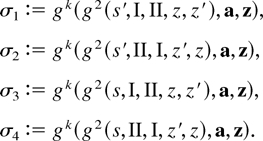
From C.2 and C.3*, we obtain that σ1 [pr ] σ2 and σ3 [pr ] σ4. Again, from C.2 follows σ3 [pr ] σ1 and σ4 [pr ] σ2; hence, we have

Then,

2.2.1. We will now show that there is a′ ∈ A with

To simplify the notation, we put w(s) := Vn−k−1(s). Assume that a ∈ A is optimal in σ1 and b ∈ A is optimal in σ4. If a = b, then (7.16) holds for a′ = a. If a ≠ b, then

Here, the last inequality follows, as it is assumed in this lemma that s [map ] Δl(s) is increasing for all l ≤ n; hence, we see from (7.14) that
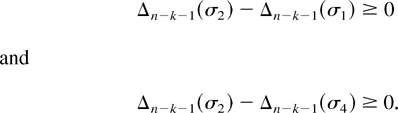
In the same way, we obtain
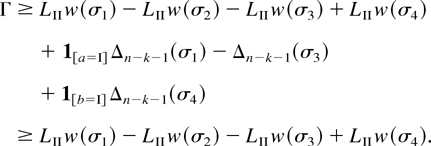
2.2.2. Inserting the definition of La into (7.16), we obtain

As Φk depends only on the first k components of a = (a1,…,ak+1), we can choose ak+1 = a′ to obtain

and similarly for σ1,σ2, and σ4.
2.2.3. Returning to (7.15), we obtain from (7.18) and (7.19),

where the last step follows from the induction hypotheses. █
Lemma 7.5: Let C.4* and C.5* hold. Then, for all k

, the following expression is s-increasing:

Proof: We have from the definition of Rk

The first part of this expression is s-increasing by condition C.4*, the second is a sum of terms which are s-increasing by C.5*. █
8. CONCLUSION
In this article, we have investigated optimal assignment rules in a particular model of aircraft arrivals. We have shown that optimal policies are of switching type only if we restrict the information on which decisions are based to the state of the two runways (i.e., to the workload and the types of aircraft waiting at the end of the queues).
Determining the optimal assignment policy explicitly is a most difficult task. Classical approaches such as policy iteration or value iteration (see [10]) are of limited use here due to the complex search space of possible decision rules. Recent approaches to incorporate numerical approximation techniques are presented, for example, in [5].
Our results narrow the space of possible decision rules. If we restrict the search to monotone rules (i.e., to switching levels), we are sure to cover policies that are optimal among those that depend only on the state of the runways.
The authors of the present article have some experience with the optimization of assignment policies using heuristic search methods as genetic algorithms for which the expected waiting times are estimated by discrete event simulation. Monotone policies or, rather, the switching levels are easily stored and manipulated on a computer. Although our results show that these rules need not be optimal in general, they perform quite well in practice.
Our future research will focus on two topics. First, we will investigate models that take into account more than just one arrival. Even in the random environment assumed here, airport controllers usually know about the next few arrivals and can base their decision on that information. Second, we will work on approximation techniques, as for example in [5], by making use of structural properties as proven in this article.
Acknowledgment
The authors would like to thank the referee of a former version of this article for useful suggestions concerning the monotonicity with respect to the types.
References
REFERENCES
Altman, E. &
Stidham, S., Jr.
(1995).
Optimality of monotonic policies for two-action Markovian decision
processes, with applications to control of queues with delayed
information.
Queueing Systems
21:
267–291.Google Scholar
Bäuerle, N.,
Engelhardt-Funke, O., &
Kolonko, M.
(2002).
Routing of airplanes to two runways: Stability and bounds for
the waiting times,
submitted.
Beasley, J.E.,
Krishnamoorty, M.,
Sharaiha, Y.M., &
Abramson, D.
(2000).
Scheduling aircraft landings—The static case.
Transportation Science
34:
180–197.Google Scholar
Bertsekas, D.
(1987).
Dynamic programming: Deterministic and stochastic models.
Englewood Cliffs, NJ:
Prentice-Hall.
Bertsekas, D. &
Tsitsiklis, J.N.
(1996).
Neuro-dynamic programming.
Englewood Cliffs, NJ:
Prentice-Hall.
Bolender, M.A. &
Slater, G.L.
(2000).
Evaluation of scheduling methods for multiple runways.
Journal of Aircrafts
37:
410–416.Google Scholar
Hordijk, A.,
Koole, G.M., &
Loeve, J.A.
(1994).
Analysis of a customer assignment model with no state information.
Probability in the Engineering and Information Sciences
8:
419–429.Google Scholar
Horonjeff, R. &
McKelvey, F.X.
(1994).
Planning and design of airports,
4th ed.
Boston:
McGraw-Hill.
Neuts, M.F.
(1977).
Some explicit formulas for the steady-state behaviour of the queue
with semi-Markovian service times.
Advances in Applied Probability
9:
141–157.Google Scholar
Puterman, M.L.
(1994).
Markov decision processes. Discrete stochastic dynamic programming.
Wiley Series in Probability and Mathematical Statistics.
New York:
Wiley.
Schäl, M.
(1975).
Conditions for the optimality in dynamic programming and for the
limit of n-stage optimal policies to be optimal.
Zeitschrift für Wahrscheinlichkeitstheorie und verwandte
Gebiete
32:
179–196.Google Scholar
Stidham, S., Jr. &
Weber, R.
(1993).
A survey of Markov decision models for control of networks of
queues.
Queueing Systems
13:
291–314.Google Scholar
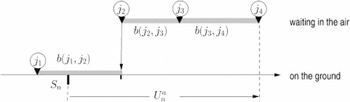
The load on runway a when aircrafts of types j1,…,j4 are present.
 You have
Access
- 4
- Cited by