



%20--%3e%3c!DOCTYPE%20svg%20PUBLIC%20'-//W3C//DTD%20SVG%201.0//EN'%20'http://www.w3.org/TR/2001/REC-SVG-20010904/DTD/svg10.dtd'%3e%3csvg%20version='1.0'%20id='Layer_1'%20xmlns='http://www.w3.org/2000/svg'%20xmlns:xlink='http://www.w3.org/1999/xlink'%20x='0px'%20y='0px'%20width='64px'%20height='64px'%20viewBox='5.5%20-3.5%2064%2064'%20enable-background='new%205.5%20-3.5%2064%2064'%20xml:space='preserve'%3e%3cg%3e%3ccircle%20fill='%23FFFFFF'%20fill-opacity='0'%20cx='37.785'%20cy='28.501'%20r='28.836'/%3e%3cpath%20fill='%23595959'%20d='M37.441-3.5c8.951,0,16.572,3.125,22.857,9.372c3.008,3.009,5.295,6.448,6.857,10.314%20c1.561,3.867,2.344,7.971,2.344,12.314c0,4.381-0.773,8.486-2.314,12.313c-1.543,3.828-3.82,7.21-6.828,10.143%20c-3.123,3.085-6.666,5.448-10.629,7.086c-3.961,1.638-8.057,2.457-12.285,2.457s-8.276-0.808-12.143-2.429%20c-3.866-1.618-7.333-3.961-10.4-7.027c-3.067-3.066-5.4-6.524-7-10.372S5.5,32.767,5.5,28.5c0-4.229,0.809-8.295,2.428-12.2%20c1.619-3.905,3.972-7.4,7.057-10.486C21.08-0.394,28.565-3.5,37.441-3.5z%20M37.557,2.272c-7.314,0-13.467,2.553-18.458,7.657%20c-2.515,2.553-4.448,5.419-5.8,8.6c-1.354,3.181-2.029,6.505-2.029,9.972c0,3.429,0.675,6.734,2.029,9.913%20c1.353,3.183,3.285,6.021,5.8,8.516c2.514,2.496,5.351,4.399,8.515,5.715c3.161,1.314,6.476,1.971,9.943,1.971%20c3.428,0,6.75-0.665,9.973-1.999c3.219-1.335,6.121-3.257,8.713-5.771c4.99-4.876,7.484-10.99,7.484-18.344%20c0-3.543-0.648-6.895-1.943-10.057c-1.293-3.162-3.18-5.98-5.654-8.458C50.984,4.844,44.795,2.272,37.557,2.272z%20M37.156,23.187%20l-4.287,2.229c-0.458-0.951-1.019-1.619-1.685-2c-0.667-0.38-1.286-0.571-1.858-0.571c-2.856,0-4.286,1.885-4.286,5.657%20c0,1.714,0.362,3.084,1.085,4.113c0.724,1.029,1.791,1.544,3.201,1.544c1.867,0,3.181-0.915,3.944-2.743l3.942,2%20c-0.838,1.563-2,2.791-3.486,3.686c-1.484,0.896-3.123,1.343-4.914,1.343c-2.857,0-5.163-0.875-6.915-2.629%20c-1.752-1.752-2.628-4.19-2.628-7.313c0-3.048,0.886-5.466,2.657-7.257c1.771-1.79,4.009-2.686,6.715-2.686%20C32.604,18.558,35.441,20.101,37.156,23.187z%20M55.613,23.187l-4.229,2.229c-0.457-0.951-1.02-1.619-1.686-2%20c-0.668-0.38-1.307-0.571-1.914-0.571c-2.857,0-4.287,1.885-4.287,5.657c0,1.714,0.363,3.084,1.086,4.113%20c0.723,1.029,1.789,1.544,3.201,1.544c1.865,0,3.18-0.915,3.941-2.743l4,2c-0.875,1.563-2.057,2.791-3.541,3.686%20c-1.486,0.896-3.105,1.343-4.857,1.343c-2.896,0-5.209-0.875-6.941-2.629c-1.736-1.752-2.602-4.19-2.602-7.313%20c0-3.048,0.885-5.466,2.658-7.257c1.77-1.79,4.008-2.686,6.713-2.686C51.117,18.558,53.938,20.101,55.613,23.187z'/%3e%3c/g%3e%3c/svg%3e)
%20--%3e%3c!DOCTYPE%20svg%20PUBLIC%20'-//W3C//DTD%20SVG%201.0//EN'%20'http://www.w3.org/TR/2001/REC-SVG-20010904/DTD/svg10.dtd'%3e%3csvg%20version='1.0'%20id='Layer_1'%20xmlns='http://www.w3.org/2000/svg'%20xmlns:xlink='http://www.w3.org/1999/xlink'%20x='0px'%20y='0px'%20width='64px'%20height='64px'%20viewBox='5.5%20-3.5%2064%2064'%20enable-background='new%205.5%20-3.5%2064%2064'%20xml:space='preserve'%3e%3cg%3e%3ccircle%20fill='%23FFFFFF'%20fill-opacity='0'%20cx='37.637'%20cy='28.806'%20r='28.276'/%3e%3cg%3e%3cpath%20fill='%23595959'%20d='M37.443-3.5c8.988,0,16.57,3.085,22.742,9.257C66.393,11.967,69.5,19.548,69.5,28.5c0,8.991-3.049,16.476-9.145,22.456%20C53.879,57.319,46.242,60.5,37.443,60.5c-8.649,0-16.153-3.144-22.514-9.43C8.644,44.784,5.5,37.262,5.5,28.5%20c0-8.761,3.144-16.342,9.429-22.742C21.101-0.415,28.604-3.5,37.443-3.5z%20M37.557,2.272c-7.276,0-13.428,2.553-18.457,7.657%20c-5.22,5.334-7.829,11.525-7.829,18.572c0,7.086,2.59,13.22,7.77,18.398c5.181,5.182,11.352,7.771,18.514,7.771%20c7.123,0,13.334-2.607,18.629-7.828c5.029-4.838,7.543-10.952,7.543-18.343c0-7.276-2.553-13.465-7.656-18.571%20C50.967,4.824,44.795,2.272,37.557,2.272z%20M46.129,20.557v13.085h-3.656v15.542h-9.944V33.643h-3.656V20.557%20c0-0.572,0.2-1.057,0.599-1.457c0.401-0.399,0.887-0.6,1.457-0.6h13.144c0.533,0,1.01,0.2,1.428,0.6%20C45.918,19.5,46.129,19.986,46.129,20.557z%20M33.042,12.329c0-3.008,1.485-4.514,4.458-4.514s4.457,1.504,4.457,4.514%20c0,2.971-1.486,4.457-4.457,4.457S33.042,15.3,33.042,12.329z'/%3e%3c/g%3e%3c/g%3e%3c/svg%3e)
%20--%3e%3c!DOCTYPE%20svg%20PUBLIC%20'-//W3C//DTD%20SVG%201.0//EN'%20'http://www.w3.org/TR/2001/REC-SVG-20010904/DTD/svg10.dtd'%3e%3csvg%20version='1.0'%20id='Layer_1'%20xmlns='http://www.w3.org/2000/svg'%20xmlns:xlink='http://www.w3.org/1999/xlink'%20x='0px'%20y='0px'%20width='64px'%20height='64px'%20viewBox='5.5%20-3.5%2064%2064'%20enable-background='new%205.5%20-3.5%2064%2064'%20xml:space='preserve'%3e%3cg%3e%3ccircle%20fill='%23FFFFFF'%20fill-opacity='0'%20cx='36.924'%20cy='28.403'%20r='28.895'/%3e%3cpath%20fill='%23595959'%20d='M37.442-3.5c8.99,0,16.571,3.085,22.743,9.256C66.393,11.928,69.5,19.509,69.5,28.5c0,8.992-3.048,16.476-9.145,22.458%20C53.88,57.32,46.241,60.5,37.442,60.5c-8.686,0-16.19-3.162-22.513-9.485C8.644,44.728,5.5,37.225,5.5,28.5%20c0-8.762,3.144-16.343,9.429-22.743C21.1-0.414,28.604-3.5,37.442-3.5z%20M12.7,19.872c-0.952,2.628-1.429,5.505-1.429,8.629%20c0,7.086,2.59,13.22,7.77,18.4c5.219,5.144,11.391,7.715,18.514,7.715c7.201,0,13.409-2.608,18.63-7.829%20c1.867-1.79,3.332-3.657,4.398-5.602l-12.056-5.371c-0.421,2.02-1.439,3.667-3.057,4.942c-1.622,1.276-3.535,2.011-5.744,2.2%20v4.915h-3.714v-4.915c-3.543-0.036-6.782-1.312-9.714-3.827l4.4-4.457c2.094,1.942,4.476,2.913,7.143,2.913%20c1.104,0,2.048-0.246,2.83-0.743c0.78-0.494,1.172-1.312,1.172-2.457c0-0.801-0.287-1.448-0.858-1.943l-3.085-1.315l-3.771-1.715%20l-5.086-2.229L12.7,19.872z%20M37.557,2.214c-7.276,0-13.428,2.571-18.457,7.714c-1.258,1.258-2.439,2.686-3.543,4.287L27.786,19.7%20c0.533-1.676,1.542-3.019,3.029-4.028c1.484-1.009,3.218-1.571,5.2-1.686V9.071h3.715v4.915c2.934,0.153,5.6,1.143,8,2.971%20l-4.172,4.286c-1.793-1.257-3.619-1.885-5.486-1.885c-0.991,0-1.876,0.191-2.656,0.571c-0.781,0.381-1.172,1.029-1.172,1.943%20c0,0.267,0.095,0.533,0.285,0.8l4.057,1.83l2.8,1.257l5.144,2.285l16.397,7.314c0.535-2.248,0.801-4.533,0.801-6.857%20c0-7.353-2.552-13.543-7.656-18.573C51.005,4.785,44.831,2.214,37.557,2.214z'/%3e%3c/g%3e%3c/svg%3e)
%20--%3e%3c!DOCTYPE%20svg%20PUBLIC%20'-//W3C//DTD%20SVG%201.0//EN'%20'http://www.w3.org/TR/2001/REC-SVG-20010904/DTD/svg10.dtd'%3e%3csvg%20version='1.0'%20id='Layer_1'%20xmlns='http://www.w3.org/2000/svg'%20xmlns:xlink='http://www.w3.org/1999/xlink'%20x='0px'%20y='0px'%20width='64px'%20height='64px'%20viewBox='5.5%20-3.5%2064%2064'%20enable-background='new%205.5%20-3.5%2064%2064'%20xml:space='preserve'%3e%3cg%3e%3ccircle%20fill='%23FFFFFF'%20fill-opacity='0'%20cx='36.944'%20cy='28.631'%20r='29.105'/%3e%3cg%3e%3cpath%20fill='%23595959'%20d='M37.443-3.5c8.951,0,16.531,3.105,22.742,9.315C66.393,11.987,69.5,19.548,69.5,28.5c0,8.954-3.049,16.457-9.145,22.514%20C53.918,57.338,46.279,60.5,37.443,60.5c-8.649,0-16.153-3.143-22.514-9.429C8.644,44.786,5.5,37.264,5.5,28.501%20c0-8.723,3.144-16.285,9.429-22.685C21.138-0.395,28.643-3.5,37.443-3.5z%20M37.557,2.272c-7.276,0-13.428,2.572-18.457,7.715%20c-5.22,5.296-7.829,11.467-7.829,18.513c0,7.125,2.59,13.257,7.77,18.4c5.181,5.182,11.352,7.771,18.514,7.771%20c7.123,0,13.334-2.609,18.629-7.828c5.029-4.876,7.543-10.99,7.543-18.343c0-7.313-2.553-13.485-7.656-18.513%20C51.004,4.842,44.832,2.272,37.557,2.272z%20M23.271,23.985c0.609-3.924,2.189-6.962,4.742-9.114%20c2.552-2.152,5.656-3.228,9.314-3.228c5.027,0,9.029,1.62,12,4.856c2.971,3.238,4.457,7.391,4.457,12.457%20c0,4.915-1.543,9-4.627,12.256c-3.088,3.256-7.086,4.886-12.002,4.886c-3.619,0-6.743-1.085-9.371-3.257%20c-2.629-2.172-4.209-5.257-4.743-9.257H31.1c0.19,3.886,2.533,5.829,7.029,5.829c2.246,0,4.057-0.972,5.428-2.914%20c1.373-1.942,2.059-4.534,2.059-7.771c0-3.391-0.629-5.971-1.885-7.743c-1.258-1.771-3.066-2.657-5.43-2.657%20c-4.268,0-6.667,1.885-7.2,5.656h2.343l-6.342,6.343l-6.343-6.343L23.271,23.985L23.271,23.985z'/%3e%3c/g%3e%3c/g%3e%3c/svg%3e)
1. Introduction
Red Supergiants (RSGs) are cool, evolved massive stars with initial masses of 8–30 M $_\unicode{x2299}$, representing the final evolutionary stage before they end their lives in a Type II supernova (SN) explosion (Ekström et al. Reference Ekström, Georgy and Eggenberger2012; Levesque Reference Levesque2017). However, the apparent lack of luminous RSGs detected as SN progenitors has sparked an ongoing debate over the fate of these stars, known as the so-called “RSG problem”. While several studies support its existence (Li et al. Reference Li, Van Dyk and Filippenko2006; Smartt et al. Reference Smartt, Eldridge, Crockett and Maund2009; Smartt Reference Smartt2015; Fang et al. Reference Fang, Moriya and Maeda2025), others argue that this problem is not statistically significant and may stem from the methodologies used to derive SN progenitor properties (Davies and Beasor Reference Davies and Beasor2020; Beasor et al. Reference Beasor, Smith and Jencson2024; Strotjohann et al. Reference Strotjohann, Ofek and Gal-Yam2024). Alternative explanations include the failed-SN scenario, involving direct collapse into a black hole (De et al. Reference De, MacLeod and Jencson2024), or post-RSG evolution (i.e., Yellow Hypergiant (YHG) phase; de Jager Reference de Jager1998; Gordon and Humphreys Reference Gordon and Humphreys2019) in which the star loses its outer envelope. Nevertheless, recent empirical studies (e.g., Beasor et al. Reference Beasor, Davies and Smith2020; Decin et al. Reference Decin, Richards, Marchant and Sana2024; Antoniadis et al. Reference Antoniadis, Bonanos and de Wit2024) have derived weak winds that are insufficient to produce post-RSG objects. The detection of vast episodic mass-loss events in luminous RSGs (e.g., NML Cyg and VY CMa; Richards et al. Reference Richards, Yates and Cohen1996; Singh et al. Reference Singh, Richards, Humphreys, Decin and Ziurys2023) provides an alternative mechanism to the steady winds. The physical mechanism driving these episodic events remains unknown, and their impact on stellar evolution is unclear, as the significance of episodic mass loss varies greatly among RSGs (Humphreys and Jones Reference Humphreys and Jones2022). Eruptions and large mass ejections due to instabilities (Glatzel and Kiriakidis Reference Glatzel and Kiriakidis1993) are expected at luminosities close to the Humphreys-Davidson limit (
 $\log(L/{L_\unicode{x2299}})=5.5-5.8$; Humphreys and Davidson Reference Humphreys and Davidson1979; Davies and Beasor Reference Davies and Beasor2020; McDonald et al. Reference McDonald, Davies and Beasor2022). Alternatively, binary interactions can trigger episodic mass loss (Landri and Pejcha Reference Landri and Pejcha2024; MacLeod et al. Reference MacLeod, Blunt and De Rosa2024). In general, binarity adds further complexity to the fate of RSGs as it can drive stellar evolution by initiating a common-envelope phase (CE), stripping their envelope, or leading to a merger (Sana et al. Reference Sana, de Mink and de Koter2012; Ivanova et al. Reference Ivanova, Justham and Chen2013). The scarcity of very luminous RSGs, the presence of large amounts of circumstellar material, and their inaccurate distances (Humphreys Reference Humphreys2019) hinder accurate measurements of their stellar properties and whether they are single or binary systems, complicating the assessment of their evolutionary stage and ultimate fate.
WOH G64 (IRAS 04553-6825) (Westerlund et al. Reference Westerlund, Olander and Hedin1981) stands out as the most extreme RSG in the Large Magellanic Cloud (LMC), on the brink of the luminosity limit ( $\log(L/L_\unicode{x2299})=5.45$; Ohnaka et al. Reference Ohnaka, Driebe, Hofmann, Weigelt and Wittkowski2008), being one of the coolest (M5-7e; Elias et al. Reference Elias, Frogel and Schwering1986; Levesque et al. Reference Levesque, Massey, Plez and Olsen2009), largest (
 $R=1540$ R
 $_\unicode{x2299}$; Levesque et al. Reference Levesque, Massey, Plez and Olsen2009) and the record-holder in terms of mass-loss rate (
 $\dot{M}\gt10^{-4}$ M
 $_\unicode{x2299}$ yr
 $^{-1}$; Beasor and Smith Reference Beasor and Smith2022; Antoniadis et al. Reference Antoniadis, Bonanos and de Wit2024). Interferometric observations in the near and mid-IR revealed elongated emission, which was attributed to a dusty, disk-like structure of 3-9 M
 $_\unicode{x2299}$ (Ohnaka et al. Reference Ohnaka, Driebe, Hofmann, Weigelt and Wittkowski2008; Ohnaka et al. Reference Ohnaka, Hofmann and Weigelt2024). It is also an OH/IR star with strong multi-component maser emission, possibly due to an external disk, two expanding dust shells, or bipolar outflows (van Loon et al. Reference van Loon, Zijlstra, Bujarrabal and Nyman2001; Marshall et al. Reference Marshall, van Loon and Matsuura2004).
2. Results
In this talk, we present the results from Munoz-Sanchez et al. (Reference Munoz-Sanchez, Kalitsounaki and de Wit2024). We combined new observations with archival photometric and spectroscopic data to analyze WOH G64.
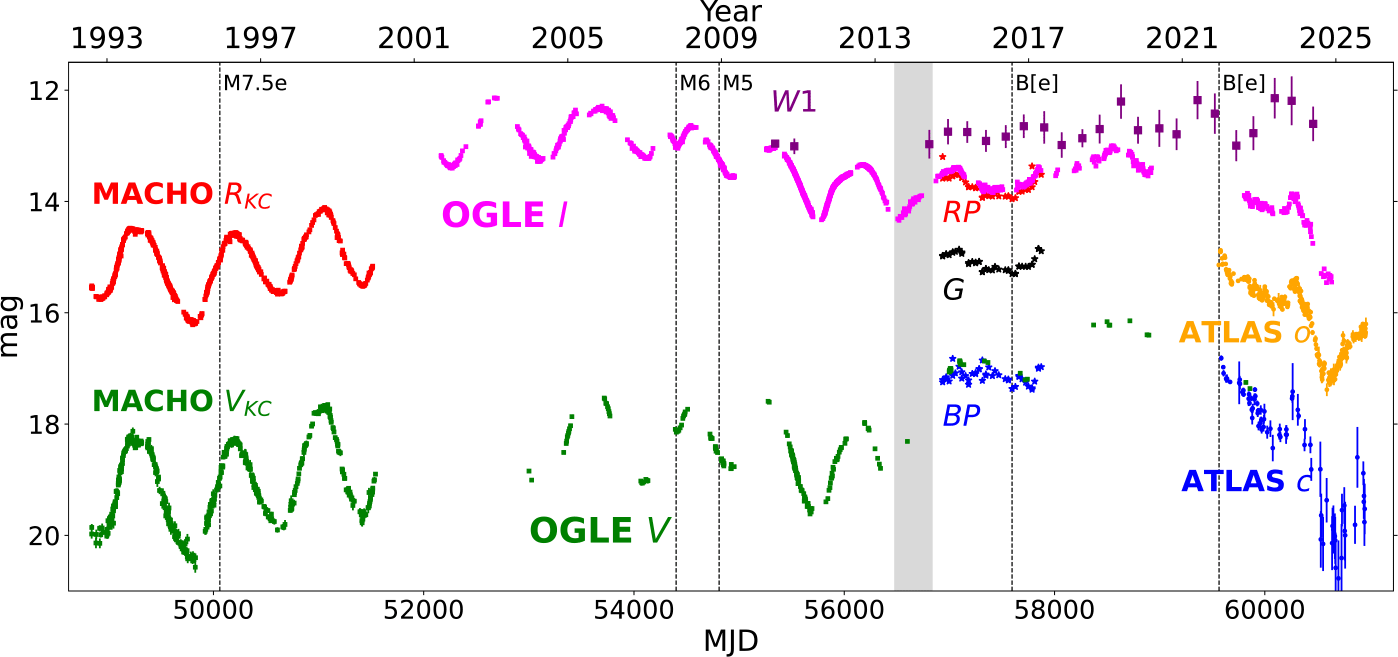
The optical light curve of WOH G64, spanning from 1992 to the present, clearly shows two distinct phases, separated by a transition in 2014 (Fig. 1). WOH G64 exhibits a sinusoidal pattern from the 1990s until 2013, but between mid-2013 and mid-2014, the star became significantly bluer, with a color change of  $\Delta(V-I) \approx 1.8$ mag. The change was caused exclusively by a sudden brightening in the V-band within a year, while the I-band remained approximately constant. Since 2014, WOH G64 has exhibited irregular variability, including a recent fading of 2 mag over 10 months, reaching its faintest observed I-band state to date. Mid-infrared (IR) brightness before and after the transition does not show significant changes, except for three brightenings of
 $\Delta W1 \approx 0.5$ mag with a potential periodicity of
 $\sim$ 750 days.
Optical light curves of WOH G64 spanning  $\gt$30 years. Each dataset is labeled with the corresponding survey and filter. The shadowed patch between 2013.5 and 2014.5 constrains the epoch of the transition. The vertical lines indicate the epochs of spectroscopy and the corresponding optical spectroscopic classifications reported for WOH G64.

Figure 1 Long description
Panel: A line graph showing the optical light curves of WOH G64 over a period of more than 30 years. The horizontal axis represents the Modified Julian Date (MJD) ranging from 1993 to 2025. The vertical axis represents the magnitude (mag) ranging from 12 to 20. Multiple datasets are labeled with corresponding surveys and filters: MACHO R_KC and V_KC, OGLE I and V, RP, G, ATLAS O, BP, and C. The shadowed patch between 2013.5 and 2014.5 indicates the epoch of the transition. Vertical lines mark the epochs of spectroscopy and corresponding optical spectroscopic classifications reported for WOH G64.
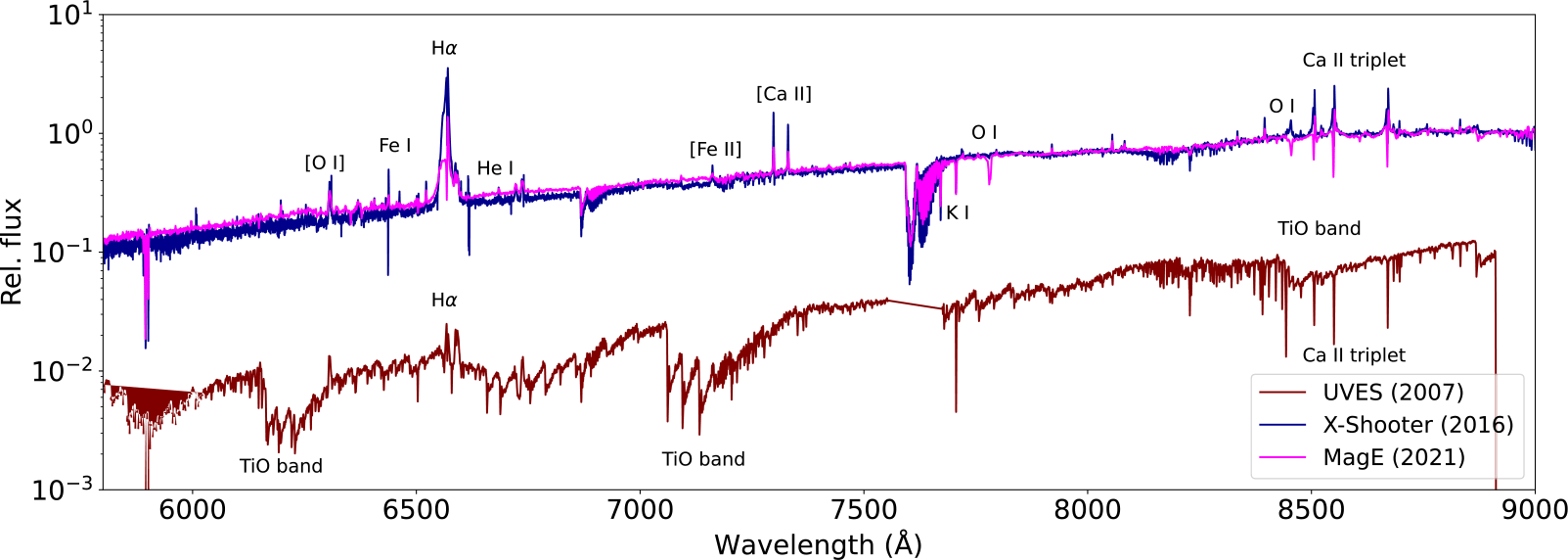
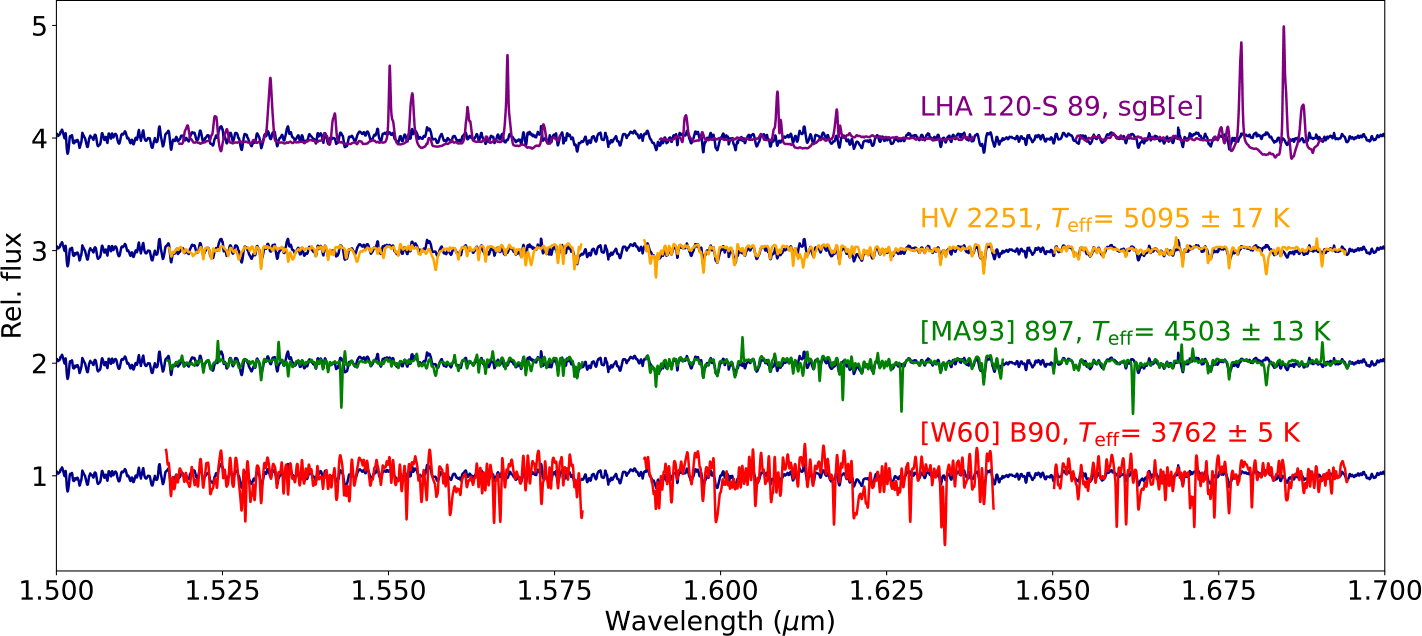
An extraordinary change in the optical spectral features accompanied the dramatic photometric transition in 2014 (Fig. 2). In 2007, WOH G64 exhibits spectral features characteristic of an M6 Ie-type RSG (Solf Reference Solf1978), including deep TiO bands and strong Ca <sc>ii</sc> triplet absorption lines. Remarkably, we detect strong double-peaked emission from forbidden emission lines (e.g., [N <sc>ii</sc>] and [S <sc>ii</sc>]), strangely seen in RSGs. Multi-epoch spectroscopy after the transition revealed the most extreme change ever seen in the optical spectral features of a RSG. In 2016 and 2021, the optical spectral range is dominated by asymmetric emission lines from permitted (e.g., Fe <sc>i</sc>, H <sc>i</sc>, and He <sc>i</sc>) and forbidden transitions (e.g., [Ca <sc>ii</sc>], [Fe <sc>ii</sc>], [N <sc>ii</sc>], and [S <sc>ii</sc>]) leading to a B[e]-star classification (Lamers et al. Reference Lamers, Zickgraf, de Winter, Houziaux and J.1998; Kraus Reference Kraus2019). Simultaneous near-IR spectroscopy in 2016 revealed a composite spectrum, with the H band characterized by neutral atomic absorption lines typically seen in late-G to early-K stars (Rayner et al. Reference Rayner, Cushing and Vacca2009). Fig. 3 presents a comparison of the H-band spectrum of WOH G64 with that of a supergiant B[e] star (sgB[e]), two Yellow Supergiants (YSGs), and a RSG. If WOH G64 was a sgB[e], its full spectral range would consistently resemble that of a hot B-type star embedded in low-density circumstellar material. However, the H-band features observed in WOH G64 closely resemble those of YSGs, suggesting an effective temperature of  $T_{\mathrm{eff}} \sim 4700$ K (Fig. 3). The absence of typical RSG features in the H-band further supports the spectral transition reported in the optical. The composite spectral features of a warm star in the near-IR and a B[e] star in the optical indicate that WOH G64 is a massive symbiotic binary (Lamers et al. Reference Lamers, Zickgraf, de Winter, Houziaux and J.1998), where the main RSG has evolved into a YHG.
Comparison of the multi-epoch optical spectroscopy of WOH G64. The main spectral features are indicated for each epoch. The spectra are scaled to unity between 8700-8800 Å, but the UVES spectrum is shown with an offset.

Comparison of the H band of WOH G64 from X-Shooter (blue) in 2016 with the APOGEE spectra of four supergiants of the LMC, indicating their T  $_{\mathrm{eff}}$ from APOGEE.

3. Discussion
Binary interactions in a symbiotic system provide a compelling framework to explain the observations of WOH G64, including its asymmetric morphology and surrounding torus (Ohnaka et al. Reference Ohnaka, Driebe, Hofmann, Weigelt and Wittkowski2008; Ohnaka et al. Reference Ohnaka, Hofmann and Weigelt2024), the He <sc>I</sc> emission detected after 2016, likely produced by a hot companion (e.g., Cowley Reference Cowley1969) or an accretion disk around it (e.g., Beristain et al. Reference Beristain, Edwards and Kwan2001), the double-peaked forbidden emission tracing bipolar outflows from the accretor during mass transfer (Soker Reference Soker2015), and the radial velocity shifts seen in several lines.
Binary interactions could therefore have driven the observed transition. Mass transfer is expected in RSGs within wide binaries, potentially leading to a CE phase (Paczyński and Sienkiewicz Reference Paczyński and Sienkiewicz1972; Ercolino et al. Reference Ercolino, Jin, Langer and Dessart2024). However, predicting the outcome or duration of CE evolution remains challenging, as it depends sensitively on stellar parameters and involves complex, multi-timescale 3D processes that are difficult to model (Ivanova et al. Reference Ivanova, Justham and Chen2013). WOH G64 has long exhibited an unusually cool and extended atmosphere compared to typical RSGs (Levesque Reference Levesque2017), which may have been a pseudo-atmosphere formed during a CE phase. During the CE evolution, the system could enter a slow, self-regulated phase where orbital decay energy is transported outward and radiated efficiently (Clayton et al. Reference Clayton, Podsiadlowski, Ivanova and Justham2017). This process may drive large-amplitude, recurrent pulsations that eject shells every few decades, yielding an average mass-loss rate of  $\dot{M}\sim10^{-3}$ M
 $_\unicode{x2299}$ yr
 $^{-1}$, comparable to the estimations for WOH G64 (
 $\dot{M}\gt10^{-4}$ M
 $_\unicode{x2299}$ yr
 $^{-1}$; Antoniadis et al. Reference Antoniadis, Bonanos and de Wit2024).
Beyond binary interactions, the transition could be driven by single-stellar physics. The luminosity of WOH G64 is close to the Humphreys-Davidson limit where significant eruptions are expected (Glatzel and Kiriakidis Reference Glatzel and Kiriakidis1993). For instance, Var A, one of the most luminous stars in M33 (Hubble and Sandage Reference Hubble and Sandage1953), underwent an eruption lasting over 45 yr and serves as a notable example (Humphreys et al. Reference Humphreys, Jones and Gehrz1987; Humphreys et al. Reference Humphreys, Jones and Polomski2006). During the eruption, Var A exhibited late-M spectral features due to its optically thick wind. When the eruption ended, Var A returned to its YHG state, exhibiting F-type features along with both forbidden and permitted emission lines. Similar to Var A, WOH G64 might have been a YHG undergoing an eruption for more than 30 yr, until it returned to a quiescent state in 2014 when the false pseudo-atmosphere dissipated. These two cases are outstanding because other YHGs exhibit typically short-lived eruptions (e.g., Koumpia et al. Reference Koumpia, Oudmaijer and Graham2020). However, the dramatic optical changes in WOH G64, fast transition, and higher obscuration suggest an even more extreme event than in Var A.
Our findings challenge current models of massive star evolution by underscoring the critical role of binary interactions and episodic eruptions in shaping the fate of evolved massive stars. In particular, WOH G64 offers valuable insight into the late evolutionary stages of the most luminous RSGs, and the long-standing “RSG problem”. Recent studies of the extreme RSGs VY CMa and NML Cyg have uncovered potential evidence of companions (Smith et al. Reference Smith, Beasor and Close2025; De Beck et al. Reference De Beck, Andrews, Quintana-Lacaci and Vlemmings2025). Determining whether binarity is responsible for their extreme properties and their vast episodic mass-loss events is crucial for understanding the final evolutionary path of massive stars (Marchant and Bodensteiner Reference Marchant and Bodensteiner2024). In the case of WOH G64, its future remains uncertain due to limited constraints on the system’s physical and orbital parameters. Continued spectroscopic and photometric monitoring of this unique system will be essential to constrain its binary properties, uncover the mechanism behind its dramatic transition, and predict its ultimate fate.
 >
 eff

 Open access

