With population aging comes an increase in age-related conditions, including chronic diseases, behavioural or cognitive disturbances, and autonomy deficits. For these reasons, a growing number of older persons must leave their own homes to go to nursing homes (Gaugler, Mittelman, Hepburn, & Newcomer, Reference Gaugler, Mittelman, Hepburn and Newcomer2009). A nursing home is a type of residential care designed for older people with physical or cognitive autonomy deficits and having difficulties in activities of daily living (e.g., food preparation, housekeeping, laundry, taking medication). Nursing homes are intended to provide a safe environment and continuous nursing care. The risk of long-term care placement increases after 65 years of age (Gassoumis, Fike, Rahman, Enguidanos, Wilber, Reference Gassoumis, Fike, Rahman, Enguidanos and Wilber2013). Leaving their own homes to live in a nursing home is a major life event for many older people, which can result in negative behavioural and psychological consequences (Nakanishi, Hattori, Nakashima, & Sawamura, Reference Nakanishi, Hattori, Nakashima and Sawamura2012). The person must accept the loss of familiar surroundings and adjust to the new environment.
Regarding this change of living and, consequently, the change in the way of life, the decision is more often a necessity than a choice (Castle, Reference Castle2003; Rioux, Reference Rioux2008; Sury, Burns, & Brody, Reference Sury, Burns and Brody2013), and the individual must develop a new network to best adapt to the foreign environment and the new lifestyle (Vercauteren & Chapeleau, Reference Vercauteren and Chapeleau1995). Adjustment to a new environment involves developing new behaviours that meet the demands of the environment as well as developing new skills, including qualities such as problem solving or managing anxiety (Bizzini, Reference Bizzini, Richard and Mateev-Dirkx2004; Freeman & Roy, Reference Freeman, Roy, Freeman and Freeman2005). Thus, adjustment can be viewed as a dynamic process that involves the use of strategies to adaptively acclimate to the nursing home (Roy & Andrews, Reference Roy and Andrews1991; Reference Roy and Andrews2009). Therefore, coping with these events is based on internal processes that modulate the dynamic relationship between individuals and their environment (Castonguay & Ferron, Reference Castonguay and Ferron1999), which may underlie actions and behaviours and thus promote adaptation (Altintas, Majchrzak, Leconte, & Guerrien, Reference Altintas, Majchrzak, Leconte and Guerrien2010).
The purpose of this research was to provide a better understanding of the mechanisms involved in the adjustment to a nursing home in light of the participation in leisure activities and motivation for leisure. Based on self-determination theory (Deci & Ryan, Reference Deci and Ryan1985; Reference Deci and Ryan2000), with this study we examined the relationship between leisure activities, motivational profile, adjustment to the institution, and satisfaction with life in older adults who live in nursing homes.
Adaptive Function of Leisure Activities
Among factors that play a role in the adjustment to a nursing home, leisure activities appear to be crucial. The adaptive function of leisure activities in older persons has been repeatedly emphasized (Fitzsimmons, & Buettner, Reference Fitzsimmons and Buettner2002; Sylvester, Voelkl, Ellis, Reference Sylvester, Voelkl and Ellis2001). It is important for older persons to participate in leisure activities; this participation requires organization of the activities according to participants’ expectations and needs. The participation of older persons in leisure activities is associated with a better social integration of the individual into the group with opportunities for socializing, engagement in activities (Genoe & Dupuis, Reference Genoe and Dupuis2014; Kelly, Steinkamp, & Kelly, Reference Kelly, Steinkamp and Kelly1987), better life satisfaction (Kelly et al., Reference Kelly, Steinkamp and Kelly1987), less depression (Dupuis & Smale, Reference Dupuis and Smale1995; Cheng, Chow, Yu, & Chan, Reference Cheng, Chow, Yu and Chan2012), better well-being (Dupuis & Smale, Reference Dupuis and Smale1995; Tak, Kedia, Tongumpun, & Hong, Reference Tak, Kedia, Tongumpun and Hong2015), successful aging (Rowe & Kahn, Reference Rowe and Kahn1997), and better adjustment to life events or transitions, such as impairment of health, retirement, and arrival at a nursing home (Duke, Leventhal, Brownlee, & Leventhal, Reference Duke, Leventhal, Brownlee and Leventhal2002; Silverstein & Parker, Reference Silverstein and Parker2002). Participation in leisure activities promotes greater satisfaction in living in a nursing home and thus better adaptation for older persons (McGuinn & Mosher-Ashley, Reference McGuinn and Mosher-Ashley2001).
Leisure activities, under the supervision and organization of a recreation professional, correspond to freely chosen activities in an institutional setting. The activities are organized according to the desires of the older persons and adapted to their abilities. These activities must provide participants with entertainment, relaxation, vitality, and stimulation (Kelly, Reference Kelly1996). In nursing homes, leisure activities fit into a support process in which the primary purpose is to improve the fulfillment of daily life with satisfaction and enjoyment (Leitner & Leitner, Reference Leitner and Leitner2012). Thus, a wide range of activities must be offered in order to improve feelings of control and autonomy, engagement in activities, and self-determined motivation for leisure activities, which leads to a positive impact on the person’s adjustment (Genoe & Dupuis, Reference Genoe and Dupuis2014; Altintas et al., Reference Altintas, Majchrzak, Leconte and Guerrien2010; Coleman & Iso-Ahola, Reference Coleman and Iso-Ahola1993, Iso-Ahola, Reference Iso-Ahola, Jackson and Burton1999; Losier, Bourque, & Vallerand, Reference Losier, Bourque and Vallerand1993).
Self-Determination Theory
Self-determination theory (SDT) is a macro theory of human motivation and optimal functioning (Deci & Ryan, Reference Deci and Ryan1985; Reference Deci and Ryan2002). We briefly present and define the different forms of motivation that underlie this study’s theoretical framework.
SDT (Deci & Ryan, Reference Deci and Ryan1985; Reference Deci and Ryan2002; Vansteenkiste, Niemiec, & Soenens, Reference Vansteenkiste, Niemiec, Soenens, Urdan and Karabenick2010) defines three main types of motivation based on the reasons and goals that arise when a person is engaged in an action: intrinsic motivation (IM), extrinsic motivation (EM), and amotivation (AM). IM refers to doing something because of the pleasure one can obtain from the task itself or from the sense of satisfaction in completing or working on it. EM refers to doing something for instrumental reasons (obtain rewards, avoid punishments or culpability).
Four forms of EM are distinguished: self-determined forms (integrated regulation and regulation through identification) and non-self-determined forms (introjected regulation of behaviour and externally regulated behaviour). Self-determined EM entails personal endorsement and a feeling of choice, although the reason to perform the task is neither satisfaction nor to seek fun but merely to attain an external outcome. Integrated regulation occurs when regulation is fully integrated in the self and congruent with one’s values and needs (participation in leisure activities due to external motivations, and this is consistent with one’s values, needs, e.g., to achieve a social relation). Regulation through identification involves consciously valuing a behaviour as personally important so that its regulation is identified as personal causation, and achieving a goal benefits the person (e.g., participation in leisure activities due to external motivations; this is important for adaptation to a nursing home). In contrast, non-self-determined EM depicts both behaviours as performed because of an internal or external pressure to do so: introjected regulation refers to doing something to maintain high self-esteem, pride, avoid guilt, or avoid anxiety (e.g., participation in leisure activities due to an internalized, pressuring voice), and external regulation pertains to a behaviour that is performed because of an external demand or possible reward (e.g., participation in leisure activities due to competition between a recognized search and external reinforcement).
Finally, AM is a lack of intrinsic and extrinsic motivation. That is, AM involves a relative lack of motivation; a person perceives no reason to initiate or continue an activity (Vallerand & Fortier, Reference Vallerand, Fortier and Duda1998).
These different types of motivation are organized on a continuum according to their relative self-determination in relation to internalization of level values, goals, beliefs, or social norms. The self-determination continuum refers to the perceived locus of causality, which may be internal (the behaviour is perceived to be voluntary and issued by choice), or external (the behaviour is perceived to be induced by external pressures). IM is associated with an internal locus of causality and represents the highest level of self-determination. On a relatively lower level, self-determined forms of extrinsic motivation also correspond to an internal locus of causality, whereas the non-self-determined forms correspond to an external locus of causality. The end of the self-determined continuum is represented by AM (Deci & Ryan, Reference Deci and Ryan1985; Reference Deci and Ryan2008; Ryan & Connell, Reference Ryan and Connell1989).
Motivational Profiles and Outcomes
Recent research used motivational profiles to investigate behavioural (e.g., leisure participation), cognitive (e.g., depression), and affective (e.g., emotion) outcomes and demonstrated the interest of an approach based on profile analysis (Boiché, Sarrazin, Grouzet, Pelletier, & Chanal, Reference Boiché, Sarrazin, Grouzet, Pelletier and Chanal2008; Gillet, Vallerand, & Rosnet, Reference Gillet, Vallerand and Rosnet2009; Ratelle, Guay, Vallerand, Larose, & Senécal, Reference Ratelle, Guay, Vallerand, Larose and Senécal2007; Stephan, Boiché, & Le Scanff, Reference Stephan, Boiché and Le Scanff2010). According to the authors, such an approach would be more informative than the motivational orientation expressed by the self-determination index (SDI, Vallerand & Bissonnette, Reference Vallerand and Bissonnette1992). The SDI score is calculated by weighting each type of motivation to reflect motivational orientation. High SDI scores indicate a high level of self-determined motivation, and low SDI scores indicate a low level of self-determined motivation. This score ignores the different forms of motivation.
However, profile analysis allows the identification of the different motivational profiles present in a sample and, on the basis of intra-group comparisons, enables the study of the relationships between different motivational profiles and the associated consequences (Ratelle et al., Reference Ratelle, Guay, Vallerand, Larose and Senécal2007). Motivational profiles have been successfully used in the SDT approach in different life contexts such as sports (Gillet et al., Reference Gillet, Vallerand and Rosnet2009; Vlachopoulos, Karageorghis, & Terry, Reference Vlachopoulos, Karageorghis and Terry2000), education (Boiché et al., Reference Boiché, Sarrazin, Grouzet, Pelletier and Chanal2008; Ratelle et al., Reference Ratelle, Guay, Vallerand, Larose and Senécal2007; Vansteenkiste, Sierens, Soenens, Luyckx, & Lens, Reference Vansteenkiste, Sierens, Soenens, Luyckx and Lens2009), work (Gillet, Berjot, & Paty, Reference Gillet, Berjot and Paty2010), and aging (Altintas & Guerrien, Reference Altintas and Guerrien2014; Stephan et al., Reference Stephan, Boiché and Le Scanff2010). Overall, the literature reported that non-self-determined profiles were related to negative outcomes in different life contexts (lesser athletic or academic performance, greater distraction, surrender of activity or burnout, and lesser engagement in physical activity), whereas the self-determined profiles were related to positive consequences (better athletic or academic performance, more pleasure and persistence in activities, and better engagement in physical activity).
For an activity, individuals may present different motivational profiles that are more or less self-determined. These profiles are determined by the combination of the aforementioned different forms of motivation. If a person presents high levels of self-determined motivation (IM; self-determined EM: EM with regulation through identification) associated with low levels of non-self-determined motivation (non-self-determined EM: EM with external regulation; AM), the motivational profile will be qualified as self-determined. In contrast, a person with low levels of self-determined motivation and high levels of non-self-determined motivation will be qualified as a non-self-determined profile. Any combinations of the different forms of motivation are possible to determine a motivational profile (e.g., a profile with low levels of self-determined motivation and non-self-determined motivation, or a profile with high levels of self-determined motivation and non-self-determined motivation).
Various studies based on SDT showed a link between self-determined profiles and psychological adaptation in various areas of life and well-being (Deci, Connell, & Ryan, Reference Deci, Connell and Ryan1989; Deci et al., Reference Deci, Ryan, Gagné, Leone, Usunov and Kornazheva2001; Grouzet, Vallerand, Thill, & Provencher, Reference Grouzet, Vallerand, Thill and Provencher2004; Ratelle, Vallerand, Chantal, & Provencher, Reference Ratelle, Vallerand, Chantal and Provencher2004; Vallerand & O’Connor, Reference Vallerand and O’Connor1989).
Concerning research on aging, Stephan et al. (Reference Stephan, Boiché and Le Scanff2010) found a relationship between the motivational profile and physical activity behaviours among older women. Three distinct motivational profiles were reported (high combined, high introjected, and moderate introjected). The profile presenting the higher level of self-determined motivation (high-combined profile) drove a better level of engagement in physical activities than the other two introjected profiles. The self-determined forms of motivation presented a benefit in terms of behavioural consequences (e.g., higher participation level in physical activity in later life). Recently, Altintas and Guerrien (Reference Altintas and Guerrien2014) investigated the relationship between motivational profiles and their affective consequences in older persons. A profile analysis revealed three motivational profiles among participants: (1) moderate motivation profile (with moderate levels of self-determined motivation, non-self-determined motivation, and amotivation); (2) additive profile or high-high motivation profile (with high levels of self-determined and non-self-determined motivation with low levels of amotivation); and (3) self-determined motivation profile or high-low motivation profile (with high levels of self-determined motivation, low levels of non-self-determined motivation, and amotivation). Results revealed that both the self-determined motivation profiles and the profiles with high levels of self-determined and non-self-determined motivations reported the highest levels of psychological well-being. These two studies on aging demonstrated the interest of using motivational profiles in the theoretical framework of SDT to better understand the underlying processes of adaptation in older age. However, few studies on motivational profiles and the adaptation of older persons to their nursing homes have been published to date.
Present Research
The purpose of this research was to provide a better understanding of the mechanisms involved in the adaptation to a nursing home by using a motivational profile approach. Self-determined and additive motivation profiles in later life are related to well-being (Altintas & Guerrien, Reference Altintas and Guerrien2014). Moreover, leisure participation and motivation for leisure predict better adaptation and life satisfaction in nursing homes (Altintas et al., Reference Altintas, Majchrzak, Leconte and Guerrien2010). On this basis, we expected to highlight the relationships between motivational profiles, leisure activities, adaptation to the nursing home, and satisfaction with life. We hypothesized that the motivational profiles with higher levels of self-determined motivation than non-self-determined motivation would represent the optimal profiles in terms of participation to leisure activities and adaptation to living in nursing home. In this study, the adaptation of the older persons was assessed by the adjustment to a nursing home, the satisfaction with life, and a behavioural dimension (leisure activities participation).
Methods
Participants and Procedure
Data were collected from several nursing homes in the north of France with older people who had physical or cognitive autonomy deficits, and difficulties in activities of daily living (e.g., food preparation, housekeeping, laundry, taking medication). Continuous nursing services were offered, and freelance medical services were possible. A sample of 113 French participants living in nursing homes participated in this research: 93 women, 20 men (M age = 84.11 years, SD = 6.93 years, age range = 65–99 years).
The participants lived in nursing homes for an average of 41.70 months (SD = 40.63). After authorization was obtained from the nursing homes’ authorities prior to the investigation, each participant completed a written consent. After the presentation of the objective of the study and the oral presentation of the instructions, the researcher invited the participants to individually and anonymously complete the different questionnaires that assessed motivation, participation in leisure activities, life satisfaction, and adjustment to the nursing home. In addition, global cognitive efficiency was evaluated by the staff of the nursing homes (nurses or physicians) and was used in this study as a Mini-Mental State Examination control variable (MMSE: M = 25.69, SD = 3.42). The participants were included in the sample when the MMSE score was higher than 21 (Folstein, Folstein, & McHugh, Reference Folstein, Folstein and McHugh1975), thus excluding older persons with severe cognitive impairment.
The voluntary participants responded individually and anonymously, generally in two sessions. The average completion time was between 75 and 90 minutes. Each participant was individually debriefed and thanked for his or her participation. Data collection occurred in nursing homes beginning in 2011 and ending sometime in 2013. Moreover, the education level was measured with the criteria proposed by Kalafat, Hugonot-Diener, and Poitrenaud (Reference Kalafat, Hugonot-Diener and Poitrenaud2003); 44 participants had a professional certificate or no diploma, and 30 participants had a certificate of elementary education. Furthermore, 29 participants had a high school education, and 10 participants were university graduates.
Measures
Adaptation to the Nursing Home
Adaptation to the nursing home was assessed by the EAPAR (Echelle d’Adaptation de la Personne Agée à sa Résidence) to determine the level of adjustment of individuals to their environment. This scale was developed and validated with French-speaking Canadian older persons by Castonguay and Ferron (Reference Castonguay and Ferron1999). Adjustment was measured using 17 self-reported items that refer to the three following spheres of adaptation: the personal sphere (5 items, e.g., “My habits of life harmonize well with the functioning of the residence”), the social and interpersonal sphere (7 items, e.g., “I take pleasure in participating in the activities of the residence with other residents”), and the global well-being sphere (5 items, e.g., “I have less desire to live than before my arrival at the residence”). Items were rated on a dichotomous basis (yes or no). The scores on the 17 items were combined into an overall adaptation score for the nursing home. In this study, the internal consistency of the scale was satisfactory (α = 0.68).
Motivation in the Elderly
The Elderly Motivation Scale (EMS; Vallerand & O’Connor, Reference Vallerand and O’Connor1989; Reference Vallerand and O’Connor1991) was developed to assess the motivation of French-speaking Canadian older persons in six different life contexts: health, biological needs, relationship with others, leisure activities, information, and religion. The EMS is a 72-item scale that assesses intrinsic motivation , two forms of extrinsic motivation (self-determined EM and non-self-determined EM) and amotivation (AM). The items were rated on a 7-point Likert scale ranging from 1 (“Does not correspond at all”) to 7 (“Corresponds exactly”). The 72 items allowed the attainment of four scores, one for each type of motivation (IM, self-determined EM, non-self-determined EM, and AM). In addition, an SDI was computed by weighting each type of motivation according to the continuum of self-determination determined by the SDT (Deci & Ryan, Reference Deci and Ryan2000). This study involved all subscales of the EMS except the subscale concerning religion. Because of cultural reasons, we removed the religion subscale from this study. Notably, in the pre-test phase, most participants refused to respond. Our French cohort described this subscale as intrusive and inappropriate. The internal consistencies of the subscales were between 0.79 and 0.89.
Satisfaction with Life
The Satisfaction With Life Scale (SWLS; Diener, Emmons, Larsen, & Griffin, Reference Diener, Emmons, Larsen and Griffin1985) was developed to assess a global judgement of satisfaction with one’s life. This scale contains 5 items rated on a 7-point Likert scale ranging from 1 (“Strongly disagree”) to 7 (“Strongly agree”). The French-Canadian version of the scale was created by Blais, Vallerand, Pelletier, & Brière (Reference Blais, Vallerand, Pelletier and Brière1989). The internal consistency was satisfactory (α = 0.76) in this study.
Leisure Activities
The Nottingham Leisure Questionnaire (NLQ; Drummond, Parker, Gladman, & Logan, Reference Drummond, Parker, Gladman and Logan2001) assesses the leisure activities in which the person engages. This scale contains 30 items that correspond to 30 different leisure activities (such as watching TV, singing, dancing, and walking) and one “other” category that allows the addition of an activity that is not presented in the NLQ. The scale permitted the evaluation of the leisure activity with one question: “How often do you do the following?” Items were rated on a 3-point Likert scale from 0 (never), through 1 (occasionally), to 2 (regularly). The scale allowed the computation of two scores: the number and variety of activities, and their frequency. In this study, the 30 items were translated into French by two bilingual French scholars. Two other bilingual scholars retranslated each French-translated version back into English. All the discrepancies were discussed in the delineation of the final French form of the NLQ. The internal consistency of the French form was satisfactory (α = 0.76).
Statistical Analyses
We conducted the statistical analyses with Latent Gold 4.5 and SPSS software. First of all, preliminary analysis for this study explored means and correlations between variables. Thereafter, we implemented a latent profile analysis to identify the number of valid profiles (Lanza et al., Reference Lanza, Flaherty, Collins, Schinka and Velicer2003). These procedures allowed us to detect the valid number of motivational profiles on all subscales of the EMS (except the subscale concerning religion) and to identify groups of participants who would differ on the motivational profile. Latent Gold 4.5 software was used to determine the number of profiles in the sample with the best fit and their composition. Two to six profile solutions were tested (Vermunt & Magidson, Reference Vermunt, Magidson, Hagenaars and McCutcheon2002).
A one-way MANOVA was conducted with the motivational profile groups as the independent variable and the four dimensions of the motivation in a later life context as the dependent variables. In addition, ANOVA tests and Tukey’s HSD post hoc test were used to compare the different profiles on each dependent variable: adaptation to a nursing home, satisfaction with life, and the behavioural dimension (participation in leisure activities).
Results
Preliminary Analyses
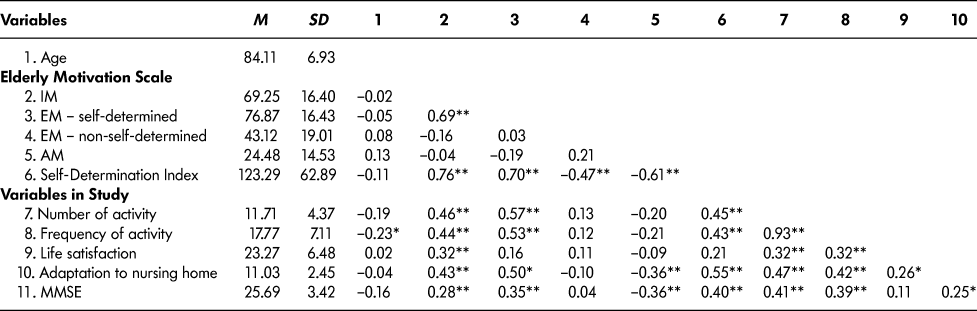
The results for means, standard deviations, and correlations for all the variables used in the study are presented in Table 1. As shown in Table 1, only age negatively correlated with the frequency of activities (r = –0.23, p < .05); that is, the practice of leisure activities decreases with the increase in age. Significant correlations were found between the different variables of this study. Specifically, three significant results are noted. First, the leisure variable (number of activities and frequency of activities) was correlated positively and significantly with adaptation to nursing home (r = 0.47, p < .01 and r = 0.42, p < .01, with number of activities and frequency of activities respectively) and life satisfaction (r = 0.32, p < .01 and r = 0.32, p < .01, with number of activities and frequency of activities respectively).
Descriptive statistics and correlations for all variables

Note. n = 113; *p < .05, **p < .01. M = mean; SD = standard deviation; AM = amotivation; EM = extrinsic motivation; EMS = Elderly Motivation Scale; IM = intrinsic motivation; MMSE = Mini-Mental State Examination.
The higher the practice and frequency of activities, the higher the adaptation to nursing home and life satisfaction. Second, a strong correlation was found between the two measures of leisure (number of activities and frequency of activities) and the two forms of self-determined motivation. The number of activities performed was positively and significantly correlated with IM (r = 0.46, p < .01) and self-determined EM (r = 0.57, p < .01). Similarly, frequency of activities and self-determined motivations were positively correlated (r = 0.44, p < .01 and r = 0.53, p < .01 with IM and self-determined EM respectively). We found no significant correlations regarding the two other non-self-determined motivations (non-self-determined EM and AM). Finally, regarding the adaptation to nursing home and satisfaction with life, IM was positively and significantly correlated with adaptation (r = 0.43, p < .01) and satisfaction with life (r = 0.32, p < .01). Self-determined EM was also correlated with adaptation (r = 0.50, p < .05); no other significant correlations were found with satisfaction with life. Similarly, AM was negatively and significantly correlated with adaptation to nursing home (r = –0.36, p < .01); nevertheless, we observed no significant correlation between AM and satisfaction with life. Lastly, non-self-determined EM was not significantly correlated with adaptation or satisfaction with life.
Motivational Profiles
On the basis of the four forms of motivation (IM, self-determined EM, non-self-determined EM, and amotivation), we conducted a latent profile analysis to determine the number of profiles in the sample with the best fit and their composition. The identification of these profiles let us determine the optimal number of motivational profiles and their relations with the other variables of this study. We used the recommendations of Lanza, Collins, Lemmon, and Schafer (Reference Lanza, Collins, Lemmon and Schafer2007) to test the models and used the Akaike Information Criterion (AIC, Akaike, Reference Akaike1987), Bayesian Information Criterion (BIC, Schwarz, Reference Schwarz1978), and Entropy values to determine the best model fit. The lower values of AIC and BIC associated with a higher value of Entropy indicate the best model fit.
To determine the optimal number of profiles and their composition, latent profile analysis, as described in the literature (Lanza, Flaherty, and Collins, Reference Lanza, Flaherty, Collins, Schinka and Velicer2003), was conducted on the four dimensions of the Elderly Motivation Scale: (1) IM; (2) EM, self-determined; (3) EM, non-self-determined; and (4) AM. The statistical results and the extant literature tend to support that the most suitable solution is a four-profile solution (Table 3).
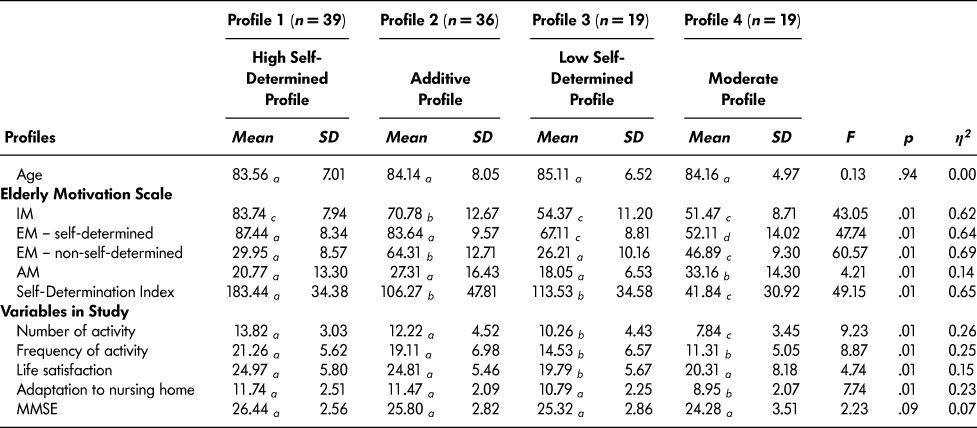
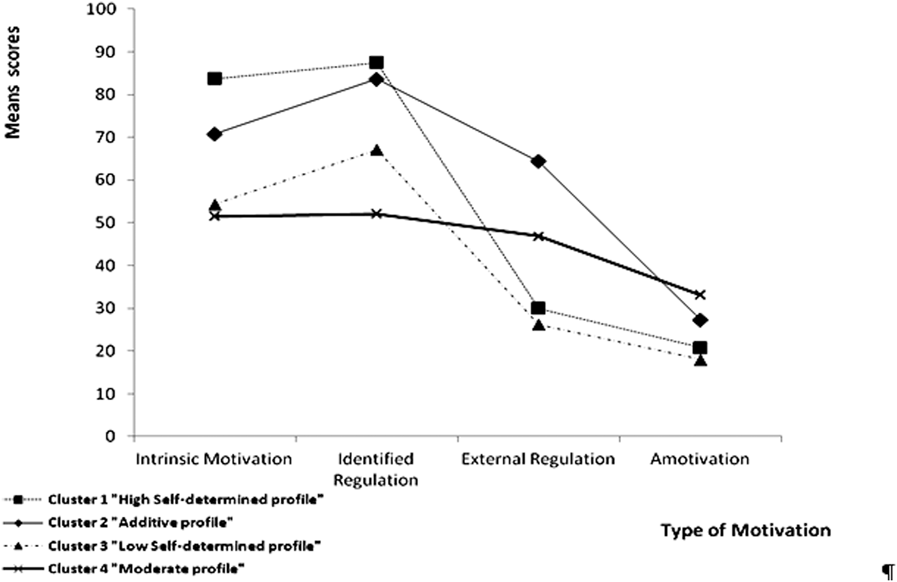
The means of the EMS subscales for each profile are reported in Table 2 and presented in Figure 1. Profile 1 corresponded to 34.51 per cent of the sample (n = 39, high self-determined profile), characterized by high levels of IM and self-determined EM and low levels of non-self-determined EM and amotivation. Profile 2 corresponded to 31.87 per cent of the sample (n = 36, additive profile), characterized by high levels of IM, self-determined EM, non-self-determined EM, and a low level of amotivation. Profile 3 represented 16.81 per cent of the sample (n = 19, low self-determined profile), characterized by moderate levels of IM and self-determined EM and low levels of non-self-determined EM and amotivation. Finally, Profile 4, represented 16.81 per cent of the sample (n = 19, moderate profile), characterized by moderate levels of IM, self-determined EM, non-self-determined EM, and amotivation.
Means and standard deviations for the study variables as a function of profiles

Note. n = 113. For each dependent variable, means with different subscripts indicate a significant difference at p < .05 using Tukey’s HSD (honest significant difference) post hoc test. SD = standard deviation.
Latent profiles analyses model fit indexes for the 2-, 3-, 4-, 5-, and 6-cluster solutions

Note. AIC = Akaike Information Criterion; BIC = Bayesian Information Criterion; LL = log-likelihood; n par = number of parameters.
Elderly Motivation Scale (EMS) scores for each motivational profile

In addition to the profile check, we conducted a one-way MANOVA with motivational profile groups as the independent variable and the four dimensions of the motivation as the dependent variables. MANOVA results showed significant differences between the four groups on the motivational dimensions (F(10,30) = 15.18, p < .001). This latter result confirmed that the number of profile was valid in the sample (see Figure 1). No difference between the four motivational profiles was found for the age and education level of the participants, but differences were found for the SDI (Table 2).
Finally, the relationships between motivational profiles and the study variables (participation in leisure activities, number and frequency of activities, satisfaction with life, and adaptation to nursing home) were tested using an ANOVA and Tukey’s post hoc test. The results showed a significant association between the motivational profiles and study variables (Table 2). First, the means of number and frequency of activities, satisfaction with life, and adaptation to nursing home of the high self-determined profile and additive profile were significantly higher than those of the moderate and low self-determined profiles. However, the moderate profile and low self-determined profile presented different levels for these variables. The levels of the low self-determined profile were higher than the levels of the moderate profile. Clearly, older people living in nursing homes with a high level of IM and self-determined EM and a low level of amotivation tend to have better participation in activities, satisfaction with life, and better adaptation to the nursing home. Second, no significant differences were found between the high self-determined profile and the additive profile on the number and the frequency of leisure activities, satisfaction with life, or adaptation to the nursing home. These two profiles differed only on the non-self-determined EM dimension. This result regarding the role of external reinforcement in nursing homes adjustment will be discussed in a later section. Third, the low self-determined profile has clearly a lower level of the number and frequency of activities and satisfaction with life or adaptation to nursing home than the high self-determined and the additive profiles.
Discussion
We designed this study to provide a better understanding of the mechanisms that underlie the older person’s adaptation to a nursing home. More specifically, our objective was to identify the different motivational profiles among older persons who live in nursing homes and then characterize these profiles based on the following dimensions: adaptation to nursing home, satisfaction with life, and participation in leisure activities. We hypothesized that motivational profiles with higher levels of self-determined motivation than non-self-determined motivation would represent the optimal profiles in terms of participation in leisure activities, adaptation to nursing home living, and satisfaction with life. High self-determined and additive motivational profiles appeared as the optimal profiles and led to a number of implications.
Latent profile analysis allowed us to identify four motivational profiles: high self-determined, additive, low self-determined, and moderate. The results showed that these motivational profiles did not differ on biological characteristics (age or gender). In contrast, we identified differences in behavioural and affective dimensions (participation in leisure activities, adaptation to nursing home, and satisfaction with life). First, participants with the moderate profile reported the lowest levels on the SDI for participation in leisure activities, adjustment to nursing home, and satisfaction with life. Second, participants with the low self-determined profile reported higher levels in these three outcomes than those with the moderate profile, and lower levels for these same outcomes than those with the high self-determined and additive profiles. Third, despite higher levels on the SDI, no difference was found between the high self-determined profile and the additive profile regarding the levels of participation in leisure activities, adaptation to nursing home, or satisfaction with life. Clearly, these two profiles were associated with similar positive outcomes and represent the optimal profiles in terms of adaptation to the nursing home. The only difference between the high self-determined profile and the additive profile in this study is the level of non-self-determined EM. In the former case, this level is low, whereas it is high in the additive profile. This interesting finding led us to note that non-self-determined EM does not have a negative impact on adaptation to the environment when simultaneously associated with a high level of self-determined motivation. Similar profiles and positive associated outcomes were reported in the SDT literature (Altintas & Guerrien, Reference Altintas and Guerrien2014; Boiché et al., Reference Boiché, Sarrazin, Grouzet, Pelletier and Chanal2008, Gillet et al., Reference Gillet, Vallerand and Rosnet2009; Ratelle et al., Reference Ratelle, Guay, Vallerand, Larose and Senécal2007).
As Lepper & Henderlong (Reference Lepper, Henderlong, Sansone and Harackiewicz2000) suggested, one might interpret our results as a support to the aforementioned literature: When self-determined motivation is high, non-self-determined motivation may act in synergy to lead to positive outcomes. This result is particularly informative on the debate regarding the adaptive value of non-self-determined motivation (e.g., extrinsic motivation) and external rewards (Lepper, Corpus, & Iyengar, Reference Lepper, Corpus and Iyengar2005). In addition, researchers found significant differences between the two self-determined profiles (high and low), which differed on the levels of self-determined motivations (IM and self-determined EM) and on the SDI. This point demonstrates the importance of the consequences of different forms of motivation on behavioural and affective outcomes in later life; it also demonstrates that levels of each form of motivations are important for these same outcomes.
Concerning the engagement in leisure activities, adaptation to nursing home and satisfaction with life, this study is aligned with previous research because it shows a significant relationship between these latter variables and self-determined motivation. Notably, the engagement in leisure (measured by the frequency and the number of activities) is positively correlated with the satisfaction with life as well as to the two forms of self-determined motivations (IM and self-determined EM). The relationship between participation in leisure activities and self-determined motivation was reported in past research (Altintas et al., Reference Altintas, Majchrzak, Leconte and Guerrien2010; Coleman & Iso-Ahola, Reference Coleman and Iso-Ahola1993; Iso-Ahola, Reference Iso-Ahola, Jackson and Burton1999; Losier et al., Reference Losier, Bourque and Vallerand1993; Vallerand & O’Connor, Reference Vallerand and O’Connor1991). However, this research extends those findings by showing a relationship for older persons between engagement in leisure activities, self-determined behaviours towards daily activities, and both psychological and environmental adjustment to the nursing home. In many cases, living in nursing homes presents poor intrinsic value. Also, all leisure activities proposed in nursing homes are not intrinsically motivated. In practical terms, self-determined motivation highly related with engagement to leisure activities and adaptation to nursing homes is not regularly present. The initial level of interest is often poor. Promoting internalization of tasks and motivation is necessary to enhance engagement and adaptation in older people. For this purpose, the use of extrinsic incentives seems judicious (Lepper & Henderlong, Reference Lepper, Henderlong, Sansone and Harackiewicz2000). These extrinsic rewards encourage the development of the level of interest, and they should promote the intrinsic value of living in nursing homes and participating in leisure activities.
To enhance self-determined motivation, it is also possible to promote perceptions of autonomy and personal control (Lepper & Henderlong, Reference Lepper, Henderlong, Sansone and Harackiewicz2000). According to SDT (Deci & Ryan, Reference Deci and Ryan1985, Reference Deci and Ryan2002), people actively attempt – through their interaction with the environment – to satisfy three basic needs: autonomy (the need to be perceived as the origin of one’s own behaviour), competence (the need to feel effective and have the opportunity to exercise one’s capacities), and relatedness (the need to feel connected to others, to love and care, and to be loved and cared for). The satisfaction of these psychological needs determines the motivational profile or levels of IM, EM, and AM. The basic need of autonomy requires giving more control (Alaphillipe, Reference Alaphillipe and Paquet2009) or to create an autonomy-supportive climate (Trouilloud, Sarrazin, Bressoux, & Bois, Reference Trouilloud, Sarrazin, Bressoux and Bois2006). For older patients in nursing homes, previous results show that residents who were given freedom to make choices –to be able to arrange their room and the responsibility of caring for a plant – present a better well-being, a better health status, and much more activity, compared to results from residents that depend on staff decisions or who were in a no-control condition (Langer & Rodin, Reference Langer and Rodin1976). Furthermore, an environment that supports the basic psychological needs of autonomy, competence, and relatedness creates a climate facilitating self-determination, control, and power to provide opportunities for older people to engage in actions that can maintain or improve their capacity and autonomy (Philippe & Vallerand, Reference Philippe and Vallerand2008; Vézina & Pelletier, Reference Vézina and Pelletier2009). Supporting autonomy by proposing leisure activities can reduce negative effects of stress on health more easily when perceived control and autonomy are high (Chou & Chi, Reference Chou and Chi2001; Craike & Coleman, Reference Craike and Coleman2005).
To summarize, this study provides strong support for SDT’s predictions regarding the relationship between human motivation and optimal functioning when the cognitive efficiency is equal among the four profiles (Deci & Ryan, Reference Deci and Ryan2002). Clearly, the self-determined and additive motivational profiles will represent the optimal profiles in terms of leisure activities and adaptation to the nursing home.
A number of study limitations should be noted. One limitation concerns the small size of the sample. Such a low number is due to the difficulty in assessing older people in nursing homes because of the large number of variables tested in the research as well as the length of some of the scales used. Thus, regarding their representativeness for the general older population, these findings should be interpreted with caution. A second limitation is the recruitment from different nursing homes without testing the actual self-determined environment of each institution. In fact, past research conducted in the SDT’s framework have shown that the level of autonomy provided in the nursing homes impacts psychological adaptation through its effect on people’s subjective perceptions of autonomy and self-determined motivation (e.g., Philippe & Vallerand, Reference Philippe and Vallerand2008). Finally, another limitation concerns certain variables such as the quality of interpersonal relationships, which appeared to be a crucial factor that leads to the experience of well-being (Molix & Nichols, Reference Molix and Nichols2013). Similarly, Custers, Westerhof, Kuin, Gerritsen, & Riksen-Walraven (Reference Custers, Westerhof, Kuin, Gerritsen and Riksen-Walraven2012) reported that for nursing home residents, the quality of interpersonal relationships is the most important need that must be satisfied.
Notwithstanding these limitations, this study has a number of strengths, which provide certain insights for future research. First, it would be necessary to similarly reproduce this research with a larger sample to extend these findings to older residents who live in nursing homes. Second, due to the differences that may exist between the different nursing homes in terms of the actual autonomy provided and the quality of interpersonal relationships, future research is needed to control these variables. Finally, concerning the leisure participation, it would be necessary to investigate the relationship between the types of activities that are provided in the residence, the “hobbies” of the resident, and the resident’s likelihood to choose and/or to practice an activity that makes sense and interests him or her.
To conclude, this study is the first to assess the relationship between motivational profiles, participation in leisure activities, and adaptation to the nursing home in older people living in a nursing home. These findings may contribute to a better understanding of the mechanisms that underlie a suitable adjustment to collective structures such as nursing homes. Moreover, in the clinical field, this study highlights the importance of identifying the motivational profiles of the residents if one wants to improve the well-being of older adults by promoting an adaptive and stimulating environment.