1. Introduction
Maritime transport is the backbone of international trade and the global economy. More than 80% of the volume of international trade in goods is carried by sea (UNCTAD, 2021). In the past few decades, with economic development, the number of ships has gradually increased and the trend towards larger ships has become apparent, making water traffic busier and riskier (Ancuţa et al., Reference Ancuţa, Stanca, Andrei and Acomi2017; Chai et al., Reference Chai, Weng and De-qi2017), particularly in hotspots, such as restricted waters, which is evident by the recent Suez Canal blockage (Galil et al., Reference Galil, Marchini, Occhipinti-Ambrogi and Ojaveer2017). With increased volume comes the frequent occurrence of water traffic accidents, more serious casualties, property damage and environmental pollution (European, 2021). The safety of vessels and the regional and global maritime transportation system have therefore drawn more attention from both academia and industry. To facilitate the effort of reducing the occurrence of maritime traffic accidents and improving the safety management of maritime transport, there is an urgent need to conduct research on an overview of recent maritime traffic safety to obtain new insights, identify hotspots and highlight potential new solutions.
Many scholars have proposed a large number of methods to ensure the safety of water traffic, among which the research on collision avoidance between ships attracts much attention. Xu and Wang (Reference Xu and Wang2014) conduct a deep analysis of collision avoidance evaluation methods and provide background and understanding of related work. Ozturk and Cicek (Reference Ozturk and Cicek2019) classify NCR assessment studies based on a systematic approach, and reveal the gaps to be filled by future research. Szlapczynski and Szlapczynska (Reference Szlapczynski and Szlapczynska2017) offered a systematic review of the newer ship domain models, further promoting the application of the ship domain in the direction of collision avoidance, capacity analysis, etc. In the study of the whole traffic flow, the rapid development of the AIS system has made great contributions to the acquisition of ship navigation, and traffic flow information (Robards et al., Reference Robards, Silber, Adams, Arroyo, Lorenzini, Schwehr and Amos2016). Lee et al. (Reference Lee, Mokashi, Moon and Kim2019) highlight multiple ways the AIS can be utilised. Yang et al. (Reference Yang, Wu, Wang, Jia and Li2019) provided a comprehensive review regarding the applications of AIS data for solving a broad range of maritime problems and outlined some promising future applications and directions of AIS data-enriched research. Zhou et al. (Reference Zhou, Daamen, Vellinga and Hoogendoorn2019) provides a review of the literature on maritime traffic models from the vessel behaviour modelling perspective, the shortcomings of the models and their future development in ensuring the safety of maritime traffic was pointed out. As a research hotspot in recent years, unmanned ships are expected to bring safer and more efficient maritime traffic (Thombre et al., Reference Thombre, Zhao, Ramm-Schmidt, García, Malkamäki, Nikolskiy, Hammarberg, Nuortie, Bhuiyan, Särkkä and Lehtola2022), and much extensive research has also been conducted on its key technologies, such as path planning, collision avoidance, situation perception, risk assessment, etc., which has further promoted the progress of maritime traffic safety assurance. It can be found that most of the current reviews on maritime traffic safety focus on systematic research on methods such as risk analysis and unmanned ship technology. However, from a larger perspective, there are very few general review articles on maritime traffic safety or ship traffic safety research that could analyse the general advancements in the related fields from a comprehensive perspective.
In response to this research need, this study uses bibliometrics to synthesise and summarise the literature in this field from 2000 to 2023. The research mainly focuses on literature with the main purpose of ensuring the safety of maritime traffic. The objectives of the work are two-fold. First, this review adopts the bibliometric analysis method to analyse the research in this field on a global scale to obtain the current status of research distribution, main researchers, research status, cooperation relationship, main institutions, etc. Second, based on the insights of bibliometrics and comprehensive evaluations with a focus on ensuring maritime traffic safety, we analyse the current gaps in the research field and future research directions. Compared to relevant research, the innovation of this paper lies in the use of bibliometric methods to describe the characteristics and development of research in the field of water traffic safety from a larger perspective, and it has a certain degree of innovation in the selection of literature data and tools.
The remainder of this paper is organised as follows. Section 2 provides details about the data collection process, i.e. what literature is considered in the scope of the current review and how this literature is identified. The bibliometric methods are also shown. Section 3 then presents the results of the bibliometric analyses, and Section 4 provides insights into specific topics within the research literature, including global research partnerships and research hotspots. Section 5 provides a concluding discussion of the findings, focusing on past and present trends and future research directions. Figure 1 shows the main research process.
Main process of the exploration of the state-of-the-art of maritime safety research

2. Material and methods
2.1 Data collection procedure
The data for this study were retrieved from the Web of Science (WoS) database, which is one of the largest multidisciplinary bibliographic information databases and is linked to a flexible content search platform. WoS was selected as a database as it is generally considered one of the most comprehensive databases, with high-quality information contents (Li et al., Reference Li, Goerlandt and Reniers2021). The WoS Core Collection (WoSCC): Citation Indexes (SCI-EXPANDED, SSCI, CPCI-S and CPCI-SSH) databases were used to search original research articles and review papers related to maritime traffic safety from 2000 to 2023.
In the first stage, the search of the literature on maritime traffic safety was carried out on 7 Jul 2023 using the following query: (TS = (ship*) OR TS = (vessel*) OR TS = (maritime) OR TS = (marine)) AND (TS = (traffic) OR TS = ransportr*)) AND (TS = (safe*)). In total, 3,180 publications were obtained from the WoS. Considering that the results of most conference papers are later published in journals, only journals are analysed here to avoid double counting. Therefore, articles from conference proceedings, editorials, technical notes and review papers are not included in the search.
To collect the most detailed literature data in this field and avoid neglect of valuable documents, many synonyms and more general terms, such as ‘transportation’, were used in the search, and wildcards were utilised to consider various forms of inflection and conjugation. However, a preliminary analysis of the constructed dataset found that the research of many works of literature is not directly related to maritime traffic safety, or the guarantee of water traffic safety is only reflected in a small part of its research significance, not its main purpose. Considering this fact, we carried out the second step of the work.
In the second stage of data sample preparation, all papers determined from WoS were investigated by focusing on a title, abstract and keywords (both Author Keywords and KeyWords Plus). Documents that passed the first validation were classified as relevant for further analysis. These papers were included in the new dataset and forwarded to the next step of filtering and determining the final sample (1,217 papers).
Many factors affect the safety of maritime traffic, so research in many directions will have an impact on it. According to our research purpose, articles are considered relevant to our research if they are aimed at reducing the occurrence of maritime traffic accidents or ensuring maritime traffic safety. Where water traffic is mentioned but the purpose of the research does not directly correspond to water traffic safety, the articles were excluded from the study.
In the third step, we browsed all the literature and made a brief analysis of the research to judge whether it met our research criteria. A final count of 844 publications were identified in the database. Each publication in WoS contains the author, year, title, journal, keywords, abstract, subject categories, addresses of the authors and references. These data of the 844 publications sorted in the WoS were exported for performing bibliometric analyses. Figure 2 shows some characteristics of this dataset.
(a) Annual publication trends; and (b) proportion of publications in each country

2.2 Bibliometrics and research mapping
Bibliometric methods were applied, and a variety of bibliometric mapping tools were used to analyse the journal papers in a visual, user-friendly way.
The bibliometric analysis originated from information and library science, which is a method that relies on the visualization of quantitative information about a research domain, allowing researchers to obtain insights into specific aspects thereof. Total scientific production, number of citations, authors’ affiliations or keywords are exemplary indicators utilised in this method (Li et al., Reference Li, Goerlandt and Reniers2021). Currently, a wide variety of tools has been developed which has led to increased interest in performing scientometric analyses across scientific domains (Moral-Muñoz et al., Reference Moral-Muñoz, López-Herrera, Herrera-Viedma, Cobo, Glänzel, Moed, Schmoch and Thelwall2019). The method is also applied to obtain insights into several maritime-related research domains, for instance, the maritime transportation system (Gil et al., Reference Gil, Wróbel, Montewka and Goerlandt2020), shipping risk management (Kulkarni et al., Reference Kulkarni, Goerlandt, Li, Banda and Kujala2020; Fu et al., Reference Fu, Goerlandt and Xi2021), accident analysis (Cao et al., Reference Cao, Wang, Yang, Wang, Wang and Liu2023) and vessel traffic service (Crestelo Moreno et al., Reference Crestelo Moreno, Roca Gonzalez, Suardíaz Muro and García Maza2022).
The bibliometric mapping was about quantitative methods (mathematics and statistics) for visual representation of scientific research. With the application and development of bibliometrics, more than 30 free tools have already been developed for bibliometric mapping, among which VOSviewer is a famous tool for the task. VOSviewer is short for Visualization of Similarity, developed by van Eck and Waltman from Leiden University, the Netherlands, in 2010 (van Eck and Waltman, Reference van Eck and Waltman2010). The tool has several functions for bibliometric mapping, including collaboration analysis (e.g. authors, institutions and countries/regions), topics analysis (e.g. keywords or terms) and citation-based analysis (e.g. bibliographic coupling and co-citations). Several papers have already applied VOSviewer for bibliometric mapping analysis in environmental protection and safety-related topics, such as process safety (Li, Reference Li2022), tourism (Köseoglu et al., Reference Köseoglu, Rahimi, Okumus and Liu2016), business intelligence (Chen et al., Reference Chen, Chiang and Storey2012), sustainability avenues (D'Amato et al., Reference D'Amato, Droste, Allen, Kettunen, Laehtinen, Korhonen, Leskinen, Matthies and Toppinen2017) and environmental protection (Xue et al., Reference Xue, Reniers, Li, Yang, Wu and van Gelder2021), etc., as the main bibliometric tool in this paper. The use of VOSviewer consists of four main steps: (1) importing literature data; (2) selecting the type of network to analyse, such as the authors’ collaborative relationship and the citation relationship of the article, etc.; (3) the software generates the network relationship; and (4) exporting the results.
In addition, to present the data, such as the geographical location information of the literature, other methods have also been used in this study. Bibliometrix is an open-source R-package for performing comprehensive bibliometric analyses, which is simple, efficient and flexible (Aria and Cuccurullo, Reference Aria and Cuccurullo2017). Netscity is an online application to analyse world-scale scientific production and collaboration data between cities and map them both on a world base map and in a relational space (Maisonobe et al., Reference Maisonobe, Jégou, Yakimovich and Cabanac2019). Contrary to existing tools that mainly focus on displaying co-occurrence networks, Netcity especially focuses on processing the geographical information comprised in bibliometric data, and innovations have been made in the counting methodology and in the degree of geographic delineation, allowing users to aggregate their data at the level of this set of urban area perimeters as well as at the country level.
3. Results
In this section, we use a variety of bibliometric methods to analyse the database of 844 articles obtained in Section 2.1. The summary generated through an overall analysis includes basic statistics about the analysed dataset, which is presented in Table 1. A total of 1986 authors were involved in the scientific production on maritime traffic safety, and a total of 181 journals participated in the publication of these studies. The descriptive analysis of the articles was conducted using Bibliometrix.
The summary of the bibliometric data sample

These generalised data are used as the basis for subsequent analysis, providing an in-depth insight into the main directions, collaborations and influence of research in the field of maritime traffic safety.
3.1 Narrative clusters and focal topics in maritime traffic safety research
3.1.1 International maritime traffic safety research
Co-occurrence analysis is used to analyse the terms of the selected 844 publications related to maritime traffic safety, using VOSviewer software (van Eck and Waltman, Reference van Eck and Waltman2010). The terms of the publications are extracted from the titles and abstract fields, which can better reflect the main research theme of the article. In the choice of counting methods, the fractional counting method holds that each behaviour, such as co-authoring or citing a publication, should have equal weight, regardless of the number of authors. In many studies involving bibliometrics, the fractional counting method is more desirable than the full counting method (Perianes-Rodriguez et al., Reference Perianes-Rodriguez, Waltman and van Eck2016). Considering that the topic keywords in each article may appear multiple times, to more accurately obtain the real research directions and topics in the field of maritime traffic safety, we choose the fractional counting method instead of the full counting method.
As shown in Figure 3, 119 items are identified as critical terms of the publications addressing maritime traffic safety. All the terms in the figure represent items with more than 20 occurrences in the selected 844 publications. The size of each item corresponds to the number of occurrences, only nine terms occur at least 200 times in the dataset. These terms are ‘Ship’ (431 occurrences) and ‘Data’ (334), followed by ‘Analysis’ (302), ‘Approach’ (259), ‘Risk’ (259), ‘Accident’ (253), ‘Vessel’ (253), ‘Area’ (210) and ‘Collision’ (200). While these terms are indeed clearly associated with the general topic of maritime traffic safety research, they are generic and provide little insight into the specific narratives and focus topics in the considered research domain.
Term co-occurrence maps of maritime traffic safety research, visualised using VOSviewer (van Eck and Waltman, Reference van Eck and Waltman2010)

To provide further insights into the narrative patterns and the focal topics in the research domain, a terms cluster analysis is conducted, which analyses the terms in pairs and groups. The links between the items show the connections between the keywords in the publications, i.e. the figure shows which terms are commonly found together. The stronger the link between terms, the thicker the lines. Co-occurrence relations give insights into the semantic links in the dataset, which makes it easier to conduct the interpretation of the dominant narrative patterns in the research domain. Further clustering of the terms based on their co-occurrence strength provides insights into the main research areas. Using the VOS clustering technique (Waltman et al., Reference Waltman, van Eck and Noyons2010; Waltman and van Eck, Reference Waltman and van Eck2013), three clusters are detected and shown in Figure 3: (1) ‘Accident & risk analysis’ (including 41 terms), (2) ‘Maritime traffic management’ (52 terms), and (3) ‘Collision avoidance manoeuvring’ (26 terms). The authors analyse the labels of these clusters based on three aspects: (1) the definitions of the terms in each cluster, (2) how they could contribute the maritime traffic safety and (3) what contribution they could make.
From Figure 3, one can see that, in general, the research on maritime traffic safety focuses on three main aspects: (1) accident and risk analysis of maritime traffic, (2) maritime traffic management and (3) collision avoidance of ships. Such findings are consistent with the key factors that the stakeholders of the industry and academia pay attention to, which are: (1) reduce the number of maritime accidents, (2) improve maritime traffic efficiency and the management level with the preference for maritime traffic safety and (3) avoid the occurrence of the accident (Chen et al., Reference Chen, Huang, Mou and van Gelder2019).
To obtain further insights into the evolution and influence of the research topics in maritime traffic safety research, visual overlays are applied to the term co-occurrence map of Figure 3. The results are shown in Figure 4, which (a) describes the average publication year in which the terms appear, and (b) the average citations of the terms. The results of the average publication year of the papers in each cluster are almost the same, distributed in late 2018 and early 2019.
(a) Term co-occurrence map with overlays of average publication year; and (b) term co-occurrence map with overlays of average citations

In the co-occurrence map with an overlay of the average number of citations, shown in Figure 4(b), it is seen that the terms with the highest co-occurrence are primarily located in Cluster #1, which is an accident and risk analysis of maritime traffic. Within this cluster, the term ‘Grounding’ has the highest average number of citations. Other impactful terms include ‘IMO’, ‘Bayesian Network’, ‘Expert Knowledge’, ‘Human Factor’, ‘Consequence’, ‘Historical Data’ and ‘Risk Analysis’. Such findings indicate that the research on accident and risk analysis is closely related to the formulation of IMO regulations, and focuses more on human factors. In Cluster #2, terms related to maritime traffic management, such as ‘Application’, ‘Maritime Authority’, ‘Identification’, as well as ‘Security’ and ‘Waterway’ are highly impactful. Finally, in Cluster #3, terms related to ship manoeuvring, including e.g. also ‘Collision’, ‘Ship Domain’, and ‘Course’, are comparatively more impactful than other terms in the cluster, which indicates that the collision avoidance during the ship encounters is naturally the key aspects for the research.
3.1.2 Comparison of Chinese and international research
Among the 844 articles in this database, 338 articles have the first author affiliation in China, accounting for nearly 40% of the total articles. To conduct a more detailed analysis of the international research on maritime traffic safety, co-occurrence analysis is used to analyse the terms of these articles to excavate the main research directions of China and compare it with all other countries. Figure 5 indicates the ratio of the terms appearing in respective articles whose first author is affiliated with China and other countries’ maritime traffic safety research. The nodes’ colour shows a gradation from blue to yellow. The closer the colour is to yellow, the higher the percentage of occurrences of the term in studies conducted in that region compared to studies conducted globally.
(a) Term co-occurrence maps of Chinese maritime traffic safety research; and (b) term co-occurrence maps of international maritime traffic safety research, with overlays of terms frequency ratio, visualised using VOSviewer (van Eck and Waltman, Reference van Eck and Waltman2010)

It can be found that among Chinese scholars’ research in these three main directions, the terms with a relatively high ratio in Cluster #1 ‘Accident & risk analysis’ are ‘Risk Factor’, ‘Insight’, ‘Sensitivity Analysis’, ‘Relationship’, ‘Bayesian Network’, ‘Arctic’, ‘Hazard’, ‘Ship Type’, ‘Case Study’ and ‘Historical Data’. Included in Cluster #2 ‘Collision avoidance manoeuvring’ are ‘Yangtze River’, ‘China’, ‘Navigation Risk’, ‘Experiment’, ‘Clustering’, ‘Efficiency’, ‘Characteristic’, ‘Traffic Flow’, ‘Technology’ and ‘Degree’. Included in Cluster #3 ‘Maritime traffic management’ are ‘Feasibility’, ‘Effectiveness’, ‘Colregs’, ‘Collision Risk’, ‘Trajectory’, ‘International Regulation’, ‘Reliability’, ‘Collision Avoidance’, ‘Scenario’ and ‘Ship’.
In other countries for maritime traffic safety research, the terms with a relatively high occurrence ratio in Cluster #1 ‘Accident & risk analysis’ are ‘Maritime Industry’, ‘Transport’, ‘IMO’, ‘Incident’, ‘Grounding’, ‘Region’, ‘Strait’, ‘Assessment’, ‘Board Ship’ and ‘Operation’. Included in Cluster #2 ‘Collision avoidance manoeuvring’ are ‘Vessel’, ‘Maritime Traffic’, ‘Route’, ‘Application’, ‘Shipping’, ‘Area’, ‘Movement’, ‘Location’, ‘Ship Navigation’ and ‘Control’. Included in Cluster #3 ‘Maritime traffic management’ are ‘Vessel Traffic Service’, ‘Navigator’, ‘Rule’, ‘Operator’, ‘Safe Navigation’, ‘Action’, ‘Collision’, ‘Course’, ‘Situation’ and ‘Distance’.
Simultaneously, another overlay analysis of the term co-occurrence map was conducted. Figure 6 indicates the average publication years of the articles on maritime traffic safety in China and all other countries.
(a) Term co-occurrence maps of Chinese maritime traffic safety research; and (b) term co-occurrence maps of international maritime traffic safety research, with overlays of average publication year, visualised using VOSviewer (van Eck and Waltman, Reference van Eck and Waltman2010)

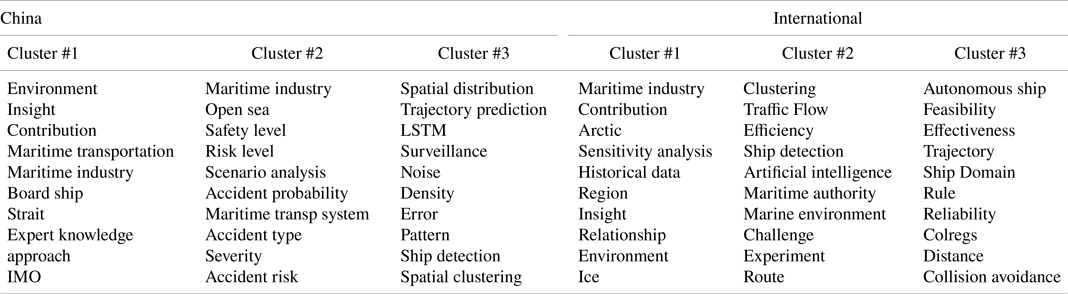
In the study of maritime traffic safety in China, the terms in Cluster #1 with a relatively recent average publication time are ‘Environment’, ‘Insight’, ‘Contribution’, ‘Maritime Transportation’, ‘Maritime Industry’, ‘Board Ship’, ‘Strait’, ‘Expert Knowledge’, ‘Approach’ and ‘IMO’. Included in the Cluster #2 are ‘Ship Detection’, ‘Field’, ‘Challenge’, ‘Route’, ‘Location’, ‘Marine Environment’, ‘Shipping’, ‘Experiment’, ‘Influence’, and ‘Performance’. Included in Cluster #3 ‘maritime traffic management’ are ‘Autonomous Ship’, ‘Reliability’, ‘Feasibility’, ‘International Regulation’, ‘Trajectory’, ‘Scenario’, ‘Colregs’, ‘Action’, ‘Operator’, and ‘Safe Navigation’.
And in other countries for maritime traffic safety research, the terms with a relatively recent average publication time in Cluster #1 are ‘Maritime Industry’, ‘Contribution’, ‘Arctic’, ‘Sensitivity Analysis’, ‘Historical Data’, ‘Region’, ‘Insight’, ‘Relationship’, ‘Environment’ and ‘Ice’. Included in the Cluster #2 are ‘Clustering’, ‘Traffic Flow’, ‘Efficiency’, ‘Ship Detection’, ‘Artificial Intelligence’, ‘Maritime Authority’, ‘Marine Environment’, ‘Challenge’, ‘Experiment’, and ‘Route’. Included in the Cluster #3 are ‘Autonomous Ship’, ‘Feasibility’, ‘Effectiveness’, ‘Trajectory’, ‘Ship Domain’, ‘Rule’, ‘Reliability’, ‘Colregs’, ‘Distance’ and ‘Collision Avoidance’.
It is worth mentioning that to better visualise the results, the average publication time span of keywords in the literature published by Chinese scholars is automatically set to mid-2019 to 2021, while other countries are automatically set to 2017 to 2019. This is likely to indicate that the number of documents published by Chinese scholars in the field of water traffic safety in recent years is much higher than that of other countries. To verify this view, this paper provides statistics on the average publication time of 338 articles and 506 articles, respectively. It is found that the average publication time of Chinese scholars is February 2020, while that of other countries is June 2017 (Table 2).
Terms with relatively recent average publishing time

3.2 Collaboration analysis of maritime traffic safety research
3.2.1 Countries/regions distribution and collaboration network of global publications
The analysis of the collaboration situation of the whole maritime traffic safety publications is of great significance to understanding the overall research status. As shown in Figure 7(a), 69% of the 844 articles were authored by scholars from the same country, including collaborations between cities/regions and collaborations within the same city/region, and most of them were published in the same city/region. The remaining 31% are a collaboration between countries, among which 198 articles (23%) were published jointly by two countries, and 67 (8%) articles were published jointly by three or more countries.
(a) Geographical distribution of the publications; (b) publication cooperation relationship of countries with at least five publications; and (c) single-country publication, multi-countries publication proportion, and multi-countries publication ratio of each country

To show the cooperation between countries in more detail, this paper analyses the articles published by the top 20 countries in the database used in this paper. As shown in Figure 7(b), the size and colour of the node represent the country's total connection with other countries, and the connection of the lines indicates that the nodes at both ends have a cooperative relationship. The thickness of the lines depends on the number of co-authored articles. The more articles co-authored, the thicker the lines. It is clear that China occupies an important position in the cooperation of international maritime traffic safety research, ranked first in the number of collaborating countries and in the number of collaborative literature. In addition, Finland, the United States, the United Kingdom, the Netherlands, Singapore and other countries also have good cooperative research relations with other countries. Figure 7(c) shows the single-country publication, and multi-countries publication ratio of these countries.
In Figure 8, the cooperation relations between countries and regions and the distribution of the articles published are shown. The visualization of geographical locations shows that European countries are quite active in terms of research cooperation. Meanwhile, in terms of the number of papers published, Europe and East Asia have a concentrated and rich output of papers.
Geographic distribution and regional cooperation network in maritime traffic safety publications, visualised using the approach by Netscity

3.2.2 Major institutions and authors collaboration networks
There are 698 institutions identified from the addresses provided in the publications. For the analysis, institutions with four or more publications are extracted from the dataset, with a total of 74 institutions meeting this threshold. However, nine institutions have no cooperative relationship with other units and have a small number of publications, so they are not displayed. Finally, the collaboration network of these remaining 65 institutions in maritime traffic safety is constructed and shown in Figure 9, the node and label sizes indicate the number of publications of an institution, where the thickness of the links between each node pair represents the strength of research collaboration between the two institutions. The colours represent clusters of institutions with a comparatively high degree of joint research activities, a total of 11 clusters were identified.
Institutions collaboration network of maritime traffic safety papers, (nodes = 65, links = 431), visualised using VOSviewer (van Eck and Waltman, Reference van Eck and Waltman2010)

Among the 65 institutions, the most published papers are from the Wuhan University of Technology from Hubei Province, China, which has published 126 articles out of a total of 844 (14.92%). They are followed by the Dalian Maritime University (73, 8.65%), Aalto University (59, 6.99%), Shanghai Maritime University (52, 6.16%), Liverpool John Moores University (48, 5.69%) and Gdynia Maritime University (33, 3.91%). Among these highly productive institutions, the average publication year (APY) is used to determine which institutions have become active in recent years. The University of Chinese Academy of Sciences (APY = 2022.5), Universitat Autònoma de Barcelona (APY = 2022.5), Shanghai Ship and Shipping Research Institute (APY = 2022.2), Chinese Academy of Sciences (APY = 2022.09) and Tsinghua University (APY = 2021.8) have more recently become active in the research domain compared to other institutions.
The total links (TL) of the institutions are selected as an indicator to measure the degree to which institutions are open to and active in interorganizational collaboration. The TL is equal to the number of links of a node and thus measures the number of organizations with which a given institution has collaborated. Among the institutions in the network, Wuhan University of Technology has linked with 30 institutions, having the largest collaboration network among all organizations in the dataset. This is followed by Aalto University (TL = 19), Shanghai Maritime University (TL = 19), Liverpool John Moores University (TL = 15), Dalian Maritime University (TL = 14) and Jimei University (TL = 13).
Figure 10 shows the authors’ collaboration network of maritime traffic safety research. There are 1986 authors identified from the addresses provided in the publications. For the analysis, authors with four or more publications are extracted from the dataset, with a total of 108 authors meeting this threshold; among them, 81 authors who have cooperative relations with each other were extracted. Pentti Kujala from Aalto University (the Vice Dean of the School of Engineering) and Zaili Yang from Liverpool John Moores University have published 36 papers, followed by Floris Goerlandt (Dalhousie University), Jakub Montewka (Aalto University), Jinfen Zhang (Wuhan University of Technology), and Xinping Yan (Wuhan University of Technology). Author collaboration is also further divided into different communities based on their collaboration strength, as indicated by the clusters marked in different colours. In Figure 10, authors in the same cluster have closer academic collaborations and are more likely to be from the same institution.
Author's collaboration network of maritime traffic safety publications, (nodes = 81, links = 688), visualised using VOSviewer (van Eck and Waltman, Reference van Eck and Waltman2010)

For a more in-depth study of the impact of authors and their groups, an overlay of the average article citation was carried out, as illustrated in Figure 11(a), where the size of the nodes and labels represents the total number of citations of the literature published by the scholar analysed in this paper, the colours of the nodes represent the average number of citations. The top ten authors with the highest average number of article citations are Angelo P. Teixeira (84.67), Pentti Kujala (78.53), Jakub Montewka (76.96), Lokukaluge P. Perera (76), Floris Goerlandt (73.48), C. Guedes Soares (64), Qiang Meng (61.57), Krzysztof Wrobel (55.62), Weibin Zhang (54) and Naixue Xiong (52.5).
Authors’ collaboration network of maritime traffic safety publications, (a) with overlays of average article citations; and (b) with overlays of average publication year, visualised using VOSviewer (van Eck and Waltman, Reference van Eck and Waltman2010)

Figure 11(b) shows the authors collaboration network with overlays of average publication year. Among the authors and their collaborations, Bing Han, Lei Zhang, Maohan Liang, Zhongyi Sui, and Spyros Hirdaris have become more active in recent years, as indicated by their average publication years, which are 2022.4, 2022.4, 2022.1, 2021.8 and 2021.8, respectively.
In addition to the scholars’ personal contribution to the field of water traffic safety, the team is also a factor that cannot be ignored. Through the analysis and clustering of the cooperative relationships, nodes of the same colour can be regarded as members of the same team. Therefore, the activity of the team can be measured by the average publishing time of the scholars represented by the same colour nodes. Through calculation and analysis, it is found that the average publishing time of 10 teams is distributed between May 2019 and July 2020. The three teams represented by Shanshan Fu, Zaili Yang and Junmin Mou are the most active, while the team represented by Jinxian Weng has a relatively early average publication time.
3.2.3 Major journals of maritime traffic safety and their citing relations
The last stage of collaboration analysis concerned the investigation of the sources of documents included in the data sample. Those are mainly high-quality journals related to maritime traffic safety.
There are 181 journals identified from the sources provided in the publications, The sources with at least two published documents are extracted, with in total of 71 journals meeting this threshold. Figure 12 depicts the network of citations. The node and label sizes indicate the number of publications of a journal, and the links between each node pair represent the articles they published have a relationship of cross-references; the width of the links represents the strength of citation between the two journals.
High-volume journals in maritime traffic safety and their citation networks, visualised using VOSviewer (van Eck and Waltman, Reference van Eck and Waltman2010)

There are five journals with the largest number of publications, namely Ocean Engineering (128, 14.48%), Journal of Marine Science and Engineering (67, 7.58%), Journal of Navigation (60, 6.79%), Reliability Engineering & System Safety (57, 6.44%) and Safety Science (47, 5.32%). The total number of papers published in these sources comprises 43% of all articles in the data sample. Distinguishing the main themes of the journals indicates that the papers on maritime traffic safety-related research are mostly published in top journals in the fields of marine engineering, marine science, navigation technology, safety and reliability, and the related research results show an active state in terms of academic cooperation.
3.3 Cited analysis of maritime traffic safety research
3.3.1 Cited journal analysis
Highly cited journals are journals from which articles are frequently cited by maritime traffic safety researchers. Hence, these journals can be regarded as influential knowledge sources in the maritime traffic safety research community. Figure 13 shows the journals’ co-citation network of maritime traffic safety articles. In this network, Ocean Engineering (2879), Journal of Navigation (2019), Reliability Engineering & System Safety (1964), Safety Science (1870), Accident Analysis & Prevention (653), Risk Analysis (517), Maritime Policy & Management (438), IEEE Transactions on Intelligent Transportation Systems (362), Expert Systems with Applications (345) and Transnav (331) are highly cited journals, each having received more than 300 citations from the papers in maritime traffic safety.
Co-citation network of highly cited journals in maritime traffic safety research, visualised using VOSviewer (van Eck and Waltman, Reference van Eck and Waltman2010)

The sources were mapped with regard to their co-citations, i.e. how many times they were cited together (Waltman et al., Reference Waltman, van Eck and Noyons2010). In this type of analysis, a relation between two publications depends on the number of documents that cite both of these papers (van Eck and Waltman, Reference van Eck and Waltman2014). This kind of bibliometric network was utilised to visualise mutual relations between the sources. The minimum value of citations per source was set to 50; thus, 66 of them met the threshold. The size of nodes was set by the number of citations.
The most relevant sources determined by co-citations are Ocean Engineering and Reliability Engineering & System Safety, followed by Ocean Engineering and Journal of Navigation, and Ocean Engineering and Safety Science. The co-citation relationship between these four journals also occupies the top of the overall ranking. Therefore, the leading journals in maritime traffic safety research, Ocean Engineering and Journal of Navigation, have become a connector between safety and navigational-related sources.
3.3.2 Cited authors analysis
Highly cited authors by the maritime traffic safety research community show that articles by these authors are influential the maritime traffic safety research. A co-citation map of the authors presented in Figure 14, shows that Goerlandt (466), IMO (385), Szlapczynski (310), Montewka (298), W.B. Zhang (219), Hanninen (181), Fujii (173), Pietrzykowski (169), L.P. Perera (161), and Akyuz (157) are frequently cited authors.
Clustered co-citation network of highly cited authors in maritime traffic safety research, visualised using VOSviewer (van Eck and Waltman, Reference van Eck and Waltman2010)

The number of co-citations between the articles published by Goerlandt and Montewka, Zhang, and Szlapczynski occupy the top three, respectively. They have made great contributions to the research in the field of maritime traffic safety and played a leading role.
3.3.3 Cited documents analysis
Highly cited references signify publications that have been frequently used as a basis for new research developments. Hence, such articles can be regarded as the immediate intellectual basis of the maritime traffic safety research domain. In total, 73 references with more than 30 citations are identified and extracted to construct the reference co-citation network. Figure 15 shows the distribution of these publications. Among these sources, the Journal of Navigation (16), Reliability Engineering & System Safety (15), Safety Science (11) and Ocean Engineering (11) account for 53 out of 73 publications; that is, 72.6% of the articles come from these four journals, showing their key role in advancing the knowledge basis of maritime traffic safety research.
Co-citation network highly cited references in maritime traffic safety research, visualised using VOSviewer(van Eck and Waltman, Reference van Eck and Waltman2010), (sublabel indicates publication year and source)

The articles with high citations are listed in Figure 16. The global citations represent the number of citations of the article in the entire WoS database, while local citations represent the number of citations of the article in the database selected by this article, that is, 844 articles on maritime traffic safety research. The figure indicates that the most highly cited articles are at the forefront both of global and local citations, which means that they have a very large contribution to the study of maritime traffic safety.
The top-ten publications with the most global citations and the most local citations

4. Discussion
The analysis of maritime traffic safety research shows that the research productivity of the entire research community has made rapid progress, especially in the past five years, and has continued to grow. This is inextricably linked to the trend of globalization of trade, the rapid development of the shipping economy and the application of emerging intelligent technologies in the field of maritime shipping.
In the analysis of the main research topics and hotspots of maritime traffic safety, terms are divided into three clusters by VOSviewer's clustering algorithm, and the three clusters are labelled as ‘Collision avoidance manoeuvring’, ‘Accident & risk analysis’, and ‘Maritime traffic management’, according to the characteristics of the terms in each cluster in the field. This also represents the main three directions in the research aimed at ensuring the safety of maritime traffic. At the same time, through the analysis of the average publication year and the number of citations, it can be found that accident risk research is obviously more active or deemed of greater concern by scholars than the other two research directions, but the average publication year is earlier. This shows to a large extent that the theoretical research on accident risk is gradually being applied to ship manipulation and maritime traffic management. In recent years, emerging intelligence technologies, such as ‘autonomous ships’, ‘MASS’ and ‘situational awareness’, have become research hotspots and important directions for future development. This has a lot to do with the development of intelligent ships and the application of intelligent technology in ship traffic; especially in recent years, many countries in the world have started the application of intelligent ships.
Based on the high proportion of published papers in China, we conducted a comparative analysis of research on maritime traffic safety in China and other countries. It is possible that the high volume of publications is due to greater population size; after all, China has been the second-largest publisher of SCI papers in the world for 10 consecutive years. The analysis shows that the research in China is relatively balanced, and a lot of research has been done on the three stated primary topics listed previously. While the research in other countries is mainly distributed in the other two directions, there is relatively less in ‘maritime management’. The limitation of these data is that it cannot represent the advanced nature of the country in the relevant research direction, but it can also reflect the country's preferences and needs in the direction of research. The scale of Chinese water traffic validates this view. In the global ship file, the international navigation ships in global operation of a total of 79,753 ships, dry bulk carriers, general bulk, container ships and oil tankers, the four main types of ships, occupy 46.21% of the global number of ships. Combined with the display of the average year of publication, it can be found that the research in this area in other countries has been more widely distributed in recent years. This also indicates that water transportation management is evolving with the overall trend of global shipping development.
In the analysis of major national collaborations, it can be found that most of the articles are still completed by scholars in a single country or region, and the number of cooperative research between countries still needs more exploration. Part of the reason for this phenomenon is that few major countries are conducting research in the field of water traffic safety, and therefore cooperation between countries can be relatively reduced. As the country with the largest number of publications, China also has the largest number of international cooperation articles, playing a pivotal role in international maritime traffic safety research. However, the centres of global maritime traffic safety research are mainly distributed in the Western European region, as shown in Figure 8. This is closely related to Europe's long maritime history, while the huge share of European trade in global trade also contributed to its position as the centre of global maritime transportation. Although the activity of relevant academic research cannot directly represent the advancement of the field, we can see some correlation from it, and academic research can indirectly reflect the general degree of development of the relevant fields.
Despite there being many institutions and scholars conducting research on maritime traffic safety, as seen in Figures 9 and 10, the main leading work is still gathered in several major scientific research teams. It is noteworthy that the number of scholars from China accounts for a large proportion, but the main research results still focus on several leading scholars from other countries, as seen in Figure 14. However, the years of research done by these scholars are relatively early, and new researchers are constantly making contributions, as seen in Figure 11.
Figure 12 illustrates that articles on maritime traffic safety are mainly distributed in journals in the two fields of maritime traffic and safety science, and these journals also have the greatest influence on maritime traffic safety articles, as seen in Figure 13. Some other journals related to energy, environment, and information technology also have a certain influence but did not have much influence in the field of research.
5. Conclusions
In this paper, a bibliometric mapping analysis performed of the maritime traffic safety literature that is available from the WoS core database found that the research community has become increasingly active in recent years, and three main research directions are divided into maritime traffic safety research.
According to the analysis of cooperation, there is too little research collaboration between countries, and by far most of the collaborations occur within China. Although a large cooperation network of institutions and authors has been formed around the world, only a few leading international scholars and institutions have established an extensive network of research partnerships. The term ‘co-occurrence analysis’ indicates that many new intelligent technologies are gradually being applied in this field and becoming a research hotspot. The journals with greater add-on maritime traffic safety research are mainly distributed in the field of maritime traffic and safety science.
While scientometric methods can only provide a high-level overview of the maritime traffic safety research domain, it is also recommended that further narrative literature reviews of these research domains are conducted, to obtain more detailed insights into the developments and knowledge gaps. The trends, patterns, developments, gaps, and research directions identified using the presented analyses could serve as a fruitful basis for this. The findings in this report are subject to at least two limitations. First, there are subjective factors influencing the selection of literature data, which will have an impact on the results of this paper; Second, although WoS is more authoritative, the data in it are not representative of the entire field of research and would be more comprehensive if combined with other literature databases.
Finally, the objective of this study was to provide an analysis to accurately and systematically describe the current status of water traffic safety research, broaden knowledge on the publications related to this subject and enable researchers to focus their research on filling the gaps in the subject and contribute more effectively to science. It is hoped that the insights obtained from the presented analysis can be used by researchers and scholars to identify possible areas of future collaboration. This can invigorate the research domain, bringing in new ideas, concepts, and methods, and may lead to higher productivity, strengthen the quality and acceptance of solutions for the various complex challenges facing the research domain, and ultimately help to further improve the safety performance of maritime traffic.
Acknowledgment
The work presented in this study is financially supported by the National Key Research and Development Program of China (2023YFE0203700) and the National Natural Science Foundation of China (Grant Number: 52101402, 52271367).
Competing interests
The author(s) declare none.