




No CrossRef data available.
Article contents
Reassessment of the cost-effectiveness of hormone replacement therapy in Sweden: Results based on the Women's Health Initiative randomized controlled trial
Published online by Cambridge University Press: 25 October 2005
Abstract
Objectives: The purpose of the study is to reassess the cost-effectiveness of hormone replacement therapy (HRT) based on new medical evidence found in the Women's Health Initiative (WHI). Within a model framework using an individual state transition model, the cost-effectiveness of 50- to 60-year-old women with menopausal symptoms is assessed based on a societal perspective in Sweden.
Methods: The model has a 50-year time horizon divided into a cycle length of 1 year. The model consists of the following disease states: coronary heart disease, stroke, venous thromboembolic events, breast cancer, colorectal cancer, hip fracture, vertebral fracture, and wrist fracture. An intervention is modeled by its impact on the disease risks during and after the cessation of therapy. The model calculates costs and quality-adjusted life years (QALYs) with and without intervention. The resulting cost per QALY gained is compared with the value of a QALY gained, which is set to SEK 600,000. The model requires data on clinical effects, risks, mortality rates, quality of life weights, and costs valid for Sweden.
Results: The cost-effectiveness ratios are estimated at approximately SEK 10,000, which is below the threshold value of cost-effectiveness. On the condition that HRT increases the quality of life weight more than 0.013 units, the therapy is cost-effective.
Conclusions: In conclusion, given the new evidence in WHI, there is still a high probability that HRT is a cost-effective strategy for women with menopausal symptoms.
Information
- Type
- GENERAL ESSAYS
- Information
- International Journal of Technology Assessment in Health Care , Volume 21 , Issue 4 , October 2005 , pp. 433 - 441
- Copyright
- © 2005 Cambridge University Press
Women in the industrialized part of the world today are living more than one third of their life after menopause. For example, in Sweden, approximately 1.7 million women are above the age of 50 years, which corresponds to 19 percent of the population. At menopause, which occurs on the average at age 51, approximately 75 percent of women experience menopausal symptoms such as hot flushes, night sweats, and atrophy-related symptoms of the urogenital tract (41). Ten percent of women suffer from symptoms more than 15 years after the menopause. The effect of menopausal symptoms on quality of life may be substantial, as shown by, for example, Daly et al. (12) and Zethraeus et al. (57). In Sweden, the costs for estrogens (estrogens, progestins, and combination drugs) increased from 370 to 500 million SEK during the period 1995–2000. In the year 2000, sales were restricted to women above the age of 45 years and with menopausal symptoms and were estimated to be 300 to 400 million SEK. Also, if costs for physician visits are added, the total intervention cost of hormone replacement therapy (HRT) amounts to 600 to 700 million SEK in the year 2000 (41).
The use of HRT mitigates or eliminates menopausal symptoms and leads to a major improvement in quality of life for women with menopausal symptoms (12;57). HRT also offers protection against osteoporosis and related fractures and previously was believed to offer a cardioprotective effect as shown in observational studies (40). However, recent randomized studies do not show any reduction in cardiovascular events in secondary or in primary prevention (1;20;39). Evidence of the effect of HRT on breast cancer had been inconclusive, but now the general belief is that the risk of breast cancer increases with the use of HRT (1;4;9;10;39;40–42). For hysterectomized women on estrogen-only therapy, however, the Women's Health Initiative (WHI) study (1) shows a decreased risk of breast cancer. Results based on the WHI (39) show that HRT also changes the risk of colorectal cancer, venous thromboembolic events (VTE), and stroke. For nonhysterectomized women taking estrogens only, an increased risk of endometrial cancer is evident. The increased risk of endometrial cancer is eliminated by the addition of a progestin (39;41). Combining estrogen with a progestin may induce uterine bleeding; however, such bleeding may reduce or vanish if a combined HRT is continuously applied, although break-through bleeding often occurs in the first few months (41). Today, estrogen-only therapy is most frequently given only to women with a hysterectomy, whereas women with an intact uterus are given estrogen combined with a progestin to eliminate the endometrial cancer risk.
Cost-effectiveness analysis is a method for assessing costs and benefits of alternative ways of allocating resources to assist decisions aimed at improving efficiency. To determine whether a treatment is cost-effective compared with an alternative, the cost per gained unit of effectiveness (e.g., cost per gained quality-adjusted life year [QALY]) must be compared with the willingness to pay for a gained unit of effectiveness (e.g., the value-gained QALY). If the price per unit increase in effectiveness exceeds the cost, the program is cost-effective. The value of a gained QALY is usually stated to be approximately SEK 500,000–600,000 (US$ 50,000–60,000) (18;23). In this study, we use a value of SEK 600,000 per QALY gained, which also can be derived from the value that the Swedish road authorities put on a statistical life.
Modeling is required to assess the cost-effectiveness of HRT (31;54), which has been mentioned in many previous studies (2;7;13;14;16;46–48;50;52;53;58–60). Modeling is necessary, because clinical trials cannot provide all the information that is needed for economic evaluation, which requires cost and effectiveness information in a long-term perspective. There are several types of modeling alternatives, for example, decision tree models, Markov models, and discrete event models. Usually, a so-called state transition Markov model is used, which is characterized by a time horizon divided into equal increments of time called Markov cycles, health states, and transition probabilities, which reallocates a hypothetical population between disease states, for example, once a year.
The purpose of the study is to reassess the cost-effectiveness of HRT for an average population of Swedish women with menopausal symptoms. The cost-effectiveness analysis is carried out based on a societal perspective and on new clinical findings in the WHI studies (1;39). The cost-effectiveness of HRT is calculated in six patient groups dependent on age (50, 55, or 60 years) and uterine status (intact uterus or hysterectomized). Women with an intact uterus are given combined therapy, whereas hysterectomized women are given estrogen-only therapy. In particular, the following questions are investigated: Is it still cost-effective to use HRT for women with menopausal symptoms, given the new information in WHI? What is the minimum gain in quality of life that is required just to make the HRT cost-effective for women with menopausal symptoms? For each group, extensive one-way sensitivity analysis is carried out where, for example, the effects of HRT, remaining effects of HRT, size of the quality of life improvement, treatment duration, and intervention cost is varied.
MODEL
The cost-effectiveness model used in this study is based on a previously developed model that included coronary heart disease (CHD), breast cancer, and fracture outcomes (58–60). Some alterations have been made to capture all relevant effects of HRT found in the WHI. The following disease states were added to the model: stroke, VTE, and colorectal cancer. A detailed description of the model is available in Zethraeus et al. (56).
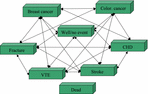
The structure of the model that was used is shown in Figure 1. The arrows show the allowed transitions in the model. There is always a possibility of dying or staying in the same health state. CHD consists of three different health states: acute myocardial infarction, angina pectoris, and coronary insufficiency. The fracture state consists of a hip fracture, vertebral fracture, and a wrist fracture state (Figure 1).

The structure of the model. Color., colorectal; CHD, coronary heart disease; VTE, venousthrommoboembolic events.
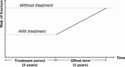
An intervention is modeled by its impact on the disease risks during therapy and, in some instances, effects that persist after the cessation of therapy, toward an offset time period. In Figure 2, an example on how the effect of HRT on the risk of a disease can be modeled is shown. If a remaining effect of HRT on the fracture risk after the treatment period is assumed, this is modeled as a linear decline in the effect for a given “offset time.” In Figure 2, the remaining effect persists for 5 years after the cessation of therapy.

Modeling an intervention.
DATA
The data for the model are based on available evidence for risks, mortality rates, quality of life weights, and costs valid for Sweden. The inclusion of costs is based on a societal perspective, including intervention costs, disease related costs, and costs in added years of life. Cost and quality of life data are to a major extent based on empirical studies. Data on disease risks and mortality rates are obtained from different national registers and epidemiological studies. A detailed presentation of all data is presented in Zethraeus et al. (56).
Effect of Hormone Replacement Therapy
The effects of HRT on disease risks during therapy are taken from the WHI studies (1;39). Based on the WHI (39), the following relative risks (RR) were used for women with an intact uterus on combination therapy: CHD (RR=1.29), stroke (RR=1.41), VTE (RR=2.11), breast cancer (RR=1.26), colorectal cancer (RR=0.63), hip fracture (RR=0.66), vertebral fracture (RR=0.66), and other osteoporotic fracture (RR=0.77).
Based on the WHI (1), the following RRs were used for women with a hysterectomy on estrogen-only therapy: CHD (RR=0.91), stroke (RR=1.39), VTE (RR=1.33), breast cancer (RR=0.77), colorectal cancer (RR=1.08), hip fracture (RR=0.61), vertebral fracture (RR=0.62), and total osteoporotic fractures (RR=0.70). Estrogen-only therapy significantly increased the risk of stroke and significantly reduced the risk of hip, vertebral, and other total osteoporotic fractures. In the base case assumption, a remaining effect of 5 years is assumed for fractures (3). No other remaining effects are assumed to exist (4).
Disease Risks
Age-specific population risks of hip, vertebral, and wrist fracture for Swedish females used in the model were derived from a population-based study from Malmö (26). To estimate the age-specific incidence of nonskeletal events (breast cancer, colorectal cancer, CHD, stroke, VTE) data were extracted from the Swedish national inpatient register administered by the Centre for Epidemiology at the National Board of Health and Welfare.
Mortality Rates
The age-specific annual mortality rates for the general population in Sweden are based on the years 1998–2001 (43). To fit the model structure, normal mortality rates had to be adjusted to exclude the risk of dying from those disease events that were included in the model (58). This adjusted normal mortality was calculated as normal mortality multiplied by the share of all causes of death (44) that was not explained by CHD, stroke, breast cancer, and colorectal cancer.
Patients with hip fractures and clinical vertebral fractures have a higher mortality compared with the normal population (5;6;11;21;28;35). Age-differentiated mortality risks (first and following years) after clinical vertebral fractures were derived from Johnell et al. (24). A part of the excess mortality after fracture compared with normal mortality cannot entirely be ascribed to the fracture event but also to other comorbid conditions (28;29;37). Thirty percent of the observed excess mortality after a hip or vertebral fracture was assumed to be associated with the fracture event. Wrist fracture was not assumed to be associated with any excess mortality (6;24). Mortality after breast cancer, colorectal cancer, CHD, stroke, and VTE was derived by linking the inpatient sample extracted from the inpatient register with the register for causes of death also monitored by the Centre for Epidemiology at the National Board of Health and Welfare. The yearly mortality rates were estimated using parametric Weibull survival regression (30).
Quality of Life Weights
The estimation of the gain in quality of life from HRT is based on a Swedish empirical study (57). In the base case analysis, we assume that the gain in quality of life due to HRT is equal to 0.29, which corresponds to an average woman with menopausal symptoms.
The impact on quality of life the first year after a fracture was based on a study conducted at the orthopedic department at the Malmö University Hospital in the south of Sweden (55). Quality of life values for the population (33) were used as proxies for the patient quality of life without a fracture. Accounting for the gender distribution in the study sample, the disutility the first year after fracture was calculated (27). The quality of life in subsequent years after a hip fracture was assumed to be 90 percent of that of a healthy individual (25). Wrist fracture was not assumed to be associated with any utility loss the second and following years after fracture. The utility loss the second and following years after a clinical vertebral fracture was set to 0.05 (36). The utility loss after CHD, based on previous studies (17;22;49), was assumed to be 0.1 for all years after disease event and for all ages. As in Zethraeus et al. (58–60), we assumed the utility loss associated with breast cancer to be equal to the loss after CHD. The same utility loss was assumed for colorectal cancer and VTE.
Costs
All costs are expressed in 2003 prices. When needed, the costs were inflated using the Consumer Price Index from Statistics Sweden (44). The annual intervention cost for women on combination therapy (with an intact uterus) is estimated at SEK 2,972. This value consists of drug costs (SEK 1220 [41]) and 1.5 physician visits per year at a price of SEK 1,168 per visit. The corresponding annual intervention cost for women on estrogen-only therapy (with a hysterectomy) is estimated at SEK 2,078. This value consists of drug costs (SEK 910 [41]) and 1 physician visit per year at a price of SEK 1,168.
Direct and indirect fracture costs in Sweden during the first year after a hip, clinical vertebral, and wrist fracture was derived from Zethraeus et al. (55). Hip fracture costs the second and following years were based on the assumption that 10 percent of all patients remain at a nursing home for the rest of their lives (25) at a weekly cost of 1,486 SEK (45). It was conservatively assumed that these fractures were associated with costs only during the first year after fracture.
Costs related to CHD, stroke, breast cancer, colorectal cancer, and VTE are based on Zethraeus et al. (60), Liljegren et al. (32), and the national inpatient register. The potential savings in hospital costs were estimated as the difference 1 year after and before the event, using the patient as her own control (61). Costs in added years of life (34), defined as the difference between annual production and consumption in different age groups, are based on Ekman (15).
RESULTS
The health effect, cost, and cost-effectiveness results of a 5-year HRT are presented in Tables 1–4. The results are separated for women with an intact uterus and for women with a hysterectomy.


Health Effects and Costs
The health effect consequences of HRT in the different patient groups in terms of life years (LYs) and QALYs are presented in Table 1. HRT suggests a loss in the expected number of life years for women with an intact uterus on combination therapy. The mean decrease in expected life years is between 0.04 and 0.05, which corresponds to 15–18 days. After discounting, the mean decrease varies between 0.02 and 0.03 life years. HRT will increase the number of expected QALYs compared with no therapy in all the age groups. The increase in the number of QALYs (with and without discounting) is between 1.2 and 1.3.
For women with a hysterectomy on estrogen-only therapy, HRT suggests a gain in life expectancy, which amounts to 0.01–0.06, which corresponds to 4–22 days. After discounting, the mean increase is between 0.006 and 0.03 years. HRT will increase the number of expected QALYs compared with no therapy in all the age groups. The increase in QALYs (with and without discounting) is estimated at between 1.2 and 1.3 (Table 1).
The cost consequences are shown in Table 2. The mean difference in costs in the different age groups is estimated at between 10,000 and 15,000 SEK. In older age groups, the cost-level becomes higher. This finding is because the value of production decreases, which suggests that the costs of (consumption–production) will increase and result in a total higher cost level (Table 2).
Cost-Effectiveness
The cost-effectiveness results for women with an intact uterus are presented in Table 3. In the base case scenario, the cost per QALY gained varies between SEK 9,000 and 13,000 in the different age groups, which is below the defined threshold value of SEK 600,000. It is clear that the cost-effectiveness ratios are stable to all but one of the alternative scenarios specified in the sensitivity analysis. The results are only sensitive to whether the therapy has a positive effect on menopausal symptoms or not. If it is assumed that HRT does not increase quality of life, HRT is dominated by the no-therapy alternative, which means that the no-treatment alternative suggests more QALYs and lower costs (Table 3).
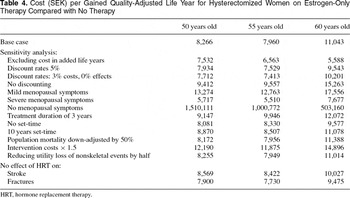
The results for women with a hysterectomy are presented in Table 4. In the base case scenario, the cost per gained QALY varies between SEK 8,000 for a 50-year-old women and SEK 11,000 for a 60-year-old women, which is also below the defined threshold value of SEK 600,000. The cost-effectiveness ratios are stable to all but one of the alternative scenarios specified in the sensitivity analysis. If it is assumed that HRT does not affect quality of life, then the cost-effectiveness ratio exceeds the threshold value of SEK 600,000 (above SEK 1 million at the ages 50 and 55). However, for a 60-year-old woman, the cost-effectiveness ratio (SEK 500,000) is still below the threshold value (Table 4).
To investigate the effect that the elimination of menopausal symptoms has on cost-effectiveness, a threshold analysis was carried out. The purpose of the threshold analysis was to determine the minimum increase in quality of life that is required just to make the treatment cost-effective. The analysis showed that HRT is cost-effective for women with or without a hysterectomy (irrespective of age) if the gain in quality of life exceeds 0.013 units.
DISCUSSION AND CONCLUDING REMARKS
This study has re-examined the cost-effectiveness of HRT for an average Swedish female population with menopausal symptoms based on a societal perspective and new evidence presented in the WHI studies (1;39). The cost per gained QALY varies for 50- to 60-year-old women between SEK 8,000 for women with a hysterectomy and SEK 13,000 for women with an intact uterus, which is far below the defined threshold value of SEK 600,000. The results show that the value of the positive effects for women with menopausal symptoms in terms of symptom relief clearly outweighs the negative effects of HRT. Given that HRT increases the quality of life more than 0.013 units, HRT becomes cost-effective in all the studied patient groups. In one patient group, 60-year-old hysterectomized women on estrogen-only therapy, HRT is cost-effective irrespectively of any symptom relief. The threshold value of 0.013 can be compared with empirical findings that shows that HRT on average increases quality of life with 0.29 and with 0.18 for women with mild menopausal symptoms, which clearly exceeds the required increase in quality of life that makes HRT cost-effective (12;57). Thus given the new evidence in WHI, there is still a high probability that HRT is a cost-effective strategy for women with menopausal symptoms.
The results in this report are similar to the findings presented in two recent published studies (8;31) that assess the health effects of HRT based on the WHI (39). The purpose of the study by Col et al. (8) was to determine, by exploring the trade-off between symptomatic relief and risk of disease, which women might benefit from HRT. For an average 50-year-old woman, a 2-year HRT treatment time suggested a loss in expected survival of 12 days, which can be compared with 15 days found in this report (or 4 days if assessing a treatment time of 2 years). The findings in this report are also close to the results presented in Kim and Kwok (31). The purpose of that study was to estimate quality-adjusted life expectancy with and without HRT for women with an intact uterus on combination therapy (based on the treatment in WHI [39]). The results showed that a 5-year treatment time reduced the expected life length by 0.01 years, using a 3 percent discount rate for women at low risk of breast cancer and CHD. This finding is very similar to the results found in this report, which shows a decrease in expected (discounted at 3 percent) life length of 0.02 years for 50-year-old women with an intact uterus on combination therapy.
A majority of previous cost-effectiveness studies have based the estimations of the quality of life weights before and after HRT on assumptions, rather than based on empirical data (7;13;46;51;52). Empirical studies carried out in the United Kingdom and Sweden, however, indicate that the effect of menopausal symptoms on the quality of life, either measured by the rating scale or the time-trade off method, has been underestimated (12;19;38;57). For example, in Zethraeus et al. (57), the gain in the quality of life measured by the time-trade off method was estimated at 0.18 for women with mild symptoms and 0.42 for women with severe symptoms, respectively. A limitation of the above empirical studies is that they include few patients and may not be representative of all women receiving HRT in Sweden and the United Kingdom. To investigate the real effect of menopausal symptoms and HRT on the quality of life, further randomized studies are required.
The model used to estimate the cost-effectiveness with HRT is based on a previous model that has been well validated and published in the literature (58–60). The model also produces similar results on the health effect measures compared with the results found in two recent published studies (8;31), which further validates the findings in this study. Nevertheless, some of the data in the model have to be based on assumptions. In particular, there is a lack of empirically based quality of life estimates related to nonskeletal disease events. To take this into account, extensive sensitivity analysis has been carried out, where the base case assumptions are changed. The results from the sensitivity analysis show that the conclusions are stable to variations in these variables.
It is not evident whether the results found in the WHI are valid for other populations, for example, women with high risk of fracture (osteoporotic women). The WHI focused on a healthy female population and the extent to which benefits on the skeletal system in individuals at high risk outweigh adverse effects requires re-examination in this context. Epidemiological information indicates that the baseline risk for breast cancer is approximately 30 percent lower in individuals with osteoporosis, possibly related to more marked gonadal hormone deficiency in individuals with low bone mineral density (and low body mass index). Further studies are required to investigate the cost-effectiveness of HRT in this population group.
CONTACT INFORMATION
Niklas Zethraeus, PhD (henz@hhs.se) Assistant Professor, Centre for Health Economics, Stockholm School of Economics, P.O. Box 6501, SE-113 83 Stockholm, Sweden, Fredrik Borgström, PhD student (Fredrik.b@healthecomonics.se), Medical Management Centre at the Karolinska Institute (KI) and Stockholm Health Economics, Klarabergsgatan 33 3tr, SE-111 21 Stockholm, Sweden, Bengt Jönsson, PhD (hebj@hhs.se), Professor, Centre for Health Economics, Stockholm School of Economics, P.O. Box 6501, SE-113 83 Stockholm, Sweden, John Kanis, PhD (w.j.pontefract@sheffield.ac.uk), Centre for Metabolic Bone Diseases (WHO Collaborating Centre), University of Sheffield Medical School, Sheffield S10 2RX, UK
Funding for this study was provided by Wyeth Lederle.
References
Anderson GL,
Limacher M,
Assaf AR, et al.
2004
Effects of conjugated equine estrogen in postmenopausal women with hysterectomy: The Women's Health Initiative randomized controlled trial.
JAMA.
291:
1701–
1712.Google Scholar
Armstrong K,
Chen TM,
Albert D, et al.
2001
Cost-effectiveness of raloxifene and hormone replacement therapy in postmenopausal women: Impact of breast cancer risk.
Obstet Gynecol.
98:
996–
1003.Google Scholar
Bagger YZ,
Tanko LB,
Alexandersen P, et al.
2004
Two to three years of hormone replacement treatment in healthy women have long-term preventive effects on bone mass and osteoporotic fractures: The PERF study.
Bone.
34:
728–
735.Google Scholar
Beral V.
2003
Breast cancer and hormone-replacement therapy in the Million Women Study.
Lancet.
362:
419–
427.Google Scholar
Cauley JA,
Thompson DE,
Ensrud KC, et al.
2000
Risk of mortality following clinical fractures.
Osteoporos Int.
11:
556–
561.Google Scholar
Center JR,
Nguyen TV,
Schneider D, et al.
1999
Mortality after all major types of osteoporotic fracture in men and women: An observational study.
Lancet.
353:
878–
882.Google Scholar
Cheung AP,
Wren BG.
1992
A cost-effectiveness analysis of hormone replacement therapy in the menopause.
Med J Aust.
156:
312–
316.Google Scholar
Col NF,
Weber G,
Stiggelbout A, et al.
2004
Short-term menopausal hormone therapy for symptom relief: An updated decision model.
Arch Intern Med.
164:
1634–
1640.Google Scholar
Colditz GA,
Hankinson SE,
Hunter DJ, et al.
1995
The use of estrogens and progestins and the risk of breast cancer in postmenopausal women.
N Engl J Med.
332:
1589–
1593.Google Scholar
Collaborative Group on Hormonal Factors in Breast Cancer.
1997
Breast cancer and hormone replacement therapy: Collaborative reanalysis of data from 51 epidemiological studies of 52 705 women with breast cancer and 108 411 women without breast cancer.
Lancet.
350:
1047–
1059.
Cooper C,
Atkinson EJ,
Jacobsen SJ, et al.
1993
Population-based study of survival after osteoporotic fractures.
Am J Epidemiol.
137:
1001–
1005.Google Scholar
Daly E,
Gray A,
Barlow D, et al.
1993
Measuring the impact of menopausal symptoms on quality of life.
BMJ.
307:
836–
840.Google Scholar
Daly E,
Roche M,
Barlow D, et al.
1992
HRT: An analysis of benefits, risks and costs.
Br Med Bull.
48:
368–
400.Google Scholar
Daly E,
Vessey MP,
Barlow D, et al.
1996
Hormone replacement therapy in a risk-benefit perspective.
Maturitas.
23:
247–
259.Google Scholar
Ekman M,
Zethraeus N,
Dahlstrom U, et al.
2002
[Cost-effectiveness of bisoprolol in chronic heart failure].
Lakartidningen.
99:
646–
650.Google Scholar
Geelhoed E,
Harris A,
Prince R.
1994
Cost-effectiveness analysis of hormone replacement therapy and lifestyle intervention for hip fracture.
Aust J Public Health.
18:
153–
160.Google Scholar
Glasziou PP,
Bromwich S,
Simes RJ.
1994
Quality of life six months after myocardial infarction treated with thrombolytic therapy. AUS-TASK Group. Australian arm of International tPA/SK Mortality Trial.
Med J Aust.
161:
532–
536.Google Scholar
Hirth RA,
Chernew ME,
Miller E, et al.
2000
Willingness to pay for a quality-adjusted life year: In search of a standard.
Med Decis Making.
20:
332–
342.Google Scholar
Hornberger JC,
Redelmeier DA,
Petersen J.
1992
Variability among methods to assess patients' well-being and consequent effect on a cost-effectiveness analysis.
J Clin Epidemiol.
45:
505–
512.Google Scholar
Hulley S,
Grady D,
Bush T, et al.
1998
Randomized trial of estrogen plus progestin for secondary prevention of coronary heart disease in postmenopausal women. Heart and Estrogen/progestin Replacement Study (HERS) Research Group.
JAMA.
280:
605–
613.Google Scholar
Jalava T,
Sarna S,
Pylkkanen L, et al.
2003
Association between vertebral fracture and increased mortality in osteoporotic patients.
J Bone Miner Res.
18:
1254–
1260.Google Scholar
Johannesson M.
1995
The cost effectiveness of hypertension treatment in Sweden.
Pharmacoeconomics.
7:
242–
250.Google Scholar
Johannesson M.
2001
At what coronary risk level is it cost-effective to initiate cholesterol lowering drug treatment in primary prevention?
Eur Heart J.
22:
919–
925.Google Scholar
Johnell O,
Kanis JA,
Oden A, et al.
2004
Mortality after osteoporotic fractures.
Osteoporos Int.
15:
38–
42.Google Scholar
Jonsson B,
Christiansen C,
Johnell O, et al.
1996
Cost-effectiveness of fracture prevention in established osteoporosis.
Scand J Rheumatol Suppl.
103:
30–
38.Google Scholar
Kanis JA,
Johnell O,
Oden A, et al.
2000
Long-term risk of osteoporotic fracture in Malmö.
Osteoporos Int.
11:
669–
674.Google Scholar
Kanis JA,
Johnell O,
Oden A, et al.
2004
The risk and burden of vertebral fractures in Sweden.
Osteoporos Int.
15:
20–
26.Google Scholar
Kanis JA,
Oden A,
Johnell O, et al.
2004
Excess mortality after hospitalisation for vertebral fracture.
Osteoporos Int.
15:
108–
112.Google Scholar
Kanis JA,
Oden A,
Johnell O, et al.
2003
The components of excess mortality after hip fracture.
Bone.
32:
468–
473.Google Scholar
Kiefer N.
1988
Economic duration data and hazard functions.
J Econ Literature.
26:
646–
679.Google Scholar
Kim C,
Kwok YS.
2003
Decision analysis of hormone replacement therapy after the Women's Health Initiative.
Am J Obstet Gynecol.
189:
1228–
1233.Google Scholar
Liljegren G,
Karlsson G,
Bergh J, et al.
1997
The cost-effectiveness of routine postoperative radiotherapy after sector resection and axillary dissection for breast cancer stage I. Results from a randomized trial.
Ann Oncol.
8:
757–
763.Google Scholar
Lundberg L,
Johannesson M,
Isacson DG, et al.
1999
Health-state utilities in a general population in relation to age, gender and socioeconomic factors.
Eur J Public Health.
19:
128–
140.Google Scholar
Meltzer D.
1997
Accounting for future costs in medical cost-effectiveness analysis.
J Health Econ.
16:
33–
64.Google Scholar
Oden A,
Dawson A,
Dere W, et al.
1998
Lifetime risk of hip fractures is underestimated.
Osteoporos Int.
8:
599–
603.Google Scholar
Oleksik A,
Lips P,
Dawson A, et al.
2000
Health-related quality of life in postmenopausal women with low BMD with or without prevalent vertebral fractures.
J Bone Miner Res.
15:
1384–
1392.Google Scholar
Parker MJ,
Anand JK.
1991
What is the true mortality of hip fractures?
Public Health.
105:
443–
446.Google Scholar
Read JL,
Quinn RJ,
Berwick DM, et al.
1984
Preferences for health outcomes. Comparison of assessment methods.
Med Decis Making.
4:
315–
329.Google Scholar
Rossouw JE,
Anderson GL,
Prentice RL, et al.
2002
Risks and benefits of estrogen plus progestin in healthy postmenopausal women: Principal results from the Women's Health Initiative randomized controlled trial.
JAMA.
288:
321–
333.Google Scholar
SBU [The Swedish Council on Technology Assessment in Health Care].
1996.
Behandling med östrogen.
SBU report No 131.
Stockholm:
SBU;
SBU [The Swedish Council on Technology Assessment in Health Care].
2002.
Behandling med östrogen—En evidensbaserad kunskapssammanställning.
SBU report No 159.
Stockholm:
SBU;
Stanford JL,
Weiss NS,
Voigt LF, et al.
1995
Combined estrogen and progestin hormone replacement therapy in relation to risk of breast cancer in middle-aged women.
JAMA.
274:
137–
142.Google Scholar
Statistics Sweden.
Sweden's statistical databases.
Available at: http://www.scb.se/eng/databaser/ssd.asp.
Stockholms stads budgetavräkning.
Stadsledningskontorets redovisningsstab. 2003.
Available at: www.stockholm.se.
Tosteson AN,
Rosenthal DI,
Melton LJ, et al.
1990
Cost effectiveness of screening perimenopausal white women for osteoporosis: Bone densitometry and hormone replacement therapy.
Ann Intern Med.
113:
594–
603.Google Scholar
Tosteson AN,
Weinstein MC.
1991
Cost-effectiveness of hormone replacement therapy after the menopause.
Baillieres Clin Obstet Gynaecol.
5:
943–
959.Google Scholar
Tosteson AN.
1994
Hormone replacement therapy: Benefit, risk and cost considerations.
J Clin Pharmacol.
34:
719–
722.Google Scholar
Tsevat J,
Goldman L,
Soukup JR, et al.
1993
Stability of time-trade off utilities in survivors of myocardial infarction.
Med Decis Making.
13:
161–
165.Google Scholar
US Congress, Office of Technology Assessment.
1995.
Effectiveness and costs of osteoporosis screening and hormone replacement therapy: Vol. I: Cost-effectiveness Analysis, Vol. II: Evidence on benefits, risks and costs.
Washington DC:
US Government printing Office;
Weinstein MC.
1980
Estrogen use in postmenopausal women–costs, risks, and benefits.
N Engl J Med.
303:
308–
316.Google Scholar
Weinstein MC,
Schiff I.
1983
Cost-effectiveness of hormone replacement therapy in the menopause.
Obstet Gynecol Surv.
38:
445–
455.Google Scholar
Weinstein MC,
Tosteson AN.
1990
Cost-effectiveness of hormone replacement.
Ann NY Acad Sci.
592:
162–
172.Google Scholar
Zethraeus N,
Ben Sedrine W,
Caulin F, et al.
2002
Models for assessing the cost-effectiveness of the treatment and prevention of osteoporosis.
Osteoporos Int.
13:
841–
857.Google Scholar
Zethraeus N,
Borgström F,
Johnell O, et al.
Costs and quality of life associated with osteoporosis related fractures—Results from a Swedish survey.
Working Paper Series in Economics and Finance at the Stockholm School of Economics, No 512. 2002.
Zethraeus N,
Borgström F,
Jönsson B et al.
A reassessment of the cost-effectiveness of hormone replacement therapy in Sweden—results based on the Women's Health Initiative randomised controlled trial.
Working Paper Series in Economics and Finance at the Stockholm School of Economics, No 571. 2004.
Zethraeus N,
Johannesson M,
Henriksson P, et al.
1997
The impact of hormone replacement therapy on quality of life and willingness to pay.
Br J Obstet Gynaecol.
104:
1191–
1195.Google Scholar
Zethraeus N,
Johannesson M,
Jönsson B.
1999
A computer model to analyze the cost-effectiveness of hormone replacement therapy.
Int J Technol Assess Health Care.
15:
352–
365.Google Scholar
Zethraeus N,
Johanneson M,
Jönsson B.
A computer model to analyse the cost effectiveness of hormone replacement therapy.
EFI Research Paper No 6578; January 1998.
Zethraeus N,
Lindgren P,
Johnell O, et al.
A computer model to analyse the cost effectiveness of hormone replacement therapy—a revised version.
SSI/EFI Working Paper Series in Economics and Finance at the Stockholm School of Economics, No 368; 2000.
Zethraeus N,
Stromberg L,
Jonsson B, et al.
1997
The cost of a hip fracture. Estimates for 1,709 patients in Sweden.
Acta Orthop Scand.
68:
13–
17.Google Scholar
The structure of the model. Color., colorectal; CHD, coronary heart disease; VTE, venousthrommoboembolic events.
Modeling an intervention.

Life Years (LYs) and Quality-Adjusted Life Years (QALYs) with and without HRT for 50- to 60-Year-Old Women with an Intact Uterus or Hysterectomizeda
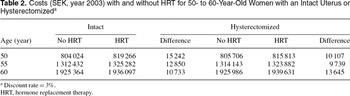
Costs (SEK, year 2003) with and without HRT for 50- to 60-Year-Old Women with an Intact Uterus or Hysterectomizeda
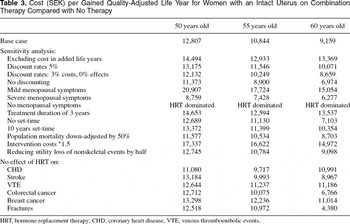
Cost (SEK) per Gained Quality-Adjusted Life Year for Women with an Intact Uterus on Combination Therapy Compared with No Therapy
Cost (SEK) per Gained Quality-Adjusted Life Year for Hysterectomized Women on Estrogen-Only Therapy Compared with No Therapy
 You have
Access
- 27
- Cited by