


Theorist of rubbish Michael Thompson once remarked that ‘Words, when it comes to dynamic processes, are a snare and a delusion even to the wary. Pictures are much better’ (Thompson Reference Thompson1979, p. 218). How does one speak about waste? How does one retrace the mobile, heterogeneous order of recorded things? Which images do we have to write about processes of wasting? When Thompson penned his now-classic Rubbish Theory in the late 1970s, waste remained a relatively unusual, marginal object of study – an object which, because of its very malleability and elusiveness, required new modes of writing, new imaginings. Thompson persuasively argued that the theorist of rubbish ‘[had] to deal in different forms of discourse simultaneously. And since they cannot be mixed they must be juxtaposed. The joke, the paradox, the shock technique and the journalistic style, far from being unscholarly devices to be avoided at all costs, become rubbish theory's inseparable accompaniments’ (Thompson Reference Thompson1979, p. 5). In keeping with the rhapsodic approach recommended by Thompson, this article proposes a (necessarily incomplete) rubbish theory of recorded sound where ‘[t]he ecologist's insistence on the connectedness of everything has to coexist with the knowledge that we can never take everything into account’ (Thompson Reference Thompson1979, p. 215). Accordingly, I present three situated moments – or plateaux – in order to partially uncover the particular affinities between popular music and the Anthropocene, from early phonography to the present digital realm (with a focus on the UK, United States and British India).Footnote 1 Throughout, I use a number of polyvalent terms related to waste, including ‘surplus’, ‘garbage’ and ‘rubbish’. Although these words cover slightly different grounds, all of them relate to notions of excess, persistence, devaluation and transformability (or reversibility).
Scanlan (Reference Scanlan2005, p. 22) has noted how, in Old and Middle English, the word ‘waste’ denoted ‘a land or an environment […] unsuitable to sustain human habitation’, and was further used to describe the depletion of land through human exploitation and overuse (p. 23). It seems apt, therefore, to relate dereliction (and practices of wasting) to the Anthropocene. Rather than pursuing waste as an abstract aesthetic category, I link it to the intensification – in the Western world – of industrial capitalism at the turn of the 20th century (Thompson Reference Thompson1979; Strasser Reference Strasser1999), a point when the fields of ‘ecology’ and ‘economy’ came into close contact. Indeed, waste may even be envisioned as an exemplar Anthropocenic ‘oikos’ (the ancient Greek term for ‘home’). Although motivated and informed by an historical impulse, this article also remains explorative and open-ended; it weaves together a number of stories, discourses, and materialities in the hope of creating innovative connections, and generating productive ways of approaching the relationship between popular music and its environment(s).Footnote 2 This article starts with a ‘partial inventory’ of the Anthropocene, outlining the heuristic values of waste studies for research in popular music. The first plateau retraces the more historical links between popular music and waste, showing how waste (and the positive discourses surrounding it) became a defining element of the discourse and practices of early phonography. I aim to show how recorded sound participated in (and helped define, in an emblematic manner) a rapidly expanding ‘throwaway culture’ (Slade Reference Slade2006) at the turn of the 20th century. The second plateau presents a more global panorama of the recording industry through a focus on shellac (a core, reversible substance of the early recording industry; Smith Reference Smith2015; Devine Reference Devine2015). Finally, the third plateau outlines some insights into the ways in which popular music may ‘play’ and incorporate residual materialities in the contemporary ‘digital age’.
Assembling the Anthropocene: a partial inventory
For decades now, popular music theorists have strived to resituate musical production, consumption and disposal within the larger economical and psychical model of industrial capitalism (Frith Reference Frith1988; Hesmondhalgh and Negus Reference Hesmondhalgh and Negus2002; Hennion Reference Hennion2007). Curiously, though, they have often ignored music's relationship to material and discursive-symbolic practices of wasting, disposing and discarding. Straw's (Reference Straw1999–2000) agile infrastructural survey of second-hand music in Canada is an early, notable exception, which anticipated broader theoretical accounts on ‘residual media’ (Acland Reference Acland2007). More recent studies deal explicitly with the music industry as a relentless producer of material waste and pollution – the recording industry's dependence on raw materials and natural resources, as well as the entanglement of technological and natural–geological times, have come under the growing scrutiny of media and music theorists (Gabrys Reference Gabrys2013; Parikka Reference Parikka2015a; Smith Reference Smith2015; Devine Reference Devine2015). The latter, adhering more or less closely to the heterogeneous agenda of Anthropocenic thinking, interrogate the long duration or ‘deep time’ (Gould Reference Gould1987; Zielinski Reference Zielinski and Custance2006) of media objects, where
the world of thought, senses, sensation, perception, customs, practices, habits, and human embodiment is not unrelated to the world of geological strata, climates, the earth, and the massive durations of change that seem to mock the timescales of our petty affairs. And yet, the human affairs have demonstrated an impact. (Parikka Reference Parikka2015a, p. vii)
Despite its apparent urgency and preponderance in contemporary critical thinking, the heterogeneous Anthropocene began its conceptual gestation long ago: early traces of a proto-ecological consciousness can be found in the works of Rousseau for instance, most tangibly in his 1754 Discourse on the Origin of Inequality (Trachtenberg Reference Trachtenberg2015; Bonneuil and Fressoz Reference Bonneuil, Fressoz and Fernbach2016). The term ‘Anthropocene’ was originally coined by chemist Paul J. Crutzen in 2000 to refer to ‘the massive changes human practices, technologies, and existence have brought across the ecological board’ (Parikka Reference Parikka2015a, pp. 16–17). The American environmentalist scholar Max Liboiron insists that more than 90% of waste produced today in the United States is of industrial origins (consisting of heavy materials used in factories). Modern waste is defined by its composition, but most importantly its scale, tonnage, toxicity and heterogeneity which make it an all-engulfing presence, easily qualifying as a ‘hyperobject’ (Morton Reference Morton2013, p. 1).
Since its inception in the early 1890s, the record industry – one of the first truly transnational industries – has exploited a number of planetary resources and colonial subjects. As posited by Devine, ‘the 78 era is part of a longer history of musical globalisation – a history which is not only about the movement of recordings around the Earth but also the movement of earth to make recordings’ (Devine Reference Devine2015, p. 375). Gramophone production used shellac from India, manila copal from the Philippine Islands, rosin or colophony from France, America, and Russia, as well as Kieselghur from Germany (Bell Reference Bell1936, pp. 29–30). As such, the gramophone record is a composite object, in which a number of durations, materialities and relations are sedimented: it partially materialises (asymmetric) power relations between the West and the East, drawing our attention to the set of racialised inequalities underpinning the genesis of the Anthropocene (Yusoff Reference Yusoff2018, p. 12).
Thinkers of the Anthropocene have noted the difficulties and paradoxes arising when one tries to describe phenomena that so clearly comprehend, and simultaneously exceed, human activity. Perhaps this is why it has given rise to so many discussions, terminologies and theoretical tensions, which are notably symptomised by a form of onomatomania or ‘mania for names’ (see Haraway Reference Haraway2015). My account is partial to Jason Moore's term ‘Capitalocene’, which aims to ‘situat[e] the rise of capitalism, historically and geographically, within the web of life. This is capitalism not as economic system but as a situated and multispecies world-ecology of capital, power and re/production’ (Moore Reference Moore2017, pp. 608–9) – although I recognise that the terms ‘capitalism’ and ‘the Anthropocene’ do not strictly coincide. In the mid-1970s – a few years after the 1968 Biosphere Conference in Paris – it was estimated that (Western) human needs, in terms of energy and raw materials, had exceeded the biosphere's capacity for self-renewal (Berthoud et al. Reference Berthoud2012, p. 35). The 1970s thus marked the beginning of an ‘entropy crisis’ or entropic tipping-point. Simultaneously, the turn of the 1970s was marked by an accrued interest in matters of waste and dereliction across Europe and North America (Barr Reference Barr1969; Fraser Darling Reference Fraser Darling1969; Rathje and Murphy Reference Rathje and Murphy2001). In 1962, John Steinbeck travelled extensively across North America, setting out to collect and sew together impressions about his own time and contemporaries. The resulting autobiographical text, Travels with Charley, combines quiet celebrations of earthly life with moments of visionary melancholy. With great perceptiveness, Steinbeck writes about the inescapability of capitalism, symptomised by its hyper-waste – a waste which cannot be absorbed or recycled anymore:
Everything we use comes in boxes, cartons, bins, the so-called packaging we love so much. The mountains of things we throw away are much greater than the things we use. In this, if in no other way, we can see the wild and reckless exuberance of our production, and waste seems to be the index. […] I wonder whether there will come a time when we can no longer afford our wastefulness – chemical wastes in the rivers, metal wastes everywhere, and atomic wastes buried deep in the earth or sunk in the sea. When an Indian village became too deep in its own filth, the inhabitants moved. And we have no place to which to move. (Steinbeck Reference Steinbeck1997[1962], p. 25)
Recorded sound, with its lavish and elaborate packaging, its plastic discs and wrappings (at least since the inception of the LP age), has certainly been part of the wastefulness described by Steinbeck.Footnote 3 Significantly, waste and pollution appear as a human signature, a paradoxical gesture of authorship: for Koehler (Reference Koehler and Eskin2017, p. 108), ‘the age of landfills is also the age of landmarking’. The monumentality of garbage was systematically explored by Rathje and Murphy in their archaeology of garbage project conducted at the University of Arizona. Their ‘Garbage Project’ was to rediscover the recent US past through the remnant of the Fresh Kills landfill, in New York City. Fresh Kills had first opened in 1948 and finally closed in 2001. With its mass of 1000 million tons, it was ‘one of the largest man-made structures in North America’ (Rathje and Murphy Reference Rathje and Murphy2001, p. 3). The authors further celebrate the gigantic landfill as: ‘a treasure trove – a Pompeii, a Tika, a Valley of the Kings – of artefacts from the most advanced civilisation the planet has ever seen’ (Rathje and Murphy Reference Rathje and Murphy2001). Waste was perceived as something which human beings inherit from previous generations. In her novel Surfacing, whose publication coincided with the beginning of the Garbage Project,Footnote 4 Margaret Atwood (Reference Atwood1972, p. 131) ironically remarked that garbage had become the inglorious, unmistakable signature of human beings, the only thing left for them to imprint their territory with.
It would be possible to recount and retrace the history of recorded sound through an inventory of its discarded commodities and disappearing songs.Footnote 5 In the 1929 German silent film Menschen am Sonntag (People on Sunday, dir. Curt and Robert Siodmak/Edgar G. Ulmer, UFA), a young woman hurriedly buries the broken shards of a gramophone record in a patch of soft, sandy earth. Somehow the record, partly made of natural substances (and especially of shellac), seems to return to its place of origin (Roy Reference Roy2017). The gesture of concealing the record in the sand can be read as an act of closure: it produces a reassuring, deceptively perfect circle where nature, having become culture (in the shape of the record), returns to its pseudo-natural state once more.Footnote 6
The same hope of ‘recycling’ media objects – as if seamless recycling could occur – lies at the heart of many contemporary propositions for ‘greening’ and repurposing media (Maxwell and Miller Reference Maxwell and Miller2012). Yet, total recycling is a fantasy, and in reality we stumble upon countless abandoned and inoperative residual media formats. These, like waste itself, are ob-scene (literally: out of place), resisting easy elimination, absorption or interpretation.Footnote 7 They simply persist. In ‘Le chiffonnier de la Bastille’ (‘The Bastille ragpicker’ – a popular, semi-forgotten Reference Montero1958 ditty penned by poet Marcel Saint-Martin), French singer and actress Germaine Montero recalls ‘un vieux phono en mille morceaux’ (‘an old phonograph in one thousand shards’). She sings about residual objects which do not fit or do not work anymore,Footnote 8 and her song becomes a mosaic of everyday forgotten objects, the derivative, vernacular equivalent, perhaps, of T.S. Eliot's Waste Land (1922), and its ‘heap of broken images’ (Eliot Reference Eliot1999 [1922], p. 23). Montero's records themselves – although they continue to exist materially – have slipped into relative cultural and physical obscurity with the passing of years. Nebraska novelist Mari Sandoz (Reference Sandoz and Sandoz2001[1966]), in her autobiographical tale ‘The Christmas of the Phonograph Records’, tells the reader of the actual physical destruction of records. She evokes the fragile collection of wax cylinders lovingly assembled by her father (with his modest financial means), only to be destroyed by the negligence of a child. The memory of the lost collection, reduced to a heap of mute fragments, would haunt Sandoz all through her adult life.
Pictures are much better (to recall here the words of Thompson Reference Thompson1979, p. 218). The images outlined above are windows, at once poignant and trivial, persistent and fragile, each of them alluding, obliquely, to music in everyday settings, inseparably enmeshed within rituals of consumption and disposal. Fascinating and infectious as it is, I am not interested here in the trope of the broken record per se, or in the slow rhapsody of decaying things (see Bennett Reference Bennett2010; Schwenger Reference Schwenger2006). I wish to keep, however, the (fractured) image and its composite substrate in mind: for it may be in such concrete images, as Bachelard suggested, that our reflection takes root and grows. Rubbish, according to Michael Thompson, ‘serves to draw attention to the way in which objects are socially processed and to suggest that a description of this process should be included in the answer to the question: “How is society possible?”’ (Thompson Reference Thompson1979, p. 130). Accordingly, the fractured, diffractive lens of waste studies brings us closer to particular socio-historical moments which may help us give subtler, more diverse answers to the question of musical consumption in the contemporary paradigm – where music exists under very specific cultural and industrial conditions, and in the peculiar form of recorded sound.
First plateau: early phonography and the rise of perishable music
From its inception, recorded sound ceaselessly wavered between the poles of perishability – or novelty – and permanence. On the one hand, the phonograph was gravely celebrated by Edison (as well as Berliner) as a means of achieving immortality or even fantasised as a magical machine to reach the dead (Anon. 1877, p. 304; Berliner Reference Berliner1913, p. 194). On the other hand, most of the first decade of phonographic production (on cylinders and gramophone records) – comprising musical and spoken records – consisted of light, recreational novelty numbers including ‘popular musical talents, […] low comedy, simple songs, cornet and clarinet solos, […] military music’ (Berliner Reference Berliner1913, p. 193). The talking machine participated into a growing culture of pleasure, slowly insinuating itself into a late-Victorian society more or less overtly yearning for modern, more sophisticated forms of sensory gratification (Cohen Reference Cohen2006). By the 1910s, a typical bourgeois interior in Britain may indeed have boasted a talking machine as well as a telephone (Lancaster Reference Lancaster1939, pp. 54–5).
At the turn of the 20th century, the playback device (be it phonograph or gramophone) ‘mattered’ more than the recordings per se (Day Reference Day2000, p. 17) – for those who could afford it. Musical equipment was sold alongside clocks, sewing-machines, furniture, and bicycles (Chew Reference Chew1981, p. 28), and a batch of indifferent records were frequently given away ‘for free’ to the gramophone purchaser to play on his newly acquired playback device. As such, early purchasers first and foremost bought a state-of-the-art technology, rather than (necessarily underdeveloped) cultural practices or particular repertoires. Edison candidly promoted the ‘novelty’ value of his phonograph (Garofalo Reference Garofalo1999, p. 323), a device which many early commentators and users affectionately or disparagingly described as a ‘toy’ (Roe Reference Roe1968, p. 97). In the years leading to 1924 – when Columbia patented discs with a ‘more silent surface’ – little happened in terms of ‘improving’ the quality of sound reproduction. Early phonograph scholars Wilson and Webb report that, in the 1912–24 period, the many developments in gramophone design were ‘dictated by a desire to improve the appearance and convenience of the instrument [rather] than by any consideration for the quality of the reproduction’ (Wilson and Webb Reference Wilson and Webb1929, p. 45). The acoustic, pre-1925 gramophone repertoire (although by no means unsubstantial) was disparate and often anecdotal, with a predilection (in the UK) for comical numbers and light operettas, as well as songs sung in dialects and regional accents (Roy Reference Roy and Storey2016, p. 191). Day reported the terse, slightly patronising words of Edison, describing gramophone listeners in the early 1920s: ‘All the world wants music; but it does not want Debussy; nor does it want complicated operatic arias’ (Day Reference Day2000, p. 58). Disputing the claim that ‘early discs of Caruso marked the gramophone's coming of age’, Day further demonstrated how lighter popular repertoires constituted the core, best-selling material of early record catalogues (Day Reference Day2000, pp. 4–5). Moreover, it can be argued that novelty records were more readily consumed collectively, with friends and family; solitary séances of record-listening must have been infrequent, if only because most people – especially among the less economically privileged – encountered talking machines in public spaces. The machines were commonly used for instance on the high street, to lure potential buyers into shops (Glasser Reference Glasser1990, pp. 152–3), as well as in fairs, panopticons, and theatres (Roy Reference Roy and Storey2016, p. 190).
The hard-core, audiophile (male) collector, with his arcane, exacting phonographical knowledge, only appeared (as a recognisable type) in the interwar period (Maisonneuve Reference Maisonneuve2009; Day Reference Day2000; Le Mahieu Reference Le Mahieu1982), a crucial turning point in the making of the modern (musical) consumer across Europe and North America.Footnote 9 This is not to say that records were unimportant for listeners before the 1920s, simply that they enjoyed a more ephemeral and haphazard existence; this is notably because recordings made in the acoustic era were ‘extremely fuzzy snapshots, blurred round the edges, in parts indistinct and out of focus’ (Day Reference Day2000, p. 33). The intensification and increasing popular appeal of collecting practices may be related to the introduction of the electrical system of recording in 1925. However, it must be noted that early gramophiles initially welcomed electricity with mixed, if not frankly hostile, feelings (Gelatt Reference Gelatt1977, p. 233), only progressively warming up to the aesthetic possibilities afforded by electrical records (Gelatt reports that ‘the die-hards began to change their tune in the spring of 1926’; Gelatt Reference Gelatt1977, p. 233). The electrical process allowed for a much more diverse range of instruments, timbers and voices to be satisfactorily reproduced (Philip Reference Philip2004, p. 35; Katz Reference Katz2010, p. 91) – thus encouraging practices of close, repeated listening. The idea of cultivating (musical) taste through recording soared throughout the 1920s, with events such as phonograph recitals and musical appreciation clubs, as well as the circulation of specialised publications (including Compton McKenzie's influential Gramophone magazine, founded in the UK in 1923).
Despite the rise of audiophile practices in the electrical era of recording, records also continued to be closely associated with dance crazes (so that the history of early popular music can be recast as the history of danceable numbers). They were crudely linked to short cycles of production, consumption and disposal – a pattern perhaps best captured in some of the period's works of fiction. Artefacts such as novels and films – among other forms of storytelling – frequently provide vibrant, often colourful entry-points into the cultural imagination and practices of the phonograph age.Footnote 10 In The Beautiful and Damned, F. Scott Fitzgerald dryly depicts the novelty-obsessed US youth of the 1920s through his portrait of Muriel Kane. Muriel, attired and made-up like the fashionable actress Louise Brooks, ‘was […] tremendously timely: she knew the latest songs, all the latest songs – when one of them was played on the phonograph she would rise to her feet and rock her shoulders back and forth and snap her fingers’ (Fitzgerald Reference Fitzgerald1989[1922], p. 72). Im Schallplattenladen (‘In the record shop’), a German film comedy from 1934, gives us rare glimpses into the record shop of the interwar period, and the cultural perception of records. The film contains a piquant exchange between a customer, played by Karl Valentin, and a sales assistant:
Karl Valentin: One of those round, dark black discs.
Sales assistant: Fine, but do you want records with music or with singing?
Karl Valentin: No, just with the sound of the record, cheap sound. (Quoted in Glasmeier Reference Glasmeier, Block and Glasmeier2018[1989], p. 33)
Valentin purchases a record with relative carelessness, at a time when what he calls ‘cheap sound’ and disposable novelty songs were common (as exemplified by the Tin Pan Alley production model; Frith Reference Frith1986). Indeed, the early record industry was governed by a logic of over-production; ‘throwaway’ music was an explicit part of a system which relied on ‘a small number of successful recordings propping up a vastly larger number of failures’ (Powers Reference Powers, Park, Jankowski and Jones2011, p. 6). As they kept manufacturing the (necessarily passing) novelty, song factories constantly fabricated obsolescence so that ‘the record industry […] stimulated the formation of an enormous sector of trite ephemera’ (Chanan Reference Chanan2000[1995], p. 151). According to Slade's typology of obsolescence, the recording industry – paralleling that of fashion – can be seen as generating psychologically obsolescent forms, where contents rather than actual hardware become devalued (Slade Reference Slade2006, p. 55). In other words, the value of the recording was bound with a rhetoric of newness; once this extrinsic value was exhausted, the record became (at least potentially) valueless.
The record industry and its wasteful model was not an exception (it could be paralleled to the motion-picture industry for instance): it represented a particular, situated expression of a much larger socio-economic paradigm. In her pioneering monograph Waste and Want and subsequent studies, Susan Strasser (Reference Strasser1999) showed that industrial capitalism partly relies on the relentless production of waste (or over-production) in order not only to produce, but also to reproduce, itself. She traced the advent and sharp increase of disposable products and the formation of new consumer's affective and economical habits in the 20th-century United States, arguing that ‘Between practicing household reuse and selling things to peddlers and general stores, most Americans produced comparatively little trash before the 20th century’ (Strasser Reference Strasser1999, p. 46). At the turn of the 20th century, she notes, people's relationships to waste began changing and ‘disposal became separate from production’ (Strasser Reference Strasser1999, p. 48). Waste is therefore one of the byproducts of modern means of production but also, one might say, a result of changing attitudes towards consumption. Strasser persuasively argues that until the 20th century the phenomenon of consumer waste did not exist and that it first emerged as a quintessentially US phenomenon, a point also made by Steinbeck (Reference Steinbeck1997[1962], p. 25). She underlines that the figure of the trash collector – as opposed to the ragpicker – did not appear before the 20th century in the United States and that ‘most nineteenth-century Americans had to make do with whatever was at hand instead of solving problems with new products’ (Strasser Reference Strasser, Tischleder and Wasserman2015, p. 42). Throwaway products multiplied in the interwar and post-war eras: they were cheaper to mass-manufacture (and arguably required less skill and manual labour); crucially, it was also more profitable in the long term to resell the same items several times to a consumer (lightbulbs being a classical example of this). The term ‘obsoletism’ was invented by American designers Roy Sheldon and Egmont Arens in the 1930s. The neologism, which initially appeared in their co-authored book Consumer Engineering: A New Technique for Prosperity (1932), described ‘the device for stimulating consumption. … People are persuaded to abandon the old and buy the new in order to be up-to-date, to have the right and correct thing. … Wearing things out does not produce prosperity, but buying things does’ (quoted in Slade Reference Slade2006, pp. 66–7). Disposability and planned obsolescence – be it physical or, increasingly, stylistic obsolescence – were underpinned by the economists’ belief that repeated consumption would help relaunch the US economy after World War II.Footnote 11
In the words of Powers, ‘an economy structured to profit from musical newness requires not just material products but also discourse that naturalizes and makes meaningful its continued production’ (Powers Reference Powers, Park, Jankowski and Jones2011, p. 6). This logic of over-production or ‘exhaustion’ (Straw Reference Straw1999–2000, p. 152) came to impact upon the ways in which individuals consumed and thought of music. However, the naturalised integration of waste into the record industry does not authorise us to conclude that all recorded sound was ‘trite ephemera’ or, to reuse one of Sonic Youth's song titles, ‘total trash’. Indeed, it would be anachronistic to anxiously project more contemporary concerns with ‘value’ and ‘authenticity’ onto early recorded repertoires. Thousands of recordings were made in the acoustic era of the phonograph, for it was deemed important to capture as many voices and sounds as possible. Musicians, actors and other public personalities (including royalty) were hurriedly coaxed into recording studios. Recording scouts and engineers such as Fred Gaisberg travelled extensively to record the voice of the ‘cultural other’ (raising other problems, of an ethical order), seeking to draw a sonic cartography of the world (Moore Reference Moore1999). Whilst an element of hierarchisation and classification occurred in non-musical repertoires, recorded music was more loosely categorised than it is today – the clear-cut distinction between high and low culture, between popular and serious music, would only be consolidated later.Footnote 12 In the mid-1920s, under the impulse of collectors and critics, and with the aesthetic possibilities offered by the development of electrical recording, recorded sound began to be more systematically thought of as a potential art form (rather than a fleeting, perishable entertainment or a ‘fuzzy snapshot’; Day Reference Day2000, p. 33).
As already noted, the value of novelty records was closely – and necessarily – entwined with the aura of the present moment. They were consumed, and prized, to the extent of their novelty – and therefore of their potential to represent (however fleetingly) the pulse of the contemporary. Day (Reference Day2000, p. 6) describes, for instance, the immediate appeal that Harry Lauder's voice recounting football anecdotes had for listeners. To this day, popular music continues to be profoundly entwined with the rhetoric of the instant or the momentary – in its affective dimension, pop signifies a moment in time, a quick episode (Frith Reference Frith1988, p. 21). This concept, however, has become highly debatable and equivocal in an age of musical profusion, general availability, and coexistence of genres and fashions. ‘The Lucky Strike Hit Parade’, the first-ever ‘chart’ programme, was launched on US radios in April 1935. Charts such as the Top 40 continued to celebrate, at least until recent years, the ephemerality and complete actuality of popular music (Powers Reference Powers, Park, Jankowski and Jones2011, p. 6).Footnote 13 Accordingly, the consumption of popular music can fruitfully be related to the concept of neo-philia (Straw Reference Straw1999–2000, p. 166) – the thrilling love of the new – and to the sense of synchronicity (or kinship) with others which one experiences while waiting for a new record to be released. However, the industrial production of newness can also be read in a less sinister or cynical light where ‘A normally functioning cultural mechanism constantly produces newness’ (Groys Reference Groys and Goshgarian2014, p. 41). Furthermore, the normative industrial model (which moves linearly from production to consumption and disposal) cannot exactly mirror the actual life of popular music, which generates its own complex set of biographical attachments – and where pleasure also relies on remembrance, repeated listening, and the recognition of the old within the new. Popular music, then, is best understood as that which wavers between the poles of timeliness and timelessness.Footnote 14
Second plateau: the toxic reversibility of shellac in World War I and World War II
For Haraway (Reference Haraway2015, p. 159), the Anthropocene is characterised by its ‘scale, rate/speed, synchronicity, and complexity’. These terms are useful to explore the transnational, nonlinear trajectory of shellac and recordings during the two World Wars, and to address their material and ideological reversibility. In the 1896–1948 period, most gramophone records manufactured in the United States and the UK were made from shellac, a resinous, abundant substance secreted by thousands of tiny parasitic beetles, the Laccifer Lacca, native to the forest regions of India. Despite its more contemporary association with Berliner's disc and the record industry, shellac is ‘one of the oldest products of the ancient Hindus’ (Hicks Reference Hicks1961, p. 11), and was first imported to Europe in the 17th century (via the British East India Company). By the turn of the 20th century, the record industry was a huge, steady importer and consumer of shellac (Smith Reference Smith2015; Devine Reference Devine2015). Before the outbreak of World War I, the shellac trade was growing steadily, answering the increased demand for the novel pleasures of record-listening in domestic and public environments. This tendency would continue in the interwar period. In 1927–1928 alone, Great Britain, Germany and France ‘collectively produced 260 million records, representing 18,000 tons of shellac’ (Berenbaum Reference Berenbaum1995, p. 123). In 1935, half of the shellac that England exported was to manufacture gramophone records (Parry Reference Parry1935, p. 170). It may be suggested that the wastefulness of early phonography – and the particular culture of listening it propagated – was partially conditioned by the perceived inexhaustibility of shellac. As such, in addition to their symbolic or psychological obsolescence, records were first and foremost ‘perishable’ and transformable commodities from a tangible point of view, a condition which became more acutely palpable during the two World Wars. In my second plateau, I therefore pay closer attention to the materials of recorded sound – especially shellac – to deepen my analysis of popular music's relation to waste, recyclability and reuse – and to connect the recording industry's history to a more explicit exploitation of people and planetary resources.
In the two World Wars, shellac, along with materials such as paper, rubber, and iron, was requisitioned as part of government-driven salvage drives (Strasser Reference Strasser1999) in the UK and US (Blake Reference Blake2004, p. 143; Pollard Reference Pollard1998, p. 69), and notably used in the production of detonating compositions and munitions. The accidental and uncanny toxic fate of shellac during the two World Wars – when the material circulated between the record industry and the weapons industry, ceaselessly oscillating between the poles of culture and barbarism – may help us unveil a buried, ‘shadow history’ of the music industry.Footnote 15 As such, it may be said that the history of shellac, like the material itself, is fully malleable. Taken by itself, shellac is a largely innocuous insect resin (it is even edible). However, during the two World Wars, it temporarily became part of powerful assemblages which could kill or destroy (in other words, it became ‘activated’). As such, I consider shellac as a toxic and hazardous material, on different levels. The word ‘hazard’ anticipates a metamorphosis, literally a ‘becoming something else’. The hazardous substance is suspended between two states: it is therefore dynamic and partial, rather than given and predictable. It is always in the making or, to use Latour's terminology, caught in a moment of assembling, a moment in which it progressively exceeds or transcends itself (Müller Reference Müller2015). If some materials are toxic in and for themselves, some others become harmful upon entering into new chemical and ideological alliances. This may come as no surprise: materials are in-between, fluctuant entities, which can generate (and function within) a variety of physical and ideological assemblages.
In the UK, the record industry became indirectly controlled by the War Office Authorities in November 1914, when the passing of the Defence of the Real Act in November 1914 ‘gave the government power to take over factories’ (Brown Reference Brown1999, p. 157). One of these factories was the massive Hayes record-pressing plant outside of London. The Hayes Factory had been established in 1907 by the Gramophone Company, later to become EMI. The raw material, imported from India, was transformed there to press records. The sophisticated Hayes site also boasted the most advanced recording studios in the UK (established in 1912); in addition to record-pressing and recording facilities, it also produced clockwork motors and metal parts for gramophones (Martland Reference Martland1997, p. 48). As well as controlling record-pressing plants, the British Government made direct arrangements with Indian shellac factories, taking over the control of shellac in the country (Parry Reference Parry1935, p. 172). Within weeks of the declaration of war in August 1914, the Hayes record-pressing plant was almost entirely devoted to the production of munitions (Blake Reference Blake2004, p. 25).Footnote 16 A variety of ‘time-fuses, shell cases and aircraft parts’ were produced there (Lowe et al. Reference Lowe, Miller and Boar1982, p. 105), and shells were also filled on site. One of the earliest documented properties of shellac for armament had been discovered in 1814, when the English landscape artist and inventor Joshua Shaw invented percussion caps for guns (Brown Reference Brown1999, p. 174). One century later, shellac was used to seal and waterproof hand grenades, particularly the improved Mills Bombs (model no. 36) adopted by the British troops in the course of World War I, and still used in World War II. The material further served the following purposes:
As a protective or waterproofing varnish on the exterior or interior of numerous stores; as an adhesive on paper and textile discs in fuses, shells, etc., and for the attachment of labels on packages; as a binding agent for certain detonating compositions and for ignition compositions in pyrotechnic stores; as an ingredient of special varnish for marking T.N.T. exploders, and of Kieselguhr varnish for coating the inside of pyrotechnic cylinders; and as a means of securing roller pins and pallet fans in watches. (Parry Reference Parry1935, pp. 172–3)
Making and shellacking shells and fuses required relatively modest skills and relied on simple engineering processes (Brown Reference Brown1999, p. 157). Shellac, because of its isolating properties, was used to coat the inside of shells, preventing the dangerous fillings from leaking: but it could not protect the workers of the ‘Amatol section’ from being exposed to fillings which included Lyddite (in World War I) and, increasingly, TNT. Lyddite would cause frequent cases of jaundice, discolouring the skin of the women handling it – the Hayes shell-filling workers were familiarly known as the ‘canaries’ – while TNT notably led to progressive poisoning and disfiguring of the employees.
However, and ironically, the production of records at Hayes was not entirely suspended, and the record-pressing and munition-making activities shared the same topography. There are a few photographs which show us war workers during their canteen breaks, enjoying an impromptu concert given by a visiting recording artist (Blake Reference Blake2004, p. 25). The virtues of record-listening were further extolled by the propagandist press. Parallel to the uses of shellac by the weapons industry, a number of campaigns were initiated to encourage people to donate their unwanted records – and listening devices – to soldiers, notably war casualties.Footnote 17 Here, a comparison can be drawn between the musical contents of records and their materiality: indeed, the disc, uncannily echoing the material properties of shellac (which is a binding substance), were reimagined as a quick social cement to re-assemble a national body broken by war (Roy Reference Roy2018a; Brittain Reference Brittain1986[1933], p. 220), even when the shellac-based munitions destroyed lives elsewhere.
British shellac came from the Indian provinces, which contributed to the war effort materially as well as humanly during the two World Wars. For instance, over three million Transit Plugs for shells and bombs were manufactured between 1941 and 1945 at the Angelo Brothers factory, the world's biggest machine-made shellac factory, established just outside Calcutta (Anon. 1956, p. 49). During the wars, the material became increasingly expensive and hard to secure. The blockade of the Malayan Peninsula by the Japanese in late 1941 made access to the Raj almost impossible (Read and Welch Reference Read and Welch1976, p. 424; see also Pollard Reference Pollard1998, p. 61). As stated in a 1942 article of the US Broadcasting magazine, ‘India is almost the only source of supply and shipments are subject to extreme shipping hazards’ (Broadcasting 1942, p. 10). In the face of an increasingly arduous access, the US Office of War Information sought to develop a strong synthetic substitute (Read and Welch Reference Read and Welch1976, p. 424), so that it would not be dependent on ‘imports from India’ (Broadcasting 1942, p. 10). The synthesis of polyvinyl and its adoption in the West further coincided with the partition of British India, and the progressive withdrawal of the British from the governance of local shellac factories. Polyvinyl – which was a lighter, semi-flexible and unbreakable material – became the main material of the Western record industry as well as ‘the most environmentally pernicious plastic in use, though knowledge of its toxicity was suppressed until the last quarter of the twentieth century’ (Maxwell and Miller Reference Maxwell and Miller2012, p. 59).Footnote 18 What made the 78s era so special is that the manufacture of discs mainly relied on non-toxic and renewable natural resources, as had been the case before the thermo-industrial revolution (Berthoud et al. Reference Berthoud2012, p. 26; Smith Reference Smith2015). The relatively careless logic of overproduction (reliant on the felt ‘generosity’ of nature), described in my first plateau, endured – and even expanded – when vinyl (a non-recyclable, extremely polluting substitute) was introduced.
Third plateau: reissuing and reinventing musical waste in the digital age
The most notable qualities of (musical) waste are its resistance, its persistence, its ubiquity, and its potential reversibility. In this last plateau, I explore some aspects of the recycling of musical waste in the digital age, relating phono-archeology (the practice of excavating and reissuing forgotten records; Juno and Vale Reference Juno and Vale1993) to tangible hyper-abundance.Footnote 19 If shellac could be materially transformed and reused (dealers could send back their unsold records to the pressing plant), vinyl records and compact discs, on the other hand, do not degrade naturally and cannot be satisfactorily recycled on a mass scale, thus constituting a real environmental threat and anticipating alternative reuse strategies.
Straw (Reference Straw1999–2000, p. 160) has evocatively written about the massive, now shut-down warehouses of Montreal and the accumulated decades of music sheltered there. Writing at the turn of the 21st century, and still largely within the paradigm of the pre-digital realm (Straw's piece bears no mention of the internet, MP3s or computers), ‘Music as commodity and material culture’ provides a rich starting point to reflect upon the entwinement of popular music and/as waste. One may discern in Straw's writings (as in Benjamin's pieces on collecting) an implicit positive valuation of waste, as providing a route into buried, monadic historical moments (or perhaps aesthetic ‘gems’). In a 1983 diptych entitled ‘Buried treasure’ and mirroring, in a vertical arrangement, a garbage pit and a treasure chest, US conceptual artist Mike Kelley evocatively expressed the interchangeability of ‘trash’ and ‘treasure’. Kelley's picture can be turned upside down: the garbage pit becomes a treasure chest, and vice versa. Similarly, although he mentioned the tangible surplus of music, Straw was mostly concerned with waste as entropy, which could potentially be metabolised into value – a reading which continues to have currency and pertinence in the digital environment. Indeed, it may be that the internet has reinforced – rather than diminished – the visibility, diversity, and availability of musical contents (Reynolds Reference Reynolds2011). This was partially stimulated by the development of the more participatory, user-driven Web 2.0, which has facilitated the uploading and ‘sharing’ of musical files and zipped albums, notably through MP3-blogs and music-sharing websites such as SoundCloud and Bandcamp (respectively founded in 2007 and 2008). In addition to this, steadily growing music and video streaming platforms (such as YouTube and Spotify) may be seen as musical wastelands/treasure heaps awaiting redemption: they constitute, perhaps, the digital equivalent of Straw's gigantic warehouses and other cemeteries of lost records.
By 2018, 12 years after it was launched, Spotify boasted a catalogue of over 30 million songs while users had uploaded 120 million tracks to SoundCloud (Eriksson et al. Reference Eriksson, Fleischer, Johansson, Snickars and Vondereau2019, p. 96). Incidentally, Spotify is mirrored by a shadow website, Forgotify,Footnote 20 which allows users to search for (and listen to) un-played, neglected Spotify tracks (the website's motto reads: ‘Millions of songs on Spotify have been forgotten. Let's give them new life in new ears – yours’). The potentially continuous exposure to recorded sound, both online and physically, has implications for the consumption as well as production of music, where the latter is perceived to be inexhaustible or inescapably ‘ubiquitous’ (Kassabian Reference Kassabian2013; Reynolds Reference Reynolds2011). Specific subgenres such as the sample-based genre of hauntology (Reynolds Reference Reynolds2011; Sexton Reference Sexton2012; Roy Reference Roy2015) emerged in direct relation to musical abundance (or cultural waste).
Late 20th century and early 21st century popular musics entertain a peculiar aesthetic fascination with discarded musical texts, where sonic remnants from the past are sampled, rearranged, re-appropriated. This process, which was first bound with hip-hop and turntablist cultures of the 1970s and 1980s (reliant on masses of discarded and cheaply available records), was arguably routinised and accelerated by mass-scale digitisation. For instance, digital archival projects such as RE:VIVE (launched in 2016 by the Netherlands Institute for Sound and Vision)Footnote 21 make available free ‘sample packs’ for musicians to download, encouraging them to re-perform archival contents in their own fashion. Here we can note an important turn in the concept and practice of the archive, where the latter shifts from being a relatively sedimented sanctuary of memory to being a dynamic, accessible and perpetually reusable (and therefore direction-less?) repertory – where heritage is better understood in terms of ‘liquid music’ available for streaming.Footnote 22 In addition to this, informal memory institutions such as reissue record labels (Dust-to-Digital, Sublime Frequencies, Finders Keepers, Light in the Attic, to name only a few) absorb the waste from past decades in order to generate alternative assemblages and re-readings of musical heritage, consciously opposing ‘more official, mainstream heritage projects’ (Sexton Reference Sexton2012, p. 572). Absorption and transformation are two modes of inheriting the recorded past: ironically, the commercial gesture of reissuing transforms the past into a new commodity, bound to be consumed, forgotten, and wasted. Rather than transforming waste into cultural value, cultural value – in its very omnipresence – may ultimately become undistinguishable from waste.
The concept and vocabulary of the ‘Anthropocene’ have now circulated beyond the scientific community. In addition to the symbolic appropriation of discarded sounds, artists have developed a range of nuanced responses to the material surplus of music – demonstrating a commendable will to translate more abstract knowledge into participative action. Such interventions range from the most pragmatic to the most poetic, starting with the search for greener packaging (a movement which actually started quite early in the history of CD packaging; Pfeifer Reference Pfeifer1992). The British non-profit micro-label Consumer Waste, for instance, which specialises in releasing contemporary experimental music, prides itself in using packaging made of ‘100% post-consumer waste materials’ for its CDs (it may be argued however that CDs themselves cannot be ‘greened’; Figure 1).Footnote 23
Years, 2011, Bartholomäus Traubeck. Photocredit: Bartholomäus

In addition to this, some artists make records out of diverse, non-polluting and organic materials (including edible substances), thus operating an unwitting return to the early, experimental days of phonographic culture, when the material formula for records was not stabilised.Footnote 24 In his 2011 installation ‘Years’, German sound artist Bartholomäus Traubeck remembers the very primitive shape of the record. He literally plays disc-like slices cut out from a tree, offering an implicit comment on natural cycles and the lac insect's contribution to early phonography – and perhaps on the little examined environmental cost of early record production. German sound and visual artist Sascha Brosamer's 2017 installationFootnote 25 – featuring standardised suitcase gramophones and tropical trees – illustrated the global routes of the shellac trade as the material travelled from port to port, obliquely commenting on phonography's role in the reproduction of racialised inequalities (Figure 2).
The polyphony of the colonial ports, named after Michael Denning, 2017, Sascha Brosamer. Photocredit: Anatol Serexhe.

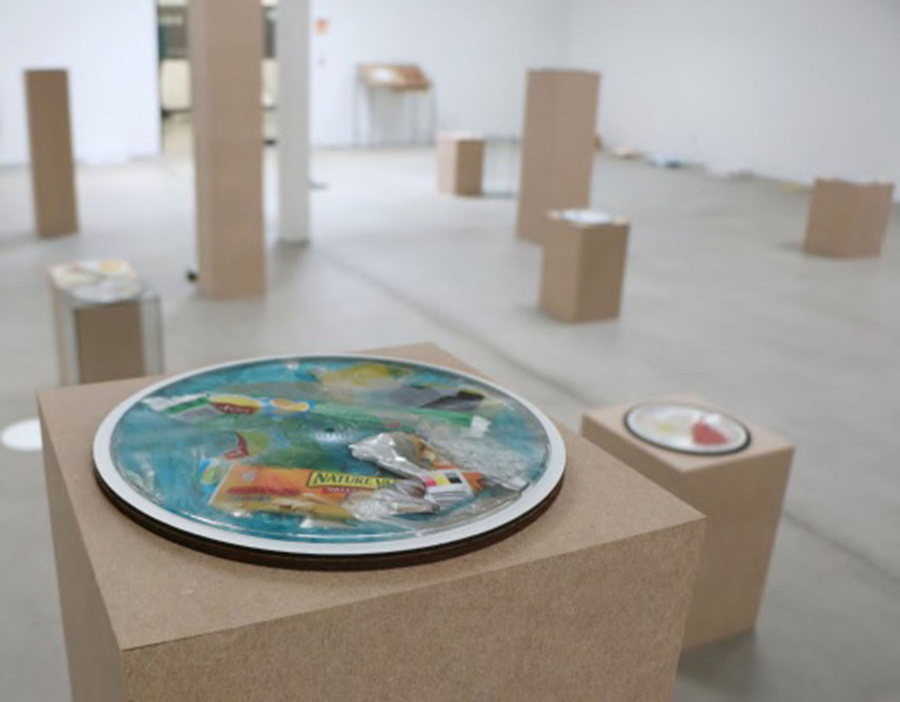
In another project entitled Repetitive Movements (2018),Footnote 26 Brosamer continued to reflect on the planetary circulation and apparent ‘fluidity’ of records. He manually made moulds from a selection of records belonging to 78s collector Andreas Schmauder. He then manually proceeded to re-produce these records using plastic trash found on waterfronts and coastlines around the world, including debris – which he calls ‘samples’ – collected alongside the musically iconic Mississippi river (among the reproduced records, one can find for instance recordings originally made by Louis Armstrong in the Mississippi Delta; Figure 3).
Repetitive Movements, playable handmade Louis Armstrong record with plastic trash from the Mississippi, Sascha Brosamer, 2018. Photocredit: Kerstin Rössner.
It is possible indeed to think with and through the invasive materials of the Anthropocene, as further demonstrated by the British chamber opera Synthetica … A Toxic Enchantment (composed by Karen Wimhurst, 2018), which explores the 20th century's particular ‘love affair’ with plastics, aptly capturing the sonic and visual grain of the Anthropocene – and the ambivalent aesthetic seduction of synthetics.
Conclusion: all passion spent
In the early 1930s, Henry Miller was living and writing in Paris, where he witnessed the slow ascent of fascisms in Europe. The novelist was sensitive to the ways in which radiophonic contents could circulate and potentially permeate the collective unconscious. In a prescient passage of his autobiographical novel Black Spring, he connected the then-ubiquitous ‘Song of Love’Footnote 27 to the war to come:
Out of the little black boxes an unending river of romance in which the crocodiles weep. […] It is this Song of Love which now pours out of millions of little black boxes at the precise chronological moment, so that even our little brothers in the Philippines can hear it. It is this beautiful Song of Love which gives us the strength to build the tallest buildings, to launch the biggest battleships, to span the widest rivers. It is this song which gives us the courage to kill millions of men at once by just pressing a button. This song which gives us the energy to plunder the earth and lay everything bare. (Miller Reference Miller2009[1936], p. 154, my emphasis)
For Miller, the novelty song contains, in miniature, a gigantic and toxic ideology. Rather than a distant anecdote, we may hear in Miller's words a warning and a resonance with the present technological condition. Contemporary technologies of information and communication also bear a heavy energetic and human cost. Despite their claims of presentness and immateriality, these technologies massively contribute to the planet's exhaustion, as meticulously evidenced by the French EcoInfo research group (Berthoud et al. Reference Berthoud2012; Watson and Oswald Reference Watson and Oswald2018). For instance, critical resources such as aluminium, germanium and silicium (used in the manufacture of mobile phones, flat screens, computers and so on) are currently being extracted in China, where open-pit mining poses – among other issues – enormous sanitary threats. Conversely, South Asia is also where Western electronic and plastic waste converges back, often to be burned or buried rather than recycled (Berthoud Reference Berthoud2012, p. 30). As such, there would be scope to critically compare contemporary practices of mineral extraction (and dumping) in South Africa and Asia with the early transnational music industry – and its logic of human and material exploitation.
In this article, I have suggested that the production and consumption of popular music have been wasteful practices from the inception of the recording industry. Although recorded music effectively constitutes a singular form of environmental pollution, to isolate it from other industries would be to miss the point. The development of phonography was inseparably bound with a natural and economic environment, a model of production and a positivistic conception of history as a teleological process. The large-scale issues raised by the ‘Anthropocene’ often seem unsolvable: this is not only because the damage has irreparably occurred (and continues to occur), but because ‘solutions’ – if they were to exist – would realistically involve a total, radical refashioning of the current economic, socio-political and indeed, psychological, model of Western societies (Liboiron Reference Liboiron2014). It follows that we may be mistaken when we assume the shift from ‘solid’, visibly wasteful capitalism to liquid, digital and apparently ‘cleaner’ capitalism marks a positive improvement – or even that capitalism is not always, simultaneously, solid and fluid, both a materially visible force and a more invisible, phantom energy.
There would be other – more positive – directions for waste studies, too, in which the logic of waste could possibly be decoupled from the logic of industrial capitalism. There exists, too, a more complex, embodied and untraceable relationship between musical consumption and waste. People invest in music – at economic, material, but also (and perhaps foremost) psychic and libidinal levels. It may be that musical consumption, in its broader understanding, is simultaneously a matter of affective attachment and dispersion – an expense of socio-psychical energies (Hennion Reference Hennion2007). These energies, although they are less directly measurable, are by no means abstract. What does it actually cost us to consume music? This question would call for another understanding of the notion of excess; a parallel, positive, and creative imagining of waste as the measure and medium of life itself (Bataille Reference Bataille1949).