

Up to 97% of families who have children born with hearing loss have typical hearing themselves (Mitchell & Karchmer, Reference Mitchell and Karchmer2004; Singleton & Tittle, Reference Singleton and Tittle2000). Understandably, the primary concern for a majority of these families is for their children to achieve successful social inclusion into the hearing world using spoken communication (Kushalnagar et al., Reference Kushalnagar, Mathur, Moreland, Napoli, Ostering, Padden and Rathmann2010). Well-established literature, however, suggests that children with hearing loss (HL) have poorer understanding of mind and emotion (theory of mind [ToM]) than their typically developing hearing peers (Meristo et al., Reference Meristo, Falkman, Hjelmquist, Tedoldi, Surian and Siegal2007; Peterson, O’Reilly, & Wellman, Reference Peterson, O’Reilly and Wellman2016; Peterson, Slaughter, & Wellman, Reference Peterson, Slaughter and Wellman2018).
ToM skills are believed to be an essential component of social competence and involve the development of the ability to attribute mental states to oneself and others (e.g., understanding others’ actions, feelings, and intentions; Cowan, Le, & Cohen, Reference Cowan, Le, Cohen, Lewandowski and Moustafa2019). Studies from mother–child interactions in typically hearing children suggest that ToM development is closely linked to children’s language development (de Rosnay & Hughes, Reference de Rosnay and Hughes2006; Hughes & Leekam, Reference Hughes and Leekam2004), with strong indications that language competency facilitates various forms of interactions, such as sharing of viewpoints, connected interactions, and articulation of mental and feeling states (Milligan, Astington, & Dack, Reference Milligan, Astington and Dack2007; Schick, De Villiers, De Villiers, & Hoffmeister, Reference Schick, De Villiers, De Villiers and Hoffmeister2007). The question that then arises is whether the achievement of age-appropriate language skills within the preschool years can assist social skills development for children with HL.
Remarkable advancements in hearing technology (hearing aids, cochlear implants), the refinement of techniques for the development of listening and spoken language as a communication outcome, and the incorporation of universal newborn hearing screening as standard care means that children with all levels of HL can, and frequently do, achieve developmental milestones at the same level as their hearing peers. An increasing number of studies indicate that if children are identified early via universal newborn hearing screening programs, fitted with optimal amplification technology, and entered into specialist listening and spoken language early intervention programs, ideally before 6 months of age, then these children can achieve age-appropriate listening, speech, and language outcomes before 12 months of age (Ching, Dillon, Leigh, & Cupples, Reference Ching, Dillon, Leigh and Cupples2018; Dettman et al., Reference Dettman, Dowell, Choo, Arnott, Abrahams, Davis and Briggs2016; Wolfe, Reference Wolfe2019). Such encouraging results continue throughout childhood, provided children are consistently, optimally amplified and receive careful monitoring with close family guidance/involvement. What is not known is whether the development of these important skills at such an early age is sufficient to support optimal social development and inclusion.
In keeping with the focus on children’s readiness for age-appropriate social engagement, a decision was taken by practitioners implementing The Shepherd Centre’s (TSC) early intervention program for children with HL to investigate whether the gains in language skill, which approximate typical trajectories, carry over into their social skills. TSC, located in New South Wales, Australia, is well established and has a 50-year history of assisting children with all levels of HL, largely by the process of equipping parents with the skills to develop their child’s full potential within the listening and spoken language world. TSC actively promotes best practices for students and families that include diagnosis of HL by 1 month of age, fitting with hearing aids within 1 month of diagnosis, and enrolment in early intervention by 6 months of age, in keeping with the guidelines of the Joint Committee on Infant Hearing (2007).
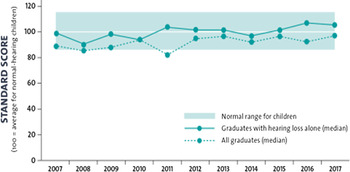
Assessments of children with HL alone graduating from TSC indicated that over a 10-year period, between 2007 and 2017, median language scores fell within the average range (see Figure 1). Impressively, when considering all graduates, which includes children with English as a second language and those with additional needs who were capable of doing a formal assessment, there is only one year where the median language scores dipped below typical ranges (2011). The results presented in Figure 1 are confirmation that the early intervention approach is allowing children with HL to meet age-appropriate milestones in their language development.
The Language Outcomes for Early Intervention Graduating Children With Hearing Loss, 2007–2017.
Note. All graduates include children with English as a second language and those with additional needs who were capable of doing a formal assessment. Language measures for all cohorts used the Preschool Language Scales – Fourth Edition (PLS-4; Zimmerman, Steiner, & Pond, Reference Zimmerman, Steiner and Pond2002) or the Clinical Evaluation of Language Fundamentals Preschool-2 (CELF Preschool-2; Semel, Wiig, & Secord, Reference Semel, Wiig and Secord2004). All language assessments were conducted by experienced listening and spoken language therapists, with a speech pathology background. Total language scores on these assessments combine both receptive and expressive language abilities. These standard scores indicate whether children’s language is in the average, below average, or above average range.

ToM was initially assessed for the early intervention cohort of 4- to 5-year-old children in 2007 and compared with a sample of typically developing hearing children. Using the first four ToM items from Wellman and Liu’s (Reference Wellman and Liu2004) scale, typically developing children (M age = 56 months) had a mean score of 2.72 (/4). However, a small sample (n = 11) of similarly aged children with HL from TSC’s early intervention program (M age = 59 months) had a notable delay, achieving a mean score of 1.36, which was very similar to the performance of younger typically developing children (1.44; M age = 44 months; Palmer, Reference Palmer2007). In view of the close relationship between level of language and ToM development documented in the research literature, a greater focus on improving language development as part of TSC’s early intervention program was instituted between 2007 and 2012. Subsequent to this change, the language scores of graduates of TSC improved from a median standard score of 88 in 2007 to a median of 94.5 in 2012.
With regard to social skills, however, data from 2012 indicated not only a continued delay in ToM acquisition for TSC graduates but also some alternative patterns of ToM development for children with HL (Neal et al., Reference Neal, Hopkins, Davis, Lynch, Fulcher, Abrahams and Hungerford2017). The 2007 and 2012 ToM indicators, as well as informal feedback from families, suggested that although one-to-one educational sessions were effective in improving the speech and language of children with HL, they did not appear to sufficiently impact the development of social skills. To address this issue, TSC staff developed an additional eight-session weekly social skills group program for both children and parents/caregivers, which was administered in the year prior to starting formal schooling. The first of these programs was implemented in 2013. Four years after the implementation of this first social skills program, the ToM skills of TSC’s early intervention graduating children were again assessed and compared with a cohort of typically hearing children.
Purpose of the Research
Given that the considerable, measurable gap in children’s understanding of mind and emotion persisted from 2007 to 2012, it appeared that existing intervention strategies were not sufficiently addressing potential social challenges for young children with HL. Clinicians were interested in determining whether a social skills program designed and implemented by early intervention staff could improve social skills development. Following the introduction of the small-group-based social skills program, ToM data were again collected in 2017 for children with HL and a comparison group of their hearing peers. To more fully understand factors that may be associated with social success, a social persuasion assessment was also introduced in the 2017 assessments battery (Slaughter, Peterson, & Moore, Reference Slaughter, Peterson. and Moore2013). Importantly, the persuasion task has been shown in a one-to-one context to function much like conventional ToM assessments, despite its more obvious contextual relevance for children’s social interactions. An innovation of this study was to also introduce a version of the persuasion task in which two children were simultaneously trying to engage in persuasive strategies, to better mimic contested or busy communicative interactions that children have to navigate in real-world contexts.
The goal of the present study was to investigate two questions:
-
1. Do children with HL participating in the early intervention and the 8-week social skills program prior to school age show equivalent ToM understanding to their hearing counterparts?
-
2. Are there aspects of social understanding skills that may not be captured in a conventional ToM assessment but which have important implications for intervention strategies?
The first question was addressed by simply comparing the performance of children with HL to children without HL on the standard ToM Scale developed by Wellman and Liu (Reference Wellman and Liu2004). To address the second question, we employed two persuasion tasks, one administered one-to-one, which is typical for therapy sessions, and one administered with two children in a group, both coordinating their communicative efforts.
Method
The ToM and persuasion skills of TSC’s early intervention graduates were assessed and compared to a cohort of typically hearing peers. Ethics approval was granted from the University of Wollongong (HREC 2017/254), along with permission from TSC’s research advisory committee. Written consent to participate in the research and for de-identified data to be presented at conferences or published in peer-reviewed journals was provided by the parents of all children included in the research.
Participants, Setting, and Design
Children with HL included in the social skills intervention all attended the same TSC early intervention program. Participants received one-to-one specialist intervention with qualified listening and spoken language therapists and some also attended TSC’s early intervention playgroups. Attendance at the 8-week social skills program post 2012 was additional to these sessions. All clinicians at TSC had received training in the development of ToM and facilitation strategies for the targeted social skills sessions from university specialists and experienced early intervention staff.
As it was not possible to have a waitlist control group of matched children with HL, we were not able to implement a natural experiment design and directly evaluate the impact of the social skills program on children’s ToM understanding. Nevertheless, as noted, it is clinically important to establish whether the development of ToM skills in children with HL is on par with their typically developing counterparts. Therefore, a developmental sample of comparison hearing children (3-, 4-, and 5-year-olds) was used to benchmark the ToM skills of children with HL in the social skills program for both the widely used scaled ToM tasks and the persuasion tasks. This allowed an objective evaluation (using formal comparison of mean scores) of how the children with HL compared to their hearing counterparts.
Children included in the 2017 assessment were 15 children with HL (M age = 59.5 months, SD = 4.67) as well as a sample of comparison typically hearing children. All participants with HL were TSC’s early intervention graduates in 2017. There were 19 TSC graduates. Four had been diagnosed with significant additional needs and could not be assessed, leaving 15 participant graduates. The typically hearing cohort comprised 16 children aged 3 years (M age = 43.6 months, SD = 3.01), 25 children aged 4 years (M age = 55.2 months, SD = 3.08), and 21 children aged 5 years (M age = 62.8 months, SD = 2.04). The children with typical hearing were recruited from preschools in the Illawarra region of New South Wales. The children without HL did not participate in the social skills program.
Measures
Language assessments were routinely completed for all children with HL graduating from TSC’s early intervention program between 2007 and 2017. The Preschool Language Scales – Fourth Edition (PLS-4; Zimmerman, Steiner, & Pond, Reference Zimmerman, Steiner and Pond2002) or the Clinical Evaluation of Language Fundamentals Preschool-2 (CELF Preschool-2; Semel, Wiig, & Secord, Reference Semel, Wiig and Secord2004) were utilised. ToM was assessed for the children with HL in 2007, 2012, and again in 2017 using the ToM Scale devised by Wellman and Liu (Reference Wellman and Liu2004). In 2017, the ToM skills of the children without HL recruited for the research were also assessed by experienced university researchers. Children in the 2017 cohort, those with and without HL, were also assessed using two persuasion tasks based on the procedures described by Slaughter et al. (Reference Slaughter, Peterson. and Moore2013).
Theory of mind assessments (Wellman & Liu, Reference Wellman and Liu2004)
The first four components of the ToM Scale, which had been used in the 2007 and 2012 assessments, were also used in the 2017 assessments. These were Diverse Desires, Diverse Beliefs, Knowledge Access, and False Beliefs. The fifth component, Hidden Emotion, was also used in the 2017 assessment for both children with and without HL.
Persuasion tasks (Slaughter et al., Reference Slaughter, Peterson. and Moore2013)
For a greater understanding of factors associated with social success, a persuasion task was introduced in 2017. This task required children to convince a puppet (held by an adult) to do certain things (e.g., brush his teeth; eat broccoli). The persuasion task has shown a strong relationship with ToM in a range of ages (Peterson et al., Reference Peterson, Slaughter and Wellman2018; Slaughter et al., Reference Slaughter, Peterson. and Moore2013). The aim was to solicit persuasive verbal responses.
The first persuasion task, directly based on Slaughter et al. (Reference Slaughter, Peterson. and Moore2013), was a one-to-one (1:1) condition: one educator/researcher to one child. The researcher would hold a peer-like puppet and the child was then given three opportunities to convince the puppet to complete an action (e.g., to eat some broccoli). The child was not able to physically manipulate or use force on the puppet. Instead, the child was encouraged to ‘speak to the puppet and tell him things’ to make him complete the action. Three persuasion attempts were permitted for each action. The actions were eating broccoli and brushing teeth. Initially, the puppet refused to complete the action (e.g., saying the broccoli was ‘yucky’). The puppet then listened attentively to the next comment but still refused. After a third attempt the puppet complied (e.g., ate the broccoli). All the persuasive attempts were recorded verbatim for scoring, which followed Slaughter et al. (Reference Slaughter, Peterson. and Moore2013; without valence scoring) by awarding children 1 point for each distinctive persuasive argument (e.g., broccoli makes you strong; you can have dessert after if you eat some). Children could obtain ½-point scores for using formulaic politeness modulations. Commands and appeals to complete the action were not given a score. Each distinctive argument could only be scored once.
The second persuasion task was a one-to-two (1:2) condition: one educator/researcher to two children. The same procedure as the 1:1 condition was utilised. In this situation, there was either one researcher with two typically hearing children or one researcher with two children with HL. The children were able to collude to come up with persuasive arguments. The approach to scoring was identical, with the provision that persuasive arguments were scored only once; repetition of the same argument by a second child did not count.
The Social Skills Program
Delays in the social skills development of children with HL in TSC’s early intervention were clinically and anecdotally identified in 2007, and again in 2012, and corresponded with relatively poor performance on the ToM scale. This was observed despite the achievement of improving median language scores over this period. In order to target the persistent delay/variability in outcomes of ToM, TSC initiated an additional eight session, weekly social skills small-group intervention in 2013. The goal was to assist children and parents to cultivate perspective taking and develop communicative skills that support social understanding and cooperation. Groups met once a week for 8 consecutive weeks. A strong parent education component was included. Children aged 4–5 in their final year before early intervention graduation were offered the program. Details relating to the content and planned outcomes of the social skills program are provided as supplementary material.
Experienced clinicians (listening and spoken language therapists, audiologists, and family counsellors) received specialist training in developing social skills goals for this age group. Specific coaching on delivery of the specialised intervention modules was supplied to all clinicians, prior to commencement of the modules, by university researchers and specialist early intervention developers of the program. To assist with fidelity, each child group session (maximum eight participants) was facilitated by two listening and spoken language therapists, one of whom was the experienced trainer. Parent groups met with the family counsellor each week. An experienced paediatric audiologist was available each week to check hearing/device issues and access to sound. Audiologists assisted with one of the eight parent modules. Two guided observation sessions were facilitated by the family counsellor. These sessions provided opportunities for parents to observe and discuss their children in the group via video link.
Results
Theory of Mind Scale
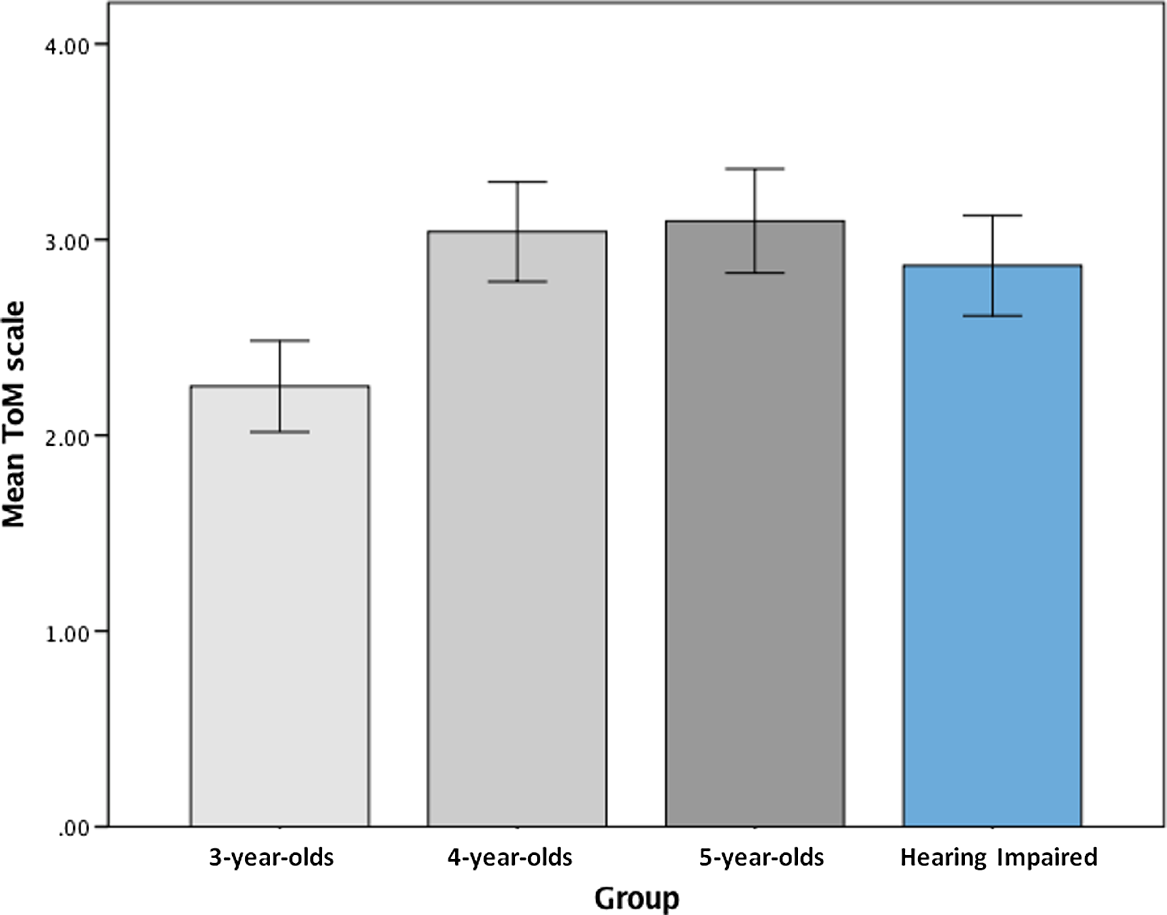
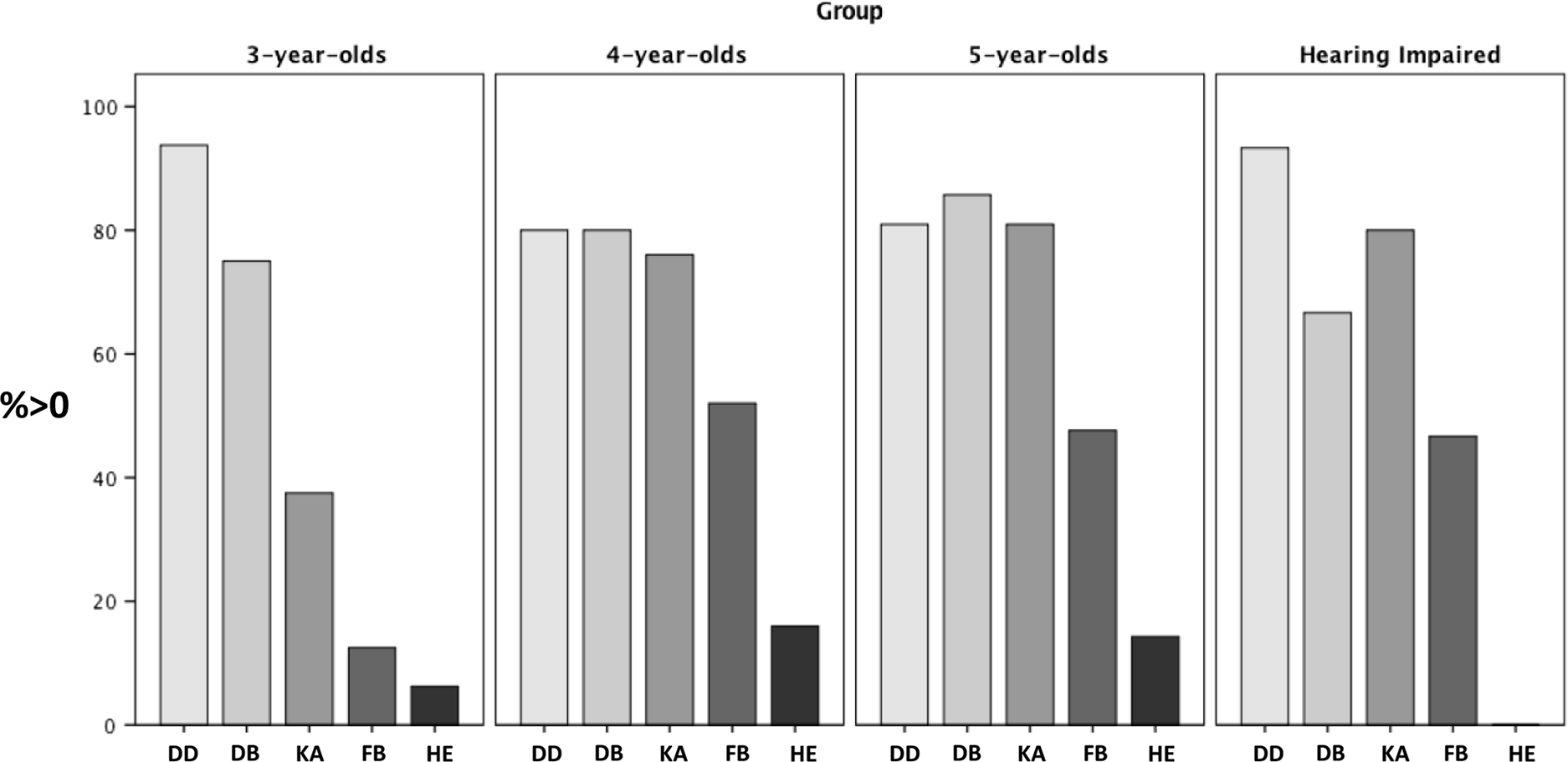
Figure 2 shows the mean score for ToM on the Wellman and Liu (Reference Wellman and Liu2004) scale for hearing children and children with HL. Regarding the hearing children, Figure 2 shows the expected developmental effect between 3 and 4 years of age, but there was no difference between 4- and 5-year-olds. Despite the small sample, a one-way between-subjects ANOVA was conducted to assess relationship between age (3-, 4-, and 5-year-olds) and ToM. Planned contrasts were used to test ToM growth along developmental lines (i.e., 3- vs. 4-year-olds; 4- vs. 5-year-olds). The overall ANOVA was marginally significant, F (2,59) = 2.86, p = .065, and planned contrasts showed that 4-year-olds performed significantly better than 3-year-olds (p = .040), as predicted, but there was no significant difference between 4- and 5-year-olds (p = .875). Although the failure to document a difference between 4- and 5-year-olds is somewhat surprising, the 5-year-olds were young and were recruited from the same preschool settings as the 4-year-olds. To examine whether the sample performed consistently with the wider literature, Figure 3 shows how children performed on the different ToM items and confirms that the sample adhered to the widely reported developmental sequence (Wellman & Liu, Reference Wellman and Liu2004).
Measures of Theory of Mind (/4) Using the Scaled Theory of Mind Assessment 2017.

Theory of Mind Performance on Individual Items 2017.
Note. DD = Diverse Desires; DB = Diverse Beliefs; KA = Knowledge Access; FB = False Beliefs; HE = Hidden Emotions.

A second one-way ANOVA was conducted to examine whether the children with HL differed in their ToM performance from their 4- and 5-year-old typically hearing counterparts. Again, planned contrasts were used but this time to examine how children with HL performed relative to each of the other age groups. The overall ANOVA was not significant, F (3,73) = 2.02, p = .119. Furthermore, planned contrasts showed that ToM performance of children with HL did not differ significantly from typically hearing 4-year-olds (p = .644) or 5-year-olds (p = .556). Despite the parity between hearing children and children with HL, it was notable that none of the children with HL passed the measure of Hidden Emotion, and their performance on the Diverse Beliefs task was also relatively poor (see Figure 3).
Persuasion Tasks
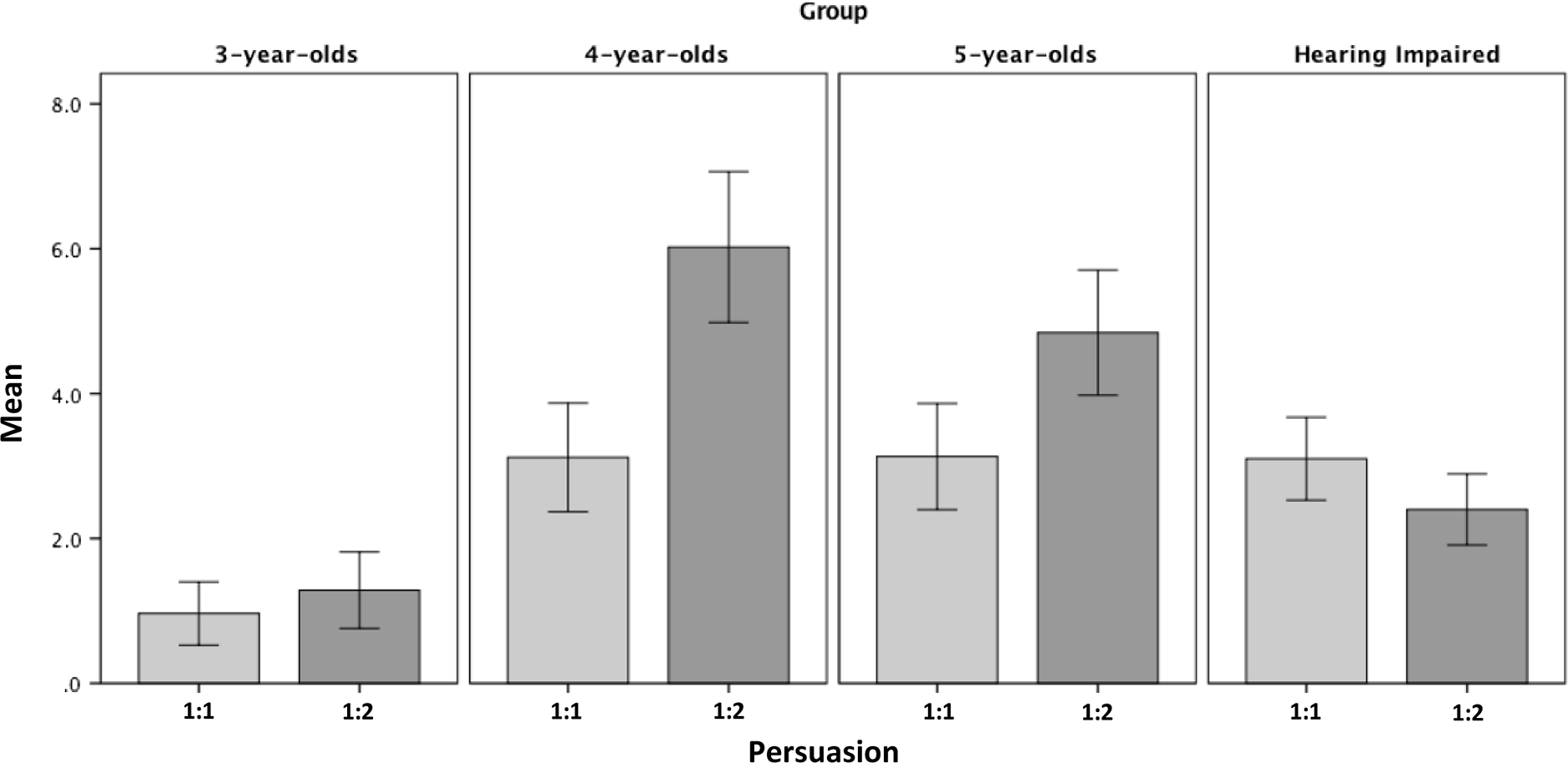
As can be seen in Figure 4, children with HL performed similarly to their typically hearing counterparts of equivalent age on the 1:1 persuasion task, and this pattern of performance very closely mirrored the ToM results. An initial ANOVA was conducted to assess whether there was a developmental effect for the 1:1 persuasion task among typically hearing children. The overall ANOVA was not significant, F (2,59) = 2.14, p = .127, and planned contrasts showed that 4-year-olds performed only marginally better than 3-year-olds (p = .077), although this was in the expected direction. Again, there was no difference between 4- and 5-year-olds. A second one-way between-groups ANOVA was conducted to examine whether the children with HL differed in their performance on the persuasion task from their 4- and 5-year-old counterparts. The overall ANOVA was not significant, F (3,73) = 1.74, p = .166. Again, planned contrasts showed that 1:1 persuasion performance of children with HL did not differ significantly from typically hearing 4-year-olds (p = .812) or 5-year-olds (p = .936).
Mean 1:1 and 1:2 Performance on Persuasion Tasks.

Finally, we examined how the modified social context of the 1:2 persuasion task affected the performance of children with HL compared with typically hearing children. Inspection of Figure 4 shows that, when compared to 3-year-olds, there was a marked improvement in 1:2 persuasion performance for 4- and 5-year-olds. This improvement, however, did not seem to translate to children with HL. As before, a one-way between-subjects ANOVA was first conducted to assess relationship between age (3-, 4-, and 5-year-olds) and 1:2 persuasion performance in hearing children using planned contrasts along developmental lines. The overall ANOVA was significant, F (2,51) = 6.52, p = .003, and planned contrasts showed that 4-year-olds performed significantly better than 3-year-olds (p = .002), but there was no significant difference between 4- and 5-year-olds (p = .602).
A second one-way between-groups ANOVA was conducted to examine whether the children with HL differed in their performance on the persuasion task from their 4- and 5-year-old typically hearing counterparts. The overall ANOVA was significant, F (3,65) = 6.42, p = .001. Planned contrasts showed that 1:2 persuasion performance of children with HL was significantly poorer than typically hearing 4-year-olds (p = .003) and 5-year-olds (p = .050). Interestingly, the performance of children with HL did not differ significantly from 3-year-olds (p = .400).
Discussion
The goal of the present study was to investigate whether children with HL participating in TSC’s early intervention and the 8-week social skills program in the year prior to school show equivalent social understanding (ToM) to their hearing counterparts, and to explore whether there are aspects of social understanding skills that may not be captured in a conventional ToM assessment but which nonetheless have important implications for intervention strategies in the future.
For over a decade, median score data from TSC’s program for children with HL consistently indicated that graduates aged 4–5 years were able to achieve receptive and spoken language scores equivalent to their hearing peers. This is noteworthy as approximately 30% of the early intervention graduates had diagnosed needs in addition to HL. TSC supports children with HL and their families using the 1-3-6 principles of the Joint Committee on Infant Hearing (2007): diagnosis of hearing loss by 1 month of age, fitting with hearing aids within 3 months, and enrolment in early intervention by 6 months of age. The language data from TSC suggests that many of the challenges to acquiring age-appropriate language skills can be overcome by early diagnosis and the consistent utilisation of advances in amplification technologies from an early age, accompanied by the provision of specialist listening and spoken language therapy.
By contrast, ToM assessment data collected in 2007 and 2012 on children in the early intervention program indicated that, despite having adequate language skills, graduate children were likely to have a delay and perform unusually on the ToM scale, which could impact social cognition development. A possible explanation for this discrepancy has been provided by the research of Kronenberger (Reference Kronenberger2019) and Hall, Eigsti, Bortfeld, and Lillo-Martin (Reference Hall, Eigsti, Bortfeld and Lillo-Martin2018), which suggests that language processing is more effortful and less automatic for children with HL than for typically hearing children. These researchers propose that challenges in speech perception in noisy listening environments accompanied by the consequently reduced experience with spoken language in early development requires children with HL to put in more work (focus and concentration) when using spoken language, leaving less energy for other areas of learning, such as understanding others’ points of view, which is captured in significant ways on the scaling ToM assessment.
The 2007 and 2012 responses indicated that the achievement of typical ToM development was problematic for TSC’s graduates. Because of the acknowledged relationship between ToM acquisition and successful social inclusion (Fink, Begeer, Hunt, & de Rosnay, Reference Fink, Begeer, Hunt and de Rosnay2014; Fink, Begeer, Peterson, Slaughter, & de Rosnay, Reference Fink, Begeer, Peterson, Slaughter and de Rosnay2015), a social skills program was rolled out to address the issue. Impetus for developing and delivering this social skills program was further indicated by parent feedback, which suggested that even though the majority of children achieved encouraging spoken language results, some still did not appear to have attained social competence/success.
What Effect Might Participation in a Social Skills Program Have on the Measure of Theory of Mind in Preschool Children With Hearing Loss?
In 2017, a cohort of children with HL who had participated in TSC’s social skills program, and a comparison group of typically hearing children, were assessed using scaled ToM (Wellman & Liu, Reference Wellman and Liu2004) assessments. Data from these assessments indicated that age-appropriate results were achieved by the children with HL in standard assessments of ToM and that these results were in line with age-matched children with typical hearing. This contrasts with the performance of children in the 2007 and 2012 cohorts with HL. There were, however, some discrepancies between children with HL in 2017 and their same-age peers on some of the individual tasks included in the assessment.
It is frequently documented that the majority of children follow age-related, sequential development of ToM and that the skills related to understanding hidden emotions are the last level of ToM development within the scale (Conte, Ornaghi, Grazzani, Pepe, & Cavioni, Reference Conte, Ornaghi, Grazzani, Pepe and Cavioni2019; Peterson et al., Reference Peterson, O’Reilly and Wellman2016). This is similarly reflected in Figure 4, where the hidden emotion step, namely, the realisation that an individual can feel one emotion yet display another and that emotions can be hidden for social benefit, was the lowest scoring and latest developing ToM stage for all typically hearing children. No children with HL, however, passed this item. Understanding hidden emotions arguably requires additional higher level paralinguistic social skills, including understanding the effect of elements such as body language, tone, pitch, sarcasm. These additional aspects of social development received limited attention in the social skills groups, which may help to explain poorer scores in these tasks. Alternatively, restricted access to the interactions that develop such skills may be stubbornly persistent for children with HL and more difficult to shift via short, focused interventions. This remains an important question of clinical significance. It was also noteworthy that children with HL seemed to struggle more than their typically hearing counterparts with the Diverse Desires item in the ToM scaling task. It is not immediately clear why this should be the case, and it may warrant closer attention if the same finding emerges in other samples.
Other studies indicate that reaching mature ToM levels requires a higher developed ability to recognise, discriminate, and label emotions (de Rosnay, Pons, Harris, & Morrell, Reference de Rosnay, Pons, Harris and Morrell2004; Grazzani, Ornaghi, Agliati, Brazzelli, & Lucarelli, Reference Grazzani, Ornaghi, Agliati, Brazzelli, Lucarelli, Veneziano and Nicolopoulou2019). Pertinent to these findings, it has been found that a focus on conversations about mental states in preschool children can have a positive effect on the development of emotion knowledge and ToM skills. A greater focus on these aspects of social cognition development may also assist in the achievement of more age-appropriate ToM skills in all categories for children with HL.
In keeping with the possibility that children with HL may continue to experience restricted access to social interactions is the probability that increased listening effort is required for children with HL, resulting in less attention to the details of more complex interactions that require, for example, the coordination of knowledge states and emotional states, such as hidden emotions (Peelle, Reference Peelle2018). Increased focus on comprehension may also leave fewer cognitive resources to read social cues, take another’s perspectives, and be socially flexible (Wingfield & Peelle, Reference Wingfield and Peelle2015). Within this view, it is not that children with HL lack skills to understand another’s perspective, but they cannot use and refine these skills to the same extent as children with typical hearing because of the resources needed to navigate complex social interactions and comprehend spoken language (Pichora-Fuller et al., Reference Pichora-Fuller, Kramer, Eckert, Edwards, Hornsby, Humes and Wingfield2016).
When we compare our observations of children in TSC in 2007 and 2012 with the ToM data achieved by the 2017 cohort, the conclusion that the social skills intervention is assisting children to develop their ToM is supported. However, given the sample size and the use of historical comparisons with children with HL who did not receive the social skills intervention, these findings should be interpreted with caution. Even so, the 2017 data may give some indication that different patterns of ToM acquisition persist, even with intensive and targeted social cognition intervention.
Are There Important Aspects of Social Skills That Might Not Be Captured in an Assessment of Theory of Mind?
Data from the inclusion of the measures of persuasion indicated that, similar to the findings of Peterson et al. (Reference Peterson, Slaughter and Wellman2018), typically hearing children demonstrated increasingly high levels of rich persuasive language as age increased. In the current study, data also indicated that the typically hearing children increasingly benefitted from the dynamic of working with a peer when developing persuasive arguments addressed to an adult. Children with HL, on the other hand, appear to be negatively affected by the presence of another peer with HL while performing similarly to children with typical hearing in a one-to-one interaction.
These findings suggest that the introduction of a social dynamic is a critical factor in the performance of the children with HL, but they do not tell us why. The poor performance of children with HL in the one adult/two children with HL situation may indicate that greater attention needs to be paid to active peer-to-peer problem-solving experiences within the social skills groups versus traditional listening and spoken language therapy, which typically predominantly involves adult–child interactions. It would also be interesting to explore whether there may be a positive impact of having the 1:2 dynamic of one child with HL and one child with typical hearing working with one adult. Further potential reasons for the difficulties experienced by children with HL in a peer-to-peer context need to be explored in order to develop potential intervention strategies.
Dean Rusk, former United States secretary of state, stated in 2014, ‘The best way to persuade people is with your ears — by listening to them’ (Inspiring Quotes, 2014). Given the technology available to children with HL in Australia, as evidenced by the provision of hearing aids within weeks of birth and the possibility of bilateral cochlear implants by 6 months of age, children with HL are indeed able to ‘hear’. They and their caregivers may, however, require further coaching/exposure on how to actively and empathetically ‘listen’ and communicate.
Implications for Practice
The skill of developing listening empathically and proactively appears to need further focused attention, and probably from even younger ages. Current research indicates that children who have been optimally amplified at an earlier age (e.g., those who receive bilateral cochlear implants at less than 12 months of age) who also attend specialist listening and spoken language programs can demonstrate age-appropriate social conversation skills, particularly when caregivers/teachers are guided to maximise active participation in conversational interactions (Guerzoni et al., Reference Guerzoni, Murri, Fabrizi, Nicastri, Mancini and Cuda2016). Including even younger infants in the 12–36-month age group in local mainstream early childhood education and care centres may offer opportunities to encourage listening to peers preferably within groups of hearing children. In this way, typical language/speaking/social interaction models can be directly experienced. Exposure/inclusion of infants with HL with their hearing peers from very early years may then facilitate the incorporation of socially significant developmental milestones.
In order to optimise social interactions and indeed impact on multiple positive life outcomes, Yoshinaga-Itano, Sedey, Mason, Wiggin, and Chung’s (Reference Yoshinaga-Itano, Sedey, Mason, Wiggin and Chung2020) research indicates the need to expand the 1-3-6 criteria for best practice for children with HL. The inclusion of a greater quantity of parent talk particularly within the preschool years is proposed. Moeller, Tomblin, Yoshinaga-Itano, Connor, and Jerger (Reference Moeller, Tomblin, Yoshinaga-Itano, Connor and Jerger2007) broaden these recommendations by advising exposure not only to a greater quantity of language but also to a greater quality of language. Use of abundant mental state language is proposed, whereby conversation includes language that contains higher level thoughts, such as ‘I wonder what might happen if …’; ‘Maybe we could try …’; ‘How do you think he might feel?’; ‘What could we do next?…’. These experiences foster opportunities to recognise and discuss emotions, as well as to discuss inner states. Interventions such as these have been shown to have positive long-term effects on peer relationships, popularity with peers, school readiness, and general life adjustment (Brock, Kim, Kelly, Mashburn, & Grissmer, Reference Brock, Kim, Kelly, Mashburn and Grissmer2019; Imuta, Henry, Slaughter, Selcuk, & Ruffman, Reference Imuta, Henry, Slaughter, Selcuk and Ruffman2016).
In a similar vein, data from Morgan et al. (Reference Morgan, Meristo, Mann, Hjelmquist, Surian and Siegal2014) indicate that mothers of typically hearing children not only use more ‘quality’ cognitive mental state language with their infants than mothers of children with HL but they also employ more communicatively effective turn-taking episodes within their interactions. If data suggest these aspects of interaction are crucial for later social-cognitive development, then coaching in these techniques during early childhood parent–child groups is indicated.
Young children require growth-promoting environments that can provide scaffolding to assist with the practice of skills before they need to perform them alone. Our data indicate that traditional specialist listening and spoken language therapy can successfully promote the development of age-appropriate linguistic and speech skills. However, this definition and traditional assessment of ‘language skills’ appears to be too narrow. In order to foster greater social competence, the social skills group situations need also to incorporate, for example, an increased focus on paralinguistic skills, namely, the aspects of spoken communication that do not involve words. The interpretation of body language, gestures, facial expressions, tone, and pitch of voice may all require attention and practice within small groups as paralinguistic features of language can change messages completely. Whether these skills can be taught directly through instruction or whether they need to be learned through facilitative activities over time is a question that will need careful attention to optimise outcomes for children.
Building executive function skills (ability to focus, change plans/thoughts in light of new information, resist making hasty judgemental decisions, etc.) is another skill essential for social success (Center on the Developing Child, 2020). Adults can facilitate the development of a child’s executive function/social skills by establishing routines, modelling social behaviour, and creating and maintaining supportive, reliable relationships. Programs that train teachers to model and coach children/families in early preschool years at the time when social-emotional skills are developing would seem appropriate. The focus for modelling and coaching could include (a) problem-solving, (b) understanding and expressing emotions, (c) controlling impulsive behaviour, (d) developing goal-directed behaviours, (e) practice in negotiation/justification of choices (Diamond & Ling, Reference Diamond and Ling2016), and (f) ability to change strategy (Burgess, Reference Burgess and Rabbitt1997) or to shift perspective (Foppolo, Guasti, & Chierchia, Reference Foppolo, Guasti and Chierchia2012; Gopnik & Rosati, Reference Gopnik and Rosati2001). Our data further indicate that coaching within peer-to-peer dyads may facilitate social cognition development beyond ToM skills.
Currently, TSC runs social skills programs across three age groups — 4–5 years of age, 6–8 years of age, and 9–12 years of age — but it may be that the optimal impact is achieved by commencing at even younger ages. A social skills program for the 12–36-month age group aimed particularly at assisting parents understand the importance and practicalities of social skills development was piloted in early 2020. After positive feedback from clinicians and parents, this program is currently being rolled out across three early intervention centres. As part of this program, simple everyday strategies are elaborated. Activities include encouraging joint attention and providing rich quality language commentaries and conversation to develop basic empathic and communicative principles. Singing together, following a child’s lead in play, and then developing further shared experiences are also included as potential social skill enhancers.
Auditory exposure (stimulation) and practice (repeated exposure in meaningful contexts) are needed by the brain in order to forge strong neural connections and to sustain those connections (Flexer, Reference Flexer2011; Glick & Sharma, Reference Glick and Sharma2017). Early sensory listening experiences form the foundation of cognitive and linguistic development (Dettman et al., Reference Dettman, Dowell, Choo, Arnott, Abrahams, Davis and Briggs2016). Practice from early ages allows the brain to rely less on the prefrontal cortex and move to other brain regions where long-term patterns (automatic) are held (Diamond & Ling, Reference Diamond and Ling2016). It is proposed that children with HL in particular require support in interpretation of emotional states and signals in their early years using embellished language in order to have a better, more automatic capacity to develop social competence (Spinelli, Fasolo, Shah, Genovese & Aureli, Reference Spinelli, Fasolo, Shah, Genovese and Aureli2018).
Further support for even earlier social interventions comes from Perry (Reference Perry2001) who states, ‘first [relationships determine] the biological and emotional “template” for all future relationships. … Timing is everything’ (p. 3). During the first 3 years of life, the human brain goes through critical development. This development is considered to be responsible for all future emotional, behavioural, social, and physiological functioning for the rest of life (Center on the Developing Child, 2007; Knudsen, Reference Knudsen2004). It is also important for children to exercise their developing skills through activities that foster creative play and social connection and, over time, to provide opportunities for directing their own actions with decreasing adult supervision. It is proposed that coaching parents of infant children with HL about the integration of practical executive function skills and other pragmatic cognitive skills can enhance social interaction. These strategies may be more effective than asking caregivers to set aside more time to do specific one-to-one tasks as is offered in traditional individual therapy.
Limitations and Future Research
Limitations of concern in this present study include the restricted participant numbers and heterogeneity of participants. Using historical data for comparison is also a limitation. However, in practice, random assignment to social skills and control groups presents ethical difficulties. For this reason, the research must be considered to be confirmatory (i.e., monitoring the social-cognitive skills of children in the program) and exploratory (i.e., investigating domains in which children are still struggling using formal assessment methods). Although it is encouraging that some participants had additional needs to their HL and still managed to achieve typical language/ToM scores, it would be beneficial to separate out the various cohorts to provide more specific targeted support. More precise control of study cohorts with regard to age of diagnosis, fitting of optimal amplification devices, and levels of family participation in the therapy would provide support for stronger recommendations.
ToM is, of course, only one measure of social skill competence. The persuasion task used in this study identified other areas of development that require further investigation into the use of language in a social context with a peer-to-peer dynamic of children with HL working together. Further investigations that explore a broader range of aspects of social skills development are recommended.
Conclusion
TSC’s social intervention programs in this study have done much to understand and implement practices aimed at optimal outcomes for children with HL. The introduction of a specific social skills program in the preschool years brought about positive improvements in ToM skills. However, participating in persuasion skills tasks indicated there are additional areas of assistance that require further investigation for young children with HL. In 1969, Weinstein and Beckhouse claimed that the specific skill of persuasion ‘is as essential to participating in society as the skills enabling people to get others to think, feel or do what they want them to’ (p. 537). In this vein, these findings add considerably to the few studies addressing the development of essential social skills for children with HL. Future studies can determine whether similar social intervention programs for children of a younger age with a greater emphasis on abundant quality language conversations can set the children on a positive social path. Social skills groups that have a wider focus on paralinguistics and peer-to-peer conversations/problem-solving may also provide further benefits.
Supplementary material
To view the supplementary material referred to in this article, please visit https://doi.org/10.1017/jsi.2021.12
Acknowledgements
This paper has been established and funded through The Shepherd Centre Early Intervention Program for Children with Hearing Loss and their Families. The Shepherd Centre is member of the Australian Hearing Hub, an initiative of Macquarie University that brings together Australia’s leading hearing and healthcare organisations to collaborate on research projects.