Introduction
Lesbian, gay, bisexual and queer (LGBQ) women (hereon sexual minority women) living in the UK experience worse health than their heterosexual peers throughout their lives. During the early lifecourse, young sexual minority women are more likely than young heterosexual women to smoke (Hagger-Johnson et al., Reference Hagger-Johnson, Taibjee, Semlyen, Fitchie, Fish, Meads and Varney2013). During adulthood they are at increased risk of being overweight or obese (Semlyen et al., Reference Semlyen, Curtis and Varney2020), and are more likely to have poor mental health (King et al., Reference King, McKeown, Warner, Ramsay, Johnson, Cort, Wright, Blizard and Davidson2003; King and Nazareth, Reference King and Nazareth2006; Elliott et al., Reference Elliott, Kanouse, Burkhart, Abel, Lyratzopoulos, Beckett, Schuster and Roland2014; Semlyen et al., Reference Semlyen, King, Varney and Hagger-Johnson2016), misuse alcohol (King et al., Reference King, McKeown, Warner, Ramsay, Johnson, Cort, Wright, Blizard and Davidson2003; King and Nazareth, Reference King and Nazareth2006; Mercer et al., Reference Mercer, Bailey, Johnson, Erens, Wellings, Fenton and Copas2007; Shahab et al., Reference Shahab, Brown, Hagger-Johnson, Michie, Semlyen, West and Meads2017), smoke (King and Nazareth, Reference King and Nazareth2006; Mercer et al., Reference Mercer, Bailey, Johnson, Erens, Wellings, Fenton and Copas2007; Shahab et al., Reference Shahab, Brown, Hagger-Johnson, Michie, Semlyen, West and Meads2017) and report poorer self-rated health (Elliott et al., Reference Elliott, Kanouse, Burkhart, Abel, Lyratzopoulos, Beckett, Schuster and Roland2014). Much less is known about health inequalities and their underlying social determinants in the later stages of the lifecourse. A non-probability-based online survey of sexual minority people over the age of 55 showed that older sexual minority women in the United Kingdom (UK) drink alcohol more often than older heterosexual women (Guasp, Reference Guasp2011), but information on inequalities among older sexual minority women across other health and social outcomes, and/or from population-based studies, is lacking. This is a concerning knowledge gap because population-based health statistics play a key role in informing the prioritisation of public health and social care investment, and information on the existence of inequalities in health and social indicators across sexual orientation groups provides an important baseline to identify and address unfair and unjust inequities. At stake are successful health and social care promotion initiatives targeted at sexual minority women; studies have highlighted the need for a pro-active agenda for sexual minority women's health which addresses the creation of systemic institutional change to improve the health and social conditions of sexual minority women, and the care they receive (Fish and Anthony, Reference Fish and Anthony2005), and all of these actions need to be evidence-based.
In addition to the limited availability of suitable data, a related culprit behind the lack of information on health inequalities among older sexual minority women is the ‘invisibility’ of this population in the fields of epidemiology, sociology and gerontology (Traies, Reference Traies2015). As argued by Kehoe (Reference Kehoe1986) and Deevey (Reference Deevey1990), older sexual minority women embody, at the very least, three intersecting systems of oppression (sexism, heterosexism and ageism) that result in their marginalisation, disempowerment, and subsequent exclusion from academic and policy discourses. The invisibility of older sexual minority women is further exacerbated by their own active hiding (Traies, Reference Traies2016). The fact that so many older sexual minority women are still wholly or partially ‘in the closet’ is often given as the reason why so little research into this group exists and why gay men are still more likely to be the subject of non-heterosexual ageing research (Traies, Reference Traies2016).
A related limitation present in UK gerontology is the omission from analyses of individuals who select ‘prefer not to say’ as a response category when asked about their sexual orientation. Studies in the United States of America (USA) show that concealment and non-disclosure of sexual orientation may contribute to poorer mental health (Meyer, Reference Meyer2003; Pachankis, Reference Pachankis2007; Hatzenbuehler, Reference Hatzenbuehler2009) and greater internalised homophobia (Lewis et al., Reference Lewis, Derlega, Griffin and Krowinski2003; Wright and Perry, Reference Wright and Perry2006), which reflects dominant discourses about sexual minority identity that position coming out of the closet as positive and healthy, and staying in the closet as harmful (McLean, Reference McLean2007). Learning more about the health and social circumstances of this group of older women who prefer not to disclose their sexuality is important in order to understand the health of all women who self-report a sexual identity other than heterosexual.
Although there is a growing body of quantitative research examining the life experiences and health conditions of older sexual minority women in North America, there has been a comparatively much smaller quantitative research exercise in the UK. The current cohorts of UK older sexual minority women have lived through highly sexist, heterosexist and homophobic historical and social contexts, and it is important to understand, at a population level, how these multiple systems of oppressions that older sexual minority women have lived through intersect, and how they are embodied in their health and ageing processes in older life. The present study aims to address these gaps in the literature by examining inequalities in the health and social circumstances of UK sexual minority women aged 50 and older, compared to heterosexual women of the same age, using a nationally representative survey.
Conceptual framework
This study is situated within a conceptual framework which draws from the lifecourse theory (Elder, Reference Elder1994; Dannefer, Reference Dannefer2003), the Health Equity Promotion Model (Fredriksen-Goldsen et al., Reference Fredriksen-Goldsen, Simoni, Kim, Lehavot, Walters, Yang and Hoy-Ellis2014) and intersectionality theory (Crenshaw, Reference Crenshaw1993; McCall, Reference McCall2005; Bowleg, Reference Bowleg2012). It considers the impact on health of the lifecourse accumulation of experiences of otherness, exclusion and marginalisation at the intersection of age, sex and sexuality, while recognising the positive and health-protective effects found in the lives of older sexual minority women. According to a lifecourse perspective that captures the influence of social structures and historical conditions on health (Elder, Reference Elder1994), the socio-historical context that older sexual minority women have lived through is key to understanding their current health, ageing processes and social circumstances. People born in different time periods and socio-historical contexts live their lives being exposed to different barriers, opportunities and oppressions (Elder, Reference Elder1994). This interplay of human lives and historical times is particularly relevant to understanding the health and socio-economic circumstances of older sexual minority women who have lived their formative and mid-life years through a significant history of oppression due to, at least, their gender and sexuality. Women born before 1970, the birth years of people aged 50 and older in 2019, have been subject to political exclusion throughout their lives, including lack of legal employment protections in the workplace, same-sex marriage rights, and other challenges related to overt structural and interpersonal discrimination. Although female homosexuality has never been criminalised in England, it was socially considered as morally wrong (Traies, Reference Traies2016), and it was officially classified as a mental disorder by the World Health Organization until 1990 (Cochran et al., Reference Cochran, Drescher, Kismödi, Giami, García-Moreno, Atalla, Marais, Meloni Vieira and Reed2014). Parallel to the narrative of pride and liberation that emerged from the Stonewall Riots in 1969 and the formation of the UK Gay Liberation Front in 1970, experiences of discrimination and oppression of gay and lesbian populations continued through structural and individual actions. This included, for example, legislation under Section 28 of the Local Government Act of 1988 introduced by the Conservative Government led by Margaret Thatcher, that prevented local councils from funding any materials and activities that ‘promoted homosexuality’ or the discussion of lesbian, gay, bisexual or transgender (LGBT) issues (Greenland and Nunney, Reference Greenland and Nunney2008). Section 28 was repealed in 2003, and more recent legislation ensures the protection of lesbian, gay and bisexual citizens. However, experiences of marginalisation and discrimination in the UK are still rife; the recent UK National LGBT Survey shows that over two-thirds of all sexual minority respondents avoid being open about their sexual orientation for fear of a negative reaction, and 40 per cent of respondents have experienced an incident in the past year because of their sexual orientation (Government Equalities Office, 2018).
In this historical and current social context, older sexual minority women have experienced multiple interlocking systems of oppression (Collins, Reference Collins2000) that have shaped their current health and ageing outcomes. Experiences of discrimination and oppression are associated with mental health problems among LGBQ populations (Meyer, Reference Meyer2003), and several US studies document the poorer physical and mental health of older sexual minority women when compared to their heterosexual counterparts (Addis et al., Reference Addis, Davies, Greene, MacBride-Stewart and Shepherd2009; Fredriksen-Goldsen et al., Reference Fredriksen-Goldsen, Kim, Barkan, Muraco and Hoy-Ellis2013; Seelman, Reference Seelman2019). Although these associations have not been formally examined in quantitative, population-based health studies in the UK, one would expect that the multiple lifecourse exposure to experiences of otherness, marginalisation and exclusion experienced by older sexual minority women will be reflected in health and socio-economic inequalities when compared to older heterosexual women.
Although the exposure to social injustices over the lifecourse is hypothesised to result in differential embodiment of ageing processes among UK older sexual minority women when compared to their heterosexual counterparts, it is important to also take into account the positive and health-protecting resources that sexual minority women have access to when examining their health and ageing processes. As argued in the Health Equity Promotion Model (Fredriksen-Goldsen et al., Reference Fredriksen-Goldsen, Simoni, Kim, Lehavot, Walters, Yang and Hoy-Ellis2014), considering only a deficit-driven model to explain the health and ageing of sexual minority older populations disregards their social and emotional resources, which may buffer against the detrimental effects of marginalisation and exclusion. This study is therefore also framed around a narrative of celebration, agency and autonomy (King, Reference King2016), which acknowledges the role of the socio-emotional resources of older sexual minority women in their reaching later life with greater resilience, more self-reliance and stronger social networks than older heterosexual women (Fredriksen-Goldsen et al., Reference Fredriksen-Goldsen, Simoni, Kim, Lehavot, Walters, Yang and Hoy-Ellis2014; King, Reference King2016). This means that, as has indeed been found in some US studies (Deevey, Reference Deevey1990; de Vries and Hoctel, Reference de Vries, Hoctel, Teunis N and Herdt G2006; Gonzales and Henning-Smith, Reference Gonzales and Henning-Smith2015; McParland and Camic, Reference McParland and Camic2016; Seelman, Reference Seelman2019), older sexual minority women may show an advantage in terms of psycho-social indicators when compared to older heterosexual women.
Study aims
This study aims to ascertain whether, and to what extent, there are health inequalities across sexual orientation groups in the UK by analysing population-level data on the physical and mental health of older sexual minority and heterosexual women. Given the importance of understanding the mechanisms behind health inequalities, the present study also examines the underlying social inequalities to identify key social determinants of the health of older women across sexual orientation.
Design and methods
This study uses data from the UK Household Longitudinal Study (UKHLS, also known as Understanding Society), a longitudinal household panel survey of approximately 40,000 households (University of Essex, Institute for Social and Economic Research, NatCen Social Research and Kantar Public, 2018). The UKHLS provides longitudinal data on factors such as health, education, income and social life (Knies, Reference Knies2014). For each wave, responses were collected over a 24-month period with face-to-face and self-completion computer-aided personal interviews. The first wave of the survey was carried out in 2009–2010. This study uses complete data from women aged 50 and older who were active in Waves 3 (2011–2012) and 7 (2015–2016) (N = 8,209).
Sexual orientation
Data on sexual orientation were obtained from adult respondents (aged 22 and older) in Wave 3 with the following question: ‘Which of the following options best describes how you think of yourself?’ Response categories were: heterosexual or straight; gay or lesbian; bisexual; other; prefer not to say; don't know; and refused. Sexual minority women were identified as those who reported a sexuality other than heterosexual or straight (i.e. gay or lesbian, bisexual, other). A separate category identifies women who chose ‘prefer not to say’. Estimates for responses to ‘don't know’ and ‘refused’ categories are not included in the analyses due to very small cell sizes.
Outcomes
Four measures were used to assess the health and health behaviours of older women: mental health, physical functioning, overall self-rated health and harmful alcohol consumption. All health outcomes were collected in Wave 7.
Mental health was assessed with the 12-Item Short-Form Health Survey Mental Component Summary (SF-12 MCS), a measure of non-specific psychological distress that consists of 12 questions relating to the respondent's self-reported general health, health limitations, emotional problems, pain and feelings of depression, and how they interfere with social activities (Ware et al., Reference Ware, Kosinski and Keller1996). Physical functioning was measured with the 12-Item Short-Form Physical Health Composite Scale (SF-12 PCS). The SF-12 PCS assesses an individual's self-reported, overall perceived physical functioning and physical health (Ware et al., Reference Ware, Kosinski and Keller1996). SF-12 MCS and SF-12 PCS scores range from 0 (low functioning) to 100 (high functioning), with higher values indicating better mental and physical health. Both scales use norm-based scoring to have a mean of 50 and a standard deviation of 10.
Overall self-rated health was measured with a question that asked respondents to rate their health into five response categories ranging from excellent to poor. Response categories were dichotomised into ‘good, very good or excellent’ and ‘fair or poor’ general health.
The AUDIT-C (the three-item version of the Alcohol Use Disorders Identification Test), an alcohol screen that identifies people who are hazardous drinkers or have active alcohol use disorders (Bush et al., Reference Bush, Kivlahan, McDonell, Fihn and Bradley1998), was used to measure harmful alcohol use. The AUDIT-C is scored on a scale of 0–12, where scores of 0 reflect no alcohol use. In women, a score of 3 or more is considered positive, and in this analysis this cut-off was used to assess harmful alcohol drinking.
Covariates
Factors thought to be associated with health and sexual orientation were considered in analytical models. These include marital status (single; married, partnered or co-habiting; divorced, widowed or separated), highest educational qualification (degree or above; O-level, A-level or equivalent; other qualification; no qualification), monthly income, economic activity (in employment; unemployed; retired; other), socio-economic position of last job following the National Statistics Socio-economic Classification (NS-SEC) classification (management and professional; intermediate; small employers and own account; lower supervisory and technical; semi-routine and routine; unemployed) and place of residence (urban area; rural area). All covariates were collected in Wave 7.
Age was included as a continuous variable, and includes participants who were 50 years of age and older at time of interview. Models also control for age squared to account for potential non-linear age effects. Gerontological research often distinguishes between the ‘young-old’ (50–64 years), the ‘old’ (65–74 years) and the ‘old-old’ (75+ years). Although there are differences in the ways these three groups will have experienced power relations and systems of oppression due to their gender and sexual orientation, the small sample sizes in the UKHLS precludes any disaggregation into these categories for meaningful analytical purposes.
Statistical analysis
Bivariate analyses examined health outcomes and explanatory factors by sexual orientation to provide descriptive statistics on the health and socio-economic inequalities of older women. Regression analyses explored the association between sexual orientation and the four measures of health (mental health, physical health, general self-rated health and harmful alcohol use). Models were built sequentially in order to explore the contribution of socio-economic factors to health inequalities among sexual minority older women. The baseline model (Model 1) examined the unadjusted association between the different health outcomes and sexual orientation. Model 2 examined health inequalities across sexual orientation adjusted for age and aged squared. Model 3 further adjusted for marital status and area of residence, and the final model (Model 4) additionally adjusted for socio-economic characteristics (education, income, economic activity, socio-economic position). All models used heterosexual women as the reference category.
Data were analysed using the ‘svy’ commands in Stata version 13 (StataCorp, 2013). All analyses were based on complete cases and were weighted to take account of the stratified and clustered sample design, and the unequal probability of being sampled.
Results
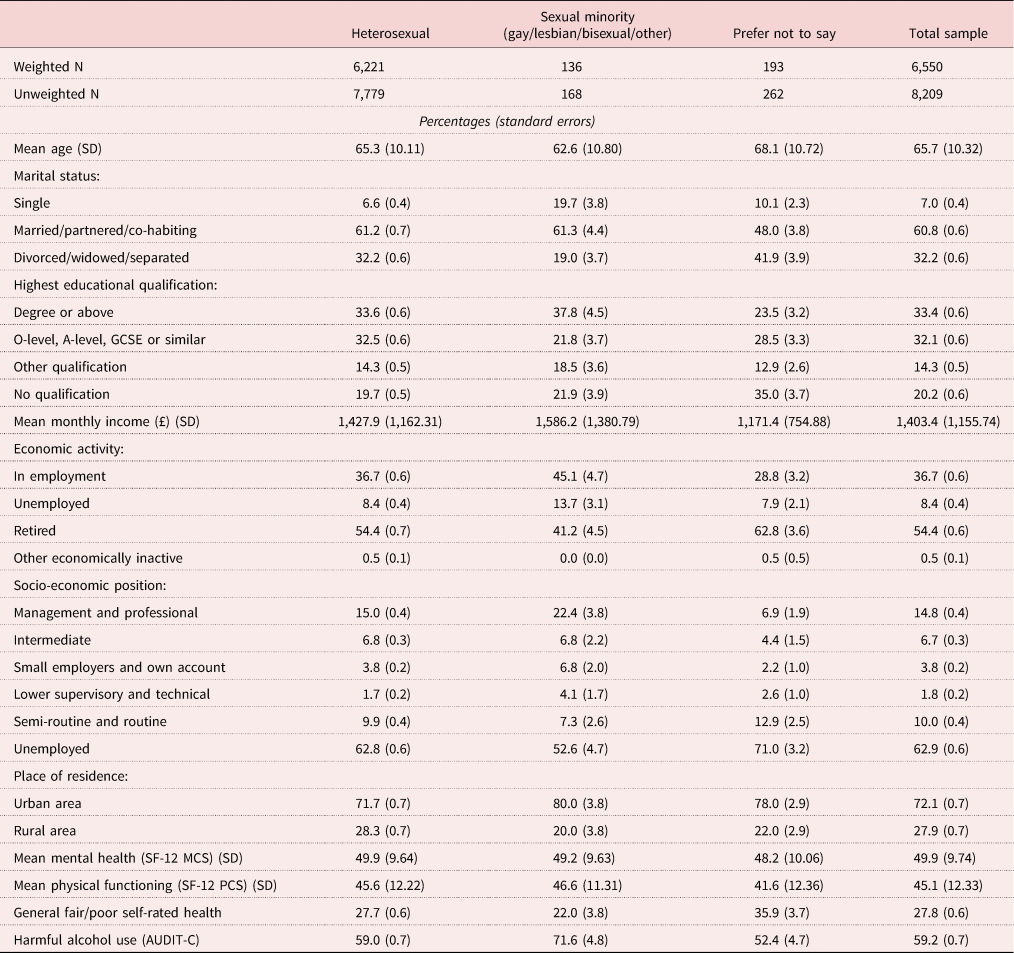
Two per cent of the sample identified as gay/lesbian, bisexual or other (N = 136) and 3 per cent preferred not to disclose their sexual orientation (N = 193). The large majority of women (95%) self-identified as heterosexual. Sexual minority women were younger, had a higher level of formal education, higher income and higher socio-economic position than their counterparts (see Table 1). Women who preferred not to disclose their sexual orientation were older, more likely to be divorced, and had lower income and lower educational qualifications than heterosexual or sexual minority women.
Summary statistics by sexual orientation of women aged 50 and older in the UK Household Longitudinal Study Wave 7 (2015–2016)

Notes: SD: standard deviation. GCSE: General Certificate of Secondary Education. SF-12 MCS: Short-Form Health Survey Mental Component Summary. SF-12 PCS: Short-Form Physical Health Composite Scale. AUDIT-C: three-item version of the Alcohol Use Disorders Identification Test.
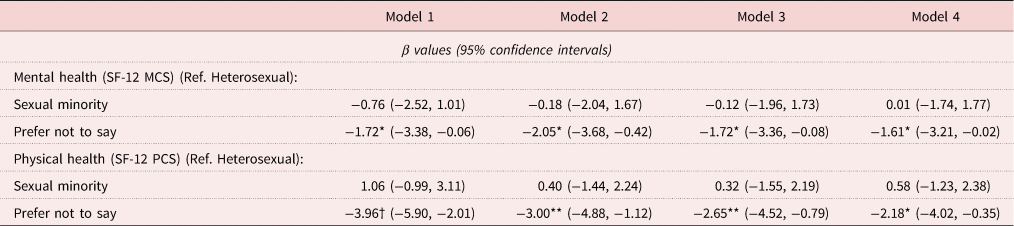
Analyses of health inequalities presented in Tables 2 and 3 show that across physical and mental health outcomes, women who did not disclose their sexual orientation had worse health than heterosexual women and sexual minority women (see Model 1, Tables 2 and 3). Upon adjustment for covariates in Models 2–4 these associations attenuated, although the differences between women who preferred not to disclose their sexuality and heterosexual women remained strong and statistically significant across mental and physical health outcomes (β = −1.61, 95% confidence interval (CI) = −3.21, −0.02 for mental health; β = −2.18, 95% CI = −4.02, −0.35 for physical health).
Mental and physical health of older sexual minority women, and women who prefer not to disclose their sexual orientation, compared to that of older heterosexual women, in the UK Household Longitudinal Study Wave 7 (2015–2016)

Notes: Model 1 is unadjusted; Model 2 adjusts for age and age squared; Model 3 adjusts for age, age squared, marital status and area of residence; Model 4 additionally adjusts for highest educational qualification, monthly income, economic activity and socio-economic position of last job. SF-12 MCS: Short-Form Health Survey Mental Component Summary. SF-12 PCS: Short-Form Physical Health Composite Scale. Ref.: reference category.
Significance levels: † p < 0.001, * p < 0.05, ** p < 0.01.
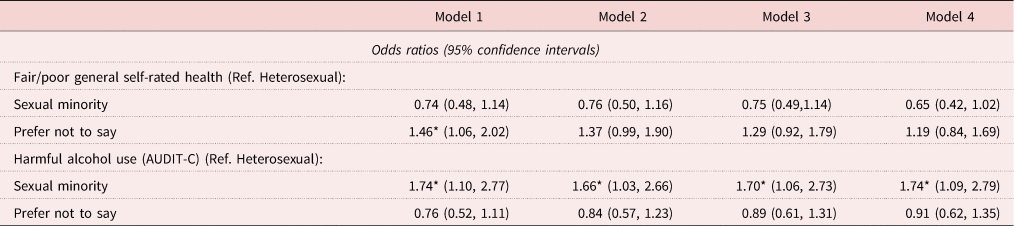
Self-rated health and harmful alcohol use of older sexual minority women, and women who prefer not to disclose their sexual orientation, compared to that of older heterosexual women, in the UK Household Longitudinal Study Wave 7 (2015–2016)

Notes: Model 1 is unadjusted; Model 2 adjusts for age and age squared; Model 3 adjusts for age, age squared, marital statu, and area of residence; Model 4 additionally adjusts for highest educational qualification, monthly income, economic activity and socio-economic position of last job. AUDIT-C: three-item version of the Alcohol Use Disorders Identification Test.
Significance level: * p < 0.05.
Women who self-identified as gay/lesbian/bisexual had higher odds of harmful alcohol use than heterosexual women. This association reduced slightly after adjusting for age, age squared, marital status and area of residence in Models 2 and 3, but due to the higher socio-economic circumstances of sexual minority women, gained strength in Model 4 after adjusting for education, monthly income, economic activity and socio-economic position (odds ratio = 1.74, 95% CI = 1.09, 2.79; Table 3).
Discussion and implications
This study set out to examine inequalities in health and social circumstances among older sexual minority women, and women who preferred not to disclose their sexuality, compared to older heterosexual women. It aimed to contribute to the literature by examining two under-researched populations in UK gerontology – sexual minority women, and women who prefer not to disclose their sexual orientation – and explore their health and social circumstances as they reach older age. Findings show that sexual minority women aged 50 and over are on average younger and have higher socio-economic resources (in terms of education, income and occupational status) than their heterosexual peers. In contrast, older women who prefer not to disclose their sexual orientation are older and have the lowest income and educational qualifications of all sexual orientation groups. These findings echo what has been previously reported in other UK social surveys in terms of the socio-economic position of older LGBQ groups. Results from the 2007 Citizenship Survey show that the gay and lesbian population in England and Wales are more likely than their heterosexual peers to be educated to degree level or above, and on average have higher income (Aspinall, Reference Aspinall2009). Similarly, a survey of over 2,000 heterosexual, lesbian, gay and bisexual individuals over the age of 55 found that older LGB people are over-represented in managerial and professional occupational groups (Guasp, Reference Guasp2011). Although less has been reported on the social circumstances of older people who choose not to disclose their sexuality, a study using general practitioner records in England found that older patients were more likely than younger patients to leave the question on sexual orientation unanswered (Elliott et al., Reference Elliott, Kanouse, Burkhart, Abel, Lyratzopoulos, Beckett, Schuster and Roland2014), which reflects this study's finding that women who prefer not to disclose their sexuality are older than both sexual minority and heterosexual women. Although none of these three reports focused specifically on women, they provide support for this study's finding that sexual minority women – much like the larger LGBQ older population – have on average higher socio-economic resources compared to both older heterosexual women and women who prefer not to disclose their sexual orientation.
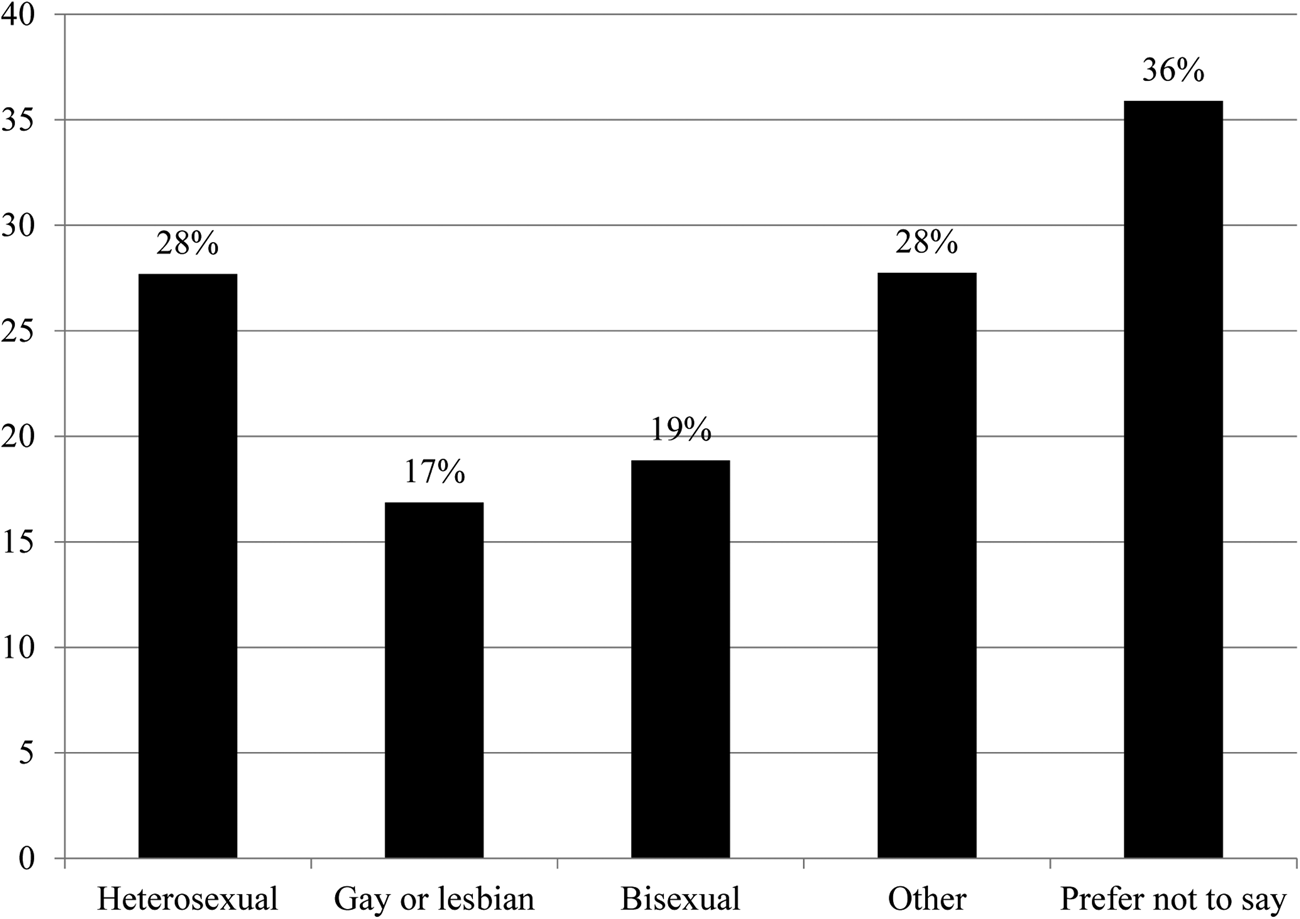
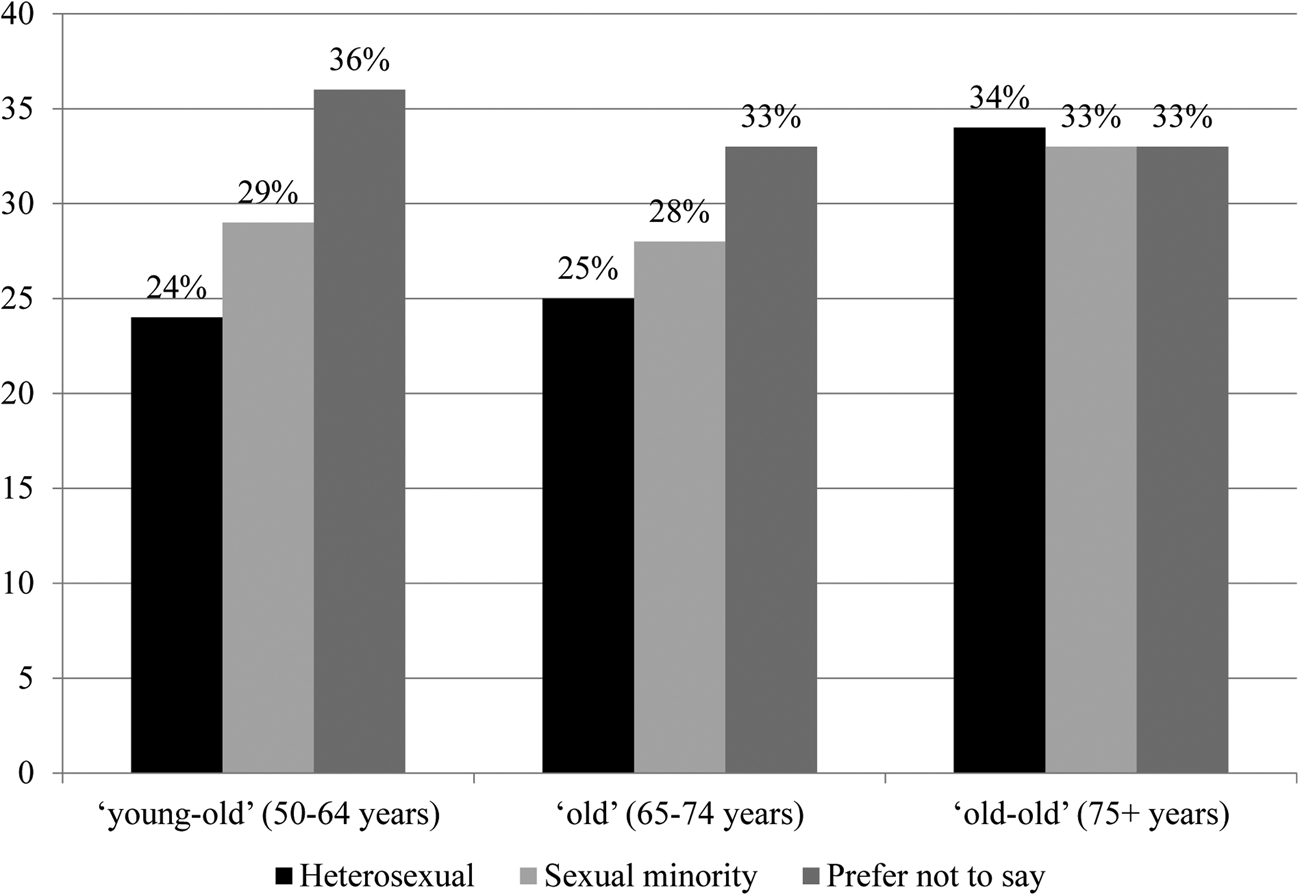
These patterns of socio-economic differences across sexual orientation groups are reflected in findings from the health inequalities analyses – there is no evidence of inequalities in physical and mental health between sexual minority and heterosexual older women, but results show that older women who prefer not to disclose their sexuality have worse mental and physical health than both older heterosexual women and sexual minority women. Findings regarding the absence of physical and mental health inequalities between sexual minority and heterosexual older women contradict what is reported in the international literature, which reports that compared to older heterosexual women, older sexual minority women report poorer mental health (Wallace et al., Reference Wallace, Cochran, Durazo and Ford2011; Fredriksen-Goldsen et al., Reference Fredriksen-Goldsen, Kim, Barkan, Muraco and Hoy-Ellis2013; Gonzales and Henning-Smith, Reference Gonzales and Henning-Smith2015), cognitive health (Seelman, Reference Seelman2019), functional health (Fredriksen-Goldsen et al., Reference Fredriksen-Goldsen, Kim, Barkan, Muraco and Hoy-Ellis2013; Gonzales and Henning-Smith, Reference Gonzales and Henning-Smith2015; Seelman, Reference Seelman2019), and a higher risk of cardiovascular disease and obesity (Addis et al., Reference Addis, Davies, Greene, MacBride-Stewart and Shepherd2009; Fredriksen-Goldsen et al., Reference Fredriksen-Goldsen, Kim, Barkan, Muraco and Hoy-Ellis2013) than older heterosexual women. UK studies using the same data-set analysed here (the UKHLS) but not restricting their analyses to older women, do report clear health inequalities by sexual orientation, whereby bisexual, gay and lesbian male and female respondents report poorer health than heterosexual people (Booker et al., Reference Booker, Rieger and Unger2017). The study by Booker et al. (Reference Booker, Rieger and Unger2017) did not stratify by age or gender, but was able to disaggregate into more specific sexual orientation groups, and found that bisexual respondents have worse health than both heterosexual and gay and lesbian respondents (Booker et al., Reference Booker, Rieger and Unger2017). The present analyses have not been able to disaggregate sexual orientation groups due to sample size restrictions, and it is likely that inequalities in health are being concealed by grouping together women who self-report their sexual orientation as lesbian, bisexual and other. Descriptive statistics presented in Figure 1 do show a higher percentage of reports of fair or poor self-rated health by older women who self-report their sexual orientation as ‘other’ compared to older women who self-report their sexual orientation as gay/lesbian or bisexual, indicating likely differences within older women who do not identify as heterosexual. It is also possible that inequalities in health among sexual minority and heterosexual women exist among the oldest old – the generation of sexual minority women who have endured the most pervasive experiences of oppression and marginalisation (Fredriksen-Goldsen and Muraco, Reference Fredriksen-Goldsen and Muraco2010). Given limited sample sizes, this study was not able to examine health inequalities across different age cohorts. However, descriptive analyses provided in Figure 2 show the opposite – greater differences in the percentage reporting fair or poor self-rated health in the younger age cohorts. Unfortunately, due to data restrictions, the present analyses could not disaggregate age groups further to examine health inequalities by sexual orientation according to generation or specific age groups.
Reports of fair or poor self-rated health by sexual orientation among older women in the UK Household Longitudinal Study.
Note: N = 8,209.

Reports of fair or poor self-rated health by sexual orientation and age among older women the UK Household Longitudinal Study.
Note: N = 8,209.

As discussed in the introduction, this study employs a theoretical approach that considers, alongside lifecourse experience of oppression and marginalisation, the positive and health-protecting resources that older sexual minority women have, including increased social networks, resilience and self-reliance, which can provide a buffering effect for sexual minority women as they reach older age (Fredriksen-Goldsen et al., Reference Fredriksen-Goldsen, Simoni, Kim, Lehavot, Walters, Yang and Hoy-Ellis2014). It may be that these protective factors counteract the harm of oppression and marginalisation on sexual minority women's health. There are two other studies that have found no differences in ageing-related outcomes across sexual orientation: a web-based study conducted in the UK found no significant differences in decline in cognitive functioning by sexual orientation among neither women nor men (Maylor et al., Reference Maylor, Reimers, Choi, Collaer, Peters and Silverman2007), and a study of health behaviours among older men reported no differences in terms of exercise and diet between older gay men and heterosexual men (Slevin, Reference Slevin2008). This is the first UK-based study to use population-level data to examine health inequalities across sexual orientation among older women, and additional research with larger samples of older sexual minority women should explore this finding further.
Although this study found that older sexual minority and heterosexual women have similar levels of physical and mental health, there was a clear inequality in the risk of harmful drinking – older sexual minority women are almost twice as likely as older heterosexual women to engage in harmful alcohol consumption. This is a well-documented finding in the international literature (King et al., Reference King, McKeown, Warner, Ramsay, Johnson, Cort, Wright, Blizard and Davidson2003; Hunt and Fish, Reference Hunt and Fish2008; Guasp, Reference Guasp2011; Fredriksen-Goldsen et al., Reference Fredriksen-Goldsen, Kim, Barkan, Muraco and Hoy-Ellis2013; Bryan et al., Reference Bryan, Kim and Fredriksen-Goldsen2017; Shahab et al., Reference Shahab, Brown, Hagger-Johnson, Michie, Semlyen, West and Meads2017), and the mechanisms behind this finding have been well-hypothesised. Some studies suggest that the social network structures of LGBQ older women are likely to influence behaviour in unique ways, which may facilitate or encourage higher levels of alcohol consumption (Trocki et al., Reference Trocki, Drabble and Midanik2005; Bryan et al., Reference Bryan, Kim and Fredriksen-Goldsen2017). Others suggest that social norms and repercussions in relation to drinking norms differ for sexual minority women compared to heterosexual women, so that sexual minority women enjoy more-tolerant and permissive norms towards alcohol use (Cochran et al., Reference Cochran, Grella and Mays2012). Studies conducted among younger sexual minority women propose that increased alcohol consumption may be an expression of non-conforming with gender roles (Rosario et al., Reference Rosario, Schrimshaw and Hunter2008), or it may reflect the fact that women are more likely to experience double discrimination, which may increase the risk of engaging in harmful health behaviours as a coping mechanism (Bowleg et al., Reference Bowleg, Huang, Brooks, Black and Burkholder2003).
The strongest evidence of health inequalities across sexual orientation groups that this study provides is that shown between older women who prefer not to disclose their sexuality and older heterosexual women. Across the mental and physical health outcomes examined, older women who did not disclose their sexuality had worse health than older heterosexual women and older sexual minority women, but lower alcohol consumption than these two populations. This finding is to some extent similar to results reported by Booker et al. (Reference Booker, Rieger and Unger2017), who used the UKHLS but did not restrict their analyses to older women, and found that people who prefer not to disclose their sexuality are healthier than gay/lesbian and bisexual respondents, but have poorer health than heterosexual respondents (Booker et al., Reference Booker, Rieger and Unger2017). It should be noted that the UKHLS asks only one question on sexuality, which is related to identity, but there is no information on behaviour or attraction. It is therefore not possible to discern from these analyses whether women who preferred not to say what their sexual orientation is are in fact older women who are ‘in the closet’, older women who have not understood this question or older women who simply prefer not to state what their sexuality is without necessarily meaning that they are concealing a non-heterosexual sexuality. In any case, studies have shown that people who put themselves in this category in an anonymous survey are systematically different from the heterosexual population (Powdthavee and Wooden, Reference Powdthavee and Wooden2015), and so it is of interest to unpick these study results further. Should one assume the first scenario (that these are older women who prefer not to disclose a non-heterosexual sexuality), there are several explanations for this finding. A large body of literature has shown a negative association between sexual orientation concealment and worse mental health (Schrimshaw et al., Reference Schrimshaw, Siegel, Downing and Parsons2013; Sedlovskaya et al., Reference Sedlovskaya, Purdie-Vaughns, Eibach, LaFrance, Romero-Canyas and Camp2013), which could be due to the increased stress and hypervigilance that results from being preoccupied with the discovery of a stigmatised identity (Meyer, Reference Meyer2003; Pachankis, Reference Pachankis2007). Relatedly, a body of work has evidenced the positive associations that exist between openly identifying as gay male or lesbian (being ‘out’) and higher levels of self-esteem and life satisfaction, increased social support and better adjustment to the ageing process (Adelman, Reference Adelman1990; Sharp, Reference Sharp1997; Grossman et al., Reference Grossman, D'Augelli and Hershberger2000; D'Augelli and Grossman, Reference D'Augelli and Grossman2001). These findings reflect the hypotheses held by most studies that examine non-disclosure of sexuality, which propose that disclosure is inherently positive and non-disclosure is, in contrast, related to negative outcomes. This ‘disclosure imperative’ suggests that being ‘out’ is what LGBQ populations should aspire to, but it ignores the potential risks of disclosure and the fact that for individuals who are single or partnered with someone of a different gender, disclosure of a non-heterosexual identity may feel irrelevant or uncomfortable (McLean, Reference McLean2007). Particularly for this cohort of older women who have lived most of their lives in contexts of multiple marginalisation, and have become accustomed to being ‘hidden’ (Traies, Reference Traies2016), non-disclosure of sexuality may be a consequence, and a marker, of lifecourse experiences of oppression and discrimination.
This study has some limitations that should be acknowledged. First, as previously discussed, analyses had to combine women who self-report their sexual orientation as lesbian, bisexual, gay and other into a ‘sexual minority’ group. Studies show differences between bisexuals and lesbians in terms of socio-economic status and health, whereby bisexuals have poorer outcomes than both lesbians and heterosexuals (Simoni et al., Reference Simoni, Smith, Oost, Lehavot and Fredriksen-Goldsen2017). Due to limited sample sizes, the present study had to combine several sexual minority identities into one, which is likely masking important within-group differences, as well as health inequalities between the different sexual minority women and heterosexual women. The UKHLS is the only UK survey at time of writing that contains a large enough sample of older sexual minority women to examine (although crudely) health inequalities by sexual orientation. Relatedly, another limitation of this study is in regards to its measure of sexual orientation. The UKHLS asks only one question, related to identity, and does not take into account other aspects of sexual orientation such as attraction and behaviour. This approach to measuring sexual orientation assumes that sexuality is stable over time, but studies have shown that sexual orientation may be fluid (Baumeister, Reference Baumeister2000). Further, the use of only one question does not allow deeper exploration of the sexual orientation of respondents who have selected ‘other’ or ‘prefer not to say’. In addition, the use of a binary gender variable and assumptions of stability do not allow for identification of transgender respondents in the UKHLS data-set. A final limitation related to data constraints is the impossibility of exploring oppressions at the intersection of several marginalised social positions including ethnicity, sexuality, gender and class, among others.
This study's limitations regarding small sample sizes and measurement restrictions are common and concerning in the field of queer gerontology. Even in the USA, where most of the research on LGBTQ ageing is taking place, there are few health-related studies that use population-based samples or directly compare older LGBQ women to their same-age heterosexual peers (Seelman, 2019). A recent editorial in The Lancet (2019) highlighted that LGBTIQ health data still suffers chronic omission from most health initiatives, and suggested that this needs to be rectified. Future population-level data collection efforts in the UK should ensure, as a matter of social justice, that samples are inclusive of LGBTQ populations, and that they contain adequate measures of sexual orientation and gender identity. This includes asking participants about sexual orientation, identity and behaviours; ensuring that sample sizes are big enough to conduct robust analyses to examine the circumstances of older LGBTQ people; and capturing relevant constructs to understand the underlying mechanisms behind health inequalities in later life across sexual orientation.
Conclusion
This is the first UK study to analyse population-level data on the health and social circumstances of older sexual minority women, heterosexual women and women who prefer not to disclose their sexuality, in order to ascertain whether, and to what extent, there are health and social inequalities across sexual orientation groups in the UK. Findings on the increased risk of alcohol consumption by older sexual minority women have grave implications. The health and health needs of older sexual minority women are one of the most neglected practice and research areas in UK health and health care (Hunt and Minsky, Reference Hunt and Minsky2006), and research suggests that sexual minority women do not respond to preventive health-care messages, and do not seek intervention or support from the health sector (Hunt and Minsky, Reference Hunt and Minsky2006). Understanding their social and health circumstances is key in order to ensure appropriate and equitable services for older LGBQ populations.
This study highlights the general health and social disadvantage experienced by older women who prefer not to disclose their sexuality. In order to understand further the characteristics and health needs of women who choose not to self-report their sexual orientation, and identify drivers of healthy ageing for this population, studies must include suitable sampling designs with sufficiently large samples of older women and comprehensive measures of sexual orientation, identity and behaviour.