Richard III's (1483–85) reputation as a northerner and as a special friend of the City of York has been much debated. While duke of Gloucester during the reign of his brother, Edward IV (1461–83), Richard exercised great influence in the north of England, and his death at the battle of Bosworth was recorded with great sorrow in the City of York's civic registers.Footnote 1 Following the rediscovery of his skeleton in Leicester in February 2012, there was some public discussion as to whether he should be reburied in Leicester or in York that was ended by judicial review in 2014.Footnote 2 Arguments for Richard's attachment to York were often emotionally charged and focused on the idea of a special affection between Richard and the citizens of York.Footnote 3
The most-cited piece of evidence in the City of York Council Archives to support claims of a loving relationship between the City and Richard is taken from a series of fifteenth-century council records now known as the House Books in which an entry on 23 August 1485 records (in English): ‘King Richard late mercifully reigning upon us was thrugh grete treason of the duc of Northfolk and many othre that turned ayenst hyme, with many othre lordes and nobilles of this north parties, was pitiously slane and murdred to the grete hevynesse of this citie.’Footnote 4 This rhetoric does suggest great grief, though one that was tinged with anxiety.Footnote 5 Anxiety was indeed an emotion that City councillors also felt in 1485 as they wondered what to do next. The very next sentence (added in fresh ink, perhaps indicating some pause for consideration) determines that the council will write to the earl of Northumberland to ask for his advice as to how best to act next for the profit and safeguarding of the City in this ‘woeful time’. In such an emotionally charged context, how should we interpret this evidence? We need to begin by asking what were the House Books and whose truth do they tell us? In what sense do they represent the ‘City’ of York, which around this date had a population of perhaps 10,000, and within which opinion about Richard (as recorded in the same House Books) was divided?Footnote 6 This article will focus on the use of emotional rhetoric in the government of the City during the reign of Edward IV in particular, at a time when Richard was building his power-base in the north. It will argue that the specific historical circumstances of both Edward's and Richard's assertion of authority in the north depended on the employment of new types of civic record, with a particular focus on the regulation of speech, thought and, therefore, the display of emotions. These developments can be situated within wider developments in civic bureaucracy in England, Burgundy and France, reflecting new forms of central administration and of political activity in the regions.
Much recent work on the history of medieval emotions has emphasized the degree to which the emotions and emotional language were central to both the performance and the inscription of power.Footnote 7 This use of the emotions was conditioned by contemporary understanding of the social nature and role of emotions and was so ingrained by the fifteenth century that accounts of emotional language and behaviour were commonly used to achieve particular political ends.Footnote 8 Love, for example, was a necessary precursor to the achievement of civil peace and concord.Footnote 9 Yet love arose and followed from other emotions, including both grief and anger. It is unsafe therefore to take the records of emotions concerning Richard III's death as a straightforward expression of the citizens’ feelings. Rather, the choice of individual words, the fuller written statement and even the nature of the register in which it was written all raise questions about the political purposes that they served.
The York House Books and the development of civic archives
The House Books were a new series of registers produced as records of the City council from around 1461.Footnote 10 The earliest surviving records are very incomplete. They have been bound and rebound on several occasions, leaving many gaps and some disordering in the sequence of the records, as well as severe damage caused by damp, flood damage and poor conservation. It is now almost impossible to reconstruct their original extent and organization, but there are some clues as to how this changed over time. The first year for which we have anything even approaching a full set of records (though still very incomplete) is the year 1476–77, when the volume starts with the slightly damaged heading in Latin (here translated) ‘Register of the City of York, newly made. . .February. . .Edward IV, for the time of Thomas Wrangwish, then Mayor of the city.’Footnote 11 New mayors always took their oath on 3 February, which was the feast of St Blaise, and also the day following the Purification of the Virgin Mary (or Candlemass) exactly 40 days after Christmas. Following his election, the new mayor, Thomas Wrangwish, attended at the Minster accompanied by all the aldermen and other elected civic officials. The mayor-making was traditionally a time when new ordinances for the government of the City would be read out to the assembled freemen in the Guild Hall. The prominence of this initial entry, and the reference to a ‘register newly made for the time of Thomas Wrangwish’, strongly suggests that the House Books were originally intended to be a record of a particular mayor's term of office and that (at least in their inception) we might more accurately call them Mayors’ Books rather than House Books (a name that came into use only after 1909). Indeed, the scope of their contents further suggests that they were a record of the business of the mayor's council, attended by the ‘Twelve’ aldermen and sometimes joined by members of the slightly wider council of the ‘Twenty-Four’. The councils of the ‘Twelve’ and the ‘Twenty-Four’ were dominated by merchants and by former and future civic officials (such sheriffs, chamberlains and bridge masters who between them managed the City's finances and payments due to the crown).Footnote 12 By contrast, the common council of Forty-Eight was made up of representatives of the City's crafts. The Forty-Eight did not attend the mayor's council but had an important role to play in the election of civic officials and in the acclamation of those newly elected. The common council might petition the mayor's council and seek to influence it on specific matters but they did not explicitly control its legislative programme or political deliberations. Within this hierarchical structure of government, the so-called House Books therefore are the records of the processes of the highest echelon of civic government, the inner council of the mayor, senior civic officials and the aldermen; the ruling elite.
Why did the council feel the need to generate such a new set of records from the mid-fifteenth century? By that date, civic government in York had been developing its archives for nearly 300 years and over that time they had constantly evolved and developed in both format and purpose.Footnote 13 It seems certain that civic officials were beginning to use written records as an administrative tool, probably in the form of parchment rolls and written in Latin, well before the reign of Edward I (1272), and possibly from at least the later twelfth century, but few of them survive. After 1272, increasing sophistication in the organization of a civic archive led to the greater use of registers (that is books, or codices, rather than rolls). From 1272 (or shortly afterwards), the great register of York Freemen was begun and contained lists of new freemen and elected civic officials.Footnote 14 A further increase in the use of registers was not apparent in York until the mid- to late fourteenth century (a generation or two after their adoption by other provincial cities such as Southampton, King's Lynn and Bristol).Footnote 15 By the 1330s, the City's bailiffs (at that time second in the hierarchy after the mayor) seem to have been keeping a register of records relevant to their duties, but the major turning point was the 1370s when two new Memoranda Books (known as AY and BY) were begun.Footnote 16 The use of registers in civic government was important because they supported more discursive forms of writing which town clerks began to use not only to record court customs and legal formulas, but to select and organize these in relation to important constitutional milestones, new legislation (both local and national) and even short narrative accounts of historical events and local custom.Footnote 17 Roger Burton, senior town clerk of York from 1405 to 1436, wrote in 1439 that such writing needed to compensate for the fallibility of human memory.Footnote 18 This was not just Burton's common sense, but a familiar trope at the time, which suggests that he was aware of intellectual developments in the writing of History.Footnote 19 It was an idea which led Burton to a thorough reorganization of the civic archives in part by expanding the Memoranda Books through the addition of all kinds of inventive memorabilia, such as a history of the City's swords, a full chronicle of the archbishops of York and various didactic aids (including instruction in how to use Arabic numbering).Footnote 20 Roger Burton conscientiously wrote his own initials against most of the new entries associated with his initiative, but he was supported in his work by a team of clerks. Their interest in memory, and insertion of little snippets of science, moral comment and above all large corpora of History into the reformed civic archive provides an insight into their general literacy and complements the evidence that we have of the wide private reading of such clerks documented in the lists of books some left in their wills.Footnote 21 By the fifteenth century, the compilers of the civic archives in York were educated and widely read. Like their direct contemporaries, John Carpenter and his colleagues in London, they were interested in the creation of records not just for their immediate pragmatic, bureaucratic purposes, but for the potential moral impact of their historical record in the present and future.Footnote 22
The Memorandum Books were written predominantly in French or Latin, and included few records in English.Footnote 23 By and large, they included copies of legal or financial records but they provided little to no account of contemporary political processes. By contrast, the records of the later fifteenth century, particularly the House Books, included more records in English, and often included reports of direct speech verbatim. Lists of the names of councillors attending meetings were regularly recorded. There was thus a new focus on describing the processes, and even the conversations and arguments through which decisions were reached in the mayor's council. One of the most distinctive new elements in the House Books was the listing by name of members of the ‘Twelve’ and ‘Twenty-Four’ who attended every council meeting, along with regulations relating to punishment for non-attendance.
This was accompanied by a strong focus on policing attendance by councillors at council meetings, the enforcement of good attendance and the punishment and replacement of poor attenders. For example, on 27 June 1476, at a council meeting attended by 9 of the ‘Twelve’ and 10 of the ‘Twenty-Four’, two councillors were fined for their failure to attend despite warning from the mayor.Footnote 24 In September 1476, William Holbeck was dismissed for absenting himself from the council. Indeed, he had fled with his whole household beyond the jurisdiction of the City into the Dominican Friary because, he said, ‘he wistnot if he might saiff com and goo’.Footnote 25 While in another example in July 1476, the common clerk, Thomas Yotten, was dismissed on a charge of embezzlement and other misdemeanours that he verbally confessed to the council.Footnote 26 Correspondence relating to his dismissal went back and forth between the City, the earl of Northumberland, the king and Richard duke of Gloucester, and at every stage the letters were read out loud and debated. Such detailed descriptions of conversations and the careful verbatim copying of letters in English (in themselves a form of conversation by writing) were a new form of memorialization in the City archives. The description of the council's reaction to the news of the death of Richard III fits comfortably within this new style of more conversational record.
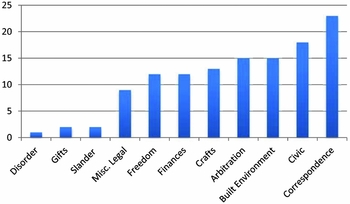
Indeed, the distinctive character of the new House Books can further be seen in a fuller analysis of the business recorded during the first mayoralty of Thomas Wrangwish in 1476–77 (Figure 1).Footnote 27 While at first glance, the character of this business might seem quite miscellaneous, there is in fact a strong focus on political process. Many legal disputes were assigned to be solved through arbitration.Footnote 28 There is a considerable volume of correspondence, mostly letters between the City, the crown and leading magnates such as the duke of Gloucester or the bishop of Durham. Much of the business concerning crafts and the policing of the franchise consists of reports on the progress of disputes over craft ordinances and the status of those claiming the freedom of the City. There is a considerable emphasis on the processes and ceremonial associated with the holding of council meetings and the attendance and conduct of councillors and civic officials (Figure 1: ‘Civic’). Cases of slander were still relatively few in number – they grew in volume during the reign of Richard III – but most reflected gossip against the ruling mayor and aldermen and were often recorded in great detail. Slander cases, involving criticism of the mayor of other civic officials, had been reported since at least 1418.Footnote 29 But slander by the later 1470s was treated more severely. In 1476, John Sharp, a weaver, was imprisoned for his criticisms of Mayor Wrangwish and his craft.Footnote 30
Thematic analysis of the surviving contents of the York House Books for the year of Thomas Wrangwish as mayor, February 1476/77

What all these types of material have in common is their interest in the power of speech and the necessity for engagement in ‘good conversation’. Letters are a form of good conversation,Footnote 31 arbitration involves equitable judgement of alternative and opposed conversations, the proper conduct of council meetings and slander and political rumour all reflect on authority through good and bad speech. And of course conversation in this period meant not just speech but the very essence of living together, of making society through intercourse with others, of bridging the relationship between the intimate self and wider society.Footnote 32 Good conversation was thus an essential element in governance of the self and others and involved engaging hearts and wills through the emotions in collective endeavours, and the record of such conversation necessarily employed the language of the emotions. The intimate languages of the heart, of chastity, of love and of grief were already to be found in public discourse about civic concord in York. In 1428, John Lyllyng, a citizen and mercer charged with selling adulterated goods, wrote a letter to his fellow citizens that the charge was to him ‘full hevy and grevous’ and begged them with all his ‘hert to be gude maisters and frendes’ to him and to grant him their ‘gude hertes for the werke of haly charite’.Footnote 33 By the time of the first surviving House Book (1476–77) the term ‘welbeloved’, perhaps originating in Chaucer but adopted into English correspondence from the 1440s, was routinely used to describe citizens and other officials, while potential rebels were imagined as acting out of rancour and malice.Footnote 34 Letters to the king, Edward IV, equally routinely and repetitively, referred to his good and gracious lordship, and the honour and reverence in which his citizens held him.Footnote 35 For more acutely political matters more emotional vocabulary was used. When Edward IV sought to replace the City recorder with his own man, Miles Metcalfe, he wrote that since he had heard that the ‘trusty and welbeloved Guy Fairefauxe’ planned to leave the office he ‘havying tender respecte’ towards the ‘right welbeloved Miles Metcalfe whom we have in singular favour of our grace, desire you [the mayor and council] in our herty wise that. . .ye will at the contemplacion of thies our lettres’ before any other receive Metcalfe as the replacement for Fairfax.Footnote 36 By contrasting ‘welbeloved’ with ‘right welbeloved’, mentioning his ‘hert’ (seat of all emotions and conscience), and asking for their ‘contemplacion’, Edward IV was appealing for the same kind of engagement of the will in pursuit of a greater common good as Lyllyng. The use of such rhetoric in a letter copied into the civic register was intended not only to bring about change (in this case, the accommodation of the civic will to the royal will), but also to realize and preserve it in perpetuity. In order to achieve this, the rhetorical use of emotion was essential to the inscription of the change of will that was required, and was regularly employed to a greater or lesser degree in most records in English that related to the achievement of concord.
The European context
The new interest in recording thoughts and speech (and letters) was far from unique to York. Other major towns were compiling similar collections, such as the City of London's Journals (records of the court of common council, from 1416), the Coventry Leet Book (from the 1420s) or The Norwich Assembly Books (from the 1430s), and these collections of urban proceedings and correspondence coincide with the creation of more famous letter collections belonging to English gentry families (the Pastons from 1422, or the Stonors and Celys from around 1475).Footnote 37 One immediate context for the compilation of all these collections was the gradual decline of the government of Henry VI into civil war, his deposition in 1461 and the coronation in his place of Edward IV, the first Yorkist king. A great deal of the material collected in these volumes relates to such political issues. The growth of such civic letter collections in a period of civil war (reflecting in part the keen need of the crown to save and assert its authority in regions that were at some distance from London) can be compared to the situation in contemporary France, where the increase in both letter writing by the crown to provincial towns, and the practice of keeping copies of such letters in urban registers, was a reflection of the crown's deliberate attempt to engage provincial communities, particularly those furthest from the centre such as Amiens or Lyon, more actively in political discourse during a period of the restoration of royal authority under Charles VII and Louis XI (between the 1430s and 1483).Footnote 38 In particular, Louis XI's correspondence with the towns of Bourges, Poitiers and Tours between 1463 and 1470 employed a strongly affective rhetoric, and peaked in volume during diplomatic and military crises.Footnote 39 His letters were used to convey political news, to appeal for surveillance against sedition, to mobilize resources and to seek to impose his own candidates in civic offices. Similarly, in Burgundy municipal registers reveal the extent of correspondence with the ducal court during periods of civil conflict and insecurity, as well as their contemporary use and influence in other forms of historical record.Footnote 40 Perhaps with these precedents in mind, Edward IV was a prolific writer of letters to provincial English towns. For example, he wrote in very familiar terms to the City of Coventry from London on the day after he became king in 1461, again one week later, and again from York just six weeks later, to urge them ‘lovingly and with good hearts’ to join him in the suppression of rebels and the array of defensible men. His letters were copied into Coventry's Leet Book.Footnote 41 As the century progressed, however, such correspondence between the crown and its county cities became more discursive, touched on a wider number of topics and was used for much more than simple reception of information from the crown. By the end of the century, letters could also be used by the City to achieve a diplomatic victory against the king. In protracted correspondence early in the reign of Henry VII, the mayor and aldermen of York deftly and politely (but persistently) resisted the king's desire to replace certain of their civic officials with candidates of his own choice.Footnote 42
Aurality and the culture of civic politics
In such new civic record collections, we can see fifteenth-century town clerks wrestling with the issue that politics were as much about speech and thought as they were about action or bureaucratic administration. They were about interior orientation and the desired orchestration of that in public conduct. This interest in the relationship between speech and conduct was a notable feature of mid-fifteenth-century culture in both popular and courtly contexts. The development of inquisitorial prosecutions practised in the church courts, and the increasingly popular use of written bills and petitions in secular courts, developed into distinctive literary genres of political writing.Footnote 43 In more courtly circles, an interest in Cicero's work on the foundations of human society in speech, and the role of speech in procuring peace, were inspiring new interest in written dialogues including the Somnium Vigilantis composed in c. 1459 to defend the Lancastrian cause.Footnote 44 In the context of reading as well as writing, the relationship between interiority, exteriority and the role of speech in mediating between the two was also a well-established part of the culture. Reading was primarily a social activity. The majority of texts were written to be read aloud in a context that included formal commentary upon, and informal discussion of, the work being read.Footnote 45 This type of literacy (described as aurality) was not simply a half-way house between a fully oral culture and a literate one. It was not that people could not read silently (there is much evidence that they could and did), but that the cultural convention was that reading was a communal and shared experience situated within the context of speech (and indeed thought).
The fact that urban administrators were trying to record that aural context shows that they were well aware of the wider public scenarios in which political opinions were formed beyond the council chamber and that they were seeking to engage actively with them. So, rather than civic government being dominated by a single temperate and top-down discourse of the common good, by the fifteenth century, City councillors were engaging with a wider kind of public political debate (including sometimes intemperate, emotional debate) that existed beyond the confines of the council chamber and the Guild Hall, in the streets, taverns and houses of the City. No doubt such conversation had always taken place, but the greater consciousness of it in the new kinds of civic records that were being kept for the aldermanic class suggests a heightened awareness of the need to engage with and indeed regulate that discourse.Footnote 46 This was a political culture that was engaging (even struggling) with the liquidity of political exchanges and personal opinions.Footnote 47
Indeed, the focus on both proper and improper speech, on debate, that was reshaping the civic records was evident in other aspects of civic culture. The rebuilding of the City Guild Hall from the 1440s, as well as the refashioning of older craft halls such as the Mercers’ Hall in Fossgate or the Tailors’ Hall in Aldwark, allowed for the incorporation of smaller meeting rooms alongside their larger common halls so that the mayor's council (or senior guild officials) could withdraw to the seclusion of a council chamber for private conversation.Footnote 48 More space was also added for the creation and keeping of records. The new Guild Hall that emerged from the fifteenth-century reconstruction was thus better designed to accommodate the new concern with the aurality of civic culture and created a hierarchy of more and separate spaces in which different forms of speech and writing could be accommodated. Concern about participation in civic conversations extended beyond the various councils and the freemen to the City's alien population; in particular, the Scots were discouraged from hanging around the Guild Hall where they might overhear discussion inside.Footnote 49 Adjacent buildings were also co-opted for public meetings. The Austin Friary, right next door to the Guild Hall, was frequently used for formal arbitrations over civic disputes and was adopted by Richard duke of Gloucester as a temporary base during some of his visits to York.Footnote 50
Perhaps the most obvious consequence of this more visible concern with the aurality of civic governance, and the efforts to capture and even regulate speech and its attendant emotions was the creation of the oldest surviving text of the Corpus Christi dramas (the York Mystery Plays) in the 1470s. Indeed, it is also in the year 1476–77 that we have several significant records in the House Books of the reorganization of those performances. On 3 April 1476, a new English ordinance appointed four of the most able players (or actors) in the City to review all the plays and their players on behalf of the mayor, and to allow only those plays and players they considered ‘sufficient’ to be performed or to perform.Footnote 51 Richard Beadle has suggested that this was the most likely moment for the generation of the written play texts, produced by civic officials to monitor and check the speeches of the performers.Footnote 52 It may also have been at this point that the performance of the plays was finally separated from the Corpus Christi procession and the two events were spread over two consecutive days. On 31 May 1476, a new ordinance required the attendance of all councillors and crafts in the Corpus Christi procession, and this was immediately followed by a note on the misdemeanours of one particular craft, the Cordwainers (or shoemakers), and new regulations for a new play by the craft of linenweavers and their separation from the older craft and performance of the Weavers.Footnote 53 At the very least, these ordinances suggest a substantial reorganization of the plays in the weeks leading up to their performance in the summer of 1476 during the first year of Wrangwish's mayoralty. The reforms obviously speak to a civic concern about the quality of the plays but also hint at the potential for the plays to be used politically. Certainly, from records in later House Books, we know that there was a long and ongoing dispute between the Cordwainers and the Weavers about their position in the Corpus Christi procession, as a result of which they often refused to join the procession and carry their torches as required. We can also detect that behind this lay craft disputes arising from changing economic conditions as the older crafts of the Cordwainers and the Weavers were increasingly struggling with competition from economic rivals in other crafts, particularly the Mercers’ company (whose members dominated the higher elected civic offices) as well as from other towns. By the 1480s and 1490s, these tensions were leading to near annual disruption of either the Corpus Christi procession or the plays, and that the civic authorities feared that there was even a threat of armed rebellion.Footnote 54 In the House Books, they collected reports of rumours that the Cordwainers had appointed a military captain who could raise a force of 200 or even 300 men who would take the part of the Cordwainers against the City council. Their fears were even to some extent realized in 1504 when some 3,000 people imprisoned the mayor and councillors in the Guild Hall and forced them to do their bidding.Footnote 55 The regulations introduced in May 1476 suggest that such tensions around the possible and maybe actual subversion of the Corpus Christi performances were already apparent.
Certainly, the texts of the plays, even as they are preserved in the official civic version, offer plenty of opportunities for subversion. The play of Noah and the Flood offered the opportunity to debate the patriarchal authority of husbands over their wives. The burlesque performance of the powerless King Herod presented a parody of tyrannical kingship, which was immediately contrasted in the cycle with the decorous and charitable behaviour of the Three Kings in the story of the Epiphany. Contemporaries well understood that the story of the Three Kings presented a picture for ‘our mind and our thought of the correct and decorous behaviour of earthly kingship in the company of the divine’.Footnote 56 The audience was left with plenty of scope to make up their own minds as to which type their current king most adhered to. The play of the Pinners, joking while nailing Christ to the cross, offered the chance to lampoon the authority of employers and employees alike: so grossly focused on their work that they neglected their shared humanity. While even the final play of the Last Judgement, performed by the Mercers’ craft, who tended to dominate the civic council, could provide a powerful opportunity for the audience to resist and challenge their authority if played unconvincingly by the Mercers’ players, one of whom took on the role of God himself. It is not hard reading the play texts, or indeed watching them being performed, to imagine why those in authority might be concerned to seek to regulate their performance and control their speech and its emotional engagement of so public an audience.
All this suggests that the development of the House Books and the York Mystery Plays was part of a much wider reform of civic governance, which demonstrated a heightened concern about the quality and political impact of public speech and affective conduct during a time of civil conflict and rising political tensions within York, and which reflected wider changes in civic archival culture outside as well as within England. There are intimations, however, that we can make the historical context and the association with Yorkist royal government even more specific than that.
A Yorkist coup
The second reign of Edward IV, starting in 1471, coincided with a particularly unusual spate of civic disturbances. There were election riots, associated with the election of new mayors in 1471, 1473 and 1482, and major riots over the enclosure of common lands in 1480 and 1484.Footnote 57 These were partly the consequences of constitutional changes made by Edward IV himself to the conduct of civic elections as (after 1464) members of the common council were given the power to nominate mayoral candidates and (after 1473) even elect them.Footnote 58 In part, the riots may have reflected economic tensions and competition as the City's economy declined. But without doubt, they were also associated (in ways that are still not fully understood) with court and county politics and formed one of the pretexts for Edward's promotion of his brother Richard to a position of influence in the north. In May 1471, Richard was appointed lieutenant of the north, in 1472, he married Anne Neville, and over the next three years he gradually secured all the Neville lands in the north.Footnote 59 During 1476–77, Richard seems to have become increasingly active, even dominant, in civic affairs. In March 1476, he entered the City with a force of 5,000 men through Bootham Bar saying that he was sent by the king to support the rule of law and peace, and the grateful councillors later presented him with six swans and six pikes.Footnote 60 The same year, he intervened personally to ensure the dismissal of Thomas Yotten, the town clerk, and became a member, together with his wife, of the City's prestigious Corpus Christi fraternity.Footnote 61 It was no doubt during this year that Richard paved the way for the grand reception of Edward IV into the City in 1478, on which the council spent over £35, easily the largest sum among gifts and presents during that period.Footnote 62
Without doubt by 1476, and probably earlier, Richard was advancing his own men into positions of influence in the City but in order to do this he had to undermine the influence of other local families, not only the Percy and Neville families but also exiled Lancastrians including Lord Roos, all traditional lords of Yorkshire and the north and patrons of the City. Perhaps the single most significant sign of the growing influence of Richard duke of Gloucester in the City was the election as mayor in February 1476 of Thomas Wrangwish, whose election was so swiftly followed by the sudden appearance of Richard with his 5,000 men at Bootham Bar.Footnote 63 The dismissal at the same time of Thomas Yotten, who as common clerk was head of the civic administration, the mayor's right hand in the execution of government, and the custodian of the civic records including the new House Books, also looks politically motivated. Yotten appealed to the Percy earl of Northumberland against his removal from office, but Richard duke of Gloucester intervened to support Wrangwish and Yotten was soon replaced as common clerk by Nicholas Lancaster. Lancaster was already a client of Wrangwish's and later became a core figure in the Ricardian affinity.Footnote 64 He became a City alderman in 1484 and was twice elected as mayor in February 1485 and 1489.Footnote 65 This was a unique career path in the fifteenth century. As common clerk, Lancaster was an employee of the council, not an elected official, and he was the only common clerk ever to progress from an employed position to the top elected posts. Lancaster was, Beadle believes, almost certainly the common clerk who presided over the compilation of the new register of the Mystery Plays. Finally, in 1477, came the appointment of Miles Metcalfe as the recorder of the City. The recorder was the senior legal and diplomatic position among the City's paid administrators and the recorder was usually a senior professional lawyer who represented the City in Westminster. Metcalfe was another prominent and much-rewarded member of Richard of Gloucester's affinity, acting as his deputy in the administration of the extensive northern estates of the duchy of Lancaster.
The three appointments in 1476–77 of Wrangwish as mayor, Lancaster as common clerk and Metcalfe as City recorder certainly have the appearance of a political coup, backed up by a tremendous show of force by Richard of Gloucester and achieved through the removal of civic officials whose loyalties lay elsewhere. This was probably the reason that William Holbeck, who in the early 1470s had served on more than one occasion as mayor, felt in fear of his life in 1476–77 at the moment when he was also removed by Wrangwish from his position as a senior alderman and respected member of the mayor's council.Footnote 66 Other councillors punished for non-attendance may similarly have been political opponents. Even the reorganization of the Corpus Christi drama may be associated with Richard's influence. As we have seen, the cycle was extended to incorporate a greater focus on the Virgin Mary, a saint for whom Richard had a special personal devotion, while the development of ceremonial that was more allusive and symbolic and less feudal in character would be broadly comparable to contemporary developments in royal patronage of similar provincial urban processions in France.Footnote 67 Indeed, the Ricardian coup of 1476–77 was so successful that Richard's men remained in power into the 1480s when Wrangwish and Lancaster were each elected as mayor during Richard III's short reign (Wrangwish in 1484 and Lancaster in 1485) and were also joined by new Ricardians, such as the town clerk John Harrington, a Cambridge graduate appointed as common clerk in 1484 who was granted a generous royal pension by Richard of £20 per year.Footnote 68 It was most likely Harrington who composed the emotional phrases recording the death of Richard III at Bosworth and had them copied into the House Book, or more strictly the mayor's book, that of his colleague Mayor Nicholas Lancaster.
This core of Ricardian supporters can hardly be said to be representative of the City of York as a whole. Some 30 years ago, David Palliser wrote that they were but one faction in the City and through the reconstruction of this Ricardian coup staged in 1476–77 we can now emphatically re-emphasize that point. It is clear that Wrangwish and his associates were indeed but one faction among possible contenders for both elected and paid civic posts and that the whole period was characterized by pronounced popular argument and debate about the proper course of civic government in York. The agenda of this popular politics was not only shaped by court politics, there were major economic and social factors in play too, but it was almost certainly inflamed by them. Popular dissent, criticism of civic officials and pressure for civic reform helped produce a culture of civic governance which increasingly looked for ways in which it could informally regulate and record political speech and political opinion through the use of spies and reporters (on dissidents), through the rearrangement and design of civic buildings, and through tightening up control of the conduct of civic officials and the performance of civic ceremonial by those whom the mayor and his hand-picked officials regarded as ‘sufficient’. It was in this climate of political intrigue and developing cultures of surveillance and propaganda that the performance texts of the Corpus Christi drama were produced and extended to incorporate a greater focus on the Virgin Mary.
Legacies
The very production of such discursive records of government also contributed in the longer term to the development of new forms of popular politics. Through their records of dissidents, the House Books provide us with glimpses of opposition to the ruling elite. During a disputed mayoral election in January 1483, some artisans, drinking in the tavern, were reported for voicing the opinion that it was not appropriate for Richard of Gloucester to influence the choice of their new mayor.Footnote 69 As Liddy and Haemers commented, ‘such alehouse chatter bore witness to a widespread popular sentiment in favour of urban self-government which the civic authorities could not contain’.Footnote 70 But turning ‘chatter’ into a record also gave it a status in the political process that rumour alone previously lacked. By 1493, arbitrators in the dispute between the Weavers and Cordwainers were asked ‘to drawe up a paupire of theyr mynds’, and by 1504, direct action by rebellious commons was resolved through consideration of their ‘billes of complaynt’.Footnote 71 Such writing was not just a process for those in power to record the dissidence of their opponents in order to suppress it, but had become integral to official political process. The very act of recording dissidence eventually increased its impact in the public government of the City and formalized, even empowered, its role within civic discourse, enabling a politics of opposition.
In 1476–77, however, such formal acceptance of the role of criticism in local politics had not yet found its place in the records. The York House Books originated as a new form of record within a new Yorkist political culture founded upon a heightened awareness of the political importance of good conversation. This pronounced interest in the association between interior conscience and exterior action was in turn part of a wider cultural, religious and political agenda of mid-fifteenth-century European sovereigns. The correspondence of Edward IV and his brother with the provincial northern city of York can be directly compared with the correspondence of the kings of France and the dukes of Burgundy with the remoter municipal communities whose politics they struggled to control, as they sought to assert royal authority throughout their realms. Like them, Richard duke of Gloucester's successful control of York, the chief city of the northern province that he was required to secure, was achieved in part by the threat of military force and by the insertion of his own men into core civic offices. However, both of these traditional measures were critically sustained by the use of an affectively engaging rhetoric, a war of hearts and minds, that was preserved in civic registers, and in the new official civic version of the Corpus Christi drama. Eventually, such records would enable the birth of a more oppositional politics in the public sphere than had traditionally been allowed. It is perhaps ironic therefore that above all this new political discourse in the 1470s and 1480s resulted in the creation of an idea of a loving relationship between the City of York and Richard that has endured for centuries and which has taken on new popular meanings as it has done so. Such is the power of the written word.