Introduction
Since Esping-Andersen (Reference Esping-Andersen1990) presented the three worlds of welfare typology thesis based on the examination of the labour market decommodification of eighteen OECD members,Footnote 1 the study of the classification of welfare regimes has been dominated by his work and the criticisms of it. This article is concerned with two particular criticisms. The first criticism is that Esping-Andersen's decision to organise the principle of classification does not pay sufficient attention to the gender factor (Daly, Reference Daly and Sainsbury1994; Sainsbury, Reference Sainsbury and Sainsbury1999; Bambra, Reference Bambra2007). The second criticism is that East Asian welfare countries are under-represented in the eighteen OECD members studied by Esping-Andersen (Reference Esping-Andersen1990) (Walker and Wong, Reference Walker, Wong and Kennett2004; Ku and Jones Finer, Reference Ku and Jones Finer2007). To respond to the first criticism, Bambra (Reference Bambra2007) has constructed a defamilisation typology. However, as Bambra's work also focuses on the same eighteen OECD countries and another three European countries,Footnote 2 East Asian countries are equally under-represented in this typology as in the Esping-Andersen's labour market decommodification index. To respond to the second criticism, there is a debate on the existence of sufficient conditions for the development of an all encompassing East Asian welfare regime (Jones, Reference Jones1993; Holliday and Wilding, Reference Holliday and Wilding2003; Lee and Ku, Reference Lee and Ku2007). However, no attempt has been made to inform this debate based on the study of defamilisation of East Asian countries.
This article, with the focus on the concept of defamilisation, addresses these two under-studied areas. It is organised into three main sections. The first section discusses two different approaches to the study of East Asian welfare regimes. The discussion of these two approaches serves to show that the examination of whether there exists an all encompassing East Asian welfare regime is closely related to the study of defamilisation. At the end of this section we discuss the limitations of these two approaches and suggest that these limitations can, to a certain extent, be dealt with by collecting and analysing the data of the defamilisation typology. The second section is concerned with how a defamilisation typology is developed based on the ideas of Bambra (Reference Bambra2007). This typology covers eighteen OECD members studied by Esping-Andersen (Reference Esping-Andersen1990) and the four tiger economies (Hong Kong, Taiwan, South Korea and Singapore). The last section demonstrates the contribution of this defamilisation typology to the discussion of the two preconditions for the development of an all encompassing East Asian welfare regime. The first is finding significant differences in the welfare systems between the four East Asian tiger economies and Japan, and the seventeen non-Asian OECD members studied by Esping-Andersen (Reference Esping-Andersen1990), and the second is finding significant similarities in the welfare systems between the East Asian countries discussed in this article.
Before going into the details of these analytical tasks, it is necessary to explain why this article selects the four tiger economies. These four tiger economies have been studied by a number of analysts (for example, World Bank, 1993; Holliday, Reference Holliday2000; Ramesh, Reference Ramesh2004). Holliday and Wilding (Reference Holliday and Wilding2003) explain the attractiveness of the four tiger economies to comparative studies by highlighting that they have sufficient economic and social similarities to support fruitful comparison. It is important to note that the four tiger economies not only have a longer experience of providing social welfare than other East Asian countries (except Japan), three of them (Taiwan is not ranked) are the only East Asian countries having the Human Development index score comparable to that of the eighteen OECD countries (United Nations Development Programme, 2010). Certainly the four tiger economies cannot represent all East Asian countries. However, if there are significant differences in the ways that these four countries organise social welfare, it is reasonable to challenge the argument that there exists an all encompassing welfare regime in East Asia.
Defamilisation and the debate on the East Asian Welfare Regime
Lister (Reference Lister1997: 173) defines defamilisation as ‘the degree to which individual adults can uphold a socially acceptable standard of living, independently of family relationships, either through paid work or through social security provisions’. This definition is shared by analysts (for example, Taylor-Gooby, Reference Taylor-Gooby, George and Taylor-Gooby1996; Bambra, Reference Bambra2007). Lister's view on defamilisation conveys two messages. Firstly, this concept is concerned with the freedom gained by women from the family (Bambra, Reference Bambra2004). Secondly, how much of this kind of freedom women can gain depends not only on the types of social services accessible to them but also on whether they can survive as independent workers in the labour market (Bambra, Reference Bambra2007). It is interesting to find that the debate on the existence of an all encompassing East Asian welfare regime is highly related to the debate on the degree of defamilisation in East Asian countries. To illustrate this point, this section discusses two different approaches to the study of East Asian welfare regimes. The first approach stresses that cultural values play an important role in shaping the national welfare system (Croissant, Reference Croissant2004). With the emphasis on the importance of cultural values, Jones (Reference Jones1993) discusses the question of whether and where East Asian countries might fit into Esping-Andersen's typology. Her verdict is that they do not fit (Jones, Reference Jones1993). She explains that as most of the East Asian countries share the Confucian heritage, they should belong to the fourth world of welfare capitalism – the Confucian welfare state. This category, according to Jones, has the following elements:
Conservative corporatism without (Western-style) worker participation; subsidiarity without the Church; solidarity without equality; laissez faire without libertarianism: an alternative expression for all this might be ‘household economy’; welfare states – run in the style of a would-be traditional, Confucian, extended family. (Jones, Reference Jones1993: 214)
Jones’ idea is in line with that of other analysts. For example, Rozman (Reference Rozman1991) emphasises that Confucian traditions of diligence, entrepreneurism, striving for education and state coordination have led South Korea, Taiwan, Hong Kong and Singapore to achieve the ‘economic miracle’. Karim et al. (Reference Karim, Eikemo and Bambra2010) use the term ‘Confucian welfare regime’ to describe the welfare systems in Hong Kong, South Korea, Singapore, Taiwan and Japan. They argue that this welfare regime is marked by a residual approach to social welfare. It is important to note that Confucianism is highly associated with the traditional breadwinner family model. In this model, women are expected to stay at home looking after family members and the state is expected to focus on ‘enabling’ women to play this role rather than helping them to live a life independent of the family (Chiu et al., Reference Chiu, Wong and Yi2008). Obviously, the breadwinner family model reinforces a low degree of defamilisation. In traditional Chinese societies Confucian scholars actively promoted normative ideas supporting the breadwinner family model and thus a lower degree of defamilisation. For example, they stressed Three Types of Obedience and Four Virtues (Chau and Yu, Reference Chau and Yu1997: 609):
the obedience of a girl to her father at the natal home, a married woman to her husband after marriage, further, a wisdom to her son after the death of her husband. (Three Types of Obedience)
to perform the appropriate behaviour conforming to the ethical code, to be careful in her speech with no-nonsense comments, a pleasant appearance to please her husband, and to be diligent in the management of domestic duties. (Four Virtues)
Based on these normative ideas, women in traditional Chinese societies were required to confine themselves to fulfilling domestic duties under the leadership of different male family members in different stages of life and were not encouraged to take an active part in the public sphere. If the influence of Confucianism in East Asia is as great as it was in the past, it is reasonable to expect to find that the welfare systems in this region differ significantly from those of most of the eighteen OECD countries studied by Esping-Andersen (Reference Esping-Andersen1990) and that they are marked by a low degree of defamilisation. Analysts argue that Confucianism still has a role in guiding people in some East Asian countries such as Taiwan and South Korea in organising their life (Chau and Yu, Reference Chau, Yu, Walker and Wong2005; Walker and Wong, Reference Walker, Wong, Walker and Wong2005; Chiu and Wong, Reference Chiu and Wong2009). For example, there is a prevailing belief in Taiwan that reciprocal arrangements between generations should be maintained by family members living in the same households (Chiu and Wong, Reference Chiu and Wong2009); and married women in South Korea are still more responsible for their husband's family than their own family (Lee, Reference Lee, Chang and Kim2005). However, there is almost a consensus that Confucianism in East Asia is no longer as influential as in the past (Shin and Shaw, Reference Shin and Shaw2003; Chau and Yu, Reference Chau, Yu, Walker and Wong2005). This view receives support from the approach that stresses that the welfare systems in East Asia are shaped significantly by global forces (Walker and Wong, Reference Walker, Wong, Walker and Wong2005; Yu, Reference Yu2008). A number of studies in relation to this approach show that the gender division of labour both within the economy and within the family in East Asia is increasingly moulded by the need to respond to the demands of the international market and the changes brought by communication technologies (for example, Sung, Reference Sung2003; Wong and Yeoh, Reference Wong and Yeoh2003; Won and Pascall, Reference Won and Pascall2004; Yu, Reference Yu2008; Lin et al., Reference Lin, Chang and Huang2011; Wong et al., Reference Wong, Tang and Ye2011). While most of these studies focus on different individual East Asian countries, they convey three similar messages. Firstly, following industrialisation in East Asian countries such as Singapore, South Korea, Hong Kong and Taiwan, many women no longer only play the role of full-time family carers. Instead, they take an active part in the labour market and achieve financial independence. This point is supported by statistics. The labour force participation rate for women in Hong Kong, Singapore, South Korea and Taiwan was respectively 55 per cent, 54 per cent, 49 per cent and 50 per cent in 2010 (National Statistics, R.O.C. Taiwan, 2010; United Nations, 2010).
Secondly, this economic trend is coupled with important demographic changes, namely the prevalence of spinsterhood among women, a low fertility rate, an increase in the divorce rate and an increase in the dependency ratio of older people. The four tiger economies provide a number of examples of these changes. In Singapore, the total fertility rate dropped from 3.03 to 1.42 in the period 1970–2001 (Teo and Yeoh, Reference Teo and Yeoh1999; Wong and Yeoh, Reference Wong and Yeoh2003). In Hong Kong, the percentage of never-married women in the age group 40–44 increased from 3 per cent to 16 per cent in the period 1981–2006. Moreover, the crude birth rate (the number of live births per 1,000 population) dropped sharply from 16.8 in 1981 to 7.4 in 2009 (Wong et al., Reference Wong, Tang and Ye2011). In South Korea the divorce rate increased from 0.5 per cent in 1975 to 2.5 per cent in 2000 (Shin and Shaw, Reference Shin and Shaw2003). In Taiwan, because of steadily declining fertility and increasing longevity, the dependency ratio of older people is expected to increase from 13.8 per cent in 2006 to 30.3 per cent by 2026 (Lin et al., Reference Lin, Chang and Huang2011).
Thirdly, in response to these demographic and family changes, the governments in East Asia play a more active role than in the past in providing family measures, such as maternity leave, paternity leave, and childcare facilities. Examples of these measures can also be found in the four tiger economies. The Singapore government gives all employees the right to two days of childcare leave each year, on the condition that the child is under eight years old and the employee has worked for the employer for at least three months (Chiu et al., Reference Chiu, Wong and Yi2008). In Taiwan, parents of children over five years of age enrolled in registered private preschools can receive a NT$10,000 a year (Chiu and Wong, Reference Chiu and Wong2009). In Hong Kong, the government has implemented a five-day working week policy since 1 July 2006. This policy is seen as one of the government's responses to a low birth rate (Wong et al., Reference Wong, Tang and Ye2011). In South Korea, the 2001 Maternity Protection Act extended paid maternity leave from eight weeks to twelve weeks at 100 per cent wage replacement (Won and Pascall, Reference Won and Pascall2004). Moreover, the government in South Korea extended parental leave from one to three years on a flexible basis for public servants (Peng, Reference Peng2011).
These three messages imply that, compared to the past, more women in East Asia have the opportunity to maintain a socially acceptable standard of living, independently of family relations, through paid work and relying on social welfare provided by the government. It is important to note that similar kinds of social and family changes, such as an increase in women's participation in the labour market, a decrease in the fertility rate, a rise in the number of delayed marriages and a rise in the divorce rate, are found in Western Europe and Anglo-Saxon countries (Abrahamson et al., Reference Abrahamson, Boje and Greve2005; Chiu et al., Reference Chiu, Wong and Yi2008). Moreover, the governments in these countries have provided family measures, such as the provision of maternity leave and childcare facilities in response to these changes (Gauthier, Reference Gauthier1996; Korpi, Reference Korpi2000; Bambra, Reference Bambra2007). Hence, based on the above-mentioned approach that stresses the importance of global forces in shaping the welfare systems in East Asia, it is reasonable to throw doubt on the argument that East Asian countries form a distinct welfare regime. However, this approach is not without limitations. As with other approaches to studying the East Asia welfare regime, it relies mainly on case studies of individual countries, rather than developing systematic indicators for measuring the similarities and differences between the East Asian countries and the eighteen OECD countries studied by Esping-Andersen (Reference Esping-Andersen1990) (Ku and Jones Finer, Reference Ku and Jones Finer2007). As a result, the arguments developed in these studies, whether they are stressing that the East Asian welfare regimes belong to one of the three worlds of welfare, or emphasising that these regimes belong to the fourth world of welfare, lack sufficient comparative data to back them up. In response to this limitation of the studies of East Asian welfare regimes, Lee and Ku (Reference Lee and Ku2007) have developed fifteen indicators to study the welfare systems in Japan, South Korea, Taiwan and seventeen non-Asian OECD countries. However, their study does not cover the issue of defamilisation. To deal with this grey area, the next section discusses the collection and analysis of the data relating to the defamilisation typology for the four tiger economies in East Asia and the eighteen OECD countries.
Developing the defamilisation typology
There are four main steps in developing the defamilisation typology: (i) identifying the factors for measuring defamilisation; (ii) including the countries into the typology; (iii) identifying the source of comparable data; and (iv) classifying countries based on the analysis of the data.
In 2007, Bambra built a defamilisation typology covering the eighteen OECD countries studied by Esping-Andersen (Reference Esping-Andersen1990) and another three European countries. She used three factors to measure defamilisation: the relative female labour participation rate, maternity leave compensation and compensated maternity leave duration (their measurements are discussed in later sections of this article). Bambra's typology is not without limitations. For example, it only covers the maternity leave rather than a comprehensive way of capturing the government's family measures that enable women to rely financially less on the family (such as the childcare services and tax allowances). Despite this limitation of Bambra's typology, this current article still borrows the three measuring factors designed by Bambra (Reference Bambra2007) for two main reasons. Firstly, as mentioned by analysts (Aspalter, Reference Aspalter2007; Powell and Barrientos, Reference Powell and Barrientos2011), the main advantage of constructing the ideal-regime type is not to cover the whole picture of the welfare systems, but to focus on some dimensions of the welfare systems at the expense of the others. This is what Esping-Andersen (Reference Esping-Andersen1997) describes as the economy of explanation that enables us to see the forest rather than a myriad of unique trees. In relation to this point, Bambra (Reference Bambra2007) has convincingly shown that these three factors indicate important dimensions of defamilisation: the relative female labour participation rate is intended to show the extent to which the economy of the country concerned facilitates female employment; the maternity leave compensation and compensated maternity leave duration are intended to show whether women are given sufficient welfare support when they decide to have children or if they are encouraged to rely on the family. The second reason for using Bambra's ideas is that the measuring factors have not only been applied to the analysis of the eighteen OECD countries studied by Esping-Andersen (Reference Esping-Andersen1990), but the issues (women's participation in the labour market and maternity leave) covered by these measuring factors are also discussed by the above-mentioned studies on the gender division of labour in the economy and society in East Asia (for example, Won and Pascall, Reference Won and Pascall2004; Wu, Reference Wu2007; Chiu et al., Reference Chiu, Wong and Yi2008; Chiu and Wong, Reference Chiu and Wong2009). Hence, it is reasonable to believe that these factors provide useful indicators for comparing the defamilisation in the eighteen OECD countries and the four East Asian countries.
It is important to note that there are differences between the defamilisation typology developed in this article and that designed by Bambra (Reference Bambra2007) in the selection of countries and in identifying the source of data. Bambra's typology covers twenty-one countries. The defamilisation typology presented in this article covers the eighteen OECD countries studied by Esping-Andersen (Reference Esping-Andersen1990) and the four tiger economies. In developing the defamilisation typology in 2007, Bambra relied mainly on the data provided by the United Nations in 2005. This current article has made use of the data provided by the United Nations in 2010. As discussed by Bambra (Reference Bambra2004), welfare regimes are not static institutions. They can be subjected to changed environments in which they experience pressures such as changes in economic conditions (for example, the employment situation, economic growth) and changes in demographic structure. Therefore, in constructing or reconstructing welfare typologies, it is more desirable to rely on data that are as recent as possible.
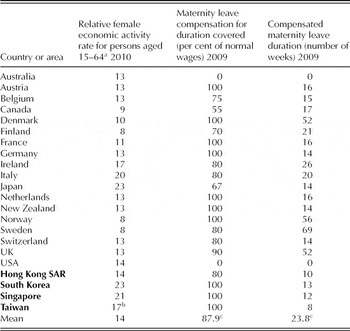
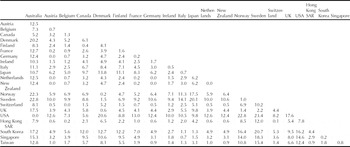
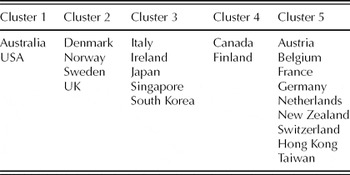
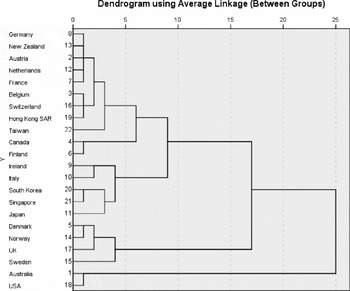
In relation to data analysis, the work done for this article used the average linkage cluster analysis technique to interpret data and classify countries. Cluster analysis has been used by a number of analysts to construct and review welfare typologies (Powell and Barrientos, Reference Powell and Barrientos2004; Wendt, Reference Wendt2009). The average linkage cluster analysis is a commonly used form of cluster analysis. On the basis of the data collected by us, this technique was used to classify the twenty-two countries in different clusters according to the three factors suggested by the defamilisation. This analysis located the closest pair of countries and combined them to form a cluster; this process continued until all cases could be located in a particular cluster. At the end of this process, there was considerable homogeneity among countries within a cluster and reasonably clear boundaries between countries in different clusters. The data for each of the defamilisation measures are outlined in Table 1.Footnote 3 The squared Euclidean distance was used to calculate the proximity matrix. The analysis was carried out using PASW Statistics 18. The result of the work based on average linkage cluster analysis is presented in the dendrogram (Figure 1) and the proximity matrix (Table 2). In order to check the stability of the cluster solutions, three other procedures were used (average linkage within groups, centroid linkage and median linkage). All these procedures created five identical clusters, and the development of a level of homogeneity within the groupings suggested that the five clusters best represent the structure of the data. Components of each of these clusters are shown in Table 3.
Defamilisation index data (2010)

Notes: a Calculated as the difference between the female and male labour participation rate.
b Data from 2009 (National Statistics, R.O.C. Taiwan, 2009).
c Excluding those countries that have a value of 0.
Hierarchical cluster analysis proximity matrix (squared Euclidean distance)

Note: Rounded to 1 decimal place.
Components of the five clusters

Dendrogram – hierarchical cluster analysis

Discussion
Table 1 shows the performance of the twenty-two countries in the three factors of defamilisation. The first is relative female economic activity rate for persons aged fifteen to sixty-four in 2010, calculated as the difference between the male and female labour participation rate. Therefore, the higher the rate means the smaller the proportion of female workers in the labour force. The second is maternity leave compensation for duration covered in 2009, weighed in terms of the percentage of the normal wage a female worker receives during the compensated maternity leave period. The third is compensated maternity leave duration, measured by the number of weeks of paid maternity leave.
The relative female economic activity rate in the twenty-two countries ranges from 8 per cent to 23 per cent, with an average of 14 per cent. Finland, Norway, Sweden, Denmark and Canada are those with the lowest rates – all score 10 per cent or less. This means they have the highest proportion of female workers in the labour force. Japan and Korea have the highest rate of 23 per cent, followed by Singapore (21 per cent) and Italy (20 per cent), indicating that they have the smallest proportion of female workers in the labour force. The scores of other countries (including Hong Kong and Taiwan) show smaller differences, ranging from 11 per cent to 17 per cent.
The overall picture in maternity leave compensation for the duration covered appears to be less diverse. Ten countries (including South Korea, Singapore and Taiwan) provide compensation at 100 per cent of the normal wage. Another ten countries (including Hong Kong and Japan) provide compensation at 55 per cent to 90 per cent. Only Australia and the USA provide no compensation. The mean percentage is 87.9 per cent.
The number of weeks of compensated maternity leave shows greater variation among the twenty-two countries. With the mean at 23.8 weeks, female workers in Sweden (sixty-nine weeks), Norway (fifty-six weeks), Denmark (fifty-two weeks) and the UK (fifty-two weeks) are entitled to compensated maternity leave for one calendar year or over. Their counterparts in most other countries have an entitlement of eight to twenty-six weeks of compensated maternity leave. The exceptions are Australia and USA which do not provide female workers with any entitlement in this respect.
As discussed above, some analysts suggest that East Asian welfare regimes are characterised by their Confucian values and therefore would have a lower degree of defamilisation, while women would have a lower degree of labour participation. Public policies in these countries would tend to encourage women to stay at home rather than supporting them to lead an independent life through participation in the labour market. Figures in Table 1 show that these assumptions may not be applicable to all East Asian countries. Despite the fact that some East Asian countries (e.g. Japan, South Korea and Singapore) have a higher relative female economic activity rate, some (e.g. Hong Kong and Taiwan) share a similar rate with most non-Asian countries. This means female workers in these countries are, by and large, just as active in the labour force as their non-Asian counterparts. In terms of maternity leave compensation, South Korea, Singapore and Taiwan provide 100 per cent of the normal wage in the maternity leave period, and Hong Kong and Japan provide 80 per cent and 67 per cent of the normal wage respectively. Such entitlements are enjoyed by women with a wage and not by those concentrating their effort in looking after their family. As far as compensated maternity leave duration is concerned, the scores of all East Asian countries are under the mean of 23.8 weeks. This means women in these countries are expected to return to work after child birth sooner than their counterparts in most non-Asian countries, instead of being supported to stay at home to look after their new-born for longer.
Table 3 shows the results of the cluster analysis. Five clusters have been identified, each with different characteristics. Due to the high level of homogeneity in the scores for maternity leave compensation for duration covered, this factor is less influential than the other two in shaping the clusters. As shown in the table, the first cluster is composed of Australia and the USA. This cluster is marked by very low government commitment to maternity leave. The second cluster is formed by Denmark, Norway, Sweden and the UK. This cluster is marked by a combination of low relative female labour participation rate and a long compensated maternity leave duration. The third cluster consists of Italy, Ireland, Japan, Singapore and South Korea. The characteristic of this cluster is a combination of a high relative female labour participation rate and fairly short compensated maternity leave duration. The fourth cluster, composed of Canada and Finland, is characterised by a combination of a low relative female labour participation rate and fairly short maternity leave duration. The last cluster is composed of nine countries (namely, Austria, Belgium, France, Germany, the Netherlands, New Zealand, Switzerland, Hong Kong and Taiwan). This cluster is marked by a combination of a fairly low relative female labour participation rate and fairly short compensated maternity leave duration.
As mentioned in the Introduction, there are two preconditions for the development of an all-encompassing East Asia welfare regime – the first is finding significant differences in the welfare systems between the East Asian countries and the seventeen non-Asian OECD countries studied by Esping-Andersen (Reference Esping-Andersen1990), and the second is finding significant similarities in the welfare systems between East Asian countries. However, the five East Asian countries are split between two clusters, suggesting that they are not homogeneous enough to form a cluster of their own. In addition, both the two clusters are mixed groups, made up of countries from East Asia and from elsewhere. This means that countries (whether they are East Asian or not) in these clusters share significant similarities. By referring to the results of the analysis above, it is therefore difficult to conclude that the two preconditions exist.
Conclusion
This article has discussed two approaches to the study of East Asian welfare systems. The first stresses the importance of cultural factors in shaping welfare systems in East Asia. This approach tends to suggest that an East Asian welfare regime exists because welfare systems in East Asia are to a great extent similar to each other and different from other countries. The second approach emphasises the significance of global forces in moulding the welfare systems in East Asia. Since East Asian and non-Asian countries are facing similar issues in the global market, their governments’ responses to these issues may resemble those in non-Asian countries. Despite the fact that the two approaches support different views on this issue, they share the same limitation: they lack sufficient empirical data to back up their argument. In response to this limitation, the defamilisation typology covering the eighteen OECD countries studied by Esping-Andersen (Reference Esping-Andersen1990) and the four tiger economies has been developed. The results of this typology show that the East Asian countries in the study are not homogeneous in the three factors of defamilisation. In addition, they do not locate in the same cluster. Instead, different East Asian countries share various characteristics with non-Asian countries in their respective clusters. In view of the data from the defamilisation typology, it should not be taken for granted that there is an all encompassing welfare regime in terms of defamilisation in East Asia, even though several countries in this region do share a Confucian heritage.
Acknowledgements
The authors would like to thank the journal reviewers for their comments, which have provided invaluable insights for the improvement of the article.