Introduction
Rice (Oryza sativa L.) is one of the most important food crops in the world and is widely cultivated in China with a planting area of 31.7 million hectare, as accounted for 20% of world rice area (Lan et al., Reference Lan, Lin, Wang, Zhang and Chen2012; Lv et al., Reference Lv, Li, Che, Han and Liu2011). As such, keeping sustainable rice yields could ensure food security of China (Fan et al., Reference Fan, Shen, Yuan, Jiang, Chen, Davies and Zhang2011). Paddy soils are the largest anthropogenic wetlands on earth, and study on paddy soil was propitious to protect soil environment. Soil organic C, which is closely associated with soil physical, chemical and biological properties, and whole soil fertility, could reflect change of soil environment (Xu et al., Reference Xu, Lou, Sun, Wang, Baniyamuddin and Zhao2011). Soil organic C sequestration in croplands is not only to increase soil C stock but also to improve soil productivity because there is generally a positive relationship between soil organic C and soil productivity (Pan et al., Reference Pan, Smith and Pan2009). Similarly, soil N sequestration could reduce the amount of N fertilizer application, N leaching, and increased plant-available N content (Sainju et al., Reference Sainju, Senwo, Nyakatawa, Tazisong and Reddy2008). So, it is vitally important to keep reasonable soil C and N concentration. Soil C, N sequestration is generally influenced by many factors, such as tillage, cropping systems, cover crops and fertilization (Sainju et al., Reference Sainju, Singh, Whitehead and Wang2006). Some studies indicate that soil organic C contents were increased by fertilization, organic amendments, cropping rotations, conservative tillage, fallow and so on (Kundu et al., Reference Kundu, Bhattacharyya, Prakash, Ghosh and Gupta2007a, Reference Kundu, Bhattacharyya, Prakash, Gupta, Pathak and Ladhab; Zhang et al., Reference Zhang, Wang, Xu, Huang, Liu and Peng2010; Zhou et al., Reference Zhou, Gan, Shangguan and Zhang2013). For example, soil organic C contents showed increasing trends in all fertilization treatments under a typical rice–wheat agro-ecosystem of China (Shen et al., Reference Shen, Yang, Yao, Wu, Wang, Guo and Yin2007). Meng et al. (Reference Meng, Cai and Ding2005) reported that balanced application of NPK fertilizers and organic manure significantly increased soil organic C sequestration in a fluvo-aquic soil long-term experiment. Jiang et al. (Reference Jiang, Hengsdijk, Dai, de Boer, Jiang and Cao2006) reported that continuous application of farmyard manure and NPK fertilizers increased soil organic matter by 80% and 10% respectively over 20 years in the northern part of China's Jiangsu Province. Nonetheless, soil organic carbon contents declined with continuous application of inorganic fertilizers alone without organic material inputs under long-term wheat–wheat–maize cropping system in northwest China (Su et al., Reference Su, Wang, Suo, Zhang and Du2006).
Soil microbes were sensitive indicators of soil environment and could reflect soil sustainability and land productivity, which play an important role in maintaining soil productivity through biochemical processes, such as soil organic matter decomposition and nutrient cycling (Wu et al., Reference Wu, Qin, Chen, Wu and Wei2011). Moreover, soil microbes could degrade organic compounds, modify inorganic products and release plant-available nutrients so as to promote crop growth (Gong et al., Reference Gong, Yan, Wang, Hu and Gong2011). Meanwhile, the type or amount of soil organic matter could directly affect the soil microbial community structure or functions (Lucas et al., Reference Lucas, Casper, Jackson and Balser2007). Application of organic manure in combination with chemical fertilizer increased soil culturable microbial counts in contrast to the single application of chemical fertilizers, and the balanced application of NPK fertilizers enhanced soil culturable microbial count compared with unbalanced application of inorganic fertilizers and unfertilized control (Gong et al., Reference Gong, Yan, Wang, Hu and Gong2009).
However, there were few investigations on the effects of long-term repeated application of organic and inorganic fertilizers on soil C, N sequestration, soil microbes and crop yields in the middle reach of the Yangtze River rice–wheat cropping systems. Long-term field experiments could gain some information repositories about sustainable agriculture and provide key information on the impacts of agricultural management practices on soil and assess the sustainability of agroecosystems. The main objective of this investigation was to study soil properties, C, N sequestration, soil microbe counts and crop yield changes as affected by 30 years of long-term organic and inorganic fertilizer application, and to evaluate the relationship between soil C, N sequestration and crop yields.
Materials and Methods
Site description of the long-term fertilization experiment
The on-going long-term experiment was established in 1981 belonging to the National Soil Fertility and Fertilizer Efficiency Long-Term Monitoring Network, situated at the Nanhu Experimental Station in the Hubei Academy of Agricultural Sciences, Wuchang, China (30°29′42″N and 114°18′54″E, 20 m a.s.l.). The climate in this experimental site is temperate, humid. The mean annual temperature is 13 °C and ranges from a minimum of 3.7 °C in January to a maximum of 28.8 °C in July. The mean annual precipitation is 1300 mm, of which 60% occurs from April to July and the annual non-frost period is 240 days. According to FAO, soil at the experimental site is yellow brown soil.
Experiment details
The long-term fertilization experiment was designed with eight treatments and three replications, laid out in a randomized complete block design with 24 plots, and each plot was 5 × 8 m in size. The eight fertilization treatments comprised the following: (1) unfertilized treatment (Control); (2) inorganic nitrogen fertilizer treatment (N); (3) inorganic nitrogen plus inorganic phosphorus fertilizer treatment (NP); (4) inorganic nitrogen, inorganic phosphorus plus inorganic potassium fertilizer treatment (NPK); (5) pig dung compost (manure) treatment (M); (6) inorganic nitrogen fertilizer plus pig dung compost treatment (NM); (7) inorganic nitrogen, inorganic phosphorus fertilizer plus pig dung compost treatment (NPM) and (8) inorganic nitrogen, inorganic phosphorus, inorganic potassium fertilizer plus pig dung compost treatment (NPKM).
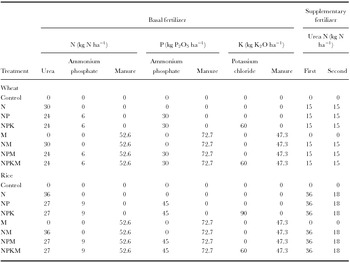
Application doses of fertilizer and split times are shown in Table 1. The inorganic nitrogen, phosphorus, and potassium fertilizers were supplied as urea ((NH2)2CO, N 46%), ammonium phosphate (NH4H2PO4, N 12%, P2O5 60%) and potassium chloride (KCl, K2O 60%). The organic manure was pig dung compost, in which pig dung averagely contained 282 g kg−1 C, 15.1 g kg−1 total N, 20.8 g kg−1 P2O5, 13.6 g kg−1 K2O and 69% water. Three split doses of nitrogen fertilizers were applied with in each crop (the ratio of basal fertilizer:seedling fertilizer:jointing fertilizer was 2:1:1 in wheat growth stages, and the ratio of basal fertilizer:tillering fertilizer:booting fertilizer was 4:4:2 in rice growth stages). Phosphorus and potassium fertilizer were applied as basal fertilizers, which were applied before sowing wheat and transplanting rice annually. Pig dung compost (22.5 t ha−1 annually, namely 11.25 t ha−1 in wheat and 11.25 t ha−1 in rice crop, wet weight basis) was applied as basal fertilizers prior to sowing wheat or transplanting rice annually. The fertilizers used and doses and times of application were typical for this region. All basal fertilizers and manure were evenly broadcasted on the soil surface by hand and incorporated into the plough layer by tillage as soon as possible before sowing wheat or transplanting rice seedling. Tillage was done to 20-cm depth by plough and followed by harrow. The fertilized and unfertilized plots had the same type of tillage.
Experimental design and application amount of inorganic fertilizers and manure from 1981 to 2010.

The supplement amount of nutrient from manure was calculated according to the average N, P and K contents in manure for 30 years.
All plots were sown with wheat (Triticum aestivum L.) in winter and cultivated with rice seedling (Oryza sativa L.) in summer annually starting from 1981. The wheat was directly sowed with seed in November and harvested in May of the second year, followed by rice, which was transplanted in June and harvested in October. The above ground crop was cut with sickle and removed, and no straw was returned into the soil. Nevertheless, wheat or rice stubble and root were incorporated into the soil with plow before planting wheat or transplanting rice seedling. Besides the fertilizer treatments, all other agronomic management was identical in fertilized and unfertilized plots.
Wheat and rice were harvested from ground level manually by sickle in May and October every year. The wheat and rice grains were separated from straw using a plot thresher. Wheat and rice straws were removed from the field after threshing. Wheat and rice grains were weighted after sun-drying and were recorded from a whole plot (14% water content by oven-dry basis).
Soil sampling
Initial soil samples were collected in 1981 before the start of the experiment. Total 24 soil samples were collected from the upper soil layer of each plot using a 1-cm diameter soil auger on 2nd June 2010 after wheat was harvested but soil was not plowed. Each soil sample comprised 10 cores (1-cm diameter × 20-cm deep), which were mixed to form a composite sample. The soil samples were stored in insulated and tied plastic bags to prevent moisture loss, and were transported to the laboratory as soon as possible. The soil samples were kept in cold storage at 4 °C until processing. All soil biological analysis was completed within a week of soil sampling.
Soil analysis
The bulk density was expressed by dividing the weight of the dried soil by the volume of the core using the core volume and dry soil weight. Soil subsamples collected from the 0–20 cm were air-dried for 14 days at room temperature, sieved through a 1-mm screen and mixed; these subsamples were used to analyse for alkaline hydrolysable nitrogen (N), available phosphorus (P), available potassium (K) and soil pH. The air-dried subsamples were ground to pass through a 0.25-mm sieve to determine soil organic C and total N contents. The potassium dichromate external heating method was applied to determine soil organic C content (Blakemore et al., Reference Blakemore, Searle and Daly1972). The semi-micro Kjeldahl method and the alkaline-hydrolysable diffusion method were applied to determine total N and alkaline-hydrolysable N content (Bremner, Reference Bremner and Sparks1996). Soil-available P was extracted with 0.5-mol L−1 NaHCO3 (soil:solution = 1:20) and measured with the Olsen method (Olsen et al., Reference Olsen, Cole, Watanabey and Dean1954). Soil-available K was extracted with 1-mol L−1 NH4Ac (soil:solution = 1:10) and measured with the flame photometry method (Carson, Reference Carson and Dahnke1980). Soil pH was measured with 0.01-mol L−1 CaCl2 slurry (soil:solution = 1:2.5) using a glass electrode.
Plate counts of culturable microorganisms
Total numbers of culturable bacteria, fungi and actinomyces were counted as colony forming units (CFU) using the 10-fold dilution plate methods for 24 soil samples in 2010. The beef extract peptone medium, the Martin medium and the Gause's No. 1 synthetic medium were used to culture bacteria, fungi and actinomyces respectively (Xu and Zheng, Reference Xu and Zheng1986).
Calculation of soil C, N stock and sequestration
Soil organic C and total N stock were calculated by multiplying soil organic C or total N concentrations by bulk density and depth. The amount of sequestered organic C and total N in 0–20-cm soil depth in every treatment was estimated after subtracting the initial soil organic C and total N stock.
Statistical analysis
All obtained data were subjected to statistical analysis of variance (one-way ANOVA) using the SPSS 11.5 software package, and were used to evaluate differences between different treatments. Pearson linear correlation (two-tailed) was used to evaluate relationships between the parameters. Difference obtained at p < 0.05 level was considered as statistically significant using the least significant difference (LSD) test.
Results
Selected soil physical and chemical properties
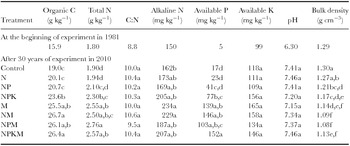
Soil physical and chemical properties were shown in Table 2. Application of organic manure combined with inorganic fertilizer (NM, NPM and NPKM treatments) significantly (p < 0.05) increased soil organic C contents in contrast to the corresponding application of inorganic fertilizers alone (N, NP and NPK treatments). The balanced application of NPK fertilizers significantly (p < 0.05) increased soil organic C contents in comparison to unbalanced application of inorganic fertilizers (N and NP treatments). The content of soil organic C and total N due to 30 years fertilizaton was 6–41% and 2–45% increase in comparison to control respectively. The content of alkaline N and available P due to 30 years fertilization was 7–44% and 37–796% increase compared with control respectively. Soil bulk density in the fertilization treatment was 2–17% decrease contrasted with control.
Selected soil physical and chemical properties at the beginning of experiment in 1981 and after 30 years of experiment in 2010.

Different letters indicate significant differences (p < 0.05) between treatments according to the LSD multiple comparison.
The content of soil organic C, total N, alkaline N, available P and available K after 30 years fertilization treatments was 26–67%, 8–45%, 12–55%, 364–2942% and 11–67% increase in contrast to the initial values respectively. Moreover, the ratio of C:N and soil pH also have incremental trend. However, soil bulk density decreased by 2–16% in comparison to the initial values.
Soil C and N stock and sequestration
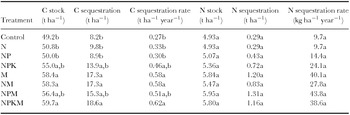
The initial soil organic C stock was 41.1 t ha−1 in 1981. After 30 years of application of organic manure and inorganic fertilizers, soil organic C stock, sequestration and sequestration rate were 50.8–59.7 t ha−1, 8.9–18.6 t ha−1 and 0.30–0.62 t ha−1 year−1, with an average of 55.5 t ha−1, 14.5 t ha−1 and 0.48 t ha−1 year−1 respectively (Table 3). Soil organic C stock, sequestration and sequestration rate were 49.2 t ha−1, 8.2 t ha−1 and 0.27 t ha−1 year−1 in the unfertilized treatment respectively. Soil organic C stock, sequestration and sequestration rate in organic manure and organic manure combined with the inorganic fertilizer treatment were increased compared with the inorganic fertilizer alone treatment, and the same in the balanced application of the NPK fertilizers treatment were increased contrasted with the unbalanced fertilized and unfertilized treatments.
Stock and sequestration in soil organic C and total N (0–20 cm) during the 30 years period of experiment.

Different letters indicate significant differences (p < 0.05) between treatments according to the LSD multiple comparison.
The initial soil total N stock was 4.6 t ha−1 in 1981. After 30 years of application of organic manure and inorganic fertilizers, soil total N stock, sequestration and sequestration rate were 4.93–5.95 t ha−1, 0.29–1.31 t ha−1 and 9.7–43.8 kg ha−1 year−1, at an average of 5.49 t ha−1, 0.85 t ha−1 and 28.3 kg ha−1 year−1 respectively (Table 3). Soil total N stock, sequestration and sequestration rate were 4.93 t ha−1, 0.29 t ha−1 and 9.7 kg ha−1 year−1 in the unfertilized treatment respectively. Soil total N stock, sequestration and sequestration rate in organic manure and organic manure combined with the inorganic fertilizer treatment were increased compared with the inorganic fertilizer alone treatment, and the same in the balanced application of the NPK fertilizers treatment were increased contrasted with the unbalanced fertilized and unfertilized treatments.
Plate counts of soil culturable microorganisms
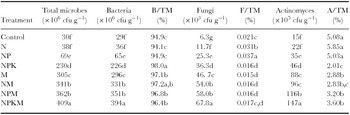
Composition and counts of soil culturable microorganisms were found to be significantly (p < 0.05) different between fertilization treatments (Table 4). Regardless of microbial species, the highest values of CFU were observed in the NPKM treatment and the lowest values in the unfertilized treatment. Application of organic manure combined with inorganic fertilizer (NM, NPM and NPKM treatments) significantly (p < 0.05) increased CFU values compared with the corresponding application of inorganic fertilizers alone (N, NP and NPK treatments). The balanced application of NPK fertilizers significantly (p < 0.05) increased CFU values compared with unbalanced application of fertilizers (N and NP treatments). The CFU values of total microorganisms, bacteria, fungi and actinomyces in different fertilization treatments were increased by 26–1262%, 25–1282%, 84–970% and 47–881% respectively in comparison to the unfertilized treatment. The CFU values of total microorganisms increased by 800%, 426% and 78% in NM, NPM and NPKM treatments compared with N, NP and NPK treatments respectively. The CFU values of total microorganisms increased by 508% and 234% in the NPK treatment contrasted with N and NP treatment alone respectively.
Plate counts of soil culturable bacteria, fungi and actinomyces in different fertilization treatments of the long-term fertilizer experiment.

Different letters indicate significant differences (p < 0.05) between treatments according to the LSD multiple comparison.
Crop grain yields
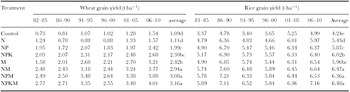
Average grain yield of wheat and rice for every five years is shown in Table 5. The average grain yield of wheat from 1982–2010 was significantly (p < 0.05) higher in NM, NPM and NPKM treatments than in other treatments; it was significantly (p < 0.05) higher in NP, NPK and M treatments than in N and unfertilized treatments, and was significantly (p < 0.05) higher in M treatment than in N, NP and unfertilized treatments. Nevertheless, the difference in yield between N and unfertilized treatment was not significant.
Average grain yield of wheat and rice in different fertilization treatments from 1981–2010.

Different letters indicate significant differences (p < 0.05) between treatments according to the LSD multiple comparison.
The average grain yield of rice from 1981–2010 was significantly (p < 0.05) higher in NM, NPM and NPKM treatments than in other treatments; it was significantly (p < 0.05) higher in NP, NPK and M treatments than in N and unfertilized treatments, and was significantly (p < 0.05) higher in NPK treatment than in N, NP and unfertilized treatments, and was significantly (p < 0.05) higher in N treatment than in unfertilized treatment.
Correlation analysis
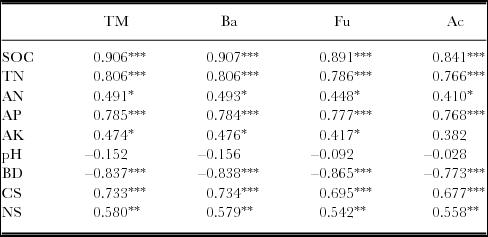
The CFU values of soil microbes (including total microbes, bacteria, fungi and actinomyces) were significantly (p < 0.05) positively correlated with the content of soil organic C, total N, alkaline N and available P, and were significantly (p < 0.01) positively correlated with soil C and N stock (Table 6). The CFU values of soil microbes were significantly (p < 0.001) negatively correlated with soil bulk density.
Correlation coefficients between soil microbes and crop yields and selected soil physical–chemical properties in 2010.
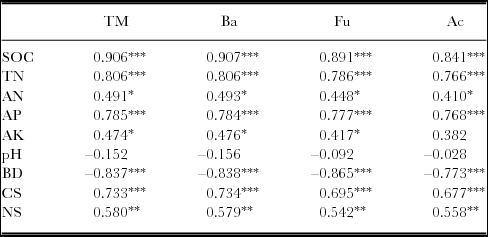
SOC׃ soil organic carbon content; TN: total N content; AN: available N content; AP׃ available P content; AK׃ available K content; BD׃ bulk density; CS׃ carbon stock amount; NS׃ N stock amount; TM׃ total microbe counts; Ba׃ bacteria count; Fu׃ fungi count; Ac׃ actinomyces count.
*p < 0.05; **p < 0.01; ***p < 0.001; n = 24.
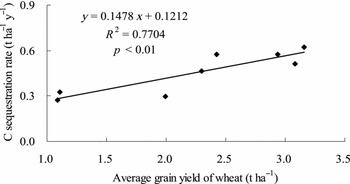
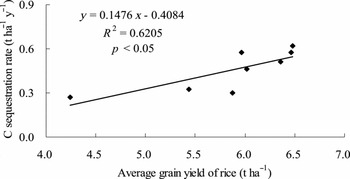
A significantly positive regression relationship could be established between soil organic C sequestration rate and the average grain yield of wheat and rice (y = 0.1478 x +0.1212, R 2 = 0.7704, p < 0.01; y = 0.1476 x –0.4084, R 2 = 0.6205, p < 0.05 respectively) (Figures 1 and 2). Similarly, soil N sequestration rate was significantly positively correlated with average grain yield of wheat and rice (y = 10.711 x +5.7087, R 2 = 0.6689, p < 0.05; y = 10.425 x –31.099, R 2 = 0.5122, p < 0.05 respectively).
Regression relationship between soil organic C sequestration rate and the average grain yield of wheat.

Regression relationship between soil organic C sequestration rate and the average grain yield of rice.

Discussion
Soil physical–chemical properties in response to long-term fertilization
Similar to the previous study, soil organic C, total N, alkaline N, available P and bulk density were significantly affected by soil fertilization (Chu et al., Reference Chu, Lin, Fujii, Morimoto, Yagi, Hu and Zhang2007; Hu and Qi, Reference Hu and Qi2011). The content of soil organic C and total N in inorganic fertilizer treatments increased by 6–24% and 2–21% compared with unfertilized treatment, whereas with organic manure treatments it increased by 34–41% and 34–45% contrasted with unfertilized treatment. This showed that soil organic C and total N sequestration in organic manure treatments is more evident than in inorganic fertilizer treatments. The possible reason is that an addition of organic C was incorporated into soil through manure besides high crop residues in organic manure treatments (Liang et al., Reference Liang, Chen, Gong, Fan, Yang, Lal and Kuzyakov2012). Similarly, the content of soil total N was increased in all fertilization treatments compared with the control treatment, especially in organic manure plus chemical fertilizer treatments in a long-term fertilizer experiment of red soil (Lv et al., Reference Lv, Li, Che, Han and Liu2011). The ratio of C:N was increased in the fertilization treatments compared with the initial values, and was similar to the result reported by Gong et al. (Reference Gong, Yan, Wang, Hu and Gong2011) in the North China Plain, whereas Su et al. (Reference Su, Wang, Suo, Zhang and Du2006) reported that the ratio of C:N was decreased in an arid region of northwest China.
The content of available P was increased in organic manure treatments; its main reason was that pig dung compost contained abundant of phosphorus and this could be accumulated in the soil. Soil bulk density was significantly decreased in fertilization treatments except the N treatment in contrast with the unfertilized treatment, and was similar to the previous study (Zhao et al., Reference Zhao, Wang, Li, Chen, Ying and Liu2009), but was contrasted with the result of Nayak et al. (Reference Nayak, Gangwar, Shukla, Mazumdar, Kumar, Raja, Kumar, Kumar, Rai and Mohan2012). Lee et al. (Reference Lee, Lee, Jung, Park, Lee and Kim2009) observed that the soil bulk density was significantly decreased in organic manure treatments comparable with control, but there had no significant difference between NPK treatment and control. Kundu et al. (Reference Kundu, Bhattacharyya, Prakash, Gupta, Pathak and Ladha2007b) also reported that the content of soil organic C and total N increased in the control treatment compared with the initial values of the 30-years fertilizer experiment.
Soil carbon and nitrogen sequestration in response to long-term fertilization
The present results showed that all the fertilized and unfertilized treatments could promote soil organic C sequestration; the average soil organic C stock increased by 13.7 t ha−1 in the 30-years period, as indicated potential for organic C sequestration in paddy soils. This is similar to the other long-term fertilizer experimental site, in which Shen et al. (Reference Shen, Yang, Yao, Wu, Wang, Guo and Yin2007) reported that soil organic C contents in all treatments showed increasing trends, even in the control treatment. The main reason was that there had some stubble and root residues in unfertilized treatment. Average soil organic C sequestration (0–20 cm) was 10.9 t ha−1 in inorganic fertilizer treatments, but was 17.1 t ha−1 in organic manure and organic manure in combination with inorganic fertilizer treatments through 30 years fertilization, which manifested that application of organic manure has strongly promoted soil organic C accumulation because organic manure was an additional carbon resource incorporated into soils (Chakraborty et al., Reference Chakraborty, Chakrabarti, Chakraborty and Ghosh2011). At the same time, crop biomass in organic manure treatments was higher than in inorganic fertilizer treatments; correspondingly, crop residue (including crop stubble and root biomass) was also higher in organic manure treatments (Kundu et al., Reference Kundu, Bhattacharyya, Prakash, Ghosh and Gupta2007a). The soil organic C sequestration rate (0–20 cm) was 0.27–0.62 t ha−1 year−1 in the present experiment. In contrast to other long-term experimental sites, soil organic C sequestration rate was 0.15–0.51 t ha−1 year−1 (0–20 cm) in Belle Mina, Alabama, southeastern USA (Sainju et al., Reference Sainju, Senwo, Nyakatawa, Tazisong and Reddy2008), and was 0.04–0.16 t ha−1 year−1 in Inceptisol in southeastern Norway (Holeplass et al., Reference Holeplass, Singh and Lal2004).
Soil total N sequestration was significantly higher in organic manure treatments than in inorganic fertilizer treatments in the present study. Similarly, Gami et al. (Reference Gami, Lauren and Duxbury2009) found that soil total N stock were significantly higher in farmyard manure treatment than in NPK fertilizers and unfertilized treatments in Nepal. Gong et al. (Reference Gong, Yan, Wang, Hu and Gong2011) also reported that soil organic N sequestration was significantly higher in organic manure treatments than in inorganic fertilizer and unfertilized treatments in the North China Plain. Zhou et al. (Reference Zhou, Gan, Shangguan and Zhang2013) reported that soil total N stock were increased in organic manure treatments but were decreased in mineral fertilizer treatments through 27-years fertilizer experiment in the Loess Plateau region.
Soil microbes in response to long-term fertilization
The population, composition and structure of soil microbes could be affected by the application of fertilizers (Börjesson et al., Reference Börjesson, Menichetti, Kirchmann and Kätterer2012; Chakraborty et al., Reference Chakraborty, Chakrabarti, Chakraborty and Ghosh2011). The plate counts of soil microorganisms (including total microbes, bacteria, fungi and actinomyces) were significantly higher in organic manure treatments than in inorganic fertilizer treatments. Wu et al. (Reference Wu, Qin, Chen, Wu and Wei2011) found that application of inorganic fertilizers alone did not affect bacterial abundance, but inorganic fertilizers combined with rice straw return to soil significantly increased bacterial abundance with shifts in bacterial community composition. High culturable microbial counts of soil in organic manure treatments showed that there had been high crop residues (root and stubble) and root exudates in organic fertilizer treatments, which provide more carbon resources for the propagation of microorganisms (Gong et al., Reference Gong, Yan, Wang, Hu and Gong2011).
Crop grain yields in response to long-term fertilization
Long-term fertilization increased average grain yield of wheat and rice in contrast to unfertilized control, indicating that N, P and K elements were essential requirements for maintaining wheat or rice growth. In this experiment, the highest average grain yield of crop was in organic manure plus the NPK fertilizers treatment, and the lowest value was in the unfertilized treatment. Similarly, organic manure plus the NPK fertilizers treatment supported the highest wheat and rice grain yields at the Suzhou experimental site of East China (Shen et al., Reference Shen, Yang, Yao, Wu, Wang, Guo and Yin2007). Gu et al. (Reference Gu, Zhang, Tu and Lindström2009) also reported that the highest average grain yields of wheat and rice were in organic manure plus the NPK fertilizers treatment, and the lowest value was in the unfertilized treatment in the Suining long-term experimental site of Southwest China. Likewise, the highest grain yield of rice was also found in organic manure plus the NPK fertilizers treatment in early and late rice cropping systems (Lan et al., Reference Lan, Lin, Wang, Zhang and Chen2012).
The average grain yield of wheat was significantly higher in the organic manure alone treatment than in N and NP alone treatments. Other researchers also found that the grain yield of wheat was significantly higher in the compost alone treatment than in the NP alone treatment in the wheat–maize cropping system of North China Plain (Hu and Qi, Reference Hu and Qi2010). Kato and Yamagishi (Reference Kato and Yamagishi2011) also found that in Japan, the grain yield of Yumeshihou wheat was significantly higher in the organic manure treatments than in the inorganic fertilizer treatments. Singh et al. (Reference Singh, Singh, Ladha, Khind, Gupta, Meelu and Pasuquin2004) found that the highest average grain yields of wheat and rice were in the farmyard and green manures treatments under the long-term rice–wheat cropping system of India. They manifested that organic manure could substitute for inorganic fertilizer. The average grain yield of wheat had no significant difference between N fertilizer alone and the unfertilized treatment in the present study. However, average grain yield of rice were significantly higher in the N fertilizer alone treatment than in the unfertilized treatment in the present study. Similarly, Gu et al. (Reference Gu, Zhang, Tu and Lindström2009) also found that the average grain yield of rice was significantly higher in the N fertilizer alone treatment than in the unfertilized treatment, while the average grain yield of wheat had no significant difference between the N fertilizer alone treatment and unfertilized treatment, as coincided with our study results.
Conclusions
Based on the above results, we found that long-term repeated application of organic manure combined with inorganic fertilizer significantly increased soil organic C contents in contrast to the corresponding application of inorganic fertilizers alone. The balanced application of NPK fertilizers significantly increased soil organic C contents in comparison to unbalanced application of fertilizers. Soil organic C and total N sequestration rate in organic manure and organic manure combined with the inorganic fertilizer treatments were increased compared with the inorganic fertilizer alone treatment, and that in the balanced application of NPK fertilizers treatment were increased contrasted with the unbalanced application of fertilizers and unfertilized treatments. Application of organic manure combined with inorganic fertilizers significantly increased the CFU values of soil microorganisms compared with the corresponding application of inorganic fertilizers alone. The balanced application of NPK fertilizers significantly increased the CFU values of soil microorganisms contrasted with unbalanced application of fertilizers. The average grain yields of wheat and rice were significantly higher in organic manure combined with inorganic fertilizer treatments than in organic manure or inorganic fertilizer alone and unfertilized treatment. Therefore, long-term application of organic manure combined with inorganic fertilizer and balanced application of NPK fertilizers could increase soil organic C concentrations, C and N sequestration, counts of soil culturable microorganisms and crop grain yields.
Acknowledgements
The project was sponsored by the National Basic Research Program of China (973 Program) (2013CB127406); the Special Fund for Agro-Scientific Research in the Public Interest of China (201003016, 201203030); the Scientific Research Foundation for the Returned Overseas Chinese Scholars, State Education Ministry (2012-940); and the Natural Science Foundation of Hubei Province (2008CDB042).