Introduction
Auricular haematoma is a common complication of blunt trauma to the auricle. The most common cause of auricular haematoma is participation in contact sports, especially rugby, wrestling, boxing, mixed martial arts and cage fighting. Other causes include assault, self-harming and accidental trauma.
The anterior auricular skin and perichondrium are tightly adherent to the underlying cartilage. Blunt injury leads to blood vessel shearing from the richly vascular perichondrium to the underlying avascular cartilage leading to sub-perichondrial haematoma accumulation.Reference Giles, Iverson, King, Hill, Woody and Bouknight1 If left untreated, a blood clot forms and undergoes fibrosis with neocartilage formation, which can lead to cauliflower deformity in the long term. Depending on the mechanism and duration of injury, cartilage necrosis can occur, often leading to severe structural abnormality and aesthetic deficits. Local discomfort and pain is associated with auricle deformity. The haematoma can become infected, leading to cellulitis, abscess formation and structural damage to the auricle.
Auricular haematoma management is based on the principle of haematoma or seroma evacuation and obliteration of the dead space between the perichondrium and underlying cartilage. Numerous techniques have been described in the literature, but none is universally accepted as the preferred option. Conventional treatments include aspiration, compressive bolster and stab incision drainage with head bandage; these are often associated with recurrence, thus requiring further surgical intervention. The principle of surgical evacuation and mattress suture obliteration of dead space was reported in 1991.Reference Vuyk and Bakkers2 This report describes the open surgical management of primary, recurrent and spontaneous auricular haematoma. The utility of this technique in a university hospital setting is also demonstrated.
Materials and methods
Auricular haematoma patients who underwent open surgical management performed by the authors at two university hospitals in Scotland were prospectively audited (2010–2013). Information was collected on patient demographics, clinical presentation, disease aetiology, examination findings, previous interventions, details of open surgical management and post-operative follow up. These data were analysed using Excel 2007 (Microsoft, Redmond, Washington, USA). Patient consent was obtained using standard institutional procedures. As this was an audit of practice, no formal ethical approval was deemed necessary.
Management technique
Open surgical management of auricular haematoma can be performed under local or general anaesthesia. The choice of anaesthesia largely depends on patient preference. Adequate anaesthesia was achieved by local infiltration of both sides of the auricle with 5 ml Lignospan Special® using a fine dental needle.
Intra-operative details
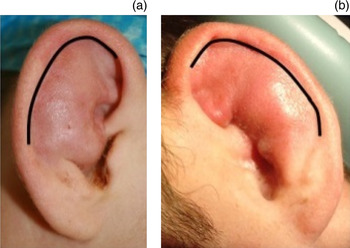
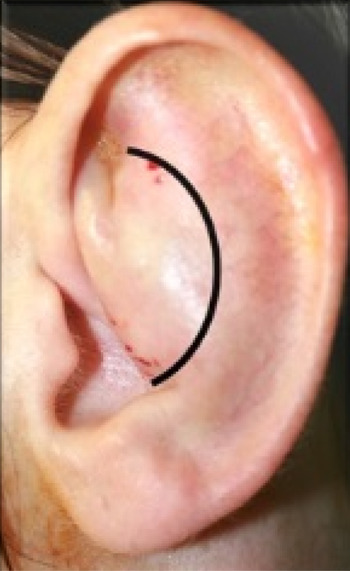
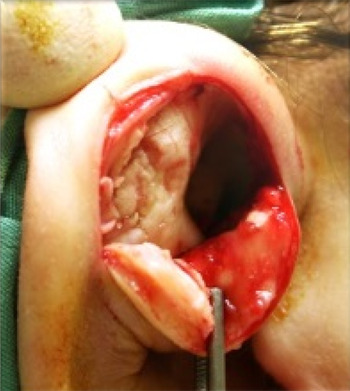
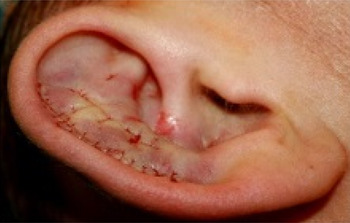
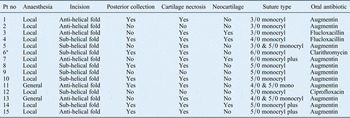
The site and extent of incision was determined by the location of haematoma. The two most commonly used incision types were those of the sub-helical fold or anti-helical fold (Table I). The sub-helical fold incision was located medial to the helical fold (Figure 1) and the anti-helical fold incision was made inferior to the anti-helix on the anterior surface of the auricle (Figure 2). Anterior flap elevation was simple because of previous hydrodissection because of the haematoma. The organised blood clot was then evacuated, followed by thorough saline irrigation. The underlying cartilage was carefully examined and any necrotic or neocartilage was debrided (Figure 3). The rest of the auricle was carefully examined to rule out haematoma located posteriorly to the cartilage. Posterior haematomas were evacuated through a small fenestration in the intact cartilage, followed by saline irrigation. No additional posterior incisions were required. One patient required bipolar coagulation of a granulation that had developed around the necrotic cartilage. The flap was repositioned and approximated using multiple through and through horizontal mattress sutures of fine biodegradable monofilament. Additional mattress sutures were used to obliterate the dead space in the isolated areas. Particular attention was paid to the lower crus of the triangular fossa, where vertical mattress sutures were inserted to drape the skin over the crus. Flap approximation and dead space obliteration were confirmed before closure of incision using interlocking continuous suture of biodegradable monofilament (Figure 4).
Photographs showing two examples (a, b) of a sub-helical fold incision.

Photograph showing an anti-helical fold incision.

Photograph showing auricular cartilage necrosis.

Photograph showing the quilting and closure of an incision.

Operative details of open surgical management

*An isolated mattress suture to the triangular fossa was reinserted after a previously inserted suture had slipped out. Pt no = patient number
Post-operative care
In all, 13 patients had open surgical management performed under local anaesthesia and were discharged home on the day of surgery; 2 patients underwent open surgical management under general anaesthesia and required overnight hospitalisation. All patients received oral antibiotics for one week (Table I). A topical antibiotic ointment was also used to cover the incision and suture site for one week. Patients were reviewed after one, three and six weeks. Any residual suture material was removed at the final visit. No bolsters, head bandages or external compressions were routinely used with this technique. Two patients had light head bandages applied for their comfort during the first 24 hours.
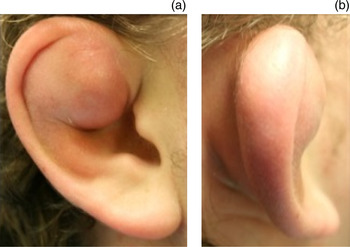
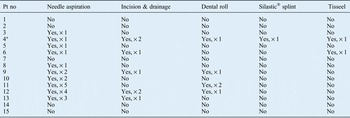
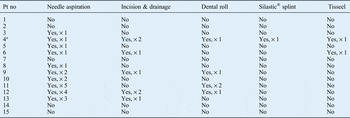
A total of 15 patients underwent open surgical management for auricular haematoma. Three were female; they had developed a spontaneous auricular haematoma or seroma. The remaining 12 were male; of these, most had sustained auricular haematoma during contact sport (Table II). Most patients had a large haematoma involving most of the pinna (Figure 5). The two patients who chose general anaesthesia did so because they had previously undergone failed surgical interventions under local anaesthesia by other surgeons (Table III).
Photographs showing two aspects (a, b) of a large auricular haematoma.

Characteristics of patients undergoing open surgical management

*Duration of auricular haematoma or seroma before OSM was performed. Pt no = patient number; y = years; OSM = open surgical management; d = day; m = month; L = left; R = right
Previous interventions before open surgical management

*The patient had excessive fibrous tissue and neocartilage formation because of the Tisseel (fibrin sealant) deposited between the cartilage and overlying skin flap. Pt no = patient number
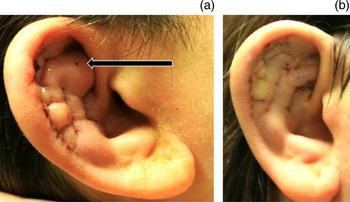
Both spontaneous and post-traumatic auricular haematomas or seromas were managed with open surgery. In this series, four patients with spontaneous auricular seroma had already undergone unsuccessful conventional treatment comprising aspiration followed by a compressive head bandage. All responded well to open surgical management. However, in one patient, the suture at the lower crus of the triangular fossa became loose; thus, occlusion of the dead space was lost (Figure 6a). A fresh suture was inserted under local anaesthesia to prevent recurrence (Figure 6b).
Photographs showing (a) a suture slipped (indicated by arrow) from the lower crus of the triangular fossa, and (b) reinsertion of a vertical mattress suture.

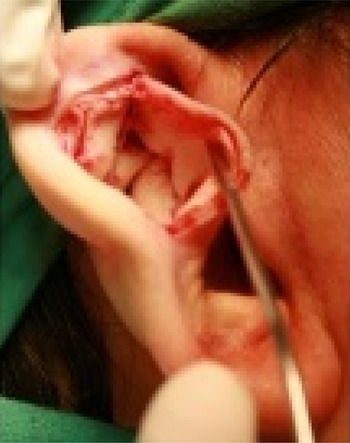
The remaining 11 patients with traumatic auricular haematomas were treated successfully, with no recurrence. Five patients were found to have a trans-cartilaginous haematoma due to traumatic fragmentation (Figure 7). Three patients had purely posterior haematomas, which were successfully drained via the anterior approach through the small fenestration in the cartilage. In 12 patients, auricular cartilage necrosis was evident (Figure 3).
Photograph showing an intra-cartilaginous haematoma.

Complications
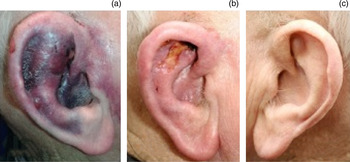
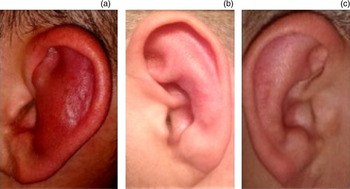
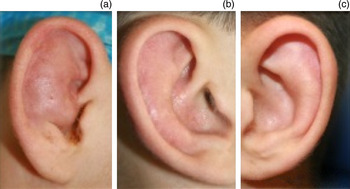
Patient 5 developed auricular cellulitis which responded to intravenous antibiotics, with a satisfactory outcome (Figure 8). Patient 3 developed a suture abscess which resolved with removal of the suture (Figure 9). Both of these patients and the clinicians were satisfied with the aesthetic outcome (Figure 10).
Photographs showing (a) pre-operative perichondritis, (b) resolving perichondritis at the four-week review and (c) the contralateral uninjured ear.

Photographs showing (a) a stitch abscess of the pinna, (b) the aesthetic appearance after resolution and (c) the contralateral uninjured ear.

Photographs showing (a) a large auricular haematoma, (b) the final aesthetic appearance and (c) the contralateral uninjured ear.

Discussion
The external ear consists of the auricle, external acoustic meatus and canal. Structural abnormalities in the auricle lead to obvious aesthetic deformities that can interfere with sound transmission.
The perichondrium and skin are richly supplied by the posterior auricular artery and the anterior auricular branch of the superficial temporal artery, and receive contribution from the occipital artery. The tightly adherent perichondrium is the main source of nutrition to the otherwise avascular cartilage. Any separation of the perichondrium from the cartilage can lead to necrosis of the auricular cartilage.
An auricular haematoma usually occurs secondary to blunt trauma. Shearing of the perichondrial vessels leads to haematoma formation. The exact plane of location of the blood is debated. Pandya's animal model describes an intra-cartilaginous haematoma.Reference Pandya3 The Ohlsén animal model demonstrated that blood placed sub-perichondrially in rabbit ears resulted in a cauliflower deformity, in contrast to subcutaneously placed blood, which resolved within two weeks.Reference Ohlsén, Skoog and Sohn4 Clinical experience of the authors supports haematoma location in the sub-perichondrial plane. Most often, auricular haematomas are anterior, but they can also be posterior or both.
A Cochrane review has reported numerous therapeutic techniques, including aspiration, simple incision and evacuation, anterior and posterior incision with fenestration of cartilage and evacuation, through and through suturing, tie-over dressings, silicone splints, cotton wool and plaster of Paris dressing, passive drainage, suction drainage, use of a swimmer's nose clip, and compression bandage.Reference Jones and Mahendran5 The two most common techniques are aspiration with bolster compression and simple incision and drainage with compression. Both are associated with high failure and recurrence rates, requiring further surgical intervention.
Most conventional techniques are associated with considerable inconvenience to patients and frequent recurrence. Complete evacuation and close approximation of the perichondrium and underlying cartilage are essential to prevent recurrence. Any residual dead space is likely to lead to either haematoma recurrence or seroma formation; this acts as a nidus for neofibrocartilage formation, resulting in a cauliflower deformity. The previous practice of the authors was the conventional treatment of aspiration and dental roll bolster compression. Frequent recurrences were encountered, leading to the adaptation of the open surgical management as the preferred treatment.
Conclusion
Auricular haematomas require complete evacuation of blood, removal of necrotic cartilage and close approximation of the perichondrium to the cartilage to prevent recurrence and attendant aesthetic and functional deficits. In our experience, open surgical management achieves those objectives clearly and predictably.
Open surgical management of recurrent auricular haematomas is simple and reliable, and can usually be accomplished in a clinical setting under local anaesthesia. Satisfactory aesthetic and functional outcomes have led to a change in practice. Open surgical management is now the primary option preferred by the authors for the surgical management of auricular haematoma and spontaneous seromas. Aspiration, bolster compression, and simple incision and drainage are no longer used or advocated as treatment options.