1 Introduction
Jessen & Ringen (Reference Jessen and Ringen2002) argue that the laryngeal contrast in German stops is one of [spread glottis] (henceforth [sg]) vs. no laryngeal specification. According to their analysis, there is no syllable-final devoicing of stops, because all stops are voiceless unless (variably) voiced by passive voicing when between sonorants. Jessen & Ringen's analysis, however, says nothing about fricatives. Unlike stops, German fricatives do contrast in voice in word-initial position, and there is a clear voice contrast in intervocalic position as well. Hence it might be suggested that, although there is no coda devoicing of stops in German, there is coda devoicing of fricatives.
In this paper we consider two interconnected but separate issues. The first is what the feature of contrast in German fricatives is. The second, interconnected, issue is whether there is coda devoicing of fricatives in German.Footnote 1 We argue, on the basis of experimental evidence, that there is no coda devoicing per se in German. Specifically, we compare the different predictions of two phonological optimality-theoretic (McCarthy & Prince Reference McCarthy and Prince1993, Prince & Smolensky Reference Prince and Smolensky1993) analyses of German fricative alternations, one that actively bans voicing in coda position, and one that preferentially preserves voicing in presonorant position. We argue that the results support only the positional faithfulness account that preserves voicing in presonorant position, not the coda-devoicing account.Footnote 2
Discussions of what features can best describe the variety of so-called ‘voice’ contrasts found in the world's languages and what types of voice assimilation occur have persisted in the literature of generative phonology for several decades, including the discussions by Lisker & Abramson (Reference Lisker and Abramson1964), Keating (Reference Keating1984, Reference Keating1996), Westbury & Keating (Reference Westbury and Keating1986), Cho (Reference Cho1990, Reference Cho1994), Lombardi (Reference Lombardi1991, Reference Lombardi1999), Iverson & Salmons (Reference Iverson and Salmons1995), Avery & Idsardi (Reference Avery and Idsardi2001), Rooy & Wissing (Reference Rooy and Wissing2001), Wetzels & Mascaró (Reference Wetzels and Mascaró2001) and Vaux & Samuels (Reference Vaux and Samuels2005). Yet, in spite of this attention, there are possibly more unanswered questions than satisfactory answers. One dominant assumption that has persisted since Lisker & Abramson (Reference Lisker and Abramson1964) is that the feature [voice] is appropriate to characterise languages with two-way laryngeal contrasts involving any two of the following: negative Voice Onset Time (VOT), or (pre)voicing; short-lag VOT, or voicelessness; long-lag VOT, or aspiration.Footnote 3 An alternative view, one that has recently received some significant support in the literature (Rice Reference Rice1994, Iverson & Salmons Reference Iverson and Salmons1995, Jessen Reference Jessen1998, Jessen & Ringen Reference Jessen and Ringen2002, Kallestinova Reference Kallestinova2004) is that the feature [voice] should be more narrowly defined, used only for languages with prevoicing in initial stops (i.e. true [voice] languages), but not for languages with a short-lag/long-lag VOT contrast. There is substantial reason to believe that this alternative approach will shed light on persistent phonological questions about voice and voice assimilation. In this paper, we adopt this narrow position.
The remainder of the paper is organised as follows. In §2, we show how the analysis of German stops in Jessen & Ringen (Reference Jessen and Ringen2002) can be expanded to account for voicing in fricatives. This analysis, which invokes a positional faithfulness constraint, is compared to an analysis with coda devoicing. It is argued that the two analyses make crucially different predictions in cases where fricatives which are underlyingly voiced occur in codas before onset sonorant consonants. §3 describes an experiment we undertook to determine which account makes the correct predictions. It is argued that the results support the analysis with a positional faithfulness constraint rather than with coda devoicing. In §4, we discuss the variation in the results and how this variation can be accommodated in our OT analysis. Throughout, we make the traditional assumption that German fricatives contrast for [voice]; in §5, we address possible objections, including the possibility that [sg] is the feature of contrast. Concluding remarks are given in §6.
2 German fricatives
The German ‘lax’ stops b, d, g are not usually voiced word-initially. Even in word-medial intervocalic position, voicing in b, d, g does not always occur (i.e. is variable) in production and has a negligible effect in consonant perception experiments (see Jessen Reference Jessen1998, Reference Jessen2004, Jessen & Ringen Reference Jessen and Ringen2002 for details). In contrast to stops, German has phonetically voiced fricatives in word-initial position as well as in intervocalic position; for example reisen ‘travel’ with [z] vs. reißen ‘tear’ with [s] and Sklave ‘slave’ with [v] vs. Strafe ‘penalty’ with [f] (see also the examples in (8) below).Footnote 4 We argue that this difference in the distribution of voiced fricative and stop tokens results from the fricatives, but not the stops, being specified for the feature [voice]. Hence, it might be suggested that although there is no coda devoicing of stops in German, there is coda devoicing of fricatives, since these underlyingly voiced fricatives appear to be devoiced in syllable-final position.
- (1)
a. Word-initial (data from Jessen 1998)

b. Root-final

Jessen (Reference Jessen1998: 87) reports that all the speakers in his experiment show significant differences in voicing between tense and lax fricatives in word-initial (specifically utterance-initial) position, as well as in intervocalic position. In contrast, he reports that only one of his speakers shows any significant voicing difference between tense and lax stops in word-initial position, whereas all speakers have significant voicing difference between intervocalic tense and lax stops. In other words, unlike stops, fricatives in German clearly exhibit voicing both in intervocalic position, where passive voicing might be implicated, and in word-initial position, where it is unclear what phonetic constraint could be responsible.
Hence stops and fricatives differ: in initial position, there is a voicing contrast in fricatives, but not in stops. Thus, it would appear that although there are no underlying German stops specified for [voice], there are fricatives specified underlyingly as [voice].
In their OT analysis of the German stops, Jessen & Ringen motivate constraints (a) requiring that input and output correspondents have the same specification for [sg] (Ident[sg], shown in (2a)), and (b) prohibiting voiced spread glottis stops (*[voi,sg], as in (2b); see also Davis & Cho Reference Davis and Cho2003). (This is in addition to the familiar markedness constraints banning aspirates (*[sg]) and voiced obstruents (*VoiObs).) According to this analysis, all German stops are underlyingly voiceless; the actual contrast is between stops that are specified as [sg] and those that are not. The only voiced stops arise by (phonetic) passive voicing, which accounts for the (variable) voicing of intersonorant non-[sg] segments. (Throughout, we follow Jessen & Ringen in assuming privative [voice] and [sg].)
- (2)
a. Ident[sg]
An input segment and its output correspondent must have the same specifications for [spread glottis] (cf. McCarthy & Prince 1995).
b. *[voi,sg]
Voiced spread glottis stops are prohibited.
In addition to the constraints in (2), Jessen & Ringen assume a constraint, ProsodicWord-R[sg] (PW-R[sg]), to account for the fact that passive voice does not apply to the forms in (3a), as well as the fact that the stops are aspirated or produced with some devoicing of the following sonorant.Footnote 5
(3) Clusters that span prosodic word boundaries (*-variably voiced)
Wiese (Reference Wiese1996) argues that suffixes that begin with consonants form independent prosodic words.Footnote 6 Hence the words in (3a) are made up of two prosodic words, whereas those in (3b) are single prosodic words. Jessen & Ringen note that when there are two prosodic words, as in the forms in (3a), a stop that would otherwise be expected to be voiced by passive voicing is not. In fact, it is produced with some aspiration or (partial) devoicing of the following sonorant. In contrast, when there is a single prosodic word, passive voicing occurs (see (3b)).
(4) PW-R[sg]
A prosodic word-final stop is [sg].
The difference between the voicing of the intersonorant stops in handlich and Handlung is illustrated in (5). (Prosodic word boundaries are indicated with curly brackets.)
(5)
The constraint PW-R[sg] accounts not only for the failure of passive voicing in the forms in (3a), but also for an interesting contrast in passive voicing behaviour. We find no passive voicing in the prosodic word-final velar stop of Ta[kh] (< /k/; cf. Ta[g]e ‘day pl’) in Tag und Nacht ‘day and night’, when a word-final stop occurs between sonorants, but (variable) passive voice does occur in die Bude [b] (< /p/ude) ‘the booth’ when a word-initial stop is between sonorants (Künzel Reference Künzel1977).
The constraints assumed in Jessen & Ringen will account for the fact that word-final fricatives are voiceless in German if the PW-R[sg] constraint is generalised to cover all obstruents, as in (6).
(6) (Generalised) PW-R[sg]
A prosodic word-final obstruent is [sg].
(7)
But this account does not explain the voicelessness of other coda fricatives in German (illustrated in (8)). Nor does it connect with independent claims about the [sg] status of German voiceless fricatives (Jessen Reference Jessen1989, Reference Jessen1996, Reference Jessen1998; cf. Vaux Reference Vaux1998).Footnote 7
(8)
The voicelessness of fricatives in clusters preceding stops can be accounted for by the interaction of the constraints assumed in Jessen & Ringen, with two additional, independently motivated constraints:Footnote 8 (a) Ident(preson fric), a positional faithfulness constraint requiring that presonorant fricatives retain their input voice specification on output correspondents (cf. Lombardi Reference Lombardi1991, Reference Lombardi1999, Padgett Reference Padgett, Suzuki and Elzinga1995, Beckman Reference Beckman1998, Steriade Reference Steriade1999 and Petrova et al. Reference Petrova, Plapp, Ringen and Szentgyörgyi2000, Reference Petrova, Plapp, Ringen and Szentgyörgyi2006 for variations on presonorant faithfulness, and Jun Reference Jun1995 for manner-sensitive faithfulness), and (b) Fric[sg], requiring that (voiceless) fricatives be [sg] (Vaux Reference Vaux1998).Footnote 9
- (9)
a. Ident(preson fric)
Presonorant fricatives retain their input voice specification on output correspondents.
b. Fric[sg]
Fricatives are [spread glottis].
(10) Underlying [voice] fricative
As shown in (10a), the optimal output for an input voiced fricative followed by a (voiceless) stop is voiceless – though there is no coda-devoicing constraint in the grammar. This is because only fricatives in presonorant position retain their input voice specifications. Voiced fricatives are simply not possible here, because fricatives that are not in presonorant position are forced to be voiceless by high-ranking Fric[sg]. In contrast, the input voiced fricative in (10b) surfaces with voicing because it is before a sonorant.
The tableaux in (11) illustrate that the optimal output for an input with a voiceless (unspecified) fricative is one in which the fricative is specified as [sg] in the output.
(11) Underlying unspecified fricative
It's worth noting that, given the logic of Richness of the Base and Lexicon Optimisation (Prince & Smolensky Reference Prince and Smolensky1993), this grammar effectively requires that German fricatives be specified for either [voice] or [sg] in lexical representations. (By contrast, the stops will have either a [sg] specification, or no laryngeal specification at all.) For reasons of space, we omit the tableaux illustrating the remaining logical possibilities for input fricative specification; the reader may verify that a fricative which is specified as [sg] in the input will emerge with the [sg] intact in both pre-obstruent and intersonorant position, while an underlyingly [voice, sg] fricative will pattern like the [voice] fricative in (10).
These constraints also correctly predict that when there are two prosodic words, a prosodic-word-final fricative will be voiceless, as illustrated in (12) for grasreich ‘full of grass’.
(12)
Interestingly, there are crucial cases involving fricatives where it is not clear what the facts are. For example, the data in (13) are linguistically parallel to neblig, Handlung, nörglich in (3b), in that the relevant obstruent occurs before a sonorant within a prosodic word, but the pronouncing dictionaries do not agree as to whether the fricatives in (13b) are voiced ([z]) or voiceless ([s]) (whereas they agree that the stop in neblig is [b], not [p]). Specifically, Krech et al. (Reference Krech, Kurka, Stelzig, Stock, Stötzer and Teske1982) prefer a voiceless fricative in words like (13b), whereas Mangold (Reference Mangold1990) prefers a voiced fricative.Footnote 10
(13) Uncertain fricative voicing
Fasrig and gruslig, with voiced [z], would be predicted by the analysis just sketched. The fricative, which is underlyingly specified as [voice], would retain its voice specification because it is in presonorant position, and there is no prosodic word boundary before the suffix -ig – thus no requirement that the fricatives receive a boundary-marking [sg] specification at the right edge of the prosodic word. This is illustrated in (14).Footnote 11
(14) Positional faithfulness analysis
On the other hand, since [zl] and [zʁ] are not possible onsets (Wiese Reference Wiese1996: 263, n. 73, Jessen Reference Jessen1998: 337, n. 5), the traditional analysis with coda devoicing (e.g. Vennemann Reference Vennemann1978, Rubach Reference Rubach1990) would predict fasrig and gruslig with [s], as illustrated in (16).
(15) *VoiCoda (*VoiObs&*Coda) (Ito & Mester 1998)
Voiced obstruents are prohibited in codas.
(16) Coda-devoicing analysis
In order to determine which of the two approaches is correct, we conducted an experiment.
3 Experimental evidence
3.1 Method
32 native speakers of Standard German, 17 male and 15 female students, were recorded in a sound-treated recording studio at the University of Bielefeld, Germany.Footnote 12 The students' ages ranged from 19 to 31, with an average of 23. All had been raised in or around Bielefeld. No speakers were included who were raised in regions known to exhibit voicing of intervocalic voiceless fricatives (e.g. Hessian) or a consistently voiceless production of voiced /z/ (e.g. Alemannic).
The subjects spoke into a condenser microphone from a distance of about 30 cm. They were instructed to read the list in a natural tempo and were told not to speak directly into the microphone (in order to avoid recordings of breath stream impacts in obstruent production). The recordings were analysed acoustically with the speech-analysis software Praat (Boersma Reference Boersma2001).
The list read by the subjects consisted of 75 sentences, some of which contained words with the linguistic structures crucial to the present study (fasrig, etc.). This list was read three times and the results for all three readings were evaluated. The target words are given in (17).
(17) Target words analysed in the experiment
All words in (17a) are single prosodic words, consisting of a stem followed by the derivational suffix -ig or -ung. The alveolar fricative, which is the target of the present investigation, has an input [voice] specification, which is apparent from related words such as gruseln [z] and Faser [z] (see (13) above).
In (17b), the alveolar fricatives fall into two groups. The first two words do not have input [voice]. This can be inferred from the lack of alternations in pairs such as Wasser [s] and wässrig [s], both with voiceless fricatives. The second two words have underlyingly voiced fricatives (cf. lös-en and Gräs-er, with [z]) that occur at the right edge of a prosodic word (before the derivational suffix -reich or -lich). In this position the fricatives are predicted to be voiceless by assignment of [sg] at the right margin of prosodic words, a process which affects all obstruents, as illustrated in (12) above for grasreich (with [s])<{gra/z/}{reich}.Footnote 14
The four examples in (b) were included as voiceless control items for the crucial voiced items in (a). In order to distinguish the alveolar fricatives in (a) from those in (b) terminologically, the ones in (a) will be called ‘predicted voiced’ and the ones in (b) ‘predicted voiceless’ – bearing in mind that predicted voiceless can mean either that the fricatives are not input [voice] or that they are input [voice] but phonetically voiceless due to PW-final [sg].
Measurements of the following acoustic events were performed: ‘beginning of fricative’, as defined by the onset of turbulence in the frequency regions which are characteristic for an alveolar fricative, ‘end of fricative’, as defined by the offset of alveolar frication turbulence, and ‘end of voicing’, defined as the point in time where voicing periodicity ends during the fricative.Footnote 15 Two durations were calculated from these three events: ‘voicing duration’, as defined by the time interval from beginning of fricative to end of voicing, and ‘voicing percentage’, as defined by the percentage of voicing duration relative to the total duration of the fricative (i.e. end of fricative minus beginning of fricative). The segmentation of the beginning and end of the fricative relied on the spectrogram, where the high-frequency turbulence pattern of the alveolar fricative is visible, whereas the segmentation of voicing was based primarily on the waveform, where the onset and offset of individual periods can be determined most accurately.Footnote 16 This set of measurements was performed on all tokens in which the following sonorant consonants were classified as non-syllabic. For the syllabic cases (see §3.2), an abbreviated format was used, where only voicing percentage was determined (i.e. fully voiced tokens, which occurred frequently with syllabic sonorants, were not measured for fricative duration).
Phonologically, in tokens where the following sonorant is syllabic, the alveolar fricative constitutes the onset of the following syllable, whereas in tokens where the sonorant is non-syllabic, the alveolar fricative occurs in the syllable coda. Since this distinction is crucial to the phonological analysis, we classified each token in the experiment into the categories non-syllabic or syllabic. This classification had to be performed on auditory grounds, because no single acoustic criterion for syllabicity was available. All the auditory syllabicity judgements were made by the second author. In order to verify syllabicity status, independent judgements were obtained from two phoneticians (see §3.3).
It should be noted that the issue of whether the sonorant is syllabic or not only arises with /l/, as in kräuslig, Berieslung, gruslig, fusslig and dusslig, and not with /ʁ/, as in knausrig and fasrig. In Standard German, syllabic allophones of sonorant consonants occur with /l/ and the nasals, but not with /ʁ/. For example, the word Dussel ‘fool’ (alternating with dusslig ‘foolish’), can be pronounced either with a syllabic sonorant or with a sequence of schwa and a non-syllabic sonorant. On the other hand, the word Faser ‘fibre’ (alternating with fasrig ‘fibrous’) cannot be pronounced with a syllabic consonantal allophone of /ʁ/; the only option is pronunciation with a near-open schwa-like vowel (see Krech et al. Reference Krech, Kurka, Stelzig, Stock, Stötzer and Teske1982 and Mangold Reference Mangold1990). Since syllabic (consonantal) variants of /ʁ/ do not exist in Standard German, the three-way alternative that exists for /l/ – viz. /z/ followed by non-syllabic l, /z/ followed by syllabic l and schwa inserted between /z/ and non-syllabic l – reduces to a two-way alternative, where either /z/ is followed by a non-syllabic /ʁ/ or a schwa is inserted between /z/ and /ʁ/ (these alternatives will be discussed in §3.2). This two-way alternative is much easier to identify auditorily or acoustically (presence of vocalic peak between /z/ and /ʁ/) than the alternative between syllabic and non-syllabic /l/, and therefore needs no independent evidence.
3.2 Results
We found that the sonorant that follows the alveolar fricative in question was sometimes produced syllabically and sometimes non-syllabically. For example, in some tokens, the sonorant /l/ in gruslig was non-syllabic, while in others it was syllabic. This variation was mainly due to speaker differences, but also occurred between words and repetitions. In the most extreme case, a schwa was inserted between the fricative and the sonorant, which, however, occurred much less frequently than a syllabic sonorant without schwa (except if the sonorant was /ʁ/, as mentioned above). 15 speakers used schwa as one of the possible variants for the type of words listed in (17a). For three of these 15 speakers, this was their most frequent variant for these words. For the others it was a much rarer variant, and for four of the 15 speakers schwa only occurred in one token out of all words in (17a).Footnote 17 In the results (given in Table I below), cases with schwa are not listed separately, but are counted together with syllabic sonorants in the category ‘syllabic’.
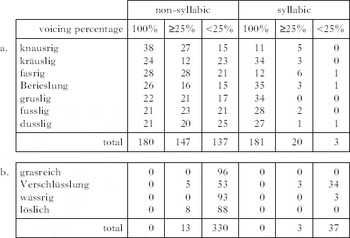
Detailed results for (a) predicted voiced fricatives, (b) predicted voiceless fricatives.

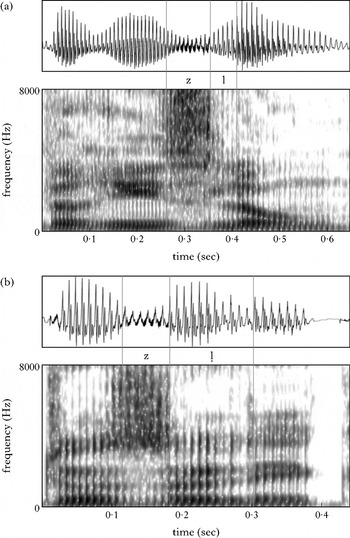
During evaluation of the data, at least three acoustic correlates of syllabicity were found. Sonorants that sounded syllabic tended to be longer than those that sounded non-syllabic (cf. Jones Reference Jones1959 and Roach et al. Reference Roach, Sergeant and Miller1992) and they tended to have higher amplitude. Another interesting correlate was resistance to coarticulation: in tokens where the fricative was entirely voiceless (particularly in predicted voiceless fricatives) or voiceless toward its end, the following sonorant tended to be fully voiced when it sounded syllabic but tended to be partially voiceless when it sounded non-syllabic. Hence in these cases the coarticulatory extension of voicelessness from the fricative into the following sonorant is resisted in syllabic sonorants. Whereas in many tokens the classification was straightforward, there were also a number of tokens where the perceptual classification was difficult. In such cases, the dominant perception was adopted, but the opposite was also perceived, e.g. non-syllabicity was perceived where the dominant perception was syllabic (see below for further discussion). Samples of non-syllabic and syllabic sonorants are illustrated in Fig. 1.
Examples of (a) [z] followed by non-syllabic sonorant (Berieslung; Subject 28, reading 1), (b) [z] followed by syllabic sonorant (dusslig; Subject 32, reading 2). Note that the sonorant in (b) is longer (in relation to the preceding [z]) and the amplitude of the initial portion of the sonorant is higher than in (a).

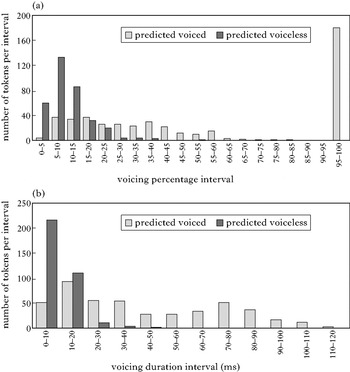
A first impression of the results is given in Fig. 2a, which shows a histogram of the voicing percentage values in all non-syllabic tokens pooled across the 32 speakers and the three readings. Separate results are presented across all the words with predicted voiced fricatives (light grey columns), as in (17a), and across all the words with predicted voiceless fricatives (dark grey columns), as in (17b). The x-axis shows different intervals of voicing percentage values.
(a) Voicing percentage of fricatives in tokens in which the following sonorant /l/ or /ʁ/ was classified as non-syllabic, pooled across words, repetitions and speakers. (b) Voicing duration in tokens classified as non-syllabic, pooled across words, repetitions and speakers. Predicted voiceless fricatives have either no voicing at all (as part of the 0 to 10 ms interval) or have a tail of voicing into the fricative that is only rarely longer than 20 ms. Although tokens with voicing duration values from 0 to 20 ms also occur among predicted voiced fricatives, many tokens of predicted voiced fricatives have voicing durations that are much longer.

Figure 2a shows that the vast majority of predicted voiceless tokens have a voicing percentage from 0 to 25 – with a peak occurrence between 5 and 10%. Predicted voiced tokens also have many tokens in the range from 0 to 25%, although it should be noted that voicing percentage among predicted voiced fricatives is rarely lower than 5%. Furthermore, predicted voiced fricatives also have many tokens with voicing percentages larger than 25%, which is extremely rare among predicted voiceless fricatives. Very strikingly, a large number of predicted voiced tokens are fully voiced, which can be seen in the height of the column in the 95–100% interval.Footnote 18
In addition to pooling the data in the manner shown in Fig. 2, the results were also evaluated separately for each target word and separately for tokens with syllabic and non-syllabic sonorants. These results are presented in Table Ia for predicted voiced fricatives and in Table Ib for predicted voiceless fricatives.
Voicing percentage was divided into three classes: 100% voiced, at least 25% (but less than 100%) voiced and less than 25% voiced. The choice of the 25% boundary was made because the predicted voiceless fricatives rarely have voicing percentages greater than 25%. Hence this dividing line shows how many predicted voiced fricatives have voicing percentages so small that they fall into the range of predicted voiceless fricatives, and how many predicted voiced tokens have voicing percentages that are clearly higher than those found in predicted voiceless fricatives.
A number of observations can be made about the data presented in Table I. Beginning with the syllabic tokens in (a), we can see that the vast majority of predicted voiced fricatives before a syllabic sonorant are fully voiced. Partially voiced tokens with voicing percentages above 25% are much less common and those below 25% are close to zero. It seems from this result that the position before a syllabic sonorant, and hence in the syllable onset, is favourable for voicing.
One might hypothesise from this finding that the speakers who produced a syllabic sonorant did so in order to enhance fricative voicing. This could be construed as an argument in favour of a coda-devoicing analysis: speakers avoid coda position for input [voice] fricative because in that position the voicing feature cannot be implemented faithfully. However, that this cannot be the correct explanation for syllabic sonorant production is shown by the results for the word Verschlüsslung in Table Ib. In this word the fricative is not input [voice], but otherwise has the same status (PW-internal position) as the words in (a). This word has a considerable number of tokens (37) that were produced with a syllabic sonorant. If voicing preservation were the reason for syllabic sonorant production there would not be any reason for syllabic sonorants being produced in words with no input [voice] specification to be preserved.Footnote 19 Furthermore, syllabic sonorant production in PW-internal position also occurs for stops. For example, the words adl-ig ‘noble’ (cf. Adel ‘nobility’) or zottl-ig ‘shaggy’ (cf. Zottel ‘tuft’) can be produced with or without a syllabic sonorant. In Jessen & Ringen (Reference Jessen and Ringen2002) it is claimed that orthographic b, d, g in German have no laryngeal specification and that p, t, k are input [sg]. If stops – including b, d, g – have no [voice] specification, voicing preservation cannot be the explanation for the variation between syllabic and non-syllabic sonorants, but needs an independent explanation. We suggest below that this variation results from constraints being unranked.Footnote 20
For the non-syllabic cases, the predicted voiced fricatives with <25% voicing are most supportive of the coda-devoicing analysis, whereas those with 100% voicing are most supportive of the positional faithfulness analysis. This would only give a slight advantage to the positional faithfulness analysis, since the number of tokens in the 100% category is only slightly larger than those in the <25% voicing category. What about the cases with more than 25% and less than 100% voicing, which amount to about one-third of the tokens? We will argue that these tokens support the positional faithfulness analysis – the only way these tokens with partial but long voicing can be accounted for is by assuming that they are voiced candidates according to OT analysis, but are partially devoiced for phonetic reasons. If both the 100% and the ⩾25% cases support positional faithfulness, the numerical support for the positional faithfulness account is clearly stronger than the alternative. But, we will argue, even if the number of <25% cases were equal to or greater than the sum of the 100% and the ⩾25% cases, positional faithfulness would still be the better option because, in the positional faithfulness approach, <25% voicing in phonologically voiced fricatives can be derived phonetically, whereas there is no way within the coda-devoicing approach to derive the cases with ⩾25% to 100% voicing. Any such procedure would also affect phonologically voiceless fricatives, and these almost never have voicing percentages larger than 25%.
3.3 The issue of sonorant syllabicity
Because there was no single acoustic criterion to use to determine which /l/'s were syllabic and which were not, independent verification of the classification was sought. A subset of the tokens was given as a spliced speech file (with one-second pauses inserted between the words) to two phoneticians with more than seven years of experience in auditory phonetic analysis and no knowledge of the purpose of the experiment. The words selected for presentation were all three repetitions of the words kräuslig, gruslig, fusslig and dusslig, as spoken by four speakers who were selected because – in the auditory judgement of the second author – they produced both syllabic and non-syllabic tokens about equally often (most other speakers had a preferences in one direction or the other). Furthermore, with these speakers, all of the tokens of these four words were produced with 100% or at least more than 25% voicing during /z/. Of the 48 tokens presented, each of the phoneticians had the same syllabicity judgement as the second author for 40 tokens, a degree of agreement of 83%. The remaining disagreements generally involved the same tokens for both phoneticians, and went in both possible directions (syllabic for non-syllabic and non-syllabic for syllabic). The total number of tokens among the 48 in which at least one of the two phoneticians heard a syllabic instead of a non-syllabic sonorant was seven. If these seven are taken off the total number of tokens with 25–100% voicing that were heard as non-syllabic by the second author, a high number of non-syllabic tokens still remain. To be precise, the remaining non-syllabic tokens with 25–100% voicing would be 0·85×(180+147)=277 (see the totals in the first two data columns in Table Ia). The number is higher (296) if the cases with syllabic /ʁ/ are taken out of this calculation, as they should be. This means that even if we remove all of the tokens whose classification might be questioned, there are still an estimated 296 tokens with voiced fricatives in coda position preceding onset sonorant consonants. These are predicted by the positional faithfulness account, but not by the coda-devoicing analysis.
3.4 Speaker-by-speaker analysis and inclusion of fricative duration
In addition to providing the group data shown in Fig. 2 and in Table I, we also analysed each speaker separately, in order to test on a speaker-by-speaker basis whether the data are better explained by coda devoicing or by presonorant faithfulness. In this speaker-by-speaker analysis, we also included ‘fricative duration’ (time from beginning to end of the fricative /z/) as a separate variable, in order to examine the potential of fricative duration to act as a phonetic correlate of the voiced/voiceless distinction, which for some speakers might still cue the voicing contrast when voicing duration does not. For this purpose, differences in both voicing duration and fricative duration between the predicted voiced fricatives of the words in (17a) and the predicted voiceless fricatives in (17b) were analysed with t-tests separately for each speaker.Footnote 21 Since tokens with syllabic sonorants are not crucial, only non-syllabic tokens were included in the t-tests. One speaker produced all predicted voiced tokens with syllabic sonorants, and was therefore excluded. The results for voicing duration and fricative duration are shown in the table in the Appendix.Footnote 22
The results show that for 27 out of 31 speakers at least one of the two phonetic parameters is significantly different in predicted voiced and voiceless fricatives. Both voicing duration and fricative duration were quite often significantly different (for 13 speakers). This confirms the prediction of presonorant faithfulness that before sonorants the contrast between voiced and voiceless fricatives is preserved. When only one of the two parameters was significant, it was most often voicing duration (for eleven speakers), but the opposite situation, where just fricative duration was significant, occurred as well (for three speakers).
For 27 of 31 speakers (discounting the one with 100% syllabic sonorants, which constitutes neutral evidence), these results can only be modelled with a phonological analysis that is based on presonorant faithfulness. Coda devoicing, on the other hand, would predict that all the items investigated here have the same phonetic characteristics (no voicing, or very short voicing tail and long fricative duration), because all occur in the coda, where the voiced/voiceless contrast for fricatives would be neutralised. Coda devoicing could only capture the remaining four speakers for whom predicted voiced fricatives are statistically the same as their predicted voiceless counterparts.
4 Some remarks on variation
4.1 Variation in sonorant syllabicity
There are two distinct types of variation documented in our experimental data: variation in the syllabicity of the liquid in the target fricative+liquid clusters, and variation in the duration/percentage of voicing produced in the predicted voiced fricatives. The first type of variation, we argue, can be accounted for by means of unranked constraints in the phonology. The variation in voicing production, however, we attribute to the difficulty of producing voicing in fricatives. We will first illustrate the key aspects of the syllabification analysis, and then turn our attention to the treatment of the variable fricative voicing.
As noted above, the experimental data showed variation between a coda-onset pronunciation of the target fricative+liquid clusters (e.g. gru[z.l]ig) and a pronunciation in which the fricative appeared in the onset of a syllable with a syllabic sonorant nucleus (e.g. gru[.z .l]ig). This variation can be captured in Optimality Theory with crucially unranked constraints (Anttila Reference Anttila, Hinskens, van Hout and Wetzels1997, Ringen & Heinämäki Reference Ringen and Heinämäki1999). If two constraints are crucially unranked, either ranking results in a possible output. In the case at hand, the unranked constraints are *PeakLiquid and NoCoda.
(18) *PeakLiquid (cf. Prince & Smolensky 1993)
Liquids are prohibited in syllable peaks.
Also essential to the analysis is an undominated phonotactic constraint, shown in (19). Note that *Complex is not sufficient to rule out these onset clusters – complex onsets are entirely legal word-initially, but [zl] and [zʁ] are banned even in this position.
(19) *[zl]/[zʁ]
[zl] and [zʁ] clusters are prohibited in onset position.
The interaction of the unranked *PeakLiquid and NoCoda with the constraint in (19) (and the other constraints motivated above) yields two different optimal outputs – both of which are attested in our data. This is illustrated in (20), where higher-ranking *PeakLiquid in (20a) favours syllabification of the fricative in the coda, while higher-ranking NoCoda in (20b) favours a syllabic sonorant.Footnote 23
(20)
4.2 Variation in fricative voicing
Our analysis based on presonorant faithfulness still leaves open the question of why it is sometimes the case that the fricative /z/ in words like gruslig is phonetically voiceless instead of voiced. That is, though our experimental findings confirm that the fricative retains its voicing in coda position in many utterances, devoicing does also occur. We suggest that phonetic factors are responsible for the devoicing of /z/ in the presonorant context studied here.
Voiced fricatives are difficult to produce in general (Ohala Reference Ohala and MacNeilage1983). This difficulty has to do with an inherent conflict between the production of voicing and the generation of turbulence that is essential for the identification of a fricative and its place of articulation. For the generation of strong frication turbulence, high intra-oral air pressure is necessary, but if intra-oral air pressure is raised too much, it becomes too similar in magnitude to subglottal air pressure, and voice production will cease. This problem is particularly severe in the production of strident fricatives such as /z/. In order to distinguish strident from non-strident fricatives, strident fricatives need to be produced with high-amplitude frication turbulence. But simultaneous voice production inevitably leads to a reduction of frication amplitude. This has the consequence that the difference in frication amplitude between voiced strident and voiced non-strident fricatives is much smaller than the amplitude difference between voiceless strident and voiceless non-strident fricatives, so that the perception of the feature [strident] is challenged for voiced fricatives (Balise & Diehl Reference Balise and Diehl1994). When a strident fricative such as /z/ is devoiced, it means that the speaker was not able to maintain this balance between the goals of voice production and the generation of strong frication turbulence. This does not necessarily have the consequence that the distinction between /s/ and /z/ is lost for the listener, because the distinction is also cued by other means such as a difference in duration between voiceless (longer) and voiced (shorter) fricatives (see Jessen Reference Jessen1998 for an overview and German data). Perhaps because of this and other cues to the voiced/voiceless distinction among fricatives, the speaker often gives in to the articulatory difficulty of voiced strident fricative production, and devoicing occurs.
Some authors report an asymmetry in voicing behaviour between /v/ and /z/, in the sense that the percentage or amount of devoicing is larger in /z/ than /v/ in German (Jessen Reference Jessen1998, Möbius Reference Möbius2004, Kuzla et al. Reference Kuzla, Cho and Ernestus2007). This difference is not unexpected. Specifically, the explanation of fricative devoicing based on Balise & Diehl (Reference Balise and Diehl1994) works for /z/, but not for /v/. In addition, the size of the oral cavity behind /v/ is larger than behind /z/, so that, as with stops, the more anterior articulations are more supportive of voicing. The size of this place-dependent devoicing effect differs between studies; it is non-significant in Jessen (Reference Jessen1998), but significant in Kuzla et al. (Reference Kuzla, Cho and Ernestus2007). Place-dependent devoicing can interact with the phonetic devoicing effect that a preceding voiceless sound exerts on a voiced fricative, e.g. across a word boundary. According to the results of Möbius (Reference Möbius2004), Kuzla et al. (Reference Kuzla, Cho and Ernestus2007), and (less strongly) Jessen (Reference Jessen1998), the voicing difference between /v/ and /z/ is larger after a voiceless sound than after a voiced sound or after pause, so that a post-voiceless alveolar fricative clearly has the lowest percentage or amount of voicing. What happens if /z/ is preceded by a voiceless sound – or in any of the weaker devoicing effects discussed here – is something we believe should be modelled phonetically (gradient devoicing). With perhaps a few unsystematic exceptions, there is no complete (categorical) devoicing at work and therefore no need for a phonological constraint of progressive assimilation to voicelessness in German. Notice that if an assimilatory devoicing constraint were at work it would change all of the phonetic voicing correlates of a voiced fricative – not just vocal fold vibration – in a way that would make it indistinguishable from the voiceless counterpart. There are no indications that such a neutralising assimilation happens in any systematic way for German fricatives in presonorant position.
Having explained why, in general, /z/ might be devoiced, another devoicing influence might arise from the fact that the instances of /z/ that were studied here occur before a sonorant consonant instead of a vowel. In her study of the devoicing of /z/ in American English, Smith (Reference Smith1997) found that frequency of devoicing increases with decreasing levels of sonority in the segment that follows /z/. Smith shows that two of her four speakers produced devoicing of /z/ more often before /l/ than before a vowel. Smith mentions two major types of causes for devoicing: (contextual) influence of glottal opening and insufficient transglottal pressure difference. Since both vowels and sonorants are intrinsically voiced and therefore produced without glottal opening, only the second of her explanations can apply to our case. It is possible that the stronger oral constriction of sonorants as compared to vowels is partially anticipated during /z/, which would lead to higher values of intraoral air pressure and hence a higher probability of devoicing. Our results in Table Ia, where devoicing of /z/ was much rarer if the following sonorant was syllabic than if it was non-syllabic, are consistent with Smith's sonority generalisation: when /l/ is syllabic, it has higher sonority than when it is non-syllabic and therefore should cause less devoicing.
5 Possible objections
5.1 Is there a coda-devoicing alternative?
5.1.1 Variable voicing alternative
We have argued that positional faithfulness provides an analysis of our experimental findings. Conceivably, proponents of the coda-devoicing analysis could object to our conclusions. They would predict that, in words like gruslig, the feature [voice] should not surface because the fricative occurs in coda position. However, they could claim that the coda fricative might still be voiced, as it is in our data, due to variable voicing of fricatives between vowels or sonorants, which occurs in the phonetics. They could support their view by pointing out that in roughly one-third of the tokens of words like gruslig this kind of phonetic re-voicing does not apply, hence supporting the variable nature of such a phonetic re-voicing process. But such an alternative account would not work, for the following reason. When the control items Verschlüsslung and wässrig were examined acoustically, it turned out that the underlying voiceless fricatives in these words were nearly always mostly or fully voiceless (as illustrated in Table Ib, where all but five of 151 tokens were less than 25% voiced). If a phonetic process of fricative voicing between vowels or sonorants occurred in the language, why would words like wässrig be systematically excluded from such a process? The different phonological category of the fricative in words like gruslig on the one hand (phonologically voiced) and words like wässrig on the other hand (phonologically voiceless) cannot be responsible, since due to coda devoicing the alveolar fricatives in both words would be left without a [voice] specification.
For example, as illustrated in (21), in the case of gruslig, the coda-devoicing account produces a voiceless non-[sg] coda fricative which could reasonably be subject to phonetic passive voicing.
(21) Coda devoicing; voiced input
(In the phonetics, PassiveVoice yields gru[z]lig, with variable voicing.)
But with a voiceless input, if the input fricative has no laryngeal specification, the output would be expected to undergo passive voicing, as illustrated in (22).
(22) Coda devoicing; unspecified input
(In the phonetics, PassiveVoice yields *pre[z]en, with variable voicing.)
The result is exactly parallel to that obtained in (21): an unspecified fricative which can be the target of phonetic passive voicing in intersonorant position. But there are no underlyingly voiceless fricatives which undergo variable voicing in intervocalic position.Footnote 24
As illustrated in (23) and (24), the coda-devoicing analysis cannot be salvaged by assuming Fric[sg].
(23) Coda devoicing, assuming Fric[sg]; unspecified input
This analysis derives a [sg] fricative in (23) which is immune to passive voicing, as desired. However, consider the results with a voiced input in (24).
(24) Coda devoicing, assuming Fric[sg]; voiced input
Here, since the output fricative is [sg], no passive voicing is possible and the voiced variant cannot be accounted for.
As we have just seen, a coda-devoicing analysis which assumes privative features and variable phonetic re-voicing is not viable – but might the use of binary [voice] render a coda-devoicing analysis possible? The core problem with the privative feature analysis resides in the impossibility of deriving a representational distinction between fricatives which have undergone coda devoicing and those which are underlyingly voiceless. We will demonstrate that the binary feature analysis suffers from the same shortcoming. (Though the binarity of [voice] is not well supported in the phonological literature, it has not been universally rejected. Thus we consider it important to examine the possible application of [±voice] to our data.)
In a binary feature analysis, coda devoicing is achieved by changing the [+voice] specification of a coda obstruent to [−voice] (rather than removing the [voice] specification entirely, as in the privative [voice] account). Thus, an underlying [+voice, −sg] fricative, as in gruslig, will emerge from the phonology as [−voice, −sg], as illustrated in (25). In the phonetics, passive voicing will target all [−voice, −sg] segments (including stops).
(25) Coda devoicing; [+voice, –sg] input
(In the phonetics, PassiveVoice yields gru[z]lig, with variable voicing.)
Contrast the voiced input of (25) with the voiceless fricative input in (26).
(26) [–voice, +sg] input
When the input voiceless fricative is specified as [+sg], this approach does derive a representational difference between two classes of voiceless fricatives; passive voicing could apply to segments specified as [−voice, −sg], but not to those specified as [−voice, +sg].
There is, however, a significant problem for this binary feature approach: it predicts the existence of a third, unattested, category of fricatives. Consider the case of an input specified as [−voice, −sg] (as required by Richness of the Base).
(27) Hypothetical [–voice, -sg] input
(In the phonetics, PassiveVoice yields *pre[z]en, with variable voicing.)
As (27) shows, the result of a [−voice, −sg] input is a [−voice, −sg] output which will be subject to phonetic re-voicing regardless of its prosodic affiliation. In other words, these fricatives would show variable voicing in both onset and coda position, yielding three distinct classes of intersonorant fricatives: (i) non-alternating voiceless fricatives, (ii) fricatives which are voiced in onsets and variably voiced in codas and (iii) fricatives which are variably voiced in both coda and onset position. This third class of intersonorant fricatives is not attested.
In order to avoid generating a three-way fricative contrast, the binary feature analysis can be supplemented with Fric[sg]. This will have the desirable effect of collapsing the spurious contrast between the two classes of [−voice] fricatives, as illustrated in (28).
(28)
Any voiceless input will correctly emerge from this grammar with a [−voice, +sg] specification, thereby blocking the application of passive voicing in the phonetics. But, as (29) shows, the addition of Fric[sg] produces undesirable results in the case of a voiced input fricative.
(29) [+voice, –sg] input
Fric[sg] forces all [−voice] output fricatives to bear [+sg] specifications, including those derived from coda devoicing. Thus, this binary feature analysis provides no principled way of distinguishing between those fricatives which undergo variable phonetic re-voicing, and those which systematically resist re-voicing – the same problem found in the privative feature coda-devoicing account discussed above.Footnote 25
5.1.2 Constraint conjunction alternative
Hall (Reference Hall2005, Reference Hall2006) presents an alternative coda-devoicing analysis of the data discussed in this paper. In his 2006 paper, he suggests that our analysis of fricatives incorrectly allows for a form Pla[z]ma from an input Pla/z/ma, since we have no way to block such an input/output pair. He claims that Pla[s]ma is the only possible pronunciation. If Pla[s]ma is the only possible pronunciation of this word, then it would, on our analysis, have input /s/ or /ssg/. However, Hall claims that all monomorphemic words with a fricative before a heterosyllabic sonorant consonant allow only a voiceless fricative, and that our analysis cannot account for this.Footnote 26 The argument is that, by Richness of the Base, an input with /z/ before a sonorant cannot be excluded and will surface with [z], and there are no such forms. However, his claim is incorrect. Some of our subjects produced voiced fricatives before sonorant consonants in clusters such as [zl] and [zn] in forms such as Gri[z]ly, as well as Gro[z]ny. On our analysis, such monomorphemic forms result from inputs containing a voiced fricative before a sonorant consonant. Since such forms are found in our Bielefeld data, it is not problematic that our analysis allows them.
Hall's proposal is that coda-devoicing accounts for the devoicing in forms like Pla[s.m]a from Pla/z/ma. Such forms are, in our analysis, derived from /s/ or /ssg/. Hall (Reference Hall2006) provides no account for pronunciations such as Gro[z]ny and Gri[z]ly, which were produced by our subjects, since by coda devoicing these should all have voiceless fricatives.
To account for the fact that coda devoicing does not apply in forms such as gru[z].lig, Hall assumes a high-ranked conjoined constraint OO-Ident[voice]&SCL, which is the conjunction of the Syllable Contact Law (SCL) in (30a) and the output–output constraint in (30b).Footnote 27
- (30)
a. SyllableContactLaw (SCL)
In α.β the sonority of α is greater than the sonority of β.
vowels>glides>rhotics>laterals>nasals>obstruents
b. OO-Ident[voice]
The value of [voice] for an obstruent in ‘stem A’ is identical with the value of the feature [voice] of the corresponding obstruent in derived words containing ‘stem A’.
(31)
A problem with this analysis is that it incorrectly prohibits voicing alternations in any heterosyllabic cluster that violates SCL. An example is Jagd ‘the hunt’, with [kt] from underlying /gd/ (on Hall's [voice] analysis).Footnote 28 That this is an alternating form is indicated by the plural Jagden with [d] (on Hall's analysis).
The exact nature of this alternation depends on the analysis. In Hall's analysis, where the distinctive feature on German stops is [voice], the sound represented by orthographic d alternates between voiceless [t] in Jagd and voiced [d] and Jagden.Footnote 29 In Jessen & Ringen's [sg] analysis, this stop alternates between [sg] in Jagd (due to the necessity of [sg] at the right PW boundary) and no laryngeal feature in Jagden. But the fact that an alternation occurs with pairs like Jagd~Jagden is a problem for Hall's analysis, as illustrated below.
(32)
The analysis could be saved if one were to assume that sonority plateaus (e.g. Ja[k.d]en) do not incur a SCL violation. That is, it might be claimed that the SCL in (30a) should be modified so that it only penalises sharp rises (defined in terms of sonority).
The problem noted above remains: Hall accounts for the failure of coda devoicing in polymorphemic forms such as gru[z]lig by using an output–output faithfulness constraint with constraint conjunction, as shown above – but even this strategy cannot explain the failure of coda devoicing in monomorphemes such as Gro[z]ny and Gri[z]ly for our subjects. Hall could, of course, claim that his analysis was not proposed to account for the behaviour of our speakers. Yet his 2006 paper is a critique of our analysis; his analysis is presented as an alternative to ours. It is unclear to us how his analysis could be modified to account for the failure of coda devoicing in forms such as Gro[z]ny by the speakers in our experiment.
5.2 Incomplete neutralisation
The present analysis makes the prediction that in contexts other than presonorant position within a phonological word, full neutralisation occurs between voiced and voiceless fricatives. It might appear that this prediction is problematic, since it has been claimed by some authors that final devoicing is not a complete neutralisation, but rather that in neutralisation position a phonetic difference remains between underlying voiced and voiceless obstruents in German (Port & O'Dell Reference Port and O'Dell1985). Piroth & Janker (Reference Piroth and Janker2004) is the most recent and comprehensive in a series of phonetic studies that addressed this issue (see Piroth & Janker for further references). With particular attention to the choice of lexical items that are commonly used in modern German (which was a drawback in several of the previous studies), Piroth & Janker measured the total duration of the fricative, the duration of voicing during the fricatives and the duration of the preceding vowel. The phonologically voiced and voiceless fricatives that were measured occurred in contrasting positions and in three kinds of neutralising positions – all PW-finally, one also utterance-finally. Piroth & Janker found that in all three neutralising positions, phonologically voiced fricatives were not significantly different from phonologically voiceless ones, hence neutralisation was complete and the present predictions are borne out.
It is also relevant to examine the situation for stops where complete neutralisation was predicted to occur in PW-final position by Jessen & Ringen (Reference Jessen and Ringen2002). With stops, Piroth & Janker (Reference Piroth and Janker2004) did find some incomplete neutralisation effects. However these effects were extremely unsystematic. Significant differences in neutralisation position between contrasting stops were only found in utterance-final position, for only two of six speakers, and only if closure duration and release (= burst+aspiration) were pooled together (their Table 4); when separating the effects on closure from those on release (Table 8), only one of six speakers showed a significant effect on closure and only one on release. This unsystematic nature of incomplete neutralisation suggests that spelling pronunciation was responsible. A similar kind of unsystematic behaviour, which is also likely to be a spelling pronunciation effect, is prevoicing in utterance-initial or post-voiceless b, d, g in German. Both incomplete neutralisation effects and stop prevoicing are phenomena in German that should not be modelled phonologically.
We note finally that Piroth & Janker comment that the analysis of Lombardi (Reference Lombardi1995) ‘does not explain the emergence of aspiration in devoiced plosives as found in our material’ (2004: 105). (The ‘devoiced plosives’ are, on Lombardi's analysis, those that are underlyingly specified [voice] and devoiced word-finally.) According to Piroth & Janker's Table 3 (REL column), utterance-final stops, as well as many stops in PW-final utterance-medial contexts, are aspirated. This is the pattern predicted in Jessen & Ringen (Reference Jessen and Ringen2002), where PW-final stops are [sg].
5.3 Passive voicing of fricatives?
Iverson & Salmons (Reference Iverson and Salmons2003) suggest that the intervocalic voicing of both fricatives and stops results from passive voicing. They do not explain how the voicing of the word-initial fricatives comes about; this is problematic, as word-initial position is not a plausible environment for passive voicing. Additionally, Iverson & Salmons suggest that for aspirating languages such as German, lax fricatives are only weakly or coincidentally voiced, whereas in ‘true voice’ languages such as Russian or Hungarian, voicing is more robust. However, we know of no evidence suggesting that the voicing in the fricatives of a ‘true voice’ language is any more robust than it is in German.
Additional evidence for underlying [voice] in German fricatives is found in Kuzla et al. (Reference Kuzla, Cho and Ernestus2007). Measuring total duration and voicing duration/percentage in fricatives that occur in initial positions of different prosodic boundary strengths, they found that /v z/ after the strongest boundary exhibit a positive correlation between total duration and voicing percentage. According to these results, tokens with increased total duration due to prosodic strengthening increased voicing duration and also voicing percentage. This can be interpreted as evidence that the speaker wanted to maintain fricative voicing in contexts susceptible to lengthening, in an effort to withstand the devoicing effect that lengthening has on obstruent voicing in general (e.g. in geminates). Such a strategy is only plausible if voicing in fricatives is something worth maintaining, hence a distinctive feature in the language. A similar effect was observed for Dutch /b d g/ by Cho & McQueen (Reference Cho and McQueen2005), where domain-initial strengthening lead to an increase in stop voicing, which is compatible with the view that in Dutch stops, unlike in German stops, [voice] is distinctive. That voicing in fricatives is worth maintaining in German, whereas voicing in stops is not, is also supported by evidence showing that voicing makes essentially no contribution to the perception of tense vs. lax stops, whereas voicing makes an important contribution to the perception of /f s/ vs. /v z/ in German (Jessen Reference Jessen1998: 284–293).
In sum, there is no evidence to support the claim by Iverson & Salmons (Reference Iverson and Salmons2003) that voicing in fricatives can be attributed to passive voicing. There is, on the other hand, strong support for the position we have argued for in this paper, namely that while stops in German contrast for [sg], fricatives contrast for [voice].
5.4 Phonetic enhancement
Another alternative is that the contrast is one of [sg], but that the voicing occurs not as a result of phonetic passive voicing, but as a result of ‘phonetic enhancement’ (Avery & Idsardi Reference Avery and Idsardi2001). The idea is that the [sg] contrast in fricatives is enhanced by voicing the non-spread fricatives. Such an analysis avoids the criticism that there is no phonetic reason for passive voicing of a word-initial non-spread fricative, since this is not an environment in which passive voicing is expected to occur. Enhancement occurs because it heightens a contrast. But this idea raises other questions.
One problem with the enhancement position is that it is not clear why fricatives in German are enhanced with the [voice] feature, but stops are not. Consider the facts of another Germanic language, Swedish. Swedish has both prevoiced stops and aspirated stops in its surface inventory (Ringen & Helgason Reference Ringen and Helgason2004, Helgason & Ringen Reference Helgason and Ringen2008). It might be suggested, therefore, that like German, stops contrast for the feature [sg], but that the voicing in Swedish is attributable to ‘phonetic enhancement’. This leaves unanswered the question of why there should be enhancement of Swedish stops, but not of stops in German.
Moreover, if the fact that German stops are only rarely prevoiced were, in fact, attributed to phonetic enhancement with the [voice] feature, we would expect the voicing in the (phonetically enhanced) fricatives to be similarly variable. Yet we see little or no variability in the voicing of intervocalic and initial fricatives in German. The point is that the [spread] analysis of stops and fricatives with phonetic enhancement predicts a parallelism in the voicing behaviour of stops and fricatives which simply isn't there: voiced fricatives are less prone to a voiceless realisation than ‘voiced’ stops in German.
This lack of parallelism in voicing variability in stops and fricatives is brought into focus when we consider the relationship between voicing percentage and fricative duration. Correlation and regression of voicing percentage against total fricative duration were calculated. If there is a strong negative correlation between voicing percentage and fricative duration, this means that with progressively longer fricative durations, the percentage of voicing becomes lower. Such a pattern would be expected aerodynamically, because the longer the fricative becomes, the more difficult it is to maintain voicing throughout closure. It could be argued that with active voicing due to underlying [voice], such a pattern should not occur, because the speaker would use active means to prevent cessation of voicing. When the voicing percentage was plotted against fricative duration for all non-syllabic predicted voiced tokens, it was found that tokens with 100% voicing occurred throughout most of the range of fricative durations. It is only in the fricatives with durations in the top 20% range (between about 120 and 140 ms) that no tokens with 100% voicing occurred. For all tokens with less than 100% voicing in the data set, the correlation between fricative duration and voicing percentage was −0·35, which is relatively weak.Footnote 30 This result provides evidence against the suggestion that the voicing is due to phonetic enhancement. If the voicing is merely a phonetic enhancement and speakers are not actively trying to maintain voicing, then the negative correlation would be expected to be much stronger. With phonetic enhancement at work we would also expect that tokens with less than 100% voicing would be found for a wider range of fricative durations. But the fact that only the top 20% are affected suggests that the difficulty of maintaining voicing is restricted to very long fricatives, where even active voicing gestures cannot prevent voicing from eventually disappearing.
Another argument against distinctive [sg] in association with voicing enhancement in German fricatives derives from the perceptual perspective (cf. Stevens & Keyser Reference Stevens and Keyser1989). The phonetic cue to [sg] in German stops is postaspiration, which is perceptually salient. This is possible because the centre of the glottal opening in aspirated stops is coordinated essentially with the release, not the centre, of the stop, so that the interval after the release of the stop and approximately before the vowel has begun its steady-state portion is filled with a separate turbulent sound between the stop proper and the vowel, which will not go unnoticed by the listener. When [sg] occurs in fricatives, the situation is different. Here the coordination of the centre of the glottal opening is with the centre of the fricative, not with one of its margins. This means that the time during which the glottis is spread nearly coincides with the time during which oral constriction for the fricative is formed (with the exception of rare cases such as the aspirated fricatives of Burmese). Due to this near-overlap between the glottal opening gesture and the oral constriction gesture, it is very difficult to perceive glottal opening as a separate phonetic event in fricatives. To be sure, glottal opening does have indirect perceptual consequences. Just as in stops, it acts as an effective devoicing mechanism. It might also lead to stronger frication amplitude than in fricatives that have no glottal opening gesture, or glottal opening might be perceivable in the form of breathy phonation at the end of the preceding and the beginning of the following vowel (cf. Jessen Reference Jessen1998, Reference Jessen, Solé, Recasens and Romero2003 for details and further literature). But this indirectness in the perceptibility of [sg] in fricatives suggests that [sg] in fricatives is more like an enhancement feature than a primary feature in the sense of Stevens & Keyser (Reference Stevens and Keyser1989). On the other hand, presence vs. absence of voicing during constriction, the most obvious correlate of [voice], is salient and clearly accessible to the listener, and therefore has the status of a primary feature. So the upshot of this discussion is the following: it is not the case that [sg] is primary and [voice] the enhancement feature in German fricatives; rather, [voice] appears to be primary, with [sg] serving as the enhancement feature.
A final argument in favour of the [sg] specification of fricatives, with voicing as a feature of enhancement, might be that the same laryngeal features should be involved in both stop and fricative contrasts within a given language. Since stops are specified as [sg], fricatives should be too, the argument might go. However, there are other languages in which the stops are specified for one laryngeal feature and fricatives another. For example, Rice (Reference Rice1994) and Tsuchida et al. (Reference Tsuchida, Cohn and Kumada2000) have argued convincingly for analyses of Athapaskan and English respectively in which the stops are underlyingly specified as [sg], but the contrast in fricatives involves [voice]. Unless it can be shown that these and other analyses which involve different laryngeal specifications for stops and fricatives are incorrect, this argument does not go through. German, we suggest, is another language in which the feature of contrast in stops is [sg], but in which fricatives are specified as [voice].
6 Conclusion
In this paper we have argued that the phonological feature of contrast for German fricatives is [voice]. (By the logic of Lexicon Optimisation, the voiceless fricatives in our analysis will be specified as [sg] in lexical representations.) We have presented new experimental data showing that German voiced fricatives, regardless of their syllabification, can and do retain their underlying voicing when followed by a sonorant segment.Footnote 31 This pattern of behaviour is explained by the positional faithfulness account we argued for above, but is problematic for an analysis of German which employs a coda-devoicing constraint. Interestingly, even though there is substantial variation in both fricative voicing and sonorant syllabicity, both types of variation are consistent with the positional faithfulness analysis. The variation in syllabicity of sonorants results from the existence of unranked constraints in the (phonological) grammar: *PeakLiquid and NoCoda are unranked, allowing either gru.[z].lig or gru[z.l]ig to occur as a viable surface output. The variation in fricative voicing, on the other hand, can be understood in the positional faithfulness analysis as variable (phonetic) failure to achieve voicing in segments in which voicing is difficult. There is no comparable explanation available for this variation in the coda-devoicing analysis.
We conclude that, contrary to the widely held belief, there is no coda devoicing in German. The obvious question to ask is whether there is coda devoicing in any language. That is, is there active devoicing that explicitly targets coda positions, or does the devoicing that occurs always result from constraints that protect voicing in privileged positions? This is a question for future research, but preliminary investigations suggest that there is not, as suggested by Beckman & Ringen (Reference Beckman and Ringen2008).