

Narratives are accounts of real or imaginary events (Lahey, Reference Lahey1988). They have been linked with academic success (Westby, Reference Westby and Simon1991), notably reading comprehension (Morrow, Reference Morrow1985) and writing (Spencer & Petersen, Reference Spencer and Petersen2018), and the school-based academic culture values narratives that are constructed according to rules of macrostructure (Petersen, Gillam, Spencer, & Gillam, Reference Petersen, Gillam, Spencer and Gillam2010). Macrostructure has been called the core component of narrative (Peterson & McCabe, Reference Peterson, McCabe, McCabe and Peterson1991) as it addresses story structure and typically includes setting, character, initiating event or problem, feelings, and a resolution (Hudson & Shapiro, Reference Hudson, Shapiro, McCabe and Peterson1991).
Original fictional narratives can be realistic or fantastical. Creating an original fictional narrative requires the narrator to coordinate understanding of the relevance of the narrative, structure their ideas within an accepted macrostructure framework, and use specific linguistic devices to create a cohesive text (Johnston, Reference Johnston2008). They must also understand the role characters play, the way they think and feel, and what motivates them to act (Benson, Reference Benson1993).
Autism spectrum disorder (ASD) is a lifelong neurodevelopmental disorder characterised by impairments in social communication and interaction as well as by behavioural inflexibility (American Psychiatric Association, 2013). Difficulties with narrative have been found to occur in most individuals with ASD (Eigsti, de Marchena, Schuh, & Kelley, Reference Eigsti, de Marchena, Schuh and Kelley2011), and individuals with ASD may produce narratives with impaired story structure (Norbury, Gemmell, & Paul, Reference Norbury, Gemmell and Paul2014). Given the diagnostic profile and narrative performance of individuals with ASD, and that narrative deficits do not necessarily resolve without intervention (Fey, Catts, Proctor-Williams, Tomblin, & Zhang, Reference Fey, Catts, Proctor-Williams, Tomblin and Zhang2004), it is a logical target for intervention.
Intervention studies with children with ASD to develop the macrostructure of personal narrative (Favot, Carter, & Stephenson, Reference Favot, Carter and Stephenson2018b; Petersen et al., Reference Petersen, Brown, Ukrainetz, Wise, Spencer and Zebre2014) and fictional narrative retells (Favot, Carter, & Stephenson, Reference Favot, Carter and Stephenson2018a) have been conducted, but only one study has been conducted with children with ASD to develop original fictional narratives (Gillam, Hartzheim, Studenka, Simonsmeier, & Gillam, Reference Gillam, Hartzheim, Studenka, Simonsmeier and Gillam2015). Children in this study had nonverbal intelligence within normal limits, and according to the severity ratings of the Clinical Evaluation of Language Fundamentals – Fourth Edition (Semel, Wiig, & Secord, Reference Semel, Wiig and Secord2003), one participant had language abilities within normal limits, two had a mild language disorder, and two had a severe language disorder. Probe narratives were collected by asking participants to look at a picture of a problem (e.g., missing the bus) and generate a narrative. An intensive individual intervention was provided, with between 17.5 to 27.5 hours for each participant. The intervention was effective for three of the five participants, including both participants with severe language disorder, on a combined measure of five macrostructure elements. Thus there is very little research on strategies to teach children with ASD and language disorder to generate original fictional narrative, and the single existing study employed an intensive intervention.
The purpose of this pilot study was to trial the methodology for a brief intervention for children with ASD and language disorder to develop original fictional narrative skills. The specific research questions were as follows:
1. Does individualised oral narrative intervention have an effect on the macrostructure of fictional narrative based on a realistic scenario produced by a school-aged child with ASD and language disorder?
2. Do improvements in the macrostructure of realistic original fictional narratives generalise to fantasy-based original fictional narratives?
3. Is the brief intervention feasible and what adjustments to intervention and measurement are necessary?
Method
Participant and Setting
Joe (pseudonym), aged 9 years 8 months, attended the university-based special education program where the intervention took place. The university research ethics committee approved the research, and written informed consent was collected from the participant’s parents. Joe received a diagnosis of ASD from a paediatrician using the Diagnostic and Statistical Manual of Mental Disorders (5th ed.; American Psychiatric Association, 2013). His adaptive behaviour was rated as borderline on the Adaptive Behavior Assessment System II (Harrison & Oakland, Reference Harrison and Oakland2015), his verbal IQ was in the low average range, and his processing speed in the extremely low range (Wechsler, Reference Wechsler2016). An overall IQ score was not calculated due to a spread of subscale scores. His classroom teachers also reported that he was able to answer literal questions based on his reading age texts and was able to retell those stories providing ‘who, what, where’ information.
Joe’s receptive language was in the moderate range of disorder and his expressive language in the severe range of disorder according to the Clinical Evaluation of Language Fundamentals, Australian and New Zealand Standardised Edition – Fifth Edition (Wiig, Secord, & Semel, Reference Wiig, Secord and Semel2017). His receptive vocabulary was low average on the Peabody Picture Vocabulary Test – Fourth Edition (Dunn & Dunn, Reference Dunn and Dunn2007), and his narrative comprehension and production was below average according to the Test of Narrative Language – Second Edition (TNL-2; Gillam & Pearson, Reference Gillam and Pearson2017). Joe was a monolingual English speaker, and his speech was intelligible to non-familiar listeners as judged by the researchers. He was able to participate in structured lessons as reported by his classroom teachers.
Research Design
An AB design was implemented to investigate the effects of an explicit narrative intervention. A generalisation probe to fantasy-based fictional narratives was collected.
Dependent Variable
The dependent variable was a combined measure of five macrostructure elements (character, setting, problem, feelings, and fix). Each of the five components was scored out of a possible 2 points, with a maximum possible total score of 10. Two marks were scored if the component was complete and specific (e.g., character’s name) and 1 mark if the component was appropriate but not specific (e.g., the boy).
Materials
The researcher used a whiteboard and Picture Communication Symbols (Mayer-Johnson, 2008), hereafter referred to as icons, to represent the five macrostructure elements in each session. Each of the icon cards had a picture representing the element and the name of the element written on it. A different stimulus picture, depicting an everyday problem (e.g., burnt toast, umbrella blown inside out), was used each day to collect the probe data. Where possible, the picture illustrated the problem only (e.g., close-up of broken Lego tower) but some necessarily included information relating to the setting and character. All stimulus pictures were collected from Google Images and were printed in colour.
Probes
The participant sat next to the researcher at a desk in a small room for both the baseline and intervention probes. All probes were video recorded on an iPhone to allow for transcription and interrater reliability. The first probe was conducted using the stimulus picture only (no icons condition); the researcher directed the participant’s attention to the picture and then asked him to make up a story about the picture. When he had stopped talking for 3 seconds the researcher thanked him. The second probe (icons condition) was conducted immediately after the first. The same stimulus picture stayed on the board and the five macrostructure icons were placed across the top of the board, left to right, in the following order: character, setting, problem, feelings, and fix. The researcher did not explain the icons. The same procedure was used in the second probe.
Intervention
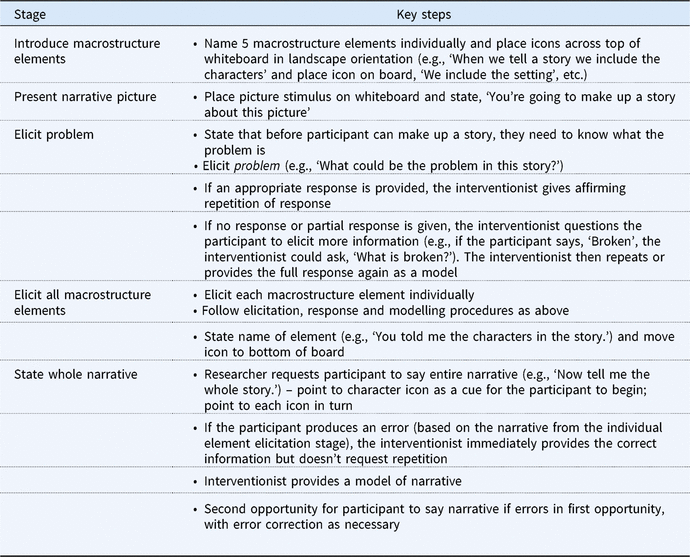
Intervention occurred immediately after the probes, using a different picture for each session. Joe received four 4–6 minute intervention sessions a week. The intervention was designed so that the participant could produce each macrostructure element separately after elicitation and then produce the whole narrative independently. The key stages and steps of the intervention are outlined in Table 1.
Key Stages and Steps of Original Fictional Narrative Intervention

Generalisation Probes
Generalisation probes to fantasy-based stimuli were collected preintervention using the picture of aliens in a park from the TNL-2 (Gillam & Pearson, Reference Gillam and Pearson2017) and postintervention using a single picture from There’s An Alligator Under My Bed (Mayer, Reference Mayer1987) in the no icons condition only. The pictures were placed in front of the participant, and he was asked to tell the best story he could.
Reliability
A trained observer independently recoded 20% of the daily probes. Reliability was calculated by dividing agreements by agreements plus disagreements. Overall coding reliability was 92%. The single coding disagreement resulted in a 1-point difference to the total score. The same trained observer conducted procedural reliability on 20% of randomly selected intervention sessions. Overall procedural reliability was 96%.
Results
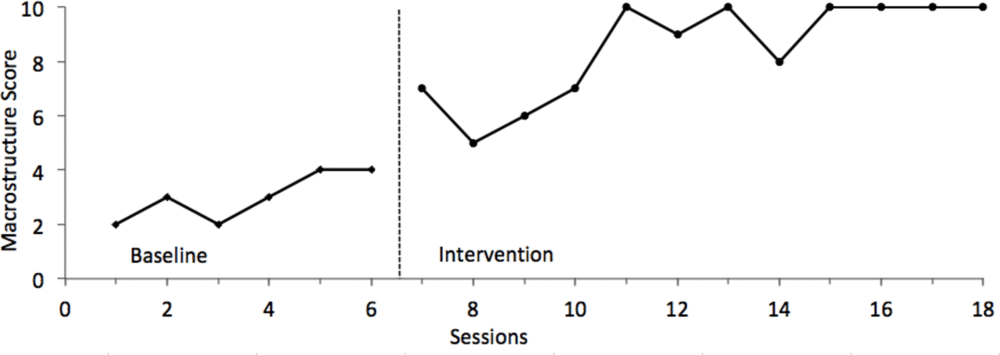
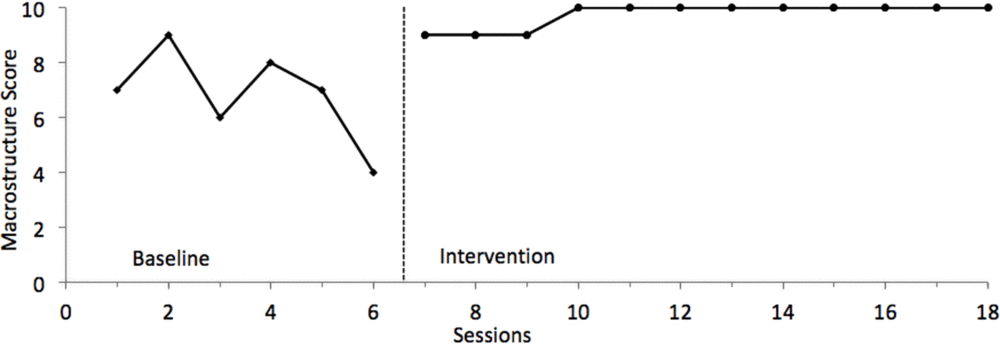
Figure 1 shows the effects of intervention on the macrostructure of original fictional narrative in the no icons condition, and Figure 2 shows the effect of intervention in the icons condition. A clear experimental effect was displayed in the icons condition but the rising baseline in no icons condition makes it difficult to confidently assert experimental control. The rising baseline in the no icons condition may have been because Joe started spontaneously reading the labels on the macrostructure icons during the baseline probes. Joe scored 8 in the preintervention generalisation probe and 9 in the postintervention probe. The intervention appeared to be feasible and effective with short intervention sessions of between 4 and 6 minutes each, approximately 55 minutes of intervention in total. No adjustments to the intervention were necessary.
Macrostructure score in no icons condition.

Macrostructure score in icons condition.

Discussion
Based on the results, it appears that the intervention was effective and feasible. There was limited evidence of generalisation, possibly due to a measurement ceiling effect. Generalisation probes were collected at the end of a comprehensive narrative assessment in which the participant was exposed to multiple exemplar narratives as part of the TNL-2 (Gillam & Pearson, Reference Gillam and Pearson2017). It is also possible that the stimulus materials used for generalisation elevated his scores, as the pictures provided character, setting, and problem information.
The total intervention time of 55 minutes compares with total intervention times of 23.5 to 27.5 hours for students with severe language impairment in the study of Gillam et al. (Reference Gillam, Hartzheim, Studenka, Simonsmeier and Gillam2015). The results of this pilot study indicate that more extensive research into this brief intervention to develop original narrative in children with ASD and language disorder is warranted.
The study has three limitations. First, the AB design is weak, but it was suitable for a pilot study to allow preliminary evaluation of the intervention (Alberto & Troutman, Reference Alberto and Troutman2009) and to assist in refining procedures. Second, Joe started to read the names of the macrostructure elements on the cards during the true baseline phase. It is possible that by being exposed to the cards he was inadvertently receiving intervention, and this would need to be addressed in future research. The third limitation was the possibility that the preintervention generalisation scores were inflated. Future generalisation probes could include stimulus pictures with less macrostructural information, as well as verbal or written stimuli.
Conclusion
There is a range of potential benefits in developing skills in narrative production, and narrative skills are linked to success in school, particularly in literacy-based areas such as reading comprehension and writing. The present study has provided preliminary evidence that a short intervention may be effective in developing fictional narrative skills in children with language disorders and ASD. Further, more rigorous studies are warranted.