In usage-based approaches to acquisition, exposure to exemplars in the input and the engagement of cognitive mechanisms are believed to facilitate the acquisition of constructions (Bybee, Reference Bybee2006, Reference Bybee2008; Ellis, Reference Ellis2006a; Goldberg, Reference Goldberg2006, Reference Goldberg2009; Tomasello, Reference Tomasello2003). According to Goldberg (Reference Goldberg2006), constructions refer to learned pairings of form and function that include both individual words (e.g., pretty, snow) and general linguistic patterns (e.g., the ditransitive [Subj + V + Obj1 + Obj2] construction as in She gave him an apple). At various stages in the acquisition of a construction, different types of input may be particularly useful. Low variability input, which contains repeated occurrences of a construction with a limited set of lexical items, may facilitate initial pattern detection. For example, a conversation between two people who are unpacking boxes in their new apartment is likely to contain numerous verb–object–locative (VOL) constructions, but those sentences will probably contain the same lexical verbs repeatedly, such as put, place, and set (e.g., put that box in the kitchen, place the coffee table in front of the sofa, set the microwave on the counter, put my suitcase in the bedroom, place my clothes in the closet, set the dishes on the table). This conversation illustrates low variability because the VOL constructions contain only three lexical verbs, and all of the exemplars follow the same basic pattern [verb + N(oun)P(hrase) + P(repositional)P(hrase)].
Low variability input can be further differentiated based on the token frequency associated with a key lexical item in the construction, typically a lexical verb or noun, so that the distribution is either balanced or skewed (Casenhiser & Goldberg, Reference Casenhiser and Goldberg2005; Goldberg & Casenhiser, Reference Goldberg and Casenhiser2008; McDonough & Nekrasova-Becker, in press; Nakamura, Reference Nakamura2012; Year & Gordon, Reference Year and Gordon2009). In balanced input, the distribution of exemplars across the lexical verb or noun has equal token frequency, which was illustrated by the VOL constructions in the apartment example because each lexical verb (put, place, set) occurred twice. Skewed input, however, contains more exemplars created from one lexical item (i.e., high token frequency) while the other lexical items occur less frequently (i.e., low token frequency). In terms of the conversation described previously, the input would be skewed if one lexical verb (e.g., put) occurred in most of VOL constructions (e.g., put that box in the kitchen, place the coffee table in front of the sofa, set the microwave on the counter, put my suitcase in the bedroom, put my clothes in the closet, put the dishes on the table). In both conversations, there are the same number of lexical verb types (three) and tokens (six), but balanced input presents all three verbs with equally-low token frequency, while skewed input presents one verb with high token frequency (put) and two verbs with low token frequency (place and set). The tendency for a large proportion of exemplars of a construction to occur with a specific lexical item is referred to as Zipf's law or described as a Zipfian distribution (Zipf, Reference Zipf1935).
Input with a skewed distribution is believed to facilitate novel pattern learning. Because it presents repeated exemplars with the same lexical item, skewed input may promote the organization of those exemplars into a category that captures key form–meaning pairings (Goldberg, Casenhiser & White, Reference Goldberg, Casenhiser and White2007). The presence of a shared concrete feature, such as the repeated lexical item, makes the abstract relational structure expressed through the construction easier to detect. In contrast, balanced input does not contain a lexical item that occurs with high token frequency. As a result, the underlying construction category may be more difficult to detect. The benefits of skewed input over balanced input have been supported in several experimental studies that examined the acquisition of a novel construction by child and adult first-language (L1) speakers of English (Casenhiser & Goldberg, Reference Casenhiser and Goldberg2005; Goldberg, Casenhiser, & Sethuraman, Reference Goldberg, Casenhiser and Sethuraman2004; Goldberg et al., Reference Goldberg, Casenhiser and White2007). These studies involved a novel construction of appearance, which consisted of English nouns (Ns) and nonce verbs (Vs) following the N1N2V–o word order, with the corresponding meaning of N1 appears in/on N2 (e.g., the spot the king moopoed, the sailor the pond naifoed). This line of research showed that skewed input was more effective than balanced input at promoting both the comprehension and production of the appearance construction.
Subsequent studies have found either no differences in the effectiveness of balanced and skewed input at promoting comprehension of the target constructions or advantages for balanced input (McDonough & Nekrasova-Becker, in press; Nakamura, Reference Nakamura2012; Year & Gordon, Reference Year and Gordon2009). These studies, however, were carried out with second language (L2) speakers of English, unlike the Goldberg studies, which were carried out with L1 English speakers. The L2 studies targeted a variety of constructions including dative constructions that the participants had some prior exposure to (McDonough & Nekrasova-Becker, in press; Year & Gordon, Reference Year and Gordon2009), the novel construction of appearance used in Goldberg's research (Nakamura, Reference Nakamura2012), and a novel Samoan ergative construction (Nakamura, Reference Nakamura2012).
Researchers have questioned whether the lack of significant effects for skewed input on the detection of L2 constructions may be due to the explicit learning environment associated with the formal classroom settings where previous studies were carried out (McDonough & Nekrasova-Becker, in press; Year & Gordon, Reference Year and Gordon2009). Skewed input may yield no advantages when participants rely on explicit reasoning as opposed to largely implicit category learning driven by input, as in Goldberg's L1 studies (e.g., Goldberg et al., Reference Goldberg, Casenhiser and White2007). However, Nakamura's (2012) study, which was carried out in a laboratory setting as opposed to a classroom context, also failed to replicate the positive findings for skewed input for either the appearance construction or the Samoan ergative construction. Nevertheless, Nakamura's participants in the skewed input conditions showed a positive correlation between their comprehension scores and their explicit knowledge of the target constructions, suggesting that explicitness was again a factor in construction learning from skewed input. Thus, it remains unclear how explicit learning impacts the extent to which skewed input facilitates the detection of L2 constructions.
Even in explicit learning contexts, skewed input may facilitate L2 construction learning depending on the nature of the learning task, specifically whether it is inductive or deductive. Indeed, most L2 classroom learning tasks differ not necessarily in terms of their implicitness or explicitness, but rather in terms of their deductive or inductive orientation (see DeKeyser, Reference DeKeyser, Doughty and Long2003). Although there has been considerable variation in the operationalization of these terms, deductive learning tasks typically explicitly state the rule or system to be learned, after which exemplars are provided as a practice activity. The instructions provided before the exemplars can vary considerably, ranging from explicit statements that there is a pattern or rule and learners should try to identify it (DeKeyser, Reference DeKeyser, Doughty and Williams1998; Robinson, Reference Robinson1996; Rosa & O'Neill, Reference Rosa and O'Neill1999), instructions that learners should simply complete the activities (Erlam, Reference Erlam2003) to teacher-guided discovery (Haight, Herron & Cole, Reference Haight, Herron and Cole2007; Vogel, Herron, Cole & York, Reference Vogel, Herron, Cole and York2011). In contrast, inductive learning tasks provide exemplars as a way for learners to identify or discover the rule or system to be learned. Although they range in explicitness, inductive learning tasks share the premise that a target pattern can be identified by the learners following exposure to relevant exemplars (Haight et al., Reference Haight, Herron and Cole2007; Herron & Tomasello, Reference Herron and Tomasello1992).
In light of the contradictory findings for skewed input in L2 pattern detection, in particular the potential mediating factor of explicit learning, we raise the possibility that the effectiveness of skewed input may be influenced by the learning task, specifically whether it is inductive or deductive. Whereas deductive instruction provides learners with a rule to be practiced, inductive instruction requires that learners identify or discover the rules through exposure to exemplars. Since no rules or patterns are given a priori under inductive instruction, the concrete similarity across exemplars provided through skewed input (i.e., the high token frequency of one lexical item) may help learners extract the relevant information. In contrast, because deductive instruction provides the rules a priori, the high token frequency of a single lexical item may not be necessary for pattern detection, so the pattern can be best practiced through balanced input. In sum, the purpose of the current study was to explore these possibilities, addressing the following research question: Which type of low variability input is more effective for novel pattern learning (accusative -n suffix in Esperanto) under inductive and deductive learning conditions in an L2 classroom context?
Method
Participants
The participants were first-year students at a large public university in northern Thailand who were enrolled in four classes of the same required English-as-a-foreign-language course (N = 117). Each class was randomly assigned to one of four treatment groups (skewed/inductive, skewed/deductive, balanced/inductive, and balanced/deductive), and all of the students in each class carried out the research activities during one regularly-scheduled instructional period. After the biographical information and research activities were completed, exclusion criteria were applied to increase the comparability of the participants across the four groups. In terms of biographical information, one student was excluded because she reported living in an L2 environment for one year, whereas none of the other students had spent more than two weeks in a country where they had to use a foreign language to communicate. In terms of performance on the research activities, 18 students were excluded for failing to learn the meaning of the target Esperanto words prior to undertaking the construction learning task (below 90% on the learning task and/or below 70% on the vocabulary knowledge test).
The final participant pool consisted of 98 Thai university students (85 women, 13 men) distributed across the balanced/inductive (n = 24), balanced/deductive (n = 22), skewed/inductive (n = 27), and skewed/deductive (n = 25) groups. They were pursuing bachelor degrees in various science and social science majors, including industrial agriculture, nursing, medical technology, physics, science education, and social science education. There were no differences in the participants’ mean age, years of prior English instruction, or knowledge of additional L2s across the four treatment groups. They were all native speakers of Thai with a mean age of 18.3 years (SD = .5) who had studied English previously for a mean of 12.7 years (SD = 1.9), which consisted of required grammar and reading classes taken in primary and secondary school. They reported having some of knowledge of Arkha (n = 1) or Chinese (n = 12) as heritage languages, and beginning-level knowledge of Japanese (n = 2) or Korean (n = 2). None of the participants were studying additional languages as part of their degree programs or for personal interest.
Target construction
The experiment targeted the Esperanto transitive construction, which involves both morphological and syntactic features. In terms of morphology, the suffix (-n) is added to mark nouns as objects. For example, the word hundo “dog” appears without an affix when it functions as the subject, but receives the -n suffix when it functions as the object (hundon). Although Esperanto has a definite article (la), which can be used to indicate a specific member of the class (i.e., “the dog”) or the entire class (“dogs”), it does not have an indefinite article, so a singular noun alone corresponds to both “dog” and “a dog”. In terms of syntax, word order in Esperanto transitive constructions is variable, as the accusative suffix differentiates subjects from objects. Although six word orders are possible (S(ubject)V(erb)O(bject), OVS, VSO, VOS, SOV, OSV), the most commonly used are SVO and OVS (Cox, Reference Cox2011; Harlow, Reference Harlow1995). The construction was considered novel for the participants because (a) they had no prior exposure to Esperanto, (b) neither Thai (their L1) nor English (their L2) inflects nouns for case, and (c) both Thai and English are SVO languages.
Unlike the morphological affixes associated with the appearance construction and the Samoan ergative construction (-o and -e, respectively), the -n suffix on nouns in Esperanto is required for learners to decode the meaning of the construction because word order is variable. For example, in Goldberg's studies, learners could differentiate between the appearance construction (N1N2V–o) and simple transitive constructions (N1VN2) by relying on word order only. Similarly, the Samoan ergative construction targeted in Nakamura (Reference Nakamura2012) could be interpreted through reliance on word order only (Ve–N1N2) as no other constructions or word orders were included in the experimental materials. In addition, whereas previous studies manipulated the token frequency of lexical verbs (such as dative constructions and the appearance construction), the current study manipulates the token frequency of nouns. In sum, because the transitive construction is highly productive (i.e., not limited to a small set of lexical verbs) and word order is variable, the most important cue for recognizing the correct meaning of the Esperanto transitive construction is the morphological affix on the direct object.
Design
A factorial design with two, between-groups variables was used to test the effect of input (balanced vs. skewed) and instructions (inductive vs. deductive) on the acquisition of a novel construction in Esperanto (accusative -n suffix). Both balanced and skewed input had low variability (i.e., low type frequency) in which only four nouns were used to create 24 sentences. However, balanced input featured each noun with the accusative suffix six times, while skewed input included one noun with the accusative suffix 12 times, while the other nouns occurred in the accusative form four times each. In terms of instructions, participants who received inductive instructions were told that Esperanto had flexible word order so it was important to pay attention to the endings of nouns in order to understand the meaning of sentences. In contrast, participants who received deductive instructions were told that Esperanto had flexible word order so the suffix -n is added to the noun that functions as the object. The dependent variable was the accuracy with which the participants could identify in test sentences which noun functioned as the object.
Materials and procedure
Vocabulary learning
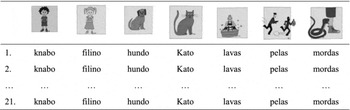
The vocabulary learning activities, which were identical for all four experimental conditions, targeted the four nouns and the three verbs that were used to create the sentences with the novel construction. The four nouns were knabo “boy”, filino “girl”, hundo “dog”, and kato “cat”, while the three present tense verbs were mordas “bite”, pelas “chase”, and lavas “wash”. Each word was individually recorded, as part of a longer list of Esperanto words, directly onto a computer by a female native speaker of Spanish using a Plantronics (DSP-300) microphone. For the first vocabulary activity, the resulting audio files were embedded in a digital audio list in which each word was spoken three times, separated by a 4000 ms pause. The participants received a checklist that showed pictures of the seven words in the first row, followed by 21 rows with the orthographic form of each word in separate cells (see Appendix for examples of all materials). The nouns were written in the base form, without any number or case affixes (e.g., knabo), and the verbs were written in present tense (e.g., lavas). The participants’ task was to circle the orthographic form corresponding to the word that they heard on the audio recording. The second vocabulary activity was used to assess whether the participants had learned the seven words. They received a second vocabulary checklist containing seven pictures without the orthographic form of the words. The participant then heard another audio file which contained a randomized list of the seven words separated by a 3000 ms pause. The participants numbered the pictures on their handout to reflect the order in which the words were presented. The audio file was played twice.
Construction learning
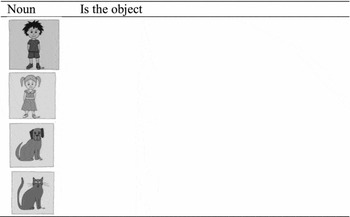
The construction learning task was designed to draw the participants’ attention to the objects in the novel constructions. They were given a table that contained pictures of the four nouns in one column and blank cells in the second column. Their task was to listen to the 24 sentences and place a tick mark in the blank cell next to each picture every time that noun occurred as an object. The table did not provide any orthographic forms of the nouns.
The training sentences consisted of 12 SVO and 12 OVS sentences, with each noun occurring as an object an equal number of times for each word order. All verbs were conjugated in present tense, which corresponds to the -as inflection. Each sentence was audio recorded by the same native Spanish speaker, as part of a longer list of sentences, using the same equipment. The resulting audio files were then organized in skewed and balanced input lists to manipulate the variable of input type. The skewed input list included 12 sentences in which hundon “dog” occurred as the object (six SVO and six OVS), and four sentences each with katon “cat”, filinon “girl”, and knabon “boy” as the objects (two each as SVO and OVS). In contrast, the balanced input list featured each noun as an object six times (three each as SVO and OVS).
To manipulate the variable of instruction type, the directions and practice sentences for the construction learning task varied. The instructions for the inductive group stated that word order in Esperanto is flexible so noun endings are used to show which noun is the subject and the object; therefore, it was necessary for participants to listen closely to the nouns in order to understand the meaning of Esperanto sentences. Their practice task was to number two pictures (“a dog biting a boy” and “a girl washing a cat”) corresponding to the order in which they heard four sentences. Two practice sentences expressed the meaning of the biting picture (SVO: hundo mordas knabon; OVS: knabon mordas hundo “a dog biting a boy”), and two practice sentences expressed the meaning of the washing picture (SVO: filino lavas katon; OVS: katon lavas filino “a girl washing a cat”). The instructions for the deductive group stated that word order in Esperanto sentences is flexible, and because of the flexible word order, Esperanto adds the -n sound to the end of a noun that functions as an object. Their practice task was to number four pictures (dog, cat, boy, girl) to correspond with four practice sentences (two SVO and two OVS) in which each noun occurred as an object once.
Test materials
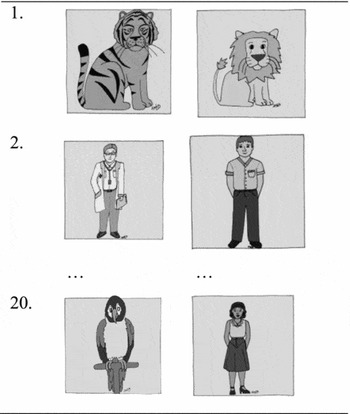
In order to determine whether the participants learned the novel construction, the construction learning phase was immediately followed by a test phase. The test consisted of 20 novel sentences (10 SVO and 10 OVS) constructed from the same three verbs presented during the learning phase (mordas “bite”, pelas “chase”, lavas “wash”) and six new nouns (tigro “tiger”, leono “lion”, birdo “bird”, doktoro “doctor”, patro “father”, and virino “woman”). New nouns were used in the test sentences in order to avoid the possibility that the participants simply acquired item-based knowledge of the four nouns presented in the construction learning task, as opposed to system learning of the word order and the accusative suffix. Because the transitive construction is highly productive and not limited to specific lexical verbs, the learning challenge is to detect and generalize the morphological affix to new nouns. Each noun appeared as an object with the -n suffix at least once, with variation in the occurrence of each noun driven by plausibility. In other words, sentences that expressed information contrary to real world knowledge were avoided, such as items like tigro lavas virinon “tiger washes woman”. The participants received an answer sheet that showed a picture of both nouns in each sentence, and their task was to circle the noun that functioned as an object. For example, they heard the sentence leonon pelas doktoro “doctor chases lion” (OVS), and circled either the picture of the lion or the doctor. The test sentences were recorded by the same native speaker of Spanish using the same equipment and were organized for presentation in a randomized list with a 5000 ms pause between sentences. Reliability statistics were calculated for SVO and OVS items separately, and Cronbach's alpha was .77 and .78, respectively.
Task sequence
The research activities were administered to the participants during 60 minutes of a regularly scheduled, 75-minute English class. They were informed that the purpose of the study was to explore the relationship between memory and L2 learning, and that they would learn some new words and how to make simple sentences in Esperanto. After completing the consent form and biographical information questionnaire, the participants carried out a 15-minute phonological memory activity as part of the pilot testing for another study. Next, the researcher explained the instructions for the vocabulary learning activities in English, and answered any clarification questions in English or Thai. Prior to playing the audio file for the vocabulary learning activity, the researcher read the Esperanto word for each picture provided on the checklist, and then supplied the English and Thai translation equivalents.
After completing the vocabulary learning and test activities (15 minutes), the researcher gave either the inductive or deductive instructions for the construction learning task in English, and then answered clarification questions in either English or Thai. The participants then performed the four practice sentences, received the correct answers, and carried out the construction learning task with the skewed or balanced input (15 minutes). Finally, the instructions for the test activity were given in English and questions were answered in Thai or English. The researcher read the Esperanto word for the six new nouns illustrated on the participants’ answer sheet prior to playing the test sentences. Lastly, the participants were given five minutes to write down in Thai or English what they had learned about Esperanto.
Analysis
The vocabulary activities were scored to identify participants who failed to learn the meaning of the seven words that were used in the construction learning task. Any participant who failed to achieve at least 90% accuracy on the vocabulary learning activity (19 out of 21 words) and 70% on the vocabulary test (5 out of 7 words) were excluded from the analysis. Test items were scored as correct (i.e., 1) if participants selected the picture corresponding to the object, and incorrect (i.e., 0) if they selected the picture corresponding to the subject. No partial points were awarded.
In order to account for response bias (i.e., a tendency for a participant to select one of two forced-choice response options), d′ values were used as the dependent variable. Based on Signal Detection Theory (Macmillan & Creelman, Reference Macmillan and Creelman2005), d′ is a measure of sensitivity that takes into account participants’ correct discrimination of a pattern (i.e., ideally, a high “hit” rate with minimal “misses”) and their bias to report false positives (i.e., ideally, a low “false alarm” rate, coupled with a high rate of “correct rejections”). Since both English and Thai are SVO languages, the expected response bias would be for the participants to select the noun following the verb as the object regardless of its morphological features. Therefore, correct responses for SVO items were coded as “hits”, while incorrect responses for SVO items were coded as “misses”. For the OVS items, correct responses were classified as “correct rejections” while incorrect responses were treated as “false alarms”. For each participant, the resulting d′ sensitivity values were computed as the difference between the proportions of hit (H) and false alarm (FA) responses, expressed as z scores (d′ = z[H] – z[FA]). Values of d′ above 1 indicate increasingly greater sensitivity to inflected morphology, with little bias to rely on the familiar SVO word order as a cue. In contrast, values at or near 0 suggest that any discrimination is largely cancelled out by the response bias, while values below zero suggest that performance is largely driven by participants’ bias to rely on the SVO word order.
For all statistical tests reported below, the alpha level for significance was set at .05. The effect sizes reported below are partial eta squared (ηp2), calculated by dividing the effect sum of squares by the effect sum of squares plus the error sum of squares. For t-tests, effect sizes are reported as r. A Bonferroni procedure was applied to adjust the level of significance for all tests of simple main effects.
Results
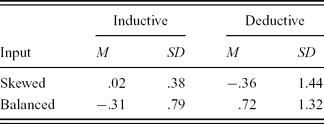
Table 1 summarizes the mean d′ values as a function of input (skewed vs. balanced) and instructions (inductive vs. deductive). These data were analyzed using a 2 × 2 analysis of variance (ANOVA), which revealed no significant main effects for input, F(1,94) = 3.04, p = .09, ηp2 = .03, or instructions, F(1,94) = 2.49, p = .14, ηp2 = .02. However, there was a significant two-way interaction, F(1,94) = 10.86, p < .001, ηp2 = .10.
Mean d′ values by input (skewed vs. balanced) and instructions (inductive vs. deductive).
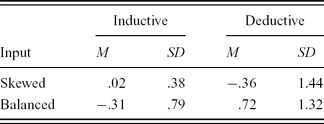
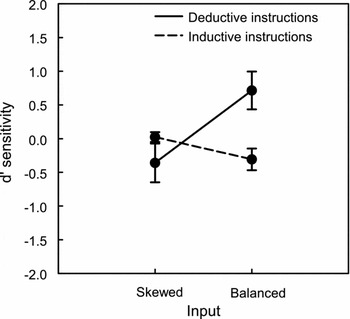
The significant interaction, which is illustrated in Figure 1, was examined further. As Figure 1 shows, the participants’ performance in the two skewed input groups was similar (p > .05) and was largely driven by response bias to select the noun after the verb as the object, regardless of its morphological features. This was also true for the inductive/balanced input group, whose performance was not different from that of the two skewed input groups (p > .05). Only the combination of deductive instructions and balanced input was successful at helping the participants detect a novel pattern based on morphology. This was the only group that attained above-chance performance, t(21) = 2.55, p = .02, r = .49.
d′ values by input and instructions. Brackets enclose ±1 SE.

Discussion
The research question asked which type of input and instructions were most effective for novel pattern learning in Esperanto. We raised the possibility that skewed input might be effective when combined with inductive instructions, but this relationship was not confirmed. Instead, the findings revealed that balanced input with deductive instructions was the only condition that resulted in discrimination at above-chance levels, thus confirming the previous findings in favor of balanced input for the L2 comprehension of dative constructions (McDonough & Nekrasova-Becker, in press) and the L2 production of appearance constructions (Nakamura, Reference Nakamura2012).
Deductive instructions about the -n suffix with balanced input may have been the optimal combination for leading the participants away from reliance on word order. Indeed, both Thai and English (the participants’ L1 and L2, respectively) are predominantly SVO, and neither language has case marking on nouns. Consequently, the provision of explicit information may have been necessary to draw learners’ attention to the morphological cue (-n) that is more reliable than word order for identifying the function of nouns (see Ellis, Reference Ellis2008, and MacWhinney, Reference MacWhinney2008, for psychological views on reliability and saliency of morphosyntactic cues). Interestingly, the same deductive instructions followed by skewed input did not facilitate pattern detection. The concrete similarity across high-token frequency exemplars provided in skewed input was not facilitative of pattern detection even after the pattern had been identified through deductive instructions. The equally-low token frequency provided in balanced input may have been more useful for establishing that the pattern was not unique or limited to a specific lexical noun.
One potentially mediating factor concerns the amount of “noise” in the input. For example, in the appearance construction studies (e.g., Casenhiser & Goldberg, Reference Casenhiser and Goldberg2005; Nakamura, Reference Nakamura2012), the input contained only one word order, whereas the input in this study presented a novel affix with both a known and a novel word order, SVO and OVS, respectively. Because the morphological affix is the most reliable cue to the transitive construction in Esperanto, it is necessary to provide both word orders in order to increase the cue strength and validity of case marking in relation to word order (MacWhinney, Reference MacWhinney2008). Simply presenting the affix with the familiar word order (SVO) would be unlikely to promote the detection of the morphological affix as L1 Thai/L2 English speakers can arrive at the correct meaning by relying on the familiar word order. And presenting the affix with a novel word order only (OVS) would also be unlikely to promote the detection of the morphological affix as the participants would simply learn that the order of subjects and objects in Esperanto is opposite from their L1 and L2, without needing to detect the morphological affix. Consequently, in both scenarios, morphology is redundant, and therefore unlikely to be detected (for overviews of redundancy, see VanPatten, Reference VanPatten1996, and Ellis, Reference Ellis2006b).Footnote 1 Exposed to both word orders simultaneously, learners have to look for the most reliable cue for assigning the correct meanings to nouns (the -n suffix), while trying to suppress interference from the competing word order cue (see Ellis & Sagarra, Reference Ellis and Sagarra2010, Reference Ellis and Sagarra2011, for discussion of cue competition and learned attention).
Researchers have suggested that L2 learners draw on explicit learning strategies during input-based learning activities carried out in a language classroom (McDonough & Nekrasova-Becker, in press; Year & Gordon, Reference Year and Gordon2009), which may negatively impact the effectiveness of skewed input for pattern detection. Similarly, in a lab-based study, Nakamura (Reference Nakamura2012) reported a positive relationship between explicit knowledge of target constructions and comprehension scores, raising the possibility that this explicit knowledge facilitated test performance, but may have ‘cancelled out’ the positive effects of skewed input. In the current study, participants who received deductive instructions (i.e., were told that Esperanto adds -n to nouns when they function as objects) could have achieved high discrimination values on the test regardless of their performance during the construction learning task. In other words, since the crucial information for decoding Esperanto transitive constructions had been provided explicitly, their success at ‘practicing’ this knowledge might not be related to their subsequent test performance. In contrast, participants who received inductive instructions (i.e., were told that noun endings in Esperanto are important) may be unlikely to achieve high discrimination values on the test unless they successfully detected the pattern during the learning task.
We explored this possibility in a post-hoc analysis of the relationship between the construction learning scores and d′ test scores. Because the main findings indicated an interaction between input and instructions, Pearson correlations were obtained for each group separately. There was no significant relationship between the construction learning and test performance for the deductive/balanced (r = −.013, p = .954), deductive/skewed (r = .003, p = .989), or inductive/balanced (r = .298, p = .157) groups. However, there was a significant correlation between the construction learning task and test performance for the inductive/skewed group (r = .543, p = .003). Although the inductive/skewed group did not achieve above-chance discrimination values, the correlation analysis indicates that their ability to detect the pattern during the construction learning task was related to their subsequent test performance. Consistent with Nakamura's (2012) findings, these results suggest that the explicit information about the target construction available in deductive instructions could negate potential benefits of skewed input (i.e., for the deductive/skewed group). And in line with classroom-based studies (e.g., McDonough & Nekrasova-Becker, in press), these results also imply that the explicit environment of a language classroom may lessen the learning impact of skewed input (i.e., for the inductive/skewed group).
In this study, we addressed one question about the contribution of low-variability input to novel pattern learning, namely, whether inductive or deductive instructions impact the effectiveness of skewed and balanced input. The findings indicated that the combination of deductive instructions and balanced input was optimal for learning a novel pattern in which morphology, rather than word order, was the most important cue. Besides the potential roles of morphology and explicit learning orientation, divergence from the findings of the previous research with the novel construction of ‘appearance’ may be related to prototypicality. In the L1 appearance studies (e.g., Casenhiser & Goldberg, Reference Casenhiser and Goldberg2005), the construction was associated with lexical verbs, and the skewed input condition provided high token frequency of the most prototypical verb. In the current study, the novel pattern (transitive construction in Esperanto) was more closely associated with nouns as opposed to lexical verbs. However, the nouns used to illustrate this construction did not vary according to how prototypical they were for the patient role. Therefore, it is possible that skewing the input by presenting a noun that is considered prototypical of the patient role (such as an inanimate noun acted upon by a human agent) with high token frequency will positively impact the effectiveness of skewed input.
A final question concerns the nature of the mental representations that result from exposure to both types of input. As reported in Nakamura (Reference Nakamura2012), L2 participants were able to articulate explicit knowledge about the rules of the appearance and Samoan ergative constructions. Although it was beyond the scope of the current study to investigate the participants’ mental representations of the Esperanto transitive construction, the experimental materials did include a debriefing question about what the participants had learned about Esperanto. Only three participants (two in the deductive/balanced group and one in the deductive/skewed group) provided a response that mentioned word order and the -n suffix for direct objects. Six participants, who were distributed across all four groups, mentioned grammar generally, but did not refer to any specific structures or patterns. As the participants were not instructed specifically to describe the grammatical rules of Esperanto, they predominantly commented on the pronunciation and meaning of Esperanto vocabulary items and their challenges when listening and remembering the new sounds. Our current research aims to clarify the types of generalizations learners form following exposure to balanced and skewed input, using more robust measures than self-report. This research can hopefully shed greater light on the benefits of learning through low-variability input, which can further clarify its applicability to explicit learning contexts.
Appendix: Examples of materials
Vocabulary learning task
You will hear the seven Esperanto words shown below. Each word will be said three times. For each item, circle the word you hear.
Vocabulary learning task.

Vocabulary test task
Now you will hear the seven words only. Each word will be said one time. For each word you hear, write its number above the correct picture.
Vocabulary test task.

Construction learning task
Now you will hear some sentences. Your task is to listen to each sentence and count how many times each noun occurs as an object. Put a tick mark in the box every time you hear each noun being used as an object.
Construction learning task.

Test task
Now you will hear Esperanto sentences with the same verbs and six new nouns. Based on what you have learned about the grammar of Esperanto, decide which noun is the object in the sentence you hear. Remember that Esperanto has flexible word order, so you need to listen to the endings of the nouns to know which one is the object.
Test task.