Extra-corporeal membrane oxygenation is an external life-sustaining circuit, which acts as a rescue cardiopulmonary bypass to allow time for the heart and lungs to repair from damage. Since its development over 50 years ago, extra-corporeal membrane oxygenation has become an invaluable tool to support patients with serious cardiopulmonary dysfunction.
There are two predominant types of extra-corporeal membrane oxygenation, distinguishable by their unique circuity. Reference Etchill, Dante and Garcia1,2 Veno-arterial extra-corporeal membrane oxygenation allows blood to be drained from a central vein and oxygenated blood to be returned to the arterial system, enabling both respiratory and circulatory support. As a result, a variation of veno-arterial extra-corporeal membrane oxygenation, termed extra-corporeal cardiopulmonary resuscitation, can be used to support patients in cardiac arrest when other resuscitation measures are futile. In contrast, the primary focus of veno-venous extra-corporeal membrane oxygenation is to support pulmonary circulation and facilitate gas exchange. It does so by draining blood from a major vein, such as the femoral vein and returning it to the right atrium or internal jugular vein.
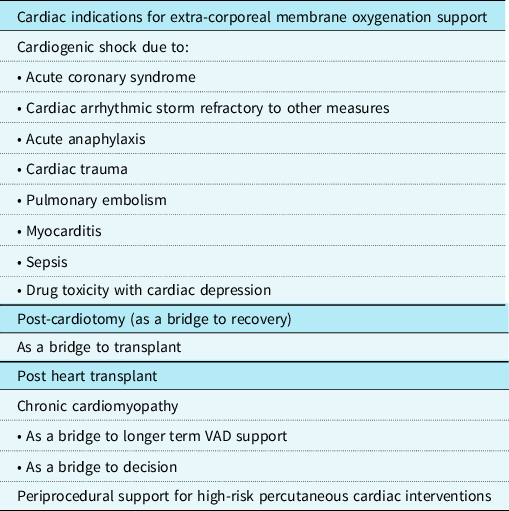
In 2019, the international consortium of Extra-corporeal Life Support Organisation reported over 130,000 uses of extra-corporeal membrane oxygenation worldwide, with 54 and 33% consisting of paediatric and neonatal cases, respectively. Reference Lasa, Jain and Raymond3 In early years, the predominant use of extra-corporeal membrane oxygenation among paediatric populations was in cases of acute respiratory failure. However, with advances in both medical management and ventilatory support, the number of acute respiratory failure cases supported with extra-corporeal membrane oxygenation has declined. Reference Barbaro, Paden and Guner4 In contrast, the use of extra-corporeal membrane oxygenation for cardiac support has expanded (from 48% in 2009 to 52% in 2015). This includes its indication as a bridge to recovery, a bridge to cardiac transplantation, and more recently for extra-corporeal cardiopulmonary resuscitation. Reference Barbaro, Paden and Guner4 A full summary of common extra-corporeal membrane oxygenation indications can be seen in Table 1.
Cardiac indications for extra-corporeal membrane oxygenation support.

Makdisi and Wang Reference Wehman, Stafford and Bittle5
Parallel to the development of extra-corporeal membrane oxygenation for cardiac support, use of alternative forms of mechanical circulatory support has also increased. Reference Wehman, Stafford and Bittle5 This includes the use of ventricular assist devices, and comparatively novel total artificial hearts, with a selection of studies reporting greater survival rates and fewer associated complications compared to extra-corporeal membrane oxygenation support. Reference Wehman, Stafford and Bittle5–Reference Fraser, Jaquiss and Rosenthal8
As the use of extra-corporeal membrane oxygenation for cardiac disease rises in paediatric populations, it is increasingly important to be aware of its benefits and limitations as a therapeutic tool and its scope for development. Reference Wehman, Stafford and Bittle5–Reference Fraser, Jaquiss and Rosenthal8
Aims
This review aims to explore and update the current literature in three important areas, defined by Extra-corporeal Life Support Organisation, for extra-corporeal membrane oxygenation in cardiac paediatric and neonatal populations:
-
1. extra-corporeal membrane oxygenation for cardiopulmonary resuscitation
-
2. extra-corporeal membrane oxygenation as a bridge to recovery
-
3. extra-corporeal membrane oxygenation as a bridge to cardiac transplantation.
Use of extra-corporeal membrane oxygenation for cardiopulmonary resuscitation
The use of extra-corporeal membrane oxygenation in paediatric cardiac arrest is an expanding indication in this patient population and is recommended by the American Heart Association guidelines on Paediatric Life Support. Reference Duff, Topjian and Berg9 According to the 2016 Extra-corporeal Life Support Organisation report, 13% of all extra-corporeal membrane oxygenation implantation in paediatric patients is done in the setting of cardiac arrest, the most common being in neonates. Reference Thiagarajan, Barbaro and Rycus10
The purpose of extra-corporeal cardiopulmonary resuscitation is to enhance chances of survival and avoid neurological injury. This is particularly important in children as neurological development is a rapid and continuous process. Studies examining outcomes following extra-corporeal cardiopulmonary resuscitation are limited and focus on in-hospital arrest. Barrett et al conducted a retrospective cohort study of patients undergoing extra-corporeal cardiopulmonary resuscitation between 1992 and 2005. They reported 22% suffered acute neurological injury following extra-corporeal cardiopulmonary resuscitation, significantly associated with cardiac disease and acidosis pre-extra-corporeal membrane oxygenation. Reference Barrett, Bratton, Salvin, Laussen, Rycus and Thiagarajan11 Lasa et al demonstrated extra-corporeal cardiopulmonary resuscitation was independently associated with an increased likelihood of surviving to hospital discharge and neurological recovery compared to conventional cardiopulmonary resuscitation. Reference Lasa, Rogers and Localio12 Long-term outcomes may not be so promising in a retrospective study of 147 patients receiving extra-corporeal cardiopulmonary resuscitation for in-hospital cardiac arrests, only a third reported good neuro-behavioural outcomes at 1 year. Reference Meert, Guerguerian and Barbaro13
The success of extra-corporeal membrane oxygenation as a strategy for life support can be modified by a variety of factors. Bembea et al performed an analysis of merged data from the Extra-corporeal Life Support Organization and the American Heart Association Get with the Guidelines – Resuscitation registries. Increased delay between initiation of cardiopulmonary resuscitation and extra-corporeal membrane oxygenation institution, noncardiac diagnoses, and pre-existing renal dysfunction were markers of poor prognosis. This emphasises the importance of simulation to train teams to assemble and deploy extra-corporeal membrane oxygenation safely in a timely manner. Furthermore, prematurity is a key factor, with survival rates as low as 21% in neonates <34 weeks of gestational age. Reference Bembea, Ng and Rizkalla14 Strategies to improve neurological outcomes, such as therapeutic hypothermia or temperature control, remain contentious. Mohler et al reported the results of therapeutic hypothermia after paediatric cardiac arrests (in-hospital), which randomised paediatric patients into therapeutic hypothermic and normothermic groups. The trial was terminated at 329 patients due to futility – patients did not show a significant difference in neurobehavioural outcomes at 1 year. Reference Moler, Silverstein and Holubkov15 It is worth mentioning that temperature management post-cardiac arrest has shifted focus to the active prevention of fever. The 2019 American Heart Association guidelines recommend continuous temperature monitoring and set a target for paediatric patients following cardiac arrest. Reference Duff, Topjian and Berg9
Extra-corporeal membrane oxygenation as a mode of cardiopulmonary resuscitation is expanding in adult and paediatric populations; however, the width of available evidence is yet to catch up to the rate of uptake. More research is required to determine the factors associated with improved neurological recovery and adverse outcomes to facilitate appropriate patient selection.
Extra-corporeal membrane oxygenation as a bridge to recovery
Implementation of extra-corporeal membrane oxygenation support to facilitate recovery following an acute cardiac injury may be utilised in infants and children following surgical intervention for congenital heart disease and acquired disease such as myocarditis. Patients with congenital heart disease post-cardiotomy can experience a dramatic drop in cardiac output and may require support in the context of cardiopulmonary arrest following surgery or weaning from cardiopulmonary bypass. The desired outcome is therefore a “bridge to recovery” in most cases.
Extra-corporeal membrane oxygenation in single ventricle physiology
Patients with single ventricle physiology (including bidirectional Glenn shunts and the Fontan) constitute a growing proportion of extra-corporeal membrane oxygenation use in congenital heart disease. However, outcomes are far from ideal – survival to discharge ranges from 31 to 41%. Reference Sherwin, Gauvreau and Scheurer16,Reference Jolley, Yarlagadda and Rajagopal17 Jolley et al analysed the outcomes of 103 patients started on extra-corporeal membrane oxygenation following bidirectional Glenn surgery and observed a high rate of neurological injury, including seizures and strokes. Reference Jolley, Yarlagadda and Rajagopal17 Neurological adverse events occur in up to a fifth of patients with bidirectional Glenn or Fontan, with other complications including haemorrhage and renal failure. Reference Rood, Teele and Barrett18
There are several predictors of adverse outcomes. Weinstein et al analysed 229 patients with bidirectional Glenn on the Extra-corporeal Life Support Organisation registry who received extra-corporeal membrane oxygenation. They reported an in-hospital survival of 33% and multivariable analysis revealed several contributory factors such as longer duration on extra-corporeal membrane oxygenation, circuit complications, renal injury, and hypercapnia pre-extra-corporeal membrane oxygenation. Reference Aydin, Duffy and Rodriguez19 Jolley et al corroborated these findings, reporting inotropic use pre-extra-corporeal membrane oxygenation and cardiopulmonary failure (as opposed to purely cardiac) as significant predictors of adverse outcomes. Reference Jolley, Yarlagadda and Rajagopal17
Extra-corporeal membrane oxygenation in bidirectional Glenn shunts
The bidirectional Glenn shunt is the first step of palliating complex congenital heart diseases, such as tricuspid atresia and hypoplastic left heart syndrome. It involves separation of the pulmonary arteries and connection of the superior caval vein to the right pulmonary artery, allowing deoxygenated blood from the upper body to bypass the heart almost entirely. This poses unique challenges to the initiation of extra-corporeal membrane oxygenation, as successful circulatory support requires adequate venous drainage and decompression. Bicaval cannulation would be required, with at least one cannula placed in the Glenn shunt. Reference Bacon, Gray, Schwartz and Cooper20 Care must be taken following the initiation of extra-corporeal membrane oxygenation to monitor cardiac output and ensure sufficient cerebral perfusion. Certain pathology, such as valve regurgitation, is more commonly seen post-bidirectional Glenn which can increase venous pressure and reduce cerebral perfusion, particularly in the setting of decreased systemic vascular resistance. Reference Mauchley and Mitchell21
Extra-corporeal membrane oxygenation in Fontan – rescuing the failing Fontan
Extra-corporeal membrane oxygenation would be intended as a rescue therapy in the “failing Fontan”. The Fontan operation is the final palliative procedure of univentricular disease and follows bidirectional Glenn by a few years, creating a functional single ventricle by connecting the inferior caval vein to the pulmonary circulation. A large retrospective study of 203 patients found Fontan patients perform significantly worse than others with cardiac conditions being supported on extra-corporeal membrane oxygenation, with a survival rate of 35% compared to 47%. Reference Rood, Teele and Barrett18 Extra-corporeal membrane oxygenation can have varying levels of success in the failing Fontan, mostly dependent on how advanced the dysfunction is.
Early Fontan failure is acute-on-chronic decompensation without irreversible end-organ damage and often manifests as arrhythmias and low cardiac output following surgery. Middle- and late-stage failures have manifested evidence of end-organ damage. Extra-corporeal membrane oxygenation is less likely to provide meaningful recovery in these patients; however, it may be used as a bridge to transplant or ventricular assist device in middle stage failure. Reference Aydin, Duffy and Rodriguez19
Extra-corporeal membrane oxygenation in myocarditis
Extra-corporeal membrane oxygenation has been used as a bridge to recovery in acquired cardiac disease, and there is evidence that outcomes may be more favourable compared to its use in other indications. In their multicentre analysis, Ghelani et al demonstrated survival of 60% in paediatric patients who required extra-corporeal membrane oxygenation support for myocarditis, which has been reflected in other analyses. Reference Ghelani, Spaeder and Pastor22,Reference Rajagopal, Almond and Laussen23
Several factors may predict patients eligible for institution of extra-corporeal membrane oxygenation. Hu et al conducted a single centre retrospective analysis of paediatric patients with a confirmed diagnosis of acute myocarditis over 5 years. They reported that patients who were more likely to be started on extra-corporeal membrane oxygenation had arrhythmias, reduced ejection fraction, vomiting, and seizures. Reference Wu, Lin, Yang, Wu and Chen24 It is important to note that while survival on extra-corporeal membrane oxygenation as a bridge in this situation has reported good outcomes, it may not be as effective as other modalities at left ventricular decompression (such as cardiac catheterisation). Reference Eastaugh, Thiagarajan and Darst25 Further research is required.
Timing of initiation
Ge et al demonstrated that later initiation of extra-corporeal membrane oxygenation is associated with a significantly higher mortality rate (41.67 versus 69.44%), greater arterial lactate concentration, and poorer ventricular function. Reference Ge, Pan, Wang, Chen and Wang26 Late initiation can be attributed to a prolonged assembly time, which is generally considered to be 45–60 minutes. Prolonged assembly times can be secondary to delays in debubbling the membrane oxygenator and adding blood to the primer. Reference Jacobs, Ojito and McConaghey27 As a result, Extra-corporeal Life Support Organisation emphasise the importance of enhanced extra-corporeal membrane oxygenation programme structures and trained individuals to implement extra-corporeal membrane oxygenation in these patients. 28 Miana et al reinforces the importance of instituting official protocols. They report a significant reduction in the number of patients who have failed to be weaned from extra-corporeal membrane oxygenation (25 versus 85%) and greater discharge rates in hospitals where extra-corporeal membrane oxygenation programmes have been implemented (5.5 versus 45%). Reference Miana, Azeka and Canêo29
Khorsandi et al support the findings of Ge et al, by demonstrating a survival to discharge rate of 47% in patients where extra-corporeal membrane oxygenation was instituted in the operating theatre versus 37.5% in patients who failed maximal medical therapy and required extra-corporeal membrane oxygenation during their ward stay. Reference Khorsandi, Davidson and Bouamra30 In these patients, survival was poorest in younger patients (<6 months) and in those with prolonged extra-corporeal membrane oxygenation duration.
Indicators of adverse outcomes
Several studies have identified that prolonged extra-corporeal membrane oxygenation duration following cardiotomy increases mortality. In a large multicentre study, which sampled 998 children from 37 different centres in the United States of America, veno-arterial extra-corporeal membrane oxygenation duration greater than 7 days raised mortality rates by 12% for every additional day on extra-corporeal membrane oxygenation. Reference Gupta, Robertson and Beam31 Studies by Alsoufi et al and Shah et al in smaller samples of 100 and 84 patients, respectively, further support these findings and also identified a number of prognostic factors such as elevated lactate and liver enzymes that contribute to greater mortality rates. Reference Alsoufi, Awan and Manlhiot32,Reference Shah, Shankar and Churchwell33
Despite well-established advantages, extra-corporeal membrane oxygenation has several limitations. Neurological complications following extra-corporeal membrane oxygenation support vary in incidence from 22 to 31% and are seen most frequently in neonates. Reference Polito, Barrett and Wypij34,Reference Nasr and Rabinstein35 These patients have an 11.1% incidence of haemorrhage and 7.2% incidence of seizures (compared to 4.9 and 6.8% in paediatric patients respectively). Reference Mehta and Ibsen36 Whilst a gestational age of <34 weeks is a widely recognised risk factor for intracranial haemorrhage, Hardart and Fackler noted additional factors including acidosis, coagulopathy, sepsis, and inotropic support, which was corroborated by a more recent analysis of the Extra-corporeal Life Support Organisation registry by Polito and colleagues. Reference Polito, Barrett and Wypij34,Reference Hardart and Fackler37 Paediatric risk factors (such as intracranial haemorrhage) are comparable to that of neonates and include metabolic acidosis and inotropic support. Reference Cengiz, Seidel, Rycus, Brogan and Roberts38
Analysis of the neurodevelopmental outcomes in paediatric patients supported by extra-corporeal membrane oxygenation displays a risk of poor neurocognitive outcomes and speech and language abnormalities. Reference Long, Galea, Eldridge and Harris39–Reference Peer, Emerson and Costello42 Garcia et al showed that intelligence quotients in extra-corporeal cardiopulmonary resuscitation survivors were significantly lower than in the mean population. Reference Garcia Guerra, Zorzela and Robertson41 Similarly, a retrospective review investigating intermediate outcomes following extra-corporeal membrane oxygenation intervention in paediatric cardiac patients highlighted the risk of neurological impairment following extra-corporeal membrane oxygenation cannulation. Reference Peer, Emerson and Costello42 However, these studies in addition to research by Costello et al and Chrysotomou et al emphasise that the use of extra-corporeal membrane oxygenation in paediatric patients are necessary for survival, with the life-saving benefits of extra-corporeal membrane oxygenation outweighing the risk of neurological sequelae. Reference Chrysostomou, Maul and Callahan43–Reference Costello, Cooper and Jacobs45
There are minimal large prospective studies looking into the long-term neurological effects of extra-corporeal membrane oxygenation intervention on paediatric patients; studies tend to focus on short-term outcomes until discharge or transfer from hospital. It is possible that in patients bridged with extra-corporeal membrane oxygenation to recovery, the underlying disease exhibits a greater influence on major outcomes and hence it is difficult to distinguish the long-term complications of extra-corporeal membrane oxygenation support. Further documentation investigating the intermediate and long-term neurological impacts of extra-corporeal membrane oxygenation intervention is needed due to its vast implications on younger populations.
Extra-corporeal membrane oxygenation as a bridge to transplantation
The use of extra-corporeal membrane oxygenation as a bridge to heart or heart–lung transplantation in paediatric practice is contentious. While it has been demonstrated to be feasible and safe in adults, there is evidence to suggest that extra-corporeal membrane oxygenation may be associated with adverse outcomes while acting as a bridge and post-transplantation.
Dipchand et al conducted a retrospective observational study of all patients under the age of 18 who were listed for transplant on the Paediatric Heart Transplant Registry between 1993 and 2013. Extra-corporeal membrane oxygenation was used sparingly (8%), and of those patients, 35% died whilst on the list and 49% received transplantation. Reference Dipchand, Kirk and Naftel6
Certain factors can influence the outcomes of extra-corporeal membrane oxygenation in this setting. Gajarski et al reported the impact of increased creatinine and renal dysfunction on mortality – it was noted that a significant proportion (67%) of patients on extra-corporeal membrane oxygenation who required dialysis died. Reference Gajarski, Mosca and Ohye46 The underlying condition can also influence how successful extra-corporeal membrane oxygenation is as a bridge to recovery or transplantation. Fiser et al reported significantly higher rates of survival for patients on extra-corporeal membrane oxygenation with cardiomyopathy compared to those with congenital heart disease (CHD) (59 versus 20%). Reference Fiser, Yetman and Gunselman47 This may reflect the greater scope for recovery and reversal of pathological processes in cardiomyopathy compared to CHD (where anatomical factors are at play).
As a bridge to transplantation, veno-arterial extra-corporeal membrane oxygenation is associated with an array of both short-term and long-term complications, including thromboembolic events, haemorrhage, renal failure, infection, and neurological sequalae. Reference Dalton, Reeder and Garcia-Filion48–Reference Mehta, Turner and Walsh51 In a retrospective analysis of the Extra-corporeal Life Support Organisation International Registry, Dalton et al reported 70.2% of patients experienced haemorrhagic complications, 16% of these included intracranial haemorrhages. Reference Dalton, Reeder and Garcia-Filion48 It is well-established that the interaction between the patient’s native blood and foreign artificial barrier used in extra-corporeal membrane oxygenation can activate the coagulation cascade. Furthermore, the inclusion of an oxygenator in the circulation can lead to a pro-inflammatory response and further promote thrombotic events, the reported prevalence of which can vary from 10 to 37.5%. Reference Dalton, Reeder and Garcia-Filion48,Reference Stansfield, Wise and Ham49,Reference Almond, Morales and Blackstone52
Extra corporeal membrane oxygenation in comparison to other forms of mechanical circulatory support
The combination of high-mortality rates and associated complications has resulted in temporary ventricular assist devices taking preference over veno-arterial extra-corporeal membrane oxygenation as a bridge to orthotopic heart transplantation. Analyses of the United Network for Organ Sharing database between 2005 and 2012 revealed 69.4% of paediatric patients received ventricular assist device as a bridge to transplantation, compared to 30.6% who received veno-arterial extra-corporeal membrane oxygenation support. Reference Wehman, Stafford and Bittle5 The use of ventricular assist devices was popularised secondary to FDA approval of the pulsatile paracorporeal Berlin Heart EXCOR (Berlin Heart, Berlin, Germany) for children between 3 and 60 kg. Reference Hetzer, Kaufmann and Walter53 To date, this is the only FDA-licensed ventricular assist device approved for paediatric use.
Fundamental differences between veno-arterial extra-corporeal membrane oxygenation and ventricular assist device should guide their implementation as a bridge to transplantation. Whilst veno-arterial extra-corporeal membrane oxygenation provides full cardiopulmonary support, ventricular assist device is limited to partial or full cardiac support. Ventricular assist device implantation is considered a semi-elective procedure that requires planning. In a single institute in Germany, Hetzer et al reported that earlier implementation of ventricular assist device is associated with better outcomes. Reference Rungatscher, Tessari and Stranieri54 Alternatively, extra-corporeal membrane oxygenation may be used in rapidly deteriorating patients when ventricular assist devices cannot be sourced or implanted in time. Whilst extra-corporeal membrane oxygenation has clear indications for emergency situations, the inclusion of oxygenators is pro-thrombotic and increases a child’s demand for anti-coagulation compared to temporary ventricular assist devices. Reference Almond, Morales and Blackstone52 Therefore, if a patient’s pulmonary function is adequate, switching from veno-arterial extra-corporeal membrane oxygenation to ventricular assist devices is recommended.
However, ventricular assist device implantation is not without its limitations. There are a limited range of devices licensed for use in paediatric and neonatal patients, higher associated mortality, and decreased transplant rates in small infants. Reference Peng, Koehl and Cantor55 Certain factors may also lead to adverse outcomes. Generally, veno-arterial extra-corporeal membrane oxygenation is preferred for short-term support in infants <5 kg, as there is evidence ventricular assist devices may be less effective in this group. Conway et al demonstrated that children supported by the Berlin Heart EXCOR weighing <10 kg were less likely to survive to transplant, or explant, compared with children weighing >10 kg. Reference Conway, St Louis, Morales, Law, Tjossem and Humpl56 Ventricular assist devices are generally contraindicated in infants weighing <5 kg. Analysis of The Paediatric Interagency Registry for Mechanical Circulatory Support found 88% of dilated cardiomyopathy patients achieved favourable outcomes, compared to 60% of those with supraventricular heart disease. Reference Lorts, Eghtesady and Mehegan57 Whilst more evidence is required, this observation could have relevance in transplant list prioritisation schemes, which currently do not distinguish between different anatomic deviations for ventricular assist device support as a bridge to transplantation. As a result, veno-arterial extra-corporeal membrane oxygenation is recommended for short-term support under these circumstances. In CHD, anatomical variations and complex physiology complicate ventricular assist device implantation. As a result, veno-arterial extra-corporeal membrane oxygenation is recommended for short-term support under these circumstances.
In situations where veno-arterial extra-corporeal membrane oxygenation or ventricular assist device may be implemented, outcomes of ventricular assist device are superior to those of veno-arterial extra-corporeal membrane oxygenation alone. Reference Dipchand, Kirk and Naftel6,Reference Dipchand, Mahle and Tresler7 In a prospective trial of paediatric ventricular assist device in the United States, compared to propensity-score-matched historical control groups undergoing extra-corporeal membrane oxygenation, survival rates were significantly higher in the ventricular assist device group. Reference Fraser, Jaquiss and Rosenthal8
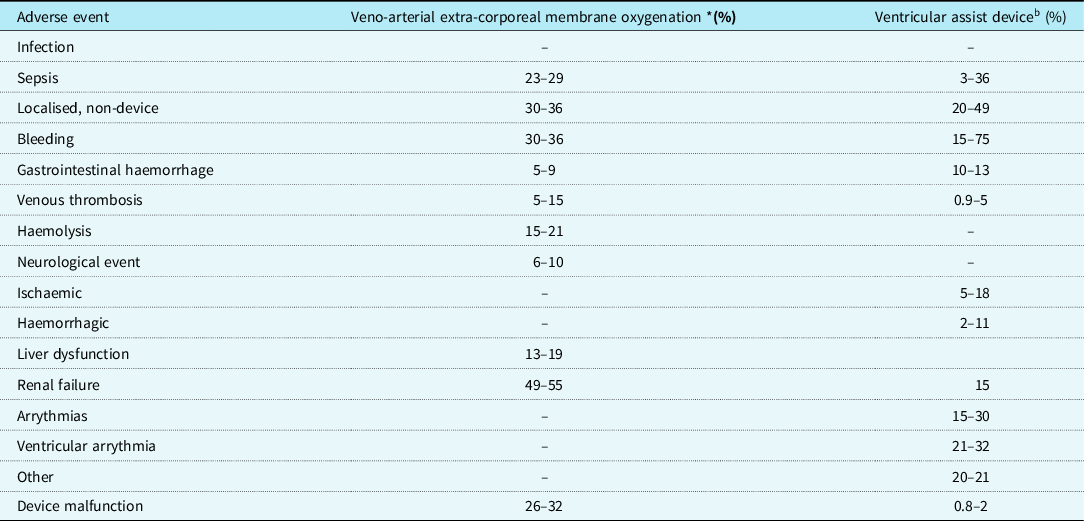
Whilst there are vast advantages of ventricular assist devices as a bridge to transplantation, major adverse events are not uncommon and are similar to those seen in extra-corporeal membrane oxygenation (Table 2). Additionally, support for small infants and those with CHD remains limited, for which further research would be of likely benefit.
Adverse events on paediatric veno-arterial extra-corporeal membrane oxygenation and ventricular assist device support.

* Zangrillo et al (2013) Reference Chrysostomou, Maul and Callahan43
Future directions
Several areas in this field remain to be explored. Extra-corporeal membrane oxygenation support in paediatric patients is most common in patients with congenital heart disease, and those with single ventricle physiology. Further research is needed to investigate methods to improve outcomes, venous drainage and decompression when deploying extra-corporeal membrane oxygenation in these patients. Additionally, anticoagulation and its monitoring would need to be explored to balance effectiveness against the risks of bleeding.
Timing of deployment is paramount to determining success. Institution of equipment can be time consuming and training of personnel is essential. This is particularly important in the setting of extra-corporeal cardiopulmonary resuscitation, and the role of simulation to cut delays without compromising safety is an important area for research.
While extra-corporeal membrane oxygenation is used in cardiac arrest to optimise neurological recovery, it is also noted to cause injury. Prospective longitudinal studies in extra-corporeal membrane oxygenation survivors could help determine the long-term consequences of such injury and trials are required to explore avenues that would optimise neurological recovery.
The research appraised here is predominantly composed of retrospective analyses of registries or single centre data. There are no randomised trials comparing extra-corporeal membrane oxygenation to other forms of mechanical circulatory support or prospective data to consider its long-term outcomes, which indicates a notable gap in the evidence base.
Conclusions
Extra-corporeal membrane oxygenation has been pivotal to supporting paediatric and neonatal patients in several life-saving cardiac conditions. However, its mortality rates and associated complications are still not clinically desirable. Moreover, there is a need for further research to uncover predictors of survival, mostly in the context of cardiopulmonary resuscitation, and long-term complications, particularly in extra-corporeal membrane oxygenation post-cardiotomy. In the face of these challenges, novel modalities such as ventricular assist devices have been trialled in these patients. Of the literature that is available, ventricular assist device usage has generated a promising venture in paediatric patients as a bridge to transplant, but there is a lack of evidence reported for small infants or patients with CHD.
Acknowledgments
None.
Financial support
This research received no specific grant from any funding agency, commercial or not-for-profit sectors.
Conflict of interest
None.
Ethical standards
This article does not contain any studies with human participants or animals performed by any of the authors.