Introduction
Epistaxis is one of the most common presentations to the ENT specialist. A reported 60 per cent of the population experience an epistaxis episode in their lifetime, and 6 per cent seek medical attention.Reference Small, Murray and Maran1
The arterial supply to the nose originates from branches of the internal and external carotid arteries, and forms a rich anastomosis known as Kiesselbach's plexus on the anterior aspect of the nasal septum. Bleeding originating from this region accounts for approximately 80 per cent of epistaxis episodes.Reference Pope and Hobbs2 Posterior bleeding originates from Woodruff's plexus on the posterior septum, and is mostly supplied by the posterior septal nasal artery (a branch of the sphenopalatine artery). Typically, the latter can be associated with greater morbidity.Reference Supriya, Shakeel, Veitch and Ah-See3
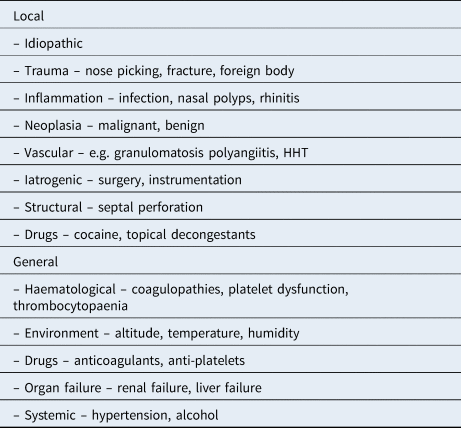
The aetiology of epistaxis is diverse (Table 1) and mostly idiopathic (80–90 per cent);Reference Pope and Hobbs2 however, trauma is a common precipitant, especially as the blood vessels are relatively superficial within the mucosa. Recurrent or persistent epistaxis can less commonly be caused by bleeding disorders or neoplasia and warrant further investigation.
Causes of epistaxis*

* Adapted from Pope and Hobbs.Reference Pope and Hobbs2 HHT = hereditary haemorrhagic telangiectasia
Managing epistaxis requires a stepwise approach, starting initially with first aid and resuscitation, and then identification of a bleeding point with subsequent cauterisation. If these attempts fail, the patient can proceed to nasal packing, and finally to surgical intervention such as arterial ligation or embolisation.Reference Pope and Hobbs2
Nasal cautery can be performed chemically with silver nitrate (AgNO3)-tipped caustic pencils, which are commercially available in two concentrations (75 per cent and 95 per cent).Reference Barr4 The silver nitrate is fused with potassium nitrate on the tip of a wooden pencil and, when directly applied to visible vessels on the septum, the resulting chemical reaction replaces healthy mucosa with scar tissue, and thromboses blood vessels within it.Reference Amin, Glynn, Phelan, Sheahan, Crotty and McShane5 The affected area of tissue is burned, and can be graded as a superficial partial thickness burn (loss of surface epithelium with no mucosal necrosis), a deep partial thickness burn (partial mucosal necrosis) or a full thickness burn (full thickness necrosis reaching the perichondrium), depending on the extent of penetration of the chemical wave front produced. Superficial bleeding vessels are contained within the mucosa; therefore, a deep partial thickness should be sufficient for effective cautery.
The effect of silver nitrate concentration on clinical outcomes in epistaxis has not been fully established, but the 95 per cent preparation is associated with greater tissue penetration and therefore possible complications.Reference Amin, Glynn, Phelan, Sheahan, Crotty and McShane5 Application of silver nitrate cautery can be painful; therefore, topical anaesthetic is preferable. However, this can make the use of silver nitrate cautery in children challenging. Nevertheless, it is a relatively inexpensive technique that requires minimal technical skill. This makes it popular amongst ENT specialists, and in general practice and emergency departments when available.
An alternative method is bipolar electrocautery, where an electrical circuit delivers thermal energy by radiation to the area, rather than by direct contact.Reference Pope and Hobbs2 The resultant burn seals the blood vessel much in the same way as chemical cautery. Ahmed and Woolford have shown that in suitably trained hands, the use of bipolar diathermy and rigid endoscopy can significantly reduce the morbidity associated with subsequent nasal packing and avoid the requirement for hospital admission.Reference Ahmed and Woolford6
Traditional teaching dictates that bilateral cauterisation of the septum should be avoided given the potential risk of a septal perforation. However, clinical studies have lent support to bilateral cauterisation without the risk of septal perforation, albeit in small sample sizes and with a short follow-up period.Reference Link, Conley, Flanary and Kerschner7 In addition, there have been no published studies on the incidence of septal perforation after cautery.
When utilising chemical cautery or electrocautery, the optimum contact time or power for a fully intact septum has not previously been determined. We examined the microscopic effects of different contact times and powers on intact porcine septum samples, to establish the optimum conditions required for cautery.
As there are no recommendations for the optimum conditions for cautery, we also evaluated current practice amongst ENT consultants in the UK to determine patterns in management.
Materials and methods
Histological assessment of cautery
A prospective, single-blinded, ex vivo study was conducted. Porcine septum samples were selected, and chemical cautery was applied using 75 per cent silver nitrate tipped caustic pencils (Bray Health and Leisure, Faringdon, UK) with varying contact times (5 seconds, 10 seconds, 20 seconds and 30 seconds). This application was repeated in three different places of the septum, but only unilaterally. The septum was then placed in formalin and sent to a veterinary laboratory to be prepared in paraffin, and stained with haematoxylin and eosin. Each treated area was labelled with a unique code corresponding to the parameter tested. A consultant histopathologist, who was blinded to the codes, examined the septum under light microscopy and graded each chemical burn as being of superficial partial thickness, deep partial thickness or full thickness.
This process was repeated using bipolar diathermy at different powers (6 W, 8 W and 10 W) and using each power at different contact times (2 seconds, 4 seconds and 6 seconds), with each combination repeated three times.
Assessment of consultant practice
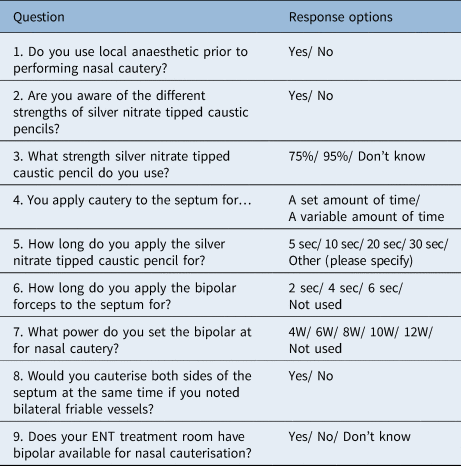
A nine-question online survey evaluating different aspects of nasal cautery practice (Table 2) was emailed to all consultant ENT surgeons in the UK who were registered with ENT-UK, the UK professional membership body for ENT and its related specialties. The survey was open for one month during July 2016. The results were collated online and statistical analysis was performed using Microsoft™ Excel spreadsheet software.
Questions used in online survey of consultant practice
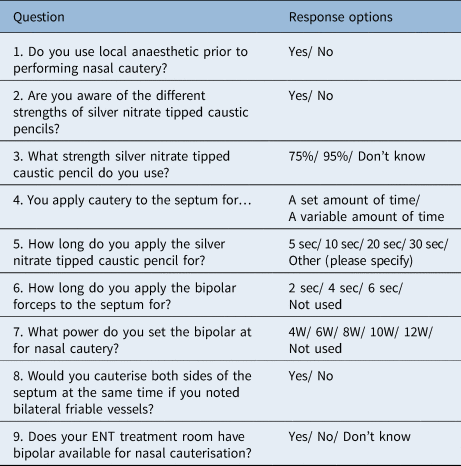
Sec = seconds
Results
Histological effects of cautery
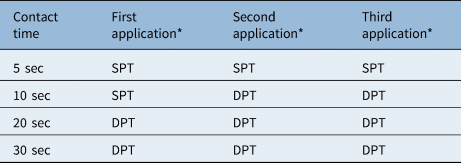
For silver nitrate cautery (Table 3), application for 5 seconds produced superficial partial thickness burns when repeated three times. When applied for 10 seconds, there was one superficial partial thickness burn and two deep partial thickness burns. At 20 seconds and 30 seconds, all applications produced deep partial thickness burns. There were no full thickness burns.
Histological effects of silver nitrate at variable contact times

*Of silver nitrate cautery. Sec = seconds; SPT = superficial partial thickness; DPT = deep partial thickness
For bipolar diathermy (Table 4), at 6 W two of the applications produced superficial partial thickness burns (both 2 seconds) and one gave a full thickness burn (6 seconds). The other six applications gave a deep partial thickness burn. At 8 W, all three samples had superficial partial thickness burns at 2 seconds, all three samples had deep partial thickness burns at 4 seconds and two samples had full thickness burns at 6 seconds. One of the samples at 6 seconds had a deep partial thickness burn. At 10 W, eight out of nine tests produced a full thickness burn, with one deep partial thickness burn at 4 seconds.
Histological effects of bipolar diathermy at variable contact times

*Of bipolar diathermy. Sec = seconds; SPT = superficial partial thickness; DPT = deep partial thickness; FT = full thickness
Consultant practices
Of the 742 surveys emailed out, 193 surveys were returned (26.0 per cent response rate). The surveys revealed that local anaesthetic is used (prior to cautery) by 92.7 per cent of the ENT surgeons who responded (n = 179).
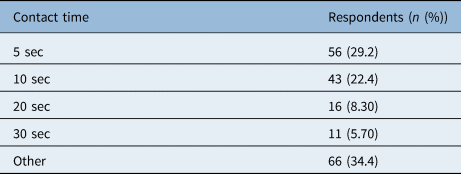
Regarding silver nitrate cautery, 49.5 per cent (n = 95) of respondents are aware that different concentrations exist; 43.0 per cent (n = 83) use 75 per cent concentration, 8.8 per cent (n = 17) use 95 per cent concentration and 48.2 per cent (n = 93) do not know what concentration they use. Silver nitrate is applied for a fixed time by 22.9 per cent of respondents (n = 44) and for a variable amount of time by 77.1 per cent (n = 148). The contact times reported were: 5 seconds (29.2 per cent; n = 56), 10 seconds (22.4 per cent; n = 43), 20 seconds (8.3 per cent; n = 16), 30 seconds (5.7 per cent; n = 11) or ‘other’ (34.4 per cent; n = 66) (Table 5). The most common responses for the 66 ‘other’ reported contact durations were: ‘until desired effect achieved’ (n = 17), ‘variable’ (n = 16) and ‘less than 5 seconds’ (n = 13).
Contact times used for silver nitrate cautery in consultant practice

Sec = seconds
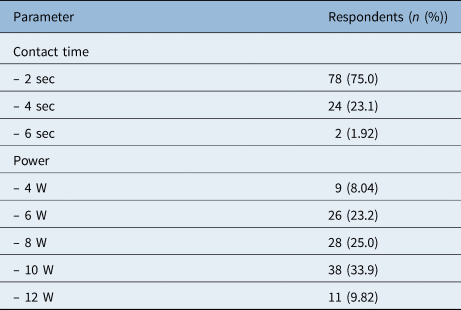
Regarding bipolar electrocautery, 42.0 per cent of respondents (78 out of 182) do not routinely use it for epistaxis. For the remaining 104 consultants, the reported durations of use were: 2 seconds (75 per cent; n = 78), 4 seconds (23.1 per cent; n = 24) and 6 seconds (1.92 per cent; n = 2). The powers used are 4 W (8.04 per cent), 6 W (23.2 per cent), 8 W (25.0 per cent), 10 W (33.9 per cent) and 12 W (9.82 per cent) (Table 6). Bipolar electrocautery is accessible in 25.4 per cent of ENT treatment rooms (n = 49) and is unavailable in 70.5 per cent (n = 136); availability is unknown in 4.1 per cent (n = 8).
Contact times and power used for bipolar electrocautery in consultant practice

Sec = seconds
A reported 40.1 per cent of consultants (n = 75) would cauterise the septum bilaterally if vessels were visible.
Discussion
Our results showed that, with silver nitrate cautery, there was no full thickness burn with an application time of up to 30 seconds, and there was little difference in penetration after 5 seconds. With bipolar electrocautery, there were no full thickness burns at 8 W or below with contact for 4 seconds or less. At 6 seconds at any power, or at 10 W for any contact time, there was a high risk of a full thickness burn (67 per cent and 89 per cent respectively).
There have been few studies demonstrating the histological effects of silver nitrate or bipolar diathermy on septal tissue. Lloyd et al. investigated the effect of 75 per cent silver nitrate on human septal cartilage, albeit denuded of mucosa, for application times of 30–60 seconds. They reported no significant difference in penetration depth between 30 and 60 seconds.Reference Lloyd, Almeyda, Di Cuffa and Shah8 Our study used septa covered in mucosa, which is more representative of clinical practice, given that this is where most target vessels lie, and tested shorter contact times. Hanif et al investigated the effect of silver nitrate on tonsil tissue. They found that, histologically, there was no difference in penetration depth between 5 and 20 seconds when using 75 per cent concentration.Reference Hanif, Tasca, Frosh, Ghufoor and Stirling9 This is encouragingly in accordance with our own results, which tested up to 30 seconds and revealed similar findings.
Studies have been conducted on tonsillar tissue that demonstrated the differences in penetration between 75 and 95 per cent concentration. For instance, in Amin and colleagues’ study, 95 per cent concentration yielded a two-fold greater penetration depth when applied for 5 seconds, possibly conferring a higher risk of complications, without necessarily providing greater efficacy.Reference Amin, Glynn, Phelan, Sheahan, Crotty and McShane5 Glynn et al. similarly showed that, in paediatric patients, 75 per cent concentration had better pain and efficacy outcomes after an eight-week follow up compared to 95 per cent concentration.Reference Glynn, Amin, Sheahan and McShane10 Based on this work of Glynn et al. and Amin et al., we chose the 75 per cent concentration for our study. We could therefore conclude that there is no benefit of 75 per cent silver nitrate cautery beyond 5–10 seconds on histological outcome, though it can safely be used for up to 30 seconds.
There have been no clear ex vivo studies demonstrating the use of bipolar diathermy on the nasal septum. However, Johnson et al. described its application in clinical practice at 15–20 W (contact time not reported) and did not report any long-term complications up to a mean follow-up period of 428 days.Reference Johnson, Faria and Behar11 Our study showed that a considerably lower power (10 W) could cause a full thickness burn, which can potentially cause complications of crusting and septal perforation.
It is thought that septal perforation occurs as a result of disruption to the overlying perichondrium and perichondrial blood supply, which leads to necrosis and subsequent perforation. For adequate treatment of epistaxis, the blood vessels that lie within the mucosa need cauterisation, suggesting that a deep partial thickness burn is sufficient, whereas a full thickness burn results in cauterisation of the perichondrium. Felek et al. tested bilateral chemical cautery at 75 per cent concentration in children, with no septal perforation; however, they applied it for only 5 seconds.Reference Felek, Celik, Islam and Demirci12 Our study showed that this contact time resulted in a superficial partial thickness burn which did not disrupt the perichondrium. This lends some support to safe bilateral cauterisation. Performing bilateral cauterisation could reduce the number of hospital appointments and potentially avoid the need for multiple general anaesthetic procedures in the paediatric population.
The survey results revealed that half of the consultants were not aware of the different silver nitrate concentrations; indeed, nearly half are not certain which strength they use in practice. This could have practical implications, as 95 per cent silver nitrate has been proven to be more penetratingReference Amin, Glynn, Phelan, Sheahan, Crotty and McShane5 and confers a greater risk to perichondrial disruption, especially as 40.1 per cent of respondents would cauterise bilaterally.
The length of contact time in practice is variable, with 77.1 per cent of responding consultants not using a fixed method. However, our results demonstrate that at least 5–10 seconds are needed for sufficient burn penetration. Although this was the practice amongst most consultants, a substantial portion still applied silver nitrate for less than 5 seconds, or used macroscopic or clinical signs to determine how long to apply it, which could have implications for symptom recurrence if undertreated. It should also be noted that the interpretation of contact time by each consultant is likely to be variable, which limits the reliability of the conclusions drawn.
Bipolar electrocautery is not commonly used across the UK in the out-patient setting, with many ENT departments not having the equipment available in the clinic setting. Bipolar electrocautery is less forgiving than chemical cautery and technically more difficult to apply, as well as being costlier to provide.Reference Ahmed and Woolford6 A third of consultants do not use bipolar electrocautery.
There was variability reported in the power settings used for bipolar electrocautery. Interestingly, 43.8 per cent of respondents admitted to setting the bipolar electrocautery power to 10 W or more; at this setting, full thickness burns were reliably produced in our study. Although the risk of complications in real terms is theoretical given the paucity of clinical data, there is an argument to support using power of 8 W or less given our data. The contact time used is more consistent, with 42.9 per cent of respondents applying bipolar electrocautery for 2 seconds, which may negate some of the risk involved. The variability in practice is likely to reflect the lack of a definite guideline or supportive studies.
• Epistaxis is a common complaint; the use of silver nitrate and bipolar diathermy for cauterisation are widespread
• Silver nitrate (75 per cent concentration) can be used up to 30 seconds without a full thickness burn, but only 5–10 seconds are needed for adequate histological effect
• Bipolar diathermy should not be used for more than 4 seconds or at more than 8 W, to avoid full thickness burn and potential complications
• Consultant practice across the UK is variable in the absence of established recommendations
• Our recommended parameters can inform further clinical studies and subsequent clinical practice
There are issues in applying our study findings to clinical practice. Our study is limited by being an ex vivo study conducted on porcine tissue and, furthermore, small sample sizes were used. It does, however, provide some insight into the contact times which could be used effectively and, in particular, the power that bipolar diathermy should not exceed. Similarly, the response rate of the survey was only 26.0 per cent; therefore, caution should be exercised when extrapolating the practice of all UK ENT consultants. Further studies should investigate the long-term effects of applying cautery at our recommended times and power settings, or using different concentrations, in clinical practice, and establish the efficacy on arresting epistaxis. In particular, it would be interesting to determine the rate of septal perforation in these patients.
Conclusion
Our study showed that the ENT consultant practice of nasal cautery varies widely. We have shown that silver nitrate (75 per cent concentration) cautery, with a contact time of 30 seconds or less, does not cause a full thickness burn. Furthermore, our findings lend some support to bilateral cauterisation with silver nitrate. Bipolar electrocautery should be performed at less than 10 W and with a contact time of less than 4 seconds, to reduce the risk of complications caused by a full thickness burn.
Competing interests
None declared