The Iberian lynx (Lynx pardinus) is, according to the World Conservation Union (IUCN) the most endangered felid in the world, with a population of no more than 160 individuals surviving in two separate metapopulations (Sierra Morena (SM) and Doñana area (DA)), both located in Andalusia, southern Spain (Guzmán et al., Reference Guzmán, García, Garrote, Pérez De Ayala and Iglesias2004). The helminthfauna of the lynx has received little attention. Only one scientific paper reported data from eight lynxes found dead from Montes de Toledo (MT), where the lynx is now thought to be extinct, SM and DA (Torres et al., Reference Torres, García-Perea, Gisbert and Feliú1998). A second paper communicated parasite egg excretion by lynxes in SM (Rodríguez & Carbonell, 1998). Recently, Vicente et al. (Reference Vicente, Palomares, de Ibáñez and Ortiz2003) observed a high prevalence and abundance of Ancylostoma tubaeforme eggs in lynx faeces in Doñana National Park (DNP). All the juvenile individuals studied (less than 6 months old) were parasitized, showing excretions of up to 21,200 eggs/g of faeces. According to Vicente et al. (Reference Vicente, Palomares, de Ibáñez and Ortiz2003), ancylostomosis may play a role in neonatal morbidity and mortality in this population of lynxes. In fact, hookworms of the genus Ancylostoma are the most pathogenic parasites of young dogs and cats (Levine, Reference Levine1980). Rodríguez & Carbonell (1998) found Ancylostoma sp. eggs in faeces of 2 of 9 lynxes in SM. However, only about 30 lynxes currently survive in DA, and about 60–110 in SM (Guzmán et al., Reference Guzmán, García, Garrote, Pérez De Ayala and Iglesias2004). Since the transmission of monoxenous parasites (such as the hookworm) is related to host density (Arneberg et al., Reference Arneberg, Skorping, Grenfell and Read1998), the presence of reservoir hosts may be necessary in the hookworm life-cycle. In northern Spain, prevalence of A. tubaeforme in feral cats (Felis catus) was 30% (Calvete et al., Reference Calvete, Lucientes, Castillo, Estrada, García, Peribáñez and Ferrer1998). Thus, as suggested by Vicente et al. (Reference Vicente, Palomares, de Ibáñez and Ortiz2003), we hypothesized that other abundant, sympatric carnivores, such as feral cats, may play a role in the maintenance and transmission of the hookworm. The aim of this study was to analyse feral cats and other sympatric wild carnivores (the Egyptian mongoose Herpestes ichneumon, and the common genet Genetta genetta), inhabiting the areas where the Iberian lynx is still present, as possible reservoirs of helminths that may parasitize the lynx. We also communicate new information about the Iberian lynx helminthfauna.
As mentioned above, the Iberian lynx persists in SM (northern Andalusia, 38°13′N, 4°10′W), and DA (southern Andalusia, 37°0′N, 6°30′W; this area includes DNP). In both areas, the most abundant felid is the domestic cat (personal observation). However, no scientific information is available regarding cat densities. Another felid, the European wildcat Felis silvestris, is present at very low densities in SM but is almost absent from DA. Other sympatric carnivores belonging to the suborder Feliformia that are present with relevant abundances are the mongoose (with an estimated density of 1.2 individuals/km2 in DNP; Palomares & Delibes, Reference Palomares and Delibes1992), the genet (0.67 individuals/km2; Palomares & Delibes, Reference Palomares and Delibes1994) and the badger Meles meles (between 0.21 and 1.02 individuals/km2; Revilla et al., Reference Revilla, Casanovas, Virgos, Palomo and Gisbert2002). Between June 2004 and June 2006, 5 lynxes (four from SM, one from DA), 19 feral cats (three from SM, 16 from DA), 12 mongooses and 4 genets (all from DA) were analysed. They were found dead, mainly road-killed, or illegally shot. It was not possible to analyse any badgers during the study period. Each animal was necropsied in detail. The internal organs were removed and systematically analysed with routine techniques for helminths (Soulsby, Reference Soulsby1982). All the retrieved helminths were stored in 70% alcohol. Nematodes were cleared with lactophenol and identified under a light microscope. Cestodes were stained with acetic carmine and identified under the microscope. All helminths were identified according to the keys in Miquel et al. (Reference Miquel, Torres, Casanova and Feliú1994), Khalil et al. (Reference Khalil, Jones and Bray1994) and Petrochenko (Reference Petrochenko1971). Terminology referring to parameters of parasitism is that of Bush et al. (Reference Bush, Lafferty, Lotz and Shostak1997).
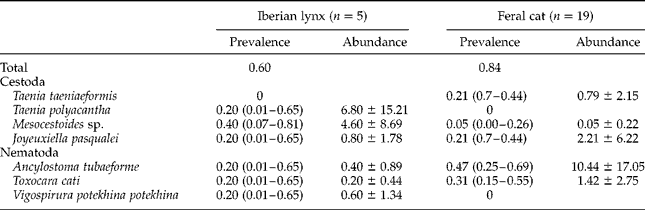
Eleven helminth species were found. Lynxes and cats shared four of these species, whereas mongooses and genets did not share any parasite species with the other carnivores. The observed prevalences and abundances in lynxes and cats are shown in Table 1. Two adult lynxes from SM were not parasitized. The other two lynxes from SM harboured 2 and 3 helminth species, respectively. The lynx from DA harboured 2 species. The mean number of species per host was 1.2, markedly lower than the number (3.1) observed by Torres et al. (Reference Torres, García-Perea, Gisbert and Feliú1998).
Overall prevalence (95% CI) and abundance (±SD) of gastrointestinal helminth parasites in the Iberian lynx (Lynx pardinus) and feral cats (Felis catus) in Sierra Morena and Doñana (southern Spain).
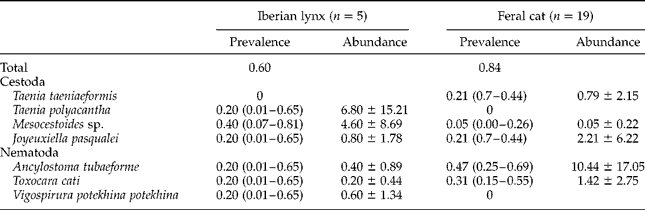
All the species found in lynxes in this work were reported by Torres et al. (Reference Torres, García-Perea, Gisbert and Feliú1998), with the exception of Joyeuxiella pasqualei. This species, which uses lizards as intermediate hosts, is common in the south of the Iberian Peninsula (Torres et al., Reference Torres, Feliú, Miquel, Casanova, Gisbert, García-Perea, García-Perea, Baquero, Fernández-Salvador and Gisbert1996). This species was also relatively frequent in feral cats. Taenia polyacantha and Mesocestoides sp. showed similar prevalence in lynxes to those reported by Torres et al. (Reference Torres, García-Perea, Gisbert and Feliú1998). Taenia polyacantha uses small mammals as intermediate hosts. Mesocestoides sp. uses amphibians, reptiles, small mammals and, in the Iberian Peninsula, the red-legged partridge Alectoris rufa (Millán et al., Reference Millán, Gortazar and Casanova2003). Individuals of T. pisiformis, which is transmitted by lagomorphs, were not found. In Torres et al. (Reference Torres, García-Perea, Gisbert and Feliú1998), this cestode also presented the lowest prevalence among cestodes. The main and almost exclusive prey of the Iberian lynx is the, formerly abundant, rabbit Oryctolagus cuniculus (Palomares et al., Reference Palomares, Delibes, Revilla, Calzada and Fedriani2001). After the myxomatosis and rabbit haemorrhagic disease epizootics, the rabbit has become a scarce prey species in the Iberian Peninsula, which is the main cause of regression of the lynx (Guzmán et al., Reference Guzmán, García, Garrote, Pérez De Ayala and Iglesias2004). Thus, the absence of T. pisiformis and the abundance of other cestode species transmitted by other potential preys may indicate a shift in the lynx diet due to the lack of rabbits. Another possibility is that T. pisiformis development in felids may be limited, and this cestode has been shown to have difficulty in becoming gravid in feline hosts (Van Zyll de Jong, Reference Van Zyll de Jong1966; Beveridge & Rickard, Reference Beveridge and Rickard1975).
Ancylostoma tubaeforme was not found in any of the lynxes from SM, but it was found in the one from DA, confirming the presence of hookworms in lynxes in this area, as reported by Vicente et al. (Reference Vicente, Palomares, de Ibáñez and Ortiz2003). Hookworms were also found in 53% of the cats in DA, and were not found in SM (however, the sample size in this area was low). In DA, adult cats were more frequently parasitized by A. tubaeforme (80%) than juvenile individuals (0%, χ2 = 6.2, P < 0.05). Toxocara cati was found in 37.5% of the cats from DA. Higher prevalences and abundances of A. tubaeforme in cats were found compared with the results of Calvete et al. (Reference Calvete, Lucientes, Castillo, Estrada, García, Peribáñez and Ferrer1998), but both parameters were lower in the case of T. cati. Toxascaris leonina, which was the most prevalent helminth in the lynx as reported by Torres et al. (Reference Torres, García-Perea, Gisbert and Feliú1998), was not found; however, the small sample size of both studies, and the fact that 5 of the 8 lynxes analysed by Torres et al. (Reference Torres, García-Perea, Gisbert and Feliú1998) came from MT, makes it difficult to compare results.
Only two acanthocephalan species were found in the mongoose: Centrorhynchus (Sphaerirostris) lancea (prevalence 8% (95% CI = 0–37); abundance 0.6 ± 2.0) and Centrorhynchus (Longirostris) undulatus (8% (0–37); 0.3 ± 1.1). Both were found in the gut of the same mongoose, and both are new species for the Iberian parasitofauna. Centrorhynchus (S.) lancea is mainly a parasite of Turdidae and Charadriiform birds in Europe, but is also found in the weasel (Mustela nivalis) in western Europe (Golvan, Reference Golvan1956; Petrochenko, Reference Petrochenko1971). Only the original description of C. (L.) undulatus from Falco brachydactylus (Falconiformes) in Morocco is available, because no other author found this species out of their type locality (Golvan, Reference Golvan1956; Petrochenko, Reference Petrochenko1971). The parasitized mongoose probably fed on some infected intermediate host, and this finding may be considered anecdotal. Surprisingly, no helminth was found in the other mongooses. The only previous information about mongoose helminthfauna is, as far as we know, that reported by Blanco et al. (Reference Blanco, Alvarez, Rey, Paniagua, Barcena and Sanmartin1993), which only referred to nematodes. In contrast, no nematode was found parasitizing mongooses in the present work. In the genet, two cestode species parasitizing three individuals were found: Taenia parva (50% (10–90); 9.2 ± 16.6) and Diplopylidium monoophorum (25% (13–75); 3.2 ± 6.5). Both species have been reported previously in Spain (Feliú et al., Reference Feliú, Miquel, Casanova, Torres, Segovia, Fons and Ruiz-Olmo1996; Casanova et al., Reference Casanova, Feliú, Miquel, Torres and Spakulova2000). Although J. pasqualei is widely distributed parasitizing the genet in Spain (Casanova et al., Reference Casanova, Feliú, Miquel, Torres and Spakulova2000), neither the mongoose nor the genet seem to play an important role in the epidemiology of helminths affecting the Iberian lynx.
In contrast, feral cats may be relevant in the life cycle of some species, mainly in directly transmitted nematodes, such as A. tubaeforme and T. cati (although the latter can use paratenic hosts) (Anderson, Reference Anderson1992). Up to 80% of the adult cats were parasitized by hookworms in DA, where feral cats are abundant and widespread. Both facts make the cat the more likely reservoir host of hookworms affecting the Iberian lynx, confirming the hypothesis of Vicente et al. (Reference Vicente, Palomares, de Ibáñez and Ortiz2003). However, a comparison of genotypes of hookworms from lynxes and cats would help to confirm this hypothesis.
Acknowledgements
This is a contribution to the ‘Programa de Actuaciones para la Conservación del Lince Ibérico en Andalucía II’ (Consejería de Medio Ambiente, Junta de Andalucía). We wish to thank D. Cobos and the Rangers from Doñana National Park; M. Delibes, F. Palomares, A. Rodríguez, J.C. Rivilla, J. Román, M. Viota and J.V. López-Bao from Estación Biológica de Doñana; and F. Martínez from El Acebuche. A. Green kindly improved the English.