Introduction
In spite of their relatively small levels in poultry feed, the role of minerals in normal metabolism is highly important. An imbalance of mineral content, that is, deficiency or excess of particular minerals, can result in immune system disorders and impairment of overall health status as well as decreases in production performance. Microelement requirements are relatively small and daily amounts range from micrograms up to milligrams. The accumulation of excessive amounts of microelements higher than those required for normal metabolic activity can induce intoxication symptoms. Some minerals are essential for the health and productivity of animals and have well-defined nutritional and biochemical roles. Many other minerals naturally occur at trace levels in feed and in the tissues of animals but they are not typically suspected to play a useful nutritional purpose (NRC, 2005). All essential microelements have at least one up to even several catalytic functions within the cell. The minerals that play a role in the poultry diet but haven't yet been classified as essential include fluoride, Ni, silicon, tin and Cr (Henry and Miles, Reference HENRY and MILES2006). Having in mind mutual interactions of individual mineral with up to six other minerals, distinguishing between mutual interactions between minerals and their deficiency is of vital importance for the identification and prevention of nutritive disorders. Moreover, a range of essential minerals can provoke toxic effects if excessive amounts are present in animal feed. This particularly pertains to copper, selenium, fluoride, V and arsenic. This article gives an overview of the role, importance and needs of poultry for V, Cr and Ni, for which essentiality in poultry nutrition is still under investigation.
Vanadium
V is a mineral with a high number of oxidative states (from -1 to +5). This makes it a multifunctional element in the body and is likely to contribute to its ability to have effects at relatively low levels (NRC, 2005).
essentiality
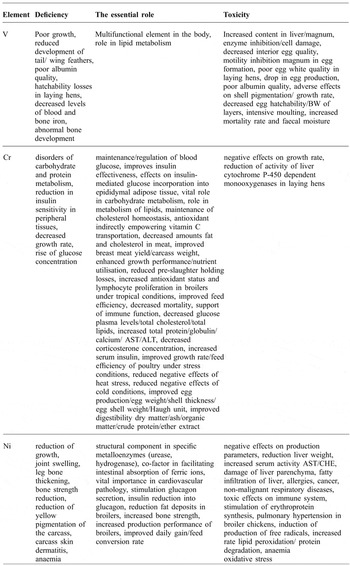
V is an essential element in various enzymes in algae, bacteria, fungi, and lichens (Nielsen, Reference NIELSEN2000). There are conflicting reports as to essentiality of V for animals. V deficiency was first described in rats. In chickens fed diets containing less than 10 µg V/kg, poor growth and reduced development of feathers of the tail and wing were observed. V deficiency often results in poorer albumin quality and hatchability loss in laying hens ( Table 1 ). Data on natural V deficiency are still scarce; however, it has been established that it can occur if the V content in feed is below nutritional requirements of poultry. V plays a role in lipid metabolism and its deficiency in feed can be associated with decreased levels of blood and bone iron, which can result in abnormal bone development (Puls, Reference PULS1990) ( Table 1 ).
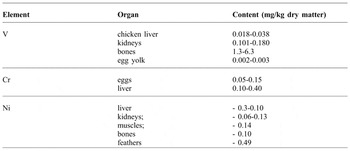
Studies indicate that V is absorbed from the digestive tract at an efficiency of 1% or less. Absorbed V is excreted by the kidneys with a minor amount excreted in the faeces (NRC, 2005). V content in the chicken ranges between 0.018-0.038 mg/kg in the liver, 0.101-0.180 mg/kg in the kidneys, 1.3-6.3 mg/kg in bones and 0.002-0.003 mg/kg in egg yolk on a dry matter basis ( Table 2 ). Somewhat lower V levels have been established in all organs in ducks.
Relevant available literature data offer only limited information about V content in feeds. Relatively high amounts of V are found in fish-based products. V can be found in high concentrations in phosphates originating from South Africa, Russia, the United States, Finland and China (NRC, 2005).
toxicity
The toxicity of V has been investigated more intensively in relation to its presence in phosphates at high concentrations in the form of calcium orthovanadate. The maximum tolerable level for V in poultry has been set at 10 µg V/kg (NRC, 1994), whereas the toxicity level is 100-800 mg/kg feed. NRC (2005) suggested the maximum tolerable level (MTL) in feed for poultry is 50 mg V/kg. More recent research indicates poultry can tolerate up to 25 mg V/kg diet and possibly up to 50 mg V/kg diet without significant decreases in weight gain and health. MTL depends on the valence of V source (toxicity tends to increase as the valency increases), the chemical form of the V source, the period of dosing, the length of exposure, and size of the dose.
Bones and kidneys are major target organs for V, but oral intake leads to its increased content in the liver. Enzyme inhibition and cell damage is considered the most likely mechanism of V toxicity. The V cation competes with ions of Ca, Mn, Zn and Fe for ligand-binding sites and interacts with phosphate ions for a range of metabolic processes. Peroxy-forms of V often mimic insulin actions in different cell types (Fantus et al., Reference FANTUS, KADOTA, DERAGON, FOSTER and POSNER1989). Reduction of interior egg quality associated with high V doses is most likely mediated by inhibited motility of the magnum during egg formation. Poorer quality of egg white has been observed in laying hens fed diets containing 6 mg V from dicalcium phosphate (DCP)/kg feed, whereas a dose of some 28 mg V from DCP/kg feed resulted in a drop of egg production (Sell et al., Reference SELL, ARTHUR and WILLIMS1982) ( Table 1 ). Kubena and Philips (Reference KUBENA and PHILIPS1982) reported that 50 mg V from calcium orthovanadate/kg feed did not cause mortality in laying hens after 28-day research period, whereas 100 mg V from calcium orthovanadate/kg feed resulted in an increase of mortality for 56%. According to the results of Miles and Henry (Reference MILES and HENRY2004) laying hens fed feed-mixes supplemented with 10 mg V/kg feed had poorer albumin quality than birds from the unsupplemented control group ( Table 1 ). The quality of albumen continued to drop two days after changing the feed and removing excess V from hens’ diet, reaching the albumin quality of laying hens from the control group after six days. Odabaşi et al. (Reference ODABAŞI, MILES, BALABAN, PORTIER and SAMPATH2006) reported that feeding hens a diet supplemented with 15 mg/kg V from ammonium-monovanadate had adverse effects on eggshell pigmentation ( Table 1 ).
The detrimental effects of excess V in feed can be alleviated by adding cottonseed meal and vitamin C (Ousterhout and Berg, Reference OUSTERHOUT and BERG1981; Whitehead and Keller, Reference WHITEHEAD and KELLER2003; Odabaşi et al., Reference ODABAŞI, MILES, BALABAN, PORTIER and SAMPATH2006) or a combination of vitamin C, vitamin E and β-carotene (Miles et al., Reference MILES, O`KEEFE, BUTCHER, COMER and WILLIAMS1997). Henry and Miles (Reference HENRY and MILES2001) suggested that feed known to contain phosphates with high V content should be supplemented with potentially harmful amounts of copper (400 ppm) and mercury (100 ppm) in order to reduce the detrimental impact of excess V. Puls (Reference PULS1990) reported that 6 mg V/kg feed negatively affected albumen quality and growth rates of poultry, whereas levels higher than 40 mg V/kg decreased egg hatchability and body weight of laying hens; levels higher than 80 mg V/kg results in intensive moulting, and above 100 mg V/kg increased mortality.
Phosphates with high V content usually originate from the Rocky Mountains (USA) with V concentrations reaching over 6000 mg/kg. The use of these phosphates can add 120 mg/kg of V in feed (Henry and Miles, Reference HENRY and MILES2001). The use of phosphates with high V content can occur in conditions of increased price of phosphates on the global market, thus less expensive sources which are poorer quality are sold into the animal feed market causing consequent V excesses of feed. When phosphate cost is high, phytase is recommended to better use plant phosphorus and reduce phosphate supplementation in feed mixes (Miles and Henry, Reference MILES and HENRY2004). Phytase can play a role also in the sphere of manure management since feeds with high V content increase faecal moisture by 10%, which may pose problems in manure manipulation on poultry farms especially for controlling the number of flies and skin lesions, which increases with manure moisture content (Henry and Miles, Reference HENRY and MILES2001). The essential role of V in poultry nutrition is still under investigation, even though its toxicity was well established a long time ago. Future studies and additional research are needed to define the toxicity of V for poultry and its possible interaction with other nutrients in the feed.
Chromium
Throughout the past few decades, the use of Cr in the nutrition of domestic animals has been the focus of research. Cr occurs in a number of oxidation states, with Cr3+ being the most stable form (NRC, 2005).
essentiality
No recommendation for the Cr requirement in poultry feed currently exists (NRC, 1997). Several varieties of Cr exist, but Cr from yeast, picolinate and chloride forms (CrCl2) have been cited mostly for their biological activities (Khan et al., Reference KHAN, NAZ and DHAMA2014a). Amatya et al. (Reference AMATYA, HALDAR and GHOSH2005) suggested that amongst the inorganic sources of supplemental Cr, potassium chromate might provide a potential source of Cr instead of CrCl2 in poultry.
A range of experiments indicated the crucial role of trivalent Cr (Cr3+) in the maintenance and regulation of blood glucose levels (via the glucose tolerance factor - GTF) ( Table 1 ). Dietary Cr3+ improves insulin effectiveness by enhancing its binding to receptors and the sensitivity of the target cells (Debski et al., Reference DEBSKI, ZALEWSKI, GRALAK and KOSLA2004). Some further research suggested the effects of Cr on insulin-mediated glucose incorporation into the epididymal adipose tissue. Besides its vital role in carbohydrate metabolism, Cr is implicated in the metabolism of lipids, maintenance of cholesterol homeostasis and manifests certain antioxidative properties as well ( Table 1 ). Being the active component of the GTF, Cr is thought to function as an antioxidant (Preuss et al., Reference PREUSS, GROJEC, LIEBERMAN and ANDERSON1997) ( Table 1 ). Through increasing the efficiency of insulin, Cr indirectly empowers vitamin C transportation (Sahin and Sahin, Reference SAHIN and SAHIN2001). In chickens, insulin is known to increase protein synthesis and the efficiency of amino acid transport and diminished protein degradation rate (Duclos et al., Reference DUCLOS, CHEVALIER, GODDARD and SIMON1993).
Debski et al. (Reference DEBSKI, ZALEWSKI, GRALAK and KOSLA2004) observed that Cr supplementation increased the weight of pectoral muscles and the meat of these broilers contained less fat and cholesterol. Hossain et al. (Reference HOSSAIN, SERGIO and SILVA1998) ( Table 1 ) fed growing broilers diet supplemented with Cr at a level of 0, 300, 400, 600 µg/kg diet and found that breast meat yield and carcass weight improved at 300 µg supplemental Cr/kg diet. Ahmed et al. (Reference AHMED, HALDAR, PAKHIRA and GHOSH2005) indicated that supplementation with 0.2 mg Cr/kg in the diet (as CrCl2) might be an effective tool for enhancing the growth performance, nutrient utilisation and most of the carcass characteristics of broiler chickens ( Table 1 ). However, the results of some studies suggest that the addition of Cr (as organic Cr) does not affect body weight and feed efficiency (Rao et al., Reference RAO, RAJU, PANDA, POONAM, MURTHY and SUNDER2012). In this study, the authors indicated that the addition of organic Cr reduced pre-slaughter water holding losses, increased the relative mass of breast, and antioxidant status and lymphocyte proliferation in broilers reared under tropical climatic conditions. Jackson et al. (Reference JACKSON, POWELL, JOHNSTON, SHELTON, BIDNER, VALDEZ and SOUTHERN2008) indicated that the dietary addition of Cr propionate (0, 200, 400 or 8000 µg/kg) improved feed efficiency and decreased mortality, but had no effect on carcass traits of broiler chickens.
The Cr content in eggs and liver range between 0.05-0.15 mg/kg and 0.10-0.40 mg/kg dry matter, respectively ( Table 2 ). In poultry, Cr absorption rate is poor and its intake is negligible (Khan et al., Reference KHAN, NAZ and DHAMA2014a). Organic Cr is absorbed in a better way into the gut as compared to inorganic forms and thus has higher bioavailability (Lukaski, Reference LUKASKI1999). The factors influencing Cr absorption from the gut include amino acids, ascorbic acid and oxalate (Khan et al., Reference KHAN, NAZ, DHAMA, SAMINATHAN, TIWARI, JEON, LAUDADIO and TUFARELLI2014b).
Feed containing less than 3 mg/kg Cr can provoke deficiency symptoms. The research data on Cr deficiency in poultry are limited since most commercial diet formulations contain sufficient amounts. Cr deficiency causes disorders of carbohydrate and protein metabolism, reductions in insulin sensitivity in the peripheral tissues and decreases in growth rate (Lindeman, Reference LINDEMAN1996) ( Table 1 ). In the case of Cr deficiency, the receptor cannot bind insulin, resulting in the rise in glucose concentrations. As a consequence, the pancreas releases more insulin to balance blood glucose levels (Debski et al., Reference DEBSKI, ZALEWSKI, GRALAK and KOSLA2004). According to El-Hommosany (Reference EL-HOMMOSANY2008) dietary supplementation of Cr in Japanese quail significantly decreased the plasma levels of glucose, total cholesterol and total lipids, whereas total protein, globulin, calcium, AST and ALT increased ( Table 1 ).
The well-established V/Cr interaction can play a role in overcoming the problem of poor growth in chickens associated with excessive dietary V, i.e. Cr supplementation can alleviate the impact of excess V activity. Similar activity has been observed in laying hens, where Cr supplementation reduced the negative effects of V on albumen quality (Jensen and Maurice, Reference JENSEN and MAURICE1979).
Cr can alleviate heat stress in poultry. Grains used in poultry diet contain relatively low amounts of Cr, and heat stress induces its mobilisation from tissues and increases its excretion thus causing increases in Cr requirement ( Table 1 ). Hence, heat stress negatively affects Cr status in poultry (NRC, 1997) as well as productivity, immunity and the antioxidative status of poultry that can cause economic losses (Kapetanov et al., Reference KAPETANOV, PAJIĆ, LJUBOJEVIĆ and PELIĆ2015). Dietary Cr supplementation improves the growth rate and feed efficiency of growing poultry, and these beneficial effects appear to be greater under stress conditions (Onderci et al., Reference ONDERCI, SAHIN, SAHIN, CIKIM, VIJAYA and KUCUK2005). The stress response is mainly associated with the activation of the hypothalamo-pituitary-adrenal (HPA) axis and orthosymphatic nervous system, which reduces the detrimental effects of high body temperature (Lin et al., Reference LIN, JIAO, BUYSE and DECUYPERE2006).
Heat stress conditions are characterised by reduced usability of feed ingredients. Cr supplementation can reduce the negative effects of heat stress, although organic Cr is much more effective compared to inorganic forms (Ahmed et al., Reference AHMED, HALDAR, PAKHIRA and GHOSH2005; Khan et al., Reference KHAN, NAZ, DHAMA, SAMINATHAN, TIWARI, JEON, LAUDADIO and TUFARELLI2014b). Sahin et al. (Reference SAHIN, SAHIN, ONDERCI, GURSU and CIKIM2002a) reported improved egg production, egg weight, shell thickness and specific weight in Japanese quails fed diets with Cr supplementation in conditions of high ambient temperatures. The same authors concluded that increasing the Cr content in broiler formulations resulted in decreases in corticosterone concentrations while increasing serum insulin levels. Consequently, decreased blood glucose and cholesterol concentrations and increased protein levels occur in heat stress conditions (Sahin et al., Reference SAHIN, OZBEY, ONDERCI, CIKIM and AYSONDU2002b). The negative effects of heat and cold climatic conditions could be prevented by the use of supplements such as vitamin C and Cr (Sahin and Sahin, Reference SAHIN and SAHIN2001; Gous and Morris, Reference GOUS and MORRIS2005). Low ambient temperature was reported to suppress nutrient digestibility in laying hens. Sahin and Sahin (Reference SAHIN and SAHIN2001) reported that combination of 250 mg vitamin C and 400 µg of Cr, as Cr picolinate, per kg of diet, can be a protective management practice in poultry to alleviate the depressive effect of cold stress on laying hen performance. Egg weight, specific gravity, egg shell thickness, egg shell weight and Haugh unit improved with a diet containing 250 mg vitamin C and 400 or 800 µg of Cr per kg of diet. Similarly, the digestibility of dry matter, ash, organic matter, crude protein and ether extract were higher with higher dietary Cr and vitamin C. The addition of vitamin C may be beneficial in enhancing the availability of Cr from inorganic compounds (Ahmed et al., Reference AHMED, HALDAR, PAKHIRA and GHOSH2005).
toxicity
Cr is not considered an element of particularly high toxicity, since adequate and toxic levels in feed significantly vary. Toxicity of Cr is associated mainly with hexavalent Cr, and for this reason registration of other valency Cr products has been delayed, despite their low toxicity and demonstrable benefits in feed. Currently, feed containing Cr levels above 300 mg Cr/kg is considered toxic. The negative effects of excess Cr on growth rate in poultry have been reported ( Table 1 ). In laying hens, the addition of 50 mg Cr/kg diet from CrCl3 and yeast did not affect egg production, bur reduced the activity of liver cytochrome P-450 dependent monooxygenases (Guerra et al., Reference GUERRA, RENZULLI, POZZETTI, PAOLINI and SPERONI2002). Future studies are needed to define the maximum tolerable levels for Cr, in its various valency states.
Nickel
Ni is considered both an essential and toxic element for humans, animals, plants and microorganisms. Different forms of Ni occur naturally in the environment, and the element is widely applied in metallurgical, chemical and food-processing industries mainly as a catalyst and pigment. The most used Ni salts include chloride, sulphate, nitrate, carbonate, hydroxide, acetate and oxide (Bangyuan et al., Reference BANGYUAN, HENGMIN, XI, JING, ZHICAI, JUNLIANG and JIANYING2013).
essentiality
The essential function of Ni has been established in rats, poultry, swine, goats and sheep. Ni plays a role either as a structural component in specific metalloenzymes (urease, hydrogenase) or as a co-factor in facilitating intestinal absorption of ferric ions ( Table 1 ). Experiments have suggested its importance in cardiovascular pathology, i.e., elevated serum Ni concentrations are observed in patients with acute myocardial infarction and stroke (Bersényi et al., Reference BERSÉNYI, FEKETE, SZILÁGYI, BERTA, ZÖLDÁG and GLÁVITS2004). Ni ions have a high affinity for proteins and amino acids and cause protein oxidation in cells. Its binding to chromatin in somatic cells can result in oxidative and structural damage to cell proteins. Currently, eight enzymes containing Ni have been identified (Bangyuan et al., Reference BANGYUAN, HENGMIN, XI, JING, ZHICAI, JUNLIANG and JIANYING2013).
According to data reported by Puls (Reference PULS1990), Ni content in tissues is quite uniform ranging from 0.3-0.10 mg/kg in the liver; 0.06-0.13 mg/kg in kidneys; 0.14 mg/kg in muscles; 0.10 mg/kg in bones and 0.49 mg/kg in feathers on a dry matter basis ( Table 2 ). Ni content in feathers increases with the age of birds as a response to exogenous contamination. The research of Mihaljev et al. (2012), which studied a range of wild bird species in the territory of Vojvodina, revealed Ni levels of 0.078-0.125 mg/kg (average 0.093±0.019 mg/kg) in the liver, 0.098-0.137 mg/kg (average 0.098±0.023 mg/kg) in the kidneys, and 0.026-0.077 mg/kg (average 0.049±0.014 mg/kg) in muscle ( Table 2 ). Ni content was analysed in 24 wild bird sample, including swan (Cygnus), water blade (Gallinula choloropus), heron (Egretta garzetta), eagle buzzard (Buteo buteo), white-tailed eagle (Haliaeetus albicilla), seagull (Larus ridibundus), white stork (Ciconia ciconia), wild duck (Anas platyrhynchos), and grey heron (Ardea cinerea). Particularly high Ni levels were observed in samples obtained from grey heron, reaching 0.125 mg/kg and 0.137 mg/kg in liver and kidneys, respectively. Nisianakis et al. (Reference NISIANAKIS, GIANNENAS, GAVRIIL, KONTOPIDIS and KYRIAZAKIS2009) found higher levels of Ni in goose eggs compared to other species tested (chicken, turkey, duck and pigeon).
Animal requirements for Ni have not yet been clearly defined and are estimated to range between 50-100 μg Ni/kg feed to prevent clinical symptoms of deficiency (Bersényi et al., Reference BERSÉNYI, FEKETE, SZILÁGYI, BERTA, ZÖLDÁG and GLÁVITS2004). According to Puls (Reference PULS1990), adequate Ni content in feed should range between 0.1 and 3.0 mg/kg of feed on a dry matter basis. Feeds of plant origin contain higher Ni levels than those of animal origin, thus, the majority of poultry diets contain relatively high amounts of this element. Ni content in grains including oat, barley and maize range from 0.08 to 1.00 mg/kg dry matter, whereas Ni levels in protein sources, such as flaxseed, soybean and sunflower, are within the range between 5.24 and 7.91 mg/kg dry matter (Kronemann et al., Reference KRONEMANN, ANKE, THOMAS and RIEDEL1980).
The symptoms of Ni deficiency have not been reported so far, which might be attributed to high Ni concentrations given in poultry requirements. Artificially induced Ni deficiency in poultry results in reduced growth, joint swelling, thickening of leg bones (increase in diameter) and reduced bone strength (Wilson et al., Reference WILSON, WILSON and RUSZLER2001) ( Table 1 ). Ni deficiency symptoms occur in specific conditions and are associated with diet composition (Wilson et al., Reference WILSON, WILSON and RUSZLER2001). Symptoms of Ni deficiency detailed by Puls (Reference PULS1990) included reduction of yellow pigmentation of the carcass, leg thickening, joint swelling, carcass skin dermatitis and anaemia ( Table 1 ).
Cain and Pafford (Reference CAIN and PAFFORD1981) reported that negative effects of Ni on body mass might be attributed to its potential interference with calcium. Exogenous Ni administration to broilers stimulates glucagon secretion, while insulin reduction into glucagon has been associated with a reduction of fat deposition in broilers, suggesting that plasma Ni concentration has an influence on carcass quality (Oscar and Mitchell, Reference OSCAR and MITCHELL1995). The effects of dietary Ni (0, 25, 50, 75, 100 and 150 mg/kg) on bone strength and performance of male broilers were investigated by Wilson et al. (Reference WILSON, WILSON and RUSZLER2000). Broilers were distributed into groups according to housing system - floor pens or cage. The authors concluded that Ni supplementation of 25 mg/kg positively influenced the bone strength and performance of broilers ( Table 1 ). This was confirmed in the research of Wilson et al. (Reference WILSON, WILSON and RUSZLER2001) using 0, 25, 50, 75, 100 and 150 mg Ni /kg feed in Bovan chickens kept in cage housing.
Bersényi et al. (Reference BERSÉNYI, FEKETE, SZILÁGYI, BERTA, ZÖLDÁG and GLÁVITS2004) investigated the effects of Ni supplementation (50 and 500 mg Ni/kg feed) on growth, nutrient digestibility and Ni retention in broiler tissue ( Table 1 ). Supplementation of 50 mg Ni/kg feed moderately improved the daily gain and feed conversion rate. However, supplementation of 500 mg Ni/kg had significantly negative effects on production parameters and reduced liver weight, while increasing serum activity of enzymes, indicating damage of liver parenchyma. The results of serum analysis suggested that supplementation of 500 mg Ni/kg feed resulted in moderate pathological fatty infiltration of the liver. The authors concluded that supplementation of 50 mg Ni/kg feed has mild or insignificant effects on growth performances of broilers. Adding of 6 and 12 mg Ni in the form of NiCl2 per kg of finisher mix did not produce positive effects on production performance in chicks (Oscar and Mitchell, Reference OSCAR and MITCHELL1995).
toxicity
Toxic properties of Ni have been more extensively investigated. Ni is spread in the environment via rainfall and wind and accumulate in soil, plant and animal tissues and consequently are consumed by humans. High Ni concentrations can cause allergies, cancer, non-malignant respiratory diseases and have toxic effects on the immune system ( Table 1 ). Dietary supplementation with high levels of Ni can stimulate erytrhroprotein synthesis, increase blood haemoglobin content and cause pulmonary hypertension in broiler chickens (Martinez and Diaz, Reference MARTINEZ and DIAZ1996) ( Table 1 ). Moreover, Ni can interfere with DNA repair mechanisms and induce the production of free radicals as well as increase the rate of lipid peroxidation and protein degradation (Bangyuan et al., Reference BANGYUAN, HENGMIN, XI, JING, ZHICAI, JUNLIANG and JIANYING2013).
At the request of the European Commission, the EFSA Panel on Contaminants in the Food Chain (CONTAM Panel) performed an assessment of the hazards for human and animal health and natural environment associated with the presence of Ni in food. It was concluded that adverse effects in pigs, rabbits, ducks, fish, dogs, chickens, horses, sheep, goats and cats were unlikely, whereas young children aged 0-3 years were at the highest health risk in the human population. Moreover, other age categories of children are at risk through ingesting harmful doses of Ni via food of animal origin (EFSA, 2015).
Cain and Pafford (Reference CAIN and PAFFORD1981) supplemented feed for ducklings with different amounts of Ni (1, 200, 800 and 1200 mg Ni/kg feed) and concluded that severe damage occurred at 800 mg Ni/kg, whereas supplementation of 1200 mg Ni/kg feed resulted in a lethal outcome. The authors reported that supplementation of 1 mg, 200 mg and 800 mg Ni/kg had no effect on body weight of ducklings. Ling and Leach (Reference LING and LEACH1979) investigated the toxicity of Ni for chickens, and found that 300 mg/kg and higher in feed significantly reduced growth, and anaemia and high mortality were observed in chickens fed diets containing 1100 mg/kg Ni ( Table 1 ). Dietary Ni content of 300 mg/kg resulted in a significant increase in kidney Ni content while higher dietary levels resulted in increased Ni concentrations in other tissues. The addition of cobalt, iron and zinc in diets containing toxic Ni levels (500 mg/kg) did not prevent or alleviate these adverse effects.
Bangyuan et al. (Reference BANGYUAN, HENGMIN, XI, JING, ZHICAI, JUNLIANG and JIANYING2013) investigated the effects of Ni supplementation (in the form of NiCl2) on oxidative stress in broiler chickens. Birds were fed rations based on maize and soybean pellets supplemented with 300 mg/kg, 600 mg/kg and 900 mg NiCl2/kg. The results revealed significantly higher malondialdehyde levels in groups receiving ≥300 mg/kg NiCl2 compared with the unsupplemented control group. After Ni supplementation, the activity of superoxide dismutase (SOD), catalase (CAT) and glutathione peroxidase (GSH-Pk) as well as glutathione hormone (GSH) level were significantly reduced compared to the control group. The authors concluded that supplementation of more than 300 mg NiCl2/kg feed can induce oxidative stress and impaired antioxidation in broilers ( Table 1 ). The negative impact of toxic doses of Ni on growth in poultry may be alleviated by increasing the protein content in the diet (Puls, Reference PULS1990).
Future studies need to focus on the biochemical function of Ni, as well as its forms and availability from natural nutrients. Increased knowledge of the harmful and essential levels of this trace mineral are necessary.
The deficiency, essential role and toxicity of V, Cr and Ni in poultry nutrition.

The content of V, Cr and Ni in some poultry organs.

Conclusions
Based on available literature, the biological role of V, Cr and Ni in normal metabolism during the production of poultry is important. Their essential role in poultry nutrition is still under investigation, while toxicity has been relatively well established for some time. Even though some feed materials might represent a potential source of harmful amounts of V, Cr and Ni, the combination of relevant quality control programs in the animal feed industry as well as the application of good production practices and adequate education of nutritionists can substantially reduce the risks associated with poultry feed contamination. Future studies and additional research are needed to define the essentiality and toxicity of V, Cr and Ni for poultry and their possible interactions with other nutrients in the feed.
Acknowledgments
This work was financially supported by a grant from the Ministry of Education, Science and Technological Development, Republic of Serbia, Project number TR 31084.