War and its consequences
Two hundred years ago Francisco de Goya produced a series of etched plates on the war of independence that devastated Spain in the years 1808 to 1814,Footnote 1 and which was not only an international conflict, fought against the army of Napoleon, but also a civil and guerrilla war. Merciless fighting and unspeakable horrors gave way first to horrific famine and then to ruthless repression. If we look today at Goya's one-of-a kind work, we are struck by its significance to current events and the force and relevance of its message, which resonates in particular with modern-day humanitarian aid workers. The engravings, which depict a world devastated by a war without limits, whose victims are without aid or protection, are like a negative image of the challenges faced by humanitarian law and humanitarian work in armed conflict.
Goya's work draws its richness from the way in which it focuses entirely on the human being. His depictions of violence are lucid and engaged, without prejudice or complacency, yet sensitive to the suffering of the victims, thereby paving the way for neutral, independent humanitarian action. The engravings also reflect Goya's personal experience of war, as painful as it was traumatic. They are the testimony of a man who witnessed the extreme violence and harm that man inflicts upon his fellow man once violence is unleashed. Like Goya the painter, humanitarian workers see this violence, see things that are unbearable to look at and that words cannot express. Both are exposed to psychological trauma and, through and in their work, try to find meaning and a path to humanity where there no longer is one.
Through his work, then, Goya not only denounces extreme violence by showing how dehumanizing it is, how it destroys what is human in man. Faced with a world of devastation, destruction, suffering, and neglect, he cries out with indignation, pleading for a gesture of humanity: ‘There is no one to help them!’ Fifty years later, the same indignation rose up in Henry Dunant when he saw the wounded and dead lying abandoned on the battlefield of Solferino, and it prompted him to come to the aid of the victims.
Goya shows us a world of extreme violence, in which no help is offered to the victims, in which the earth is empty and bare and all feelings of humanity seem to have vanished. His depictions point to the absolute and urgent need for limits to violence in armed conflict, and his plea for help for the victims is as authentic as it is obvious. Goya's extraordinary work would not be published until 1863, thirty-five years after his death and in the year of the first international conference of the Red Cross.
Much has been written about Goya's life and workFootnote 2 and there is an abundance of literature on The Disasters of War.Footnote 3 The present article proposes to examine this vast body of work in a different light – that of humanitarian action in armed conflicts. Following in Goya's footsteps, it will therefore begin the assessment of each image by looking at the victims, perpetrators, and eye-witnesses of violence, and then discuss the implication of these images for humanitarian action and those carrying out humanitarian work in the extreme violence of war. First, however, a brief summary of Goya's life before the war.
Francisco de Goya y Lucientes was born on 30 March 1746 in Fuendetodos, a village near Saragossa, in Aragon. After being apprenticed to a painter and spending time in Italy, Goya married at the age of 27. In 1775 he settled in Madrid, painting religious works and tapestry cartoons for the El Prado palace. Many of these tapestries depict an idyllic world in which men, women, and children enjoy the bounteous and fertile beauty of nature, in welcoming, light-filled surroundings.Footnote 4 The paintings are inhabited by elegant, graceful people engaged in play and happily enjoying festive moments.
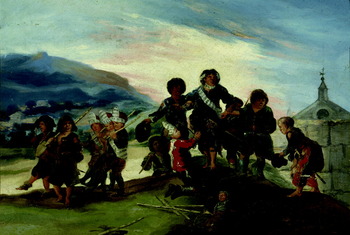
Goya's series of six paintings of children at play (1778–1785) are evidence of his keen sense of observation, the attention he paid to human beings, and the sensitivity and tenderness that he felt towards the youngest among them. The works show children at play, sometimes quarrelling, or crying in a corner. In his painting of children playing at soldiers (Figure 1), war seems but innocent child's play.
Francisco de Goya, Niños jugando a los soldados (Boys playing at soldiers), 1776–1785. Madrid, Collección Santamarca.

In 1789 Goya was appointed court painter and produced several official portraits. In Spain, the French Revolution made itself felt in feelings of hope but also uncertainty and insecurity. Goya sympathized with the ideals of the Enlightenment and the hopes associated with the Revolution. Three years later, he fell seriously ill. Although he recovered, his illness left him completely and permanently deaf. When he resumed work, his paintings became more personal, often portraying nature as hostile and as setting for disasters and violence: themes included shipwrecks, fires, an attack on a stage coach, assassinations, scenes from prisons and lunatic asylums, and, later, witchcraft and superstition.
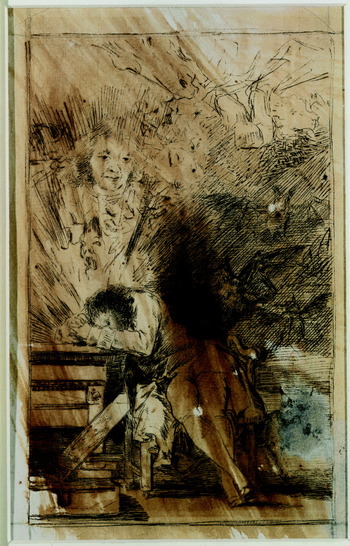
In 1799 Goya was appointed to the position of first court painter. The same year he published a series of etchings entitled Los Caprichos, in which he depicted the foibles of people and society, pointed out the dark side of human behaviour, unveiled hypocrisy, and denounced the abuse of women, the ill-treatment of children, and other forms of social violence. For Goya, it was time for reason to rule: when reason sleeps (Figure 2), superstition and menacing shadows return.
Francisco de Goya. El sueño de la razón produce monstruos (The sleep of reason produces monsters). Caprichos, plate 43 (preparatory drawing) 1797. Museo Nacional del Prado, Madrid.

The Disasters of War
In 1807, the army of Napoleon Bonaparte began its invasion of Spain. On 2 May 1808, following the abdication of the king, a popular uprising in Madrid was repressed by the French cavalry. The incident pushed Spain into a terrifying war. What began as a fight against the invaders turned into civil war as the French occupiers enjoyed the support of numerous Spanish partisans hoping to end the system of absolute monarchy. For Goya, who was 63 years old at that time, the shock was terrible, torn as he was between his liberal, enlightened views and the horrific cruelties and abuse that were to last for six years. During this period he travelled throughout Spain and witnessed first-hand the ravages of war and the suffering of the population. After the first siege of Saragossa in the summer of 1808, the Spanish general Palafox invited Goya and two other artists to come and see the devastation caused by the bombardments. The etchings subsequently published by his colleagues depict combat scenes, destroyed monuments, and heroic figures:Footnote 5 throughout time, art has been used by the victors for the glorification of war.Footnote 6 Goya returned from his voyage in a state of upheaval and did not start work until two years later, in 1810, when for more than five years he produced drawings and copper prints of scenes of war, the terrible famine of 1811–1812, and the ensuing repression. The series of engravings, which he entitled ‘Fatal consequences of the bloody war in Spain with Bonaparte’, was not widely distributed. Goya died in 1828. The prints were eventually published thirty-five years later, under the title The Disasters of War.
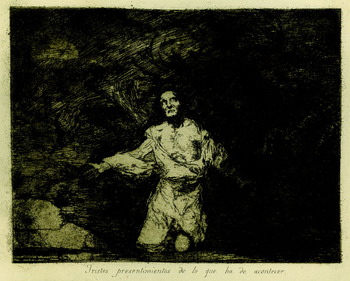
Tristes presentimientos de los que ha de acontecer (Gloomy premonitions of what must come to pass) (The Disasters, plate 1 Footnote 7)
The sky has darkened and in the distance we can almost hear the sound of marching boots and rolling drums. War is imminent, appears inevitable. The imploring look on the man's face is an expression of deepest distress and anxiety about the events that are about to take place. Alone, on his knees, he is surrounded by dark shadows and haunted by menacing, grimacing figures. What light there is reveals his near-nakedness, his ragged clothes. He is pleading for help, powerless in the face of events from which there is no escape.
The Disasters, plate 1, Tristes presentimientos de los que ha de acontecer (Gloomy premonitions of what must come to pass).

The image, which is the frontispiece to Disasters of War, could be considered a warning to the viewer. What the man seems to say is: ‘You who are about to turn these pages, be ready to look at the face of human suffering and the horrors of war.’ In Goya's time most works of art depicted the death of a hero,Footnote 8 representing war as positive, beautiful, and glorious, and the deceased as hero of a great cause. Pictures of war had moral qualities and spared little space for suffering. From the outset, Goya adopted a radically different, original attitude, rejecting the bellicose, heroic, sacrificial, and triumphalist approach. His work centres fully on the human person.
The anxiety portrayed in the drawing is a reflection of the extreme violence witnessed by Goya and, in modern times, by humanitarian workers reaching out to victims of violence. In this sense, the frontispiece image is also an invitation to silence. Learning to observeFootnote 9 and to listen to others are great qualities common to both artists and humanitarian workers.
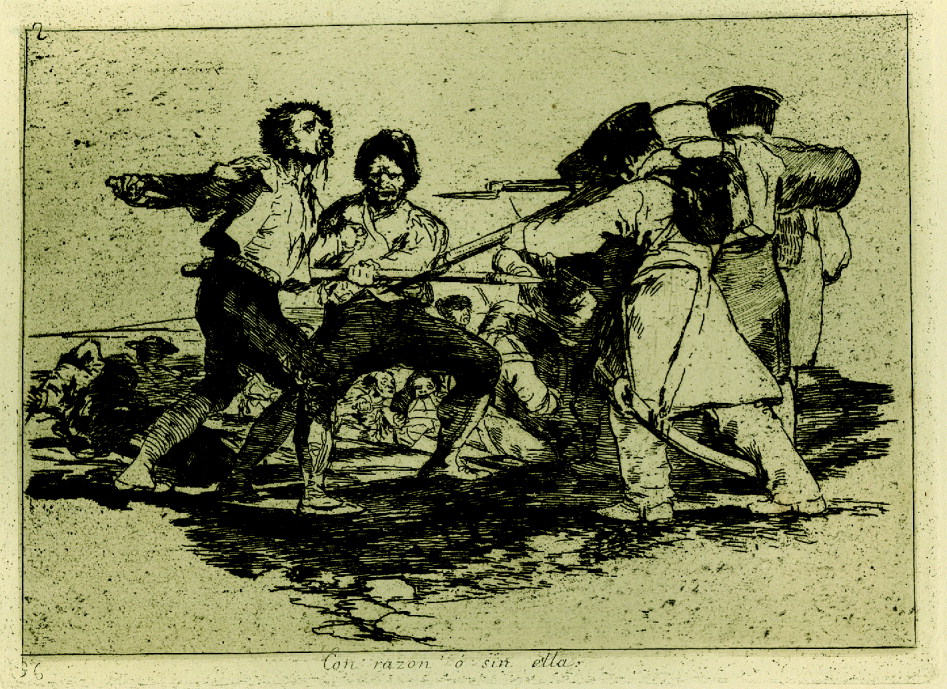
Con razon ó sin ella (With or without reason) (The Disasters, plate 2)
Without transition the artist plunges us into the heart of violence at its most brutal. The print depicts, on one side, the mechanical, faceless, impersonal violence of Napoleon's army. The rifles aimed by invisible faces reappear in the painting The Third of May 1808. On the other side, facing the viewer, are the violent insurgents. They have faces, the ferocious expressions on which reveal that this is a fight without mercy. Behind them lies a pile of bodies, both wounded and dead. In the next print, entitled The same thing (plate 3), a Spanish insurgent raises an enormous axe above a French hussar who, terrorized, attempts to plead for mercy. Violence dehumanizes both sides of the conflict.
The Disasters, plate 2, Con razon ó sin ella (With or without reason).
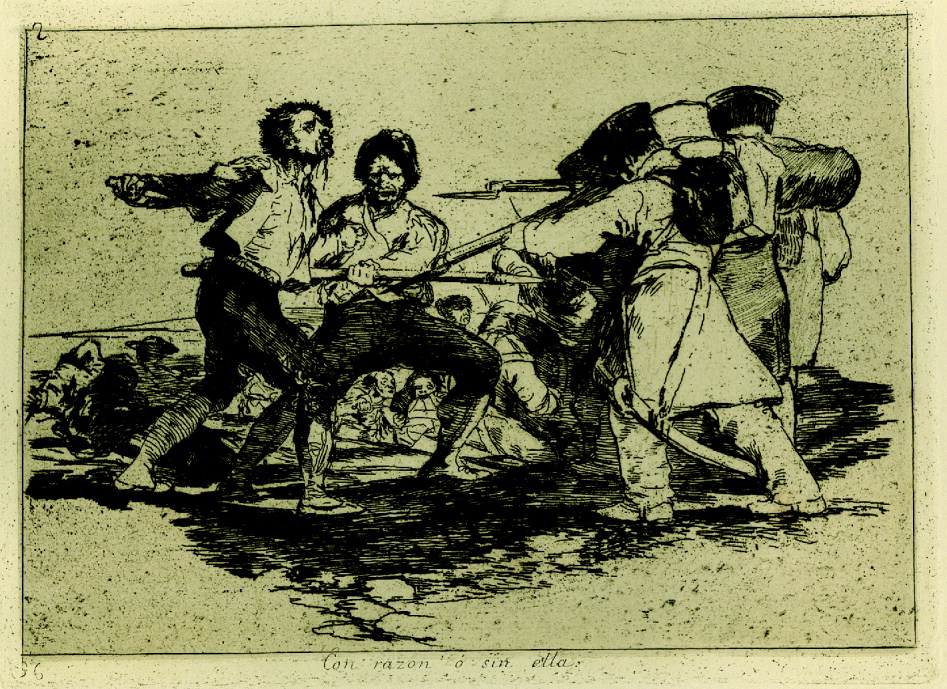
As the title says: never mind the reason for it, violence is always the same and always has the same consequences: injuries, suffering, death, and devastation. Goya was familiar with the prints entitled The Miseries of War, by Jacques Callot.Footnote 10 This series of eighteen etchings,Footnote 11 published in 1633, depicts the ravages of the war waged in Lorraine in 1630, the unbridled violence and cruelty, bloody clashes between armies, revenge wreaked by civilians, devastation, theft, rape, burning, and pillaging, the bandits, assassins, and condemned prisoners, the executions, hangings, and torture. Callot painted groups of people and crowds in wide perspective, from a distance and using symmetrical compositions that create an impression of order underlying the cruelty being depicted. Goya alters the perspective – a photographer would talk about a change in framing – and draws the viewer into the image, close to the violence and human suffering, in compositions that disorient the viewer.
With or without reason: Goya's subtitle appears to echo that of a print by Callot: ‘It is not without reason that the great Leaders were well advised to invent these punishments’. The image shows torture by strappado (in The Great Miseries of War, plate 10Footnote 12). Yet, even as he depicted these horrors, Callot seemed to condone a political or moral order that would be restored by legitimate authority and punishment. Goya considered that nothing could ever justify exactions by armed violence. He stood alone among his contemporaries in refusing to see anything heroic or glorious in actions that transform the warring parties into barbarians.Footnote 13
The subtitle chosen by Goya is also an indication of his disillusionment, he who had believed so strongly in the force of reason. The power of reason celebrated by the Enlightenment had proved impotent in the face of violence. Goya dismissed both protagonists in the conflict as equally at fault, by demonstrating that when violence is unleashed reason ceases to be of any value. Here, humanity itself is at stake.
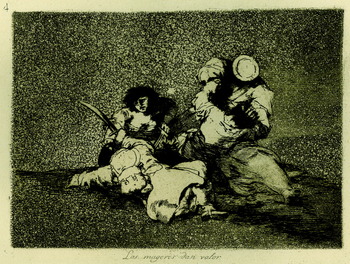
Las mujeres dan valor (The women give courage) (The Disasters, plate 4)
Violence was spreading throughout the country. The insurgents engaged in a guerrilla, a term that would enter English usage after this conflict. The Spanish authorities called on all men to take part in the fighting, setting no limits as to the means that they could deploy.Footnote 14 In this plate, Goya portrays the role of women, showing their courage and vulnerability at the same time. On the right, a woman seems to be struggling in vain against a soldier who is clearly much stronger than her. On the left, a second woman has plunged her weapon into the body of an enemy soldier. In the next plate, entitled And they are fierce (plate 5), a fighting woman clutches her child under one arm, while spearing an enemy with the other.
The Disasters, plate 4, Las mujeres dan valor (The women give courage).

These images are appalling. But they bear witness to the cruelty inflicted upon women and children, and the acts of cruelty that women committed against enemy soldiers.Footnote 15 Goya takes an unflinching look at the sort of violence that, once it has erupted, spreads as if by contagion in such a way that atrocities are at times also perpetrated by the most vulnerable members of society, including women and even children. Several recent conflicts have confirmed this.
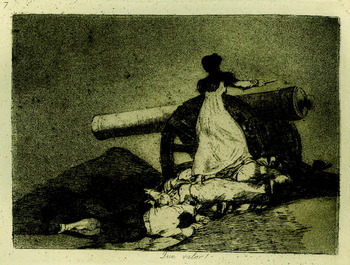
Que valor! (What courage!) (The Disasters, plate 7)
A woman ignites the powder fuse of a cannon while dead or wounded artillery soldiers lie at her feet. Like other women she wears white, a symbol of innocence and vulnerability. Amid the play of shadows and light, only her garment, the barrel of the cannon, and the bodies in the foreground are lit up. This print is the only one in the series to show an act of combat in a positive light. It illustrates the actions of one Agustina de Aragón, who rose to fame during the siege of Saragossa. And yet, whereas Goya's colleagues in Saragossa exalted her heroism by portraying her in a theatrical pose,Footnote 16 he shows her from the back, her face obscured. Obstinately refusing all references to heroism, he thus honours the courage of one woman and, through her, the dignity of a people.Footnote 17
The Disasters, plate 7, Que valor! (What courage!).

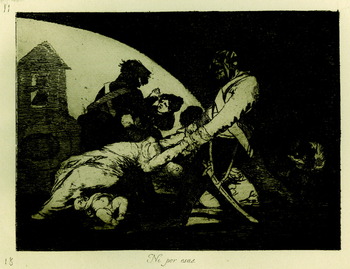
Ni por esas (Neither do these) (The Disasters, plate 11)
Goya continues the theme of women in war with three scenes of rape. Their titles speak for themselves: They do not want to (plate 9), Nor do these (plate 10), and Neither do these (plate 11), as if there were a need to remind us that rape is rape, and nothing less than a crime. The titles reveal the artist's indignation at the acts, and at the denial and leniency with which they have been received throughout history. The scene is set in the shadows, under an archway, before the eyes of a prone, powerless figure and of a baby lying at the feet of the young woman dressed in white. The background features a church; yet the situation seems hopeless and the outcome inevitable.
The Disasters, plate 11, Ni por esas (Neither do these).

Like many others, these terrible images may shock, and in doing so raise questions as to the role and limits of images in war: should scenes like these be shown? And if so, for what purpose? The same questions are still asked today with regard to photographs and documentary war films.Footnote 18 Goya replies through his work, by portraying these acts in a compassionate light that denounces the sexual violence, unmasks the shameful attitude of the perpetrators, and highlights the courage and dignity with which the women defend themselves. And Goya goes even further. His images invite us not to reduce violence to the acts themselves but to turn our attention to the experience of the victims. He invites us to plunge our eyes into those of the victims, to look at the situation from the victims’ perspective, with compassion and humanity. The images prompt us to acknowledge not only the crime and its perpetrators but also the vulnerability, suffering, and dignity of the victims. They are an appeal to the sentiment of humanity.
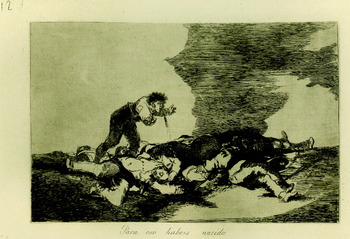
Para eso habeis nacido (This is what you were born for) (The Disasters, plate 12)
The ground is strewn with corpses. In a bare landscape under a heavy sky, smoke rises up from burning villages. The practice of burning was so widespread that it was possible to follow the movements of the French army by observing the clouds of smoke.Footnote 19 A man retching at the sight of the bodies collapses, arms outstretched, vomit flowing from his mouth. It is a scene of death, devastation, and horror. Does life have no meaning at all?
The Disasters, plate 12, Para eso habeis nacido (This is what you were born for).

Those who are witness to situations of extreme violence have to face scenes of unbearable suffering while being powerless to do anything about it. With a few strokes of his brush, Goya has thus depicted an acute traumatic response. Psychological trauma is caused by intense events involving death, serious injury, or a threat to the physical integrity of the person himself or herself or of others, and to which the individual in question was unable to respond appropriately. Whether someone was directly threatened or a witness, the traumatic event causes long-term upheaval in the psychological make-up of the individual and produces intense fears and feelings of impotence or horror.Footnote 20
It is conceivable that Goya is describing a traumatic response that he himself experienced at some point in his life. Being fairly advanced in years and isolated by his hearing loss, his natural vulnerability was probably aggravated by his sensitivity to human suffering. The two-year delay before proceeding with the engraving and the almost obsessive perseverance with which he worked at this series of plates for five years would seem to support this theory. No doubt his work provided him with an element of resilience that enabled him to overcome the trauma resulting from the horrors of war and to look for a meaning. Goya ‘does not confine himself to telling a story: he relates himself’,Footnote 21 and in doing so constructs a narrative allowing him ‘to restore clarity to his world and to make it coherent’.Footnote 22
People working in situations of armed conflict or with victims of extreme violence will be confronted with traumatic reactions. It is important that humanitarian workers should be able to recognize psychological trauma so as to be capable of understanding and helping those affected by conflict and of comprehending their own experience of, and reactions to, extreme violence. Denying these emotions or feeling invulnerable have highly negative effects on both the individual concerned and his or her work. Acknowledging such feelings and traumatic reactions makes it possible for humanitarian workers’ activities to gain in relevance, and is a source of support in a very demanding job.
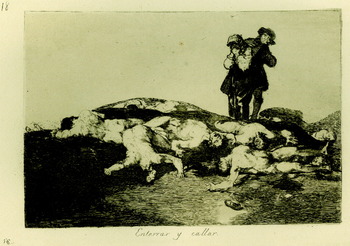
Enterrar y callar (Bury them and keep quiet) (The Disasters, plate 18)
The title of this plate might also be translated as ‘be quiet and bury them’, in the same way that we say ‘be quiet and eat’ (in Spanish, ‘comer y callar’).Footnote 23 Again, the scene before us is horrendous: a heap of bodies on a hilltop. Next to them stands a couple, evidently powerless.
The Disasters, plate 18, Enterrar y callar (Bury them and keep quiet).

Keep quiet. After all, in whom might we confide? Who will listen to our cries of distress? Whom can we tell what happened? Who is there to listen? Who can understand what it means – the mass of decomposing bodies, the stench, the nausea, the shame, horror, and dehumanization? Even our friends and loved ones politely turn their heads: ‘That's enough, your stories are making our heads spin, stop going on about this nonsense. Let's not talk about it. And so survivors and witnesses alike are condemned to silence, like the soldiers who fought in wars that were lost.’Footnote 24 Although speaking out, putting words to a traumatic, chaotic experience, is a fundamental component of the process of resilience, there are things that cannot be told, not using words, or at least not right away, and, if at all, then in bits and pieces. Sometimes other forms of expression, such as a work of art, can make it possible to find words for the story and to share it with others.Footnote 25
Keeping quiet would thus seem the only option. What else is there to be done? Well, for a start, there are the dead to be buried: the ultimate gesture acknowledging the dignity of those who died and of their loved ones. ‘Charity’, Goya writes sarcastically in a print showing bodies thrown like garbage into a mass grave (Caridad, The Disasters, plate 27). Respect for human dignity requires respect for the dead. Taking care of their remains, identifying them, informing and accompanying grieving families, providing a decent burial according to the rites of the local culture: all of these actions are an integral part of humanitarian assistance in armed conflicts.Footnote 26
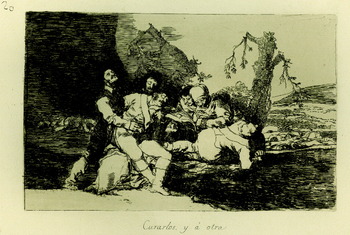
Curarlos, y á otra (Get them well, and on to the next) (The Disasters, plate 20)
Several of the prints show wounded soldiers being cared for on the battlefield. The titles ironically indicate that care is not dispensed in a humanitarian spirit. The aim is to get back on their feet those who are still able to fight: They can still be of use (plate 24), and These too (plate 25).
The Disasters, plate 20, Curarlos, y á otra (Get them well, and on to the next).

This situation is similar to the one that Henry Dunant experienced fifty years later in Solferino. Those wounded soldiers who could not be ‘restored’ to service were abandoned to their fate, as were the bodies of the dead. In his remarkable, powerful book, A Memory of Solferino, Dunant offers a poignant description of the excruciating suffering of those left on the battlefield without assistance. Goya, in turn, in the plates It will be the same (plate 21), As much and more (plate 22), and The same elsewhere (plate 23), shows the ground strewn with abandoned bodies, whether alive or dead it is impossible to tell. Confronted with the same type of situation, Dunant mobilized efforts to bring assistance to the wounded, accompany the dying with dignity, and organize relief in an impartial way.
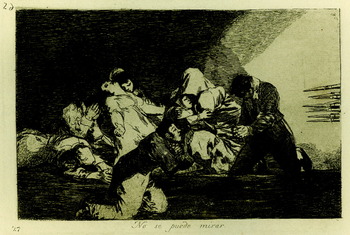
No se puede mirar (One cannot look at that) (The Disasters, plate 26)
This poignant image anticipates the painting The Third of May 1808. It shows, on the right, the barrels of guns pointing at a group of civilians who are pleading for mercy or have already collapsed.
The Disasters, plate 26, No se puede mirar (One cannot look).

The title states, ‘One cannot look at that’; it does not say ‘one cannot see that’. It is possible to see atrocities of this kind, and during the war in Spain there would have been countless occasions to witness cruelty and inhumanity in the form of collective punishments, arbitrary executions, torture, and other unspeakable acts of extreme violence. All were described in eye-witness accounts.Footnote 27
Scenes such as these are unbearable. Jorge Semprun, writing about his internment in a concentration camp, expressed it this way:
I doubt whether it is possible to relate my experience. But not because it is indescribable. It was unbearable, which is quite a different matter … . A matter that does not concern the form of the story, but its substance. Not the way it is articulated, but its density. Only those who succeed in transforming their experience into an object of art, into a creative – or recreational – space will be able to reach down to this substance, this transparent density. Only the artifice of a controlled narrative will succeed in transmitting some element of the truth in witnesses’ accounts.Footnote 28
One cannot look: this is also true for those in charge of carrying out the executions. They are faceless. All we see are the barrels of the guns and the blades of the bayonets. In the print With or without reason (see Figure 4 above) and the painting The Third of May 1808, only the lowered helmets of the soldiers are shown, as if they were taking aim without looking. It is impossible to look at a person whom we are about to kill because it is impossible to kill a person who is looking at us. A perpetrator of genocide in Rwanda put it this way: ‘It was by far preferable to kill people we didn't know rather than acquaintances, because those who knew us had time to fix our eyes with a piercing stare’.Footnote 29
‘One cannot look at that’, wrote Goya, and yet he drew the scene and in so doing made it visible for us, presumably to make us partake in his own traumatic experiences, to raise awareness of the reality of war, and to express his indignation.
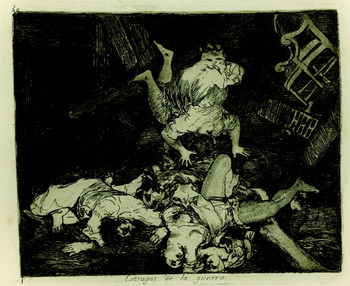
Estragos de la guerra (Ravages of war) (The Disasters, plate 30)
A vision of horror and destruction. The world is upside-down.Footnote 30 Everything is in a state of disorder, people are killed indiscriminately, whether man, woman, or child. All coherence and meaning have been lost. The scene is puzzling, bordering on the impossible. Are we looking at the inside of a house after a bombardment? Or are we looking in from above, through the smashed roof?Footnote 31 The French army's artillery relentlessly pounded the city of Saragossa, firing off more than 42,000 shells in the month of December 1808 alone.Footnote 32
The Disasters, plate 30, Estragos de la guerra (Ravages of war).

Confusion and loss of meaning are closely linked to violence. When humanitarian workers arrive in the field they think that they understand the conflict and the reasons behind it. Once they are there, however, the situation often turns out to be confusing. Uncertainty and confusion result in ethical challenges and substantial inner tensions. What is the meaning of humanitarian work amid chaos and confusion? The ethical question of how we can remain human in the face of inhumanity is omnipresent.
Esto es peor (This is worse) (The Disasters, plate 37)
There is worse to come. The prints that follow depict scenes of atrocities committed on human remains. The barbarous acts include bodies that have been mutilated, impaled, or sawn into pieces, and limbs put on display. The titles underscore Goya's horror: Why? (plate 32), What more can be done? (plate 33), and This is worse (plate 37). These horrific images may appear extreme, unreal, and exaggerated, and some consider them a symbolic representation of war, an artist's view, the product of Goya's imagination.Footnote 33 However, such scenes certainly took place on both sides of the conflictFootnote 34 and Goya might have encountered them while travelling to Saragossa, or in the area around Madrid. Contemporaries of Goya who are known to have witnessed events of this kind include the young Victor Hugo, who returned from Madrid to France via Burgos and Vittoria.Footnote 35
The Disasters, plate 37, Esto es peor (This is worse).

Today, in the year 2012, similarly terrible scenes are played out in many situations of armed violence. ‘Why?’ asked Goya. There is no answer to his question. Horrific acts of violence terrorize the population and traumatize both the first-aid workers called in to help and the families and loved ones of the victims. Violence gains in strength by the fact that images of it are spread through the media. This again raises the question as to whether scenes of violence should be made public. The debate results in serious ethical dilemmas, particularly in Latin America and Africa, where the desire of ordinary citizens to use images to highlight the severity of acts of violence clashes with political decisions not to afford them any publicity or even to black out information.
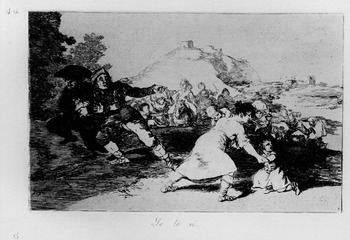
Yo lo vi (I saw this) (The Disasters, plate 44)
A group of people is running to escape from violence. Although we do not know what menace they are fleeing from, we do see the expression of terror on their faces. It seems that the worst is about to come: the motto is, ‘each man for himself’, the only exception being the woman in the foreground who turns and moves towards the source of the danger in an attempt to save the life of her child.
Goya wrote ‘Yo lo vi’, meaning: ‘Me, I saw this’. ‘I saw it myself, I was there, I saw unbearable, inhuman scenes such as these. I am a witness.’ To Goya, observing nature was synonymous with truth, experience, and experiences. Nature, he said, was his master.Footnote 36
The Disasters, plate 44, Yo lo vi (I saw this).

‘Yo lo vi’: the pronoun ‘Yo’ has a strong, insistent quality to it. It conjures up Don Quixote exclaiming ‘Yo sé quién soy!’ – ‘I know who I am!’Footnote 37 Those who have come face to face with horror, like survivors of concentration camps, no longer know who they are: Goya seems to be saying, ‘I am returning from another world, the world of horror; I am no longer the same, I no longer belong to the human community.’ Experiencing horror is traumatic and dehumanizing. At the same time as he tells us this, Goya offers us this scene, to share it with us and in doing so to restore his link with humanity. It is as if he was telling those looking at his works of art: ‘I have returned to the world of humans and I am trying to show you, to make you see things that no one can look at.’ Through his art, Goya restored his own identity as a human being, a member of the human community. By sharing his traumatic experience, he allows others who have been traumatized or deeply upset to restore their ties with humanity and to build resilience.
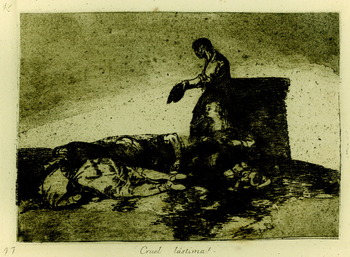
Cruel làstima! (Cruel tale of woe!) (The Disasters, plate 48)
The second part of The Disasters of War consists of a series of prints on the famine that devastated Madrid in 1811 and 1812. Men, women, and children were starving to death in the streets. Goya was not only a direct witness of the suffering but himself a victim of suffering, desolation, and the death of loved ones. In the image a man is begging, standing near his huddled wife and a baby lying on the ground. Next to them lie victims of the famine, some of them perhaps already dead.
The famine is a ‘cruel tale of woe’: cruel because of the suffering it causes, but cruel also when it is the result of indifference, cynicism, and complacency – or when it is intentional, since famine can be a weapon in disguise, the product of either political negligence or deliberate policy.Footnote 38 Famine is a ‘discreet and silent killer, leaving no trace, no evidence that it was intentional’.Footnote 39
The Disasters, plate 48, Cruel làstima! (Cruel tale of woe!).

Some of the prints in this series show rich and powerful figures arrogantly walking past famine victims without paying them the slightest bit of attention: ‘Perhaps they are of another breed’, writes Goya ironically (plate 61). Asking them for help is futile: ‘Appeals are in vain’, he notes elsewhere (plate 54).
Terrible events, events that were seen … . The same reality is shown in photographs taken in 1941 in the Warsaw ghetto.Footnote 40 How troubling it is to see the same scenes of desolation, begging, extreme malnutrition, the distress on the faces, and even piles of dead bodies (Muertos recogidos, plate 63), the wagonloads of corpses being carried to the cemetery (Carretadas al cementerio, plate 64). The photographs, however, which were taken by a German sergeant with time on his hands, prove to be inhuman, lacking in awareness and conscience, obscene. Goya the artist confers on his work an indignant quality and appeals to our sense of humanity.
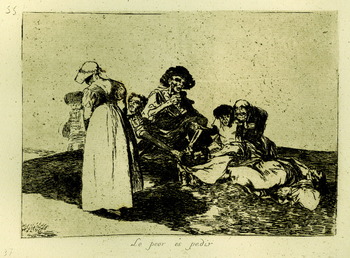
Lo peor es pedir (The worst is to beg) (The Disasters, plate 55)
The scene is again one of a family struck down by famine. A fashionable woman is moving towards a well-dressed man in the background. Both these elegant figures are entirely indifferent to the beggars struggling to survive.
The Disasters, plate 55, Lo peor es pedir (The worst is to beg).

Asking for help means being dependent on the charity and goodwill of donors without being able to reciprocate. When this happens, victims lose the possibility of exercising their capacity for action and become dependent and passive. Human identity is linked to a recognition of our capacities and our vulnerability.Footnote 41 Humanitarian action therefore runs two risks: that of falling into indifference and denying people's vulnerability and our shared humanity, which is the basis of all solidarity; and that of developing feelings of contempt when humanitarian aid reduces people to passive victims having no opportunity to reciprocate. The dynamic of giving, reciprocity, and mutual recognition is at the heart of human dignity.Footnote 42 In fact, for the traumatized individual the possibility of giving something back constitutes an element of resilience. Giving may take a variety of forms: putting on a show, sharing your thoughts, building a relationship, even having a good laugh together – all of these mean that ‘we become the one who gives’ and ‘in this way repair our wounded self-esteem’.Footnote 43
De qué sirve une taza? (What is the use of a cup?) (The Disasters, plate 59)
This image filled with humanity and tenderness is like an icon of the humanitarian gesture, of solidarity in action when another person is suffering. Notice the beseeching look on the face of the elderly woman. She is dressed in black and her head is covered by a scarf, both signs that she is in mourning. She is holding up a young woman dressed in white, who is stretched out on the ground, her strength failing, and perhaps on the verge of death. Other victims of famine are lying at their feet. The background is sombre and empty, the sky heavy, the earth dry and bare; smoke is rising in the distance. A harsh light falls on this desolate scene. The other woman, shown in profile, is simply dressed and also wears a headscarf. She is offering a bowl of soup to the prone woman, to ease her hunger and perhaps to save her life. Kneeling, she is leaning towards her, her face lit up by a lovely expression of tenderness. Her attitude shows caring, humility, and attentiveness to a suffering fellow human being.
The Disasters, plate 59, De qué sirve une taza? (What is the use of a cup?).

This woman's gesture of sharing what little food she has testifies to her solidarity and compassion. It is an image of the basic humanitarian gesture, an act of humanity that is valued in cultures and religions throughout the world. It is essentially the gesture that Henry Dunant would perform many years later on the battlefield of Solferino.
As he portrays the beauty of the gesture, Goya asks us to consider: ‘What use is a cup?’ He shows his indignation at the inadequacy of this isolated, pathetic act, a feeling of powerlessness that will be familiar to anyone who has worked in humanitarian aid. Often it is triggered by a lack of means in the face of suffering and need on a vast scale, sometimes by the apparent futility of our efforts when confronted with the cynicism of the powers that be. Either case begs the question: what use is this gesture?
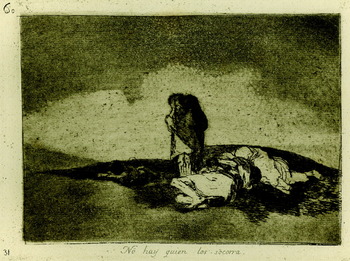
No hay quien los socorra (There is no one to help them) (The Disasters, plate 60)
This print answers the question in the negative. The reply takes the form of a cry of indignation: ‘There is no one to help them!’ The poignant image echoes the previous one. Here, a couple is shown standing, their attitude marked by distress and dignity in the face of misfortune. The man has wrapped himself in a dark blanket, his right hand hiding his tears and despair. The woman behind him is wearing black. She is but a shadow. At their feet lie several bodies, their strength fading, all dressed in white. Presumably they are family members, victims of war and famine.
The Disasters, plate 60, No hay quien los socorra (There is no one to help them).

Goya cries out in despair: ‘Not helping them is inhuman!’ Henry Dunant expressed the same indignation after the battle of Solferino, and transformed his cry of revolt into a universal call to action, first by organizing the local population to give assistance on the spot, and then by mobilizing the international community, which ultimately led to the founding of the Red Cross.
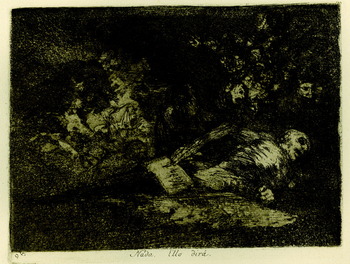
Nada. Ello dirá (Nothing. That is what it says) (The Disasters, plate 69)
A decomposing corpse holds a sign on which is written ‘Nada’ (‘Nothing’). Behind it, a mass of threatening figures emerges from the shadows. On the left we can just make out the scales of justice. Yet there is no justice. This print is part of a third group, some of which were produced after the war in the years 1815 to 1820 and in which Goya denounced the consequences of war on society, the hypocrisy, compromises, profiteering, and return of superstition and charlatans, stopping at nothing and sparing no-one. One print is entitled Truth has died (plate 79) which, as a statement, may appear banal: during and after armed conflicts, lies, injustice, and institutional decadence reign.
The Disasters, plate 69, Nada. Ello dirá (Nothing. That is what it says).

‘There is nothing.’ Is that the artist professing his faith? Or expressing his state of mind and scepticism about war and the peace that follows it? What we can say is that his expression of distress and feelings of emptiness and absolute nothingness strike many people who are confronted with extreme violence, horror, and death. In his work, Goya expressed what traumatized persons feel. Finding new meaning in life and nourishing our hope for a just world enable us to build resilience.Footnote 44
Conclusion
In 1814 Goya completed two paintings universally acknowledged as masterpieces: The Second of May 1808 and The Third of May 1808, both of which portray the popular uprising against the French invader and its ruthless suppression the following day, and which testify to the cruelty and inhumanity of war and armed conflict. These famous paintings are the product of years of hard work spent in the solitude of his studio in the years following 1810.
In his engravings and etchings, Goya depicts war and armed conflict by concentrating not on the motivations for them but on their consequences. He takes a different and radically new look at war, ‘where heroes have vanished and only human beings remain’.Footnote 45 His focus is on the person as perpetrator, witness, or victim of the worst forms of violence. His work is that of a man who has experienced, seen, and felt the violence and devastation of war, which has brought him to question violence itself by showing the extremes to which it can lead, boundless in their horror and desolation and a source of endless suffering. War destroys lives, families, institutions, and the very foundations of society. It also dehumanizes both sides of the conflict. Goya's attitude to war was considered subversive and it was no doubt for political reasons that he was unable to distribute this work.Footnote 46 Forty years would pass before his prints were eventually published in 1863, the year in which the first international conference of the Red Cross was held in Geneva, marking the beginnings of organized humanitarian action and humanitarian law in armed conflicts.
Examining the work of Goya and listening to his cries of indignation in the face of unfettered violence, the suffering of the victims, the indifference of those in power, and their inaction in plain view of distress and devastation allow us to appreciate the importance of our heritage: the humanitarian principles, international humanitarian law, and humanitarian organizations. It also enables us to understand the great challenges of humanitarian action in armed conflicts, its limits, dangers, and difficulties, the risks associated with confronting violence and trauma, but also the humanizing power of gestures of solidarity and compassion. Like Goya, many humanitarian workers can say ‘Me, I saw this’, and share their feelings of shock, revolt, and indignation; but, like Goya, we also understand that the essential aspect of our work is encountering the other person.