Neurocognitive differences between men and women have been a topic of research for decades, and recent debate surrounding the lack of proportionate representation of women in science-related fields has included the examination of cognitive differences between genders (Berenbaum & Resnick, Reference Berenbaum, Resnick, Ceci and Williams2007). Research has consistently demonstrated a female advantage in verbal episodic memory tasks (e.g., Herlitz, Airaksinen, & Nordström, Reference Herlitz, Airaksinen and Nordström1999; Herlitz, Nilsson, & Backman, Reference Herlitz, Nilsson and Backman1997; Schaie & Willis, Reference Schaie and Willis1993; Zelinski, Gilewski, & Schaie, Reference Zelinski, Gilewski and Schaie1993) and a male advantage in spatial tasks (e.g., Maeda & Yoon, Reference Maeda and Yoon2013). There is also evidence of a female advantage in processing speed measures (e.g., Daseking, Petermann, & Waldmann, Reference Daseking, Petermann and Waldmann2017; Irwing, Reference Irwing2012). Although some researchers have found a male advantage in general intelligence (referred to as g) (Irwing, Reference Irwing2012), many others have found minimal or null effects of gender on g (e.g., Saggino et al., Reference Saggino, Pezzuti, Tommasi, Cianci, Colom and Orsini2014; Salthouse, Reference Salthouse2004a; Salthouse & Ferrer-Caja, Reference Salthouse and Ferrer-Caja2003).
Age-associated differences in cognition are also well documented. Cognition can be partitioned into crystallized (or product) and fluid (or process) domains. Cross-sectionally, age is generally associated with increases in crystallized intelligence (assessed with measures such as vocabulary) until about age 60 (e.g., Salthouse, Reference Salthouse2014a), and decreases in fluid intelligence (e.g., Salthouse, Reference Salthouse2019). Fluid domains that have demonstrated age-associated declines include reasoning (e.g., Salthouse, Reference Salthouse2004b) and spatial ability (e.g., Borella, Meneghetti, Ronconi, & De Beni, Reference Borella, Meneghetti, Ronconi and De Beni2014; Salthouse, Babcock, Skovronek, Mitchell, & Palmon, Reference Salthouse, Babcock, Skovronek, Mitchell and Palmon1990). To illustrate, a recent meta-analysis by Techentin, Voyer, and Voyer (Reference Techentin, Voyer and Voyer2014) reported a large (mean d = 1.01) age-related decrease in performance on tests of spatial ability between young and older adults. In addition, verbal episodic memory (e.g., Lundervold Wollshlaeager, & Wehling, Reference Lundervold, Wollshlaeager and Wehling2014; Whitley et al., Reference Whitley, Deary, Ritchie, Batty, Kumari and Benzeval2016) and processing speed (e.g., Salthouse, Reference Salthouse2004b) also show age-associated declines.
Gender Differences in Cognition Across the Adult Lifespan
Gender differences in intelligence, often referred to as general cognitive ability (or g), has been a controversial topic in the field of psychology. Savage-McGlynn (Reference Savage-McGlynn2012) states that “No other concept in psychology has generated more debate (Johnson, Reference Johnson2004), and may arguably be the longest-running and most impassioned controversy in psychology’s history (Halpern, [Reference Halpern2011])” (p. 137). However, the number of studies that have comprehensively examined gender differences in broad domains of cognition across the adult lifespan is limited (but see Daseking et al., Reference Daseking, Petermann and Waldmann2017; Irwing, Reference Irwing2012; Salthouse, Reference Salthouse2004a; Salthouse & Ferrer-Caja, Reference Salthouse and Ferrer-Caja2003). Daseking et al. (Reference Daseking, Petermann and Waldmann2017) recently assessed gender differences in cognitive abilities in the German standardization sample for the Wechsler Adult Intelligence Scale-IV (WAIS-IV); participants ranged from 16 to 89 years of age. Daseking et al. found that men scored higher on the visual processing, fluid reasoning, and verbal comprehension indices, and women scored higher on the processing speed index. The gender effect was consistently small across the subtests (i.e., the maximum eta squared was .05). Education level had a greater effect on cognitive performance than did gender. Similarly, Irwing (Reference Irwing2012) examined gender differences in the WAIS-III using the US standardization sample spanning across ages 16–89 years using both hierarchical and bi-factor multigroup confirmatory factor analysis. Results indicated a male advantage in g, and in the information, arithmetic, and symbol search tasks, and, consistent with Daseking et al. (Reference Daseking, Petermann and Waldmann2017), there was a female advantage in processing speed.
McCarrey, An, Kitner-Triolo, Ferrucci, and Resnick (Reference McCarrey, An, Kitner-Triolo, Ferrucci and Resnick2016) recently examined gender differences in cognitive trajectories for a large battery of cognitive tasks in a large sample of individuals over the age of 50. They found that after controlling for age, education, and race, women performed better than men on most tests of cognition, except for two visuospatial tasks, in which men performed better than women. Results also showed that men demonstrated steeper rates of decline over time for a global measure of cognition, a processing speed task, and two visuospatial tasks, whereas there was no evidence of women having steeper declines in cognition over time, compared to men.
Age Moderation on Gender Differences in Cognition
There is evidence to suggest that age moderates gender differences in childhood and adolescence. For example, Lynn (Reference Lynn1994, Reference Lynn1999) suggested there are negligible gender differences in g among children and adolescents until age 16, at which time a male advantage emerges and increases into adulthood (but see Savage-McGlynn, Reference Savage-McGlynn2012). However, few studies have examined whether age moderates gender differences across adulthood. This is a compelling question because some researchers have suggested that the magnitude of gender differences may decline over time due to changes in societal expectations (e.g., Priess & Hyde, Reference Priess, Hyde, Chrisler and McCreary2010). As summarized by Perales, Lersch, and Baxter (Reference Perales, Lersch and Baxter2019), “The second half of the 20th century brought about unprecedented historical changes in the socio-economic standing of women in developed nations, collectively labelled as the ‘gender revolution’ (England, Reference England2010)” (p. 8). Commensurate with these changes, the endorsement of traditional gender attitudes and ideologies decreased. A great deal of research that has examined changes regarding society’s endorsement of traditional gender roles has used the General Social Survey (GSS). Research examining trends between 1977 and 1998 showed substantial and fairly monotonic increases in attitudes towards gender equality and less restrictive gender roles in the United States (e.g., Brooks & Bolzendahl, Reference Brooks and Bolzendahl2004). Recent work examining the GSS suggests that this trend may have reversed slightly in the 1990s, and then rebounded in the early 2000s (Cotter, Hermsen, & Vanneman, Reference Cotter, Hermsen and Vanneman2011). In addition, recent work by Reilly, Neumann, and Andrews (Reference Reilly, Neumann and Andrews2016) found that sex-role identity (e.g., masculine, feminine) accounted for more of the variance in spatial ability and language ability than did sex itself in sample of college-aged participants. Furthermore, masculine sex-roles partially mediated the relationship between sex and a spatial ability composite, and feminine sex-roles fully mediated the relationship between sex and a language ability composite. Thus, one may expect larger gender effects in older samples and smaller gender effects in younger samples due to shifts in societal beliefs as a result of changes in traditional roles for both men and women.
Practice Effects
There is evidence that gender differences in some cognitive domains may be attributed to differential practice and experience (e.g., Reilly, Neumann, & Andrews, Reference Reilly, Neumann, Andrews and Khine2017). This has been studied extensively within the field of spatial ability. As noted by Reilly et al. (Reference Reilly, Neumann, Andrews and Khine2017), “A large number of studies have examined the effects of brief training interventions to improve spatial ability. While there is wide variation in effectiveness, almost all such interventions show some improvement in spatial ability” (p. 18). It has been suggested that women may show increased improvements with training in spatial ability tasks because they have less spatial experience (Fennema & Sherman, Reference Fennema and Sherman1977; Sherman, Reference Sherman1967). However, two separate meta-analyses of spatial training interventions have failed to detect differential improvement in women (Baenninger & Newcombe, Reference Baenninger and Newcombe1989; Uttal et al., Reference Uttal, Meadow, Tipton, Hand, Alden, Warren and Newcombe2013), indicating that the gender gap in spatial ability was not reduced through training. Taking the same cognitive test more than once may be considered a type of intervention in which an individual is provided with experience practicing items from a test. One unique aspect of the current study is that participants completed the same 16 measures of cognition on three occasions within a 2-week period. One session used the original versions of the tasks, and the other two sessions used alternate versions with the same instructions but different items. Although practice or training does not appear to impact spatial ability differentially across women and men (Baenninger & Newcombe, Reference Baenninger and Newcombe1989; Uttal et al., Reference Uttal, Meadow, Tipton, Hand, Alden, Warren and Newcombe2013), there has been little assessment of the influence of practice on the gender effect within other cognitive domains. Thus, an interesting empirical question is whether the effect of gender on cognitive abilities, such as memory and processing speed, diminishes with increased practice. That is, does repeated exposure to the task result in a reduction in the influence of gender on performance?
The Current Study
The goals of the current study are to (1) examine gender differences in cognition across adulthood, (2) examine whether age moderates the gender effect on cognition, and (3) examine whether the gender effect is consistent across multiple sessions.
METHODS
Participants
Data from the Virginia Cognitive Aging Project (VCAP; Salthouse, Reference Salthouse2014b), a prospective study of cognition in community dwelling adults between the ages of 18 and 99 years, are used. Participants were recruited from the community through newspaper advertisements, flyers, and referrals from other participants. To participate, individuals needed to be fluent in English, have the equivalent of a high school level of education, and have sufficient hearing and vision to perform the tasks. Participant characteristics are presented in Table 1, by gender and across age. Gender was assessed with the question, “Are you male or female?” The current study uses data from the first measurement occasion of 5125 individuals who participated in VCAP. Participants visited the lab three different times within a period of 2 weeks to complete a comprehensive cognitive assessment. In each session, participants completed the same cognitive tasks but different versions of each task. All data were collected with the approval of the local Institutional Review Board, and in compliance with the Helsinki Declaration.
Participant characteristics

Measures
Five cognitive domains were examined: episodic memory, processing speed, reasoning, spatial visualization, and vocabulary. Episodic memory was assessed with tests of word recall (Wechsler, Reference Wechsler1997b), paired associate learning (Salthouse, Fristoe, & Rhee, Reference Salthouse, Fristoe and Rhee1996), and logical memory (Wechsler, Reference Wechsler1997b). Processing speed was assessed with the digit symbol substitution test (Wechsler, Reference Wechsler1997a) and pattern comparison and letter comparison tests (Salthouse & Babcock, Reference Salthouse and Babcock1991). Reasoning was assessed with tests of matrix reasoning (Raven, Reference Raven1962), series completion (Zachary, Reference Zachary1986), and letter sets (Ekstrom, French, Harman, & Dermen, Reference Ekstrom, French, Harman and Dermen1976). Spatial visualization was assessed with tests of spatial relations (Bennett et al., Reference Bennett, Seashore and Wesman1997), paper folding (Ekstrom et al., Reference Ekstrom, French, Harman and Dermen1976), and form boards (Ekstrom et al., Reference Ekstrom, French, Harman and Dermen1976). Vocabulary was assessed with tests of vocabulary (Wechsler, Reference Wechsler1997a), picture vocabulary (Woodcock & Johnson, Reference Woodcock and Johnson1990), synonym vocabulary, and antonym vocabulary (Salthouse, Reference Salthouse1993). See the Supplemental Table for a brief description of each task.
Statistical Analyses
Structural equation modeling is used to conduct the analyses using Amos 24.0 (Arbuckle, Reference Arbuckle2015). To evaluate model fit, several fit indices are examined, such as the chi-square test statistic, including the chi-square ratio (χ 2/df), the root mean square error of approximation (RMSEA; <.06 as good fit, <.08 as acceptable fit; Browne & Cudeck, Reference Browne, Cudeck, Bollen and Long1993; Hu & Bentler, Reference Hu and Bentler1999), and the comparative fit index (CFI) in which values ≥.95 are indicative of a good fit (Hu & Bentler, Reference Hu and Bentler1999). To assess invariance across gender, increasingly stringent levels of invariance are assessed: (1) configural invariance analyses assess whether the factor structure (i.e., the relations among the variables) is the same across groups, (2) metric invariance analyses assess whether the magnitude of the factor loadings from the observed variables to the latent constructs are invariant across groups, and (3) scalar invariance analyses assess whether the magnitude of the observed variable intercepts are invariant across groups. The fit of each model is compared to the preceding model. In evaluating model fit, Cheung and Rensvold (Reference Cheung and Rensvold2002) suggest that a change in the CFI value of ≤ –.010 is indicative of no substantial change in model fit. When an invariance model fits worse than the preceding model that it is nested within, partial invariance is investigated and is demonstrated when allowing one or more non-invariant items to differ between groups (Millsap & Kwok, Reference Millsap and Kwok2004).
A p value of .01 is used for all analyses. Full-information maximum likelihood estimation is used to deal with missing data. Unless otherwise specified, analyses were performed on data from session one.
RESULTS
Zero Order Correlations
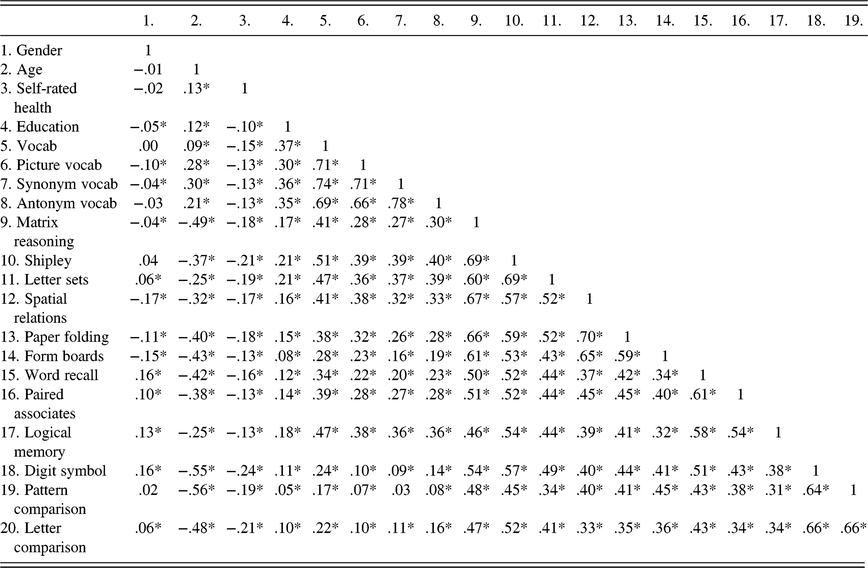
Table 2 presents the zero-order correlations between gender (coded 0 for male and 1 for female) and each of the cognitive variables. Gender was significantly negatively associated with picture vocabulary, synonym vocabulary, matrix reasoning, spatial relations, paper folding, and form boards such that men performed better on those tests. Gender was significantly positively associated with letter sets, word recall, paired associates, logical memory, and letter comparison indicating that women performed better on those tests.
Correlation matrix

Note. For gender, 0 = male and 1 = female.
* p < .01.
Invariance Analyses
Cross-sectional gender differences in cognition were first examined via invariance analyses across the total sample of participants between the ages of 18 and 99 years (N = 5125). There was strong evidence of configural and metric invariance (see Table 3), which are important prerequisites for making comparisons across groups. However, the scalar invariance model in which intercepts are constrained to be equal across men and women fit worse relative to the metric invariance model (see Model 3 in Table 3), as indicated by a change in CFI > −.01 (Cheung & Rensvold, Reference Cheung and Rensvold2002). To examine which intercepts were contributing the most to the reduction in fit, and to establish partial scalar invariance, the intercept for each of the 16 variables was constrained to be equal between the two groups one at a time. Constraining the intercepts of the spatial relations, form board, word recall, and digit symbol variables yielded the largest reductions in overall fit. Thus, when those four intercepts were allowed to vary between men and women, partial scalar invariance was obtained. There was also evidence of invariance at the structural level since the change in CFI was < −.01, and the RMSEA indicated a slight improvement in Model 5 as compared to Model 4.
Model fit for the multigroup invariance analyses across men (n = 1795) and women (n = 3330)

Gender Differences in Cognitive Factors, Covarying for Age, Education, and Health
In order to statistically control for several variables that may influence cognitive performance, a five-factor model comprising the five latent cognitive constructs (memory, speed, vocabulary, reasoning, and spatial visualization) was examined in which performance on each factor was predicted by gender (male = 0, female = 1) with age, self-rated health, and education included as covariates (see Figure 1). The resulting model fit the data fairly well, χ 2 = 3564.46, df = 138, χ 2/df = 25.83, CFI = .941, RMSEA = .070. Gender was significantly related to memory (.18*), speed (.11*), and spatial visualization (−.17*) such that women performed better on measures of memory and speed, and men performed better on measures of spatial visualization. Gender was not significantly related to vocabulary (−.03) or reasoning (.02).
Structural equation model depicting the relationship of gender to cognitive factors. Note. For gender, 0 = male and 1 = female. Age, self-rated health, and education are included as covariates but are not depicted in the figure for presentation purposes. Observed variables are depicted as rectangles, and latent variables are depicted as ovals or circles. The latent variables labeled “e” represent the error and unique variance associated with each observed variable. *p < .01.

Age Moderation of the Gender Effect on Cognition
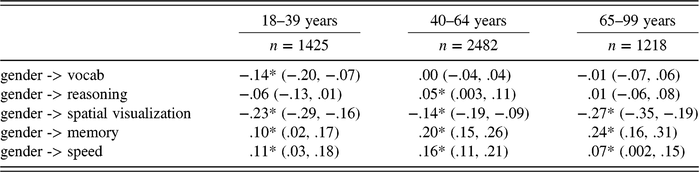
To examine whether age moderated the gender effect on cognition, the sample was divided into three age groups corresponding to 18–39 years (n = 1425), 40–64 years (n = 2482), and 65–99 years (n = 1218). The model depicted in Figure 1 was examined for each age group. Standardized coefficients and 99% confidence intervals are presented in Table 4. Gender was associated with performance on spatial visualization ability, memory, and speed consistently across all three age groups. Gender was significantly associated with reasoning in the middle-aged group only, with women performing better than men (β = .05*), but the confidence intervals of the coefficients overlapped suggesting the differences in coefficients were not significant across the age groups. There was evidence that age moderated the gender effect on vocabulary. Specifically, in the younger group the gender effect was significant (β = −.14*) on vocabulary, with men performing better than women. The confidence intervals in the middle and older adult age groups do not overlap with the confidence intervals from the younger group, suggesting that the magnitude of the coefficient in the younger group is significantly greater than in the other two age groups.
Standardized coefficients (99% confidence intervals) of gender to each cognitive construct across age groups

Note. For gender, 0 = male and 1 = female.
* p < .01.
Effect of Practice on the Gender Effect
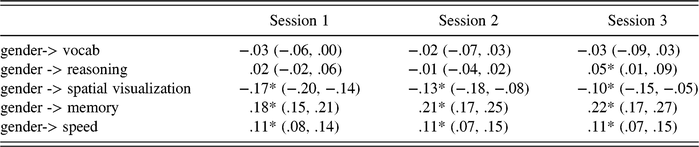
To examine whether increased practice is associated with an attenuation of the gender effect, the standardized coefficients from gender to each cognitive construct was examined for sessions 1, 2, and 3, which took place across a 2-week period. Inspection of Table 5 shows that the gender effect was consistent across the three sessions. There was a female advantage in memory with standardized loadings of .18*, .21*, and .22* across the three sessions respectively, and in speed, the standardized loadings were .11*, .11*, and .11* across the three sessions respectively. Likewise, there was a male advantage in spatial ability with standardized loadings of −.17*, −.13*, and −.10* across the three sessions, which showed an attenuation in magnitude across the sessions, but overlapping 99% confidence intervals indicate that the differences in magnitude were not significant.
Standardized coefficients (99% confidence intervals) of gender to each cognitive construct across each session

Note. For gender, 0 = male and 1 = female.
N = 5195.
* p < .01.
DISCUSSION
The results of the current study provide additional evidence that the meaning of cognitive constructs of episodic memory, processing speed, reasoning, spatial visualization, and vocabulary are invariant across gender. Specifically, we found strong evidence of both configural (invariant factor structure) and metric (invariant factor loadings) invariance. This is important because configural and metric invariance are considered to be a necessary prerequisite for making unambiguous comparisons across groups (e.g., Horn & McArdle, Reference Horn and McArdle1992). A demonstration of configural and metric invariance means that the relations among the variables, as well as the magnitude of the loadings from the observed variables to the latent constructs are not substantially different across men and women. Furthermore, partial scalar invariance (invariant intercepts) was obtained by allowing the intercepts of two spatial visualization variables (spatial relations and form boards), an episodic memory variable (word recall), and processing speed variable (digit symbol) to vary across the two groups. These variables have some of the strongest associations with age, as indicated by the correlations reported in Table 2.
Consistent with the previous research, we found a female advantage in verbal episodic memory (Herlitz et al., Reference Herlitz, Airaksinen and Nordström1999, Reference Herlitz, Nilsson and Backman1997; Salthouse, Reference Salthouse2004a; Salthouse & Ferrer-Caja, Reference Salthouse and Ferrer-Caja2003; Schaie & Willis, Reference Schaie and Willis1993; Zelinski et al., Reference Zelinski, Gilewski and Schaie1993) and in processing speed (Camarata & Woodstock, Reference Camarata and Woodcock2006; Daseking et al., Reference Daseking, Petermann and Waldmann2017; Irwing, Reference Irwing2012), and a male advantage in spatial visualization ability (e.g., Maeda & Yoon, Reference Maeda and Yoon2013; Salthouse, Reference Salthouse2004a; Salthouse & Ferrer-Caja, Reference Salthouse and Ferrer-Caja2003). These advantages were evident after statistically controlling for age, self-rated health, and education. Demographic norms that adjust for age are common in neuropsychological batteries. Some batteries (e.g., WAIS, WMS) also include norms adjusted for gender (e.g., Lange, Chelune, Taylor, Woodward, & Heaton, Reference Lange, Chelune, Taylor, Woodward and Heaton2006). Although gender effects are modest, they are consistently found which suggests that it may be worthwhile to include norms adjusted for gender on most batteries that assess episodic verbal memory, processing speed, and/or spatial visualization.
Despite speculation that changing societal expectations regarding gender norms may influence the effect of gender on cognition, there was little evidence of age moderation. Rather, gender influenced cognition similarly across the adult lifespan, with the exception of vocabulary. There was a male advantage on vocabulary, but only in the young adult group. The finding of a male advantage in the young adult group is consistent with the work by Camarata and Woodcock (Reference Camarata and Woodcock2006), who reported that males performed better on a crystallized ability (Gc) construct in three different samples spanning preschool through adulthood. The lack of consistent age moderation is interesting because it suggests that whatever contributes to gender differences, whether biological or experiential in nature, persists throughout adulthood.
A novel contribution of the current study was our ability to examine the influence of practice on the effect of gender on cognitive performance. Participants completed the tasks three different times across a 2-week period, using alternate versions of the task each time. The influence of gender on cognition was remarkably consistent across sessions, suggesting that repeated exposure to a task does not attenuate the effect of gender on cognition. This is consistent with the work (examining more intensive practice interventions) in the spatial ability domain which has shown that training or practice does not differentially impact performance in spatial ability tasks for women as compared to men (e.g., Baenninger & Newcombe, Reference Baenninger and Newcombe1989; Uttal et al., Reference Uttal, Meadow, Tipton, Hand, Alden, Warren and Newcombe2013). However, some researchers have found that trajectories of improvement in spatial ability tasks may be moderated by initial level of performance (e.g., Terlecki, Newcombe, & Little, Reference Terlecki, Newcombe and Little2008), and Uttal et al. (Reference Uttal, Meadow, Tipton, Hand, Alden, Warren and Newcombe2013) state that, “This difference in learning trajectory is important because it suggests that if training periods are not sufficiently long, female participants will appear to benefit less from training and show smaller training-related gains than male participants” (p. 367). Therefore, the brevity of the current study’s practice intervention makes it difficult to draw strong conclusions about the absence of a gender effect. It is possible that additional practice may have minimized gender differences.
Explanations for the Gender Effect on Cognition
There is currently no clear-cut explanation for gender differences in neurocognition. Some researchers speculate that biological factors, such as prenatal and postnatal hormones (Halpern et al., Reference Halpern, Benbow, Geary, Gur, Hyde and Gernsbacher2007) and biological predispositions (e.g., genes associated with the X chromosome; Johnson, Carothers, & Deary, Reference Johnson, Carothers and Deary2009), are primarily responsible, whereas others postulate environmental factors, such as parental care (e.g., parents monitoring boys less closely and being more restrictive of girls and parental assumptions of their child’s interests; Halpern et al., Reference Halpern, Benbow, Geary, Gur, Hyde and Gernsbacher2007), education (Halpern et al., Reference Halpern, Benbow, Geary, Gur, Hyde and Gernsbacher2007; Jones & Wheatley, Reference Jones and Wheatley1990), and stereotypes (e.g., Cadinu, Maas Rosablanca, & Kiesner, Reference Cadinu, Maas, Rosablanca and Kiesner2005; Halpern et al., Reference Halpern, Benbow, Geary, Gur, Hyde and Gernsbacher2007), are primarily responsible. In terms of education, it has been reported that males and females receive differential treatment according to gender, such that teachers attend to and call out male students more often in class for disruptive behavior and encourage male students to ask more questions in math and science classes, creating different learning environments for males and females (Jones & Wheatley, Reference Jones and Wheatley1990). Alternatively, the concept of stereotype threat is well documented in the literature. In the context of race, Steele (Reference Steele1997) initially proposed that a stereotype pertaining to one’s own group can negatively impact performance when the stereotype becomes “activated” without conscious awareness. This finding has been demonstrated when examining gender differences. For example, Cadinu et al. (Reference Cadinu, Maas, Rosablanca and Kiesner2005) found that women who were informed that “recent research has shown that there are clear differences in the scores obtained by men and women in logical-mathematical tasks” (p. 574) showed a decrease in performance on a difficult math test compared to control participants in a no-threat condition. This finding was mediated by an increase in negative thoughts related to mathematics. The use of stereotype threat and education as potential explanations for gender differences in cognition indicates the need to consider a more comprehensive framework, beyond solely biological factors, when discussing gender differences in cognition. Halpern and LaMay (Reference Halpern and LaMay2000) propose a psychobiosocial model as a rationale as to why no explanations have emerged to adequately interpret gender differences in cognitive performance. The model describes an integrative framework in which the influences of biological and environmental (e.g., psychosocial) factors operate interdependently to impact outcomes.
In the current study, gender effects showed little age moderation and persisted throughout adulthood. This suggests that mechanisms to explain gender differences in cognition are likely present prior to adulthood. Most of the proposed explanations described above precede adulthood. Potential mechanisms therefore include differential exposure to prenatal hormones, biological predispositions, and/or environmental influences such gender socialization in childhood. Despite increased endorsement of gender equality across the past 50–70 years, research shows that gender stereotypes still exist and are evident even in young children (e.g., Bian, Leslie, & Cimpian, Reference Bian, Leslie and Cimpian2017; Cvencek et al., Reference Cvencek, Meltzoff and Greenwald2011).
Limitations and Future Directions
The current study is limited by the fact that our assessment of gender was restricted; we asked whether participants identified as male or female (i.e., “Are you male or female?”) but there is a continuum of potential responses related to gender identity that may be informative when investigating gender differences (e.g., Smiler & Epstein, Reference Smiler, Epstein, Chrisler and McCreary2010). In addition, our sample comprised healthy community-dwelling adults who are generally high functioning and thus our results may not generalize to other samples. We found little evidence that age moderated the gender effect on cognition; future research should examine whether other variables (e.g., self-reported masculinity and femininity) moderate the gender effect on cognition across adulthood.
Conclusion
Consistent with previous work, we found a female advantage in episodic memory and processing speed and a male advantage in spatial visualization. Notably, we found little evidence for age moderation of the gender effect on cognition, suggesting that the influence of gender persists throughout adulthood. This indicates that the mechanism to explain gender differences is long-lasting, whether it is biological or experiential in nature. Our results also indicate that there is little influence of practice on the gender effect.
ACKNOWLEDGMENTS
This research was supported by National Institute on Aging Grant RO1AG024270 to TAS. The content is solely the responsibility of the authors and does not necessarily represent the official views of the National Institute on Aging or the National Institutes of Health. There are no conflicts of interest.
CONFLICTS OF INTEREST
The authors have nothing to disclose.
SUPPLEMENTARY MATERIAL
To view supplementary material for this article, please visit https://doi.org/10.1017/S1355617719000821