1. INTRODUCTION
Granular techniques applied to acousmatic composition, regardless of the procedures adopted and technological equipment available, generate considerable sound flux and powerful textures (Truax, Reference Truax1990). We consider this important aspect giving special consideration to the concept of emergence discussed in Di Scipio (Reference Di Scipio2003), McAdams (Reference McAdams and Deutsch2013) and Rossetti, Teixeira and Manzolli (Reference Rossetti, Teixeira and Manzolli2018). Briefly, emergence is understood as the result of a process in which the whole is greater than the sum of their parts; therefore, the whole has properties not shared by their parts (Ashby, Reference Ashby1956: 109–13). In the last decade, computing environments that allow music analysts to closely examine the sound spectrum content have emerged. This phenomenon has crystallised due to recent research that has produced a branch of musicology focusing on the ‘sonic’ standpoint (Malt, Reference Malt and Solomos2012; Solomos, Reference Solomos2013).
Musical analysis tools and techniques (Forte, Reference Forte1973; Smalley, Reference Smalley1997), signal processing methods (Tempelaars, Reference Tempelaars1996) and psychoacoustics (Parncutt, Reference Parncutt1989) are fields that underwent considerable development during the twentieth century. Those fields have intersected strongly, mainly in their regard of new models that reflect on musical activity in new days. Computational analysis is connected to the Musical Information Retrieval field, known as MIR (Peeters, Reference Peeters2004). This field uses audio descriptors as tools that extract information from digital audio recordings, to elucidate some issues related to temporal, spectral, energetic and psychoacoustic features of a musical work. Audio descriptors can also be associated with curves and graphics, generating different processes of visualisation and representation of the sound and timbre behaviour. The employment of those tools in musical analysis can prove useful to the extent that the information extracted from the audio track can be compared to the musical score (when available) and to an analysis from the listening standpoint, regardless of the compositional aesthetic or the instrumentation of the pieces.
As Malt (Reference Malt2015: 243–5) emphasises, there is no single answer to the question of what constitutes a good representation in terms of musical analysis. In fact, the objective of a representation is the main element to be considered. In the field of epistemology, the production of different types of representation is one of the keys to an answer. In this sense, alternative representations of the same information with different objectives produce strong effects in cognition. Facing this problem in the electroacoustic music field, Couprie developed the EAnalysis software (Couprie Reference Couprie, Carayol, Castanet and Pistone2017, Reference Couprie, Landy and Emmerson2018). According to him, enhancing different sound representations is essential in terms of line and form/structure graphics and this software seeks to effectively address these requirements.
Zattra (Reference Zattra2005) described the analysis of electroacoustic music as a complex task that includes a large typology of subgenres and different methods. She divides these methods into two main branches: listening analysis and computational analysis (mentioned above). In an overall classification, the first branch includes the research of Pierre Schaeffer (main ideas of sound object and reduced listening), François Delalande (listening types), Denis Smalley (spectromorphology – the characteristics of sound through time), Simon Emmerson (aural discourse – abstraction – or mimetic discourse – imitation) and Stéphane Roy (analysis of neutral level). The listening approach is normally based on ‘sound images’ known as sonograms. Emmerson and Landy (Reference Emmerson and Landy2012: 2) posed a few questions that could guide one’s analysis. An analysis is always imbued with a personal point of view, which means that individual analysts normally have their own intentions and hypotheses. Furthermore, it is impossible to analyse a piece of music from every conceivable angle. In order to frame an analytical standpoint, their questions were: for which users is the analysis conducted? (public); for which works and genres? (electroacoustic music is a vast practice); with what intentions? (what does the analysis want to emphasise?); and, with which tools or approaches is it done? (methodology).
Complex dynamical systems evolve in the course of time towards a direction, which means that they are normally unstable and formed by a large number of variables or isolated states. In Les méthodes nouvelles de la mécanique celeste (1892), Henri Poincaré proposed the notion of non-integrable dynamical systems and demonstrated that most dynamical systems display this property. Every dynamical system has kinetic energy that depends on the speed of the bodies and potential energy that depends on the interaction between them. Poincaré showed that an integrable dynamical system is a system in which the variables can be defined in such a way that potential energy is eliminated, that is, its particles do not interact. He explained that when resonance in phase space is found, there are obstacles to calculating trajectories, which is the origin of Poincaré’s non-integrability (Prigogine Reference Prigogine1995: 38–40). In this sense, maintaining potential energy in a system enables interaction among its variables, and this idea is the basis of emergent systems. At the beginning of the twentieth century, we witnessed a paradigm shift in physics with the emergence of new theories that would review traditional mechanics. Regarding this period, we must mention the debate between the wave/particle duality in quantum physics (Heisenberg and Bohr, 1927) and the theory of undulatory mechanics of De Broglie (1924), in which all matter presents corpuscular and undulatory characteristics (Simondon Reference Simondon2005: 130–48).
Music and dynamical systems share aspects of pattern, repetition, and variation over time (McLaughlin Reference McLaughlin2011), in this context, Manzolli (Reference Manzolli2003) has defined the concept of Strange Harmonic Attractors. In fact, tonality can be understood as a set of stability and attraction relationships perceived among musical frequencies, that is, a form of maintaining resonance in the system (Large Reference Large, Huys and Jirsa2010). Phase space graphics have already been employed in music analysis addressing tonal music (Boon, Noullez and Mommen Reference Boon, Noullez and Mommen1990). The analytical representations of granular works that we propose here are related to phase space graphics which originate from the dynamical systems representations in physics. Our phase space graphics deal with the information extracted from audio descriptors to show certain features concerning the timbre behaviour of these works.
We have developed representations such as Volume and Spectral Liveness which are applied to the analysis of acousmatic works related to the Granular Paradigm. One of our aims is to identify points of convergence between works belonging to different conceptions of the Granular Paradigm from different time periods. Since this musical approach has been employed for almost 60 years, it has been transformed over the years as compositional procedures and technical equipment have changed. A second aim is to investigate the methods, compositional techniques and sound flux-generating procedures applied to the selected works, as described above.
We believe that granular compositions have a property known as emergent timbre (McAdams Reference McAdams and Deutsch2013; Rossetti et al. Reference Rossetti, Teixeira and Manzolli2018). In granular acousmatic music, the interactions among grains which occur in the microtime domain (under 100 milliseconds) result in a macrostructure (perceived timbre) that exhibits new properties not shared by the isolated grains. In other words, macroform emerges from the activity produced by the interaction of grains in microtime, from the parametric control applied to the generation of sound clouds or from the editing techniques applied to sound in this time-scale. It is important to emphasise that one single grain, even if morphologically analysable, is not audible. Sound construction in the Granular Paradigm only creates sound objects (which are perceived as texture or timbre) to the extent that the grains are organised in clouds or sound masses. These textures are formed by superimposing thousands of grains, each with its own set of characteristics.
2. THE GRANULAR PARADIGM: COMPOSITIONAL EPISTEMOLOGY AND ONTOLOGY
The Granular Paradigm in music appeared in the late 1950s in Iannis Xenakis’s compositional ideas (Solomos Reference Solomos2006; Rossetti Reference Rossetti and Aramaki2017: 264–5). He was influenced by the acoustic quanta theory of Denis Gabor (Gabor Reference Gabor1945). As Xenakis stated, the basic hypothesis for a granular approach into music is that all sound ‘is an integration of grains, of elementary sonic particles, of sonic quanta’. Each grain ‘has a threefold nature: duration, frequency, and intensity. All sound, even all continuous sonic variation is conceived as an assemblage of a large number of elementary grains adequately disposed in time’ in terms of frequency and duration (Xenakis Reference Xenakis1992: 43).
Solomos (Reference Solomos2013: 396–7) states that the Granular Paradigm corresponds to the corpuscular sound description, as opposed to the waveform description. This approach stems from the idea of ‘grains’, extremely short sound samples, belonging to the microtime scale. Synthesising a sound according to this understanding consists in juxtaposing, within a very short time frame, a large amount of grains as well as manipulating their global density and morphological qualities. Perceptually, when a cloud is formed by more than 20 grains per second, as a single structure, a global texture or a timbre starts to be perceived.
The composers discussed – Xenakis, Truax and Vaggione – share common aesthetic features and musical conceptions. Their compositional epistemology follows an interdisciplinary approach. In their writings, we can identify concerns about the formalisation of phenomena in natural environments, seen from a statistical standpoint. They also share a similar conception of the irreversibility of time, and it can be said that they deal with the idea of an arrow of time, similar to the original notion of a ‘one-way direction’ time as conceived in the thermodynamics of the nineteenth century (Prigogine Reference Prigogine1995: 73–88). For these composers, the concept of entropy is crucial, in that time is an irreversible phenomenon, which always flows from states of non-equilibrium towards states of equilibrium. This idea leads to a musical form that is not predetermined, but rather a form that is constructed as ‘in process’ (Rossetti and Ferraz Reference Rossetti and Ferraz2016).
In 1955, Xenakis published a text in which he criticised the structural quality of serial music (Xenakis Reference Xenakis and Xenakis1994a). His critique mostly builds on two points: 1) the manipulation of the row and its transformations, which, to him, is characteristic of linear thought; and 2) the polyphonic structure – as polyphonic complexity increases (a large number of voices), our listening is no longer able to recognise each of these voices, merging them into a pitch amalgam of various registers perceived as a sound mass. This second point was crucial to Xenakis’s conceptions of stochastic music and his electroacoustic compositions of this period. In 1956, he wrote a letter to Hermann Scherchen (Xenakis Reference Xenakis and Xenakis1994b) explaining the ideas on which Pithoprakta (1956) was based:
1. Gradual and imperceptible transformations leading to huge transformations of the initial material.
2. Mass states – huge political demonstrations, as well as sociological, economic, physical and astrophysical facts have familiarised us with states in which statistical averages result in a mass overview and an individual view at the same time.
3. Based on the harmony-counterpoint criticism of serial music, he proposes the fusion of these systems into the notion of time-varying frequency density.
Xenakis’s Concret PH (1958), a musique concrète work composed at GRM, is an example in which the granular sonority was achieved by means of tape-editing procedures in the studio. They followed three steps: 1) sounds of hot coal and burning material were recorded on tape; 2) very short sections of the recording were extracted and isolated from their original context, each section corresponding to a single crackle or creak of burning coal which lasted no more than few hundredths of a second; and 3) the short noise bursts were assembled and rearranged to create a new and larger texture, by piecing together innumerable scraps of tape, which make up the form of the piece (Di Scipio Reference Di Scipio1998: 204).
In his composition aesthetics, Truax also focuses on environmental phenomena. But they are more of a metaphorical motivation than a means to formalise them mathematically. The idea of flux is central to his works from the 1970s and early 1980s, which centre on FM synthesis sound generation. During the 1980s and 1990s, his works began to reflect granular synthesis techniques based on additive and FM synthesis models (Truax Reference Truax1982, Reference Truax1988, Reference Truax1990). In his electroacoustic works, Truax emphasises the exploration of the duality of continuous dissimilar textures in instrumental and note-based music (which sound almost like analogue electroacoustic music) and the discontinuous statistical textures resembling environmental sounds (to him, an example of complexity) (Truax Reference Truax1988: 24). He even employs the term ‘stochastic texture’ when referring to the superimposition of many similar and spectrally related subevents coming from different procedures of FM synthesis. These procedures employ different modulation indices generating harmonic and inharmonic spectra (Truax Reference Truax1982).
Superimposition of textures (sound layers) is also found in Truax’s granular works. In the case of Riverrun, the use of ramps applied to synthesis variables provide the sensation of flux and movement among the granular textures, much like many environmental sounds in general and water sound in particular. It means that the applied ramps caused certain parameters to change over time at a specific rate, and sometimes with several parameters simultaneously ramped at different rates. In order to explain the paradox found in granular synthesis, Truax states that ‘the enormously rich and powerful textures it produces result from its being based on the most ‘trivial’ grains of sound – suggested metaphoric relation to the river whose power is based on the accumulation of countless ‘powerless’ droplets of water’ (Truax Reference Truax1988: 25). The compositional procedures of Riverrun (1986) are defined as granular synthesis. Roads (Reference Roads2001: 86–96) defined the technique of granular synthesis as a digital automation process that produces sound clouds controlled by an algorithmic agglutination of a large amount of grains, which have their own waveforms and amplitude envelopes.
Musical complexity for Truax is linked to a paradigm shift in musical thought which involves breaking with the view that reduces the sound phenomenon to the dimensionality of the Fourier model (pitch, time and intensity) and consider the complexity of real-world sounds. In this sense, the compositional paradigm shift is found in music works based on timbre and which adopt a multi-dimensional approach (Truax Reference Truax1992: 37). In an article from Reference Truax2015, Truax reshaped his statements about the paradigm shift in music, but we still find these early thoughts relevant because they reflect his view on electroacoustic music, which in turn is reflected in his compositions.
In terms of form, Truax highlights the importance of the complexity found in oral cultures where sound reflects a constantly changing present or a ‘becoming’ where repetition means re-enacting structures (Truax Reference Truax1992: 38). In that sentence, the emphasis on the role of the ‘present’ and the term ‘re-enacting’ is important. In this context, we shall bring to this discussion the concept of enaction coined by Francisco Varela, which enables us to shed light on the thoughts of Vaggione. According to Varela (Reference Varela1994: 73–98), enacting is providing the basis and conditions for form to emerge, it is a sense that captures the temporality of life, an individual and a social structure from a perspective where the endogenous and the exogenous mutually define each other within a certain duration, with a tendency towards isomorphism.
The concept of enaction is based on the ideas of time’s irreversibility and, as previously mentioned, an arrow of time pointing towards stability. One of its assumptions is the existence of a world without representations, where things are never predefined, since only a predefined world can be represented. In enaction, ‘form’ and ‘interaction’ are very similar, both as a possible result of this process. Therefore, form is defined as the result of the interaction between subsets and internal structures of organisms and objects, while cognition is the process by which meaning emerges from these relations since nothing is predefined. Finally, perception acts as an interface, an active process producing hypotheses and not a simple mirror of the environment. Truax does not strictly refer to the idea of enaction even if this idea is implicit. On the other hand, Vaggione mentions musical facts from the viewpoint of enactive emergence. To him, a musical work constitutes an emergence (singularity) because it cannot be reduced to its parts, or to its constitutive elements, or even to the operations performed during the compositional process (Vaggione Reference Vaggione, Soulez and Vaggione2012: 55).
Even if form is never predefined in his works, in his opinion the composer creates ‘operational’ representations to reach a determined morphological action field (Vaggione Reference Vaggione, Soulez and Vaggione2012: 53). Vaggione calls ‘operational’ the composer’s engagement in the composition process, mainly in the computer-aided field of composition, where interactive situations are constantly created. Here the notion of ‘compositional tool’ appears, a music writing interface (patch, script, audio software, graphics) that conveys an operational thought and constitutes a loop of musical actions/perceptions. By means of this method, it becomes possible to constitute ‘networks’ of emergent processes and representations which evoke the notion of ‘granularity’. To Vaggione, granularity means the development of a multi-scale approach of time in composition, discontinuous time in relation to different time-scales from microtime (the microstructure of sounds) to macrotime (musical figures of different sizes). The granular approach to musical composition is useful so that an operational treatment can be performed onto the microtime scale (Vaggione Reference Vaggione and Sedes2008: 156–7).
To Vaggione, computers are a composer’s responsive partners that can perform operations. In this sense, interaction is an important feature of musical composition processes, making room for the emergence of irreducible situations through non-linear interaction (Vaggione Reference Vaggione2001: 54). Garth Paine is another researcher who deals with the problem of interaction, focusing mainly on new instruments and interfaces. He states that ‘interactive media systems such as digital musical instruments and interfaces or immersive interactive environments present a new form of embodied relations’ (Paine Reference Paine2015: 87). The ontology of a musical process includes a plurality of layers of operations of diverse kinds: compositional tools are important; however, other instances are needed, involving concrete actions and perceptions in order to qualify results and choices: the intelligibility of music is always revealed in the act of hearing (Vaggione Reference Vaggione2001: 56). He emphasises the importance of the composer as a listener: ‘thesis, constraints, choices of the composer are revealed through perception. They are to be heard, first of all, by the composer who is also a listener … in order to produce music, an act of hearing is necessary’ (Vaggione Reference Vaggione2001: 59).
In Schall (1996) and many other works by Vaggione, we find the procedure of micromontage, which is also performed in the digital domain. It consists of the extraction of particles or ‘saliences’ from the recorded sounds and their manipulation (in time scales below 100 ms), edition and transformation in time and space. The term ‘montage’ refers to the world of cinema and musique concrète sound-editing procedures such as cutting, reversing, fading and rearranging audio samples (Roads Reference Roads2005: 299). Microtemporal decorrelation (Vaggione Reference Vaggione2002) is a specific micromontage procedure, based on the idea that our auditory perception is sensitive to very short time variations, in scales of a few milliseconds. It is constructed as a tissue of relationships in multiple sound scales, where very short space and time phase shifts of the same or similar (variations of the original) mono audio files are performed in a multi-channel audio-editor environment. This procedure has the purpose of building dense sound textures that convey sensations of space, movement and flux in electroacoustic works.
3. STUDY HYPOTHESIS AND METHODOLOGY: CONCEPTS OF VOLUME AND EMERGENCE
Volume, a concept used by Truax (Reference Truax1992: 32–5), is defined as the perceived magnitude of a sound or the psychological ‘space’ which it creates and occupies. It is the result of a complex combination of variables and it tends to increase insofar that parameters such as spectral richness (or resonance), reverberation, duration and intensity are taken into account and manipulated. It suggests a three-dimensional space, whose variables are: 1) spectral richness, dependent on frequency and intensity; 2) temporal density or temporal spacing of independent spectral components such as multiple sound sources and phase-shifted or time-delayed events; and 3) time.
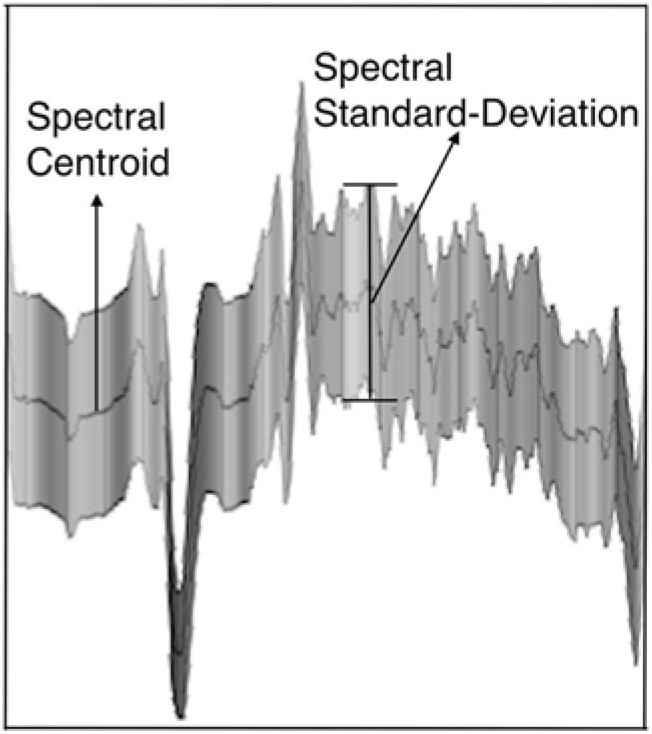
In our study, Volume is related to a graphical representation introduced by Malt (Malt and Jourdan, Reference Malt and Jourdan2009; Malt Reference Malt and Solomos2012): BStD (brightness standard deviation), a representation of timbre evolution and/or sound texture. This representation is a two-dimensional graph made from the superimposition of three curves generated by audio descriptors (see Peeters Reference Peeters2004): a) Spectral Centroid, the barycentre of energy distribution within the spectral envelope of a sound, related to the perception of sound brightness; b) Spectral Standard Deviation, the spectral variance around the Spectral Centroid; and c) Loudness, the psychoacoustic measure related to one’s perception of sound amplitude. With this analytical visualisation, the amount of Volume is proportional to the area covered by the Centroid and Standard Deviation Curves (frequency values, measured in Hertz), while the Loudness value (measured in dB) is the colour of the area (increasing values from light to dark shades of grey). In Figure 1, we present an example of the Volume representation of a given sound, calculated in Max/MSP.
Volume representation (time x frequency).

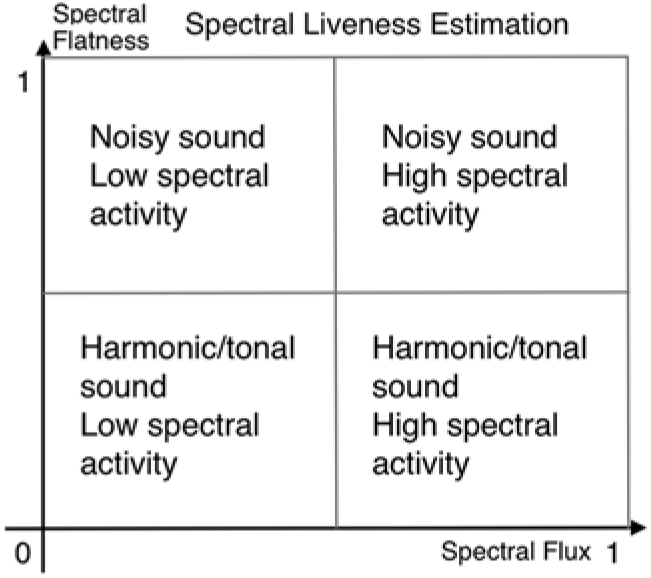
Relating to Di Scipio’s concept of Emergence (Di Scipio Reference Di Scipio2003) and a recent article (Rossetti et al. Reference Rossetti, Teixeira and Manzolli2018) we discussed the emergent sonority that is produced by the interactions among grains in granular compositions. Therefore, in order to visualise the presence of those emergent structures, we developed a graphic representation for Spectral Liveness. It is a two-dimensional phase space plot composed of two audio descriptors: Spectral Flux (a measure of how quickly the spectrum amplitude changes) on the horizontal axis, and Spectral Flatness (the amount of noise found in the spectrum, as opposed to a tonal configuration) on the vertical axis. These descriptors are calculated from the IrcamDescriptors library (Peeters Reference Peeters2004) in a patch built in Max/MSP. With this analysis we sought to create a scatter plot and check the concentration and/or dispersion of points, normalised between 0 and 1. In Figure 2 we present a graphical explanation of the results that will be found in the following analyses. Depending on the position of the points (combination of Spectral Flux and Spectral Flatness values) in the four quadrants of the plot, we obtain qualitative information about the timbre of the pieces.
Spectral Liveness estimation (interpretation of points in this representation).

The quadrants represent the following: 1) concentration of points in the bottom left quadrant describes sounds with harmonic features and low spectral activity; 2) concentration of points in the bottom right quadrant describes sounds with harmonic features and high spectral activity; 3) concentration of points in the top left quadrant describes noisy sounds with low spectral activity; and 4) concentration of points in the top right quadrant describes noisy sounds with high spectral activity. It is important to emphasise that while Volume is a temporal representation, Spectral Liveness is an out-of-time representation.
4. ANALYSIS AND SEGMENTATION
Here we present and discuss the Volume and Spectral Liveness graphs of Concret PH, Riverrun and Schall. In the Volume graph, according to the Volume, Spectral Flux and Spectral Flatness curves, we created a possible formal segmentation of the pieces. The analyses were based on the stereo versions of the works on CD. If we had been able to use multichannel versions of the works, our analyses might have produced slightly different results.
4.1. Concret PH
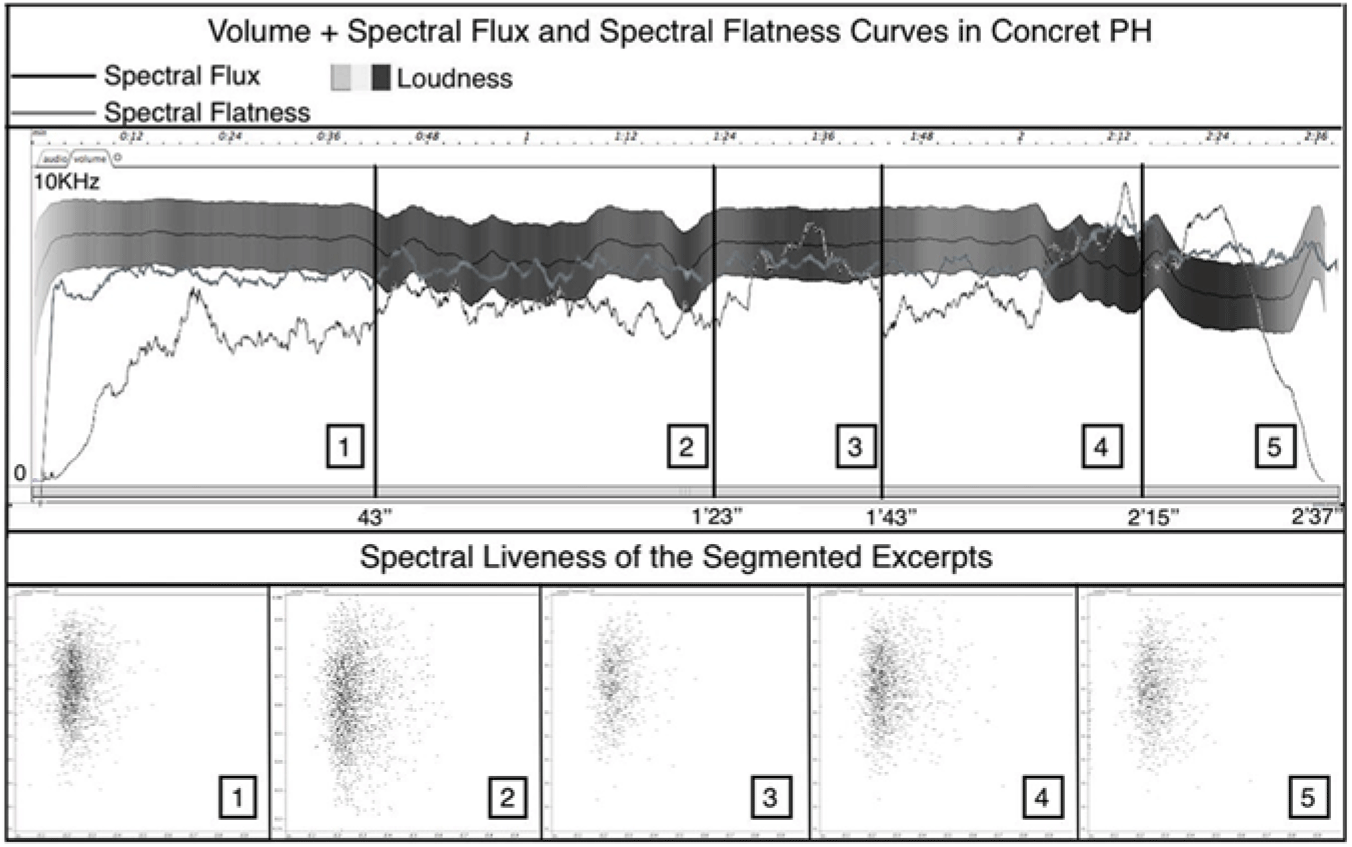
Despite the apparently monotonous granular plateau where Concret PH might be perceived at first sight, it is possible to notice that Figure 3 shows different timbre nuances related to intensity, density and brightness. The Volume graph (top of Figure 3) informs spectral variation in terms of frequency distribution and perceived intensity (Loudness). It also contains a Spectral Flux curve (in black) that maintains a rather constant profile throughout the piece, and a Spectral Flatness curve (in grey), with more variation. In this sense, the proposed segmentation takes into account Spectral Flatness values and Volume movement towards a lower-frequency region at the end.
Volume, possible segmentation and Spectral Liveness of the excerpts in Concret PH.

Spectral Liveness plots of the five segmented excerpts of this piece (see bottom of Figure 3), intended to reveal the subtle timbre variations perceived in listening. Liveness points (Spectral Flux vs Spectral Flatness) are quite concentrated in a similar region of the plot in all the excerpts. We detected that excerpts 1 and 4 have common characteristics, as well as excerpts 3 and 5. Both excerpts 1 and 4 have peaks of Spectral Flatness, ranging mostly between 0.3 and 1, while Spectral Flux values range from 0.2 to 0.6. Excerpts 3 and 5 have cloud points in the same quadrant with a lower Spectral Flux band. Spectral Flatness values range from 0.3 to 1 and Spectral Flux values from 0.1 to 0.5. Excerpt 2 displays a different behaviour, first, because of the Volume graph, which presents more frequency fluctuations. In the Spectral Liveness plot, points are more spread out, mostly the Spectral Flatness points, ranging from 0.2 to 1, while Spectral Flux ranges from 0.1 to 0.6.
The Spectral Liveness plot gives us the ‘fingerprint’ of the timbre in terms of spectral activity (Flux) and tonal/noisy timbral features. Excerpts 1 and 4 concentrate points in the top-left area of the graph, while excerpts 3 and 5 occupy the same region, but with a greater concentration of points. On the other hand, excerpt 2 displays considerable dispersion of points. In terms of Spectral Flatness, the area occupied by the points is concentrated in the middle-left area. Since granular compositions are made of grains, tiny pieces of sound, attack transients are normally highlighted in the overall perception of sound masses, as opposed to pitched/harmonic sounds.
The Spectral Liveness representations shown in Figure 3 corroborate Xenakis’s view of this piece. To him, Concret PH is a cloud formed by sound dust, like sonic gas. It is a cloud of sound dust within which there are constellations of grains that constitute the sonic form. These forms stabilise for some time and then disappear (Xenakis as cited in Delalande Reference Delalande1997: 115–17). In the five segments of the piece, one can observe these constellations of sounds in terms of spectral content (Figure 3, bottom), as one can aurally follow the movement of the grains going from one constellation to another around the moments of formal segmentation.
4.2. Riverrun
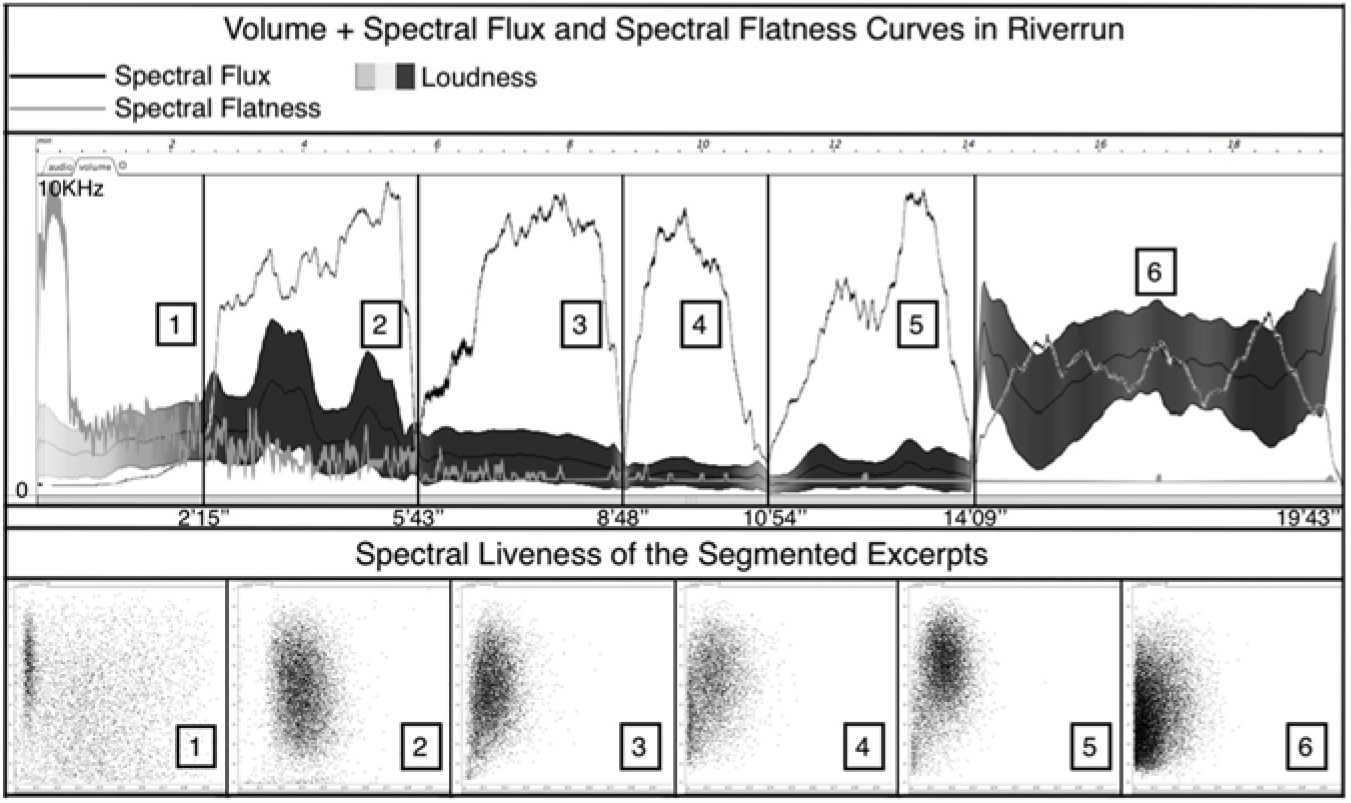
Looking at the Volume graph in Riverrun at the top of Figure 4 and considering the Spectral Flux curve, one can clearly see the points where segmentation occurs, resulting in a total of six excerpts. From 0′ to 2′15″ there is a granular texture that emerges from silence and gradually grows in intensity, while Spectral Flatness values decrease. From 2′15″ to 5′43″ Loudness increases due to the incorporation of another granular texture located in a higher frequency range. This new texture is gradually changed by a low-pass filter and timbre becomes perceptively lower. Starting at 5′43″, a continuous high-intensity low-frequency pitch emerges and undergoes different timbre modulations until 14′09″. In this excerpt, three different granular textures emerge and disappear, characterising the movements of the Spectral Flux curve reaching higher levels and decreasing three times. The first granular texture continues until 8′48″, the second until 10′54″ and the third until 14′09″. It is also possible to understand this whole excerpt of almost 9 minutes as one segment only.
Volume, possible segmentation and Spectral Liveness of the excerpts in Riverrun.

The last excerpt, from 14′09″ to 19′43″ presents a configuration similar to that of the previous section, but with higher Volume levels. That can be explained by a different mix of the two existing textures. In this mix, the high-frequency granular texture has higher intensity when compared to the continuous low-pitch sound. This configuration elevates Volume to a middle-frequency region and spreads it around a bigger area. From 19′30″ on, the lower pitch fades out and only the granular texture remains. From that point on, it is possible to see Volume moving towards a higher-frequency region while its intensity falls to a pianissimo (light grey) region.
From the Spectral Liveness plots we can observe that excerpt 1 is the one that shows the most scattered points, with Spectral Flux and Spectral Flatness values ranging from 0 to 1 (extreme variety of spectral movement). In spite of the dispersion of points, we can see a tiny concentration of points at the top-left quadrant. Excerpt 2 has a concentration of points with high Spectral Flatness and medium Spectral Flux values in the middle-right region, resembling the behaviour of the points in Concret PH. Excerpts 3, 4 and 5 have a similar concentration of points in the left region (Spectral Flux from 0 to 0.6 and Flatness from 0 to 0.9), with medium values of Spectral Flux and high values of Spectral Flatness. These three parts are similar with little variation (we can notice that the concentration of points in part 5 is in a higher region than in parts 3 and 4. Excerpt 6 presents the lowest values of Spectral Flux (0–0.5) and similar values of Spectral Flatness in comparison with the other sections (0–0.9). However, the concentration of Spectral Flatness values occurs in a lower region (0.1–0.7), indicating that timbre in this section is perceived as having more tonal characteristics.
As already pointed out by Truax (Reference Truax1988) about the discourse of this work, the variation of timbre is guaranteed by the mix of the overlapping granular textures, and the movement of the textures is given by the ramps with different durations applied to them. With the exception of the first section, the perception of more/less prominent features in timbre depends on the mix of those textures that sometimes privileges continuous surfaces and, at other times, discontinuous surfaces. The graphical representation of the mixing amalgam is given by the Volume graph showing the frequency area and its intensity in terms of brightness variation of timbre perception.
4.3. Schall
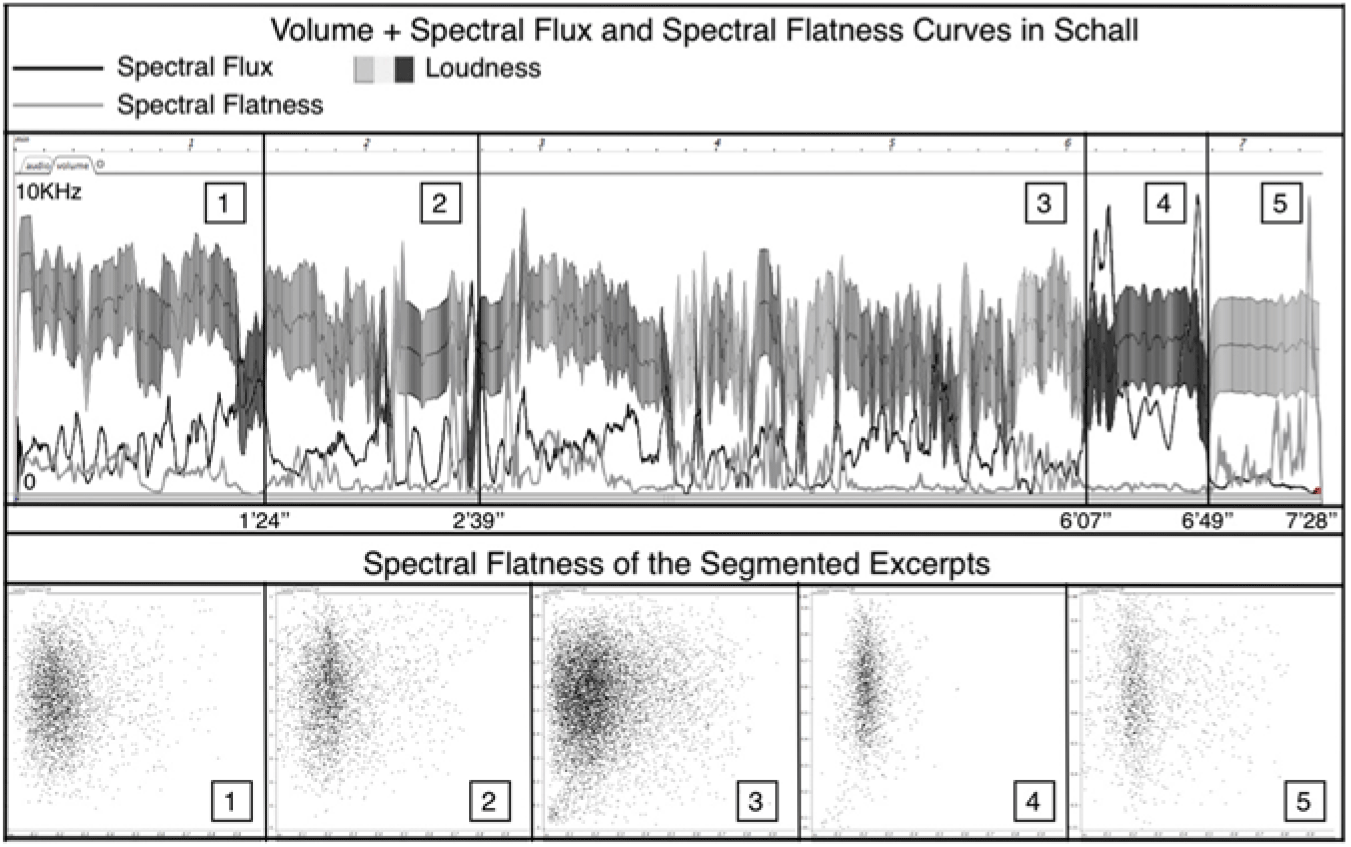
Volume in Schall (Figure 5) traces a very interesting path in the graph and is characterised by the high level of grain movement achieved with the micromontage technique. Generally speaking, the intensity of the piece is low, as shown by the light shade of grey of the Loudness descriptor, see the except for the part between 6′07″ and 6′49″, which has a darker shade of grey, showing higher intensity in this region. Concerning its segmentation, we took into account significant variations of Spectral Flux, Spectral Flatness and Volume (in terms of Loudness and frequency regions) that reflect timbre nuances to divide it into five sections.
Volume, possible segmentation, and Spectral Liveness of the excerpts in Schall.

From 0′ to 1′24″ a dramatic variation of the grains’ frequency region is perceived, from high to low regions and in different directions, finishing with a more intense gesture in the low-frequency area that, in our view, determines the end of this section. The second section, which starts at 1′24″, can be understood as a large continuum that lasts until 6′07″. The segmentation determined at 2′39″ corresponds to another high-intensity conspicuous gesture in the low-frequency area. But generally speaking, this whole excerpt of almost 5 minutes presents much movement and variation of grains, resulting in timbre modulations. Those qualities are reflected in the Volume representation, which moves through different frequency areas and shades of grey.
After 6′07″, however, the timbre changes considerably due to a denser grain texture. This texture lasts around 40 seconds and finishes with another prominent gesture in the low-frequency region and its grains concentrate on a low-midrange area shown in the graph. Due to this feature, it sounds more intense in terms of Loudness when compared with the previous excerpts, where texture seemed more rarefied (discontinuous). The last section, from 6′49″ to 7′28″, exhibits the highest points of the Spectral Flatness curve, which characterises a noisy sound with considerable Volume, similar to the previous excerpt concerning the frequency range. Otherwise, the light grey colour of this section defines a very subtle timbre with regard to intensity.
The Spectral Liveness plots corresponding to the five sections confirm that Vaggione’s granular sonority is very discontinuous and presents considerable variations regarding the perceived timbre flux and tonal/noisy qualities. The dispersion of points is very high in all sections, with values ranging from 0 to 0.9 of Spectral Flux and from 0 to 1 of Spectral Flatness. Although there is a high level of point dispersion in the Spectral Liveness graphs in the five sections, through observing the graphs it is possible to visualise convergent areas characterised by an accumulation of points in them. In our analysis, we found sections 1 and 2 similar, with an accumulation of points from 0.1 to 0.4 in Spectral Flux values and from 0.2 to 0.9 in Spectral Flatness values. Sections 4 and 5 were also found to be similar, despite the higher dispersion of points in section 5. In these sections, the accumulation of points occurs from 0.1 to 0.3 in Spectral Flux values and from 0.4 to 0.9 in Spectral Flatness values. Section 3 was found different from the others, presenting a high level of dispersion although there is an accumulation of points with Spectral Flux values ranging from 0 to 0.5 and Spectral Flatness values from 0.3 to 0.9.
By comparing the information extracted from the Volume representation with Vaggione’s writings, it is possible to verify the presence of the principle of enaction in this work. It confirms the idea of the establishment of form as an emergence, since the segmented sections do not present similar spectral characteristics to one another (see Figure 5). In addition, enaction predicts form as the result of the coupling of the internal microstructures which result in the perceived macroform. When listening to Schall, it is possible to hear small articulations constructed between grains and microelements. Those contacts in microtime are the spectral and temporal articulation links to macrotime, which gives rise to the general form of this work.
5. SPECTRAL LIVENESS COMPARISON
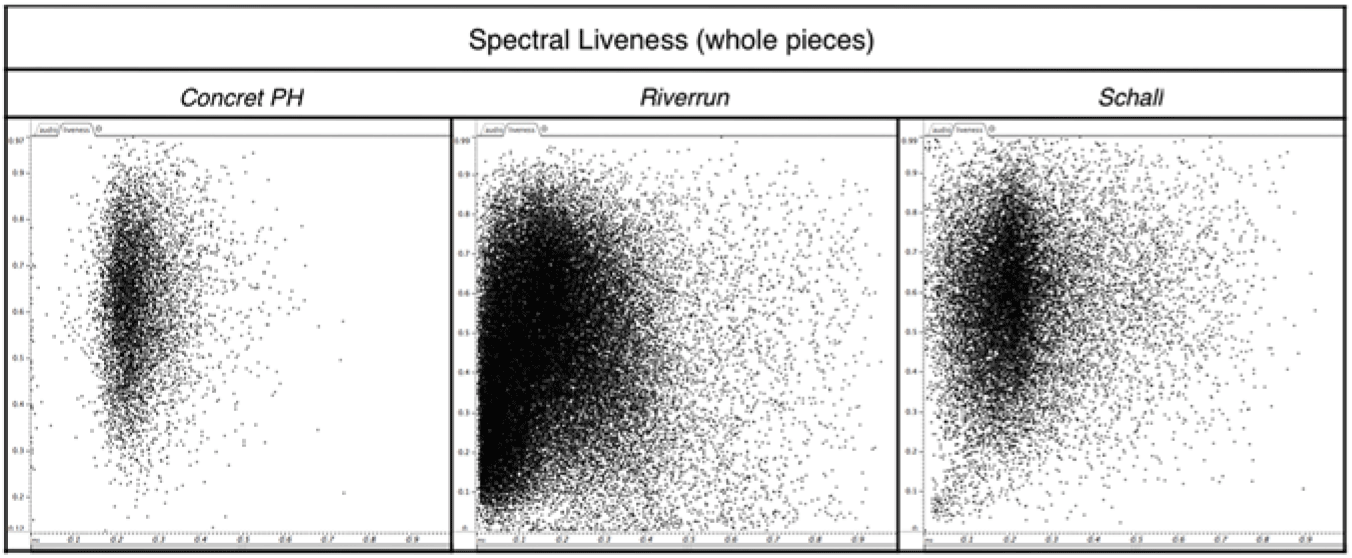
In Figure 6, we present the full Spectral Liveness graphs of the three works analysed. By observing this figure, we can notice that all three pieces accumulate points in different areas of the graphs, also with different sizes and shapes. For that reason, in Table 1, we present a comparison of the range of Spectral Liveness points considering their areas of accumulation and dispersion.
Spectral Liveness of the three works.

Range of accumulation and dispersion of points in Spectral Liveness graphs of the three works

As we compare Figure 6 with Table 1, we can observe that all three works exhibit a very wide dispersion of points (Spectral Flux values range from 0 to 0.7/0.95 and Spectral Flatness from 0 to 1). It is important to note that the amount of points depends on the duration of the works, so Concret PH is the work with the smallest amount of points, while Riverrun has the largest amount. On the other hand, the area where points accumulate is different in the three pieces, and this information is what provides the spectral fingerprint of the works. Concret PH accumulates points between 0.2 and 0.4 of Spectral Flux and between 0.3 and 0.9 of Spectral Flatness. Riverrun’s accumulation of points ranges from 0 to 0.5 of Spectral Flux and from 0.1 to 0.9 of Spectral Flatness. Schall accumulates points from 0 to 0.4 of Spectral Flux and from 0.3 to 0.9 of Spectral Flatness.
The accumulation of points in Concret PH occupies a concentrated area. Very possibly this information is related to the granular plateau which is perceived in this work, with few considerable timbre changes and discontinuities. Although a considerable flux of grains is perceived in microtime, macroform is mostly stable and indicates a timbre with the presence of noisy spectral features. Xenakis’s recordings capturing coal-burning cut into small pieces of tape which are then rearranged in space/time led to a stable texture concentrated in a constant frequency range with a reasonably constant intensity. The noisy spectral features of the piece are related to the fact that the original recorded material has similar characteristics.
Riverrun’s accumulation of points indicates a region with medium Spectral Flux (0–0.5) and widely distributed Spectral Flatness. The high variation rate of this descriptor indicates a perception of timbre that varies from tonal to noisy characteristics, and we assume that this feature is noticeable as one listens to this work. Such variety of Spectral Flatness values is explained by the granular synthesis procedures employed by Truax in the composition of this piece. The superimposition of continuous and discontinuous sound textures that vary in intensity changes our perception due to the spectral organisation of the timbre amalgam. The employment of additive and FM synthesis to produce the granular synthesis clouds results in timbres with tonal features when a continuous texture is produced, that is, timbres whose partials are organised from harmonic or inharmonic ratios. On the other hand, when discontinuous textures are produced (statistical textures), we assume that grains of small size are present, creating a timbre formed mostly of tiny pieces of sound with transient noisy characteristics.
In Schall, the accumulation of points indicates a timbre with features that are closer to those of Concret PH. This means that the perceived timbre has considerable inner movement and the sound grains are mostly noisy in spectral configuration. As we have already pointed out, Vaggione’s compositional epistemology is based on discontinuity and we believe this characteristic is quite noticeable when one listens to this work. The discontinuity of sounds, musical gestures of grains, and micro-figures with different morphologies are the main characteristics of his compositional practice. The micromontage procedure reflects this attitude in terms of a compositional process in which the composer has to edit and rearrange sounds in very small temporal scales (microtime), originating sound objects perceived as a single structure in macroscale. We shall remark that this is considered an emergent process because there is no continuity or linear relation between those different time scales; on the contrary, leaps and discontinuities are found among them.
6. DISCUSSION OF OUTCOMES AND CONCLUSIONS
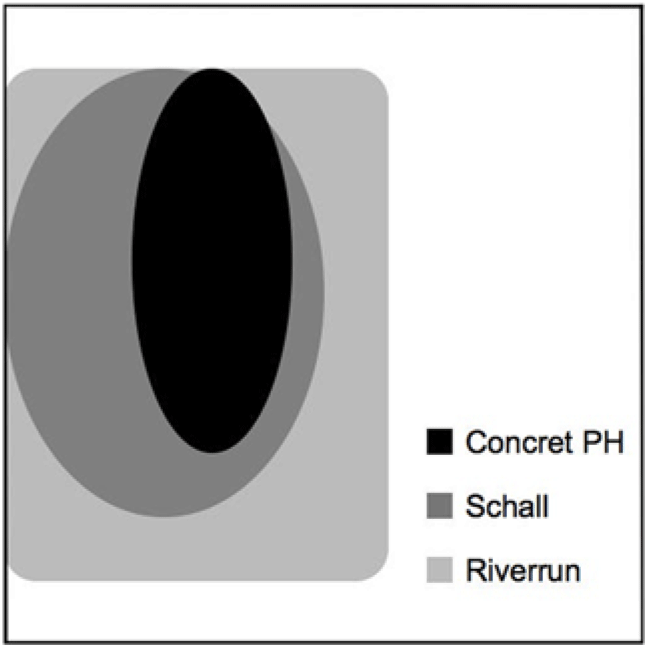
The Volume graph allows us to distinguish timbre nuances and qualities of the works, as well as identify sound and timbre pregnancies related to the three different granular techniques applied in those pieces. The Spectral Liveness graph visualises the emergent processes that occur from the articulation of grains in microtime. These processes result in regions with accumulation of points in the graph indicating the most prominent timbre features that describe the sound spectra and the emergent sonority achieved by the composers. By means of this representation, we have found a possible similarity between Concret PH and Schall, works where points accumulate in a more restricted area. On the other hand, Riverrun’s spectrum is more comprehensive and widespread in terms of timbre features. In Figure 7, we present a final graph that synthesises the Spectral Flatness values obtained from the analyses of the three pieces.
Spectral Liveness’s region of accumulation of points in the three works.

Concret PH is an example of a piece in the electroacoustic domain where Xenakis’s intentions to control microevents statistically are made explicit. In this piece, the basic premises expressed through this compositional method are musically noticeable. The first is the presence of gradual and imperceptible transformations of the material in time, which is an irreversible, one-way time process. The other point is the control of the mass states achieved by the variation of granular or frequency densities in time. Thus, we can state that the main attribute of Xenakis’s compositional thought in this piece is the manipulation of time, the principle that guides variation of material, that is, the density variation of the sound clouds. We argue that this is the procedure that creates the most aural interest.
In Riverrun, the irreversibility of time is proposed from another standpoint: the statement by Heraclitus that one cannot enter the same river twice, which is found in his fragment D.91 (Heraclitus as cited in Kahn Reference Kahn2004: 168). Even if the river seems the same from outside, the water molecules that pass through a certain point of the river are always different. Truax stated that complexity in music would overcome the traditional prominence of frequency and time variables, giving place to a multi-dimensional approach that could be defined as timbre space. If we assume that the Volume graph can indeed represent this approach of complexity in music, we can observe and evaluate how well the composer managed this idea in his composition. On the other hand, the emergent sonority of this piece is revealed from the Spectral Liveness graph, and we can observe that a larger area is covered in comparison with the other works. The area covered by the spread of the points is visible in Figure 7. It shows the composer’s intent to produce a variety of timbre, something we must highlight in this almost 20-minute musical work.
In Schall, one can also notice the presence of irreversibility of time. This feature is achieved by means of the tension and discontinuity between the micro and macrotime domains, revealed by Vaggione’s multi-scale approach to musical composition. The form of this piece, due to the difficulty in determining points of segmentation, is understood as an enacting process, never predetermined. It is constructed from the inside (work on the grains, like a sound sculpture) to the outside, creating perceived forms in macroscale (sound objects) as an emergent process in constant movement and transformation. In addition, the operational loop of actions or perceptions is fundamental for this method. The validity of a compositional procedure is always upheld by the act of listening, that is, by an aural confirmation as to where the sonic materials have been placed in time.
As a final consideration, our analysis was intended to describe some phenomena related to sound flux in granular compositions by dealing with representations. Our description intended to highlight the movement, directionality, and regions of attraction found in those works that reveal the internal forces inherent to the materials employed, a process that is common to the three works addressed. These forces produce emergent phenomena and modulate, shape how timbre is perceived. That can be compared to the idea of transduction pointed out by Gilbert Simondon (Reference Simondon2005: 32), that is, the operation from which an activity or a force propagates itself within a domain while, at the same time, this domain is being structured. The grains are composed in microtime suggesting that they have their own forces, directions, and densities that lead to emergent processes which characterise our perception in terms of the movement and evolution of sound masses and textures.
Acknowledgements
Danilo Rossetti is supported in his post-doctoral research by the São Paulo Research Foundation (FAPESP), process 2016/23433-8. Jônatas Manzolli is supported by the National Council for Scientific Research (CNPq) under a Pq fellowship, process 305065/2014-9.