In his influential essay “On the Jewish Question,” Karl Marx instigated a way of interrogating the relationship between the state and civil society. Marx insisted that the Jewish Question in 19th-century Europe extended beyond the relationship between religion and the state to encompass the relationship between secular difference, in all its forms, and the pretense of universal citizenship. Marx disclosed how the invention of formally equal men (represented by the emancipated Jew as citizen) across axes of parochial difference (represented by the emancipated citizen as Jew) was predicated on and defined against the persistence of social difference, power, and inequality, which would not be threatened in the emerging civil society.Footnote 1 Civil society, Marx argued, was established as the protected terrain within which the class interests of the bourgeois-dominated state could freely flourish through the legal enshrinement of private property and the egoistic effects of religion. The state's retreat from direct control over religion, property, family, labor, and so forth—which is to say the creation of civil society as such—was less an abdication of state power than its restructuring within the enduring capitalist order.
Marx's treatment of the Jewish Question illuminates several processes that characterize contemporary Moroccan politics. The Jewish Question has resurfaced in Morocco as an indicator of the current regime's limited efforts at liberal reform, in which the state increasingly promotes civil society as a domain of protected social difference and its unencumbered public expression. These recent efforts extend what has been a much longer process of Jewish “emancipation” in Morocco, which while not replicating the European precedent has nevertheless been conditioned by that model.Footnote 2 On the one hand, this influence is the result of France's colonization of North Africa, with its direct and enduring administrative, legal, educational, and economic impacts. On the other hand, European norms of citizenship, pluralism, and civil society in the 21st century have remained as entrenched and enforced benchmarks of neoliberal governance on the global stage.
In Morocco, the relevance of the Jewish Question can be traced through the contrasting fates of two related institutions in the 20th century. First, the emergence of a citizenship model of national belonging and political enfranchisement, in which Jewish religious difference would no longer mark exclusion from the national body politic, was marked by the dissolution of the dhimmī status of Jews. Once a defining framework for the legal relationship between Jews and the Islamic state in Morocco, the dhimmī status adhered to patron–client models of governance in which Jews were treated as differentiated subjects of a Muslim administration, both by the imposition of distinctive restrictions (residential, sartorial, legal) and the granting of designated rights (jurisprudential, confessional, economic). The complicated colonial and postcolonial histories by which the dhimmī status was critiqued, challenged, dislodged, and partly replaced by citizenship models of national identity in North Africa fall squarely within what is increasingly recognized as the pertinence of the Jewish Question beyond Europe.Footnote 3 Keeping the Jewish Question in mind allows us to appreciate how the emergence of Jews as Moroccan citizens has not resolved their ambiguous status within postcolonial national imaginaries, especially because Moroccan Jewish citizenship cannot be understood independently of the colonial process that first put the dhimmī status in danger and that, more broadly, legitimized European models of governance in the postcolonial period. The erasure of dhimmī from public memory over the course of the 20th century foreshadowed the state's recent efforts to promote itself as an actor that inclusively addresses all of its citizens on an equal basis and that meddles less and less in their rights of free expression.
At the same time, the continued power of the Moroccan state to determine and police the boundaries of acceptable national discourse, through modes of heavy-handed governance and religious legitimacy that stand in tension with neoliberal appeals, is registered in a second institution: the makhzan.Footnote 4 The makhzan refers both to the precolonial royal polity in Morocco and to its concretization under colonial rule. As a modern state apparatus galvanized under the nearly forty-year regime of King Hassan II (1961–99), the makhzan symbolizes the executive powers of the monarchy, as inscribed in the constitution and manifested in a bureaucratic machinery that includes the military, the national police, and state ministries. Technologies and agents of governance that penetrate through provincial districts down to the street level make the makhzan a coercive force of surveillance and imprisonment that Moroccans recognize and name as such.Footnote 5 Insofar as these governmental institutions are coextensive with the operations of the state at all levels, the makhzan conjoins precolonial idioms of the state with postcolonial mechanisms of policing and bureaucratic governance. On the one hand, the makhzan refers to the royal state, with its associated forms of sacred legitimacy in which the authority of the king is vested in his status as a direct descendant of the Prophet and as the “commander of the faithful.” On the other hand, the makhzan is self-consciously experienced by Moroccan subject–citizens through forms of quotidian control, surveillance, and coercion made possible by modern modes of bureaucracy, policing, and censorship. What can be called the makhzan–state in Morocco refers, therefore, to aspects of governmentality that are neither entirely a residue of the traditional past nor only a precipitate of colonial intervention.Footnote 6 The resilience of the term makhzan in popular discourse into the 21st century reflects ambiguities and failures of the state's efforts to portray itself in liberal terms.
These tensions have been especially apparent in the state's continued regulation of its Jewish communities and of their representation in public memory. The fading of the dhimmī status in the colonial period (1912–56), and the ambivalent inclusion of Jews in emerging nationalist discourses, coexisted with the postcolonial state's modes of reinscribing and controlling Jewish difference. The remaking of Jewish social life in Morocco during the colonial period included the unprecedented bureaucratization of local Jewish communities and their centralization within new jurisprudential, educational, and ritual administrations authorized by the state, which legally differentiate and regulate Jews as particular kinds of national subjects. With the emergence of anticolonial nationalism in Morocco, nationalists revalued Jewish difference against the Islamic and Arab identities that would dominate in the postcolonial nation–state. After Moroccan independence in 1956, Jews were granted citizenship, and there were some efforts to include them in the new national administration, but Jews were not easily assimilated into public visions of a national Moroccan future in the Arab world.Footnote 7
From the mid-20th century on, the specter of Jewish collaboration with the French colonial regime and Jewish migration to Israel, to cite only two facets of this uncertainty, have made the inclusion of Jews in the Moroccan nation problematic at the very least. In this context, Jews cannot simply be represented as authentic Moroccan citizens; they have to be recuperated against the grain of those historical processes that have put Jewish loyalty to the Moroccan nation–state in question. It comes as no surprise, then, that the makhzan–state has until recently held tight reins over public discourse on the Jewish Question, carefully controlling how, where, and to what end Jews were represented in public media. As much as the makhzan–state has had political, economic, and diplomatic interests in taking an inclusive stance with respect to its only significant religious minority, the figure of the postcolonial Jew could only guardedly be paraded to demonstrate the liberal virtues of the independent Moroccan state.
In this context, we argue that recent treatments of Jewish themes and histories in Moroccan cinema reflect the shifting relationship between state and civil society in the postcolonial period. The makhzan–state continues to produce nationalist narratives directly (e.g., in government-controlled media, textbooks, diplomatic oratory) and to regulate their public circulation (e.g., through legislation, police enforcement, and censorship). With the ostensible commitment of Mohammed VI's regime to widening the space of civil society, the task of producing and circulating these narratives devolves increasingly to nominally nonstate agents in the public sphere.Footnote 8 This is not an entirely new development. As the tumultuous political and literary history of postcolonial Morocco demonstrates, the state never monopolized discourses of the nation.Footnote 9 Nor is Moroccan cinema entirely independent from the state, upon which it relies for funding, professional opportunities, and authorization for distribution.Footnote 10 Nevertheless, Moroccan cinema represents an increasingly important terrain on which the strategic retreat of the state from the public sphere is played out. In what follows, we are concerned with the ways that film carves out relative autonomy from the state and, more specifically, with how the Jewish subtexts of the Moroccan nation have suddenly become so vital in this space.
This vitality and the suddenness of this new focus cannot fail to be noticed by anyone following Moroccan film.Footnote 11 In 2007, the nearly coincidental release of Où vas tu Moshé (Where are you going, Moshe?/Fin māchī yā mūshī) by Hassan Benjelloun and Adieu mères (Goodbye, mothers/Wadā‘an ayyuha al-ummahāt) by Mohammed Ismail prompted a flurry of commentary across the Moroccan media and blogosphere, focusing largely on both films’ treatments of the Moroccan Jewish experience during the episode of mass emigration in the early 1960s.Footnote 12 Already in 2006, Laila Marrakchi's film Marock had become a sensation for many reasons, not least of which was the intimate relationships the film portrays between Muslim and Jewish adolescents in Casablanca's wealthiest neighborhoods. Taken together, these three films mark the first time that Jewish themes, plots, and characters appeared significantly in Moroccan cinema. What, then, has made this the decisive moment when Jews jump onto the Moroccan screen for the first time? How have Jewish characters and narratives been mobilized in ways that reflect recent efforts to refashion the image of the Moroccan nation–state as both a longstanding moral entity and a postcolonial framework of social affiliation? How do these films embody the modes of national memory and political critique that conform to the reformist agenda of the makhzan–state?
THE JEWISH TURN IN MOROCCAN CINEMA
Among several unprecedented aspects of Marock, a work that has been called “the film of all taboos,” is that it includes Jews as integrated characters in a Moroccan social milieu.Footnote 13 The significance of this innovation is evident in the ways that the Jewish story line, only one of several in the film, has both informed the promotion of the film and dominated public responses to it. By the director's own account, the film is a semiautobiographical story of growing up wealthy and Muslim in urban Casablanca.Footnote 14 A teen flick that draws heavily on Hollywood cinematic conventions and familiar tropes of romantic tragedy, Marock is about three Muslim high school girls who struggle with the contradictions of their bourgeois privilege and religious identity. The romance between Ghita, the leading female character, and Youri, her Jewish boyfriend, is one of several relationships around which the narrative revolves. Ghita's interactions with her parents, her brother, and her girlfriends are no less essential to the film, whose narrative threads cannot be reduced to a single strand.Footnote 15
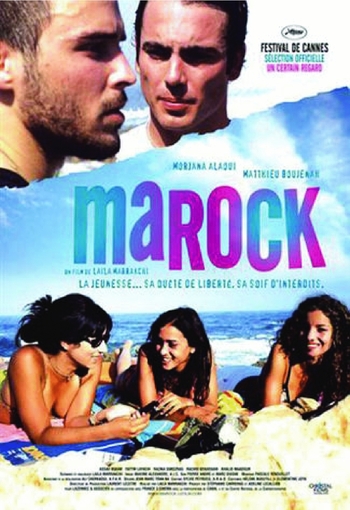
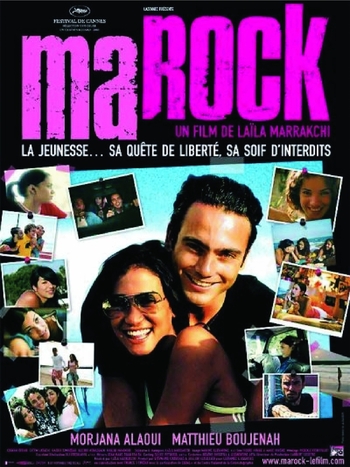
The relative and shifting narrative emphasis on these various relationships is indicated in the film's promotional materials. One version of the film poster captures the bourgeois milieu with a picture of the three bikini-clad girlfriends sunning on a beach (see Figure 1). In the upper-left corner, the poster depicts two men in Ghita's life: in the foreground is her brother, who returns from university in France with a newfound commitment to Islamic piety; in the background is her Jewish lover. In contrast, a second version of the film poster features the interfaith couple more prominently as the central image (see Figure 2).
A promotional flyer for Marock. [A color version of this figure can be viewed online at http://www.journals.cambridge.org/mes]

A promotional flyer for Marock. [A color version of this figure can be viewed online at http://www.journals.cambridge.org/mes]

Taken together, the three films under consideration have created a recognizable cultural phenomenon in Morocco. Considering these films in unison is not merely an analytical move on our part. To the contrary, recognition of this conjuncture around themes of Jewishness has been crucial to the ways in which the films have been received and debated within Morocco, as exhibited, for example, by the frequency with which they have been reviewed together and cross-referenced. Given the parallels between Où vas tu Moshé and Adieu mères, this is not surprising.Footnote 16 Both films offer nostalgic portraits of intimate Muslim–Jewish relations at the moment that mass emigration to Israel led to the seemingly inexorable deracination of the vast majority of Morocco's Jewish population. Although set in the 1990s, Marock shares with the other two films the inclusion of young Jewish characters involved romantically with Muslims.
Morocco has in many ways lagged behind other national cinemas in the region with respect to its engagement with Jewish themes. For instance, since the 1930s, Egyptian films have included Jewish characters, whose portrayal has reflected shifting nationalist narratives variously emphasizing ethno-religious pluralism and stressing Arab identity. Egyptian Jewish filmmakers were instrumental in the development of what would become the dominant movie industry in the Arabic-speaking world. However, with the ascendance of Pan-Arab nationalism and the protracted Arab–Israel conflict, Jewish characters were largely reduced to Israeli soldiers, stock figures of “the enemy” in war and espionage movies.Footnote 17
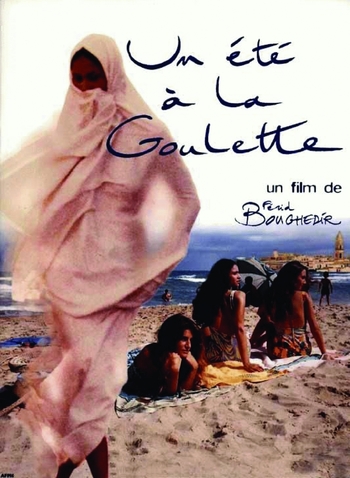
In contrast, the Tunisia film Un été à la goullete (1996) marked a postcolonial North African turn toward Jewish subjects as part of a nostalgically rendered world of interfaith harmony and pluralism.Footnote 18 Set after the fateful year 1967, when the Six-Day War would make such harmony and pluralism more difficult to imagine, Un été à la goullete depicts the intimate relationships between Muslim, Jewish, and Christian men and their efforts to protect their teenage daughters from sexual awakening. In many ways Un été à la goullete set a template for the Moroccan treatment of Jews in the films under discussion here. For example, two of the Moroccan films in question are situated in the 1960s, at the cusp between an imagined Jewish past of Moroccan integration and a future marked by upheavals related to the Arab–Israel conflict. Although set in the 1990s, Marock also nods to Un été à la goullete, as both films revolve around a trio of teenage girls and their emergent sexualities. Indeed, the movie poster for Marock, in which the three girls laze on the beach, appears to be a direct visual quotation from a similar poster used to advertise Un été à la goullete (see Figure 3).
A promotional flyer for Un été à la goullete. [A color version of this figure can be viewed online at http://www.journals.cambridge.org/mes]

European, North American, and Israeli filmmakers began to take the Moroccan Jewish experience as subject matter decades before Moroccan cineastes turned in this direction. These earlier productions were predominantly documentary in genre and style, chronicling Moroccan Jewish life in its colonial context and its postcolonial diaspora. Some of the early films were wedded to particular colonial-era institutions, such the Alliance Israélite Universelle, whose network of Franco-Jewish schools intersected significantly with French imperial efforts. The Alliance's mid-20th-century film Ils seront les hommes was produced in documentary style, replete with authoritative voice-over and set in remote locations. The film depicts a francophone teacher who heroically enters the heart of the Moroccan hinterlands (i.e., the bled) in order to bring French modernity—with its medicines, uniforms, and ordered classrooms—to a traditional, isolated, initially resistant, and ultimately won-over Moroccan community.Footnote 19 Although fully scripted, Ils seront les hommes drew on French cinematic traditions of cinema vérité, such as relying on amateur native actors for both the protagonist and his interlocutors in the village. As we shall see, this dialectic between the fictional and the documentary informs the more recent Moroccan feature films as well.Footnote 20
The Jewish turn in Moroccan cinema also highlights the ambiguity of determining the boundaries of postcolonial national cinema. As Kevin Dwyer has pointed out, Moroccan filmmakers operate in global circuits of funding and production and thus the boundary of Moroccan national cinema is fluid.Footnote 21 Beginning in the 1990s, the film adaptations of Gad El Maleh's one-man shows were among the first francophone features crafted by a Moroccan filmmaker and focused on Moroccan Jewish experience.Footnote 22 Born in Morocco, schooled in Canada, and establishing a career in France, El Maleh complicates any effort to sequester his oeuvre within a single national context. The theatrical performances captured in his adaptations lampoon Moroccan society and reflect the experience of dislocation in the Moroccan diaspora. These films have found wide Moroccan audiences, both Jewish and non-Jewish, through networks of international distribution, including the DVD black market in Morocco.
Yet, in contrast to the more recent Moroccan productions that have also focused on postcolonial Jewish experience, El Maleh's films have not generally entered into the public discussion of the Jewish turn in Moroccan cinema.Footnote 23 The fact that El Maleh established his career in France, where he produced his films independently, is not sufficient to account for this exclusion. The same conditions hold for Marock, whose funding was procured from French investors. Even though Laila Marrakchi resides in France, her work is considered part of Moroccan national cinema in a way that El Maleh's is not. This may be because Marock was filmed in Casablanca and portrayed a Muslim milieu with which Moroccan film-going audiences could identify. Along similar lines, Marrakchi's own Muslim identity cannot be ignored in the recognition of her as a legitimate contributor to Moroccan national cinema. In contrast, it seems likely that El Maleh's Jewish identity operates in his exclusion from full consideration as a Moroccan filmmaker, as does the fact that his shows and their cinematic adaptations are in the French language. In any event, what the current batch of Moroccan films indicates is the novel development of Muslim filmmakers taking an interest in Jewish characters, themes, and histories.
This turn toward Moroccan Jewish subjects by non-Jewish Moroccan filmmakers has been part of a broader trend across a range of media. Moroccan Jewish novelists in France (e.g., Edmond Amram El Maleh) and Israel (e.g., Ami Bougamim) have been writing about Jewish Morocco for decades, but only recently have Moroccan Muslim novelists begun crafting stories that attend to Moroccan Jewish pasts.Footnote 24 Newspapers have also been increasingly attentive to the national Jewish constituency, offering a wider range of sympathetic portraits than could be found previously.Footnote 25 Likewise, Moroccan television has made more room for news reportage, documentary programming, and the airing of feature films related to the place of Jews in the Moroccan national past.Footnote 26 Whereas scholarly work on Moroccan Jewish history was once almost entirely undertaken by Moroccan Jewish historians living abroad, beginning in the 1990s a new generation of local Moroccan scholars began writing about the nation's Jewish past.Footnote 27 The recently convened governmental commission to revise history schoolbooks includes, among its members, the doyen of Muslim Jewish historiography, Mohammed Kenbib, who has worked to include Jews more fully in the national curriculum.
This is not to say that Jews were ever entirely written out of the national narrative. To the contrary, the inclusion of Jews in the Moroccan nation has been advanced by the makhzan–state since its restructuring in the colonial period and its assertion in the postcolonial period, when the nation was officially crafted in Islamic and Arab terms.Footnote 28 Our point is that the Jewish turn in Moroccan cinema is part of a larger trend in which institutionally entrenched Moroccan authors, journalists, academics, state functionaries, and filmmakers have been reconsidering the Jewish component of the Moroccan national narrative over the course of the 20th century. As indicated by the warm reception that the Jewish turn has received in some quarters, the three films tell stories and animate sentiments that have, for a much longer time, circulated in less formal and more private arenas. Indeed, it is the resonance of these films with preexisting narrative frames and conventional attitudes that has allowed them to capture so much attention. At the same time, these films index a major shift in the degree of latitude for the public representation of Jews as an equivocal part of the Moroccan national community.
JEWS, “OTHERS,” AND THE LIBERALIZATION OF THE NATIONAL NARRATIVE
The appearance and distribution of these three films reflect two recent transformations in the state management of the national narrative. First, the state has allowed public representation of a wider set of controversial historical conditions and events, including the brutal political repressions under the previous monarch, Hassan II, whose reign (1961–99) is openly referred to as “the years of lead” (les années de plomb).Footnote 29 The release of political prisoners and the creation of a government truth and reconciliation commission under the new regime of Mohammed VI (1999–present) have been among the most publicized developments in this domain. Jewish-themed films set in the 1960s, during the early consolidation of Hassan II's power, contribute to this new industry of retrospective political critique, in which Hassan II's alleged complicity with the Zionist project of promoting and facilitating Jewish emigration from Morocco has come increasingly under fire. Indeed, Adieu mères includes various allusions to the makhzan–state's facilitation of Jewish emigration, including the claim that Hassan II was paid by the Israeli state for each departing Jew.Footnote 30 It is telling, moreover, that the promotional materials for Adieu mères declare that the project sheds light on the “the years of blackness” (les années noir) in Moroccan Jewish history, suggesting a recovery effort similar to that which deals with political suppression.Footnote 31
Second, the state has recognized and appropriated ethnic, linguistic, and religious diversity within the national community. Amazigh (Berber) languages, for instance, have been allowed to penetrate mass media and schooling in ways previously denied.Footnote 32 In this regard, the Jewish turn in Moroccan cinema corresponds with a similar Berber turn, marked by films such as À Casablanca les anges ne volent pas (2004), which explores the alienation experienced by Berber immigrants to Casablanca.Footnote 33Adieu mères and Où vas tu Moshé fit squarely within these developments, wherein the recuperation of repressed histories and the recognition of internal social diversities are meant to mark national liberalization and progress. The intersection between Jewish and Berber otherness in Morocco is pointedly indicated in the first scenes of Où vas tu Moshé. Zionist agents rendezvous clandestinely, in the middle of the night, with a group of Jews destined for Israel. The Berber identity of the Jewish recruits is made clear from the rural context of the meeting along with their clothing and speech.Footnote 34 Here, Jewish and Berber identities converge to determine the otherness of these characters in an Arab and Muslim nation–state.Footnote 35 At this moment of tragic dislocation, facilitated or forced by gruff and unsympathetic Zionist agents, Morocco emerges as the natural homeland of the Berber Jews, whose departure is neither condoned by the nation nor fully accepted by those leaving.
The effectiveness of film as a mode of representing legitimate diversity in the national sphere relies partly on the medium's ambiguity as a vehicle for both “objective” documentary accounts and fictional genres. In much the way that films like Ils seront les hommes operated at the boundary between artistic “fiction” and historical “fact” in the colonial period, contemporary Moroccan films have been positioned simultaneously as works of fiction and accurate representations of historical realities. Contemporary filmmakers have sometimes insisted that their work is not bound by the cannons of historical accuracy. When a representative of the Jewish community suggested that Hassan Benjelloun's Où Vas Tu Moshé was set a few years too early, before the peak of Jewish emigration in the 1960s, the director responded that a fictional work should not be judged by the canons of historical evidence. At the same time, historical accuracy and documentary authenticity have marked significant tropes around which these films have been promoted, defended, critiqued, and debated. Mohammed Ismail, for example, has touted his own rigorous efforts to accurately reproduce the clothing, the decor, and the ambience of the historical universe in which his film's narrative operates.Footnote 36 It is widely accepted, and often reiterated, that Marock depicts a social reality.Footnote 37
Public debate around these films has been less about whether the social and historical realities depicted are accurate, a point that is largely taken for granted, than about the merits of projecting those realities on the screen. All three films have been critiqued on aesthetic grounds as being too linear and too literal and therefore as having relinquished creative artistry in favor of historical realism. When one critic of the film Marock took aim at its putatively offensive portraits of Islam and its allegedly Zionist complicities, the framing denunciation was that the film looked more like documentary than high cinema. What these framings and reactions indicate is that these films operate alongside historiography and journalism as mediators of national history making. The films, and the reactions they have invited, contribute to public discourse about whether and how Jews can be interpolated accurately and authentically into the national historical narrative.Footnote 38
TENSIONS OF POSTCOLONIAL NATIONAL IDENTITY
Où va tu Moshé and Adieu mères converge on the same Moroccan past, at a moment when the future of Jews in the postcolonial nation remains uncertain. Set in the provincial city of Boujad, Où va tu Moshé traces the ambiguous and ambivalent casting off of the colonial, represented most conspicuously by the dying French owner of the tavern around which the plot is centered. Waiting for the owner's death, the political elites and religious reformers of the city plan to revoke the tavern's liquor license. Meanwhile, the bar's Muslim manager, Mustafa, is in the process of buying the establishment and discovering a way to keep the alcohol flowing. He learns that according to the law the liquor license remains in effect as long as at least one non-Muslim resident remains in the city.Footnote 39 Given Boujad's sizable Jewish population, the manager confidently makes his case before the city council. When word gets out that the Jews are planning to leave for Israel, the bar's fate rests in the hands of a single Jewish watchmaker, Shlomo, who cannot bring himself to leave and so finds himself the target of competing interests.
In one of the film's first scenes, Shlomo and a Muslim tailor leave their adjoining shops to join the throngs of Boujadis who are making their way through the city chanting an Islamic prayer in a communal effort to end a drought that has plagued the region. The camera cuts between the darkening skies and the gathered crowd, whose members eventually reach upward in exaltation as the rain pours forth. Beyond signifying the engagement of Jews and Muslims in this common communal endeavor, the scene establishes the narrative framework in which Shlomo will represent the Jew as an indigenous Moroccan deeply rooted in the national territory. This early scene draws on well-elaborated Moroccan cultural themes that emphasize the close association between Jews, efficacious prayers, and fertility.Footnote 40
Shlomo is both the most sympathetic character in the film and the most authentically Moroccan. While those around him work to manipulate the situation to their own advantage, Shlomo remains steadfastly motivated by his simple desire to stay in his Boujad home. Over the course of the film, Shlomo defiantly refuses to leave despite the pressures of his wife and daughter, the implorations of his rabbi, attempted bribes by those who want to see the bar closed, and the enticements of Zionist organizers. Staying behind even after the rest of his family ventures to Israel, Shlomo emerges as the singular character whose Moroccanness is unwavering.
Shlomo's Moroccan indigeneity is indicated, even exaggerated, in many ways. His social integration into the local community is evident in the interfaith company he keeps, both at work and in the bar. His storefront is located at the end of an alley, sandwiched between other Jewish and Muslim shopkeepers. His spare time is spent playing cards with his Muslim friends at the bar. He is a dedicated ʿoud player, a transmitter of Moroccan cultural traditions who teaches his musical skills to Muslim youth, one of whom strikes up a romantic relationship with Shlomo's own daughter. Shlomo is less sullied by the colonial past than are his Muslim neighbors. While the city council members read from French legal documents and speak among themselves in the colonial language, Shlomo is a monolingual Arabic speaker who requires others to read and translate the letters he receives from his family after their departure for Israel. Punctuating Shlomo's innocence, these rituals of translation become one site at which even his Muslim friends conspire to manipulate the situation; in one such scene, the Muslim bar owner omits information about Shlomo's daughter's impending wedding in Israel, fearing Shlomo would feel compelled to leave Boujad.
Throughout the film, Shlomo embodies entrenched Jewish stereotypes that cast Jews as pious, musical, and humble. The extent to which Shlomo represents a generic category of the indigenous Jew is evident in the title of the film, which refers to “Moshé” rather than Shlomo. The title has the merit of rhyming (Fin māchī yā mūshī), but it is just as significant that Moshé is a quintessential Jewish name in Morocco.Footnote 41 The only mention of a character named Moshé in the film occurs near the beginning, when the proprietors in Shlomo's alley note the sudden departure of a Jewish storekeeper, foreshadowing the mass exodus to follow. Shlomo occupies the empty space left by the generic Moshé in the film's title and emerges as signifier of the Moroccan Jew who can be situated within dominant strands of the contemporary nationalist narratives promoted by the makhzan–state.
This Jew is one who partakes fully in the cultural patrimony of Morocco, who contributes to its well-being, who before emigration depends for his own well-being on the munificence of the royal state, and who after departure remains nostalgic for his homeland and loyal to his king. One reason this discourse has been prominent is that it contributes so effectively to the image of the makhzan–state as protector of its subject–citizens more generally. On one level, the protection of Jews by the modern state invokes the classic status of dhimmī in the Islamic polity, where Jews were under the protection of Muslim sovereigns.Footnote 42 In the colonial and postcolonial periods, as direct reference to dhimmī status gave way to new idioms of equality of national citizenship across religious identity, the specificities of Jewish protection came to be construed by reference to the mythologized patron-king of modern Morocco, Mohammed V (d. 1961). Thus, for example, it is commonly asserted in Moroccan public discourse that Mohammed V was a resolutely unwilling partner in the application of the Vichy racial laws in Morocco during World War II and a defender of his Jewish subjects from Nazi extermination, a point that is made in the voiced-over narrative that introduces the film Adieu mères.Footnote 43
Jewish loyalty to this savior-king is a major facet of state nationalism that runs throughout Où va tu Moshé as well. The film begins with a narrative, voiced by a Jewish character, which summarizes the upheavals of mass Jewish emigration and invokes Mohammed V as the protector of his Jewish subjects. Toward the end of the film, we are made privy to the experiences of the Boujadi Jewish characters upon their arrival in Israel, where they are shown to be treated as second-class citizens. As these characters wait endlessly in employment lines, they carry giant Moroccan flags and oversized portraits of Mohammed V, which they flourish with great excitement. Facing harsh treatment in their new Israeli home, they demonstrate their loyalty to and affection for their ancestral Moroccan one.
Où va tu Moshé reinforces this trope of Jewish affection for the Moroccan nation, as embodied by the protector-king, by reference to other public venues in which similar narratives have been propagated. For example, since the 1980s there has been a revitalization of pilgrimages to the tombs of Moroccan Jewish saints, where resident and expatriate devotees continue to gather on an annual basis.Footnote 44 Aside from being religious events with particular cosmological significance, these pilgrimages have been co-opted by the Moroccan state as rituals of national culture, loyalty, and inclusion: state agencies authorize and support the manifestations, official government delegations take part in them, and members of the Jewish community and representatives of the Moroccan state deliver nationalist speeches. Such pilgrimages have come to represent the religious tolerance of the state, the full inclusion of Jews in Moroccan cultural patrimony, and the enduring attachment of Jews to their Moroccan heritage even long after they have departed the country. It is only in this context that we can understand the opening sequence of Où va tu Moshé, over which the introductory narrative is voiced. The film begins with a pilgrimage montage, pasted together from documentary shots of Jewish devotions at two different Moroccan Jewish shrines that continue to sustain international pilgrimages in the present. Entirely removed from the plot that follows, these pilgrimage scenes are sutured onto the film's main narrative only indirectly, as signs of enduring loyalty, inclusion, and nostalgia.
In these ways, Où va tu Moshé extends precisely the kinds of nationalist narratives that the postcolonial makhzan–state has found useful. Insofar as Jews can be made to represent loyal and protected subjects whose devotion to their country withstands the ruptures of postcolonial migration, this social minority can stand for the ideal kind of subject–citizen the state wants to imagine and cultivate more generally. Ismail's Adieu mères provides a case in point. Like Où va tu Moshé, Adieu mères is set against the impending mass departures of Morocco's Jews, whose main characters are portrayed as ambivalent emigrants deeply entrenched in Moroccan society. The story centers on the intimate relationship between Jewish and Muslim families bound together by ties of economic partnership, friendship, and ultimately kinship. When the film reaches its climax with the deaths of the Jewish protagonists, a husband who dies in a shipwreck on his way to Israel and a wife who succumbs to cancer, their young sons are adopted by the childless Muslim couple. Here again, the characters fit within established patterns of imagining Jewish integration in Moroccan society. On the one hand, this Muslim–Jewish relationship revolves around a business relationship between the men, who work together as distributors of unfinished wood. On the other hand, the intimacy of this relationship is figured in terms of the fluid bond between mothers and children across the religious divide. As the filmmaker has publicly declared, the inspiration for the movie came partly from his recollection of Muslim and Jewish children as being “siblings of milk,” referring to the practice in which mothers of one community would nurse children from the other.
The protection and nourishment of Jewish children by the Muslim family stands in no subtle way for the idealized relationship between the Jewish community and the Moroccan nation, which plays the role of the Muslim family writ large, with the king as its patriarch. Moreover, the film's Jewish historical narrative provides a powerful prism through which to represent the relationship between Morocco and its postcolonial diasporas that are not restricted to the Jewish populations.Footnote 45 In his defense of Adieu mères as a resolutely Moroccan film, Mohammed Ismail has noted that the Jewish exodus of the 1960s marks an initial stage of what would become a more general Moroccan social phenomenon. The globalizing pressures and opportunities that have led to the migration of much larger segments of the Moroccan national community were, Ismail suggested, prefigured by the Jewish emigration in the immediate postcolonial period. From this angle, the films under consideration here are not, in fact, groundbreaking. Rather, they extend the well-worn theme, treated in a number of films over the past two decades, of Moroccan emigration.Footnote 46Adieu mères and Où va tu Moshé simply depict one facet of a broader Moroccan historical process, and in this regard Jewish migration itself is represented as a mark of Moroccan authenticity.
ZIONISM AND THE LIMITS OF INCLUSION
Adieu mères and Où va tu Moshé embody some of the most conventional rhetorical moves by which the postcolonial Moroccan state has interpolated Jews in the national story. Jews, in this vein, come to represent patrimony, fraternity, protection, loyalty, tolerance, and pluralism. But these films also represent a more ambivalent situation in which Moroccan Jews have both defenders and antagonists, friends and enemies, those who want them to stay and those who push them to leave. As much as Jews can represent Moroccan authenticity and commitment they can also represent postcolonial alienation in a global context where Zionism figures as the antipode to Arab nationalism in North Africa and the Middle East.
In both films the departure of Jews for Israel is recognized partly as an expression of religious piety, a return to the Promised Land. As such, a historical agency, muted though it may be, is granted to Moroccan Jews, who are depicted neither as merely alienated products of colonial education who no longer feel at home in Moroccan society nor as simply the dupes of Zionist organizers.Footnote 47 In Où va tu Moshé, this attribution of historical agency is embodied by Shlomo, when he makes his final appearance at the bar and declares that his imminent departure, unlike those of others that preceded him, will be with full disclosure and in the light of day. As a representative of Moroccan postcolonial subjectivity more generally, Shlomo emerges as a fully self-conscious historical actor who actively confronts his situation even if he cannot escape its determining forces. Where emigration has become a broad Moroccan reality, Shlomo's admixture of innocence, regret, and determination provides an ideal model of how the experience should be approached.
At the same time, the particular conditions after national independence under which Jews left Morocco, and the consequences of their departure for Israel, have made the topic of Jewish emigration problematic for the makhzan–state and controversial for various Moroccan publics.Footnote 48 As the Moroccan state established itself in Arab terms while also attempting to position itself as a central mediator in Israeli–Palestinian negotiations, Moroccan Jewish emigration was occulted from public view during the decades following independence in 1956.Footnote 49 By the 1990s, when midlevel diplomatic ties with Israel were established, the national press began to make references to the Israeli origins of Jewish pilgrims returning for annual saint festivals.Footnote 50 Yet, when the state started to develop institutions dealing with Moroccan residents abroad during this period, members of the Moroccan Jewish diaspora in Israel were conspicuously absent in the public promotion of these initiatives.
The relationship between Moroccan Jews, Israel, and Zionism figures significantly in the popular reception of the films we have been discussing. In one key scene in Marock, Youri places his Star of David pendant around Ghita's neck as a sign of affection. Although the symbol can stand for Jewish identity in general, in a Moroccan context the star has been read as evoking the Israeli flag. Indeed, accusations that Marock is an expression of Zionist propaganda have invoked this scene, reading it as one in which an Arab girl surrenders to an attractive Jewish male.Footnote 51 According to its director, Où va tu Moshé was intended to disentangle the Moroccan Jew from the Zionist, yet the film's portrayal of Zionism remains entrenched in the forms of historical discourse that have long galvanized this linkage. The movie ends with the return of the narrator, who laments that Israel's present aggressions are planned and carried out by native sons of Morocco who now participate in the army of the Jewish state.
The films also confront the distinctive forms of discrimination that Jews faced in the periods depicted. Both films attend to the insecurity felt by Jews in relation to Arab nationalism and anti-Jewish sentiment. Adieu mères begins with a scene of young street urchins throwing stones at the Jewish protagonists, giving graphic depiction to their insecurity even in the context of the amicable intimacy that generally characterizes the relationship between Muslims and Jews in the film. In the opening monologue of Où va tu Moshé, the narrator simply declares, “We were afraid.” Against the myriad scenes of Muslim–Jewish conviviality are those that depict the town's Muslim leadership conniving to get the Jews to leave, albeit for the tactical purposes of closing the bar rather than because of any deep-seated hatred.
Zionism and its local agents are similarly represented in disapproving terms. Dressed in dark suits and wearing perpetual scowls, the Zionist recruiters in Morocco are portrayed as heartless and unforgiving functionaries charged with finding healthy bodies to fill the lowest ranks of the Israeli labor pool. Their callousness, and that of the Zionist project more generally, is highlighted when the local Jewish idiot, who imagines himself an army general, is deemed useless and denied permission to leave Boujad by the Zionist agents. It is only because of the emphatic support of the man's friends and neighbors that he is eventually brought along with his Jewish fellow migrants to Casablanca. When Shlomo finally sets out for Israel, he finds the “general” still in Casablanca, disoriented and bloodied by assailants, after having been abandoned to fend for himself on the urban streets. In the movie's penultimate scene, Shlomo devises a plan that will resolve the problem: the idiot will return to Boujad, to be protected by those who need his Jewish presence in order to keep open the bar. Meanwhile, the Zionist organizers treat their Moroccan recruits as second-class citizens during the harsh journey to Israel.
The well-worn equation between Zionism and Nazism is invoked in several scenes of Où va tu Moshé, first when one of the characters being spirited out of the country wonders aloud if he is going “to the ovens” and again when Jews in Israel are depicted wearing armbands with Star of David insignias. In Où va tu Moshé, the Israeli experience of Moroccan Jews is depicted in the stark terms of transition camps, unemployment, and discrimination. The callousness of the Zionist organizers is further projected when one of the Israel-bound characters prays that the boat on which he will travel stays afloat, a clear reference to the infamous foundering of the Pisces ship carrying Moroccan Jews to Israel in January 1962.Footnote 52 The reference is even clearer in Adieu mères, in which the main Jewish character and his fellow passengers meet their fate in a boat that sinks en route to Israel.
Such critical depictions of Zionism conform to broader Moroccan discourses that have circulated in both official and popular venues from the colonial period onward. In these narratives, Zionism emerges as an external force that, alongside French colonialism, was significantly responsible for the deracination of Moroccan Jews. What is new about the recent representations of Zionism in Morocco, however, is the extent to which they extend the critique to the makhzan–state as facilitating agent in this process of deracination. As one character in Où va tu Moshé implies, the makhzan–state only feigned resistance to Jewish emigration to Israel; the Moroccan government was complicit with, and directly profited from, Zionist organizing in Morocco.
THE RED LINE: CINEMA AND STATE HEGEMONY
Despite a new aura of expressive liberty under Mohammed VI, the state has not fully relinquished control over the films produced and distributed in Morocco. This control is mediated primarily through the Centre Cinématographique Marocain (CCM). Established under the French Protectorate in 1944, the CCM had full control over the funding, production, and distribution of Moroccan films in the colonial period. Since Moroccan independence, the CCM has undergone a number of structural transformations while retaining its fundamental role in authorizing the production and distribution of films nationwide.Footnote 53 Moreover, even as Moroccan filmmakers increasingly seek external financial backing for their projects, funding for Moroccan films is still mediated primarily by the state, through the agency of the CCM.Footnote 54 Of the three films considered here, only Marock, produced with the backing of French financiers, bypassed state funding entirely.
The CCM also exerts control through its power to deny or authorize the distribution of films in Morocco. In a bureaucratic environment in which censorship practices are never fully specified in the legislative guidelines by which the CCM is officially bound, filmmakers must assess what the state will allow to be represented in any given political climate. The tactical awareness of what is sometimes referred to as a “red line” that cannot be crossed is thus less a response to explicit policy than an acceptance of what can be expressed, and what must be repressed, in films. As Mohammed Ismail explained in a recent interview, the success that most recent films produced in Morocco have had in avoiding state censorship is due in large measure to the self-imposed censorship of the filmmaker.Footnote 55 The fact that many independent Moroccan filmmakers have worked directly for state media at various points in their careers suggests one of the mechanisms by which habits of self-censorship are formed.Footnote 56
The extent to which these films did or did not cross any “red line” has been an explicit topic of their media coverage.Footnote 57 The image of the “red line” is also referenced in Où vas tu Moshé. In one of the film's early scenes, Mustafa, the Muslim bartender who aspires to ownership, meets with an anonymous legal advisor who provides assurance that the liquor license will be safe even after the death of the bar's French owner. Passing the relevant documents to Mustafa, the advisor explains that the city ordinances in question have been underscored with red lines. When Mustafa is later summoned before the members of the city council, and informed of their intentions to close the bar, we learn that the law guarantees the liquor license so long as non-Muslims continue to reside in the city. The significance of the red line within the film's historical narrative corresponds to the position that the movie stakes in the present. Like the bar in 1960s Boujad, Ou va tu Moshé is positioned just this side of a red line, ideally protected by the state even as the film's mere existence will be contested on moral grounds by many social actors, especially Islamic groups. The filmmaker appears to register an awareness of the necessity of negotiating a red line that is at once codified in law and open to morally divergent interpretations. The controversies that have surrounded these films indicate that, in Morocco, public representations of Jews continue to be a fulcrum through which the permissible and the repressed are negotiated in public discourse.
In fact, the specter of censorship haunts the films we are considering. The distribution of Marock in Morocco was not permitted until one year after the film's international release, although bootlegged versions were widely available for purchase. According to state officials, this delay reflected the normal bureaucratic process by which all films are vetted. The fact that the film was ultimately authorized for release despite its controversial depictions of Islamic practice and teenage sexuality—including a romantic relationship between a Muslim girl and Jewish boy, which might be deemed an offense—has been celebrated by these officials as evidence of the state's liberal attitude to free artistic expression.Footnote 58 In this way, the state also positions itself against Islamist media voices, which have called for the censorship of Marrakchi's Marock on the grounds that it defames Islam.Footnote 59 By allowing these films to see the light of day, against the protest of those who would restrict artistic expression, the state positions itself as the protector of free speech in a liberal and secular society.
The appearance of movies about Jews takes its significance partly in reference to the absence of such films in the past. Rather than accepting the notion that Moroccan filmmakers simply had not gotten around to making films about Jews previously, we might consider the conditions under which producing such films became interesting and plausible, given that censorship functions in part through the subjectivities of the filmmakers themselves. Stated otherwise, we might consider how certain red lines have shifted to allow a space for movies about Jews in general and for the stories these films tell in particular. One of the appeals of the films, we argue, is that they all push the red line in a manner that satisfies the state, the filmmakers, and sympathetic audiences.
Like many forms of social commentary in Morocco, these films for the most part avoid direct criticism of the makhzan–state. In Où vas tu Moshé, the state is represented by Mohammed V, who looms large as a heroic and beloved protector. Conversely, it is the elected city council, whose limited authority does not implicate the royal will, that advocates for the departure of the Jews, at least as a necessary condition for closing the bar if not decisively as an expression of anti-Jewish sentiment. Yet, these films do mark a shift in the “red line” with respect to how relationships between Jews, the state, and the nation are publicly represented in Morocco. One index of this shift, as we have noted, has been an increase of public representations of Jews over the past decade, in terms of sheer volume as well as the range of media involved. Accompanying this quantitative jump has been a shift in the kinds of stories about Moroccan Jewish experience that filmmakers and others now want and are allowed to tell. In a general sense, this wider narrative space confirms the limited opening of civil society as promoted by the state.
As retrospective political interrogation has come into vogue under the new regime in Morocco, in ways that are both permitted and limited by the makhzan–state, the Jewish Question has become a vehicle for testing the limits of “free expression” in Morocco. There are a variety of factors that account for the state's allowance of, and certain publics’ engagement with, this kind of retrospective critique. On one level, the development registers the transcendence of postcolonial nationalist imperatives that made any criticism of the decolonization process taboo. In this sense, the capacity to criticize the national past can be projected as evidence of national confidence in a world where self-conscious critique appears as a litmus test of historical agency. It is also against the weaknesses and failures of the past that the current regime can attempt to define itself in progressive and democratic terms. Such terms are established not only through the particular content of critical reflection but also in the ways such reflection can be made to represent civil liberty, democratic process, and intellectual freedom. The past, as a category, serves as a refuge for certain kinds of political discourse and as an alibi for those who might also be taking aim at more current targets.
On the global stage, where the hegemony of liberal-democratic ideals of inclusion and tolerance cannot be ignored and where the treatment of minorities is taken as an index of adherence to such ideals, Où vas tu Moshé and its associated films serve a diplomatic function as well. Although a number of films from Morocco have had international exposure in recent years, Jewish-themed productions have attracted more attention and state endorsement than others. One year prior to its release in Morocco, Marock began circulating in the international film festival circuit, including a premiere at Festival de Cannes (see Figure 1). Adieu mères has the distinction of being the only Moroccan film ever screened before the French senate, in a private viewing much publicized in Morocco. Sponsored by the Moroccan embassy in Paris and attended by a coterie of Jewish representatives of the Moroccan state, international journalists, and French politicians, this screening demonstrates that Adieu mères encapsulates an image of Morocco that the makhzan–state is more than happy to project before the world. Film, as a cosmopolitan vehicle of ostensibly independent expression, can now be counted on to tell the kind of story that was once heavily controlled and restricted by the state.
It is in this sense that we emphasize that all three films relegate Jews to the Moroccan past, where they can be safely ensconced in an aura of nostalgia, memory, and loss. Yet, as the filmmakers themselves note and as critical responses to the films have demonstrated, all three films are explicit in their portrayals of certain enduring Moroccan sociopolitical realities, chief among them the processes of postcolonial migration and the geopolitics of the Palestinian–Israeli conflict.
None of these films, to reiterate, are in any sustained way critical of the makhzan–state; the internalized red line may no longer be where it was, but it still exists somewhere. Such criticism is directed against the previous regime and not the current one. These films represent, among other things, the new face of a progressive Morocco that is confident enough of its present to look critically at its past and secure enough in its national identity to recognize its internal heterogeneity. Such retrospective critique functions to deflect efforts to critically engage the current regime. Given the previous regime's tight control over film, which scarcely allowed public discourse on the Jewish Question in Morocco, the mere appearance of these films reflects the broader state strategy of allowing wider leeway in this domain.
CONCLUSION: JEWISH FUTURES
The possibility of a Jewish present and future in Morocco is not embraced, to say the least, in these films; Jews may be loyal to their homeland, but in the end they are deserters, damaged goods, and corpses. In Où va tu Moshé Shlomo ultimately leaves Morocco, albeit for Paris instead of Israel. In Adieu mères, the Jewish father finally departs for Israel but is drowned in a shipwreck on the way. His wife dies of cancer. The Jewish boyfriend in Marock meets his end in a car accident.
Some Jews do remain. In Où va tu Moshé there is the developmentally disabled man, who, after being left behind by the heartless Zionist recruiters, is welcomed back to Boujad and enthroned as the bar's savior. In Adieu mères, the Muslim friends adopt the Jewish couple's orphaned children, whose future as Moroccans is secured, though their prospects as Jews are unclear. In Marock, set in a more recent time period, the Jews that remain are bourgeois caricatures whose main interests are partying and prostitutes. These are films in which Jews exist more in the Moroccan past—even Marock is self-consciously a period piece—than in any favored present or imagined future.
Like all forms of public discourse in Morocco, film exists in the shifting space between state control and free expression. The brief discussion we have attempted to sketch demonstrates how the makhzan–state has developed a new approach to the public debate on the Jewish entailments of the Moroccan nation. This strategy allowed the makhzan–state to demonstrate nationally and globally its respect for freedom of speech and human rights by giving certain directors who are in alliance with its policies the freedom to work on taboo topics. These directors know the limits of representation. They raise topics that the makhzan–state refrains from discussing, but at the same time they engage political dissidents of the makhzan–state. The debate becomes one between different members of the “civil society” instead of between the makhzan–state and its political opponents. The importance of this shift in discourse is related to the state's awareness of engaging a rising category of urban youth who are becoming politicized and critically thinking even as they remain economically and politically disenfranchised.