

DISCUSSION POINT
• The discussion about sustainable agriculture has been arising due to the growing pressure of world’s population for food faced to the competition with fibers and bioenergy production. Increasing production without higher land occupation depends on the better use of agricultural inputs. Not only fertilizers have impact in the full production chain (from energy point of view to environmental impact due losses) but also some sources are not renewable (as phosphates), pressing for better utilization technologies.
Introduction
Agriculture is a key activity for human life. Food production is the most visible face, but fibers and bio-based energy production are gaining attention and tend to be among the main concerns for sustainable future, avoiding the competition for available resources (land, water, etc.).Reference Tilman, Balzer, Hill and Befort1,Reference Berndes, Hoogwijk and van den Broek2 Two factors are continuously pressing the agriculture for higher yields: the population growth and the increasing access to goods in developing countries. In fact, a significant part of the world income is still spent in food: people in developing countries tend to spend around 15–30% of their total income in food, but the effective values are not higher than 1800 USD/person/year. On the other hand, people in high-income countries spend more with food (from 2400 to 3000 USD/person/year), but this value does not represent a high fraction of their average income (less than 10%).3 These data indicate that there are two possible trends for food in the future: developing countries probably will increase the consumption of basic foods (grains, meat, etc.), including some industrial food as part of the new dietary habits; at the same time, wealthy countries tend to sophisticate dietary goods, increasing the consumption of organic food, functional and nutraceutical foods, increasing expenditure per kg.Reference Kearney4
However, these aspects are strongly influenced by how food is produced. The so-called Green revolution in the 20th century was possible not only by factors such as the development of adapted seeds but also, especially, by the increased use of fertilizers and chemicals (pesticides, insecticides, etc.). These agrochemicals have been playing an essential role not only in the production increase but also in the plant quality (nutrient content).Reference Pretty5 The industrial way of life, with the reduced number of agricultural workers around the world, has obscured these factors for general public. Specifically focusing on the role of industrial fertilizers, these chemicals have allowed poor soils to become important resources for crop production. Using Brazil as an example, the crop production (which is continuously growing in the last 20 years) is mainly based in weathered, tropical lands where the soil fertility is much below than in tempered areas.6 This production increase was only possible by associating pH correction with correct fertilization practices, which now are the basis of the agriculture economic importance for these areas.Reference Hungria, Campo, Souza and Pedrosa7,Reference Dobereiner8
Other technologies such as indoor production, aquaponics and aeroponics have also influenced the food offer worldwide. However, in terms of total production, the increase of massive grain production in tropical lands is probably the most necessary event for feeding the world in a sustainable manner, without increasing land occupation.Reference Godfray, Beddington, Crute, Haddad, Lawrence, Muir, Pretty, Robinson, Thomas and Toulmin9 Estimations for 2050 give that the increase of food production should be at least 1.5 times the current production to meet the world needs and it is expected that 20% of this increase can come from South America production—especially in tropical areas.Reference Ray, Mueller, West and Foley10
Therefore, it is urgent to provide technologies to increase plant nutrition efficiency, allowing the best usage of fertilizers by plants (nutrient sources) and, at the same time, reducing the ecological interference by minimal lost to keep the full cycle sustainable in a long term. These technologies also should be adequate to interact in appropriate manner with soil microorganisms in synergy, promoting integrated approaches that can include the intentional introduction of fungi or bacteria for balancing the biological activity.Reference Glick11 In fact, the nutrient uptake is limited by the low efficiency of most fertilizers, which suffers of fast volatilization, fixation by soil components or lixiviation. The three most important nutrients, named macronutrients—Nitrogen (N), Phosphate (P) and Potassium (K)—are frequently lost in field and, since the applications are in very high amounts (typically higher than 100 kg/hectare), this corresponds to the most important environmental impact in plant production, as well the main cost bottleneck.Reference Fageria, Baligar and Li12 Each fertilizer has a different behavior in field:
Nitrogen
This nutrient is the most required by plants and generally is provided by urea (CO(NH3)2), which contains 44 wt% of N.Reference Zhang, Davidson, Mauzerall, Searchinger, Dumas and Shen13 Despite NH4NO3 also being used as N fertilizer, its associated risks (mainly explosion) have de-stimulated its wide application in recent years. On the other hand, urea is cheap, easy to process and available as granules or prills (with 2–3 mm diameter), an adequate shape for automated application. However, plants only can access the nutrient after hydrolysis to NH4+, a process driven by urease enzymes largely found in soil. Since in this process there is a local pH change, excess NH4+ tend to volatilize, forming different N compounds (N oxides).Reference Skiba, Fowler and Smith14 Critically, one of them is N2O, which has an equivalent CO2 potential >300, i.e., meaning a significant contribution to greenhouse gas emissions.Reference Wang, Liu, Ju, Zhang and Malhi15,Reference Martins, Jantalia, Polidoro, Batista, Alves, Boddey and Urquiaga16 These volatilization losses may represent more than 50% of the total N applied, depending on soil and weather conditions.Reference Pan, Lam, Mosier, Luo and Chen17,Reference Wang and Alva18
Phosphate
Although less required, this nutrient is the most important limiting factor for plant growth. There are different sources, from precipitate metaphosphates [as triple superphosphate (TSP) and single superphosphate (SSP)] to very soluble ionic compounds [as monoammonium phosphate (MAP) and diammonium phosphate (DAP)]. Worthy to mention, there are many apatites (such as hydroxi-, chloro and fluorapatite) that are commercially available as phosphate sources.Reference Knox, Kaplan and Paller19,Reference Manning20 These are limited by the low solubility, which is controlled by the local pH.Reference Chien21 When these sources are solubilized, the phosphate (as H2PO4−, HPO42− and eventually as PO43−) can react against Fe and Al minerals in soil, being immobilized in poorly soluble mineral phosphates. Therefore, contrary to nitrogen, phosphate is stocked in soil but often in forms not easily available for plants.Reference Horst, Kamh, Jibrin and Chude22
Potassium
Since the most used source for this nutrient is KCl, it is easily solubilized in soil and lixiviation frequently takes place due to seasonal rain behavior. Soil percolation can lead to excessive nutrient content in underground water, carrying to other water bodies and leading to environmental problems. However, compared to N and P, K is considered a minor problem since application management can be effective to limit lixiviation (e.g., controlling application according to forecast data).Reference Romheld and Kirkby23
Other nutrients, as sulfur (S)Reference Boswell and Friesen24 and micronutrients (Zn, Mo, Mn, etc.) are also necessary and limit the plant development,Reference Hansch and Mendel25–Reference Welch27 despite being required in much lower amounts. They also demand specific strategies considering the specific chemical structure of sources. Sulfur is only absorbed as sulfateReference Attoe and Olson28; therefore, the application of micronutrients in sulfate form (ZnSO4, MnSO4, etc.) is more common to provide both nutrients, but since plant requirements are different for each element, this can limit the application approach. However, the plant growth is always limited by the elements that are below the necessary, independent of the amount, high or low.Reference Welch and Graham29
Most of the conventionally used industrial fertilizers were established decades ago, with minimal modifications in terms of new molecules or structures.Reference Chatterji30 It is important to observe that the development of any new fertilizer molecule is limited by cost balance since the huge application amounts require simple molecules with the highest possible nutrient content. This leads that the research has been concentrating efforts in increasing efficiency of conventional industrial fertilizers instead of proposing new molecules, by controlling its delivery to plants in adequate moments where absorption (and biological use) is favored.Reference Chien, Prochnow, Cantarella and Sparks31 This is based on two premises: controlling the solubility of a very soluble fertilizer source; or increasing the solubility of a poorly soluble source. Both are strategies based on considering the fertilizer as a material itself, and understanding how the structure can affect these properties.
Controlling the solubility: slow and controlled release fertilizers
Generally, a continuous supply of any nutrient would be the ideal method for better fertilizer efficiency, which could be done by several applications (or differential application) during the cultivation period. However, considering the operation cost and impacts involved in this kind of strategy (e.g., transportation, workforce, etc.), producers often apply the full-recommended dosage in only one or two applications using solid granules frequently disposed at soil surface, which naturally leads to excessive nutrient amounts in starting periods of plant production favoring loss processes.Reference Mueller, Gerber, Johnston, Ray, Ramankutty and Foley32 Therefore, since soluble fertilizers tend to be most commonly used, the solubility control is the first aspect to be addressed to increase their efficiency.
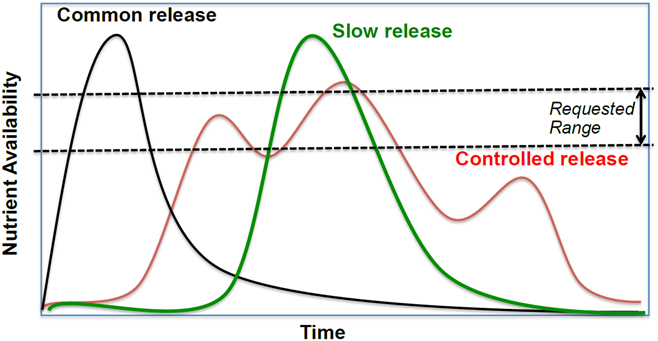
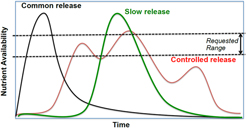
This leads to the growing interest about slow or controlled release fertilizers, which would give means to control the nutrient supply in adjusted rates considering the plant demand. A formal definition from the Association of American Plant Food Control Officials (AAPFO) for Slow and Controlled release fertilizer is “a fertilizer containing a plant nutrient in a form which delays its availability for plant uptake and use after application, or which extends its availability to the plant significantly longer than a reference ‘rapidly available nutrient fertilizer’ such as ammonium nitrate or urea, ammonium phosphate or potassium chloride. Such delay of initial availability or extended time of continued availability may occur by a variety of mechanisms. These include controlled water solubility of the material by semipermeable coatings, occlusion, protein materials, or other chemical forms, by slow hydrolysis of water-soluble low molecular weight compounds, or by other unknown means.”Reference Trenkel33 However, one can notice that even AAPFCO considers that there is not a formal difference among slow and controlled release fertilizers, frequently considered as similar or the same in many papers. A tentative to highlight the differences among systems is assuming that a “controlled release” behavior refers to materials that are responsive to external conditions, i.e., a system that would increase or reduce the release rate of some compound responsively to temperature or soil moisture, or any other external factors that can induce or stop the release. On the other hand, “slow release” would refers to all the systems that show the same release profile of unmodified systems but delayed in time (or happening in longer periods). Figure 1 schematically represents these different release systems. A combination of these profiles is frequently more adequate than a unique behavior, which is the actual procedure in practical application (e.g., mixtures of conventional, slow and controlled release fertilizers with same active principle).
Schematic view of nutrient availability along time for a cultivated soil (i.e., with nutrient drainage by plants or loss by other mechanisms, i.e., volatilization, lixiviation) according to different release systems. The “slow release” system (green) corresponds to a single, continuous event delayed in time, when compared to the “common release” system (black). On the other hand, the “controlled release” system (red) shows different peaks of release, depending on external factors. It is important to notice that the release type necessarily does not favor the “requested range”, i.e., the nutrient concentration assumed as ideal in a given condition.

In fact, defining this difference is not an easy task. Significant literature about slow and controlled release systems is found for pharmaceutics (drug delivery)Reference Allen and Cullis34 but for fertilizers, the very high application demands make that the systems need to have very high nutrient contents to be economically feasible. For instance, drug delivery systems are often found in relationships below 10–20% of active principle (i.e., the drug molecule), while in fertilizers, this number is impracticable due to transportation and application cost. Generally, we can assume that minimally these systems should have at least 50% weight of the nutrient source (the fertilizer molecule), also considering that these sources actually have variable nutrient concentrations—for instance, urea is a compound with approximately 44 wt% N. Therefore, a material for slow release of urea composed by 50% adjuvants is effectively a product with merely 22% N or, in other words, a product with 78% of nonnutritional components.
The release behavior of these systems is generically explained by diffusion equations, where the fertilizer diffusion to the medium (e.g., water or soil) is modeled by singular solutions of Fick’s laws according to granule shape (cylinder, slab, etc.) and to the behavior of the barrier material. A general relation to model the release is proposed and named as Peppas equationReference Brazel and Peppas35–Reference Peppas, Gurny, Doelker and Buri39 as follows:
 $${{{M_t}} / {{M_{{\rm{eq}}}}}} = k \cdot {t^n},$$
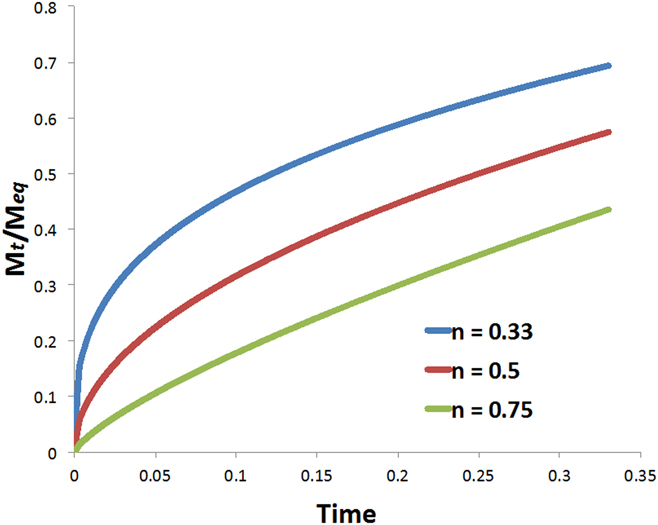
where M t and M eq are the released contents at time t and at the equilibrium state, respectively; k is the diffusion constant (which depends on the type of barrier material and releasing medium), and n is an adjustable diffusional exponent (calculated as 0.5 to simple diffusion in thin films). This exponent is useful to describe if the system differs from a simple diffusion through a barrier or a dynamic system and to compare different materials. Then, in cases where the release is defined by permeation through a static medium, it should follow simple diffusion, i.e., n ≈ 0.5, while situations where the medium is modified during the release (e.g., by swelling, side reactions, dissolution, pore opening, cracking, etc.), the release does not follow simple diffusion and n is adjustable. Generally, n > 0.5 indicates that the system tends to reduce diffusion along the time—for instance, in cases where the medium reacts with the involving material leading to compaction or cross-linking for polymers; while n < 0.5 indicates that the diffusion increases with time—as an example, when the releasing barrier is partially dissolved (as schematically depicted in Fig. 2). A generalization of Peppas equation includes the possibility of multiple events that influence the release, covering heterogeneous materials and reactive structuresReference Brannonpeppas and Peppas40–Reference Siepmann and Peppas43:
 $${{{M_t}} / {{M_{{\rm{eq}}}}}} = {M_0} + k \cdot {\left( {t - {t_0}} \right)^n},$$
where M 0 represents an “instantaneous release” (some amount promptly soluble or available) and t 0 is an induction time, i.e., the necessary time to observe any diffusion in the system. This is the case of compact systems that require some hydration time (e.g., swelling) for effectively starting the release. Since these equations are semi-empirical, literature has many examples of application, and interpretation is typically done by comparison with previous or reference experiments.
Example of Peppas equation [Eq. (1)] fitting for different n values, where n = 0.5 represents a solution of Fick 1st law (simple diffusion through a permeable medium). Fitting is generally done using data until 60% of the maximum release (target 100%, i.e., M t/M eq = 1).

Ion exchange in support minerals
From these definitions, any strategy to delay or control the diffusion of a nutrient or a nutrient source (the precursor molecule) can be considered as a slow or controlled release system. Therefore, since nutrients are always absorbed by plants in ionic form, the simplest method to control their release is exploring the ion-exchange properties of several minerals, which can store nutrients in cationic or anionic form by adsorption. These events naturally occur in soils with high organic matter content, where their high cation-exchange capacity is directly associated with the typically high fertility observed for these soil classes.Reference Atkinson, Fitzgerald and Hipps44
Soil mineralogy also provides indications about this property that can be used to artificially increase its fertility. Some zeolitesReference Mumpton45 have been used to increase fertility in simple mixture with fertilizersReference Bernardi, Oliviera, Monte and Souza-Barros46,Reference Monte, Middea, Paiva, Bernardi, Rezende, Baptista, Silva, Vargas, Amorim and de Souza-Barros47 —especially clinoptilolite, which has preference for NH4+ cation exchange.Reference Malekian, Abedi-Koupai and Eslamian48 The application of urea:clinoptilolite mixtures (around 20–25 wt%) is regarded to reduce urea volatilization by changing Ca2+ incorporated in structure by as-formed NH4+ during urea hydrolysis, acting as a cation reservoir and a regulator of hydrolysis process,Reference Bernardi, Werneck, Haim, Rezende, Piva and Monte49,Reference Eroglu, Emekci and Athanassiou50 confirmed by the reduction of ammonia volatilization.Reference Werneck, Breda, Zonta, Lima, Polidoro, Balieiro and Bernardi51,Reference Bernardi, Mota, Cardosa, Monte and Oliveira52 In fact, some authors have explored zeolite application for many different cultures (pastures, lettuce, tomato, rice, corn, etc.),Reference Campana, Alves, De Oliveira, Bernardi, Santos, Herling, De Morais and Barioni53–Reference Bernardi, De Souza, Polidoro, Paiva and Monte56 showing that this effect is universal, i.e., not associated with a specific aspect of any culture but to the nutrient dynamics in soil. In fact, the main drawback for this technology is the relative zeolite content, which is relatively high considered the fertilizer application—to reduce these amounts, their use as direct coating over granules has also been proposed.Reference Rashidzadeh, Olad and Reyhanitabar57 Therefore, the application is currently limited to naturally ocurring zeolites, despite some researchers reporting studies using more expensive synthetic materials, which have the advantage of better or specific ion selectivity.Reference Paskovic, Bronic, Subotic, Pecina, Perica, Palcic and Custic58 For them, the controlled release of micronutrients (as Zn2+ and Mn2+) has also been explored, probably due to their better market price compared to macronutrients.Reference Park, Kim, Choi, Kim, Heo, Komarneni and Choi59,Reference Paskovic, Pecina, Bronic, Perica, Ban, Ban, Poscic, Palcic and Custic60
Besides the very high cation-exchange capacity of zeolites, other minerals, notably clays, have significantly high values and have been also investigated.Reference Chen, Chen, Zhou, Yang, Ji, Tong, Zhong, Yu and Chu61 Smectites,Reference Borges, Dutra, Barison and Wypych62,Reference Borges, Prevot, Forano and Wypych63 typically montmorillonites,Reference Bhardwaj, Sharma, Sharma and Tomar64 are studied as simple mixtures with fertilizers, but other clays—as caulinitesReference Borges, Brunatto, Leitao, de Carvalho and Wypych65—are proposed to the same application. Some authors propose that a natural exfoliation of clays by dry milling with urea can occur, increasing the interaction and leading to higher efficiency for nutrient release.Reference Gardolinski, Wypych and Cantao66,Reference Fukamachi, Wypych and Mangrich67 Other clays and related minerals, such as halloisitesReference Nicolini, Fukamachi, Wypych and Mangrich68 and some phyllosilicates,Reference Borges and Wypych69,Reference Borges, Baika, Grassi and Wypych70 were studied and applied as coatings using aqueous suspensions over conventional fertilizers (urea and MAP) with some field results indicating efficiency.Reference Park, Kim, Lee, Choi, Choi, Lee and Choy71 However, compared to zeolite mixtures, field studies about clay:fertilizer mixtures are scarcely reported.
Considering the same strategy for phosphate fertilizers, since the nutrient is in this case at anionic form, other materials with anion exchange properties were explored in literature. Especially, lamellar double hydroxides (HDLs) have been investigated,Reference Benicio, Constantino, Pinto, Vergutz, Tronto and da Costa72,Reference Das, Patra, Baliarsingh and Parida73 with some emphasis on hydrotalcite due to its natural occurrence.Reference Everaert, Warrinnier, Baken, Gustafsson, De Vos and Smolders74 However, these minerals frequently have CO32− as exchangeable anion, which is hardly labile in mild conditions. The structure can be loaded with PO43−, HPO42− or H2PO4− by leaching with phosphoric acid,Reference Bernardo and Ribeiro75 but this process is more effective in denaturated HDL, produced by calcination in high temperature (>500 °C).Reference Bernardo, Moreira and Ribeiro76 In contact to phosphoric acid solutions, they are reconstructed to the hydrated HDL form, with some intercalation of phosphates instead of carbonates.Reference Bernardo, Moreira, Colnago and Ribeiro77 Compared to soluble phosphate fertilizers (e.g., MAP), phosphate-loaded HDL tends to reduce the phosphate immobilization in pot trials but the dry mass production is irresponsive to the fertilizer type due to immediate plant need.Reference Bernardo, Guimaraes, Majaron and Ribeiro78 Despite not providing an initial advantage for plant production, this indicates that the residual fertilizer is more labile, i.e., it can be assessed by further cultures while the nutrients from very soluble sources tend to be irreversibly immobilized with soil components.
Coated fertilizers
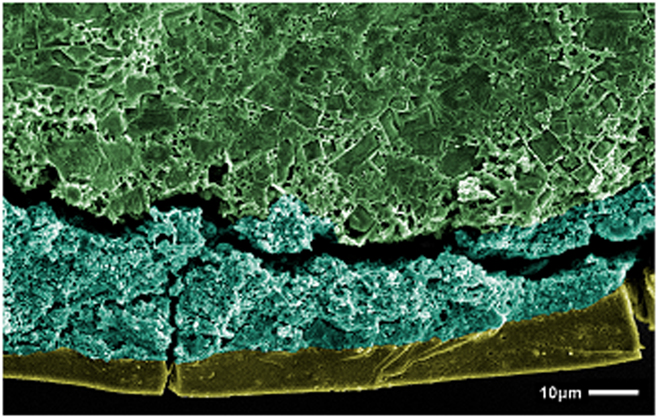
An advance regarding ion-exchange control is to protect granules with coating films, which may act as barrier to water penetration or as membranes for diffusion (Fig. 3).Reference Shaviv, Raban and Zaidel79 Since these materials are at surface, the film content is normally below 10% of the total product weight, keeping higher nutrient contents and high N recovery efficiencies in field tests.Reference Hyatt, Venterea, Rosen, McNearney, Wilson and Dolan80 Water soluble polymers, such as acrylates,Reference Jarosiewicz and Tomaszewska81 PVA,Reference Zhang, Zhang, Lu and Liang82 starch and starch derivatives,Reference Qiao, Liu, Yu, Bao, Simon, Petinakis and Chen83 chitosan,Reference Wu and Liu84 among others,Reference Costa, Cabral-Albuquerque, Alves, Pinto and Fialho85,Reference Nampoothiri, Nair and John86 are reported in literature, aiming to have complete dissolution after some incubation time. In these cases, the solubility control depends on the polymer solubilization time, which avoids the immediate water contact with fertilizer. However, this strategy is very influenced by the soil microbial activity and local moisture: since the polymer can be hydrated or dissolved in nonhomogeneous ways, the barrier can fail in different periods by crack formation, large porous formation or even due to surface irregularities.Reference Shaviv, Raban and Zaidel79
Cross-sectional view (in scanning electron microscopy) of a MAP-coated granule, with two layers indicated by the interface between the fertilizer (green), ZnO (blue), and zein coating (yellow). ZnO coating reduces the influence of surface irregularity (seen by the crack at interface) and allows better zein deposition. Reprinted with permission from Bortoletto-Santos, R., Plotegher, F., Roncato, V., Majaron, R.F., Majaron, V.F., Polito, W.L., and Ribeiro, C.: Strategy for multinutrient application in integrated granules using zein as a coating layer. Journal of Agricultural and Food Chemistry 66(37), 9582–9587 (2018). Copyright 2018 American Chemical Society.

Taking this aspect in mind, other water-insoluble polymeric coatings were proposed in the literature.Reference Tomaszewska and Jarosiewicz87 Among them, polyurethane (PU) materials can be bio-based (e.g., using vegetable oils as polyols) and produced in situ by polycondensation reaction over granules. For that, granules are initially coated by the polyol and an isocyanate is spread over them promoting PU reaction. The final coating thickness is controlled by reactant amount or by sequential coating deposition. Since PU is insoluble in water, the fertilizer release occurs through diffusion in coating, which is more effective for very long release. Experiments have shown that PU-coated urea granules can sustain release in water immersion for periods over than 50 days, much higher than expected for urea solubilization in water (around 10 h for complete dissolution, in comparative conditions).Reference Bortoletto-Santos, Ribeiro and Polito88
Modifications in the PU structure can increase this release period. The oil source plays an important role since the molecular weight and linearity of the as-produced polymer depend on the primary oil structure. Soybean and castor oils were detailed studied and the hydroxyl content of both oils determines the length of final PU structure. Castor oil produces a more compact and mechanically resistant polymer, with longer release behavior, while soybean oil should be modified to include more reactive groups to promote the polymerization reaction. The practical result is that better coating capacity and longer molecular weights (as for castor oil) allow thinner coatings to have similar performances than thicker ones, increasing the effective nutrient content in the product. This also supports that the process is not based on the coating degradation but in continuous diffusion through coating porosity.Reference Bortoletto-Santos, Ribeiro and Polito88
Despite more focus being given about urea due to its critical volatilization losses, there are propositions to apply the coating strategy for other fertilizers, especially mono- and di-ammonium phosphates. These are very soluble and easily available for plants, but contrary to urea, they do not suffer volatilization but immobilization. Then, there is some debate if coating strategy is worthy or not for phosphate fertilizers since reducing their solubility could, on the other hand, reduce the effective absorption by plants as a final result. However, recent articles have been showing that the phosphate immobilization process in soil depends also on the solubility of these sources, influenced by the immediate availability in soil. In fact, if the fertilizer can keep insolubilized phosphate amounts until the plant root system is developed enough to efficiently absorb the nutrient, the immobilization seems to be reduced by the plant activity. This is suggested by soil incubation tests, and plant experiments indicate the feasibility of this strategy, despite the effect is not yet understood at all.Reference da Cruz, Bortoletto-Santos, Guimaraes, Polito and Ribeiro89
Successive coating using different materials in layers (overcoating) is also proposed in the literature.Reference Ni, Liu, Lu, Xie and Wang90,Reference Ni, Liu, Lu, Xie and Wang91 Commonly, after the first fertilizer coating with a polymeric material, a mineral (typically inorganic) phase coating is applied to dry the previous and increase the mechanical and abrasion resistance.Reference Guan, Song, Gan and Li92 The sequential coating has also the advantage of filling large pores and making more compact structures where diffusion would be slower. Also, there is an aspect that favors the releasing control, mainly for urea: the coating dissolution may affect the local soil pH, favoring the plant absorption or the dynamics of other nutrients. For instance, some commercial products are based on first sulfur (S0) coating, produced by the molten phase, which is later coated by polymers.Reference Cox and Addiscott93 The proposition is that S0 may provide an acid environment during dissolution that reduces urea hydrolysis, consequently, reducing volatilization.
Overcoating is also worth for granular ammonium phosphates. A preliminary inorganic coating can provide a smooth surface for the polymer deposition, which reduces the occurrence of cracks and heterogeneous coating. For instance, ZnO coating associated with a 2nd zein layer was very effective for DAP slow release in soil incubation, probed by the total available phosphate in soil by exchange ionic membrane technique (which avoids incorrect interpretation of the phosphate release). Since the coating application in phosphate nutrients is not consensual, the variations proposed in literature are not wider than seen for urea, but this is an application that tends to grow in the next years due to the limited supply of phosphated materials.Reference Bortoletto-Santos, Plotegher, Roncato, Majaron, Majaron, Polito and Ribeiro94
Fertilizer composites
However, despite coating technology seems to be adequate for several situations, a limitation is that coated granules often take too long for release. Frequently, the release times are longer than the plant synchronization requirements, which mean that the nutrient stays as a “stored” amount in soil instead of absorbed. On the other hand, failure in coating preparation is critical, since minimal cracks, surface detachments or heterogeneous deposition may affect the total release behavior, consequently compromising the application.Reference Bortoletto-Santos, Ribeiro and Polito88
Alternatively, other systems are proposed where the diffusion behavior is affected by the granule structure, i.e., the diffusion occurs by multiple barriers or is delayed by reactions among other components in granule structure. This is the principle behind the first reported slow release N fertilizer, urea-formaldehyde granules.Reference Kralovec and Morgan95–Reference Tjia and Sheehan98 This polymer is produced by the condensation reaction of urea (U) against formaldehyde (F), making a linear to branched polymer (depending on the U:F relation) insoluble in water.Reference Jada99 However, since its structure is still hydrolyzed by urease enzymes, the nutrient is accessible for plants, but at very slow rates compared to pristine urea.Reference Jahns, Ewen and Kaltwasser100,Reference Christjanson, Siimer, Pehk and Lasn101
This simple reaction can be done by mixing components in different pHs, but a major drawback is how to control this very exothermic reaction that tends to fast hardening of the final polymer. This limits the production as granules and, also, limits the material to a full-reacted polymer with very long release times. It would be interesting to have polymeric structures composed by urea and UF, where this last could be gradually reacted in different molecular weights. Therefore, the hydrolysis in soil would follow the sequence of lower molecular weight (urea) to intermediate values until the fully reacted polymer (UF). This strategy is possible through using formaldehyde solid precursors, particularly paraformaldehyde (PF), a paraffin with low molecular weight that can be hydrolyzed to formaldehyde during heating. This is a self-catalytic reaction: since UF is formed by condensation, water is a byproduct that is used to hydrolyze PF and sustain the reaction path. To that, both materials can be simply mixed as powders in a rotational mixer, extruder or similar equipment, heating around 90 °C to start the reaction. The final product can be molded from melt urea, since the polymerization is retarded by PF hydrolysis occurring in the as-formed granules. Studies about this material show that the release in soil incubation is directly dependent on the PF fraction in starting mixture, giving that this simple strategy may provide N slow release fertilizers with minimal processing.Reference Giroto, Guimares and Ribeiro102
This also suggests that the nutrient source, in that case urea, can be treated alone as a matrix, where the loading of other particles would behave in the same way of polymer composites or nanocomposites. Therefore, some effects typically seen in composites and blends could be used to finely control the nutrient release not only by the chemical structure but also by micro and nanostructure. In that sense, adding exfoliated clays—especially montmorillonites—in urea may provide a similar effect of low water diffusion trough structure observed for nanocomposite biopolymers.Reference Aouada, Mattoso and Longo103 Also, clays have hydrophilic surfaces, which help their dispersion in compatible molecules such as urea. In fact, the dispersion naturally occurs when mixing both materials with moisture around 8–10 wt%, which form a plastic body at room temperature that can be molded by conventional extrusion. Clay contents below 20% are adequate to produce a well dispersed structure with enough plasticity for conformation at room temperature. This has the additional advantage of simple processing with low energy consumption.Reference Pereira, Minussi, da Cruz, Bernardi and Ribeiro104
The simple mixture also provides the possibility of using other additive materials in mixture, such as superabsorbent or biodegradable polymers, to improve specific properties as water absorption, processability or mechanical resistance. The addition of poly(methyl acrylate) or poly(caprolactone) (below 2 wt%) in composite granules of urea:montmorillonite increases the granule mechanical resistance, which is important for production rate, product storage and mechanized application. Powder formation (by granule abrasion or fragmentation) is a key issue for mechanized application since it involves losses due to wind, variation in application (powder segregation) as well occupational problems (worker’s health risks by dust formation). Therefore granules should have adequate mechanical resistance to support these steps but, at the same time, this resistance should not affect the material reactivity, i.e., the fertilizer should release the nutrients in some manner (i.e., they can not be irreversibly bonded in structure). By small polymer addition (below 2 wt%) the mechanical resistance is improved but the soluble fraction (urea) is still accessible from the surface, keeping the nutrient function. This strategy was also shown to affect the conversion of hydrolyzed urea (to NH4+) to N2O, reducing the total emission in wheat field,Reference Pereira, da Cruz, Solomon, Le, Cavigelli and Ribeiro105 with an immediate impact in the fertilizer contribution to global warming.Reference Skiba, Fowler and Smith106,Reference Freney107
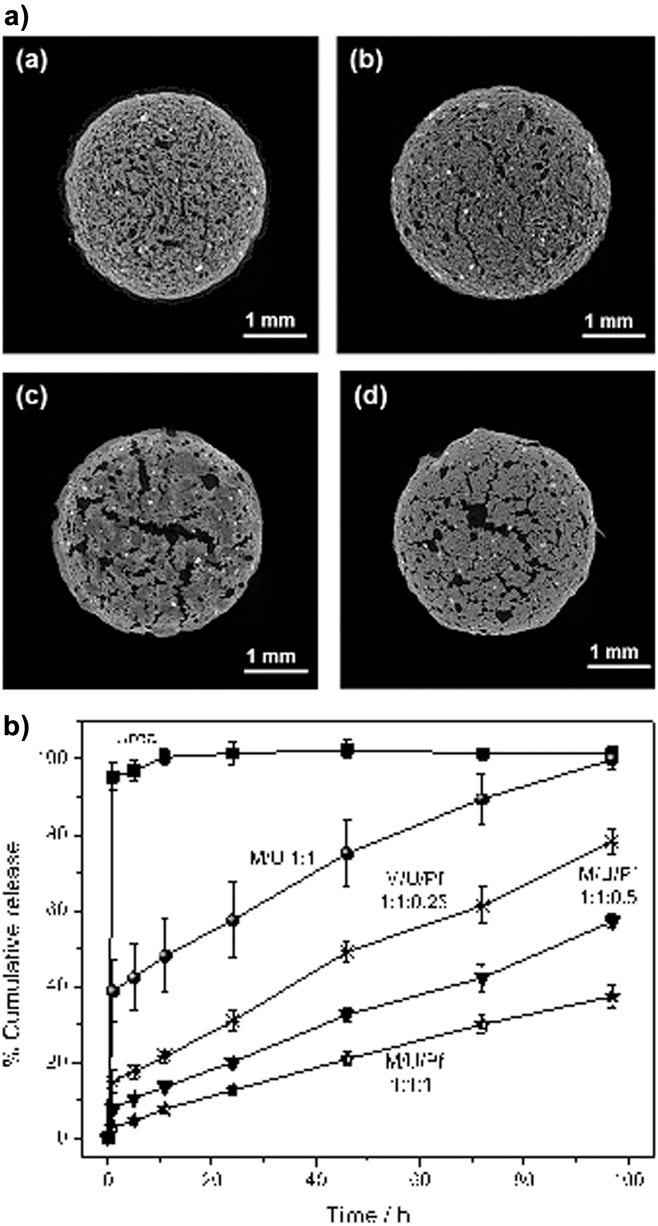
Going back to the idea of a urea-formaldehyde matrix, the same strategy is worthy to produce them by using the plastic mixture formed by urea, montmorillonite, para(formaldehyde) and water. This mixture keeps unreated at room temperature, but after molding (e.g., extrusion) granules can react to form urea:UF matrix by heating at 90 °C, with the advantage that the plastic mixture can also carry other components, such as other nutrients. The final reacted material is brittle when fully reacted, but in intermediate conditions (excess of urea) the granule is hard and dense (Fig. 4). These characteristics reflect in the release behavior in water and in soil incubation, which is again directly dependent on the reaction extension.Reference Yamamoto, Pereira, Mattoso, Matsunaka and Ribeiro108
(A) Cross-sectional X-ray tomography images (nondestructive technique) of different urea-formaldehyde:montmorillonite (all samples with 50 wt% clay) composites processed by cold extrusion: (a) only unreacted urea (M/U 1:1); (b) 25% polymerized (M/U/Pf 1:1:0.25); (c) 50% polymerized (M/U/Pf 1:1:0.5); (d) 100% polymerized (M/U/Pf 1:1:1). Images indicate the formation of internal cracks by retraction in high polymerized materials. (B) Related kinetic of urea release at 25 °C in aqueous medium (neutral pH). Reprinted (adapted) from Yamamoto, C.F., Pereira, E.I., Mattoso, L.H.C., Matsunaka, T., and Ribeiro, C.: Slow release fertilizers based on urea/urea-formaldehyde polymer nanocomposites. Chemical Engineering Journal 287, 390–397 (2016), Copyright 2016, with permission from Elsevier.

Pot trial experiments are often used to probe these properties in real systems, using test plants that are exigent regarding some specific nutrient. Tests done with ryegrass indicate that the plant production in initial times is favored by very soluble nutrient sources, as pristine urea, but in longer times the slow release systems favor the continuous plant development. Remarkably, the N recovery efficiency (i.e., the effective amount of nutrient absorbed by the plant structure) is also affected, increasing in slow release fertilizers—which indicates that the plant molecular composition (i.e., protein, cellulose, lignin contents, etc.) is affected by this gradual release producing plants with better quality.Reference Pereira, Nogueira, Cruz, Guimaraes, Foschin, Bernardi and Ribeiro109
Superabsorbent materials
As composite and nanocomposite materials, literature also proposes using polymer scaffolds with capacity to retain high amount of nutrients in porosity, with binding capacity to control their release. Hydrogels (e.g., superabsorbent materials) fit this definition regarding water absorption capacity, and applications in agriculture are known for at least 40 years generally focused on the increase of moisture capacity of soils or as auxiliary for irrigation procedures. These materials are able to absorb water from 50 to 400 times its dry weight (depending of its hydrolysis degree) making a gel with some mechanical resistance that can be manipulated. Many polymers have this capacity based in the formation of poorly soluble networks, generally ramificated polymers but with significant capacity of hydrogen binding with water.Reference Guilherme, Aouada, Fajardo, Martins, Paulino, Davi, Rubira and Muniz110 Examples include alginate,Reference Wang, Liu, Ni and Xie111 starch-based gels,Reference Qiao, Liu, Yu, Bao, Simon, Petinakis and Chen83 polyvinyl alcoholReference El Salmawi112 and notably, polyacrylic and polymetacrylic gels (PAM),Reference Aouada, de Moura, da Silva, Muniz and Mattoso113 which are the most widespread kinds of hydrogel now in the market. PAMs can be synthesized also as interpenetrated networks or copolymers with other soluble molecules, such as methyl and carboxymethylcelluloses, which increases the water affinity and confers some biodegradability to the final structure.Reference Aouada, Chiou, Orts and Mattoso114 These networks can swell, frequently in a reversible manner, keeping some content of chemically bonded water with some included water in porosity formed as cages in polymer structure. This “honeycomb” structure behaves as a sponge, where water is stored.Reference Guilherme, Aouada, Fajardo, Martins, Paulino, Davi, Rubira and Muniz110
Despite its successful history for water management, its use for hosting other chemicals, especially fertilizers, is still limited because there is a remarkable reduction in their swelling capacity when in water solution, mainly ionic. An immediate explanation is that soluble molecules compete for the same binding sites for water in hydrogel structure, ceasing its interaction chain and consequently collapsing the structure.Reference Aouada, de Moura, Menezes, Nogueira and Mattoso115,Reference Bortolin, Aouada, de Moura, Ribeiro, Longo and Mattoso116 An exception is urea, since it can interact with hydrogel structure by hydrogen bonds keeping its capacity to interact with water. Hydrogel swelling experiments in urea solutions have shown that, despite reducing the hydrogel expansion, significant urea amounts can be carried on the polymer structure, being protected and released in water typically as a slow release system. In that sense, its application as coating over fertilizer granules was proposed, using the same principle of other polymeric coatings: since the first effect expected in soil is its swelling, this process controls the fertilizer release by competition with solubilization water, as well modifying the diffusion barrier during water adsorption. However, especially in that case, release rate tends to increase along time, since the swollen hydrogel coating reduces the diffusion barrier.Reference Ni, Liu and Lu117
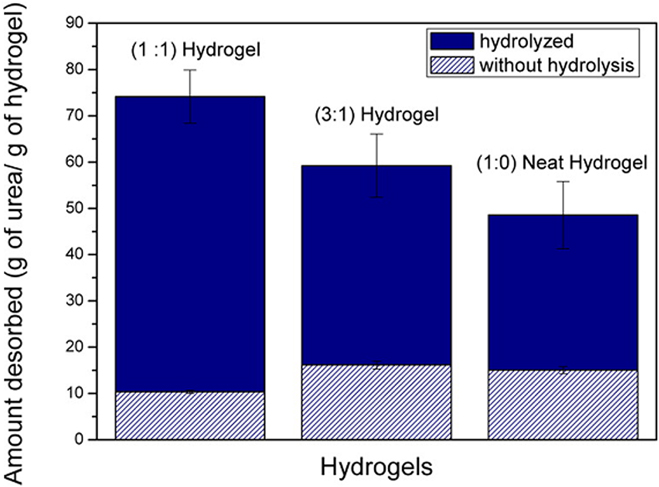
An important advance for this system was proposing a nanocomposite hydrogel, using the natural dispersion of hydrophilic clays into this polymer during synthesis.Reference Junior, de Moura and Aouada118 For polyacrylamide:carboxymethylcellulose copolymers, the synthesis involves a radical polymerization in water solution, which is compatible with both materials and allows good homogenization. This leads to nanocomposites with high clay content (around 50 wt%) allowing that the hydrogel structure can be hydrolyzed at extreme conditions increasing the water adsorption capacity—since the inorganic load increases the mechanical resistance of the product, the damage promoted by the high hydrolysis is less perceptible. Therefore, swelling can be increased by treatment in very alkaline medium, leading the final values over than 1000 times the original weight, i.e., 1000 g of water absorbed in 1 g of product. When in urea solution, these values reduce to 100 to 250 times, which is still considerably high. But noteworthy, the dispersed clay has some role in urea release in contact with distilled water: experiments have shown that nanocomposite hydrogels tend to absorb more urea (up to 70 g urea/g product, Fig. 5) than unmodified hydrogels, also delaying its release to longer periods. This is explained by the formation of rigid domains into hydrogel structure, which avoids that urea directly bonds to the polymer being dissolved in water in polymer cages. At the same time, since the release depends on the diffusion through polymer structure, the clay acts as a diffusional barrier for release.Reference Bortolin, Aouada, Mattoso and Ribeiro119
Desorption capacity of urea-loaded nanocomposite hydrogels (1:1 refers to a material with 50% clay; 3:1 a material with 25% clay), for hydrolyzed and nonhydrolized conditions. Reprinted with permission from Bortolin, A., Aouada, F.A., Mattoso, L.H.C., and Ribeiro, C.: Nanocomposite PAAm/methyl cellulose/montmorillonite hydrogel: Evidence of synergistic effects for the slow release of fertilizers. Journal of Agricultural and Food Chemistry 61(31), 7431–7439 (2013). Copyright 2013 American Chemical Society.

Urea is particularly well succeeding in this system, but other nutrients were not as successful. A general explanation returns to the role of ionic solutions in binding to the same sites of water, but also to the fact that preferential binding of cations (due to the several OH bridges in polymer structures) unbalances the ionic solution and changes the effective pH, limiting the available material in solution. Tests indicate that the swelling degree of PAAm/carboxymethylcellulose polymers decreases from 800 times in distilled water to 10 times in solutions containing borate, a micronutrient fertilizer (from sodium octaborate). Even with that reduction, it is noteworthy that these systems keep a relative nutrient:adjuvant (the nanocomposite) relationship higher than 2, which is still possible for practical applications.Reference Bortolin, Serafim, Aouada, Mattoso and Ribeiro120
Increasing the solubility: the particle size effect
Moving to the general scenario of non-volatile fertilizers, especially for phosphatic materials, the problem lies on the immobilization or irreversible precipitation against soil minerals, as Fe and Al sources.Reference Horst, Kamh, Jibrin and Chude22 Less soluble sources could avoid an immediate reaction and may provide more time for adequate plant absorption, such as directly using mineral phosphates as apatites (hydroxy-, chloro-, fluoro-, and carbonatoapatites). Immobilization from these sources is less probable since the phosphate delivery to the plants is believed to occur through solubilization promoted by plant roots in contact or close to them in particulate form.Reference Chien21 However, this is a slow process that also depends on the mineralogical history of phosphate source: chloro and fluoroapatites are much less soluble than hydroxyapatites, as well igneous rocks are less soluble than sedimentary ones. Also, natural occurring minerals are frequently composed by mixtures of different phases, some without nutritional role (as SiO2 minerals) and, critically, Fe and Al minerals—that compromise any possible advantage in terms of slow release. This leads that reports about agronomical application of phosphatic rocks are still not conclusive, and current recommendations are focused in increasing the phosphate storage in soil instead of actual fertilization.Reference Manning20
To meet the application requirements, the replacement of soluble sources by minerals depends on ways to control their solubility to adequate levels. Increasing solubility is possible by reducing particle sizes, as predicted by the Ostwald–Freundlich equationReference Atkins and De Paula121:
 $$S = {S_{\rm{o}}}\;\exp \left( {4 \cdot {\gamma _{{\rm{SL}}}} \cdot {{{V_{\rm{m}}}} / {RTd}}} \right),$$
where S o is the solubility of the flat surface (minimum energy condition), γSL is the solid–liquid interfacial energy, V m is the molar volume of the solid phase, R is the ideal gases constant and T is the temperature. From the analysis of the equation it is observed that when the term (4·γSL·V m/RTd) tends to zero, the particle solubility tends to the same of a flat surface (or bulk solubility). This condition occurs for large particles, where solubility varies little with size; conversely, when the exponential term is larger than 1 (d < 4·SLγ·V m/RT) the solubility of the particle increases and it tends to dissolve. Because the behavior of the equation is exponential, from a certain threshold small variations in particle size can lead to significant increases in solubility.
Enüstün and TurkevichReference Enüstün and Turkevich122 analyzed the validity of Eq. (3) in experimental system (strontium sulfate) observing excellent agreement with the predicted. Similar studies demonstrated that this correlation between particle size and solubility is valid for different phases. In general, this strategy is currently seen in the development of drugs, to circumvent the low solubility of drugs. In these materials, sizes around 300 nm have been proved effective in achieving desirable solubility values for oral administration.Reference Kipp123 This strategy has also been studied for phosphatic materials: Tonsuaadu et al.Reference Tonsuaadu, Kaljuvee, Petkova, Traksmaa, Bender and Kirsimae124 studied the solubility of different mineral phosphates after grinding, observing increased solubility with grinding time for all cases. The authors did not evaluate the particle sizes after grinding but observed a consistent increase in surface area (up to 20 m2/g) and variation in crystallinity, correlating these factors with the measured solubility. Yusupov et al.Reference Yusupov, Shumskaya, Kirillova and Boldyrev125 observed similar behavior for apatite grinding, still without information about the effective particle sizes produced (only milling time) and observing high reactivity of this material with zeolitic fractions added to the soil.
Generally, studies about mineral phosphates solubility focus the reduction of particle sizes through intensive grinding (top-down method), but there are proposals to obtain small particles through controlled precipitation in nanometric sizes (bottom-up). In this last, particle nucleation and growth processes are fundamental for synthesis. There are two most commonly used strategies: in the first, nucleation and growth of particles occur at moderate temperatures over long periods of time, resulting in wide distribution in particle size. In the second, the nucleation and growth processes are separated by a heat treatment to induce the nucleation process, thus achieving a narrower particle size distribution. The understanding of these mechanisms can be used to obtain highly soluble nanoparticles through the control of synthesis parameters.Reference Zhang, Li and Yan126–Reference de Oliveira, Paris and Ribeiro129 However, all methods have in common the fact that production itself is difficult to scale, usually in batch methods and usually restricted to a few grams per batch. These limits are real challenges for large-scale applications, such as in fertilizers.
Also, the effectiveness of particle size reduction is controversial since other factors can take place in a dynamical system as soil:plant environment.Reference Kah, Kookana, Gogos and Bucheli130 Montalvo et al.Reference Montalvo, McLaughlin and Degryse131 conducted agronomic experiments in different soils using hydroxyapatite as phosphate source, and they have observed small increases in wheat dry mass production when using nanoparticulate instead of bulk hydroxyapatite. However, in some conditions, the production was statistically identical for all experiments and the soluble source used as reference experiment (TSP) was more effective than any condition using minerals. This was, in some aspect, consistent to the observed by Tonsuaadu et al.Reference Tonsuaadu, Kaljuvee, Petkova, Traksmaa, Bender and Kirsimae124 since their results showed that small size reduction was effective to increase plant production while longer milling times have to lead to agglomeration and poor efficiency for nutrient availability. Other experiments using vibratory mill in SSP, which is a very soluble phosphate source despite in mineral form (calcium hexametaphosphate, majoritarily), have observed that in long grinding times the material tends to deform and re-agglomerate, a process that would be deeply detrimental to solubility instead of beneficial. In addition, the high surface areas involved could induce agglomeration by particle-to-particle contact.Reference Plotegher and Ribeiro132
Thus, it is necessary to provide means to isolate the produced nanoparticles avoiding agglomeration—for instance, dispersing them in soluble matrixes, thus allowing the control of solubility by the gradual exposure of nanoparticles to the environment and avoiding their agglomeration. Furthermore, an advantage of this strategy is the conformation as granules, which are more accepted by rural producers for application than the powder material. Matrices must necessarily be compatible with the surface of the nanoparticles—i.e., hydrophilic—and it is desirable that they can be processed continuously. A primary candidate for phosphate dispersion is again urea, which is also affected by the nanoparticle dispersion slowing its solubilization. Using hydroxyapatite as the phosphate source, this composite is easily produced in contents from 25 to 50 wt% mineral, which leads to adequate nutrient contents (considering also the urea contribution). As proposed, the solubility of hydroxyapatite is increased by the dispersion, making possible to access 100% of the total phosphate content in laboratory tests.Reference Giroto, Fidelis and Ribeiro133
Thermoplastic starch (TPS) was also successful for phosphate particles dispersion. A useful characteristic in TPS preparation is the plastification promoted by urea, which increases the nutritional value by replacing other commonly used plastificants as glycerol. Compared to urea, TPS matrix has the advantage of better processability, which facilitates granule production, but in other hand the effective nutritional content is reduced. Also, it is possible to increase granule porosity helping contact with soil solution. The results, in terms of phosphate release from hydroxyapatite, are similar to the observed when dispersed in urea, but the system imposes longer delays of urea fraction, which may be favorable to synchronize both nutrient releases. In soil incubation experiments, the mineral dispersion in soluble matrices (both urea and TPS) was effective to reduce the phosphate immobilization after 42 days of soil incubation, when compared to a soluble source (MAP) and nanometric powder hydroxyapatite—the nutrient availability of these sources was reduced to 50% of the total content, where in the composites the nutrient was available around 80–90%, indicating that the slow release effectively reduced the immobilization.Reference Giroto, Guimaraes, Foschini and Ribeiro134
Synergy among microorganisms
Considering the release process in soil, it is important to take notice about the role of microorganisms in contact to the fertilizer or plant roots. This is a vast topic, which we can only briefly go into here, and the reader is referred to some recent reviews for further study.Reference Glick11,Reference Jitendra, Jai and Kumar135 Soil is a rich environment and many acidulant microorganisms are of natural occurrence. In fact, they can colonize roots or the fertilizer granule surface, synergically acting to increase the nutrient absorption—and in that sense the fertilizer design can take advantages from this process.Reference Hungria, Campo, Souza and Pedrosa7,Reference Dobereiner8
The acidification provided by some soil microorganisms, notably Aspergillus niger, has been studied as an alternative to provide cheaper fertilizer production.Reference Chuang, Kuo, Chao and Chao136 If an adequate source of carbon is provided to the microorganism, it can be grown over mineral particles (as in phosphate rocks) and its production of organic acids dissolves the mineral structure, as well leads to in situ production of chelates that are beneficial for plant growth.Reference Mendes, da Silva, Anastacio, Vassilev, Ribeiro, da Silva and Costa137 These acids (citric, gluconic, oxalic, etc.) have different solubilization capacities, and depending on the mineral particle sizes and mineralogical features (e.g., composition, phase dispersion, formation history, etc.), they are more or less effective solubilizers.Reference Mendes, de Freitas, Pereira, da Silva, Vassilev and Costa138 As in direct solubilization in water contact, A. niger is more active in a range of particles where agglomeration is not likely to occur, i.e., micrometric sizes or dispersed structures. Going to nanometric particles, the solubilization performance is similar, indicating that the investment in longer milling times is not necessary or could be avoided for economic reasons.Reference Klaic, Plotegher, Ribeiro, Zangirolami and Farinas139,Reference Klaic, Plotegher, Ribeiro, Zangirolami and Farinas140
On the other hand, if these nanometric particles are dispersed in adequate carbon sources, as gelatinized starch, the microorganisms can grow by consumption of them increasing the local acid production. This strategy is effective to associate A. niger spores in granule production, which will be activated by the soil moisture in field. In these cases, the solubilization process of a rock phosphate (a complex apatite, containing different kinds and other minerals, as quartz) takes place in the granule, favoring application and increasing nutrient content. Since the starch gelatinization can be done in mild temperatures only by heating starch in water (without other additives), the inoculation can be done by directly mixing spores in hydration water during cooling and drying the produced granules in mild temperatures.Reference Klaic, Giroto, Guimaraes, Plotegher, Ribeiro, Zangirolami and Farinas141
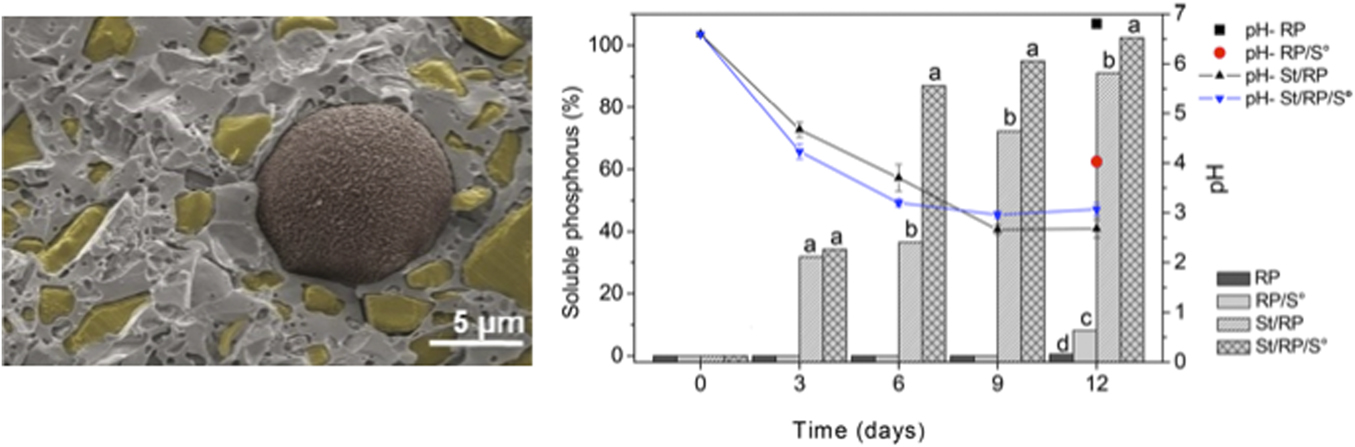
Increasing mineral phosphate solubilization is also possible if the matrix has some acidic feature, which could reduce the local pH around particles. Matrices that could provide this are sulfur-based materials,Reference Baltrusaitis, Sviklas and Galeckiene142 especially elemental sulfur (S0).Reference Evans, McDonald and Price143 Sulfur is a nutrient requested in significant amounts, which is typically provided by gypsum and, in some soils, is recycled by acid rain. However, in tropical soils, the sulfur deficiency has been noticed in the last decade and this is motivating studies about S supplementation.Reference Degryse, Ajiboye, Baird, da Silva and McLaughlin144,Reference Karamanos and Janzen145 It is important to highlight that plants only can absorb S as sulfate: this leads that S0 application, despite interesting in terms of nutrient content (all the applied amount is, in principle, a source of SO42−), is limited by the oxidation capacity of soil that depends of the microbiological activity.Reference Degryse, Ajiboye, Baird, da Silva and McLaughlin146–Reference Wen, Schoenau, Yamamoto and Inoue148 Therefore, to increase S0 oxidation, microorganisms such as A. niger can be inoculated using similar strategy based on starch dispersion.Reference Grayston, Nevell and Wainwright149 The S0 oxidation provided by the microorganism is important by itself, since it allows its usage as nutrient source with better efficiency. Also, experiments using multinutrient composites, containing a rock phosphate, S0, starch and the microorganism, have confirmed that the association is efficient to provide the maximum solubilization of phosphate in soil (as illustrated in Fig. 6). This composite also influenced the phosphate immobilization, probably by avoiding the precipitation in granule vicinity by local pH reduction. However, analyzing the average soil pH in the same experiments, it was noticed that the change is actually very localized, not affecting the full soil profile.Reference Guimaraes, Klaic, Giroto, Majaron, Avansi, Farinas and Ribeiro150 This is important since nutrient absorption by plants depends on the soil pH, which needs be basic—therefore, soil acidification is very undesirable. But, since this has happened locally, this does not seem to affect the plant production but only the phosphate and sulfur availability as nutrients.
(a) Magnified SEM image of starch/elemental S (St/S0) composite, showing S0 crystals (yellow) and A. niger spore (brown) in the structure. (b) Temporal profiles of phosphorus solubilization in culture medium and pH for treatments using phosphate rock (RP) (control, without A. niger) and composites RP/S0, St/RP and St/RP/S0 (different letters indicate significant difference between the treatments, according to ANOVA with Tukey’s test, 95% confidence level). Reprinted (adapted) with permission from Guimaraes, G.G.F., Klaic, R., Giroto, A.S., Majaron, V.F., Avansi, W., Farinas, C.S., and Ribeiro, C.: Smart fertilization based on sulfur–phosphate composites: Synergy among materials in a structure with multiple fertilization roles. Acs Sustainable Chemistry & Engineering 6(9), 12187–12196 (2018). Copyright 2018 American Chemical Society.

General comments
The sustainability issue in agriculture is complex and involves several aspects, as the carbon balance and the energy input/output, which are intrinsically involved in the effective recovery of nutrients from agrochemicals. The production cycle and other factors, such as the energy consumption in application (trucks, machines, etc.) should also be taken in account, implying that the fertilizer losses are not a problem only due to environmental issues—in fact, these are only part of the problem.Reference Zegada-Lizarazu, Matteucci and Monti151 These technologies for nutrient delivery are tools for producers but they still need do significant efforts in planning and management for effective production gain. In the same way, it should be emphasized that the need of production increase might be balanced by better management of product use, including the reduction of food waste and nutrient recycling.
Also, these strategies are not dissociated from other technologies, such as the new seed generation, irrigation technologies, planting methods—all of them are integrated for agriculture and can also request the development of other new technologies for nutrient delivering to maximize each technology gain. The management of other inputs, such as pesticides, growth promoters, etc., can also be favored by focusing the problem on the same way of fertilizers, despite the real benefits should also be deeper investigated. Finally, the regulatory discussion about the use of these novel technologies, including nanoparticles, can delay the practical application or effective adoption, while the public awareness about risks and benefits should be improved.Reference Smith and Gilbertson152
The interface of these materials with other microorganisms is a topic that deserves more attention. The research in biological control of pestsReference Monnerat, Nachtigal, Cruz, Bettiol, Campo, Fiuza, Polanczyk and Crickmore153 and about the synergy among plants and soil microorganismsReference Jiang, Zhou, Chen, Yuan, Fang, Luan, Chen, Wang, Liu, Li, Peng and Sun154 have been arising new questions about how to adequately deliver them in field and how to increase the viability of these new inputs. There is also a wide window for the development of new technologies for integrating new biotechnological advances, such as the comprehension of dsRNA action and gene targeting in plant breeding and protection.Reference Mitter, Worrall, Robinson, Li, Jain, Taochy, Fletcher, Carroll, Lu and Xu155 All these new frontiers show how challenging is the connection among materials science and agriculture.
Acknowledgments
This work was supported by CNPq (Brazilian National Council for Scientific and Technological Development, grant # 458763/2014-4), FAPESP (Sao Paulo Research Foundation, Grant No. #2016/10636-8); CAPES (Coordination for the Improvement of Higher Education Personne—Finance Code 001; and CAPES/Embrapa Call 15/2014 Grant #166); Agronano Network (Embrapa Research Network). Caue Ribeiro also acknowledge Alexander von Humboldt Foundation and CAPES by Experienced Research Fellowship (CAPES/Humboldt Agreement—Process 88881.145566/2017-1).