


Just as in other colonial societies, the authorities in the Amazon were constantly concerned with finding viable methods of economic exploitation, combined with maximum possible control over those they saw as their labor source.Footnote 1 The abundance of land and confidence in the soil’s fertility sustained the idea that, at some point, the plantation system based on African slave labor, which had long dominated several coastal regions of Brazil, would also succeed in this region. As long as this was not the case, however, the focus remained on indigenous labor and the extraction of natural resources from the forests and rivers.
Circumstances, however, repeatedly frustrated official dreams of an Amazon that specialized in export agriculture. Meanwhile, other goals and struggles surrounding the defense of this vast territory and the tensions between state planning and the actions of public and private actors on the ground also shaped the local reality. Similarly, over the course of the centuries, this society became more demographically diverse, composed primarily of Indians,Footnote 2 blacks, and mestiços (people of mixed ethno-racial descent) who often refused to submit to the will of their governors, owners, lords, and bosses.
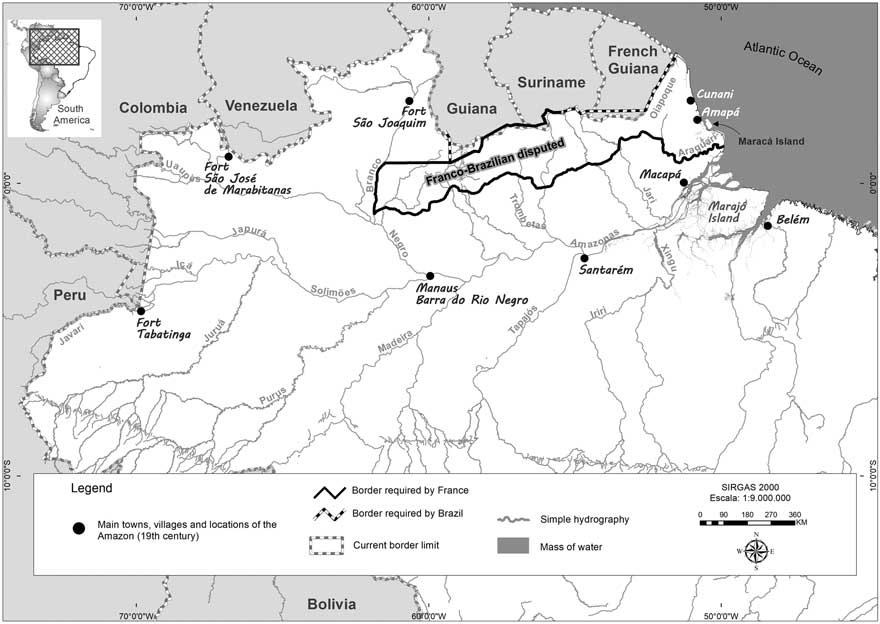
Amazônia in the nineteenth century. Cartography by Luís Augusto Pereira Lima based upon Karte vom Amazonen-Strome 1831 and Carte de la Guayana as well as maps by the Instituto Brasileiro de Geografia e Estatística (2016) and the Agência Nacional de Águas (2015).
Labor, approached from a variety of angles, has often held a privileged place among studies of the Amazon. For those who emphasized the role of the Portuguese – usually reaffirming the discourses of the colonizers – work and labor relations were “a problem to be solved”, in which nothing that was tried appeared to fit the civilizing project. In these analyses, the state and its administrators occupied a central position, and everything and everyone else, including other social actors and their material and symbolic ways of life, were seen in the light of government decisions.
Over the last three decades, however, the analytic scope of studies about the Amazon has broadened significantly by accessing individual and collective experiences that earlier studies, focused on macroeconomic and political structures, had not examined. Methodologies from social history, in dialogue with anthropology and other disciplines, have not only offered important revisions to conventional views, but also expanded the range of subjects and sources and offered new interpretations.
This shift in the historiography has sparked interest in Amazonian workers themselves, an interest that extends beyond the study of the type of worker considered “typical” for each period. Initially, in the case of Indians, scholars focused on the long history of legal devices employed by the state to justify and regulate access to the indigenous labor force. Regarding Africans, scholars sought to determine the importance of enslaved labor in an economy that was primarily centered on extraction.Footnote 3 In recent years, they have emphasized resistance to black slavery through flight and the establishment of maroon communities (mocambos and quilombos), while still accounting for the various compromises that might be reached between slaves, masters, and the wider Brazilian society that was fundamentally built on slavery.Footnote 4
Still, notwithstanding the important contributions made by studies of indigenous and African workers and the peculiarities of black slavery in the Amazon, much less attention has been paid to the forms, meanings, and conditions of freedom for the free and freed population in general. As most analyses point out, starting in the eighteenth century, the Portuguese Crown assigned distinct roles to Indians and blacks in that society. They granted the former a fragile and conditional freedom, while expecting that the latter would become the “hands and feet” of the region’s elite – something that may have become true in certain locales, but never materialized in the Brazilian Amazon as a whole.Footnote 5
This article analyzes how the actions, conflicts, and setbacks in the process of political, economic, and socio-cultural domination of the late eighteenth- and nineteenth-century Amazon resulted in the subjugation of most of the region’s inhabitants to coerced forms of labor. A central argument is that, despite the use of enslaved African labor and the official prohibition of capturing and enslaving indigenous people, successive laws and the authorities’ interference with daily life deliberately muddled the boundaries between so-called free and unfree labor. Once instituted, such practices opened the way for establishing the legal foundations for coerced labor in the Amazon, which officially lasted into the mid-nineteenth century.
Unfree Indian Labor and African Slavery in the Amazon
With the rise to power in 1750 of Sebastião José de Carvalho e Melo, Marquis of Pombal, as the leading minister to the king, indigenous freedom, African slavery, and export-oriented monoculture came to constitute the core of Portuguese planning for the Amazon.Footnote 6 In light of these new priorities, the Portuguese Crown took three closely connected measures. On 6 June 1755, all forms of indigenous slavery were abolished, and the next day orders were decreed revoking the temporal power of religious orders over the natives and creating the Grão-Pará And Maranhão General Trading Company (Companhia Geral de Comércio do Grão-Pará e Maranhão), whose goals were, amongst others, to promote the importation of enslaved Africans to the Amazon.Footnote 7
Hoping to diminish the economic impact generated by the end of indigenous slavery and, at the same time, to increase colonists’ access to this workforce, however, the governor of Grão-Pará, Francisco Xavier de Mendonça Furtado, drafted a set of instructions that would become the Directorio in 1757, a collection of laws composed of ninety-five paragraphs.Footnote 8 In addition to its preoccupation with work, this Directorio was to serve as a civilizing manual that would ensure the “dilution” of the indigenous element into colonial society.
Although its emphasis on incorporating indigenous people into the colonial project was far from novel, the Directorio created an intentionally ambiguous legal precedent as a response to the ceaseless complaints of colonists about the scarcity of manual labor.Footnote 9 While the prohibition of indigenous slavery was reaffirmed, indigenous people residing in religious missions were nevertheless offered as a workforce, their labor to be divided between the state and private demands. Organized into “corporations”, the natives were compulsorily drafted to work in private service and public works alike, often in places distant from their homes.Footnote 10
Freedom, then, was not the freedom to come and go as one pleased, but was rather more akin to a limited concession that could be curtailed and conditioned at any time. To exercise it, the Directorio argued, Indians needed to learn to be “useful to themselves, to residents, and to the state”.Footnote 11 To resort to this work force, it was enough that colonists, and even indigenous village leaders (called principais), argued that the coerced indigenous labor was “indispensable” to them. Of course, in practice, everything happened far more arbitrarily, especially when we observe the relationship between the Indians, on the one hand, and the public authorities and colonists on the other.
However, even if this limited indigenous freedom was to become effective, it was necessary that black slavery was broadly established in the productive realm, thus creating new and potent hierarchical distinctions between slaves and Indians. Thus, African slavery came to be seen as much more than just one of the pillars supporting export-oriented monoculture and was considered as a counterpoint to and essential precondition for indigenous freedom.Footnote 12 Yet, as would become clear by the end of the eighteenth century, the Grão-Pará and Maranhão Company did not exactly achieve its goals.Footnote 13
In August of 1797, Governor Francisco de Sousa Coutinho estimated that there were approximately 30,000 slaves of African origins in Grão-Pará.Footnote 14 This number was far higher than the estimates of historiographic studies realized in 1960s and 1970s which calculated a number of 15,000–18,000 enslaved people imported by the Grão-Pará And Maranhão Company between its founding and 1778, the year in which its trade monopoly expired.Footnote 15 However, the fact that the company still remained active for a few decades, along with the existence of private slave trafficking routes, suggests that Sousa Coutinho’s estimate might have some validity for the number of enslaved Africans who entered Pará, even if they did not remain in the colony long term.Footnote 16 Still, the governor asserted that for the trade to recover from the “deplorable state of abandonment to which it has been reduced these last three years”, it would be “urgently” necessary to double the number of slaves, something that would also enable continuity in their transfer from Pará, southward to Mato Grosso and Goiás.Footnote 17
Thus, at the end of the eighteenth century, Indians remained the primary workforce available in Amazônia. And all the abuses historically related to forced indigenous labor, rather than being eliminated by the regulations of the Directorio and the incentives for the African slave trade, ultimately persisted. In the face of this, in 1797, Governor Sousa Coutinho abolished the Directorio under the allegation that the greed and corruption of the so-called directors of indigenous settlements (diretores de aldeamento) had spoiled the assimilationist ambitions of the reformist political project undertaken under the Marquis de Pombal.Footnote 18 Coutinho proposed new mechanisms for incorporating indigenous people into colonial society, through his “Plan for the Civilization of the Indians of Pará”, in which their freedom was reaffirmed even as their obligations were expanded.Footnote 19
Unfree Labor and Militarism in the Early Nineteenth Century
Governor Coutinho’s proposals would become law in the Carta Régia of 1798, a document most known for replacing the Directorio, although it has also been recognized for its attempts to accelerate the transformation of Indians into colonists, assigning them specific positions in the world of labor and the military hierarchy.Footnote 20 Indeed, the Carta makes this association between labor and military service explicit from the beginning, when it orders that all Indians living in colonial cities, towns, and indigenous settlements be enlisted into “Militia Corps” (Corpos de Milícias). Some of these would be selected for the “Effective Corps of Indians” (Corpos Efetivos de Índios), which would be dedicated preferentially to royal service; others would be assigned “agreed upon” work for public service contractors or other private parties; and still others would be destined for a “Company of Fishermen”.Footnote 21 Moreover, the Carta added a fundamental innovation to previous indigenous policy by imposing compulsory service on the entire free, non-white population, including blacks, mamelucos, and cafuzos.Footnote 22
All this was to be made possible through a complete census of the inhabitants of each town and city. Thus, on 6 January 1799, Sousa Coutinho issued the “Instructions to Be Circulated Concerning the Formation of New Militia Corps”, through which he fulfilled the royal order that all Indians living “promiscuously with other [vassals]” in Pará be organized into militias, called the Light Troops (tropa Ligeira).Footnote 23 After the militias, the Carta Régia ordered the creation of the “Effective Corps of Indians”, which, despite the name, would preferably enlist “the freed blacks and mestiços while they are available, as [they are] the most robust and capable of tolerating work”. The corps would use as their model the auxiliary Infantry Companies (Companhias de Pedestres) established in Mato Grosso and Goiás.Footnote 24
To avoid conflicts over the distribution of this labor force, the Carta defined priorities. Recruitment should avoid hampering the “transport of wood and other services in which the Indians are usefully employed”. This exception aside, the Effective Corps of royal service could use men from the militias at their discretion to carry out its tasks. In exchange, Indians – most notably the oarsmen working on the numerous river boats – engaged by public contractors could not be drafted for any other public works, or to serve in the militias. Yet, this rule applied only to a limited number of indigenous persons, to be decided by the Juntas da Fazenda (administrative councils from the era of Pombal responsible for overseeing public expenditures, contracts, and works) or by the Câmaras (town councils).Footnote 25 If needed, a limited number of Indians could be recruited by judges at the request of public contractors who had not managed to hire oarsmen of their own. Finally, any person – especially colonists and property owners – had a right to the labor of those natives who they managed to “take out of the forest”, with the only condition being that they educate them and instruct them in the Christian faith.Footnote 26
The Carta Régia delegated powers to civil authorities (city councils and judges) and to military officials alike. In so doing, it set the stage for disputes over who ultimately commanded the conscripted workers and militiamen.Footnote 27 Similarly, the Crown incentivized direct agreements between private individuals, public contractors, and Indians without prior authorization. The document thus expressed the ambition that no poor man, free or freed and physically capable of work, could escape the control of the state or remain “unemployed”.
For a majority of the Amazon’s population, the Carta Régia did not simply maintain the old practices of unfree labor that the Directorio had supposedly regulated. Rather, it represented a virtually unlimited expansion of the right of any civilian, military, or state-sanctioned private authority to exploit the involuntary labor of Indians, blacks, and mestiços. By leaving undefined the “concepts of freedom and servitude, free will and dependence”,Footnote 28 the Carta Régia institutionalized an era of rampant coerced labor for the impoverished free and freed people of the Brazilian Amazon. Although the needs of the military offered the initial legal reasoning, over the course of the nineteenth century, this would be replaced by openly socioeconomic and racist justifications.
Thus, the combination of socioeconomic criteria – like type of property, income, and type of work – and socio-racial designations as established by the Carta Régia, cleared the way for an interlocking set of qualifications that made the forced use of people for labor tasks unquestionable. In the case of the Indians, the idea was to punish “their natural inclination to sloth and inaction”, but also to provide “justice” to those who settled down to farm on their own. In this case, the natives would only be “exempt from all personal work, once the value of the tithe paid on the crops cultivated exceeds the wages they would receive”.Footnote 29
Such measures consolidated the modern basis for widespread coercive labor in the Amazon, whether for public or private ends. This system served both the military interests and the territorial aspirations of the Portuguese Crown, but it also provided ways to organize and gather a labor force at strategic points throughout the Amazon Basin. Thus, at the start of the nineteenth century, the region had become a place where any type of unauthorized free labor could be officially denounced and punished.Footnote 30
In the years 1819 and 1820, shortly before the “peculiar” independence of Brazil in the form of the Brazilian Empire, the Bavarian naturalists Johann Baptist von Spix and Karl von Martius spent eight months traveling inland from Belém, the port city that was Grão-Pará’s capital, to the present-day border with Colombia.Footnote 31 By then, they reported, recruitment for involuntary labor was being carried out throughout the Amazon. “Several times each year”, they wrote, “entire bands of young Indians were removed from their villages in the interior and on Marajó Island and sent to Belém, where they received a daily wage of three vinténs,Footnote 32 in addition to food and lodging”. They were employed in fisheries, public works, shipyards, and arsenals, in addition to serving as porters and, most often, oarsmen, which required vigilance and patience, because they frequently fled, “leaving the boat and its passengers in quite a predicament”.Footnote 33
When passing through Barra do Rio Negro (today Manaus), in the western Amazon, Spix and Martius again observed the use of forced recruitment for a wide variety of tasks. In addition to “policing and guarding public buildings” in town and serving in the forts at Tabatinga, São José de Marabitanas, and São Joaquim, the recruits were required to carry out tasks that facilitated trade and other economic activities. Among these were “patrols against hostile Indians” and the supervision of areas where turtles were found.Footnote 34 They also carried out “expeditions with the goal of bringing Indians to the towns”; that is, forced resettlements, and they accompanied travelers to the interior in search of “natural products”. Others worked on government-owned livestock ranches along the Rio Branco, and any recruit could be requested and “paid separately” for private services.Footnote 35
In the 1830s, however, the royal government of the postcolonial Empire decided to drastically reduce the size of the military throughout the country in response to the instability that occurred after Pedro I’s abdication, a step that directly affected recruitment for regular and auxiliary troops throughout Brazil.Footnote 36 On 22 August 1831, the Regency dissolved the Light Militia Corps, which had been created by the Carta Régia of 1798 and had served as one of the main sources of coerced labor in Grão-Pará.Footnote 37 Nonetheless, the situation of Indians, blacks, and mestiços did not improve. The continuation of various forms of oppression along with other political and social conflicts, would combine to create the largest popular revolt the region had ever seen – an event that had direct and profound effects upon Amazonian worlds of labor.
The Workers’ Corps and Widespread Coerced Labor
The 1835–1840 Cabanagem Revolt, a mass uprising with widespread popular support that challenged both local elite and Brazilian imperial rule in Grão-Pará, would have long-lasting effects on local society, including labor relations. A sizeable literature exists on the multiple causes, the protracted course, and the varied social actors involved in the revolt.Footnote 38 In this context, it seems important to reiterate that its human and material costs fell disproportionately upon people of color.Footnote 39 In the short term, imprisonment and execution killed tens of thousands, but the revolt’s effects on the lower classes would last far longer, particularly through a restructuring of the mechanisms through which elites ordered society and compelled the population of color to work. Some of the most important of these mechanisms were the so-called Workers’ Corps (Corpos de Trabalhadores).
Created by Provincial Law 2 of 25 April 1838, under the provincial president (the equivalent of a governor), Francisco Jozé de Souza Soares de Andrea, the corps brought together Indians, mestiços, and free and freed blacks who did not own property or have full-time employment.Footnote 40 At the same time, “all white men capable of bearing arms” between fifteen and fifty were to be drafted for police service, as well as the “men of color” who owned property that could be used to supply them and their families during their absence.Footnote 41 Once these socioeconomic and racial exceptions and preferences had been observed, “all men of color age 10 and up” could then be drafted to form the Workers’ Corps.Footnote 42
The Workers’ Corps were explicitly conceived as a measure taken by a militarized state to contain and restrict the classes it considered responsible for the “anarchy” and “harm” of the Cabanagem, and several of the scholars who studied the revolt would later reaffirm this dimension.Footnote 43 More recently, however, other analyses have highlighted the connections between the nineteenth-century Amazonian context and the institution created by Soares de Andrea with the national issues of the same period, including the debates about initiating the “transition from slave to free labor”, discourses that valorized regular work as morally edifying, and official strategies designed to combat vagrancy (vadiagem).Footnote 44
However, it is also possible to understand the Workers’ Corps as the pinnacle of a century-long official policy of drawing on coerced labor, starting with the Directorio of the mid-eighteenth century, and instituted through both legislation and everyday practices created and perfected with this goal in mind. Since the mid-eighteenth-century Pombaline era, the idea of freedom conditioned by and for work shaped the policies of successive governments, who were not simply permissive with regard to various forms of slavery and coercion, but were effectively committed to guaranteeing a labor supply for public and private projects. Thus, various changes in society were reflected in laws governing coerced labor, always with a tendency to extending it to other groups beyond those defined as Indians.
The relationship between Francisco de Sousa Coutinho and the Directorio is clear, as the 1798 Carta Régia was the direct result of his attempt to substitute the former. However, the connections between the Carta Régia and the Workers’ Corps are less obvious, due to the ruptures caused by the Cabanagem and the repressive fervor of Soares de Andrea as he pacified Grão-Pará. But, as can be clearly seen in Table I, neither Sousa Coutinho, nor Soares de Andrea truly broke with the fundamental principles of compulsion in the Amazon; rather, both affirmed them.Footnote 45
Comparison of the organization of coerced labor in the Brazilian Amazon between the eighteenth and nineteenth centuries
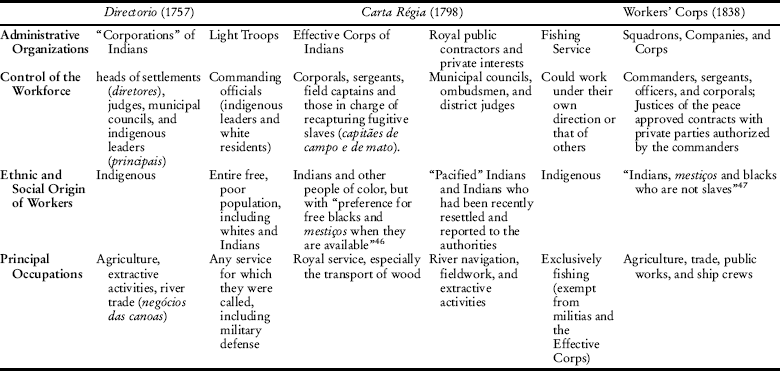
But significant changes also occurred as a direct result of the peculiarities of Soares de Andrea’s vision of militarization: One of the most important was the 1838 law’s clear attempt to distinguish the “dignity” of the military corps from the ignominy now attributed to those subjected to coerced labor. Coerced labor, once justified as a due complement to the supposed equality of all the king’s vassals, was ultimately turned into a dishonor and punishment, a suitable burden for the indolent, with their “miserable” racial and social characteristics.
The Cabanagem-era policies surrounding coerced labor also attempted to end disputes among the authorities over control of the pool of available labor. Indeed, Soares de Andrea stated as much in his final report at the conclusion of his time in office: “[A]ll the military commanders are at the same time also commanders of the police and Workers’ Corps.”Footnote 48 The third article of the law creating the Workers’ Corps also ordered that its commanders and officials be the same as in the “old Light Corps”, and, if these were not available, then it should be “the most qualified citizens” of each district, who would be nominated and receive charters to exercise this position.Footnote 49 In practice, this meant that Justices of the Peace could no longer deploy workers – even in cases in which the Carta Régia of 1798 had permitted them to do so. Instead, they were to restrict themselves to recording and validating the contracts authorized by commanders between private individuals and enlisted workers.Footnote 50
In 1846, traveler William H. Edwards noted a great fear amongst the riverine communities near Belém that especially the men were likely to be drafted for coerced labor into the military and police forces.
During the last few years, the enrollment of Indians has been carried to an unprecedented extent […]. Since 1836, ten thousand young men are said to have been carried to the south, to the incalculable injury of the agricultural interests. As might be supposed, all this enlistment has not been voluntary. The police are constantly upon the alert for recruits, and, the instant that a poor fellow sets foot within the city, he is spirited away, unless some protecting white is there to intercede in his behalf. We frequently fell in with cottages in the vicinity of the city, whose only occupants were women and children, the men having, in this way, disappeared. Most of the market boats, also, are managed by women, the men often stopping at some convenient place above, and there [hiding and] awaiting the boat’s return.Footnote 51
The “free negroes”, according to Edwards, were also “very apt to be caught in the same trap” of recruitment. After they were caught, the daily lives of recently recruited Indians and blacks were divided between training and imprisonment until, “the principles of honor therein imbibed, and the ardor of military glory excited”, they became sufficiently trustworthy to be let loose, or too worn down and exhausted to desert. Edwards added that “most free negroes” resorted to becoming or pretending to be property, to escape what they saw as a worse fate. Thus, many continued “nominally still belonging to their old master, or some other willing protector”.Footnote 52 The consent, however, which Edwards observed among black workers might actually point to the opposite: perhaps enslaved, free, and freed blacks were being forced to work under the threat that refusal would result in their being handed over to the recruiters.
In the Lower Amazon, prison and violence were used in areas where black slaves were scarce, and Indians were “difficult to catch” and “slippery when caught”. Desertions, Edwards thought, were treated too harshly by the authorities, and the punishments for captured fugitives might include up to 300 lashes, with a whip known as “cat”.Footnote 53 Still, flights continued. This often affected travelers, for it was common for the Indians forced to accompany them to escape as soon as they could, even leaving behind their personal belongings.
Forced recruitment led to significant criticism in the press and in sections of the middle and upper classes. It was also overwhelmingly rejected by the free and freed poor population. All these factors, combined with the insufficiency of voluntary enlistment, deeply concerned the authorities, who were most interested in forming well-trained, specialized, and professional troops. As a result, the solution they found was the Empire’s extension of military recruitment to children and young men from ten to seventeen, through the creation of Navy Apprentice Companies (Companhias de Aprendizes Marinheiros) in most of the provincial capitals.Footnote 54
Concomitant with the search for alternatives given the scarcity of new recruits in both the Navy and the Army, the authorities were also interested in keeping the sons of the popular classes occupied, arguing that this would prevent vagrancy and crime and instill in them discipline, morality, and a strong work ethic. Therefore, although minors could be placed in the Apprentice Companies by their parents or a legal guardian, most of them were recruited in a similar way to the adults: that is, after being “gathered up” by inspectors and officials. If they passed the aptitude tests, they were required to serve twelve years before becoming eligible for discharge, and only after sixteen could they receive a conditional discharge, with a right to a pension paying half the salary they had last received, although they could be called back to active duty if the need arose.Footnote 55
There were intrinsic relationships, both direct and indirect, between the various types of forced recruitment and the worlds of labor all over Brazil. Independent of the immediate motives of the authorities – filling the ranks, discouraging laziness, increasing social control, or punishing crime – the accusation that someone was resisting work was enough to make freedom precarious for the “free”, especially when combined with poverty and ethno-racial distinctions. This could happen in many ways, one of the most important being through laws and practices that maintained most of the free and freed population permanently eligible for recruitment. In many cases, the simple threat of forced service was enough to blackmail and intimidate the less fortunate. At the same time, for those for whom flight was not an option, many of the personal arrangements formed under such pressures could have a certain protective effect, even if they were manifestly unequal: They enabled workers to gain allies against the more aggressive and abusive “recruiters” roaming the country.Footnote 56
Although it was in perfect keeping with nineteenth-century Brazilian principles of compulsory military service and labor, the Workers’ Corps quickly became a target for criticism due to the excesses committed by its commanders, including using the workforce to serve themselves and their friends. Others argued that the institution incentivized flight and desertion among the free and freed population. In September 1858, ten deputies from the Pará Legislative Assembly introduced a bill to abolish the Workers’ Corps. Their proposal, however, was rejected.Footnote 57 The next year, the provincial president, Manoel de Frias e Vasconcellos, submitted a plan to the Assembly to completely reform the Corps and create municipal police forces.Footnote 58 However, a surprising turn of events came barely two weeks later: On 18 October 1859, twelve deputies proposed another bill to abolish the Workers’ Corps in all of Pará.Footnote 59 Three days later, the Assembly issued a highly critical brief on the reforms proposed by Vasconcellos, calling them “an attack on the inviolability of the citizen’s civil and political rights”, and concluding that Law 2 of 1838, which had introduced the Workers’ Corps, should be “repealed as soon as possible”.Footnote 60
Over the following sessions, the deputies exchanged accusations over what might have led some of them to change their minds about the Workers’ Corps, since many who supported this new abolition bill had just voted against an identical one a year before.Footnote 61 Nonetheless, the bill proceeded rapidly through the Assembly, and in less than one month it was sent to the provincial president, Antonio Coelho de Sá e Albuquerque, who signed it as Law 330 of 15 November 1859. Its single article ordered that “the Workers’ Corps be abolished, with all laws and orders to the contrary repealed”.Footnote 62
In an official communiqué to the Minister of Foreign Affairs, Albuquerque put himself at the center of this turn of events reporting that, since taking office, he had pressured the Assembly to repeal the Workers’ Corps law. According to the president, the enlistments caused so many “clamorous complaints from the less civilized and well-to-do population”, that they chose to abandon “the capital and nearby towns in favor of the [northern] region of Amapá, thus preferring to serve the interests of the French and harm those of the Brazilians”.Footnote 63 This geopolitical dimension was indeed an important additional factor and the abolition of the Workers’ Corps was a decision taken between the provincial president, the deputies, and the Ministry of Foreign Affairs of the Empire to counter French interests in the long-standing dispute over the border between Brazil and French Guiana.Footnote 64 As the authorities came to realize the considerable disadvantage at which they were placed in attempting to gain the trust and sympathy of escaped slaves, deserters, and others in the disputed region, they decided to give in. Shortly after the abolition of the Workers’ Corps, Albuquerque published in the press the repeal of the law of 1838.
While the abolition of the Workers’ Corps applied to the whole of Pará, the article came together with a letter that was exclusively addressed to the population of the contested region, in which he guaranteed the right to free movement to everyone coming from Amapá. The article, published in the Gazeta Official newspaper, said that the authorities of the cities of Macapá and Belém were flatly prohibited from recruiting any “individual who comes from the northern coasts”, as long as he came to trade, or if he was employed “in fish salting, in the extraction of rubber and oil, or in the gathering of cacao, Brazil nuts, etc”. To qualify for this exemption, residents of Amapá needed only to present themselves in either of these cities, where they would receive a guide, with whom they could “enter and exit at any port, river, or lake, with no further requirements and with no fear of difficulties”.Footnote 65 The only exception was for smugglers, who would continue to be subject to punishment. Furthermore, the article emphasized that Amapá’s workers and merchants would increase their profits and benefits by negotiating directly with Belém, while this city and its surrounding area would be able to obtain more merchandise at lower prices.
Thus, the conjunction of two factors led to an acute crisis that resulted in the rapid disappearance of the Workers’ Corps: Firstly, there was Brazil and France’s diplomatic quarrels over a vast area in the far north of the Amazon. Secondly, and more importantly, the constant flights, desertions, and several forms of political, social, and economic mobilization involving the free poor, indigenous, and enslaved population. The authorities had been constrained, pressured, and certainly surprised by the actions of subaltern people in such a way that, when the representatives of the Brazilian state realized what was at stake in 1859, the result was the collapse of the last official tool for recruiting forced labor in the Amazon.
Conclusion
The debates over free and unfree labor have sought to problematize the epistemological boundaries that separate these categories, as well as the chronological divisions that such boundaries have generated. According to older interpretations, slavery and other forms of unfree labor disappeared or diminished in importance in the wake of capitalism’s ascendance as the globally dominant economic system. This article, however, by demonstrating the coexistence of and even interdependency between freedom, slavery, and coerced labor in the nineteenth-century Amazon, adds to the growing body of literature that points out that these categories are not quite as opposed, schematic, or exclusive as has been previously assumed.Footnote 66
Within this larger picture, however, the conditions in the nineteenth-century Amazon were specific, as the dilemmas between free and unfree labor were related to two of the most long-standing problems for elites – the difficulties in accessing enslaved African labor and the supposed scarcity and excessive autonomy of the “free” workforce. As this article has shown, once the enslavement of indigenous peoples was terminated, the expectation was that this would lead to an increase in the number of African slaves whose labor would then allow for the remaining subjects to help occupy the vast territory of the Amazon. However, this move towards incorporating the Indians into Luso-Brazilian society did not signify that pressures to carry out labor tasks for the colonial economy abated. Over the course of centuries, one way or another, whether legal or illegal, unfree indigenous labor became established as a rule and indeed a fundamental part of the regions’ economy.
In the nineteenth century, this was aggravated by a political project full of ideological vigor: The focus on repressing vagrancy and using work as a tool of social control had profound implications not only for the type of freedom that Indians supposedly enjoyed, but also for poor freemen, freedmen, and mestiços. For those who were not enslaved, freedom was threateningly precarious.Footnote 67 The effective possibility that the poor might reject economic dependency, choosing to survive from the resources of the forests and rivers or banding together to deny or elude a status quo based on domination and exploitation, exerted a profound influence on laws permitting coerced labor.Footnote 68 To prevent or defeat alternatives for the lower classes, the Amazon’s economic and political elites reinforced mechanisms of immobilization and compulsion.
The 1859 repeal of the Workers’ Corps law in Pará offered hope for an enormous segment of the population that had been submitted to a long tradition of coerced labor. However, during the rise of the Amazonian rubber boom in the second half of the nineteenth century, other forms of unfree labor would develop in the far reaches of the forest, based on debt peonage, intimidation, and other mechanisms for “retaining” labor.Footnote 69 Free and unfree labor in the Brazilian Amazon were reinvented yet again, this time to meet modern capitalist industries’ demands for primary resources.
Translation: Bryan Pitts



