This report was the first to be prepared by the UCLA-based team of co-editors that took over leadership of the Review in July 2007 from Lee Sigelman, who had edited it for the previous six years. Here we report on the journal's operations during the year from July 1, 2007, to June 30, 2008, including both decisions made during the early months by Lee, as he closed up shop, and those made by the new team. Because revisions often take authors many months to complete, the time span between original submission and final acceptance of an article can be long. As a result, the issues of the journal published between mid-2007 and mid-2008 owe at least as much to Lee as they do to us—indeed, of the articles accepted during those 12 months, 83% either had been accepted by Lee or came to us as revised versions of papers he had initially handled, almost all of which we accepted. So our first task is to acknowledge the extremely important contribution Lee made to the publication in this transitional year, even as he was beginning a well-deserved rest. We are grateful to Lee for all his help, and our respect for his management skills only increases with time.
Besides Lee, many others made vital contributions to the Review's operations last year. We would like to thank: senior editor Joseph Riser; last year's cohort of editorial assistants or “EAs” (Sarah Leary, Rebekah Sterling, and Kristen Kao, who joined us mid-year); professors Ken Schultz and Liz Gerber, who helped fill a temporary gap by joining us as half-time co-editors for the second half-year; the members of the Review's Editorial Board; the always helpful staff at APSA's national office and at UCLA (in particular, Cindy Love and Brett Nighman); the UCLA administration, which made a major contribution to the journal's budget; the authors who submitted their papers; and the reviewers who donated their time, expertise, and good will to assessing these submissions.
SUBMISSIONS AND PROCESSING
The Number of Papers Submitted
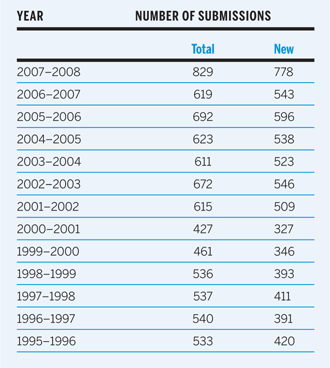
The 2007–08 year witnessed a dramatic jump in the number of submissions. New submissions came to 778, an increase of a little over 30% compared with the last previously reported full year (2005–06)Footnote 1. Total submissions—which include also those manuscripts resubmitted after revisions—were also higher, at 829. Our best guess is that the web-based submission system that was introduced concurrently with the change in editorship in July 2007 accounts for the jump in submissions, in part because it makes it easier for scholars from other countries to submit to the Review. As can be seen from Table 1, submissions had been increasing, albeit at a slower pace, in previous years.
Submissions per Year

Turnaround Times
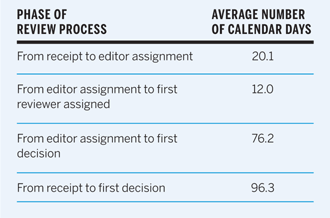
Transitioning to a collegial system of editing at the same time as switching to a web-based editorial system presented challenges. As can be seen in Table 2, the average processing time for manuscripts from receipt to first decision in 2007–08 was just over three months. (We caution that this figure cannot be compared directly to the turnaround times in previous reports, since previous practice was to provide the median rather than the mean and to measure the time in working days rather than calendar days. Our best estimate is that our median time from receipt to first decision in working days was 68, compared to 45 in 2005–06.) We are working to speed up processing wherever possible without sacrificing quality.
Elapsed Time in Review Process, 2007–2008

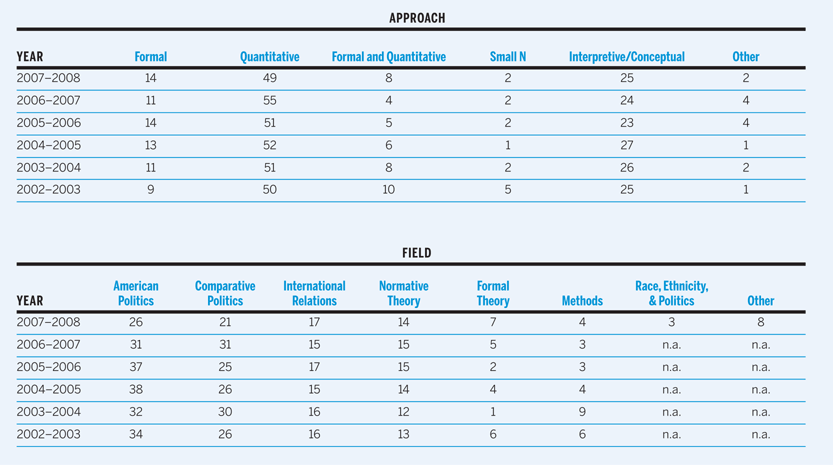
Distribution of Papers Submitted (%)

In particular, we have been trying to reduce the initial delay between receipt of manuscripts and their assignment to co-editors. This is the period during which our editorial assistants conduct technical checks on the manuscripts (for instance, making sure that they meet length requirements, that all graphs and figures referred to are actually there, and that they are properly “blinded”) and research a preliminary list of possible referees, which the handling co-editor then consults in making decisions on what referees to invite. Faced with the large increase in submissions—much of which came in a massive burst in the first months—we found ourselves under-budgeted for editorial assistants, which meant that the backlog of several weeks that emerged in our first month of operations proved very difficult to reduce. With APSA's help, including money for additional EAs, we have begun addressing the problem. The total time from receipt to first decision was lower in the second half than in the first half of the year. A less tractable problem, which we know we share with other journals, is growing “reviewer fatigue,” which becomes most problematic when a series of potential referees all decline (often after significant delay) to review a given paper.
The Mix of Submitted Papers
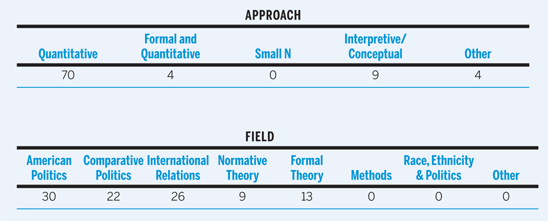
Categorized by primary analytical approach, the mix of papers submitted this year was quite similar to that in the last reported full year. Seventy-one percent used either formal modeling, quantitative methods, or both, compared to 70% in 2005–06. A quarter of the submissions used approaches classified as interpretive or conceptual. As in the past, the review continues to receive very few papers conducting small-N comparisons. Not too much significance should be attributed to small differences across years in these figures, since many papers could reasonably be classified in different ways.
In the classifications by sub-field, we added the two new categories this year, Race, Ethnicity, and Politics and Other, for papers that lie beyond the bounds of any of the traditional sub-fields. Moreover, submitting authors now choose their category, whereas previously the editor or editorial assistants did the classifying. This makes it somewhat difficult to compare the proportions across years. There was probably a decrease in the share of submissions in American Politics, and perhaps a smaller decrease in Comparative Politics. However, since many of the papers now classified under Race, Ethnicity, and Politics and Other might under the previous system have fallen under American Politics or Comparative, the change may be more apparent than real.
OUTCOMES
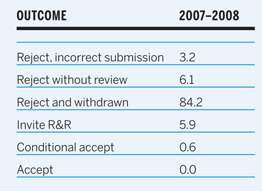
The outcomes of the review process show considerable continuity with previous reported years. The proportion of papers rejected after full-scale review was 84.2%, very close to the figure of 83.6% in 2005–06. Slightly fewer than 6% were invited to revise and resubmit, compared to 7.2% in the last reported year. (Within the year, the dynamic increased, with revise and resubmit invitations being given out slightly more frequently in the second half-year.)
Outcome of the First Round of the REview Process (%)

The mix of papers accepted during the year is shown in Table 5. We note with some concern the high acceptance rate (compared to the submission rate) for papers using quantitative methods and the relatively lower acceptance rate for interpretive or conceptual manuscripts. However, we would repeat Lee Sigelman's customary warning on interpreting such figures: “I would caution against making too much of annual fluctuations, which are subject to the idiosyncrasies of fitting complex papers into simple categories and the small number of cases on which these percentages are based,” and would reiterate that five-sixths of these acceptances were in fact “inherited” by us from Lee. Contrary to popular perception, the rates for different categories tend to vary quite significantly from year to year. In the last previously reported full year, for instance, the imbalance was in the opposite direction—conceptual/interpretive papers were accepted at a rate much higher than the rate of submissions. At the same time, because of the long lead time between initial submission and final acceptance of revised manuscripts, the acceptances in any given year reflect in large part editorial decisions made many months earlier, and can be sensitive to random clusters of high-quality submissions of particular types. We have, nevertheless, been reviewing our practice carefully to ensure that papers in all categories are given scrupulously fair consideration.Footnote 2
Distribution of Papers Accepted 2007–2008 (%)

We continue to refine our collegial editorial model but are convinced it yields better (or, at any rate, fuller) suggestions for revision, as well as published articles that are more accessible to a broad range of the profession. It is also more work, and at the same time more rewarding, than we had imagined.