


Introduction
Persistent challenges with clinical trial enrollment and retention limit the extent to which scientific discoveries are translated into clinical and community practice for real-world benefit. Enrollment barriers, including limited awareness, skepticism, mistrust, concerns about privacy, and logistical burdens, reduce participant numbers, compromising statistical power and generalizability [Reference Gul and Ali1–Reference Treweek, Pitkethly and Cook3]. Reviews of randomized controlled trials (RCTs) indicate that only 56% to 63% of clinical trials, enrolling patients across a range of health conditions, successfully meet their target enrollment goals [Reference Walters, Bonacho Dos Anjos Henriques-Cadby and Bortolami4,Reference Jacques, Ahmed and Harper5]. RCT discontinuation is common, with poor recruitment as the predominant reason [Reference Kasenda, von Elm and You6]. Even after enrollment, logistical and procedural barriers, along with study-related burdens and ineffective communication, frequently undermine participant retention. High attrition rates compromise data integrity, threaten the validity and generalizability of study outcomes, and contribute to delayed timelines and increased costs [Reference Gul and Ali1,Reference Al-Shahi Salman, Beller and Kagan7,Reference Robinson, Dennison, Wayman, Pronovost and Needham8]. Effectively addressing these intertwined challenges is essential to enhance the quality and efficiency of translational research and to accelerate the translation of scientific discoveries into meaningful clinical applications. Building trust and mutual understanding between researchers and potential participants is key to increasing research engagement [Reference Tran, Cormier and Hopwood9,Reference Ledford, Williamson and Whisenant10].
Accordingly, the U.S. National Institutes of Health’s (NIH) National Center for Advancing Translational Sciences prioritizes community engagement to improve clinical trial participation and increase the speed with which novel approaches are translated to practice [11].Community engagement is a required component for Clinical and Translational Science Awardees (CTSAs) [12]. The CTSA Consortium Community Engagement Key Function Committee Task Force on the Principles of Community Engagement describes community engagement as a continuum of community involvement, from outreach to consultation to involvement to collaboration to shared leadership [13]. The most common approach to community engagement among CTSAs is the convening of a community advisory board (CAB) that advises specific projects or provides guidance to research leaders at the institutional level. In a 2011 survey of CTSAs across the United States, 89% of CTSAs reported having a CAB [Reference Wilkins, Spofford and Williams14], Traditionally, CABs follow a consulting model [Reference Yonas, Aronson and Coad15], engaging CAB members as consultants on projects or review boards [Reference Stewart, Boateng and Joosten16]. However, previous content analysis and scoping reviews demonstrated limited effects of CABs within CTSAs, such as inconsistent alignment with local needs [Reference Patten, Albertie and Chamie17].
Substantial evidence, particularly through review methods, supports the use of community engagement in clinical and translational science [Reference Julian McFarlane, Occa, Peng, Awonuga and Morgan18,Reference Brockman, Shaw and Wiepert19]. However, a 2022 systematic review showed decreased enactment of community engagement in selection of study questions, recruitment of subjects, delivery of intervention, qualitative interpretation of findings and dissemination of results [Reference Julian McFarlane, Occa, Peng, Awonuga and Morgan18]. Moreover, clinical and translational science lacks an empirical basis for recommending a particular level of community engagement over others [Reference Wieland, Njeru, Alahdab, Doubeni and Sia20].
The current study sought to 1) describe the extent to which clinical trials associated with medical schools in the southeastern U.S. utilized specific levels of community engagement (i.e., outreach, consultation, involvement, collaboration, shared leadership [13]) and 2) examine associations between level of community engagement and study process outcomes. Framed by Ray and Miller’s conceptual model for understanding the impact of stakeholder engagement [Reference Ray and Miller21], we focused on intermediate outcomes of engagement, specifically on two measures of efficiency of research efforts [Reference Chudyk, Horrill and Waldman22]. We hypothesized that clinical trials with higher levels of community engagement would have more successful participant enrollment and retention.
Materials and methods
Using manifest content analysis [Reference Kleinheksel, Rockich-Winston, Tawfik and Wyatt23], we examined associations between community engagement strategies and three study process outcomes: total enrollment, time to full enrollment, and retention.
Sampling and data extraction
Rather than sampling published literature, we sampled databases of research studies to enable comparison of studies that did and did not enact community engagement strategies. We identified studies for inclusion through two online databases: ClinicalTrials.gov and NIH’s Research Portfolio Online Reporting Tools Expenditures and Results (RePORTER). In response to the Food and Drug Administration Modernization Act of 1997, the NIH launched ClinicalTrials.gov in 2000 to create an online database of clinical research studies and information about their results [24]. RePORTER is an online database that enables searches of intramural and extramural NIH-funded research projects [25].
Inclusion criteria focused on location of research, dates, and topic of the research study. To build a sample with similar cultural contexts, we sampled studies that were associated with 20 medical schools located in eight states in the southeastern U.S. The schools were selected from a list of the top research universities in the U.S. [Reference Parslow and Roskoski26] We also limited inclusion to studies that were conducted from 2015 to 2019 to reduce the influence of the COVID-19 pandemic on research recruitment and retention. Lastly, we focused on research topics known to have previously implemented community engagement strategies (e.g., cancer, substance use disorders, cardiovascular disease, HIV/AIDS) [Reference Keeler, Idoate and Fitzpatrick27–Reference Sheikhan, Kuluski, McKee, Hiebert and Hawke31].
The research team conducted separate queries in ClinicalTrials.gov and RePORTER to extract studies that met inclusion criteria. For location, schools included: University of Alabama at Birmingham, University of South Alabama, University of Alabama Tuscaloosa, University of Arkansas Medical Sciences, Emory University, Augusta University, Morehouse School of Medicine, Mercer University, Louisiana State University Health Sciences Center New Orleans, Louisiana State University Health Sciences Center Shreveport, University of Mississippi Medical Center, Duke University, University of North Carolina at Chapel Hill, Wake Forest University, Medical University of South Carolina, University of South Carolina, East Carolina University, Meharry Medical College, East Tennessee State University, and Vanderbilt University. For research topics, the ClinicalTrials.gov search followed topic terms: cancer, depression, anxiety, hypertension, substance use disorder, cardiovascular disease, and HIV/AIDS; the RePORTER search included eight relevant institutes as funders: National Cancer Institute, National Institute of Mental Health, National Institute of Allergy and Infectious Diseases, National Heart, Lung, and Blood Institute, National Institute on Minority Health and Health Disparities, National Institute on Alcohol Abuse and Alcoholism, National Institute on Drug Abuse, and National Center for Advancing Translational Sciences.
Researchers then reviewed the study summaries of all extracted cases to verify that studies met inclusion criteria. Researchers excluded studies that: collected data only in states outside the eight Southeastern states of interest (Alabama, Arkansas, Georgia, Louisiana, Mississippi, North Carolina, South Carolina, Tennessee) or only in foreign countries; used pre-existing datasets; were conducted with pre-existing cohorts; or included children. Researchers collapsed the two queries into a single set of cases and deleted duplicate entries. Researchers then identified all ClinicalTrials.gov entries associated with the RePORTER-queried results.
The first author reviewed every case and identified the corresponding peer-reviewed publication that described study methods. The process to identify publications included: reviewing all publications associated with the study in ClinicalTrials.gov; reviewing all publications associated with the study in RePORTER; conducting a PubMed search for the unique identification code registered on ClinicalTrials.gov (NCT number); and conducting a Google Scholar search for the NCT number. From published papers associated with each study, the first author identified the published paper that most comprehensively described the study’s procedures.
Coding procedure
The four authors developed an initial deductive codebook, which included the level of community engagement and descriptive codes (see below). The four authors and the team’s research assistants convened for an in-person meeting to conduct training on applying the codebook. During this meeting, the authors refined codebook definitions and instructions to maximize usability. Next, all coders independently pretested the codebook with a subset of cases and then met to discuss discrepancies and potentially ambiguous codes. Through an iterative process, the team conducted additional pretesting of the codebook with regular group meetings to resolve inconsistencies and refine the codebook. Once the codebook was finalized, the study protocols were divided among all coders.
The final dataset included data extracted from ClinicalTrials.gov and each study’s published paper. From ClinicalTrials.gov, researchers extracted descriptive data such as funder type and study phase. Researchers also extracted the following outcome measures: planned enrollment, actual enrollment, time to enrollment, and number of participants who completed the full study.
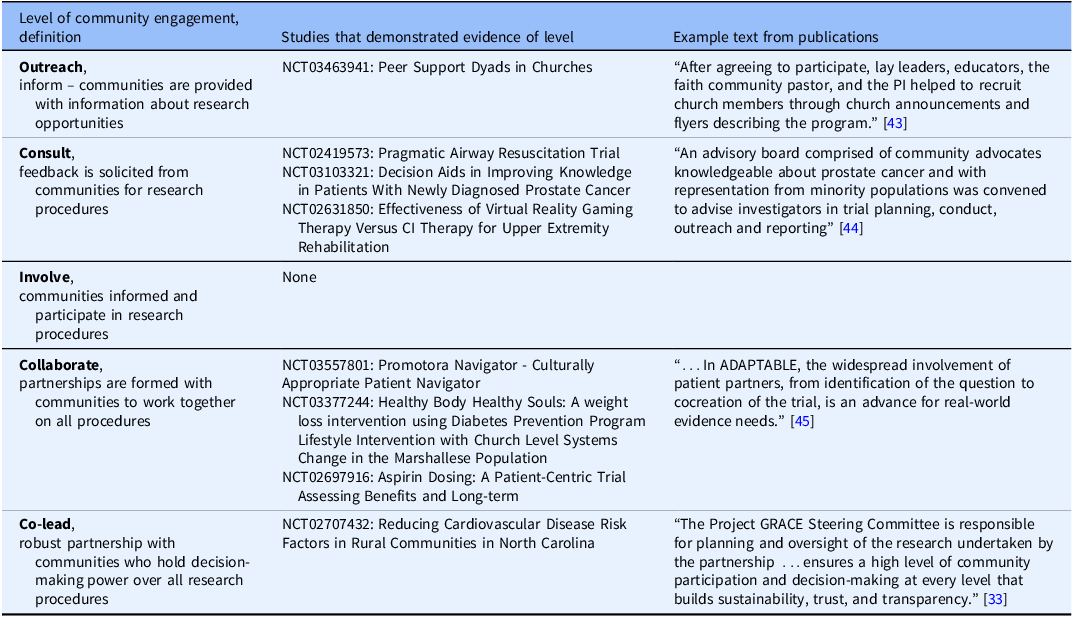
ClinicalTrials.gov does not have a standardized data field for engagement activities so to determine a trial’s level of community engagement, we extracted text from the associated peer-reviewed publications. Researchers read each full published paper and extracted any text that described engagement activities. Of the 16 papers that had any description of community engagement activities, the four authors and a research assistant met virtually to discuss the text describing community engagement activities. The research assistant moderated the discussion and facilitated an online poll process in which the four authors individually rated the study on the CTSA Consortium Community Engagement Key Function Committee Task Force on the Principles of Community Engagement continuum. Table 1 summarizes the levels along the continuum along with definitions of each level. When any disagreement occurred, the research assistant then moderated discussion until the four authors reached consensus.
Community engagement in sample, along the community engagement continuum

Table 1. Long description
In row 1, one clinical trial demonstrated evidence of outreach, describing how researchers worked with church leaders. In row 2, three clinical trials demonstrated evidence of consult, describing how they convened an advisory board. In row 3, no trials demonstrated evidence of involve. In row 4, three studies demonstrated evidence of collaborate, describing how patient partners helped cocreate the trial. In row 5, one trial demonstrated evidence of co-lead, describing how a steering committee had oversight of the research.
During the process, we recognized that publication descriptions of community engagement activities could be constrained by journal word limits. Thus, for all eight cases in which coders identified any description of community engagement activities, the third author reviewed the full protocol posted on ClinicalTrials.gov and compared the community engagement description to that in the publication. In 2 of the studies, details regarding community engagement were described in the publication that were not contained in the protocol posted on ClinicalTrials.gov. In the remainder, the details were consistent between the publication and the protocol.
Data analysis
To characterize the full dataset, we calculated descriptive statistics. To test for non-parametric associations, we created cross tabs and calculated chi-squares. For the primary hypotheses of the association between community engagement and the outcome variables (total enrollment, time to full enrollment, and retention), we calculated analysis of variance. We used IBM SPSS 29 for data management and analysis.
Results
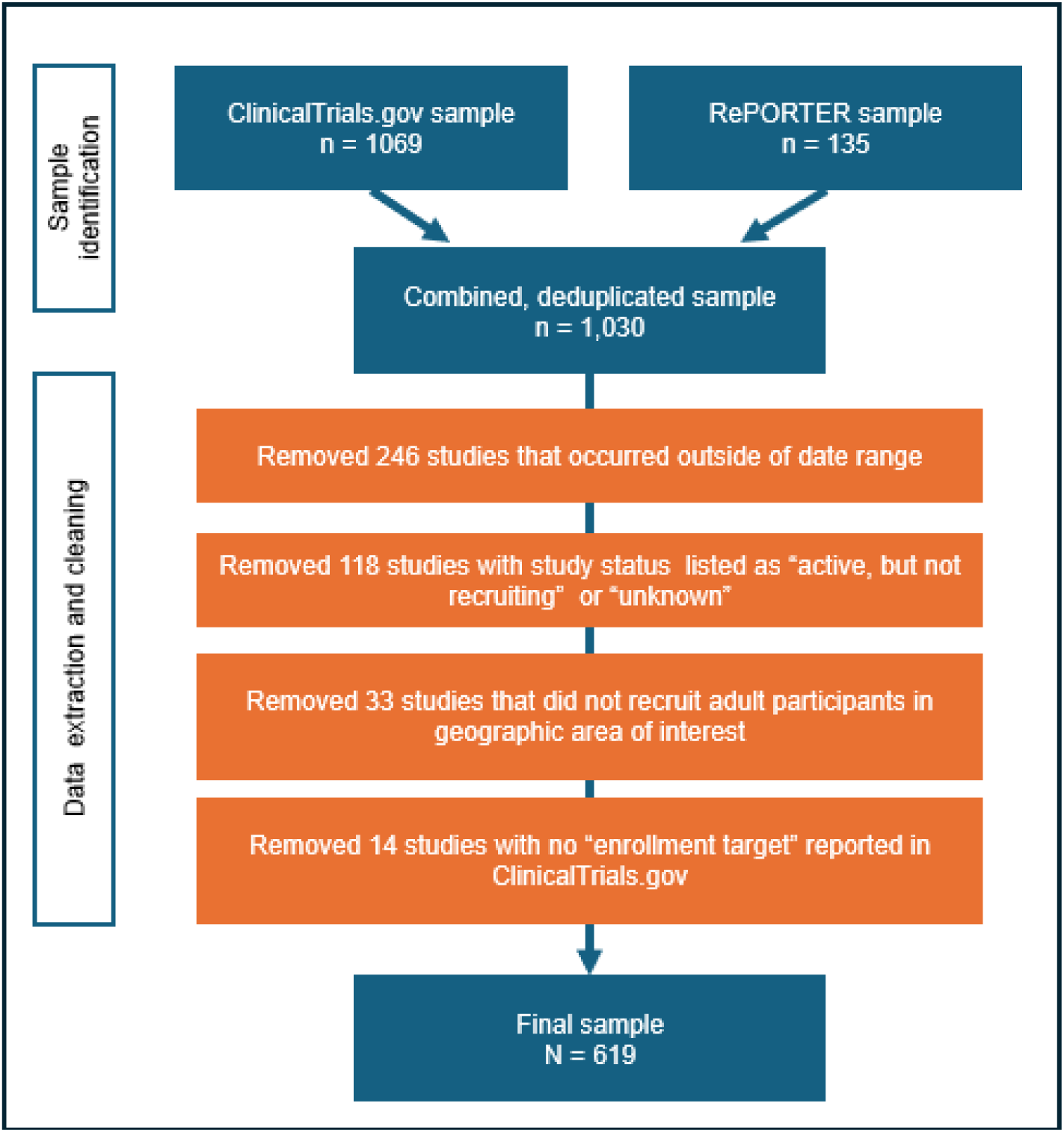
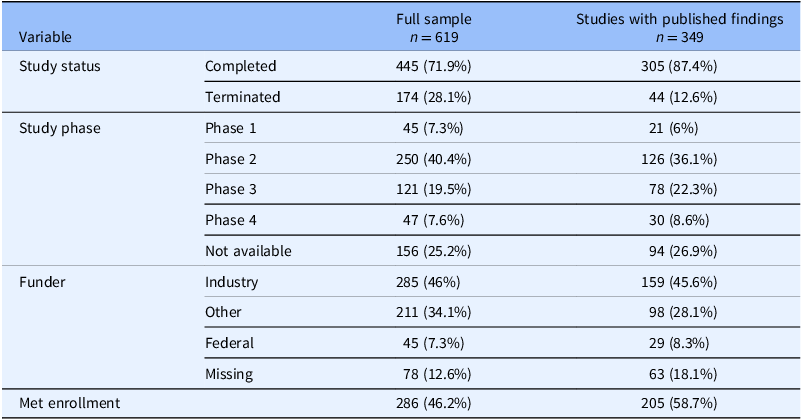
The final dataset included 619 studies. See Figure 1 for the description of the sampling, extraction, and cleaning process. Table 2 summarizes the study characteristics of the sample.
Sampling, extraction, and cleaning process.

Figure 1. Long description
In sample identification, 1069 trials were identified in ClinicalTrials.govm and 135 studies were identified in RePORTER. The combined, deduplicated sample was 1030. Then we removed 246 studies that occurred outside of date range, 118 studies with study status of “active but not recruiting” or “unknown,” 33 studies that did not recruit adult participants in geographic area of interest, and 14 studies that did not have an enrollment target. The final sample was 619 trials.
Sample characteristics

Table 2. Long description
In row 1, 71.9% of trials in the full sample were completed compared to 87.4% of trials in the subsample of those with published findings. In row 2, the greatest propostion of trials from the full sample were Phase 2 trials, with 40.4%. Similarly, of those trials with published findings, 36.1% were Phase 2. In row 3, the greatest proportion of trials were industry funded, with 46%. Similiarly, of those trials with published findings, 45.6% were industry funded. In row 4, 46.2% of trials in the full sample met enrollment, compared to 58.7% of the subsample of trials with published findings.
Of the 619 studies that met inclusion criteria, 286 (46.2%) met enrollment targets. Of the 619, 174 (28.1%) were terminated; 40 study entries specifically named low enrollment as the reason for termination. Of the 619 studies included in the full sample, 349 (56.4%) published findings. Completed studies were more likely to publish findings than terminated studies, χ 2 (1, 619) = 95.15, p < .001. Studies that met enrollment targets were more likely to publish findings than studies that studies that did not meet enrollment targets, χ 2 (1, 619) = 50.59, p < .001.
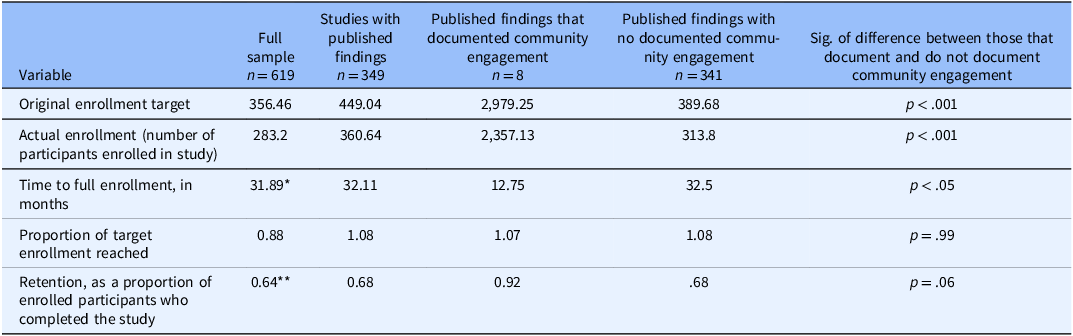
To test the effect of the levels of community engagement, analysis was limited to the 349 studies that published findings. Only eight studies described any community engagement. See Table 1. With this unexpectedly low number of studies that described any level of community engagement, we collapsed the eight studies into one group rather than conducting the a priori plan to test for effect by level of community engagement. Table 3 presents mean differences in the outcomes of interest. As a group, the eight studies that described community engagement had higher original target enrollments (F (1, 348) = 19.29, p < .001), higher actual enrollments (F (1, 347) = 30.58, p < .001), and shorter time to full enrollment (F (1, 203) = 5.58, p < .05) than studies without any description of community engagement in their associated publications. An analysis of variance did not detect a significant effect on proportion of target enrollment achieved or retention, though the analysis for retention approached significance (F (1, 345) = 3.56, p = .06), with a trend in the expected direction.
Outcomes of interest

Table 3. Long description
In row 1, the mean original enrollment target of trials that published findings that documented community engagement was 2979.25 compared to 389.68 for trials with no documented community engagement, <.001. In row 2, the mean actual enrollment of trials that published findings that documented community engagement was 2357.13 compared to 313.8 for trials with no documented community engagement, p<.001. In row 3, the mean time to full enrollment of trials that published findings that documented community engagement was 12.75 compared to 32.5 for trials with no documented community engagement, p<.05. In row 4, the mean proportion of target enrollment reached of trials that published findings that documented community engagement was 1.07 compared to 1.08 for trials with no documented community engagement. In row 5, the mean retention of trials that published findings that documented community engagement was .92 compared to .68 for trials with no documented community engagement.
*For this cell, n= 286. Only 286 studies reached full enrollment.
**For this cell, n = 616. Three studies did not report number of participants who completed study.
To further explore these effect on enrollment, we included trial size as a covariate in the model. We operationalized trial size as a trial’s planned enrollment, as documented in ClinicalTrials.gov. Documentation of community engagement was associated with higher enrollment, F (1, 348) = 12.10, p < .001. Original enrollment target was also associated with actual enrollment, F (1, 348) = 1,375.99, p < .001. For time to enrollment, only documentation of community engagement was associated with shorter time to enrollment, F (1, 204) = 6.04, p < .05.
Discussion
Major funders have supported community engagement in research processes, with some requiring community and/or patient engagement as part of their funding mechanisms [32]. Our findings provide support for continuing this practice. Results demonstrate that documented community engagement was positively associated with higher and faster enrollment in clinical trials. However, findings also reveal the infinitesimal number of clinical trials that described community engagement; only eight (2.3%) described any community engagement in associated publications, and of those, only one described the community engagement gold standard practice of shared or co-leadership.
The small number of studies with any documented community engagement prevented comparisons based on level of engagement, but community-engaged studies resulted in higher levels of enrollment and retention than those without documented community engagement. Previous reviews have described how community members and community leaders meaningfully impact research through collaboration and involvement-level participation [Reference Brockman, Shaw and Wiepert19]. There is a clear need for initiatives to promote meaningful community-academic partnerships to improve the quality, efficiency, and real-world impact of clinical research.
The present study expands findings from previous reviews. In a 2023 narrative review, only two of the 48 included studies applied a shared leadership model as the method of community engagement [Reference Brockman, Shaw and Wiepert19], and in a 2021 scoping review, only 6 of 66 included studies applied a co-leadership model [Reference Wieland, Njeru, Alahdab, Doubeni and Sia20]. These reviews are limited to their design. By design, the published studies they included must describe community engagement activities, which limited the reviews to 48 and 66 studies. This limited inclusion does not represent the research landscape. By sampling from research databases rather than published literature, the methods described here identified a much larger (n = 619), broader set of studies and then assessed whether they documented community engagement activities. This approach revealed how little researchers, in general, employ or describe community engagement methods.
In this sample, authors provided little detail about any community engagement. The imprecise description of community engagement processes and goals may lead to incorrect estimates of community engagement and its effects. The one co-led study identified here provided an exceptional description that demonstrated it is feasible to comprehensively describe engagement activities [Reference Corbie-Smith, Wiley-Cene and Bess33]. Our results show that uptake of the GRIPP (Guidance for Reporting Involvement of Patients and the Public) checklist [Reference Staniszewska, Brett and Simera34] has been slow and emphasizes the need to encourage its use across clinical trials. The GRIPP2-SF is a shorter form of the GRIPP, designed to be useful for researchers describing studies where the engagement is a support activity rather than the focus of the inquiry [Reference Staniszewska, Brett and Simera34]. In a study of the usefulness and usability of GRIPP2, researchers demonstrated the benefits of the shorter version and recommended that researchers continue to refine the checklist to improve uptake [Reference Jones, Cowe and Marks35].
Our methods reveal continuing need for studies to describe community engagement processes with greater precision. In a previous systematic review, researchers documented the need for transparency and accuracy describing the nature and extent of the partnership with community members [Reference Julian McFarlane, Occa, Peng, Awonuga and Morgan18]. The present study emphasizes the need to distinguish between community engagement processes that influence research processes and those that influence intervention design. In our results, we identified an additional eight studies that described how target users influenced the design of the intervention that was being tested by research in contrast to describing community engagement activities to inform the research process itself. Gathering input from a target population to guide intervention development and refinement is a key aspect of user-centered design methods [Reference Neuhauser, Kreps, Morrison, Athanasoulis, Kirienko and Van Brunt36,Reference Lyon and Koerner37]. Qualitative interviews, focus groups, and other strategies to gather community feedback on intervention development are relatively common, but it is much less common for community members to be active and equal collaborators throughout the research process, including determining the study design, outcomes, assessment procedures, et cetera. For example, one study in our sample tested the effectiveness of a mobile application (app). The researchers included users in the design of the app, collecting feedback on its usability and interactivity. However, they did not describe engaging users or community members in the design of the study to test the efficacy of the app.
Although we focused on trial-specific enrollment and retention as intermediate outcomes that could be improved with community engagement, researchers regularly engage the community to achieve long-term goals [Reference Ray and Miller21,Reference Chudyk, Horrill and Waldman22]. For example, researchers and institutions conduct community engagement activities to build trust [Reference Ledford, Williamson and Whisenant10], to foster relationships between researchers and community members [Reference Brockman, McGuinness and Elworth38], and to inform research agendas [Reference Palmer, Potter and Mansur39]. Our findings likely did not capture broader community engagement activities because we expect researchers would be less likely to explicitly describe broader strategies, particularly at the institutional level, that may have co-occurred with trials.
Apart from our key findings on community engagement, our results revealed: 1) a large number of terminated/low enrollment studies and 2) the failure to publish findings (regardless of completion). These findings present ethical concerns. Failing to meet enrollment goals limits power and the ability to draw conclusions from research data. Failing to publish the results of the study renders findings inaccessible. While publication bias for positive results could account for some failures in publication, studies suggest otherwise [Reference Song, Loke and Hooper40]. Both circumstances result in research participants being exposed to research risk without realizing the benefit of contributing to scientific knowledge. This violates two ethics principles: respect for persons and beneficence. By not publishing findings, researchers may violate these principles by not accomplishing the claims they outlined in consent documents that helped research participants make an informed decision about participation and by not providing a benefit to the larger public that was reasoned to be reasonable for the research risks. We cannot have perfect foresight, but we have an obligation to learn from the research we conduct [Reference Morrow, Mintzes, Gray, Law, Garrison and Dormuth41,Reference Dowd42]. Greater community engagement throughout the research process could help improve the efficiency and impact of translational science.
This study is limited by reliance on studies that were published for determining the level of community engagement, and among those, we relied on the researchers’ description of community engagement strategies. It is possible that some studies enacted greater community engagement that was not described in the resulting publication or protocol. In addition, our study relied on data from studies that were already conducted, and on studies in which level of community engagement was not experimentally studied, limiting any causal conclusions about the effects of community engagement on study process outcomes. Our method also did not include four variables that could influence plans for community engagement processes: number of data collection sites, study design (e.g., pragmatic trial, randomized controlled trial), planned length of time for data collection, and sample size recalculations mid-study. Future studies could consider if number of sites, trial design, or the length of time for longitudinal data collection is associated with greater levels of intentional community engagement. It would also be informative to study if sample size recalculations at planned timepoints are associated with a priori community engagement activities or mid-study initiation of activities.
To more clearly demonstrate the effectiveness of community engagement, and the levels of involvement, randomized trials can test models of engagement against scientist-only design. Such experimental work is critical to furthering the science of community-engaged research, and any beneficial results of that work could help encourage more researchers to enact community engagement. We also need to understand why researchers do not engage communities to identify what kind of action is required. That is, do researchers need more time, grant funding or other financial support, training, or other resources to engage patients and community members in their work? Such information could catalyze changes in grant funding mechanisms, institutional policies, training programs, or otherwise to ensure that community engagement best practices are enacted to optimize the efficiency and real-world benefits of clinical research.
Acknowledgments
We thank Kate McIntyre, Olivia Maxton, Zubin Abraham-Ahmed, Olivia Ramage, Richard Kohlhaas, Nicholas Arrowood, Ashley Allen, and Salma Abdirahim for their role in data extraction and coding.
Author contributions
Christy J.W. Ledford: Conceptualization, Data curation, Formal analysis, Funding acquisition, Investigation, Methodology, Project administration, Resources, Supervision, Validation, Visualization, Writing - original draft, Writing - review & editing; Claire A. Spears: Conceptualization, Data curation, Funding acquisition, Investigation, Project administration, Resources, Supervision, Validation, Visualization, Writing - original draft, Writing - review & editing; Leslie E. Wolf: Conceptualization, Data curation, Investigation, Project administration, Resources, Supervision, Validation, Writing - original draft, Writing - review & editing; J. Aaron Johnson: Investigation, Validation, Writing - original draft, Writing - review & editing.
Funding statement
This work was supported by Augusta University-Georgia State University Seed Award Program for Collaborative Clinical & Translational Research (#AUGSU00012).
Competing interests
The authors report no conflicts of interest.

 Open access

