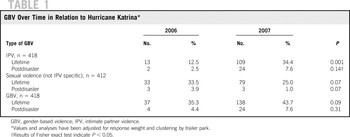
Gender-based violence (GBV) can encompass physical, sexual, and psychological violence that is perpetrated in relation to the victim’s sex and/or institutions in which gender is implicated in the act of violence.1 Although all types of GBV merit attention, sexual and physical violence against women have been a primary focus for researchers and aid organizations working with disaster-affected populations (Table 1).
GBV Over Time in Relation to Hurricane Katrina

It is assumed that GBV increases within populations affected by disasters. High rates of GBV among women have been documented within communities affected by disasters, particularly among internally displaced people (IDPs) and refugees, with population estimates of GBV ranging as high as 17% for sexual abuseReference Amowitz, Reis and Lyons2 and 25% for intimate partner violence (IPV).Reference Larrance, Anastario and Lawry3 Assessments of change in the rates of GBV following a disaster are lacking, leaving stakeholders in disaster planning with inadequate information on the nature of GBV relative to baseline conditions, especially within a protracted phase of displacement following a disaster. Qualitative and anecdotal evidence suggests that disasters play a role in the increase of GBV in the postdisaster phase,Reference Fothergill4–Reference Amowitz, Heisler and Iacopino8 but changes in the rates of GBV within disaster-affected populations have not yet been systematically assessed. In this regard, we assessed rates of GBV over time in a population of female IDPs displaced by the 2005 Gulf Coast hurricane season. By testing for changes in the rates of GBV among women in the years following Hurricanes Katrina and Rita, stakeholders in disaster planning and health services administration will be better able to respond to the protection and subsequent health issues that arise among women exposed to GBV in displaced settings.9, 10
METHODS
Participants
This study draws upon 2 phases of health needs assessments that were conducted using systematic, random sampling among IDPs living in Federal Emergency Management Agency (FEMA) travel trailer parks since the 2005 Gulf Coast hurricane season. The first phase, conducted in 2006, included IDPs in both Mississippi and Louisiana travel trailer parks as part of a larger effort to survey the population most recently affected by Katrina.Reference Larrance, Anastario and Lawry3 The second phase occurred in 2007 and included the same IDP population but in Mississippi only. This study draws comparisons within Mississippi only. Both assessments primarily were aimed at determining prevalence estimates within the population to inform the power analyses. Major depressive disorder (MDD), a condition that has been previously documented with relatively stable estimates within IDP populations, Reference Kim, Torbay and Lawry3,11,12 was used to inform the power analyses. Power analyses were conducted to determine a prevalence of depression between 0.5 and 0.1 ± 0.05, and to obtain 95% confidence that the prevalence of the sampled population would fall within this interval, we determined that a sample size of 139 to 383 respondents would be required for adequate power. In 2006, we successfully sampled 366 respondents, 187 of whom lived in Mississippi at the time of survey and 106 of whom were female.Reference Larrance, Anastario and Lawry3 In the second phase, we sampled 610 respondents, yielding a total 797 respondents living in Mississippi (314 females) between both phases of the study. Given that the central concern of the present study is to identify a change in GBV rates between 2 phases of sampling, we conducted a post hoc power analysis that revealed that the acquired sample in Mississippi was adequately powered (assuming a 1-β of 0.80) to detect up to a 6% change in postdisaster GBV rates, with an α level of 0.05, between 2006 and 2007.
Sampling
In 2006 and 2007, we surveyed all FEMA group and commercial travel trailer parks listed in the February 15, 2006, and September 14, 2007, FEMA Principal Federal Official Housing Group Daily Tracking Report with 10 or more trailers.13 This list was considered by FEMA to be a comprehensive list of FEMA-supported travel trailer parks and did not include individual trailers taken to previous homesteads. The sampling frame thus included all adult residents living in FEMA travel trailers located within group and commercial parks, and did not include those in FEMA travel trailers at residential addresses outside these parameters. Fifty travel trailer parks in total were sampled in Mississippi in 2006, and by 2007, 69 travel trailer parks were included in the sample in Mississippi. In 2006, 63 trailer parks were excluded according to size, 8 were excluded because they were industrial or exclusive sites, and access was denied at 2 sites. In 2007, 54 trailer parks were excluded based on size, 10 were excluded because they were industrial or exclusive sites, and 1 was excluded for safety concerns. In both samples, a coin toss determined the starting household. In 2006, surveyors sampled each nth household until the entire trailer park had been surveyed.Reference Larrance, Anastario and Lawry3 This method was chosen to efficiently sample a large displaced population, spread across a larger geographic region in larger numbers. In 2007, every other trailer was sampled. In both samples, 2 separate attempts were made to contact residents if no one was home at the initial attempt. Eligibility and refusals were recorded by surveyors.
Instrument
The questionnaires used in 2006 and 2007 were written in English and administered verbally. Three regional, human rights, and medical experts reviewed the questionnaire for content validity. The questionnaire was pilot tested among 6 internally displaced people in the Washington, DC, area in 2006, and the resulting suggestions about clarity and cultural appropriateness were incorporated. The 2006 and 2007 surveys included questions on respondent demographics, intimate partner and sexual violence, and mental health that were worded identically in the 2006 and 2007 surveys to assess change over time in the most reliable manner possible. Identical demographic factors between questionnaires such as age of the respondent, number of days in current trailer park, ethnicity, marital status, and income also were examined in relation to the phase of sampling.
Lifetime and postdisaster rates of GBV among women were measured in relation to Hurricane Katrina using screening items used in previous studies of disaster-affected populationsReference Amowitz, Reis and Lyons2, Reference Amowitz, Kim and Reis7 and adapted from internationally recognized definitions of GBV.1 The subtypes of GBV measured included physical and sexual GBV, and were classified as IPV or sexual violence without specification of the perpetrator (SV).
To measure SV, a single item directly screened the respondent for whether they had “ever experienced sexual violence such as molestation, being forced to undress or stripped of clothing, forced intercourse, or other sexual acts.” Following this item, respondents were asked who perpetrated the violence against them (eg, partner/spouse, family member, unknown) and whether the incident has happened to them since displacement. To measure IPV, respondents were asked whether they had personally “been subjected to violence, such as beatings, by a spouse” and were subsequently asked whether the incident has happened to them since displacement. Respondents only reported on violence that they had personally experienced.
To assess the association of GBV with mental health parameters, and given current evidence that GBV is associated with depressive symptoms in both high risk and general populations,Reference Stein and Kennedy14–Reference Kaslow, Thompson and Meadows20 we aimed to test for associations between GBV and depression by time period. Although we acknowledge that an association with depression may be indicative of other psychiatric disorders, such as underlying posttraumatic stress disorder (PTSD), we could only provide a measurement of MDD in the context of this study. Depression was assessed using the Patient Health Questionnaire-9 (PHQ-9), a well-validated, highly sensitive instrument for identifying individuals with present and past depression.Reference Brody, Hahn and Spitzer21, Reference Kroenke, Spitzer and Williams22 Number of depressive symptoms was measured as the number of PHQ-9 assessed symptoms experienced. Suicidal ideation23 and suicide attempts24 before and after the displacement among respondents were reported as yes or no responses.
Interviewers
Six data collectors were recruited in 2006, and 9 were recruited in 2007. There was no overlap in interviewers between the 2006 and 2007 cohorts. Interviewer training in both 2006 and 2007 consisted of a day of 1-to-1 instruction and role-playing that highlighted a standardized approach to questionnaire administration, followed by several days of field observation by field supervisors.Reference Reis, Amowitz and Hare-Lyons25 Local health officials in both states and FEMA granted permission for the study.
Interviews were conducted during an 8-week period in April and May 2006, and during a 2-week period in September 2007. A surveyor interviewed a male or female household member (≥18 years) who could most accurately provide information about the experiences of the entire household for the needs survey.Reference Larrance, Anastario and Lawry3 Although respondents were asked to report on the health of the household for certain items, all GBV and mental health questions were self-reported and pertained to the respondent only. Interviews averaged 25 minutes in 2006 (to ask 138 questions) and 15 minutes in 2007 (to ask 77 questions), and were conducted in the most private setting possible. Questionnaires were reviewed for completeness and for correctness of data recording after the interview by the interviewers and by team leaders daily.
Human Subjects Protection
In 2006, the study was approved by the Western Institutional Review BoardReference Larrance, Anastario and Lawry3 and in 2007, the study was approved by the institutional review board at the Uniformed Services University of the Health Sciences. Both review boards comply with the Declaration of Helsinki and are guided by Title 45 of the US Code of Federal Regulations.26 All of the data were anonymous, and verbal informed consent was obtained from all of the participants, who did not receive any material compensation.
Statistical Analysis
Stata 10 statistical software was used to manage and analyze both datasets.27 All of the analyses were adjusted for response weight as well as grouping of responses by trailer park, and all of the statistical significance levels were established at P < 0.05. Pearson design–based F statistics were used to assess changes in dichotomous variables between the 2006 and 2007 phases of the study. Analysis of variance was used to assess changes in continuous variables between time periods. Associations between GBV experience and mental health outcomes were assessed using logistic and Poisson regression to adjust for potential confounders, such as age, sex, income, ethnicity, marital status, and number of days lived in the trailer park.
To compare the emergence of new cases of violence over time, each violence rate was transformed into a crude rate for the predisaster period, as well as the 1- and 2-year postdisaster periods. The crude rate was chosen in this case because it captures new cases of violence within a discrete time period following the disaster, and allows for the comparison of rates between time periods by accounting for the incidence of new violence per 100,000 people per day. Although we did not screen for the multiple incidents of a violent act per person, the crude rate was explicitly used to capture and compare the incidence of new acts of violent within the postdisaster time period. The crude rate equation takes recall period of assessment into account, and we used it to protect against the type I error of documenting an increase in postdisaster violence from 2006 to 2007 due to a longer postdisaster recall period in 2007. The crude rate of violence was calculated as the weighted number of people reporting violence divided by the product of the weighted number of people in the sample and the mean number of days for the recall period.28 This quotient was then multiplied by 100,000 to establish a rate per person per day for ease of comparability between periods. To develop a recall period for lifetime rates, we used a highly conservative criteria that assumed that the lifetime recall only occurred in adulthood (truncated at age 18 years), and included all of the respondents whose reported violence may have occurred after displacement only. Allowing lifetime recall to reflect the respondent’s true age would greatly deflate the predisaster crude rate of GBV, thus truncating the recall at age 18 protects against underestimating the predisaster rate in the comparisons. For postdisaster violence, the number of days in the denominator of the crude violence rate equation varied based upon the difference between the date of Hurricane Katrina (August 29, 2005) and the mean date of interview.
We defined discordant lifetime change as the change in reported lifetime GBV minus the change in reported postdisaster violence between respondents in 2006 and 2007. Given that those with GBV experience are less likely to report recent GBV in a face-to-face interview,Reference Rhodes, Lauderdale and He29, Reference Trautman, McCarthy and Miller30 we speculated that an increase in lifetime prevalence between 2006 and 2007 not accounted for by changes in recent GBV experience may indicate unreported recent violence. To evaluate whether the relation between GBV and mental health outcomes varied by time period, we tested for 2-way interaction effects between time of study and type of violence experienced.
Definitions
GBV was defined as occurring if the respondent experienced physical and/or sexual violence, as described above. SV was defined as whether the respondent experienced sexual violence, regardless of perpetrator subtype. Sexual IPV was defined as sexual violence among those reporting violence perpetrated by a partner/spouse. For IPV, the perpetrator was directly specified in the screening item, thus further perpetrator specification was not necessary. “Lifetime GBV” was defined as whether the respondent had ever experienced GBV. Postdisaster violence was defined if the respondent had experienced any violence since displacement.
A household was defined as “persons sleeping and eating under the same roof or in the same structure.” MDD was defined as whether the respondent reported yes to at least 1 of the 2 screening items on the PHQ-9 and reported at least 4 additional symptoms of depression, experienced nearly every day for a 2-week period since the hurricane.Reference Brody, Hahn and Spitzer21, Reference Kroenke, Spitzer and Williams22
RESULTS
Characteristics of Respondents
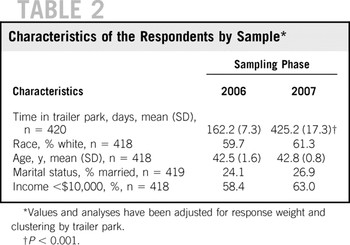
There was no appreciable differentiation between respondent ethnicity, age, marital status, or income in the 2006 and 2007 samples (Table 2). Respondents in the 2007 sample had resided in their trailer parks on average 263 days longer than respondents in the 2006 sample (P < 0.001). In 2006, contact was made with 303 potential respondents in Mississippi, 81 of whom refused to participate (14% cited lack of time as the primary reason), 18 did not complete the survey, and 17 were ineligible (response rate 62.5%). The final 2006 sample included 106 females.31 In 2007, contact was made with 742 potential respondents, 94 of whom refused to participate (7% cited lack of time as the primary reason), 9 did not complete the survey, and 29 were ineligible (response rate 82.2%). The final 2007 sample included 314 females.31
Characteristics of the Respondents by Sample

Gender-based Violence
The overall prevalence of recent GBV increased 3.2% (from 4.4% in 2006 to 7.6% in 2007; F (1,416) = 1.1; P = 0.31) and lifetime GBV increased 8.4%, from 35.3% in 2006 to 43.7% in 2007; F (1,416) = 2.9; P = 0.09. There was a discordant lifetime increase in GBV of 5.2% between 2006 and 2007. Taken together, the adult lifetime crude rate of GBV was 4.6/100,000 per day (95% confidence interval [CI] 4.1/100,000 per day to 5.0/100,000 per day), compared with the postdisaster rate of 16.3/100,000 per day in 2006 (95% CI 4.8/100,000 per day to 27.8/100,000 per day) and 10.1/100,000 per day in 2007 (95% CI 6.6/100,000 per day to 13.7/100,000 per day).
Sexual Gender-based Violence
The prevalence of recent SV decreased 2.9%, from 3.9% in 2006 to 1.0% in 2007; F (1,410) = 3.4; P = 0.07. Lifetime SV decreased 8.5%, from 33.5% in 2006 to 25.0% in 2007; F (1,410) = 3.3; P = 0.07. There was a discordant lifetime decrease in SV of 5.6% between 2006 and 2007. Taken together, the adult lifetime crude rate of GBV was 3.05/100,000 per day (95% CI 2.6/100,000 per day to 3.5/100,000 per day), compared with the postdisaster rate of 14.4/100,000 per day in 2006 (95% CI 3.2/100,000 per day to 25.7/100,000 per day) and 1.3/100,000 per day in 2007 (95% CI 0.0/100,000 per day to 2.6/100,000 per day).
Intimate Partner Violence
The prevalence of recent IPV increased by 5.1%, from 2.5% in 2006 to 7.6% in 2007; F (1,416) = 2.2; P = 0.14. Lifetime IPV significantly increased by 21.9%, from 12.5% in 2006 to 34.4% in 2007; F (1,416) = 16.1; P < 0.001. There was a discordant lifetime increase in IPV of 16.8% between 2006 and 2007. Taken together, the adult lifetime crude rate of IPV was 3.06/100,000 per day (95% CI 2.7/100,000 per day to 3.5/100,000 per day), compared with the postdisaster rate of 9.4/100,000 per day in 2006 (95% CI 0.6/100,000 per day to 18.2/100,000 per day) and 10.1/100,000 per day in 2007 (95% CI 6.6/100,000 per day to 13.7/100,000 per day).
Gender-based Violence and Mental Health
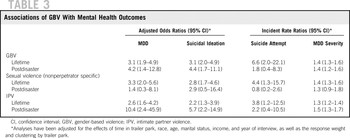
MDD, the number of depressive symptoms, suicidal ideation, and suicide attempts did not vary significantly between 2006 and 2007 (Table 3). Both recent and lifetime rates of GBV were significantly associated with an increased risk for MDD, increased number of depressive symptoms, and increased risk for suicidal ideation. However, a risk of suicide attempt was associated only with lifetime experience of GBV. This same pattern was observed for IPV. For SV, only lifetime rates were associated with an increased risk for each mental health outcome (Table 3). An interaction term between GBV and time would have indicated differential sensitivity of mental health outcomes to abuse experienced in a phase immediately following the disaster versus a protracted phase of displacement, and none of the interaction terms tested was significantly associated with any of the mental health outcomes.
Associations of GBV With Mental Health Outcomes

DISCUSSION
This study documenting changes in the rates of GBV over time among IDPs displaced by Hurricane Katrina has several important findings relevant to disaster planning and the provision of health services to IDPs in the United States. First, we documented an increase in the rate of GBV following a major disaster, which remained greater than twice the baseline rate up to 2 years following displacement. To the best of our knowledge, this is the first evidence-based study to show an increase in rates of postdisaster GBV in a population of women displaced by a disaster.
Intimate Partner Violence
In addition, we were able to document an increase in rates of postdisaster IPV during the protracted phase of displacement. Between 2006 and 2007, the rate of postdisaster IPV increased 5.1%, which is notably large during the course of 1 year relative to national lifetime estimates.32 In a convenience sample of blue collar women living in North Carolina after Hurricane Floyd, the adult lifetime prevalence of IPV was 28%, and the postdisaster rate was 4% after the storm.Reference Frasier, Belton and Hooten33 When we subclassified physical IPV (not shown) in our random sample, women showed a lifetime prevalence of 34.7% and a postdisaster rate of 7.7% in 2007, suggesting that IPV in this population is particularly high for a disaster-affected population in the United States. Such increases in our sample reflect alarmingly elevated rates of new violence, which did not settle back to baseline during the 2 years following displacement (Fig. 1), escalating from a lifetime estimate of 3.1/100,000 per day to 9.4/100,000 per day in 2006 and up to 10.1/100,000 per day in 2007. Thus, the most rapid increase in all types of violence occurred in the first year following the disaster, and continued to escalate in the 2 years following displacement (Fig. 1). In a post hoc logistic regression, after adjusting for potential confounders (eg, age, income, ethnicity, marital status), we found that the odds of postdisaster IPV were 4.6 times higher (95% CI 1.05–19.9) among respondents in 2007 than in 2006. This suggests that time period after displacement played a significant role in increasing the incidence of IPV within this population. Based on our findings, we suggest that disaster planning efforts should directly implement programs that mitigate GBV, particularly IPV, after a disaster with the expectation that rates will increase over time following displacement.
GBV over time in relation to Hurricane Katrina.

Sexual Violence
We did not document significant changes in SV relative to the disaster; however, we did document a large increase in the rate of SV within the first year following the disaster (from 3.1/100,000 per day to 14.4/100,000 per day in 2006). The current rates of sexual violence reported in this study exceed estimates of the rates of sexual violence in the state of Mississippi at large.32 Our pooled (2006 and 2007) postdisaster SV rate was equivalent to 3.04/100,000 per day since Hurricane Katrina, more than 27 times that of the local rate in Mississippi estimated before Hurricane Katrina.32 It is also worth noting that the lifetime rate of reported SV decreased in prevalence 8.5% (P = 0.16). It is possible that common issues associated with violence reporting such as fear for personal safety, sensitivity to questioning, and protection of the perpetrator resulted in underreporting,Reference Watts and Zimmerman34–Reference Rodriguez, Sheldon and Bauer40 and/or the effect of sexual trauma experienced in the immediate postdisaster phase may be more likely to be reported at a time proximal to the incident (2006) versus a further point in time (2007).
Mental Health and Gender-based Violence
Women who experienced postdisaster IPV and GBV were vulnerable to MDD, increased symptoms of depression, and suicidal ideation after accounting for potential confounders such as time in trailer park, race, age, marital status, income, and year of interview (Table 3). Women who reported postdisaster IPV in our sample were 10.4 times more likely to report symptoms of MDD than women without postdisaster IPV (Table 3). MDD, when diagnosed with a 1-year recall, occurs in 6.6% of the typical population,Reference Kessler, Berglund and Demler41 and has been documented at 31% to 50% among IDPs. Reference Kim, Torbay and Lawry3,11,12 In 1 sample of women with exposure to IPV and war-related experience in Bosnia-Herzegovina, intensity of depression was found to correlate with frequency of physical and sexual abuse.Reference Avdibegovic and Sinanovic17 Although our results cannot determine a causal relation, the observed relation between GBV experience and mental health symptoms suggests that increased GBV following a natural disaster may be 1 of the factors responsible for the high rates of MDD and suicidal ideation among women in disaster-affected populations. Reference Kim, Torbay and Lawry2,3,12 It is also possible that PTSD is an unobserved condition underlying the associations we detected between GBV and various mental health symptoms; however, given the constraints of the questionnaire, we were unable to measure PTSD in this study. Based on the associations we documented, we suggest that people reporting violence also require intensive community-based mental health services following a disaster,42 even if the abuse occurred before the disaster.
There is a need for the provision of appropriate health and social services to individuals who have experienced violence in such populations. Women are particularly vulnerable to the sequelae of abuse, most often experiencing severe and life-threatening injuries.31 Furthermore, females subjected to IPV are more likely to seek care for somatic complaintsReference Loxton, Schofield and Hussain43–Reference Drossman, Leserman and Nachman47 rather than seek care for the violence itself—leading to underreporting of violence. Among women reporting sexual assault, commonly reported consequences of the attack are bodily injury, physical disability, sexually transmitted infections, pregnancy, and reproductive complications such as miscarriage.Reference Avdibegovic and Sinanovic17 The provision of services that can address the scale of such health consequences in tandem with social services and programming to mitigate IPV in accord with the United Nations Security Council’s Resolution 132510 and World Health Organization guidelines9 is warranted in this internally displaced population.
Limitations
There are several limitations to this study. First, we studied a natural disaster–induced internally displaced population within the United States, and the findings of this study represent approximately 12,377 internally displaced people residing in travel trailer parks in Mississippi. Our results cannot be generalized to the entire hurricane-affected internally displaced population nor can our results be generalized to all disasters. Furthermore, the study does not represent residents in the host populations of Mississippi. Although the IDP population displaced by Katrina in Mississippi represents an underprivileged subset of the state’s population at large, we did not document significant demographic differences in income, age, ethnicity, or marital status between both phases of the study, suggesting the documented increase in postdisaster GBV/IPV was more a function of time after displacement than due to changing population parameters.
Second, there was an elevated response rate in the 2007 phase of sampling (82.2% in 2007 and 62.5% in 2006). Lack of time was also the primary reason for refusal in both phases. Considering that the questions on demographics, violence, and mental health were embedded within a much larger survey in 2006 in comparison with 2007, and that the difference in time duration of survey administration was roughly 10 minutes between phases, we do not feel that this introduced an appreciable bias into our ability to obtain positive responses on violence screening. The items used to measure violence in both surveys were identical across years, providing us with a reliable measurement and comparison in the context of different lengths of administration times. In addition, response rates for both phases are considered above adequate for face-to-face administered surveys.Reference Babbie48
A third limitation is that an optimal study design to test for an increase in GBV in a population would be to track individual respondents, dyads, or households over time. This type of study design would not be feasible in this population for both safety reasons (the survey was anonymous for the protection of individuals) and factors that often inhibit researchers from collecting panel data on IDPs over time, such as within and between trailer park migration, and unavailability of consistent contact mechanisms such as telephones. We feel that the successive cross-sectional random sampling design to compare rates over time was an optimal solution to the nuances of collecting longitudinal data in this population of IDPs. The additional 19 trailer parks sampled in 2007 is likely a reflection of IDPs returning to their location of origin after living elsewhere in the year following the hurricane. Although in and out migration could be associated with the increase in GBV, we found that respondents in 2007 had been living in their sampled trailer park for a significantly extended period of time compared to respondents in 2006 (on average 1.2 years in 2007 and 0.4 years in 2006), indicating that although migration occurred, it did not destabilize the sampled population between periods. Also, standard errors of the estimates in our analyses were adjusted for grouping by trailer park.
Finally, there is always a limitation that respondents did not truthfully respond to questions regarding physical and/or sexual violence. We documented discordance between lifetime and postdisaster reporting, in which a large increase in the reported lifetime prevalence of GBV between 2006 and 2007 surpassed the increase in the postdisaster rate, and it may be possible that women were likely to report recent violence as lifetime violence. It is also possible that interviewer characteristics could bias responses in a face-to-face interview; however, this field of study remains inconclusive as to how interviewer characteristics influence responses. We suggest that future research endeavors address the topic of reporting likelihood because it could significantly affect the allocation of scarce resources among IDPs. However, our rates support previous findings of increased reports and rates of intimate partner violence after disasters,Reference Wilson, Phillips and Neal49–53 despite the possibility that many cases (estimates range as high as 70%) go unreported.Reference Kothari and Rhodes54 However, we used rigorous survey methodology and provided respondents with the maximum privacy possible while administering the questionnaire.
Conclusions
Our results suggest that female IDPs are particularly vulnerable to GBV in the acute phase following a disaster and displacement and to IPV in the protracted phase of displacement. We documented increases in the incidence of GBV in the IDP population in Mississippi displaced by the 2005 Gulf Coast hurricane season. The increase in GBV incidence was more specifically driven by a rise in first-time occurrences of IPV among IDPs. Further research is needed to understand the specific time-variant factors that increase the incidence of IPV following a disaster, as well as the nature of underreporting of both lifetime and recent rates in IDP settings. Current efforts to decrease violence in this population should be taken in accord with United Nations and World Health Organization guidelines on GBV in disaster-affected populations.9, 10
Acknowledgments
The first author completed this work while with the Center for Disaster and Humanitarian Assistance Medicine. The authors are especially grateful to those who participated in this study: Danielle Rosenau, BA; Brian Rice, BA; David Lanier; Aeriel Lawry; Jordan Berg, MA; and Lynn Black, MD, MPH, who assisted in data collection; also, Eleanor Benko, BA, who assisted in both data collection and entry; and Art Sharpe, JD, director, Office of Emergency Planning and Response, Mississippi Department of Health, for assistance in arranging access to FEMA group trailer parks in Mississippi.
Grant support was provided by core funding through the Center for Disaster and Humanitarian Assistance Medicine, which had no role in design, conduct, data collection, management, analysis, interpretation of the data, preparation, review, or approval of the manuscript.
Authors' Disclosures The authors report no conflicts of interest.