INTRODUCTION
In the course of a survey of the Mediterranean fishes of Israel in Haifa Bay, an unusual sparid fish was collected in January 2010, which was determined to be a new record of Pagellus bellottii from Israel and the south-eastern Mediterranean Sea; the specimen is described herein.
The genus Pagellus Valenciennes, in Cuvier and Valenciennes, 1830 , is characterized by an elongately ovate or fusiform body, which is more or less compressed. The preopecle is scaleless and the mouth is terminal. In both jaws there is a band of conical and slender teeth in the front and at least two rows of molars at the back; the outer series of conical teeth are a little enlarged and the inner (second) row of molars are the largest (Whitehead et al., Reference Whitehead, Bauchot, Hureau, Nielsen and Tortonese1986: 898). It comprises a total of six species (Eschmeyer, Reference Eschmeyer2014): Pagellus acarne (Risso, 1827) from the Mediterranean and north-eastern Atlantic; Pagellus affinis Boulenger, 1888 from the western Indian Ocean; Pagellus bellottii Steindachner, 1882, Pagellus bogaraveo (Brünnich, 1768) and Pagellus erythrinus (Linnaeus, 1758) from the eastern Atlantic and the Mediterranean; and Pagellus natalensis Steindachner, 1903 from South Africa.
The Pagellus bellottii lives in the demersal zone of inshore waters, in hard or sand bottom areas, from shallow waters to depths of 250 m. It is gregarious; for spawning it migrates towards the coast. The species is omnivorous, mainly carnivorous and feeds on benthic invertebrates and small fish. Reproduction occurs from May to November, depending on the latitude; the species is a protogynous hermaphrodite. It reaches maturity at 1–4 years; females produce 60, 200–406, 800 eggs (at 16–35 cm). The maximum size is 42 cm standard length; the species usually reaches 20–25 cm (Whitehead et al., Reference Whitehead, Bauchot, Hureau, Nielsen and Tortonese1986: 900).
MATERIAL AND METHODS
On 20 January 2010, a specimen of Pagellus bellottii was collected by commercial fishermen in the vicinity of Haifa Bay; the exact collecting locality, depth and method of collection is unknown. The specimen has been deposited in the Hebrew University Fish Collection (HUJ) and is registered under the catalogue number HUJ 19914. Biometrical counts and measurements follow Hubbs & Lagler (Reference Hubbs and Lagler1947); the classification follows Eschmeyer (Reference Eschmeyer2014) and the references follow Fricke (Reference Fricke2014). Subspecies are no longer recognized, following the method of Fricke et al. (Reference Fricke, Bilecenoglu and Sari2007: 6).
RESULTS AND DISCUSSION
SYSTEMATICS
Order PERCIFORMES Rafinesque, 1815
Suborder PERCOIDEI Rafinesque, 1815
Family SPARIDAE Rafinesque, 1818
Genus Pagellus Valenciennes in Cuvier and Valenciennes, 1830
Pagellus bellottii Steindachner, 1882
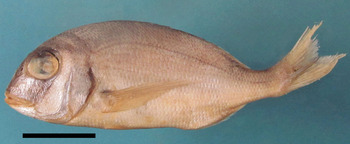
(Figure 1)
Pagellus bellottii Steindachner, Reference Steindachner1882a: 41 (Arglim Bank, Canary Islands; Gorée, Senegal).
Lateral view of Pagellus bellottii, HUJ 19914, 178.4 mm standard length (SL), vicinity of Haifa Bay, Israel. Photograph by D. Golani. Scale bar: 50 mm.

DESCRIPTION
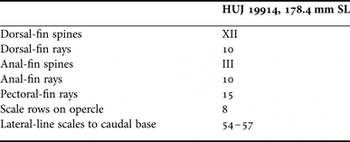
Biometrical counts see Table 1. Body oblong. Occipital scales extending forward to the level of the anterior margin of the eye. Molar teeth in two series. Upper gill rakers six, lower gill rakers ten. Dorsal-fin spines 12, fin-rays ten. Anal-fin spines three, fin-rays ten. Pectoral-fin rays 15. Opercle with eight rows of scales. Lateral-line scales 54–57 to caudal base (counts of left and right sides differing).
Biometrical counts of Pagellus bellottii, HUJ 19914, 178.4 mm SL, vicinity of Haifa Bay, Israel.

COLOUR
Body silvery in preservative, dorsal parts of body with small grey spots. Margin of opercle dark grey. Inside of mouth whitish. Lower forehead, snout and suborbital region dark grey. Dorsal fin grey, with a distal dark grey margin. Anal fin grey. Caudal-fin rays yellow, membranes grey, with a narrow distal dark grey margin. Pectoral fin yellow; pelvic-fin membranes grey.
DISCUSSION
This species was first described by Steindachner (Reference Steindachner1882a: 41) from eastern Atlantic localities (Arglim Bank, Canary Islands and Gorée, Senegal) and later described in more detail by Steindachner (Reference Steindachner1882b: 5, pl. 3, Figure 1). It was treated as a valid species by Bauchot and Hureau in Whitehead et al. (Reference Whitehead, Bauchot, Hureau, Nielsen and Tortonese1986: 899) and Bauchot and Hureau in Quéro et al. (Reference Quéro, Hureau, Karrer, Post and Saldanha1990: 804), who reported a distribution from the eastern Atlantic Ocean and the south-western Mediterranean. Lucena et al. (Reference Lucena, Abad and Garcia1982) also recorded the species from southern Spain (under the name Pagellus coupei). The species was reported by Afonso et al. (Reference Afonso, Porteiro, Santos, Barreiros, Worms and Wirtz1999: 75) and Wirtz et al. (Reference Wirtz, Ferreira, Floeter, Fricke, Gasparini, Iwamoto, Rocha, Sampaio and Schliewen2007: 35) from Sao Tome and Principe. The species was recorded by Sbaihi & Saad (Reference Sbaihi and Saad1992) from Syria, eastern Mediterranean Sea, and treated as an immigrant from the eastern Atlantic and western Mediterranean by Saad (Reference Saad2005: 105). The eastern Mediterranean record from Syria was missed by Golani et al. (Reference Golani, Orsi-Relini, Massutí, Quignard and Briand2002: 144–145). A specimen reported from South Africa by Orrell & Carpenter (Reference Orrell and Carpenter2004: 428) was based on a misidentified Pagellus natalensis Steindachner, 1903. A record from the Cape Verde Islands by Reiner (Reference Reiner1996) was considered invalid by Wirtz et al. (Reference Wirtz, Brito, Falcón, Freitas, Fricke, Monteiro, Reiner and Tariche2013: 126).
Junior synonyms of Pagellus bellottii include Dentex cuninghamii which was described by Regan (Reference Regan1905: 325) from Angola, and Pagellus coupei as described by Dieuzeide (Reference Dieuzeide1960: 109) from the Mediterranean Sea. The latter name was frequently used in publications prior to Whitehead et al. (Reference Whitehead, Bauchot, Hureau, Nielsen and Tortonese1986).
The species is placed in the genus Pagellus Valenciennes in Cuvier and Valenciennes, 1830 due to the presence of molariform lateral teeth; the front teeth are not incisor-like, there are at least eight small sharp pointed teeth in front of the jaws, the mouth is terminal, the posterior nostril is oblong or circular, scales are present on the cheeks and opercle, but not on the preopercle, the body is elongately oval, which is more or less compressed, and there is an absence of transverse stripes on the sides of the body (see Whitehead et al., Reference Whitehead, Bauchot, Hureau, Nielsen and Tortonese1986: 883, 898).
Within the genus Pagellus, the species is characterized by the occipital scales, which reach beyond the centre of the eye, the inside of the mouth is whitish and the anal fin has ten rays (see Whitehead et al., Reference Whitehead, Bauchot, Hureau, Nielsen and Tortonese1986: 899–900).
Pagellus bellottii has a distribution range in the eastern Atlantic Ocean (Gibraltar to Angola, including the Canary Islands), the south-western Mediterranean (Spain, Morocco and Algeria) and the eastern Mediterranean (Syria and Israel). The present new record from Israel and the south-eastern Mediterranean confirms the previous report from the eastern Mediterranean by Sbaihi & Saad (Reference Sbaihi and Saad1992) and the establishment of this eastern Atlantic species in the eastern Mediterranean. Apparently, some eastern Atlantic species are in a process of dispersal into the Mediterranean; they usually follow the coast of North Africa, first in the south-western Mediterranean and then also in the eastern Mediterranean. Other examples of such species include Acanthurus monroviae Steindachner, 1876 (ACANTHURIDAE), Carlarius parkii (Günther, 1864) (ARIIDAE), Cephalopholis taeniops (Valenciennes in Cuvier and Valenciennes, 1828) (SERRANIDAE), Enchelycore anatina (Lowe, 1838) (MURAENIDAE) and Solea senegalensis Kaup, 1858 (SOLEIDAE) (see Ben-Tuvia & Golani, Reference Ben-Tuvia and Golani1984; Golani, Reference Golani2005; Golani et al., Reference Golani, Fricke and Appelbaum-Golani2014).
ACKNOWLEDGEMENT
We would like to thank Mr Michael Zemel, owner of the trawler ‘Alia’, for the permission to investigate his trawl catch.