IntroductionFootnote 1
The southern Ugandan kingdom of Buganda is one of the best-documented regions in colonial Africa.Footnote 2 Over the past several years, though, scholars have worked to creatively rethink Buganda’s colonial past. These historiographical developments may be divided into four areas. First, historians such as Holly Hanson, Samwiri Lwanga Lunyiigo, Henri Médard, and Richard Reid have shown how nineteenth-century political power and the kingdom’s regional economy were far more decentralized and heterarchical than suggested in earlier scholarship.Footnote 3 Second, in his powerful study on clanship in precolonial Buganda, Neil Kodesh has complicated the royalist gaze of much of Buganda’s popular and academic historiography.Footnote 4 In this same vein, Aidan Stonehouse has illuminated the importance of cosmopolitanism in the borderlands of late nineteenth-century Buganda.Footnote 5 Next, scholars such as Nakanyike Musisi, Carol Summers, and Rhiannon Stephens have helped us understand how shifting practices of generational authority and gender affected larger debates about power and good governance during the nineteenth and twentieth centuries.Footnote 6 Finally, building on the pioneering work of Abdu B.K. Kasozi, M.S.M. Kiwanuka, Michael Twaddle, and John Rowe,Footnote 7 Derek Peterson and Jonathon Earle have studied how local communities throughout the 1900s translated Islamic and Christian literacies, and European intellectual histories into older vernacular debates about power and the past.Footnote 8
This article wishes to expand the interpretative frameworks through which modern Ganda politics have typically been explained. In ways that have been largely overlooked in existing studies, it argues that Ganda intermediaries throughout the twentieth century envisioned a political arena within which snakes, birds, trees, and rocks were important intermediaries. Social activists and reformers entered into far-reaching conversations and encounters with these multispecies actors to shape vernacular debates concerning power and regional authority. As Ugandan trade unionists and anticolonial activists were engaged in the production of historical and political thought and organizing labor and protest movements, they did so by looking toward and drawing from the region’s environmental spaces and tableaux. Buganda’s other life forms were central characters in the work of creating classifications of power and public virtue.
To develop this argument, I begin by exploring how historians of Africa have framed the study of social formation and environmental change. I then build upon developments in the field of multispecies ethnography to preliminarily identify some of the ways in which Ganda activists incorporated snakes, water, and trees to engage in the work of political imagination. Next, the article turns directly to the politics of colonial administration. By the early twentieth century, colonial administrators in Uganda had sought to politically sanitize the ostensibly “pagan” practice of using rocks, water, and pythons to organize public activism. By the nineteenth-century, in Europe, the invention of the “natural” world had proved to be a powerful strategy for distancing the divine and supernatural authority from the hullaballoo of daily life.Footnote 9 As Christopher Bayly has shown, classical liberals, republican revolutionaries, and socialists between the late 1700s and mid-1800s used the empirical epistemologies of the natural sciences to reconstitute political authority throughout the Atlantic world.Footnote 10 By advocating for a materialist world, political visionaries legitimized industrial capital, the extraction of natural resources, the expansion of colonial empires – and the critique thereof.Footnote 11 This article, though, uses the private papers of the trade unionist Erieza Bwete to show that Christian converts in Uganda – despite their modernist training in missionary schools – continued to see global communities as part of a “natural” world that was emphatically political. Finally, and more fully, this article turns to the biography of the spirit (lubaale) priest Kigaanira Ssewannyana Kibuuka, who was one of the most controversial and influential activists in late colonial Buganda. During a period when the Uganda government was working to create national iconography and Buganda’s elites were partnering with the state to secure national independence, Kibuuka’s political stagecraft conjured a powerful environment to both challenge colonial authority and make larger claims in Buganda’s moral economy. Baganda activists during the mid-twentieth century developed political classifications that drew from a world filled with trees, rocks, and other life forms. This challenges scholars to expand the conceptual frameworks with which we write the intellectual histories of colonial Africa.
The Environment and Other Life Forms in the Historiography of Africa
It was Jan Vansina, in his 1968 monograph, Kingdoms of the Savanna, who pioneered the study of historical linguistics and the environment in African studies. During a period when scholars were preoccupied with the challenges of statebuilding across postcolonial Africa, Vansina returned to a much older past, showing the extent to which cultural and social practices in central Africa were shaped by changing environs.Footnote 12 In his important work, Paths in the Rainforests, moreover, Vansina challenged scholars to think seriously about the long history of social formation and environmental change in precolonial Africa. As Vansina argued, local communities in premodern central Africa drew from the movements of animals and environmental spaces to ritualize and assert regional power. “Among all peoples of the rainforests without exception,” for instance, Vansina noted, “the leopard was a major emblem of political power and apparently always has been. Hence the disposition of the spoils of the leopard, from hunter to highest authority, is the best indicator of the political structure. To keep its spoils was to proclaim one’s independence. To hand them over was to recognize a superior authority.”Footnote 13 Following Vansina, scholars of eastern Africa, such as Steven Feierman and David Schoenbrun have offered in-depth studies on the intersectionality of social organization, political ideology, and environmental change.Footnote 14
More recently, scholars such as S. Eben Kirksey and Stefan Helmreich have contributed to the study of multispecies ethnography, which explores the natural-cultural borderlands where “a multitude of organisms’ livelihoods shape and are shaped by political, economic, and cultural forces.”Footnote 15 Summarizing this approach, Kirksey and Helmreich write:
Creatures previously appearing on the margins of anthropology – as part of the landscape, as food for humans, as symbols – have been pressed into the foreground in recent ethnographies. Animals, plants, fungi, and microbes once confined in anthropological accounts to the realm of zoe or “bare life” – that which is killable – have started to appear alongside humans in the realm of bios, with legibly biographical and political lives.Footnote 16
What is at stake in much of this emerging scholarship is the correlation between understudied organisms and political anthropology. No longer can we think about insects or fungi as non-political actors. This challenges historians to think seriously about how communities in the past interacted with other life forms to develop political ideals.
There were multiple ways that statebuilders and communities in precolonial and modern Buganda and Busoga looked toward other life forms and the environment to envision useful political pasts and public wellness. In his book on clanship and public healing in precolonial Buganda, Neil Kodesh has shown how dynastic and healers’ accounts of the origins of the Buganda kingdom, respectively, were preoccupied with the mythologies and authority of the python-king, Bemba. As Kodesh observes, “the python centers that dotted the shores of Lake Victoria formed part of an ancient intellectual complex combining the connection between ancestral ghosts, territorial misambwa spirits, and pythons with spirit possession, fertility, and the mediatory nature of water.”Footnote 17 As David Cohen has also shown in his earlier work on possession practices in Busoga, spirits were found in stones, trees, wells, rivers, and hills. At times, spirits were stationary, but they could travel with reptiles along the banks of rivers.Footnote 18 In the contemporary period, communities in these two regions continue to use songs and possession to think critically and closely about public healing and other life forms, as scholars such as Peter Hoesing and Damascus Kafumbe have shown.Footnote 19
By the early colonial period, the power of the Lake’s other life forms had challenged the aspirations of Buganda’s monarchs. As Jennifer Johnson’s work indicates, the administration of water – and the spirits of the water – was central to older debates between Buganda’s late nineteenth-century kings and the region’s spirit mediums.Footnote 20 During a period when Kabaka Mwanga was engaged in a larger political struggle with the spirit medium Mukasa, the most influential spirit of the Ssese Islands,Footnote 21 the king restructured physical architecture in the capital to reinforce central authority.Footnote 22 Buganda’s king commanded his subjects to extend Lake Victoria (Nalubaale) toward the kingdom’s capital. In doing so, he sought to surround – or “make landed” – types of regional power that were based previously around water.
But if other life forms were central actors within the interior of Buganda’s moral economy, they were also active in the expansion of Buganda’s regional power throughout the colonial period.Footnote 23 By the late 1800s, Teso clans in eastern Uganda and western Kenya had arranged their communities into a complicated series of age-group systems.Footnote 24 To organize and describe these practices, Teso communities incorporated the nomenclatures of rocks, floods, and trees, each of which raised larger discussions about clans and the production of food and beer, migration, and social change.Footnote 25 The Ganda military chief Semei Kakungulu had reorganized political power in the region by the late 1910s, a topic that has been richly explored by Michael Twaddle.Footnote 26 To undercut potential resistance, Kakungulu restricted the public rituals that had surrounded age-set practices, which were often negotiated under the shade of trees. As the colonial administrator of Tesoland, J.C.D. Lawrance, noted in the 1950s: “It is popularly believed that the Baganda suppressed the age-set ceremonies because they interfered with road making and other forms of communal labour; it is even suggested that the Baganda feared the military organisation which the system engendered.”Footnote 27
During a time when Kakungulu was undermining age-set practices in Tesoland, he and his intermediaries planted hardwood trees, mvule (milicia excelsa), throughout eastern Uganda. On the one hand, the task of reworking the public utility and placement of trees coincided with older Ganda practices of claiming land by planting mvule.Footnote 28 It was also an outcome of colonial policies that aimed to produce hardwood for crafting furniture.Footnote 29 Colonial officials, in addition, wished to see more hardwood in eastern Uganda for the purposes of creating canoes to navigate Lake Kyoga more swiftly,Footnote 30 a practice that Britons noticed extensively on the Ssese Islands.Footnote 31 But on the other hand, there were deeper ideological currents that moved Kakungulu. In the intellectual history of Buganda, mvule trees had long been talked about in relation to power and change. As one proverb noted: “Abasajja mivule: giwaatula ne giggumiza,” “Men are like mvule trees: they shed their leaves and grow them again.”Footnote 32 During the same period when Ganda historians such as Hamu Mukasa were writing extensively about the importance of political change and ostensible progress under the kingdom’s Protestant chieftaincy,Footnote 33 the production of mvule trees for Kakungulu embodied the importance of political change and rebirth. Among Teso societies, where trees and groves were both revered and maintained for facilitating political gatherings and negotiations,Footnote 34 Kakungulu’s saplings signified the reorientation and emergence of a new sort of public politics. It was now under the shade of Kakungulu’s trees that communities would gather: the focal points for public discussion were now reoriented around Buganda’s military administrator.
Environmental Ethnicity and the Labor Union Activism of Erieza Bwete
The administration of colonial empires energized what I am calling environmental ethnicity, or debates about belonging, power, and the past that were preoccupied with the question of other life forms. Colonial scientists wished to draw communities into abstract debates about the classification of the empirical world, while local communities saw and sensed more complicated and extensive patterns about society and life, as demonstrated in the tree-planting practices of Semei Kakungulu. In eastern Africa, Britain’s first generation of colonial officials envisioned a natural world that was waiting to be classified into the scientific and geographical taxonomies of nineteenth-century Europe. For Governor Sir Harry H. Johnston, Uganda offered “nearly all the wonders, most of the extremes, the most signal beauties, and some of the horrors, of the Dark Continent.” Johnston continued by noting that Uganda “offers to the naturalist the most remarkable known forms amongst the African mammals, birds, fish, butterflies, and earthworms, one of which is as large as a snake, and is coloured a brilliant verditer-blue.”Footnote 35 For the Anglican missionary Arthur Kitching, similarly, colonial navigational technologies, including steamer ships, would enable the “childlike races” of eastern Africa to overcome a harsh environment, thereby unifying a region previously populated by “[t]he widely separated tribes of Busindi, Busoga, Lan’o, and Teso […].”Footnote 36 For local activists and public healers, by contrast, the vision of colonial administrators did not stop them from seeing the “natural world” in ways that were starkly political, an observation that the colonial anthropologist John Roscoe made during his own study of rocks and regional spirits in eastern Uganda.Footnote 37 The natural world provided a repository from which activists continued to shape local discourses about authority and legitimacy in Buganda.
The significance of using environmental ideation and other life forms to rethink the history of empire and dissent warrants reiteration. Following Walter Rodney’s work in the early 1970s,Footnote 38 most of the secondary literature on labor politics and protest in interwar and postwar Africa borrowed overwhelmingly from Marxist and materialist methodologies, which informed the emergence of African social history writing during the 1980s. What the private papers of the Ugandan trade unionist Erieza Bwete show, to which I now turn, however, is that unionists and labor activists drew deeply from environmental ideologies that have been overlooked in the study of African economies and protest movements. More problematically, the metrics used by scholars of democratization in Africa continue to disregard the intersectionality of environmental ideation and political behavior.
Uganda was the second highest supplier of cotton for Britain’s Empire by the interwar period.Footnote 39 Buganda’s regional chiefs placed increasing pressure on farmers to produce large quantities of cotton. By the end of the 1930s, intrusive labor practices and the expansion of Indian-managed ginneries resulted in the organization of numerous trade unions that advocated for local growing and distribution rights.Footnote 40 But what the private papers of the trade unionist Erieza Bwete show is that dissenters during the 1940s drew from ideas about the region’s environmental landscapes to conceptualize social activism and economic protest over the ownership of cotton ginneries.
Bwete’s private papers include farmers’ union registration records, political pamphlets, personal letters, and Protestant devotional literature. His papers also include a series of personal narratives that explore Buganda’s economic disturbances during the 1940s, which were largely organized by Ganda farmers.Footnote 41 What these narratives show is that Bwete and his cohort of farmers were studying weather patterns and the movement of animals to understand the politics of the time. On one occasion, while hiding in a forest after fleeing from colonial security officers in 1949, Bwete reflected:
The rain came on us, the coldness, snakes and monkeys, all worried us much. Once a snake of about fourteen feet-five inches passed between us. We were terribly afraid and shouted. Another time, a dog came and killed a monkey in front of us. We were eventually told the meaning of this. The meaning was that our enemies will just pass through us and others will be killed in front of us.Footnote 42
The account indicates that Bwete and his interpreter, who was likely a Protestant spiritual advisor, looked upon a particular python and monkey unfavorably. To some extent, this indicates a conceptual change in how monkeys and snakes were thought about in colonial society. It was not a given that Bwete would see his monkeys as oppositional. Indeed, Buganda had no fewer than two clans with monkey totems: Ngeye (Colobus monkey) and Nkima (Red-tailed monkey). In the story a dog overcame one of the monkeys, which might signify the Dog clan (embwa) overpowering other regional clans. As Neil Kodesh has shown, Dog clan histories from the sixteenth century onward had been instrumental in developing clans and the concept of clanship as a means of explaining and legitimizing the military and territorial expansion of the kingdom.Footnote 43 It is also not self-evident that a python would be looked upon deleteriously, as pythons had long been associated with fertility and blessings in the interlacustrine region.Footnote 44 But by the 1940s, pythons had been noticeably recast in Christian and Islamic theology to signify Satan.Footnote 45 That Bwete described the length of the python with such specificity might also suggest that the snake was killed by the cohort and then measured, which would have been uncommon in the past.
It is not entirely clear if the occurrence of cool weather raised specific interpretative questions, although the temperature of cold had been used in the past to describe the idea of a place where people go after death, a gloss that was refocused by Christian translators to describe a scorching hell (amagombe). In his 1902 collection of proverbs, for instance, the Protestant Bible translator Henry Wright Duta noted: “Atamanyi mpewo y’emagombe: olusanja ajja na lumu,” or “S/he who does not know how cold it is in the underworld: s/he comes (to the burial) with one dry banana leaf (for sleeping during the mourning).”Footnote 46
While the meaning of these particular environmental forms – monkeys, snakes, dogs, and climate patterns – might have changed by the 1940s, they still preoccupied the minds of Buganda’s public activists. What the account suggests, then, however brief that it may be, is that labor unionists were not simply propelled by questions surrounding state administration, taxation, production, and policy, as an earlier generation of historians argued.Footnote 47 As radical activists in 1940s Uganda reworked older Ganda visions of moral responsibility and good governance to mobilize mass politics,Footnote 48 snakes and carnivorous canines provided equally powerful points of reference around which dissenters developed alternative nodes of authority. As the following case study shows further, communities from varied backgrounds conjured other life forms and regional spirits to shape larger discussions about colonial power and dissent.
Possession and the Political Career of Kigaanira Ssewannyana Kibuuka
The following story we know thanks to the missionary anthropologist John Roscoe. In the early 1900s, an unidentified man set out on a journey from central Uganda to the capital of Buganda, Mmengo, in the outskirts of Kampala. To avoid being noticed by too many observers, he moved only during the early morning hours and late at night. After traveling a circuitous path for one month, the traveler, late one night, reached Roscoe’s residence. The gentleman, allegedly frightened, handed Roscoe a package wrapped in bark cloth. The bearer offered strict instructions: the bundle, which was to remain closed until it was moved out of the kingdom, was to be sent to the United Kingdom, where it would be protected. After delivering the package and his instructions, the carrier quickly departed.Footnote 49 The mysterious parcel was sent to the Museum of Archaeology and Ethnology at the University of Cambridge, where Roscoe opened it in June 1907. Roscoe recorded that he did not open the package until it arrived in Cambridge. After careful examination, Roscoe discovered that he had been given the remains of Buganda’s hero-god, Kibuuka, whose activism dated to the eighteenth century. The package contained the emblems of power from Kibuuka’s shrine: a cheetah skin, a barkcloth with cowry shells, a bell, wooden stool, jawbone, an umbilical cord, and a decomposing penis.Footnote 50
Much earlier, in the mid-1700s, Kibuuka had worked with Kabaka Nakibinge to strategize military victory over Buganda’s northern neighbor, the kingdom of Bunyoro. Traditions suggested that Kibuuka routed Banyoro soldiers during combat through supernatural powers and his ability to fly. During one battle, though, while in flight, Kibuuka was struck by a volley of arrows, after which he plummeted onto a tree in Mbaale in the ssaza of Mawakota, where a shrine was built during the following years. From the late 1700s up until the twentieth century, spirit priests and activists orchestrated national political movement and dissent from Kibuuka’s shrine. As clans throughout Buganda debated and expanded their respective political and territorial claims of authority, the shrine of Kibuuka took on national status by the end of the nineteenth century.
When Buganda’s respective Muslim and Christian kings and chiefs gained control of the state in the late 1800s, they worked to undermine the integrity and authority of spirit shrines like Kibuuka’s, centres of knowledge production and power throughout the region. Roscoe argued that local spirit priests first hid the bodily remains and regalia of Kibuuka when Muslim statebuilders destroyed national shrines during a series of religious military battles during the 1880s.Footnote 51 When Christian chiefs secured control of the kingdom in the 1900s, they passed legislation to suppress possession practices. To entrench Christian authority, Buganda’s parliament, the Lukiiko, passed the Witchcraft Prevention Ordinance by 1918, which was reinforced in 1936 by the Witchcraft Prevention Law.Footnote 52 The invention of alternative forms of power was central to legitimizing control of the state throughout the colonial period. However, in Buganda’s vernacular registers, possession rituals and other life forms continued to shape how environmental spaces and political belonging were talked about.
The spirit priest Kigaanira Ssewannyana Kibuuka was born in Kyakanyomozi, Buddu, in the mid-1930s.Footnote 53 Baptized Matia, Kigaanira was raised in a strict Roman Catholic home.Footnote 54 One interlocutor noted that Kigaanira was first possessed by a spirit while studying at the prominent Christian school Aggrey Memorial. While possessed, he climbed a telephone pole and damaged the wires.Footnote 55 After his Christian education, Matia Kigaanira gained employment with the Trans-Congo/Uganda Company as a freight driver, when the Ganda god of war, Kibuuka, first publically possessed him.Footnote 56 While resting in-route at a restaurant in Fort Portal, Kibuuka descended upon Kigaanira’s head, causing the seventeen-year-old to unexpectedly smash his plate on the floor and retreat into a corner, where Kibuuka announced his imminent return to Mbaale, from whence he had been removed in the early 1900s by Roscoe’s unexpected visitor.
Matia’s political journey from lorry driver to public prophet was theatrical, a process of authenticating social activism by borrowing scripts of power that dated to the eighteenth century. Powerbrokers in the Sheep clan (Ndiga), the clan to which the hero-god Kibuuka belonged, had long adapted local histories to bolster the authority of their clan in the larger arena of monarchical politics in central Uganda.Footnote 57 Ndiga traditions would eventually suggest that Kibuuka’s heroism and sacrifice in the 1700s exemplified national devotion and civic virtue.Footnote 58 Centuries later, the historiographies of clanship constituted an obstacle for Matia Kigaanira, who was a member of the Grasshopper clan (Nseenene), another of Buganda’s several principal clans.
Kigaanira’s clan lineage raised controversy as he prophesied at Mbaale, where Ndiga elders and keepers of Buganda’s national shrine deliberated on the veracity of a Munseenene’s spiritual biography.Footnote 59 Like the mid-eighteenth century, however, late colonial Buganda was considered by many royalists to be a kingdom at war, a monarchy whose king had been forcefully removed from power by Governor Andrew Cohen, who exiled Buganda’s king (Kabaka Edward Muteesa II) between 1953 and 1955 for resisting eastern African federation.
To validate the legitimacy of his activism, Kigaanira climbed the tree where Kibuuka’s corpse had plummeted two hundred years earlier. From Kibuuka’s tree, Kigaanira foretold that Muteesa II would be reinstated. Moved by his political stagecraft and the promise of a restored king, Ndiga elders granted Kigaanira honorary status in their clan, authenticating the return of Buganda’s god of war in the early stages of decolonization. At Buganda’s national shrine, the boundaries of clanship were permeable.
With the blessing of Ndiga leaders, Kigaanira Kibuuka moved to a more centrally located hill near Mutundwe, in the outskirts of Kampala. From his new shrine, Kigaanira informed a growing audience that he would secure the triumphal return of Muteesa, with whom he communicated through the power of the wind.Footnote 60 He admonished Baganda to stop paying taxes to the colonial government and to cease attending religious services in churches and mosques.Footnote 61 Political parties such as the Uganda Nationalist Party Movement openly supported Kigaanira and argued that all Baganda must immediately construct lubaale (spirit) shrines near their homes.Footnote 62 The Party openly sought to unravel Buganda’s earlier Witchcraft Ordinances.
Kigaanira healed the sick and prophesied with a snake around his neck,Footnote 63 which echoed the region’s precolonial histories of Buganda’s protomythical king Kintu and the snake-king Bemba. Unlike Erieza Bwete, who was propelled by Christian ophidiophobia (fear of snakes), Kigaanira was compelled to find a political ally among Buganda’s pythons. Kigaanira worked with animals, trees, and rocks to signify a return to moral order in the colonial state. One correspondent noted, for instance, that white rats protected the prophet.Footnote 64 Kigaanira’s family also recalled that the prophet possessed authority over many animals. Like Jesus, who worked closely with donkeys to stage a triumphal entry into Jerusalem during Passover, noted attendees, Kigaanira foretold the whereabouts of animals, commanding them to appear and vanish at will – necessary signs to foreshadow the triumphal entry of Buganda’s own king.Footnote 65
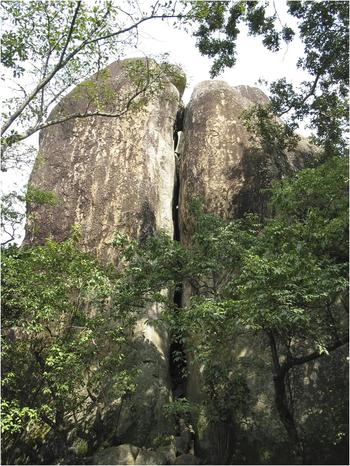
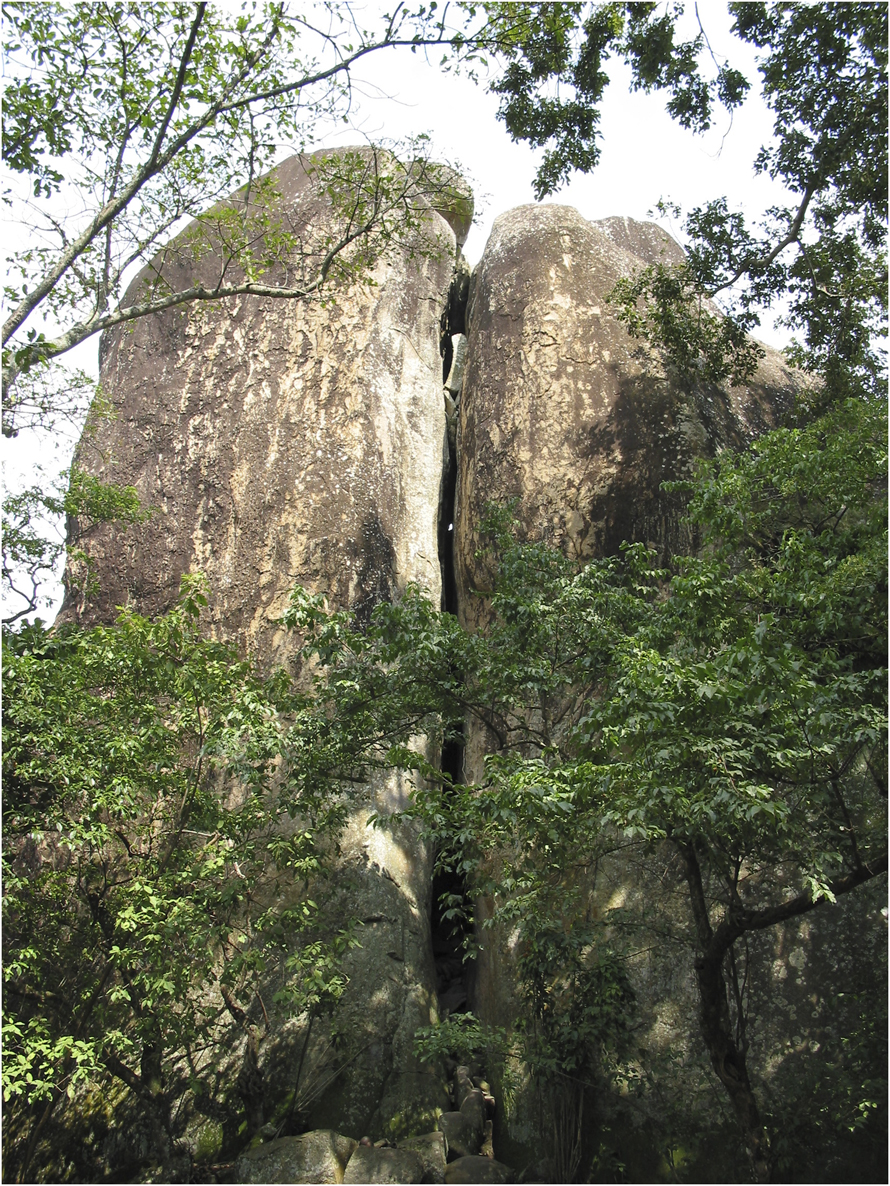
During one large demonstration near Mutundwe, a government officer was killed, for which Kigaanira was sentenced to life in prison. After serving three months of his sentence in Luzira, Kigaanira escaped and re-established his public ministry at Kkungu rock (Figure 1).Footnote 66 According to Kigaanira, he had received a revelation during a full moon that confirmed the importance of his prophetic mission.Footnote 67 After receiving the vision, the prophet mounted a large crested crane that flew him over the prison’s walls to the pillars of Kkungu, where sympathizers believed that a two-headed snake transported food and money to and from the summit. When I interviewed elderly interlocutors at Kkungu, who recalled Kigaanira’s activism during the mid-1950s, they explained that Kigaanira, like Kibuuka, was able to fly.Footnote 68 Not only had Kigaanira ascended the concrete boundaries of colonial justice, he was able to levitate to the rock’s summit.
Kkungu rock, 2010. © Jonathon L. Earle.
Kigaanira’s intimate partnership with a two-headed snake and a crested crane, which enabled him to overcome rocks and national prisons, had its own significance. As this article has already shown, pythons possessed special meaning in Buganda’s cultural registers. In addition to signifying blessing and fertility, they could also symbolize the production of twins. What’s more, the hero-god Kibuuka was generally believed to have been the older brother of the god Mukasa, who often intervened to bless women with twins.Footnote 69 One of Mukasa’s origin stories also underscored the importance of rocks. A compassionate man on the island of Bubembe, where Mukasa was first noted for his power, had placed the young champion on a rock to help protect him from adversaries. Mukasa’s later temple was also purposely built among rocks to signify the elderly man’s gesture of kindness and Mukasa’s superhuman status: since according to one tradition it was believed that he had supernaturally appeared from the island of Bukasa without the assistance of humans.Footnote 70 In the context of Kibuuka Kigaanira’s work among the rocks, the story seems to elicit the significance of twinship (or public blessing) with the prophet’s fluid and dynamic relationship with both Kibuuka and Mukasa. As Kibuuka, signified by one head of the snake, Kigaanira wielded an ability to declare war against the colonial state; but as Mukasa’s partner, the other head, he embodied healing and blessing for the kingdom’s exiled monarch and the subjects of Buganda.Footnote 71
The crested crane on which the prophet flew was directly associated with two of Buganda’s clans: the Tailless Cow clan (Ente) and the Crested Crane clan itself (Ngali). Like Mukasa, the Crested Crane symbolized public healing. “Eyeemanyi amalwalira: tatega ngaali,” recounted one proverb, “One who wishes to guard against sickness: that person does not kill a crested crane.”Footnote 72 By the First World War, colonial officials had co-opted the crested crane into the national decorum and flag of the Protectorate.Footnote 73 Indeed, Uganda’s governor during the Great War, Sir Frederick Jackson, a long-time member of the British Ornithologists’ Union, produced a three-volume illustrated study of the birds of eastern Africa in 1938.Footnote 74 Jackson had also used flags to signify political alliances and treaties between the British East Africa Company and local elders during the Scramble in eastern Africa. As one of Jackson’s field entries in 1890 succinctly noted: “I exchanged treaties with the chief and gave him the Coy’s [Company’s] flag.”Footnote 75 In 1950s Buganda, however, Uganda’s national bird flew at the discretion of Buganda’s prophet – not colonial ceremony. By soaring with Uganda’s crested crane, Kigaanira postured himself as a different sort of national exemplar: a hero whose proximity to Uganda’s national culture was made meaningful through clanship and older discourses regarding the institution of kingship.
The popularity of Kigaanira’s prophecy alarmed colonial officials, who commissioned the East African Institute of Social Research to examine the history and “revival” of possession practices.Footnote 76 Kibuuka’s newfound medium cured women of barrenness, provided herbal medicines, commanded power over animals and, more importantly, guaranteed the return of Buganda’s king during a period of national crisis. Kigaanira also attracted rural royalists,Footnote 77 and the interest of high-profile activists and elite anticolonial nationalists. Ernest Balintuma Kalibala, for instance, was a member of the Namirembe Conference, which was organized to secure Muteesa’s return from exile and to create B/Uganda’s timeline toward independence. Before serving on the Conference, he earned a PhD from Harvard University for his sociological research on Buganda’s clans.Footnote 78 After leaving Harvard, he secured a position with the United Nations. Following his return to Buganda, Kalibala created tension among members of the Conference, especially with Buganda’s foremost Protestant statesman, Eridadi M.K. Mulira, who felt that Kalibala undermined the integrity of the Conference by repeatedly visiting the possessed prophet at Mutundwe, a “prohibited area” occupied by pagan priests.Footnote 79 Throughout the duration of the Conference, Kalibala publicly denounced efforts to arrest Kigaanira, arguing that apprehension was “a gross interference with the liberty of the subject.”Footnote 80 After Kigaanira was first arrested for inciting violence,Footnote 81 Kalibala visited him in prison and organized a collection for the prophet’s release.Footnote 82
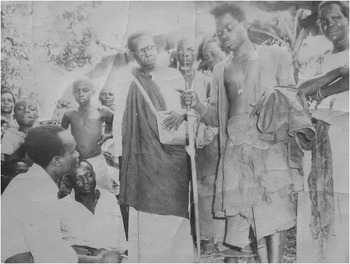
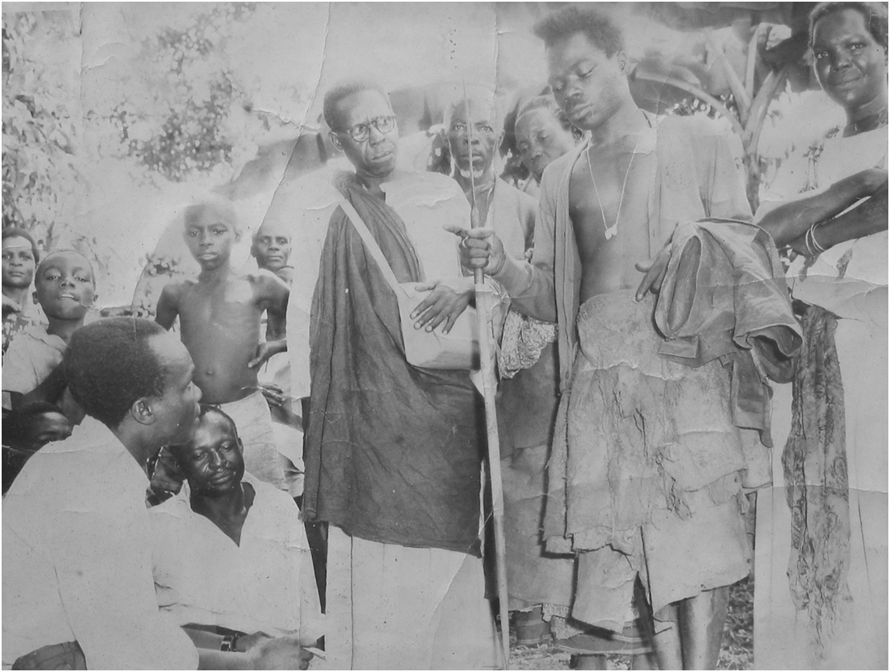
Kibuuka Kigaanira (second from right) with priestly assistant, [c. late 1950s]. Courtesy of Euginia Bonabana.
Kalibala, however, was not the only educated elite preoccupied with Kibuuka’s historical manifestations. In the late 1950s, Abubakar Mayanja was one of Uganda’s foremost anti-colonial nationalists. A founding member of the country’s first national political party, the Uganda National Congress, Mayanja adapted his coursework in history at King’s College, Cambridge, to deconstruct the official histories of colonial eastern Africa. By the early 1960s, he recalibrated his public activism, working with Muslim historians to propagate the royalist and secessionist agenda of Buganda’s government and Kabaka Yekka (the King Alone party). In late 1961, as Buganda’s Minister of Education, Mayanja sent a letter to the Vice Chancellor of the University of Cambridge. Writing on “behalf of His Highness the Kabaka of Buganda and His Government,” Mayanja requested for Kibuuka’s remains and relics to be returned to Buganda.Footnote 83 In his letter, Mayanja recounted the history of Kibuuka’s material culture, which was removed by Christian chiefs “anxious to forget their pagan past.” He noted that Buganda’s premier Protestant chief, Apolo Kaggwa, who did not have “the right to give them away,” had presented the relics to John Roscoe; not an unidentified traveler, as Roscoe had suggested. Mayanja, “especially now that Uganda [was] about to regain her Independence,” petitioned for the return of the relics of Buganda’s god of war, including his stool, drum, pots, amulets, shields, and beer bottles.Footnote 84 His campaign was successful; the remains of Kibuuka were returned in July 1962 to the Uganda Museum, where they are currently on display.Footnote 85
The story of Kibuuka Kigaanira has been ignored in Uganda’s nationalist histories, whose writers have often focused on formal party activists in the 1950s, or the likes of Milton Obote and Idi Amin in the postcolony. What his career illuminates, however, as does Erieza Bwete’s, is the extent to which the end of empire in colonial eastern Africa was shaped by larger interactions with a natural world that was imbued with political significance and power. At the height of colonial modernity, communities in Buganda reflected on the prophet’s spiritual authority and his ability to manage animals, production, and the reinstatement of a king. In my work on Buganda’s global intellectual history,Footnote 86 I have shown how Uganda’s colonial intellectuals reworked European political and religious discourses into much older debates in Luganda about power in Buganda. But what the respective careers of Ernest Kalibala and Abubakar Mayanja begin to show is that eastern Africa’s literati looked just as deeply into the region’s environmental spaces and multispecies relations to forge new possibilities for precipitating Independence and circumnavigating colonial power.
Conclusion
Approximately fifty-five years after Roscoe examined a bundle of spiritual remains in Cambridge, nationalism and debates about ethnic formation in postwar Buganda were being addressed by reflecting upon questions that cantered on the environment and the political world of other life forms. The careers of Erieza Bwete, Kigaanira, Kalibala, and Mayanja each show that in colonial Buganda trees, lakes, rocks, and birds did not constitute apolitical, “natural” subjects. Communities oriented their respective projects around a world that offered a deep environmental archive from which to image alternative futures. Nor did the environment constitute an overtly prescriptive force of historical causation or temporal stagnation: communities learned different lessons at various times. The python took on distinctive meanings in the respective political performances of Erieza Bwete and Kibuuka Kigaanira. Politics in colonial Buganda constituted a conversation that unfolded with a far-reaching range of actors: other life forms were just as consequential as their human counterparts.
Jonathon L. Earle is an Assistant Professor of African history and chair of the African and African American studies program at Centre College. His recent monograph, Colonial Buganda and the End of Empire: Political Thought and Historical Imagination in Africa (Cambridge: Cambridge University Press, 2017) is the first intellectual history of colonial Buganda. He has also recently published on the history of dreaming practices in colonial Buganda in the Journal of African History. E-mail: jonathon.earle@centre.edu