INTRODUCTIONFootnote 1
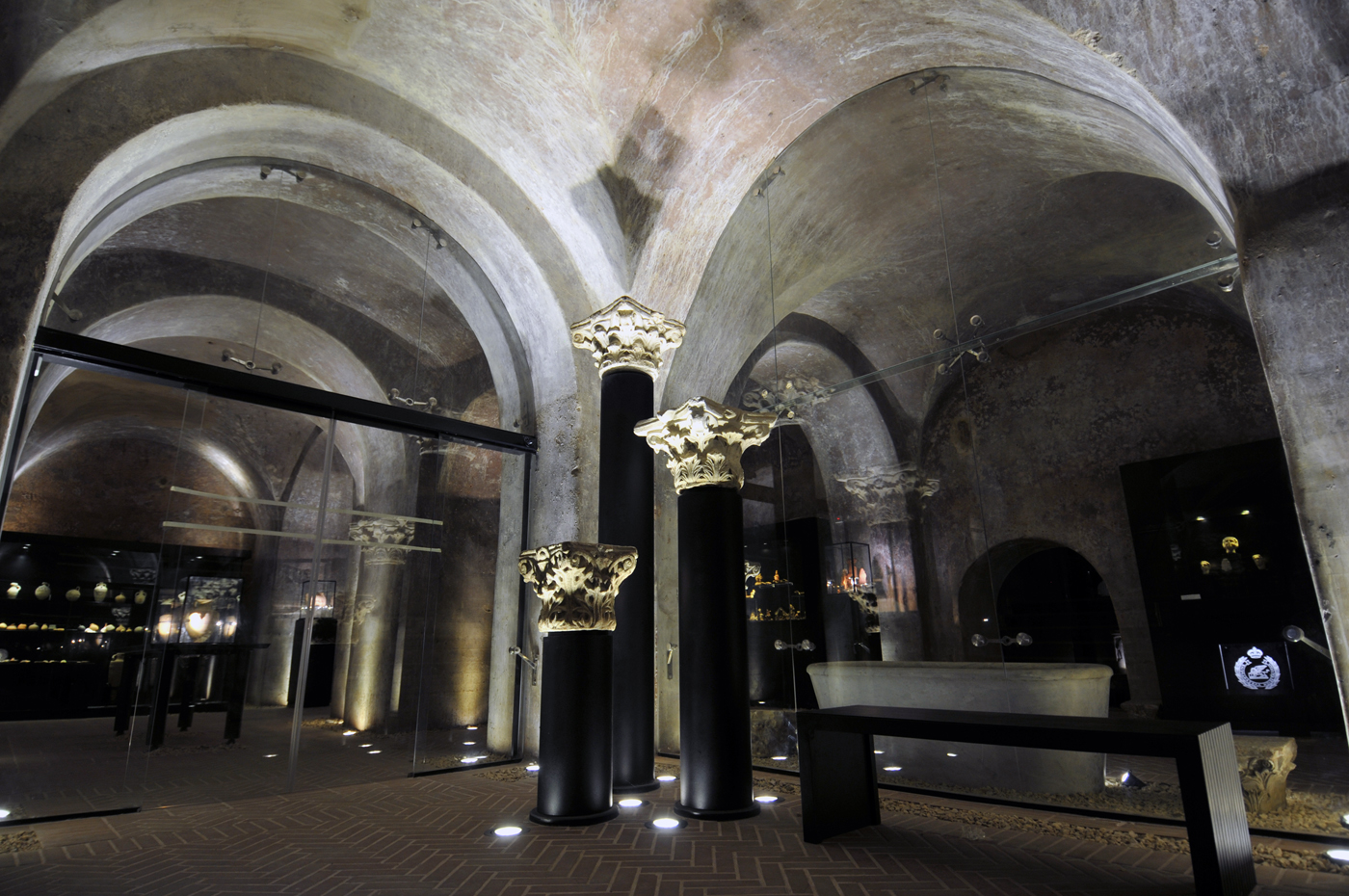
The Patriarchate of Alexandria and All Africa is probably the most ancient religious institution of the city, having remained active from the Roman period until the present day.Footnote 2 The premises of the Patriarchate are situated in the Mansheya district of Alexandria, in a building complex that had previously housed the Tositsas Boys School. This nineteenth-century landmark was extensively renovated during the 1990s and 2000s, with the aim of returning it to its former glory. The restoration process led to an unexpected archaeological discovery, which became the starting point of a development project designed to promote the ancient cultural heritage of Alexandria. A monumental cistern, dating back to the late Roman period, was discovered in the north wing of the complex. After the completion of the excavations, and on the initiative of Patriarch Theodoros II, the cistern was converted into an archaeological museum (Sacristy) in order to house the outstanding antiquities collection held by the Patriarchate. Yet what would become the most remarkable exhibit of all was the museum itself, with its spacious arched galleries, waterways and halls (Fig. 1).Footnote 3
The Patriarchal Sacristy in Alexandria. General View. Author's photo.

The museum display features many remarkable examples of art from the Pharaonic, Graeco-Roman, Byzantine and Islamic periods. The Graeco-Roman period is exhibited in the central hall of the museum, and features large and small sculptures in both classical Greek and Egyptian styles. This paper is focused on one aspect of the Graeco-Roman section: the collection of diminutive terracotta figurines from Egypt. These portray a series of popular deities hea primary concern in this paper affiliated priests and devotees, as well as ordinary humans, animals and objects.Footnote 4
Hellenistic and Roman terracotta figurines from Egypt have been extensively catalogued by scholars. They have studied them in terms of iconography and style, as well as in relation to private/domestic religious practice. It is thought that these were sacred objects, which people would take into their homes and even into their tombs, in the belief that they could extend the power of the divine image – or the rite it represented – beyond the confines of the temple and into the relevant private sphere. The approach taken here, however, is to discuss the relationship between terracotta figurines and the broader cultural and religious milieu by tracing the connections between them and other types of material evidence, such as statuary, architecture, coinage, epigraphy and funerary art. The aim is to provide a complementary perspective of the nature and role of the primary divine protagonists we find depicted as terracotta figures. The study will focus on Alexandria, the capital of Graeco-Roman Egypt, and also the most probable provenance of the majority of the museum exhibits.Footnote 5
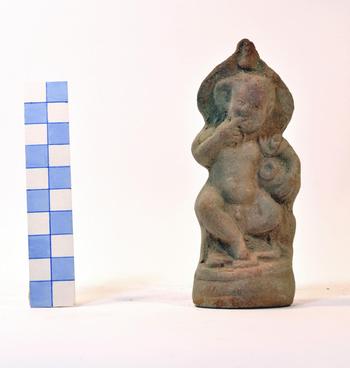
In terms of its range, the collection of divine figurines is broadly representative, consisting of Greek, Egyptian or composite deities, accompanied by the figures of priests, temple servants and devotees (1–26). Harpocrates, son of Sarapis and Isis, the deity-symbol of rebirth and fertility, was perhaps the most popular deity to be represented in terracotta figures. In this collection 13 figures depict Harpocrates, or his attendant priests and devotees (1–12 and 20). Harpocrates is typically depicted as a naked infant/an early-age child (1–8), although on occasion he is portrayed wearing cloth loosely draped around his waist area or with a cloak flowing down his back (4 and 8). He appears in various poses, seating, reclining or standing. He is typically represented in the act of making a characteristic gesture, either touching or approaching his lips with the index finger of his right hand as a sign of his infancy. Harpocrates may be depicted with curly hair, or with his head almost entirely shaved, though preserving his typical Horus side-lock. In most examples he bears a composite crown, made of the pharaonic pschent crown, placed between lotus buds. This is sometimes augmented with a thick flower wreath (1–3). In one instance, Harpocrates is depicted without a crown (8). In terms of attributes, Harpocrates may be portrayed carrying a cornucopia (1) or a wine jar (4). The latter comprises an important symbol for the celebration of the conception of Harpocrates – the ‘festival of drunkenness’ – where it was carried by his followers. In one instance he is portrayed grasping a goose (2) and in another he is portrayed riding one (7).
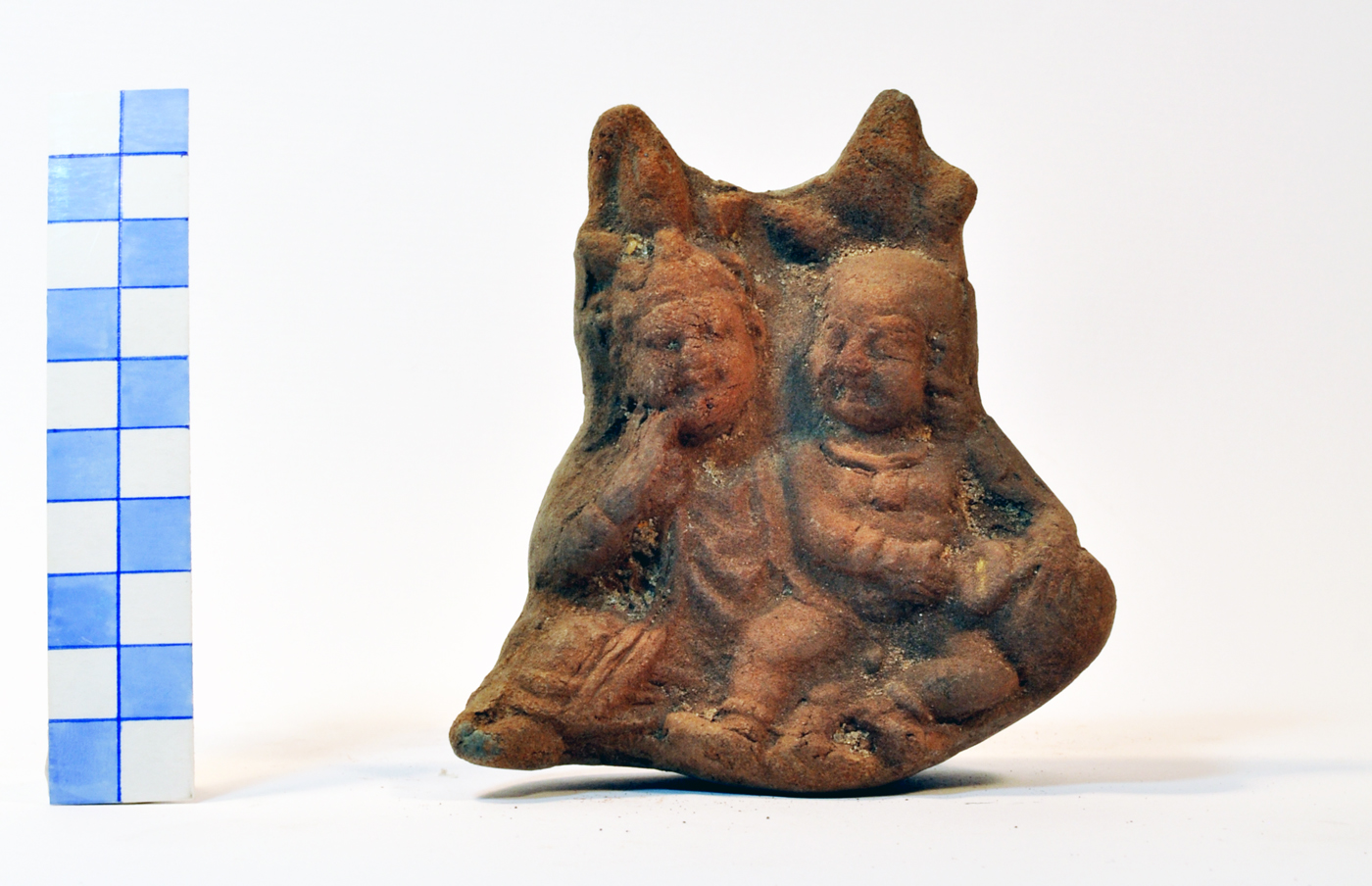
There is also a small group of two figurines in which Harpocrates is depicted as a grown child, or young adolescent, nonetheless still making his typical ‘gesture of infancy’ (9–10). In these two examples Harpocrates is depicted having the upper half of his body bare while the lower half of it is draped. He has long curly hair, crowned with a wreath of flowers and the pschent crown. Harpocrates makes his characteristic gesture with his right hand, while holding a cornucopia with his left one. In addition, the group of Harpocrates terracottas features a rare example of a double representation of Harpocrates, where the two figures differ from each other. These are usually interpreted as representations of Harpocrates and Harpocratis, his female twin. Finally, there are another three figures with Harpocratic characteristics: a fully draped, today headless, figure, making the gesture of Harpocrates with his right hand (11) and the head of a male figure, covered with a cup and having the Horus the side-lock to its right side (12). These figures may represent Harpocrates himself or perhaps priests or devotees, as in the case of figurine 20.
Apart from his individual representations, Harpocrates appears as an infant on the lap of his mother, Isis Lactans, also known in Greek as Galactotrophousa (breast-milk feeding). Isis is depicted seated on a throne, holding her left breast, about to start suckling her child. She is identifiable by her hathoric crown, the so-called Basileion, and the typical Isis knot, formed with her garment at the centre of her chest, leaving her breasts uncovered (14). Concerning Isis, the collection features another head, once part of a figurine depicting the composite serpent-bodied deity Isis-Terenouthis (15). Also, as in case of Harpocrates, there is a series of figurines of non-deities, which have been identified as priests, temple servants or devotees of Isis: 1) the head of a Kanephoros priestess (basket-bearer), crowned with a kalathos containing pine-cones and a large cobra (22); 2) two tambourine players, with characteristic Isiac coiffure and types of dress (23 and 24); and 3) a so-called African follower (25).
Osiris, brother-husband of Isis and father of Horus, also features in the collection, represented by the enigmatic yet popular figure of Osiris Hydreios situated inside a naiskos (13). In this rendering the body of Osiris assumes the form of a Hydria, surmounted by a lid portraying his head.
Bes, the Egyptian ‘ugly-faced’ protector of pregnancy and childbirth, as well as the guardian of Isis and Harpocrates, represents another popular image in the terracotta figurines repertoire, featuring in this collection in three figurines, once part of relief decoration on vases (19A–C). Bes was a major divine figure in the sacred topography of Egypt; however, no evidence survives regarding public worship of him in Alexandria.Footnote 6 Still, Bes became a popular figure in domestic use and there are numerous representations of him in terracotta at cemeteries as well (see Breccia Reference Breccia1930, 56, nos 269–76; Reference Breccia1934, 37, nos 187–97).
Finally, two major representatives of the Greek Pantheon complete the divinities portayed in the collection: 1) the lower part of a large figurine group of Aphrodite with winged Eros (17); and 2) a figurine of Zeus seated on the back of an eagle, his sacred animal (18).Footnote 7
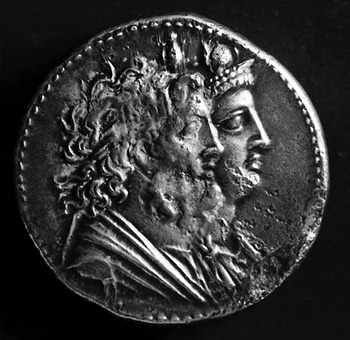
The figurine of Zeus may be the most appropriate case to begin the examination of points of commonality, borrowings and continuity. The head of the Greek Pantheon retained his principal universal character in the Roman world, but in Egypt – and particularly in Alexandria – his name and image took on a broader significance. By the time of Alexander the Great an association with Ammon had been established in the composite form of Zeus-Ammon, who was declared divine father of Alexander.Footnote 8 Throughout the Hellenistic period, the image of this ram-‘horned’ Zeus became one of the emblems of Ptolemaic kingship, most frequently promoted through coinage.Footnote 9 In Alexandria, Zeus also featured in the Ptolemaic religious regime, as a synnaos (temple-sharing) god to the deified royal couple of Euergetai (Ptolemy III and Berenike II, 246–221 bc), in a sacred venue, apparently aimed at targeting residents of Greek cultural background.Footnote 10 In addition, the portrait of Zeus seems to have been the archetype for the transformation of Osiris-Apis (Sarapis) to his Hellenistic humanised form, at least in terms of the way he was represented in the Alexandrian coinage of the Ptolemaic period. In actual fact, it is only the atef crown of Osiris on his head that differentiates the portrait of Sarapis from that of Zeus (Fig. 2).Footnote 11
Alexandrian silver tetradrachm of Ptolemy IV with jugate busts of Sarapis and Isis. Glass Negatives Archive of the Graeco-Roman Museum, AlexMed, Bibliotheca Alexandrina.

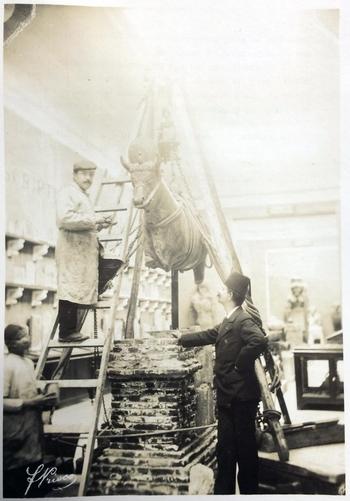
In the Roman period, the name of Zeus is attested in the monumental environment of the Great Sarapeion, which seemed to meet a true revival, especially after the extensive renovatory work carried out by Trajan and Hadrian. Hadrian was responsible for a distinctive monumental addition to the site: a shrine and statue dedicated to the Apis-bull, the original Egyptian representation of Sarapis. This marked the first occasion that the Apis-bull was introduced into the Alexandrian sanctuary (Fig. 3). Still, the statue's dedication does not feature any of the expected Egyptian names for him. Instead the dedication on the podium reads: ‘Zeus-Helios Great Sarapis’.Footnote 12 The analysis of such a phenomenon would demand a separate study in detail; nonetheless, it is clear that in such a composite cultural environment as Alexandria, Zeus had more than one ‘face’ or ‘name’, a fact that should not be ignored in a discussion regarding his nature and role.
A historical moment in Alexandrian archaeology. The installation of the Apis-bull statue in the homonymous exhibition hall of the Graeco-Roman museum of Alexandria 1898. Down to the right, G. Botti, first director of the Museum. BSRAA 2, after page 36.

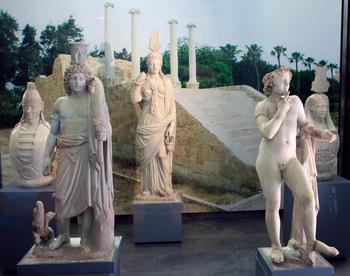
A sensitivity to the combination of elements seems appropriate for a series of divine figures such as Osiris Hydreios, Isis and Harpocrates, since in fact they are part of the same cultic category, widely known as Isiaca. They frequently shared the same sacred environment, as is the case of the so-called Ras el Soda temple of Isis, a sanctuary dating from the second century ad, once situated in an eastern suburban area of Alexandria (Fig. 4).Footnote 13
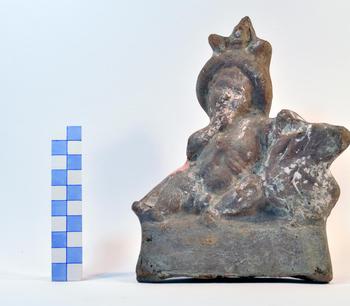
Marble statues from the Ras el Soda Temple. From left to right: Osiris Hydreios, Hermanubis, Isis, Harpocrates, Osiris Hydreios. Bibliotheca Alexandrina.

Osiris Hydreios was a popular Roman-period version of the Egyptian god of the Underworld, not only in Egypt, but also in other areas of the Empire.Footnote 14 The image of Osiris Hydreios – with a body in the form of a jar – recalls the so-called Canopic Jars into which several soft internal organs of the deceased were placed; however, by the Roman period, such funerary practices had long since ceased. It is widely accepted that the hydria-form body of Osiris is related to the sacred, life-giving water that he carries. This is also apparent in funerary contexts. Epigrams of the Roman period, for instance, include petitions to Osiris for providing the dead with his ἁγνὸν or ψυχρόν ὕδωρ (‘pure’ or ‘cold/cool water’, respectively; see IMEG 47; SB 1.335).
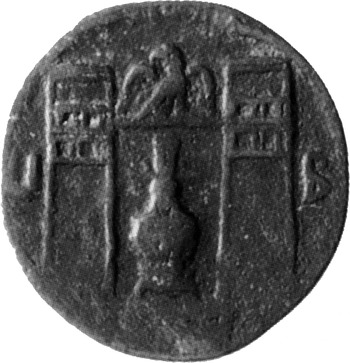
Osiris Hydreios appears frequently in Roman Alexandrian coinage, in some cases inside a temple, as either a single (Fig. 5) or paired figure (with two slightly different images of him, like in Ras el Soda) or in the hands of a priest.Footnote 15 The temple (or temples) presented in the coinage is in Egyptian style with pylon-style gates, frequently crowned by an eagle, indicating the Roman patronage of the cult. A first issue to consider would be whether the representations on coinage correspond to an actual temple that once existed in Alexandria or in a suburban area, a question which also applies to other structures and monuments presented in Roman coinage.Footnote 16 Indeed, statues of priests holding the image of Osiris Hydreios have been discovered in two areas of Alexandria, one of them in the area of the Sarapeion, and a second in the water area to the west of Akra Lochias, the cape which forms the eastern border of Alexandria's Great Harbour, by the European Institute of Underwater Archaeology, headed by Frank Goddio.Footnote 17
Osiris Hydreios in pylon-style temple. Reign of Trajan. RPC III, no. 4325.1.

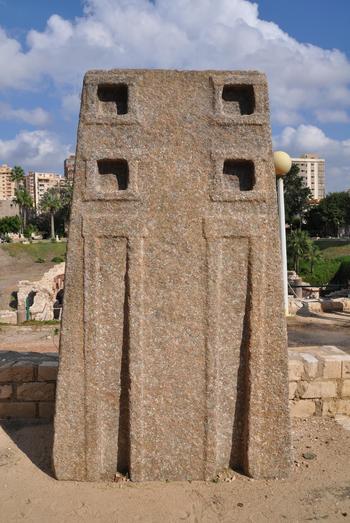
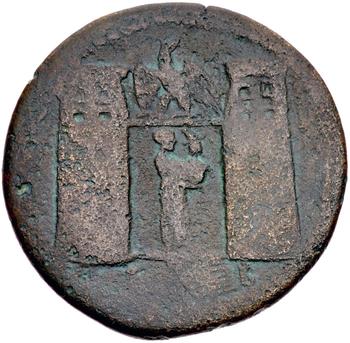
The archaeological investigation of the submerged area of Akra Lochias by the Hellenic Institute of Ancient and Mediaeval Alexandrian Studies (HIAMAS) has offered further surprising evidence regarding the existence of a pylon-style temple. The monolithic tower of a pylon gate, along with other monuments and architectural elements, was found to the east side of the cape (Fig. 6).Footnote 18 The period from Trajan to Marcus Aurelius (Antonine Dynasty, ad 98–192), which also coincides with the depictions of pylon-style temples in coinage, may be the most appropriate timeframe that could be applied for the pylon tower. Surprisingly, among those coin representations, there are a few examples that show pylon gates that seem to share strong similarities with the tower of Akra Lochias. Such is the case of the Trajan bronze coin, depicting an Isis-priest, holding Osiris Hydreios, at the doorframe of the pylon gate of a temple. The towers of the gate closely resemble that of Akra Lochias, sharing even the shape of the square ‘false windows’ (RPC III, no. 4328; Fig. 7).
Pylon tower, discovered in the submerged area of Akra Lochias. Hellenic Institute of Ancient and Mediaeval Alexandrian Studies.

Priest holding Osiris Hydreios at the entrance of pylon-style temple. Alexandria. Reign of Trajan. RPC III, no. 4329.

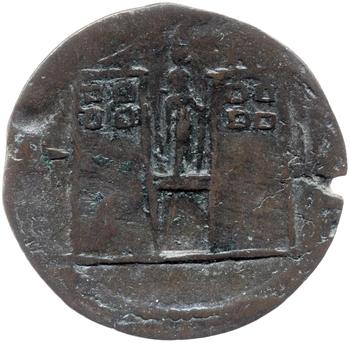
Another coin from the same regnal period presents a quite similar pylon-style temple with a statue of Isis standing on the lintel at the entrance of the temple, probably a convention of the coin’s designer (Fig. 8).Footnote 19 Perhaps, the representations of Osiris Hydreios and Isis temples on the coins refer to the same sacred venue, including both divine figures, as in the case of Ras el Soda. Besides, ancient written sources confirm the existence of an Isis temple in Akra Lochias, founded by Cleopatra VII (69–30 bc); and as material evidence from the area also suggests, this temple could have been renovated or rebuilt – or even completed – in the Roman period, as in the case of the Sarapeion and other sacred spots of the city.Footnote 20
Isis on the doorframe of a pylon-style temple. Reign of Trajan. RPC III, no. 4544.1.

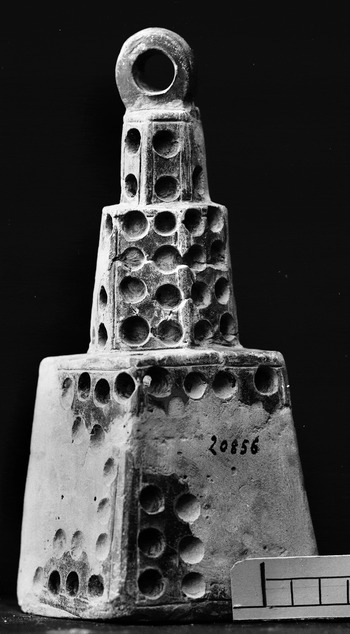
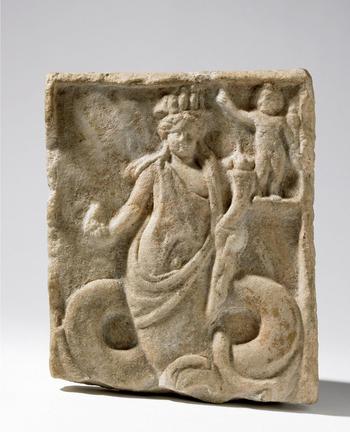
Isis represents a well-known case in the study of Graeco-Roman religion, one that needs no detailed introduction. She was one of the principal deities of the Ptolemaic period, immensely popular in both private and public spheres of life, while developing into an all-encompassing goddess. Among the ‘thousand names’ for her,Footnote 21 two are found in the Roman period Alexandrian epigraphy: those of Pharia (protector of sailors) and Plousia (wealth-bringing), corresponding to cultic spots in the city centre and on Pharos Island respectively (Fig. 9). However, none of the related cultic statues or sacred venues survives.Footnote 22 Isis also appears in coinage in at least 10 different variations, including Pharia, Euploia (provider of safe sailing), Sothis (manifestation of fertility after the inundation of the River Nile), Hydreia (corresponding to Osiris Hydreios), -Nemesis (manifestation of the sense of Justice and divine retribution), -Tyche (Fortune) and, of course, Lactans.Footnote 23 The latter version, also popular in terracotta figurines, represents one of the most iconic divine concepts of antiquity. Unfortunately, no major cultic image of Isis Lactans has been found yet in Alexandria, unlike other areas of the Graeco-Roman world.Footnote 24 Lastly, we should refer to the identification of Isis with the Egyptian snake-goddess of harvest Terenouthis, also known as Therenouthis, Thermouthis, Thermoutis and Renenutet, resulting in the image of an Isis-headed cobra. Terenouthis seemed to have enjoyed some prominence in the Graeco-Roman period, particularly in the Delta area, where a town was named after the goddess (see Franci Reference Franci2015; Fig. 10).
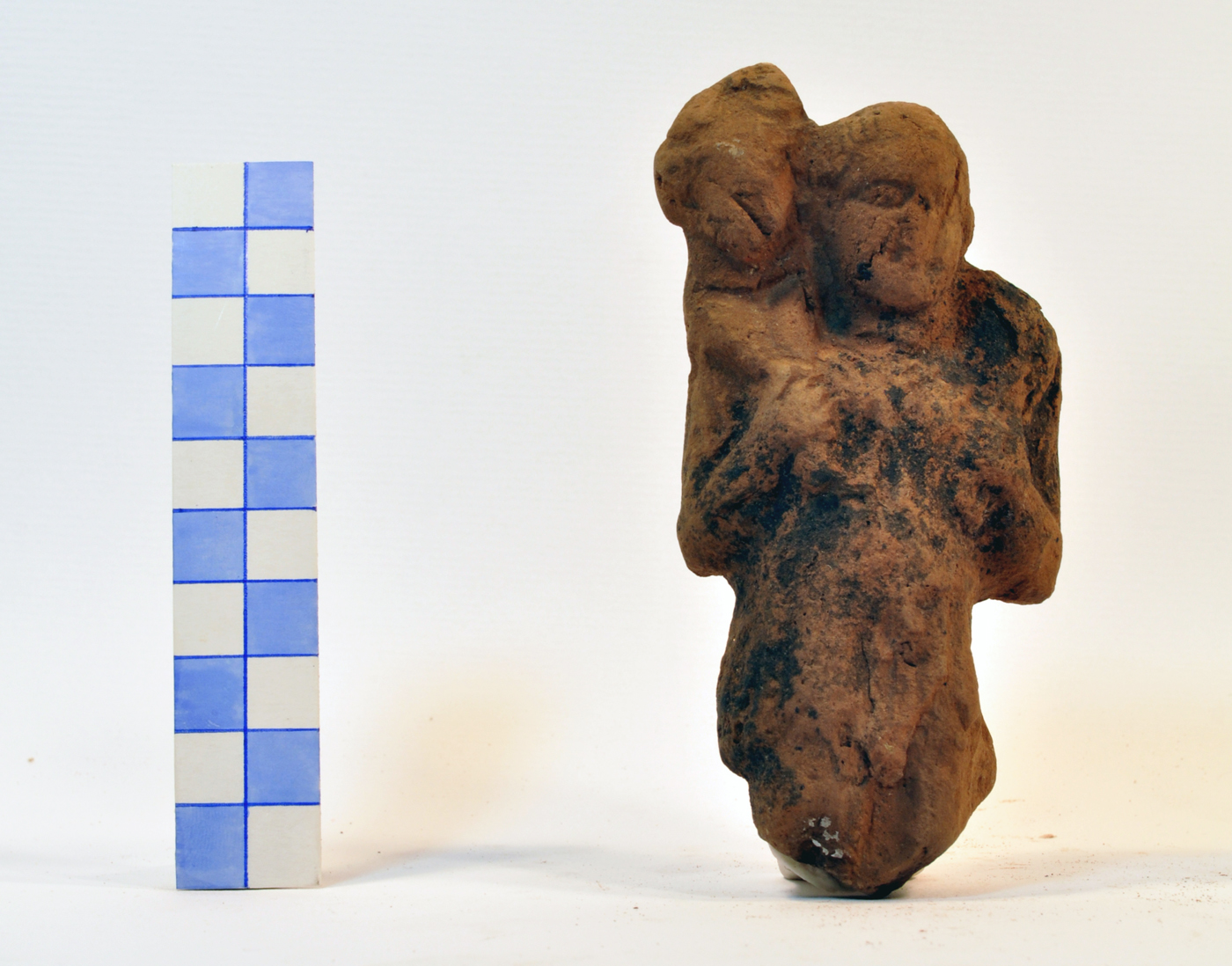
Lantern in the form of the Pharos Lighthouse, probably related to the cult of Isis Pharia in Alexandria. Alexandria, Graeco-Roman Museum 20856.

Marble relief presenting Isis-Terenouthis. From Naukratis. 1st–2nd century ad. British Museum 2005,0919.1. © The Trustees of the British Museum.

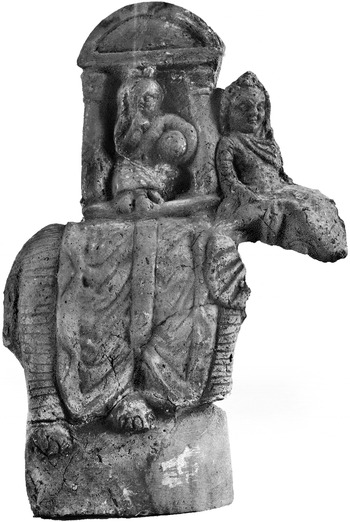
Harpocrates, son of Isis and Sarapis, is also considered a major Ptolemaic deity, whose popularity continued into the Roman Imperial period. His name comprises a transliteration of the earlier Egyptian name of the god, Hor-Pa-kheret (Horus the Child). Harpocrates obtained his own shrine in the Sarapeion of Alexandria, built by Ptolemy IV (221–205 bc), yet little is known about its fate in later times. Harpocrates is also missing from the surviving epigraphic evidence, unlike his divine parents, who ‘dominated’ the city. Still, frequent representations of him in terracotta provide doubtless evidence for his popularity in the Ptolemaic period. Among them, we should distinguish the figurine group found in the Mustapha Kamel Necropolis, probably the earliest to be discovered in context in Alexandria. It presents an image (statue?) of Harpocrates inside a naiskos, carried by an elephant. A young male figure (with ‘Harpocratic’ characteristics) rides the animal, sitting on his neck (Adriani Reference Adriani1936, 154 fig. 36; Fig. 11).
Harpocrates inside a naiskos, carried by an elephant. Found in the Mustapha Kamel Necropolis. Adriani Reference Adriani1936, 154 fig. 75.

In the Roman period, Harpocrates is frequently depicted in Alexandrian coinage, either alone or with the rest of his family, in various stages of childhood.Footnote 25 The so-called Isis temple of Ras el Soda is the only cultic spot of Harpocrates that has been discovered so far in the Alexandrian region dated to the Roman period. Meanwhile, he appears particularly affected by the identification of Isis with Aphrodite, occasionally incorporating stylistic characteristics of Eros.Footnote 26
Last but not least, Aphrodite illustrates another case of an Olympian goddess with a sustained presence, who adopted multiple faces in the Egyptian milieu. The cult of Aphrodite actually appeared in Egypt almost two centuries before the Ptolemaic period. Two temples were dedicated to Aphrodite in Naukratis, the Greek city and naval station in the Egyptian Delta, as early as the second half of the seventh century bc, from which material evidence suggests connections to Cyprus, Aphrodite's birthplace.Footnote 27 It seems that from this period on there was a wider perception of Aphrodite as an equivalent of the Egyptian goddess Hathor.Footnote 28
Aphrodite was involved in the Ptolemaic religious programme at a very early stage. She was considered a major Greek representative in the multidimensional process of Graeco-Egyptian religious syncretism, being widely identified with both Isis and Hathor.Footnote 29 Sometimes Aphrodite is even accompanied by epithets referring to her Egyptian counterparts such as Ourania, the ‘heavenly’, related to the Egyptian ‘goddess of heaven’, Hathor.Footnote 30 Aphrodite's protagonist role in the religious life of the Ptolemaic period was also guaranteed through her association with female members of the Ptolemaic family such as Arsinoe II. Aphrodite in the role of ‘the mistress of the sea’ – a cultic form imported from Cyprus – was assimilated to the deified Queen Arsinoe II Philadelphos becoming the official protector of the Ptolemaic fleet. Arsinoe also established the festival of Adonia in Alexandria, dedicated to the love affair between Adonis and Aphrodite.Footnote 31
In Roman Alexandria, Aphrodite appears in imperial ‘dress’ in a shrine included in the Caesareum, the Imperial Cult Temple of Alexandria. Her image also appears in coinage, as solely, or even part of, mythological scenes, such as in the Judgment of Paris, mainly during the Antonine Dynasty (Trajan to Marcus Aurelius, ad 98–192). The protagonist role of Aphrodite in the religious life of Roman Alexandria is further attested in the frequent depictions of her in statuary, corresponding to well-known typologies from other areas of the Graeco-Roman world, also included in the terracotta repertoire. The most beautiful example of all is the statue group of Aphrodite and Eros from Mehamara, a suburban district to the east of Alexandria, found along with other cultic images of Greek (-Roman) and Egyptian gods, once synnaoi in a local sanctuary (Fig. 12).Footnote 32 Meanwhile, she appears in a funerary context in the necropolis of Alexandria as the manifestation of life in the realm of the dead, frequently associated with Isis and Hathor. She is also sometimes represented in mythological vignettes in Alexandrian tombs, where she is depicted in scenes such as the Abduction of Persephone. Nonetheless, the decorative registers of the so-called Persephone Tombs also include some of the most traditional Egyptian subjects from the Cycle of Osiris.Footnote 33
Aphrodite of the Mehamara Collection, today in the Antiquities Museum of the Bibliotheca Alexandrina. Originally, Graeco-Roman Museum 29456. Bibliotheca Alexandrina.

A bilingual funerary environment of this nature would come as a surprise in any other part of the Roman world. However, in the City of Alexander, such examples of cross-cultural dialogue were frequent, and are representative of a long-established, and continuous, multicultural modus vivendi. Tracing the roots of this phenomenon leads one to the inception of the Ptolemaic dynasty and to the royal policies aiming to augment – not to replace or detach – the pre-existing divine milieu of their kingdom. Their contribution was more than just the placing of a group of Greek or new composite deities, ext to the traditional Egyptian gods. Rather, it was the promotion of a pioneering, comparative way of thinking and living, for those who wished to become part of Ptolemies’ ‘new’ Egypt, regardless of their cultural background. The terms were extremely flexible, particularly in matters of religion, allowing people to develop their own individual repertoire of choices.
Without a doubt, it was this enormously influential Hellenistic cultural legacy that endowed the Alexandrian ‘school of religion’ with the means to not only adapt to the Roman period, but also to enjoy another period of efflorescence resulting in an ever-increasing repertoire of options for the blessed life and in the hereafter. Thus, major protagonists, such as Zeus, Osiris, Isis, Aphrodite and other deities, were transformed into polyvalent divine entities, able to exert agency in a multicultural milieu, which over the course of time seems to have acquired distinctive patterns of principles and rights.
CATALOGUE OF TERRACOTTA FIGURINES IN THE PATRIARCHAL SACRISTY IN ALEXANDRIA
1. Harpocrates (Fig. 13)
Height: 20.8 cm
State: complete; traces of white slip; slightly worn mould.
Clay: medium clean with a few inclusions. Brown Nile silt fabric.
Craft technique: hollow. Handmade back with very small round vent.
Date: 2nd–1st century bc (?)
Harpocrates (no. 1).

Standing naked figure of Harpocrates. His index finger is raised to the lips, a characteristic gesture of Horus the Child since the indigenous Pharaonic period. He holds a jar vertically in his left hand, while resting his forearm on a pillar. His curly hair is visible on his forehead, and falls to his shoulders. He is crowned with a thick wreath surmounted by the pschent crown (the Pharaonic double crown of Upper and Lower Egypt). The arrangement is similar to those found on a female version of Harpocrates, Harpocratis; however, the latter has emphasised female characteristics that are not detectable in this figurine, at least in its current state. The figure sits on a low, rectangular base.
Comparanda: Breccia Reference Breccia1934, no. 50; Dunand Reference Dunand1979, nos 190–2; Reference Dunand1990, nos 153–4; Fjeldhagen Reference Fjeldhagen1995, no. 11; Bailey Reference Bailey2008, nos 3044 and 3083 (Harpokaratis).
2. Harpocrates (Fig. 14)
Height: 17.4 cm
State: complete; chip on the surface; traces of gypsum layered on clay; slightly worn mould.
Clay: clean with a few inclusions. Brown Nile silt fabric.
Craft technique: hollow. Handmade back with small round vent.
Date: 2nd century bc?
Harpocrates (no. 2).

Seated figure of Harpocrates, leaning to the left. He is depicted naked, touching his lips with the index finger of his right hand, while holding a goose with his left hand. He is crowned with a thick wreath with two ribbons falling on the shoulders and the pschent crown. The figure stands on a high, rectangular base.
Comparanda: Dunand Reference Dunand1979, no. 229; Fjeldhagen Reference Fjeldhagen1995, no. 1; Bailey Reference Bailey2008, nos 3053 and 3057 (without goose).
3. Harpocrates (Fig. 15)
Height: 16 cm
State: complete; few chips on the surface; traces of gypsum layered on clay. Good condition of mould with well-defined details.
Clay: medium clean with a few inclusions. Brown Nile silt fabric.
Craft technique: hollow. Handmade back with small round vent.
Date: Ptolemaic period
Harpocrates (no. 3).

The figure is seated on a high, rectangular base and tilts to the left. Harpocrates is presented naked wearing an x-form patterned chain (periammea) with a medallion at the centre of his chest. Curly hair is visible on his forehead. Harpocrates is crowned with a thick wreath, and the pschent crown is set between lotus buds. His right hand is raised to the lips – in his iconic gesture. The area to his left is indistinct; he may be grasping a goose, or it is possible that this portrays his tunic falling from his horizontally projected left arm.
Comparanda: Dunand Reference Dunand1990, no. 120; Fjeldhagen Reference Fjeldhagen1995, no. 2; Naukratis DD019.
4. Harpocrates (Fig. 16)
Height: 11.2 cm
State: complete; traces of gypsum layered on clay; a few chips on the surface; slightly worn mould.
Clay: medium clean with some inclusions. Brown Nile silt fabric.
Craft technique: hollow. Handmade back with very small round vent.
Date: Roman period
Harpocrates (no. 4).

Harpocrates seated with his left leg folded beneath him. He is represented nude, apart from his left shoulder which is covered by his tunic that falls behind. With his right hand, he makes the characteristic gesture of touching his lips; his left hand supports a vase under his left arm that is tipped forwards. The head is shaved, preserving to the right side the characteristic side-lock of Horus; he wears the pschent crown. The figure sits on a three-tiered rectangular base.
Comparanda: Naukratis DD006 and DD098 (the pose).
5. Group with two figurines of Harpocrates (Harpocrates and Harpocratis?) (Fig. 17)
Height: 10 cm
State: complete; chips on the surface; medium condition of mould.
Clay: medium clean with inclusions. Brown Nile silt fabric.
Craft technique: mould-made from two moulds, front and back. The back mould is less refined.
Date: Roman period?
Harpocrates (no. 5).

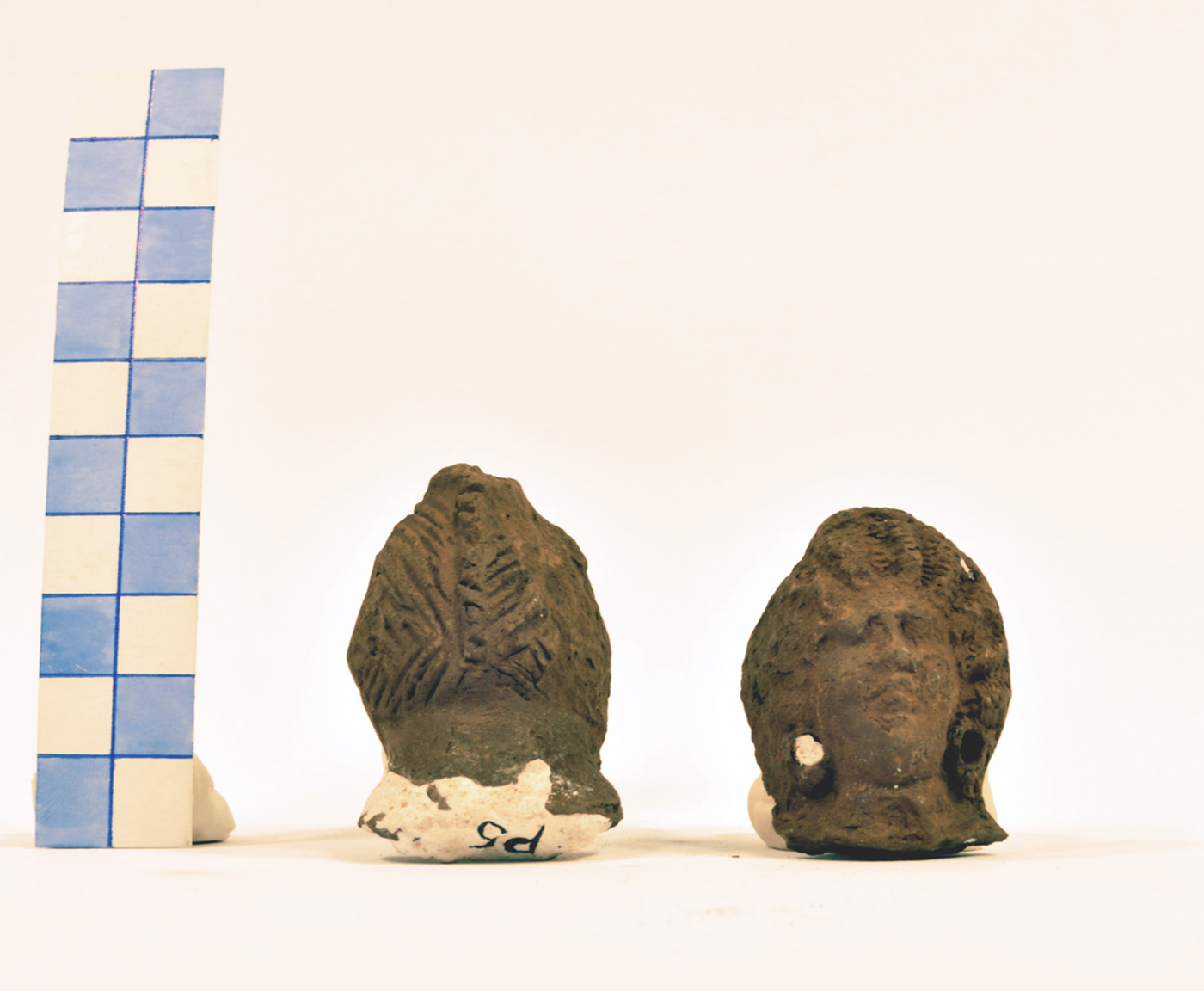
A rare example of a double representation of Harpocrates, each differing from the other. The left figure is clothed in a garment that reaches to the ankles. The index finger of his right hand is raised in the characteristic gesture, touching his lips. The head is crowned with a conical headdress, which bears round ornaments that are indistinct in their current state, surmounted with a pschent crown set between lotus buds. Such female figures have been interpreted also as Harpocratis, the female version of Harpocrates. To the right side of his head is the side-lock of Horus. The right figure is naked, holding a vase with his left hand, under the arm. He is seated and his left leg is folded under him. He wears a necklace with a round medallion, hanging from the middle, and ankle bracelets. The head appears to be shaved whilst preserving the characteristic side-lock of Horus. There is no base.
Comparanda: Breccia Reference Breccia1934, nos 131–3; Dunand Reference Dunand1979, nos 220–1; Reference Dunand1990, no. 266; Bailey Reference Bailey2008, nos 3048 and 3057 (Harpocratis); Naukratis DD115 (Harpocratis).
6. Head of Harpocrates (Fig. 18)
Height: 8.2 cm
State: fragmentary; missing rest of body; good quality mould. Traces of white slip.
Clay: medium clean with some inclusions. Brown Nile silt fabric.
Date: Roman period
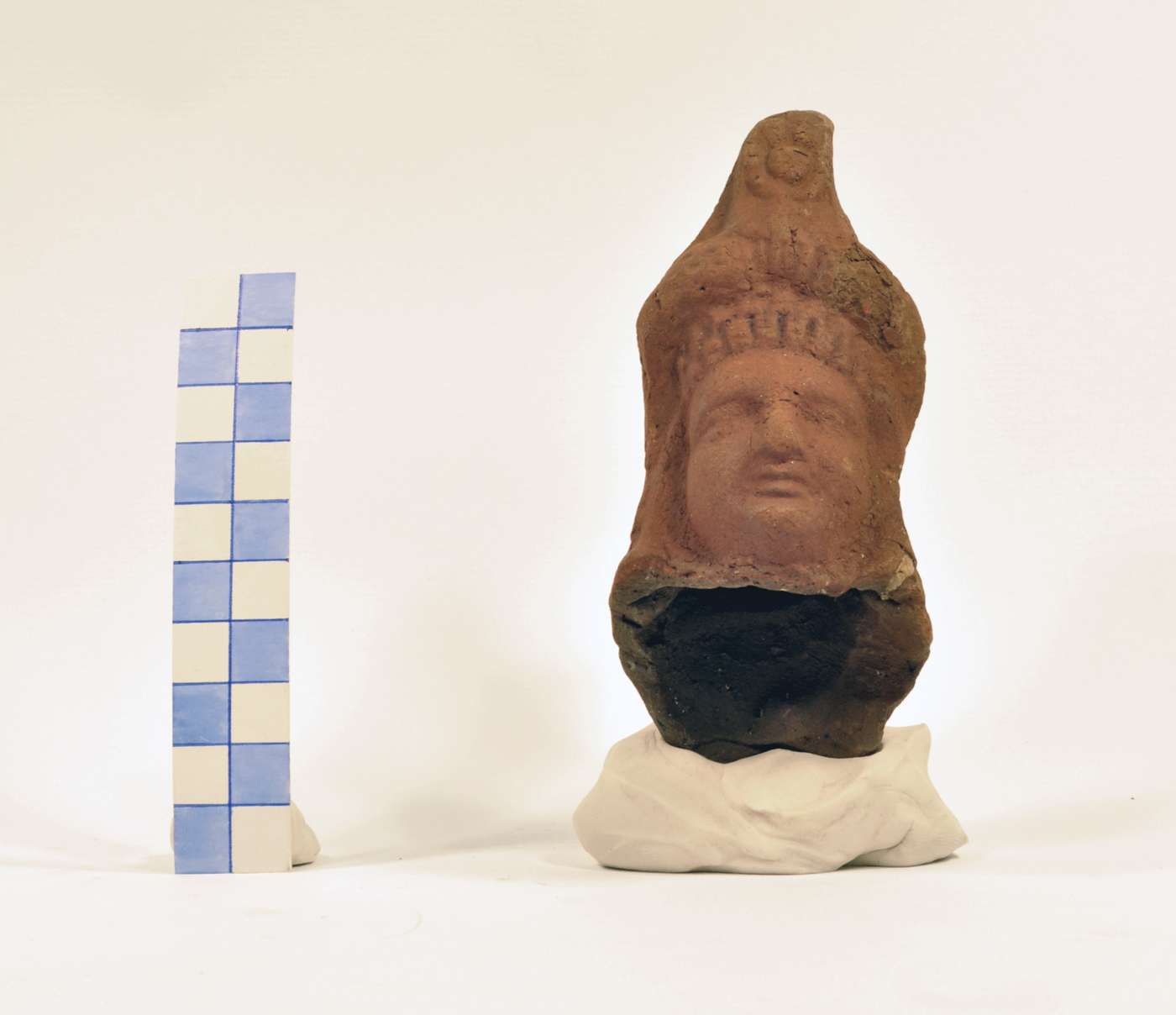
Harpocrates (no. 6).

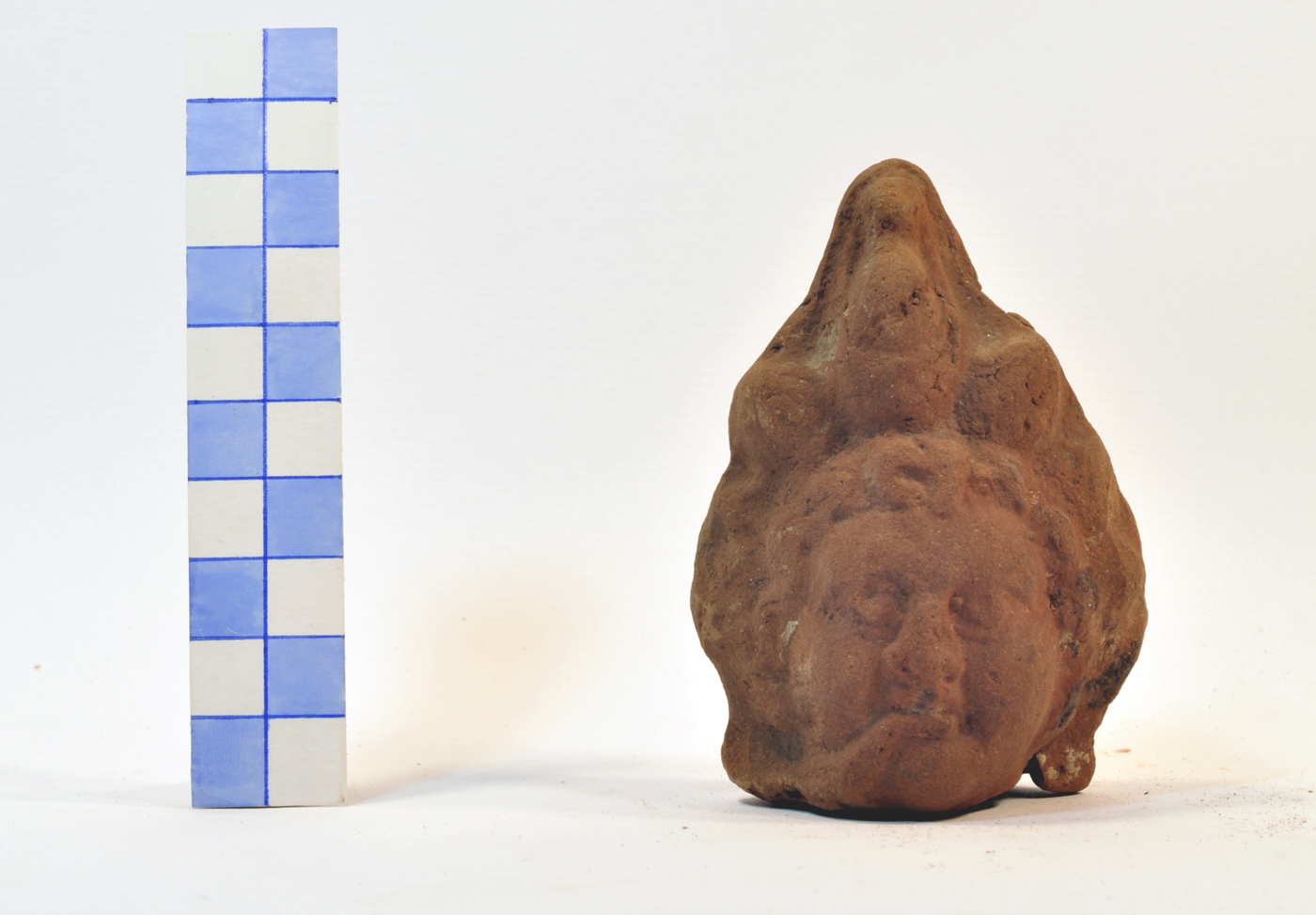
Head of Harpocrates with curly hair framing the face; he wears the pschent crown set between lotus buds. The index finger of his right hand is raised in a characteristic gesture touching his lips.
Comparanda: Breccia Reference Breccia1930, no. 198; Reference Breccia1934, no. 112; Dunand Reference Dunand1990, nos 279, 289 and 298; Pingiatoglou Reference Pingiatoglou1993, nos 34, 40 and 41.
7. Harpocrates riding a goose (Fig. 19)
Height: 16.8 cm
State: complete, two joining fragments; chips and cracks on the surface. Good condition of mould. Hollow.
Clay: medium clean with inclusions. Black core. Brown Nile silt fabric.
Craft technique: hollow. Handmade back with small round vent.
Date: 1st century bc?
Harpocrates (no. 7).

The goose is depicted to the right. The legs are rendered with incised parallel lines. Harpocrates sits with torso and head front, body in profile. The upper part of Harpocrates's body is naked, while the lower part is draped. His right hand is raised to his lips, making the characteristic gesture. He is crowned with two lotus buds and holds a sceptre with his left hand. The side-lock of Horus is visible on the right side. The figure stands on a thin rectangular base.
Comparanda: Dunand Reference Dunand1979, nos 222–8; Pingiatoglou Reference Pingiatoglou1993, no. 26; Fjeldhagen Reference Fjeldhagen1995, no. 2; Török Reference Török1995, nos 84 and 85; Bailey Reference Bailey2008 no. 3073; Bibliotheca Alexandrina 418.
8. Harpocrates (Fig. 20)
Height: 9.3 cm
State: fragmentary; missing hands and left forearm; head broken, stuck back to the body, after conservation; traces of gypsum layered on clay. Worn mould.
Clay: medium clean with inclusions. Brown Nile silt fabric.
Date: Roman period
Harpocrates (no. 8).

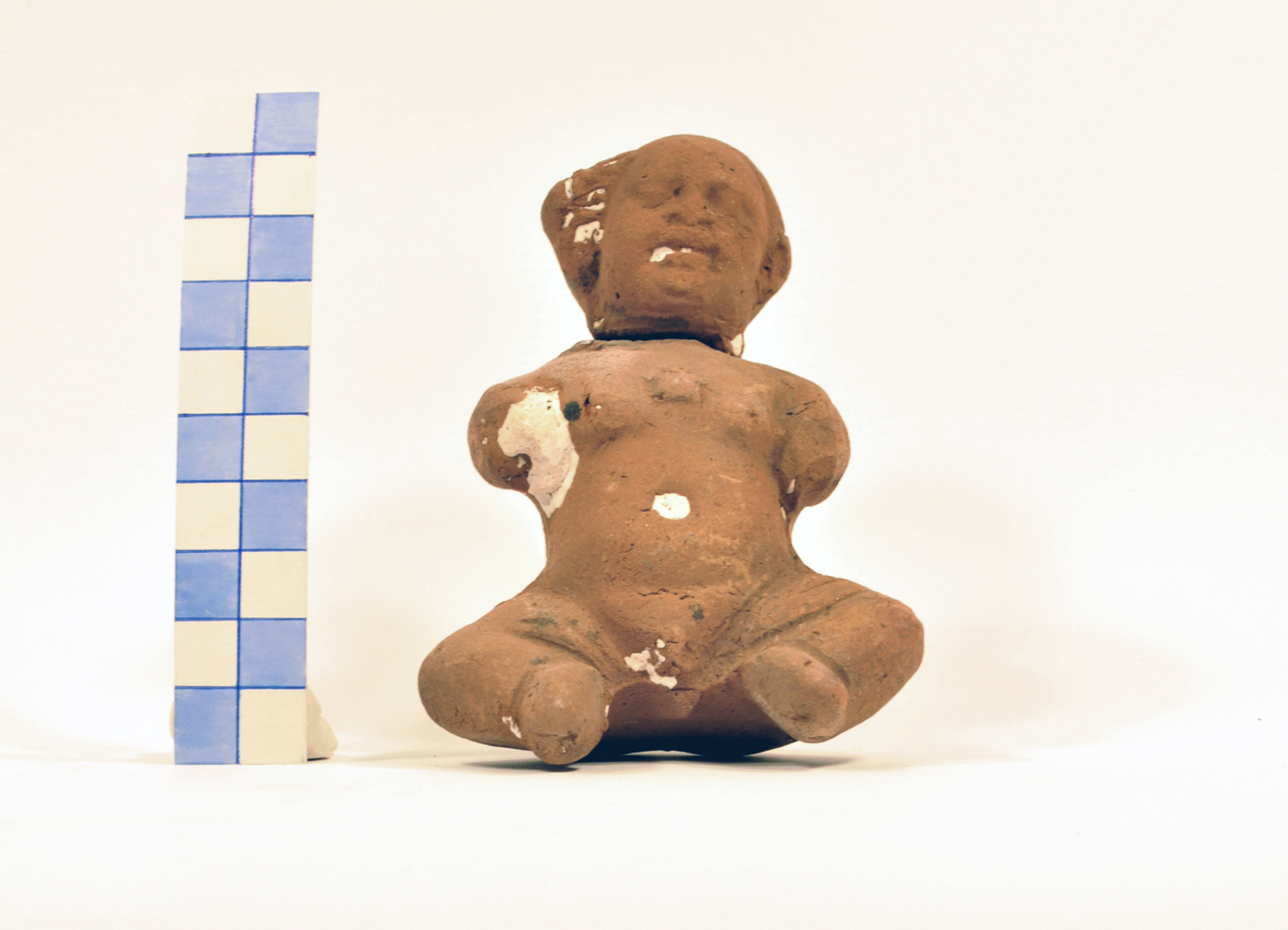
Naked male infant, seated with legs bent, knees turned out. He wears a necklace with seal at the centre of his chest. His head is shaved, preserving the characteristic side-lock of Horus. The figure is nude on the top part of the body, but the thighs are covered with a garment, leaving the pubic area uncovered.
Comparanda: Breccia Reference Breccia1934, no. 88; Dunand Reference Dunand1979, nos 134–7; Török Reference Török1995, nos 68–70 and 194–5.
9. Harpocrates (Fig. 21)
Height: 14.8 cm
State: complete; traces of gypsum layered on clay. Good condition mould.
Clay: medium clean with many inclusions. Brown Nile silt fabric. Discolouration on the top and left side.
Craft technique: mould-made from two moulds, front and back. The back mould is less refined.
Date: Roman period
Harpocrates (no. 9).

The figure stands in contrapposto with the right leg supporting its weight and the left leg bent. The upper half of the torso is bare. He wears a cloak, draped over the left shoulder, covering the lower part of the body, and leaving the upper half uncovered. A roll of folds is created below the belly. With his left arm he cradles a large cornucopia which rests on his shoulder. Long curly hair appears on the sides and on the forehead, in the middle of which a part is banded into a knot. He is crowned with a thick wreath surmounting a pschent crown set at the centre. With the index finger of his right hand, he makes the characteristic gesture of touching his lips. The figure stands on a thin oval base.
Comparanda: Dunand Reference Dunand1990, no. 157; Fjeldhagen Reference Fjeldhagen1995, no. 10; Bibliotheca Alexandrina 456.
10. Harpocrates (Fig. 22)
Height: 10.8 cm
State: fragmentary; preserved from belly button upwards; chips on the surface. Good quality mould, better definition than 9.
Clay: medium clean with inclusions. Brown Nile silt fabric. Black core.
Craft technique: hollow. Mould-made on both sides, front and back. The back side is less refined.
Date: Roman period
Harpocrates (no. 10).

Similar to 9. He holds the cornucopia resting on his left shoulder. There might be a snake behind the cornucopia.
11. Harpocrates (?) (Fig. 23)
Height: 22 cm
State: fragmentary; head missing; minor damages on surface of the upper part; traces of gypsum layered on clay. Mediocre quality of mould.
Clay: medium clean with inclusions. Brown Nile silt fabric. Discolouration on the top of the amphora.
Craft technique: hollow. Handmade back with small round vent.
Date: 2nd–1st century bc
Harpocrates, or a priest or devotee (no. 11).

The figure stands frontally with its right hand raised toward the mouth and the left hanging by its side. It wears a garment below the belly. The figure stands between two jars, placed on the floor. The left is a wreathed amphora with ribbons falling down each side. It stands on a high, rectangular base.
The identification of this headless draped figure as Harpocrates is based on the preserved part of his right hand - missing its palm – which is turned towards the mouth. Otherwise, the figure could represent a priest or devotee, related to the cult of Harpocrates. The amphora looks Hellenistic. The amphora has a wreath and wine is associated with the ‘festival of drunkenness’ and the conception of Harpocrates.
12. Harpocrates (?) (Fig. 24)
Height: 9.1 cm
State: fragmentary, preserving the head and neck; parts of cornucopia (or torch?) are preserved. Good quality mould.
Clay: medium clean with a few inclusions. Brown Nile silt fabric. Black core.
Craft technique: hollow. Handmade back.
Harpocrates, or a priest or devotee (no. 12).

Head of Harpocrates. The head is shaved, covered with a cap and features the side-lock of Horus to its right. The eyes have slits for the pupils. To the right of the figure, there is an unclear object, probably a cornucopia.
13. Osiris Hydreios in a naiskos (Fig. 25)
Height: 16.5 cm
State: nearly complete; broken on top of pediment; chips on the surface.
Clay: medium clean with inclusions. Brown Nile silt fabric. Black core.
Craft technique: Hollow. Handmade back with very small round vent.
Date: 1st century bc–1st century ad, onwards
Osiris Hydreios in a naiskos (no. 13).

A rare example of Osiris Hydreios (hydria with an Osiris-form lid on its top) inside a naiskos, consisting of a segmented pediment (tympanum broken), carried by two columns, standing on a trapezoid base. On the vase there are symbols frequently found in images of Osiris Hydreios, such as the solar disc with an ornamented pectoral gem on its top. The head is depicted wearing the nemes headdress, crowned with plumes supported by horns, fronted by a sun disk and flanked on its side by a uraeus.
Comparanda: Breccia Reference Breccia1930, nos 239 (Osiris Hydreios) and 342 (priest holding Osiris Hydreios); Dunand Reference Dunand1990, nos 426–32 (Osiris Hydreios); Török Reference Török1995, no. 292 (shrine).
14. Isis Lactans (Fig. 26)
Height: 17.1 cm
State: complete; chips and cracks on the surface; traces of gypsum layered on clay. Worn mould.
Clay: medium clean with inclusions. Brown Nile silt fabric.
Craft technique: hollow. Handmade back with small round vent.
Date: Roman period
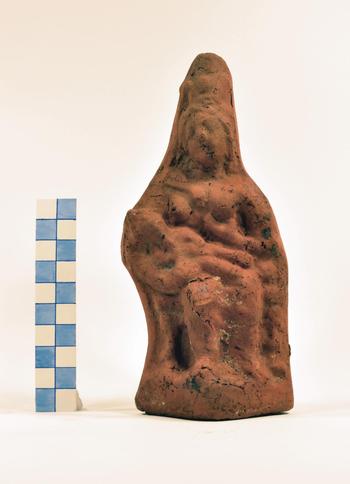
Isis Lactans (no. 14).

A figurine of Isis seated on a throne, nursing her son Harpocrates. Isis is crowned with the hathoric crown (Basileion). Her garment features the emblematic Isis knot between her breasts, which are uncovered. She holds Harpocrates with her right hand, while with her left hand she holds her left breast in order to bring her son close to it and suckle him. Harpocrates makes the characteristic gesture, touching his lips with the index finder of the right hand. The group stands on an oval base.
Comparanda: Breccia Reference Breccia1930, nos 237, 240, 381 and 481; Dunand Reference Dunand1979, nos 1–4; Reference Dunand1990, nos 369–75; Petrie UC48241.
15. Head of Isis (-Terenouthis?) (Fig. 27)
Height: 11 cm
State: fragmentary; the whole body missing; chips and cracks on the surface. Worn mould.
Clay: medium clean with a few inclusions. Brown Nile silt fabric. Black core.
Craft technique: hollow.
Date: 1st century bc–1st century ad, probably Roman period
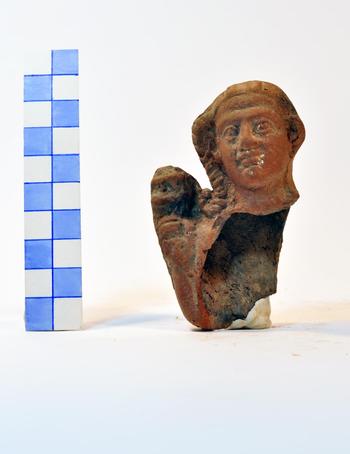
Head of Isis (-Terenouthis?) (no. 15).

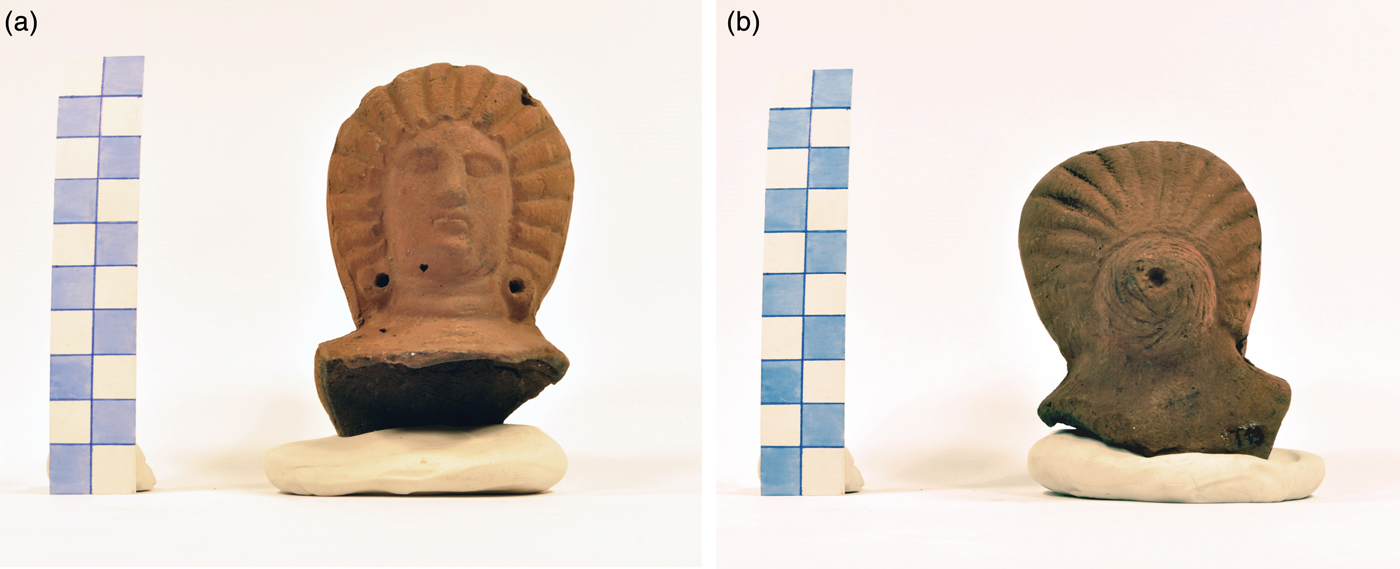
Head from a large figurine with stylised, spiral curls on the forehead and the hathoric crown. Such heads are frequently represented in Isis-Therenouthis images, combined with a serpent body. Her cult was particularly popular in the area of Fayum, which was also a major production centre for terracotta figurines.
Comparanda: Breccia Reference Breccia1934, nos 32 and 36; Dunand Reference Dunand1979, no. 27; Reference Dunand1990, nos 387–90, 397 and 398; Pingiatoglou Reference Pingiatoglou1993, no. 272 (interpreted as dancer); Bailey Reference Bailey2008, no. 3018.
16. Zeus (Fig. 28)
Height: 17.9 cm
State: complete; features worn; chips and cracks on the surface; traces of gypsum layered on clay.
Clay: coarse with inclusions. Brown Nile silt fabric. Black core.
Craft technique: hollow. Handmade back with very small vent.
Date: Roman period
Zeus (no. 16).

Figure of Zeus, seated on the back of an eagle, his sacred animal. The body is directed right whilst the head is depicted in a frontal position. His himation is draped over the head, then falls down over the left shoulder, covering his legs, while leaving the chest and the belly uncovered. His sceptre rests diagonally against his left shoulder. Originally there would have been a diadem on his curly hair and the details of his beard would have been visible. The group stands on a trapezoid base.
Comparanda: Breccia Reference Breccia1934, no. 144; Pingiatoglou Reference Pingiatoglou1993, no. 60; Bailey Reference Bailey2008, nos 3324–5; Dunand Reference Dunand1990, 480–2.
17. Aphrodite with winged Eros (Fig. 29)
Height: 15.4 cm
State: single fragment, diagonally broken; legs and left forearm of Aphrodite only preserved; chips and cracks on the surface. Eros in complete state.
Clay: medium clean with some inclusions. Brown Nile silt fabric.
Craft technique: hollow. Mould-made for both sides, front and back.
Date: Roman period
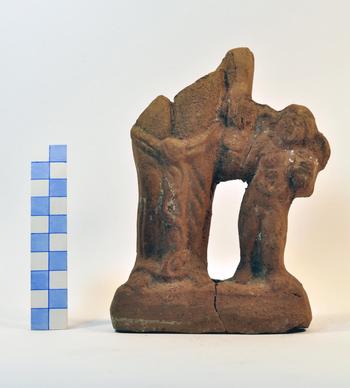
Aphrodite with winged Eros (no. 17).

Fragment of a large figurine group. Aphrodite is portrayed standing frontally. Her left arm is lowered to the side. Aphrodite's himation is loosely knotted to the thighs, above her knees. A winged Eros stands to her left. He tilts to the left, holding Aphrodite's left hand with his right arm. The left arm is bent at the elbow and raised to the clavicle. He looks up to his mother. The group stands on a rectangular base.
Comparada: Breccia Reference Breccia1930, no. 174; Dunand Reference Dunand1990, no. 7; Bailey Reference Bailey2008, nos 3348–50.
18. Female Deity (?) (Fig. 30)
Height: 6.3 cm
State: fragmentary; missing the body. Chips and cracks on the surface. Mediocre quality of the mould.
Clay: medium clean with inclusions. Brown Nile silt fabric.
Craft technique: hollow.
Date: 2nd century bc
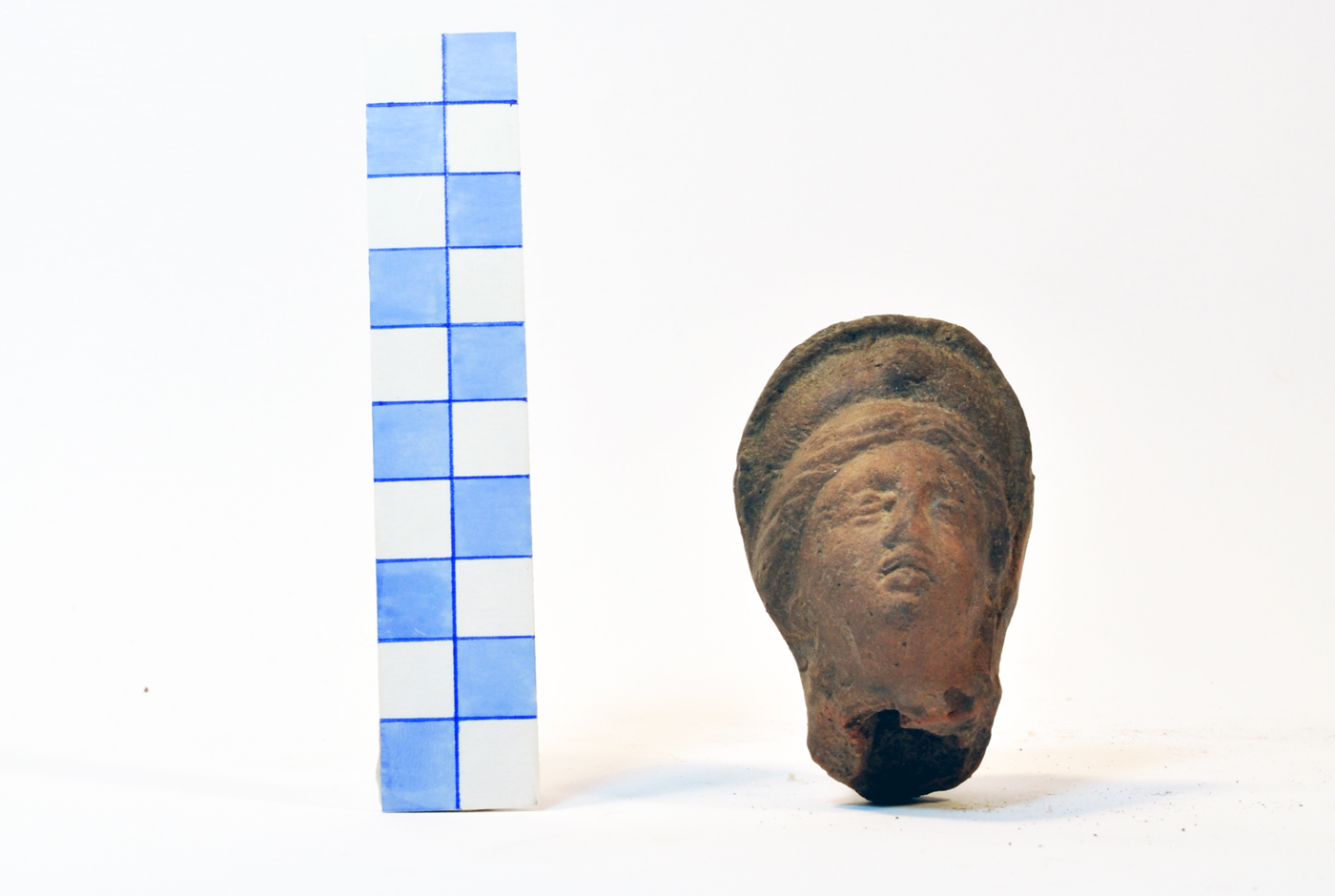
Female Deity (?) (no. 18).

Head of a female figure, with eyes deep-set and two curls of hair tied in a bow on her forehead and the rest drawn back in ringlets round the neck. The head is crowned with a stephane. Such figures are frequently identified as deities, including Aphrodite, Isis, Hera and Demeter.
Comparanda: Dunand Reference Dunand1990, nos 67, 71–3; Pingiatoglou Reference Pingiatoglou1993, nos 91–9; Szymańska Reference Szymańska2005, no. 206; Bailey Reference Bailey2008, no. 3326; Naukratis DD244 (Hera).
19. Three Figures of Bes (Figs 31–33)
Height: A: 14 cm; B: 18.8 cm; C: 10.8 cm
State: fragmentary; chips and cracks on the surface; detached from vases; traces of gypsum layered on clay, on which coloured decoration was applied; the blue colour is visible around the face on specimen A. Specimen C has red colour on the ears, nose and mouth and some traces of blue on the face, while the eyes are painted with black colour.
A: broken below the waist, with some small breaks on the headdress. Worn mould. Handmade back.
B: broken above the forehead and below the thighs. Good condition of the mould. Handmade back.
C: only the head survives. Good condition of the mould.
Clay: coarse with many inclusions. Brown Nile silt fabric. Black core in all examples.
Date: A and C: 4th–3rd century bc; B: Ptolemaic period
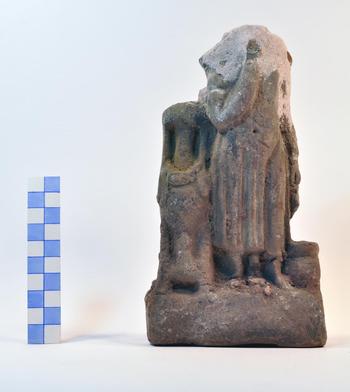
Bes (no. 19a).

Bes (no. 19b).

Bes (no. 19c).

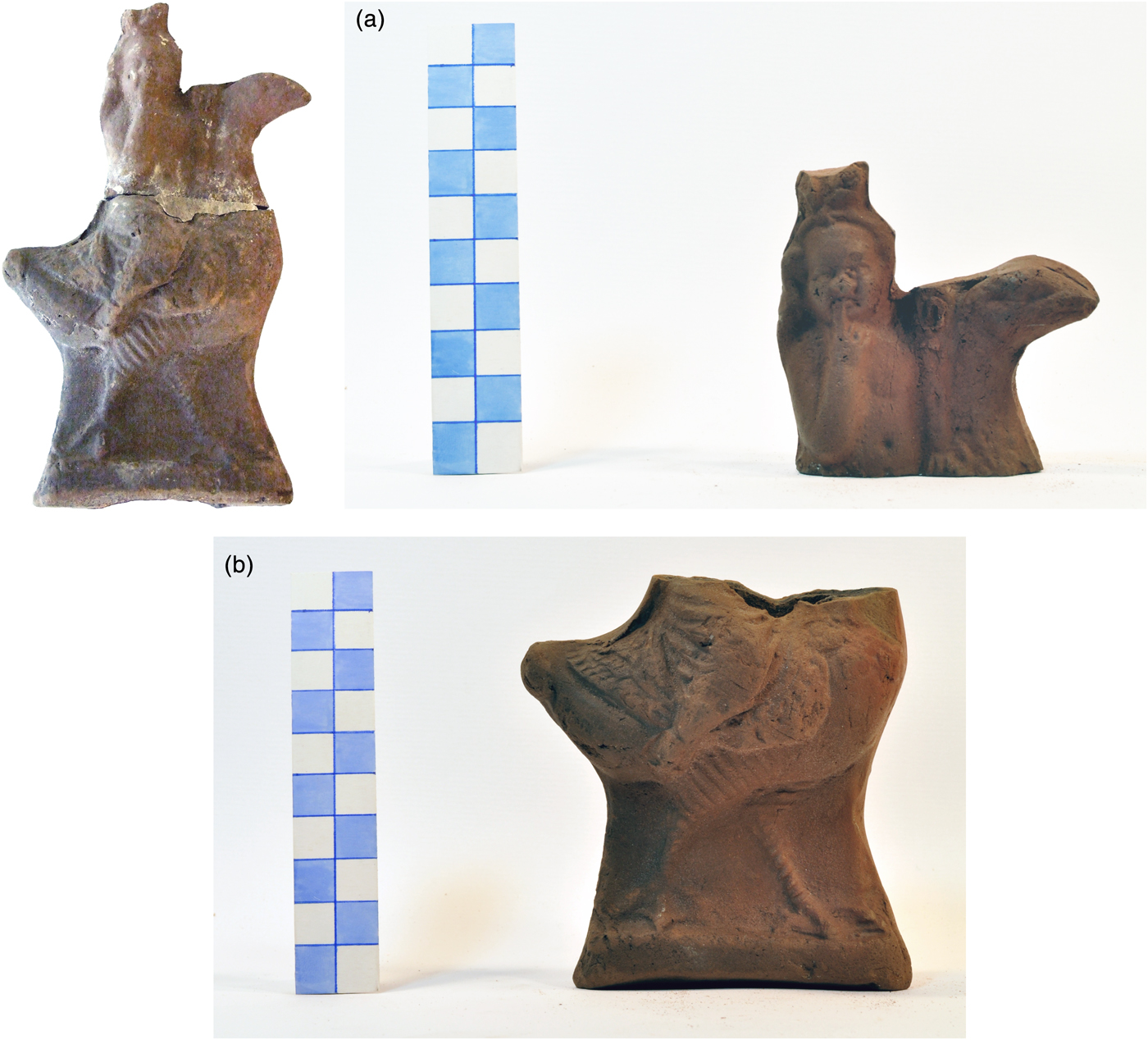
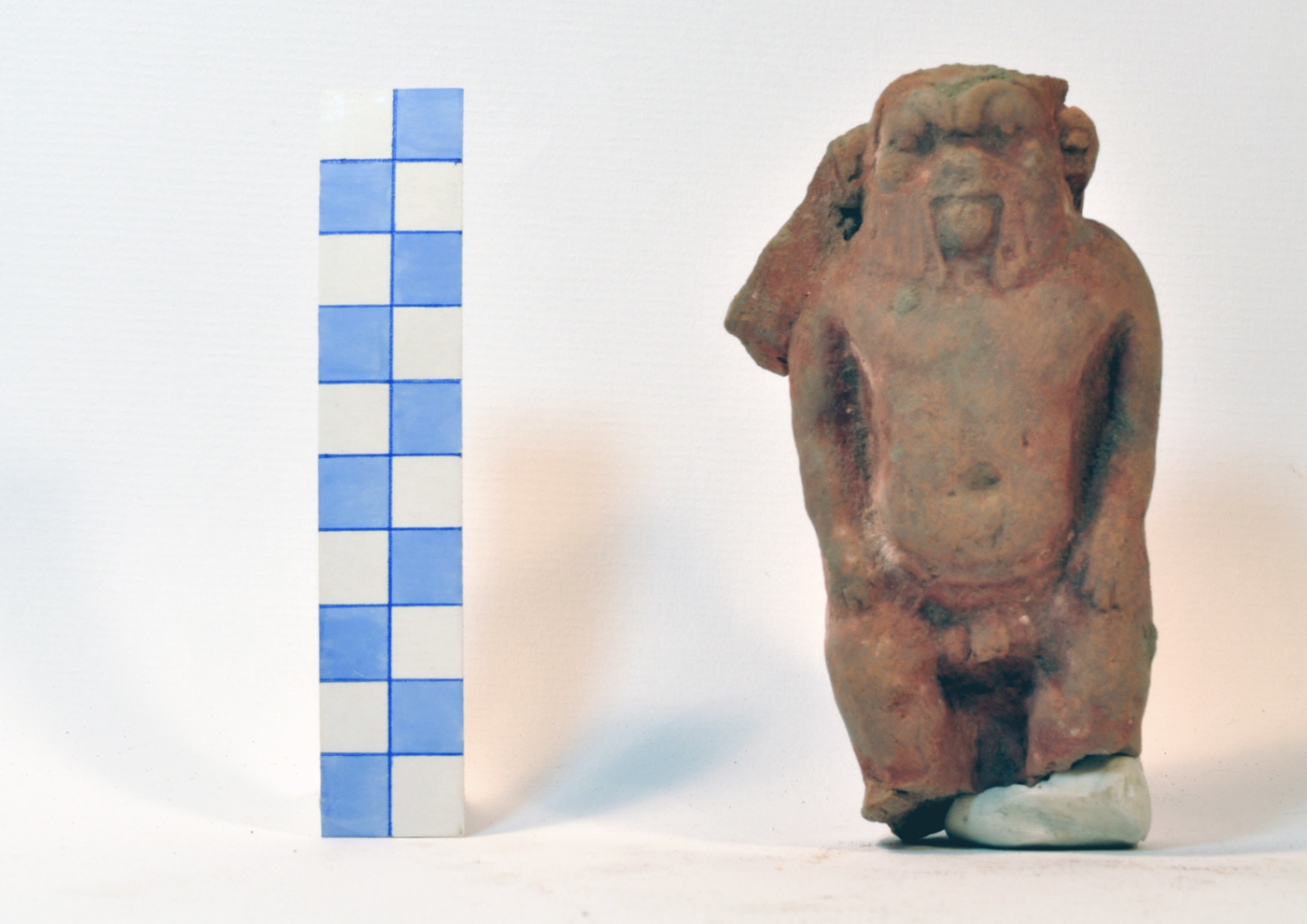
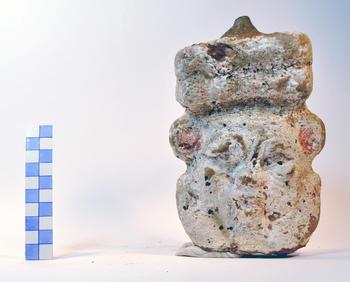
Three figures of Bes, originally parts of vases. A and B seem to have been parts of a vase handle, while C would have been taken from the body of a vase. A and B feature the lower half of the figure, while only the head is preserved from C. Bes is shown nude, standing frontally, with his arms lowered to the front of his body, over his thighs. Bes represents a popular deity solely in domestic spheres of religious life, since neither a temple nor public rite performed in his name has been recorded.
Comparanda: Dunand Reference Dunand1990, nos 30–58; Szymańska Reference Szymańska2005, nos 143–57; Bailey Reference Bailey2008, nos 3085–101; Naukratis DC131, 136, 137, 201, 202, 204, 207, 208 and 210; Petrie UC13303, UC48109.
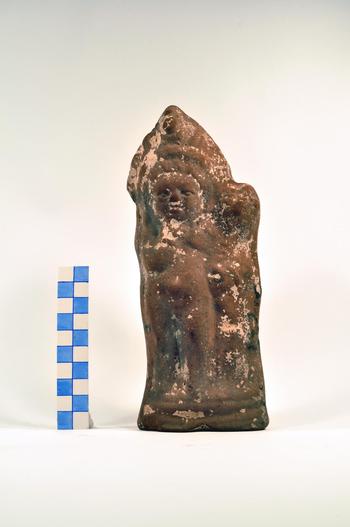
20. Priest or Devotee of Harpocrates (Fig. 34)
H. 11.2 cm
State: fragmentary; missing most of two legs; chips and cracks on the surface.
Clay: medium clean with some inclusions. Brown Nile silt fabric. Black core.
Craft technique: hollow. Handmade back.
Date: 1st century bc or later
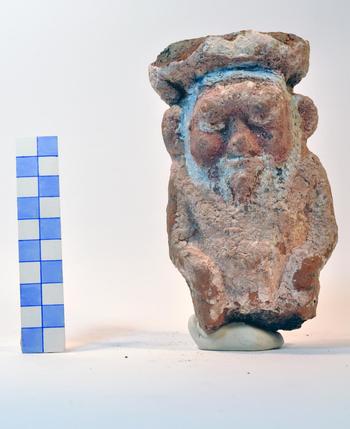
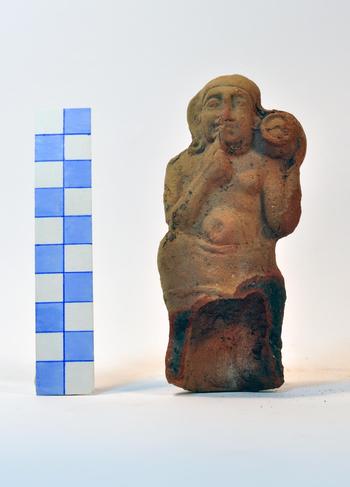
Male seated figure, naked to the waist. The head is covered with a round head cover, but the Horus side-lock is visible to the right. With the index finger of his right hand he touches his lips, in a manner similar to the characteristic gesture of Harpocrates. His left arm is bent to the elbow, supporting a vase with his hand, which rests on his left shoulder. The wine jar is an important symbol for the celebration of the conception of Harpocrates and the ‘festival of drunkenness’.Footnote 34
Priest or Devotee of Harpocrates (no. 20).

Comparanda: Bailey Reference Bailey2008, nos 3203–5; Petrie UC48381, UC48020 (body and lock).
21. Priest or Devotee (?) (Fig. 35)
Height: 6.3 cm
State: fragmentary; the lower half of the body is missing. Traces of white slip. Good mould.
Clay: medium clean with inclusions. Brown Nile silt fabric.
Craft technique: hollow. Handmade back.
Priest or Devotee (?) (no. 21).

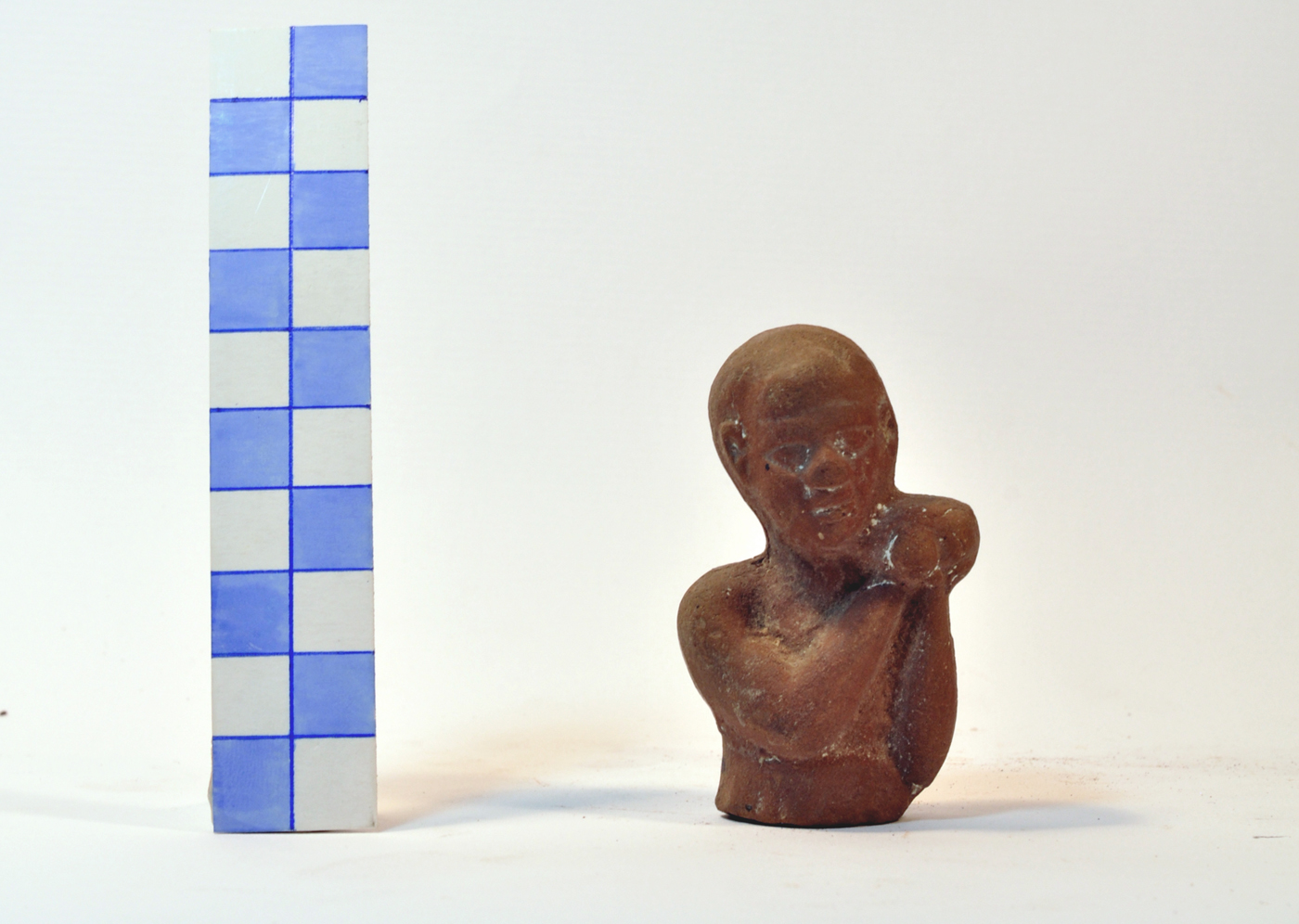
Male figure probably standing. He carries a vase, holding it with both hands on his left shoulder, in the manner of priests and devotees. The head is shaved. It could have been an Isis follower or cultist with facial characteristics that recall the ‘African followers’, depicted next to Isis, when she appears returning from the south, before the inundation to conceive Harpocrates.
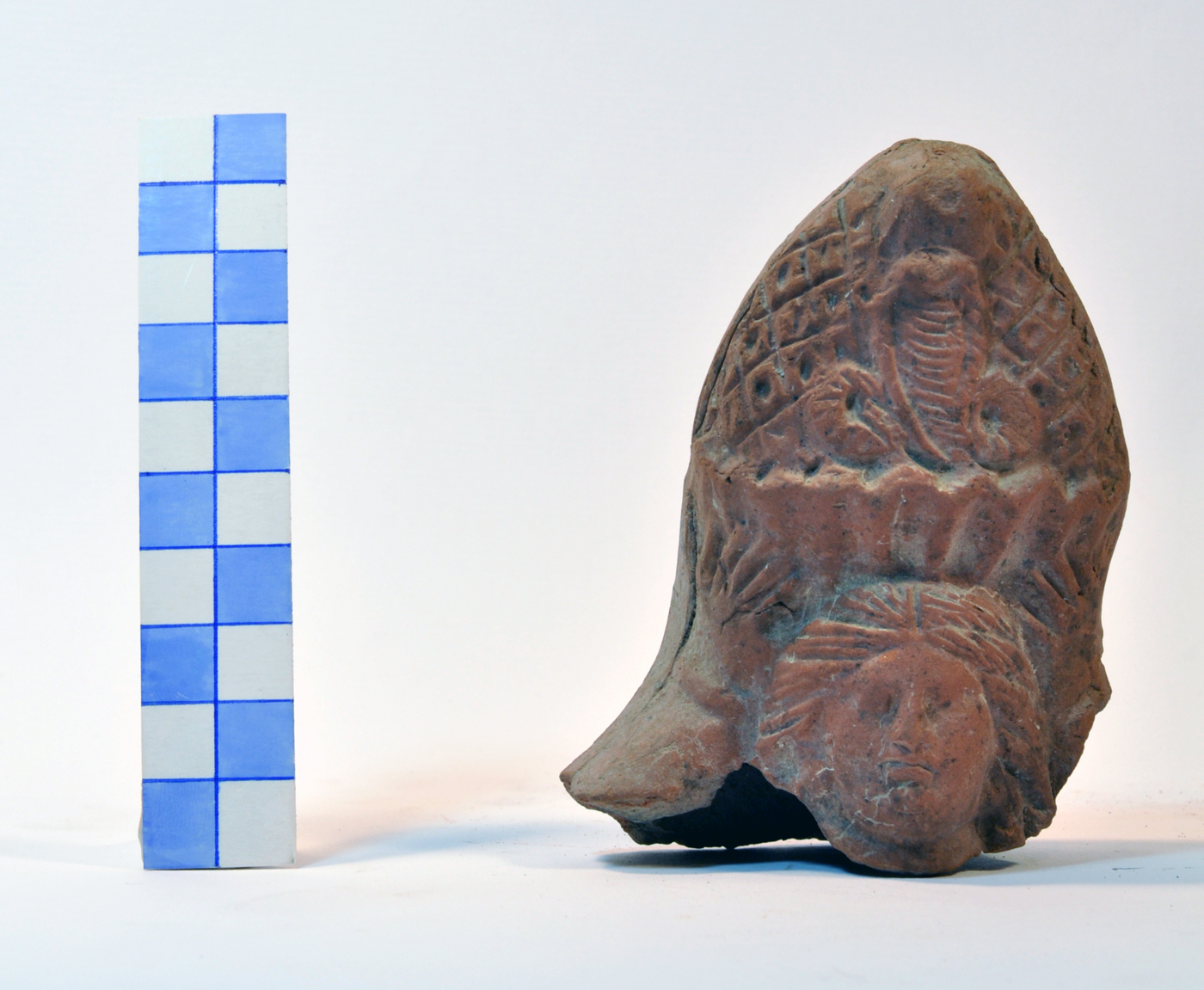
22. Head of Kanephoros (Basket-bearer) (Fig. 36)
Height: 10 cm
State: fragmentary; missing the whole body; chips and cracks on the surface. Very good condition of the mould.
Clay: medium clean with a few inclusions. Brown Nile silt fabric.
Craft technique: hollow. Handmade back.
Date: end of 1st century bc to early 2nd century ad
Head of Kanephoros (basket-bearer) (no. 22).

Both hands are raised – but only the fingers are partially preserved – in order to support a kalathos containing pine-cones and a large cobra. The hair is parted in the centre and, according to more complete examples, would fall in locks to her shoulders. The head is crowned with a wreath decorated with a rhomboid pattern, which functions as a background to the cobra. The cobra possibly represents an Isis-Renenutet symbol typical for the Isis cult and imperial estates. The figure wears bracelets on her wrists.
Comparanda: Breccia Reference Breccia1934, nos 43 and 44; Dunand Reference Dunand1979, 124–32; Reference Dunand1990, nos 485–92; Bailey Reference Bailey2008, no. 3167.
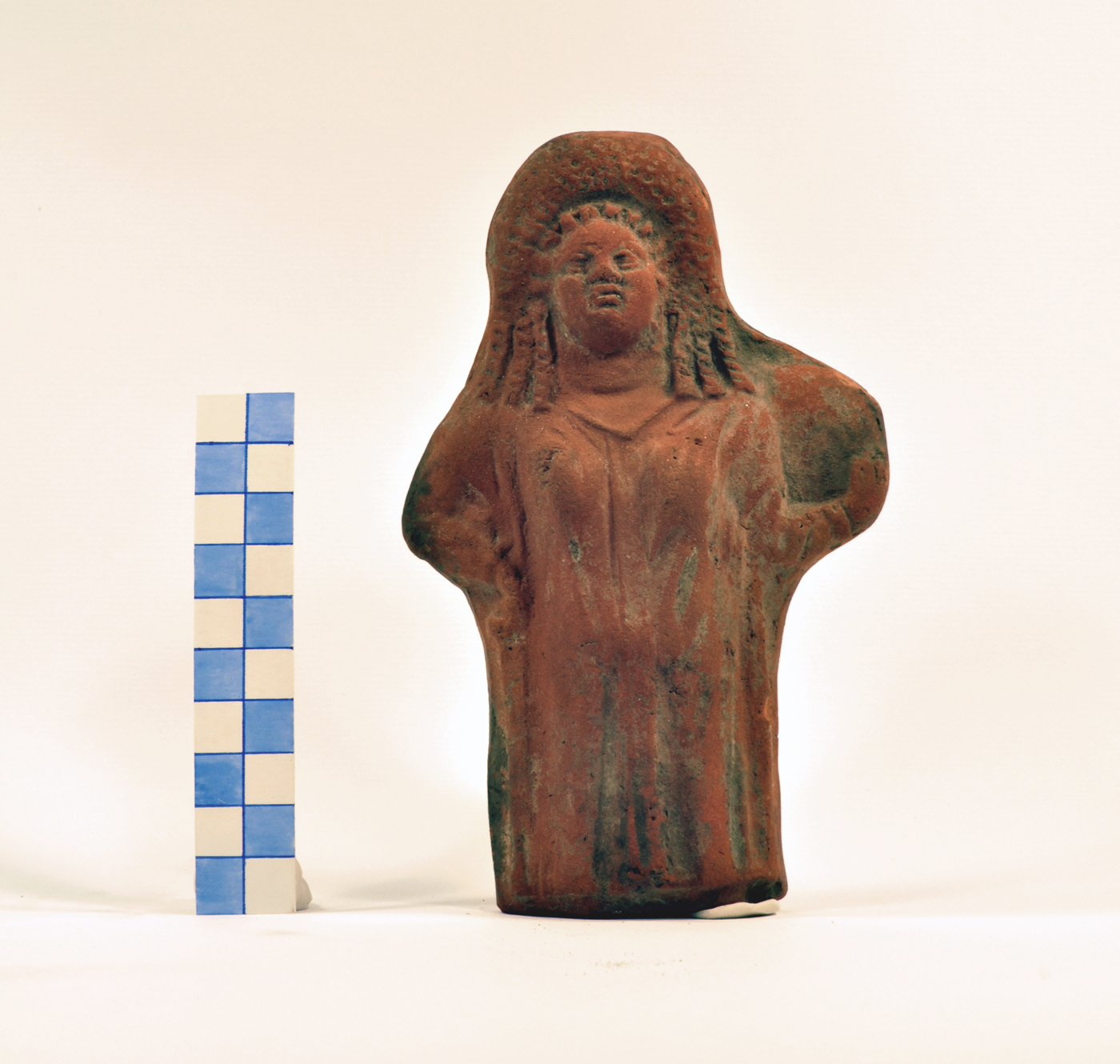
23. Tambourine player (devotee or priestess) with characteristics of Isis (Fig. 37)
Height: 15.2
State: complete; chips on the surface. Good mould.
Clay: medium clean with a few inclusions. Brown Nile silt fabric.
Craft technique: hollow. Handmade back with small round vent.
Date: Roman period
Tambourine player (devotee or priestess) with characteristics of Isis (no. 23).

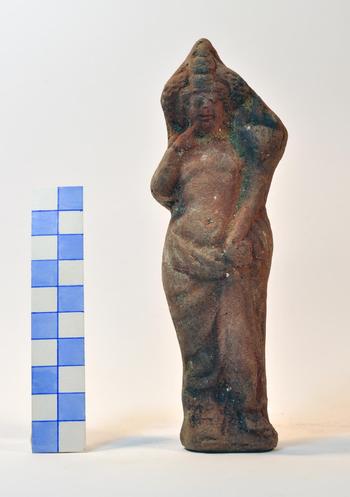
Standing draped female figure, carrying a tambourine in her left armpit. Her right arm is bent at the elbow with the palm resting on the waist. She wears a round netted headdress, revealing part of her curly coiffure on her forehead, as well as three thick curly ringlets, which fall to the shoulders on both sides: a typical feature of the iconography of Isis. She is dressed in an enveloping garment, which appears in representations of Isis during the Roman period, both in Egypt and elsewhere, considered as an archaic element deriving from the Pharaonic period.Footnote 35
Comparanda: Breccia Reference Breccia1934, no. 229; Dunand Reference Dunand1979, nos 84–7; Reference Dunand1990, no. 523; Bibliotheca Alexandrina 714 and 731
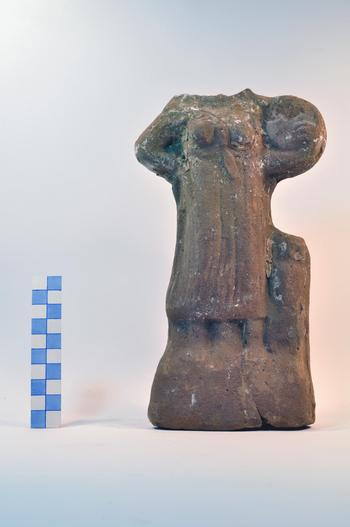
24. Headless figure of a tambourine player (devotee or priestess) with characteristics of Isis (Fig. 38)
Height: 23.4 cm
State: fragmentary; missing head; traces of gypsum layered on clay. Chips and cracks on the surface. Medium quality of the mould.
Clay: medium clean with some inclusions. Brown Nile silt fabric.
Craft technique: hollow. Handmade back with small round vent.
Date: early Roman period
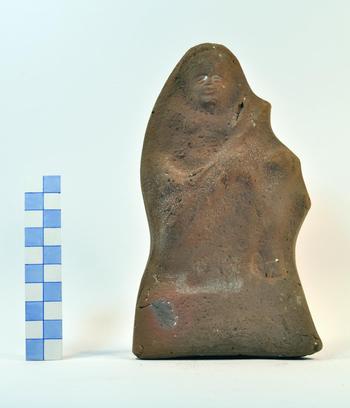
Headless figure of a tambourine player (devotee or priestess) with characteristics of Isis (no. 24).

Standing draped female figure. Compared to 23, the dress differs considerably, featuring the characteristic Isis knot and leaving the breasts exposed. Three ringlets fall to the shoulder. The right arm is bent and the hand rests on the waist. With the left hand she lifts a tambourine to the shoulder. To the right, a jar is placed on a stand. The figure stands on a high trapezoid base.
Comparanda: Breccia Reference Breccia1934, nos 338–9; Dunand Reference Dunand1990, nos 522, 524, 525, 528, 529 and 530.
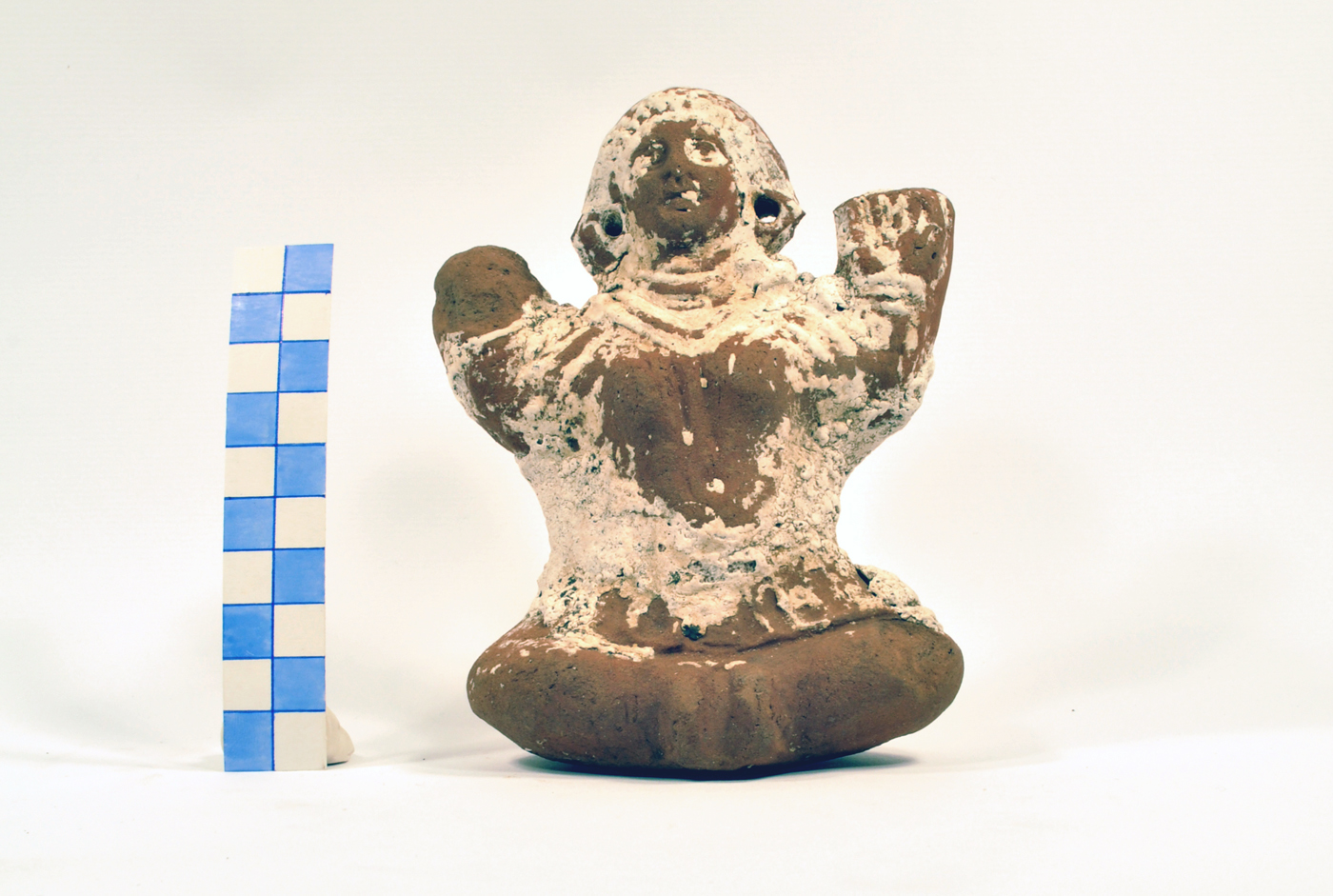
25. Female orans (Fig. 39)
Height: 13.3 cm
State: complete apart from the top parts of the hands; traces of gypsum layered on clay.
Clay: medium clean with a few inclusions. Brown Nile silt fabric.
Craft technique: both sides are mould-made, front and back.
Date: 2nd–3rd century ad
Female orans (no. 25).

The figure is draped and seated with the hands raised in a gesture of blessing, yet the upper parts of both hands are broken. The feet touch each other. The figure bears a double-lobed oval pendant between her breasts. It is possibly represented wearing shoes. Curly hair is visible on her forehead. The hair in the back has been incised with a sharp tool to enhance the representation of locks of hair. Two holes in her ears suggest that in its original state the figure may have featured earring-style ornaments made from a different material.
Comparanda: Breccia Reference Breccia1934, nos 201 and 202; Dunand Reference Dunand1979, nos 113–17; Reference Dunand1990, nos 552–4; Török Reference Török1995, nos 170–80; Bailey Reference Bailey2008, nos 3116–17; Petrie UC34344.
26. ‘Moschophoros’ (beast-carrier) (Fig. 40)
Height: 11.3 cm
State: fragmentary; missing its lower part, below the middle of the thighs. Chips and cracks on the surface. Very worn mould.
Clay: coarse with many inclusions. Brown Nile silt fabric.
Craft technique: solid. Mould-made from two moulds, front and back.
Moschophoros (no. 26).

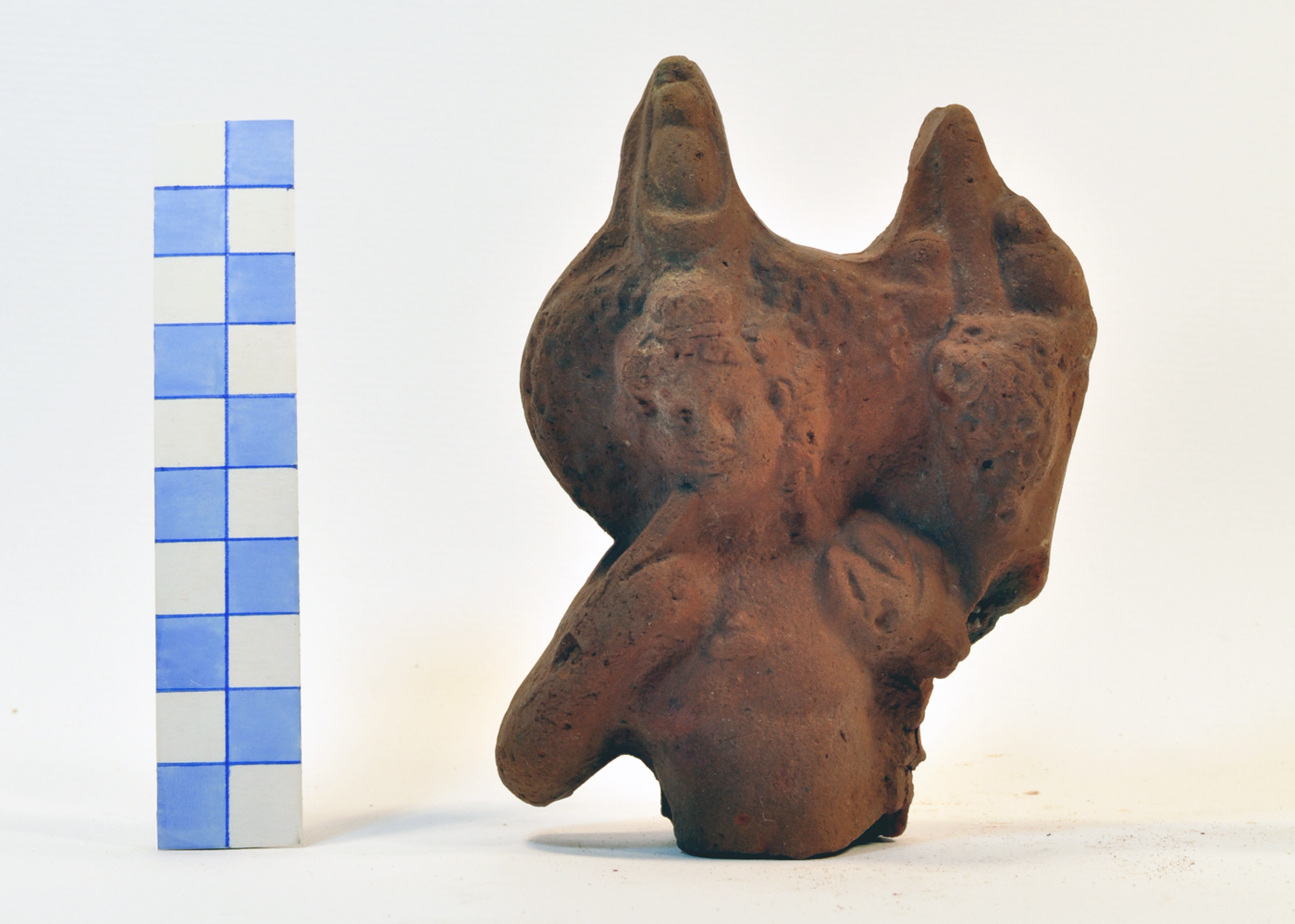
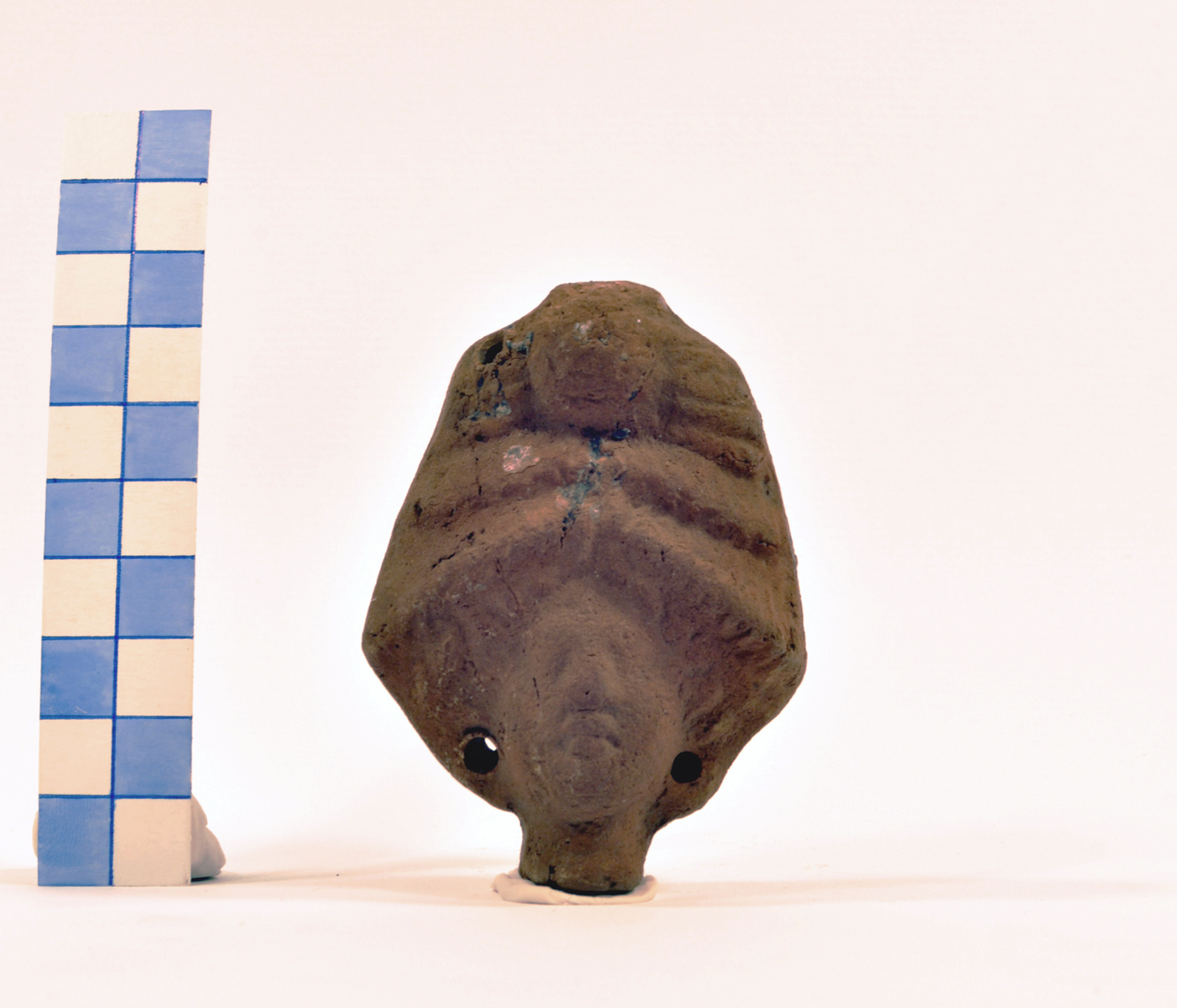
Standing male figure. His arms are bent at the elbows and raised to the shoulders, holding the legs of an animal that he carries on his shoulders. The male figure wears a cloak, leaving the front of his body uncovered. The animal's head is on the right side of the figurine. His eyes, his hair locks and the general treatment of the figures recall archaic prototypes; yet beast bearers were preserved in statuary repertoires up to the Byzantine period.
Comparanda: Breccia Reference Breccia1934, no. 295; Petrie UC16622 (6th century bc example of Kriophoros from Naukratis).
27. Female ‘coiffure head’ (Fig. 41)
Height: 7 cm (9 cm, including preserved part of the back)
State: fragmentary; missing the whole body. Chips on the surface. Good quality of the mould.
Clay: medium clean with a few inclusions. Brown Nile silt fabric. Black core.
Craft technique: hollow.
Date: late 2nd/early 3rd century ad
Female ‘coiffure head’ (no. 27).

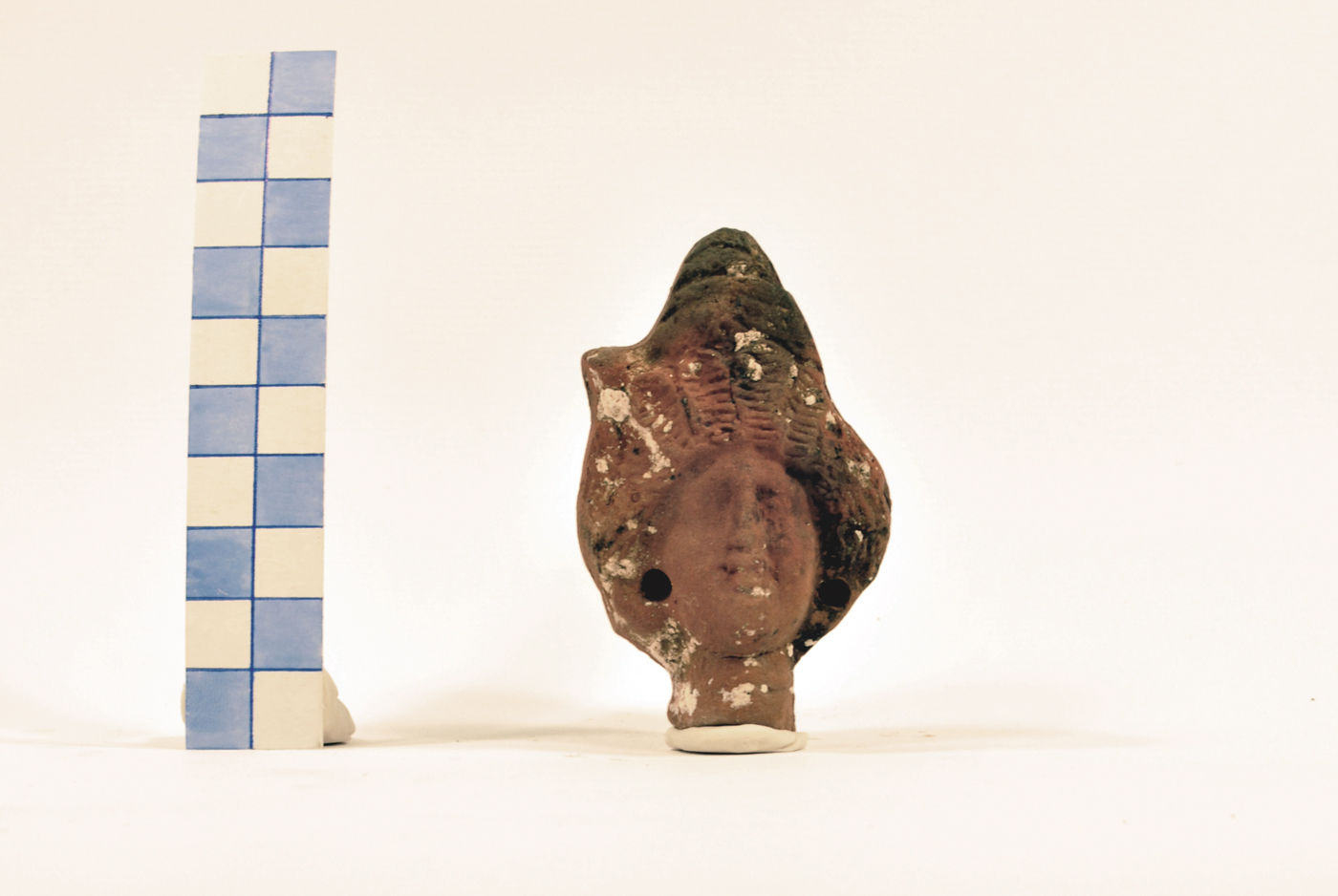
Head and neck of a female figure with hair articulated to a series of thick plokamoi (locks), bound together at the back of the neck with a bun. The neck has two wrinkles. The figure wears earrings with holes in their centre.
Comparanda: Dunand Reference Dunand1979, no. 103; Pingiatoglou Reference Pingiatoglou1993, nos 227 and 244; Bailey Reference Bailey2008, nos 3124, 3127 and 3128.
28. Female ‘coiffure head’ (Fig. 42)
Height: 4.3 cm
State: fragmentary; missing the whole body; hollow head, divided vertically to front and back halves. Chips on the surface. Worn mould.
Clay: coarse with inclusions. Brown Nile silt fabric.
Date: late 2nd/early 3rd century ad
Female ‘coiffure head’ (no. 28).

Head and neck of a female figure, similar to 27, with hair arranged in a series of thick plokamoi, bound together at the back of the neck, which is treated more roughly. The locks at the back of the head are incised. Holes in the area of the ears suggest the existence ornaments added in a different material when the figurine was in its original state.
Comparanda: Breccia Reference Breccia1934, no. 282; Dunand Reference Dunand1990, nos 708 and 725; Bailey Reference Bailey, Maxfield and Peacock2006, no. 10; Petrie UC48222.
29. Female ‘coiffure head’ (Fig. 43)
Height: 7.8 cm
State: fragmentary; missing the whole body. Chips and cracks on the surface. Worn mould. Black spots on the surface.
Clay: medium clean with a few inclusions. Brown Nile silt fabric.
Date: 2nd–3rd century ad
Female ‘coiffure head’ (no. 29).

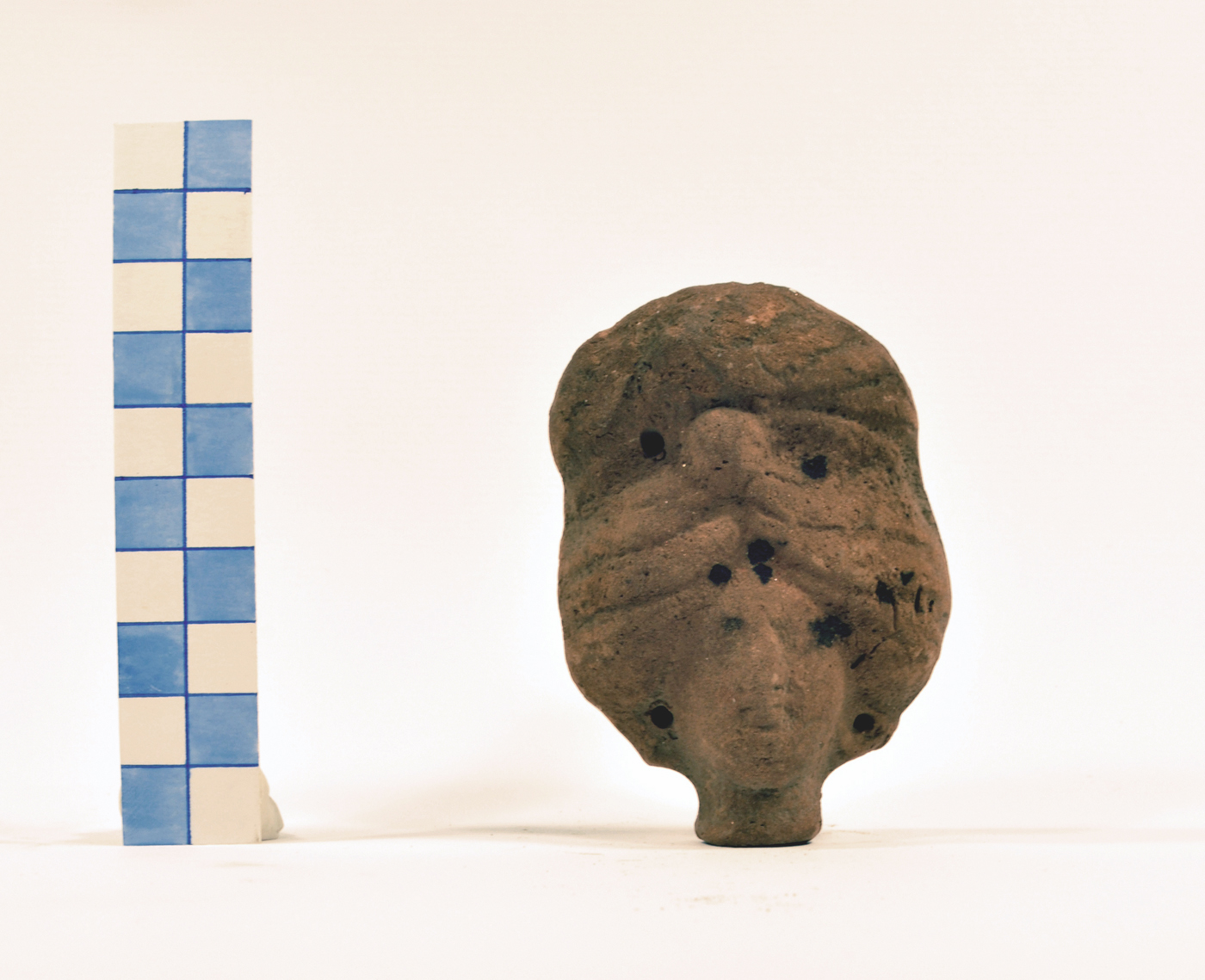
Head and neck of a woman, with an enormous coiffure arranged in two tiers. In the lower tier the hair is parted in the centre and arranged in waves, and is gathered in a bun at the back of the head. Between the lower and the higher tiers of her coiffure there is a diadem. The hair in the upper tier is arranged in coils. Holes in the area of the ears and on the coiffure suggest the presence of ornaments made from a different material when the clay figure was in its original state.
Comparanda: Breccia Reference Breccia1934, no. 253; Pingiatoglou Reference Pingiatoglou1993, nos 262 and 263; Török Reference Török1995, no. 201; Petrie UC48231.
30. Female ‘coiffure head’ (Fig. 44)
Height: 7.8 cm
State: fragmentary; missing the whole body. Ships and cracks on the surface. Mediocre quality of the mould.
Clay: medium clean with a few inclusions. Brown Nile silt fabric.
Date: 2nd century ad
Female ‘coiffure head’ (no. 30).

Head of female figurine. The head is surrounded by an enormous coiffure arranged in two tiers. In the lower tier the hair is parted in the centre and is arranged in waves, and gathered in a knot, while in the upper tier it is arranged in coils. In the middle of the upper tier there is a circular element, broken on top. It could have been the hathoric crown; in this case, the figurine could represent Isis (-Aphrodite?). Holes in the area of the ears suggest the existence of inlaid ornaments in its original state. There is another hole on the second tier of the coiffure.
Comparanda: Dunand Reference Dunand1979, no. 70; Reference Dunand1990, no. 470; Bailey Reference Bailey2008, no. 3125.
31. Female ‘coiffure head’ (Fig. 45)
Height: 7.5 cm
State: fragmentary; missing the whole body; traces of gypsum layered on clay Chips on the surface.
Clay: medium clean with a few inclusions. Brown Nile silt fabric. Discolouration on the top of the head.
Female ‘coiffure head’ (no. 31).

Head and neck of a female, surrounded by enormous coiffure arranged in two tiers. In the lower one the hair is divided in thick locks that crown the head. Hair in the upper tier is arranged in a conical-coil pattern. The hair is incised with parallel grooves to better define the locks. Holes in the area of the ears suggest the existence of inlaid ornaments in its original state. There is a crease on the neck.
Comparanda: Breccia Reference Breccia1934, no. 254; Dunand Reference Dunand1990, nos 737, 738, 763 and 764; Pingiatoglou Reference Pingiatoglou1993, nos 265 and 266; Fjeldhagen Reference Fjeldhagen1995, no. 160.
32. Female head (Fig. 46)
Height: 3.1 cm
State: fragmentary; missing the whole body; missing part of the hair knot; traces of gypsum layered on clay. Mediocre quality of the mould.
Clay: medium clean with a few inclusions. Brown Nile silt fabric. Black core.
Date: Ptolemaic period
Female head (no. 32).

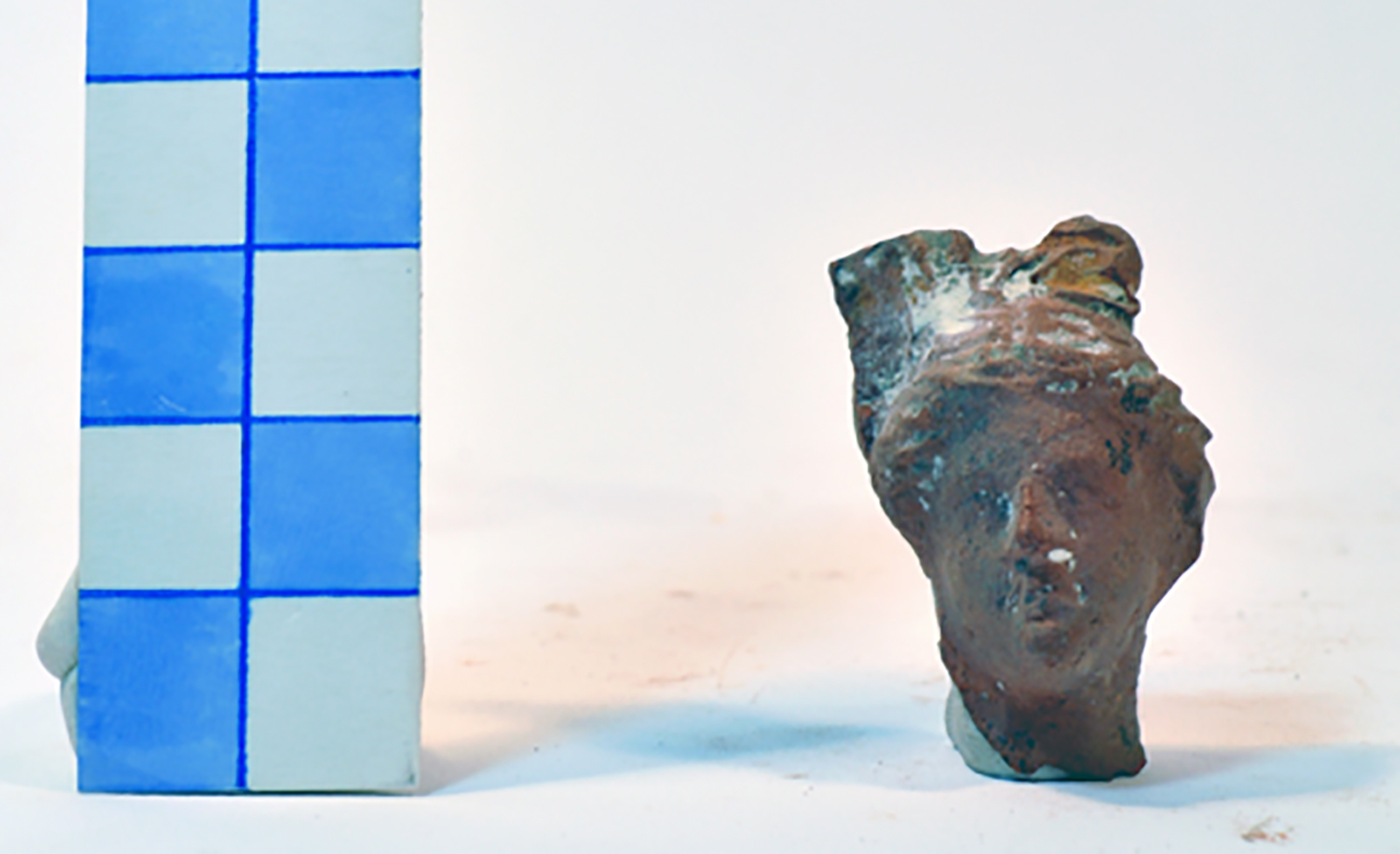
Head of female figurine. It tilts slightly to the right. The woman's tresses are swept back into a top bow-knot. The hair of the bow-knot is incised for better definition.
Comparanda: Pingiatoglou Reference Pingiatoglou1993, nos 182–9.
33. Female actors mask (Fig. 47)
Height: 6.5 cm
State: complete (?); surface eroded; traces of gypsum layered on clay. Worn mould.
Clay: coarse with many inclusions. Brown Nile silt fabric.
Date: 1st–3rd century ad
Female actors mask (no. 33).

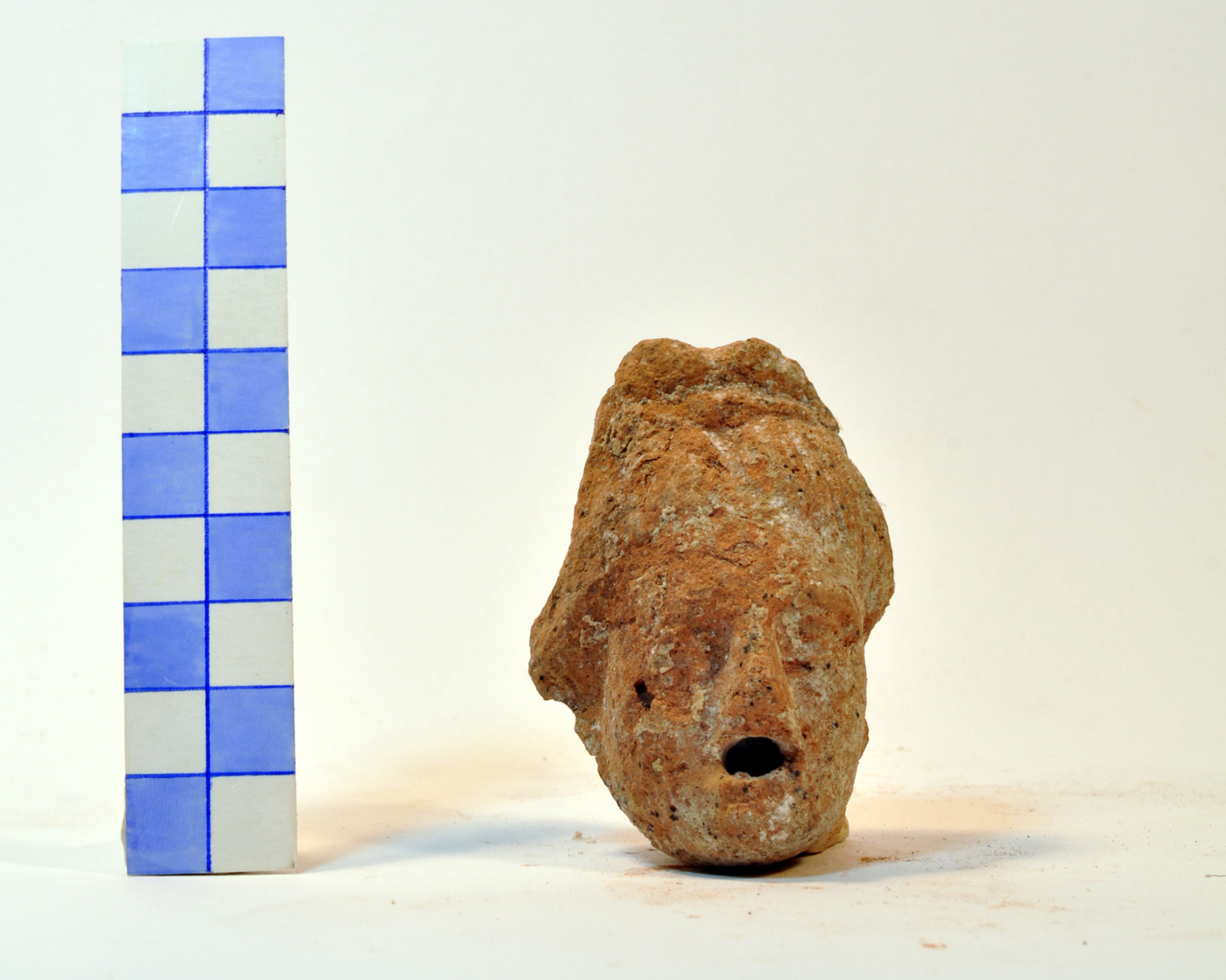
Female head with hair loosely arranged in two parts and bound in a top bow-knot. The head has a hole for the mouth, in a manner similar to a mask.
Comparanda: Bailey Reference Bailey2008, no. 3286; Petrie UC48240
34. Macrophallic figure (Fig. 48)
Height: 13.4 cm
State: nearly complete; part of the feet and phallus missing; work of low standard. Chips and cracks on the surface.
Clay: medium clean with some inclusions. Brown Nile silt fabric.
Date: 350–250 bc or earlier
Macrophallic figure (no. 34).

Naked male figure, with feet broken off, once with raised phallus. The head turns slightly to the left. The left arm is bent at the elbow and the hand rests on his waist. The right arm is bent at the elbow and the hand supports the head. Figurines with similar characteristics are found also in limestone (Naukratis) and are interpreted as Harpocrates.
Comparanda: Dunand Reference Dunand1990, nos 452–3; Naukratis CE046, 044.
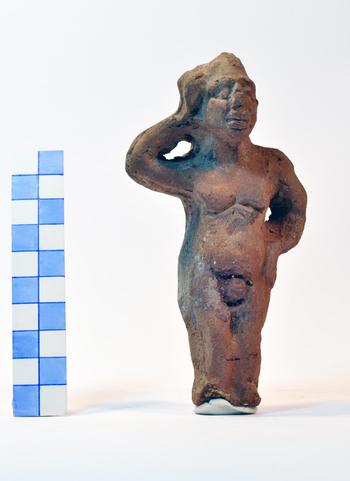
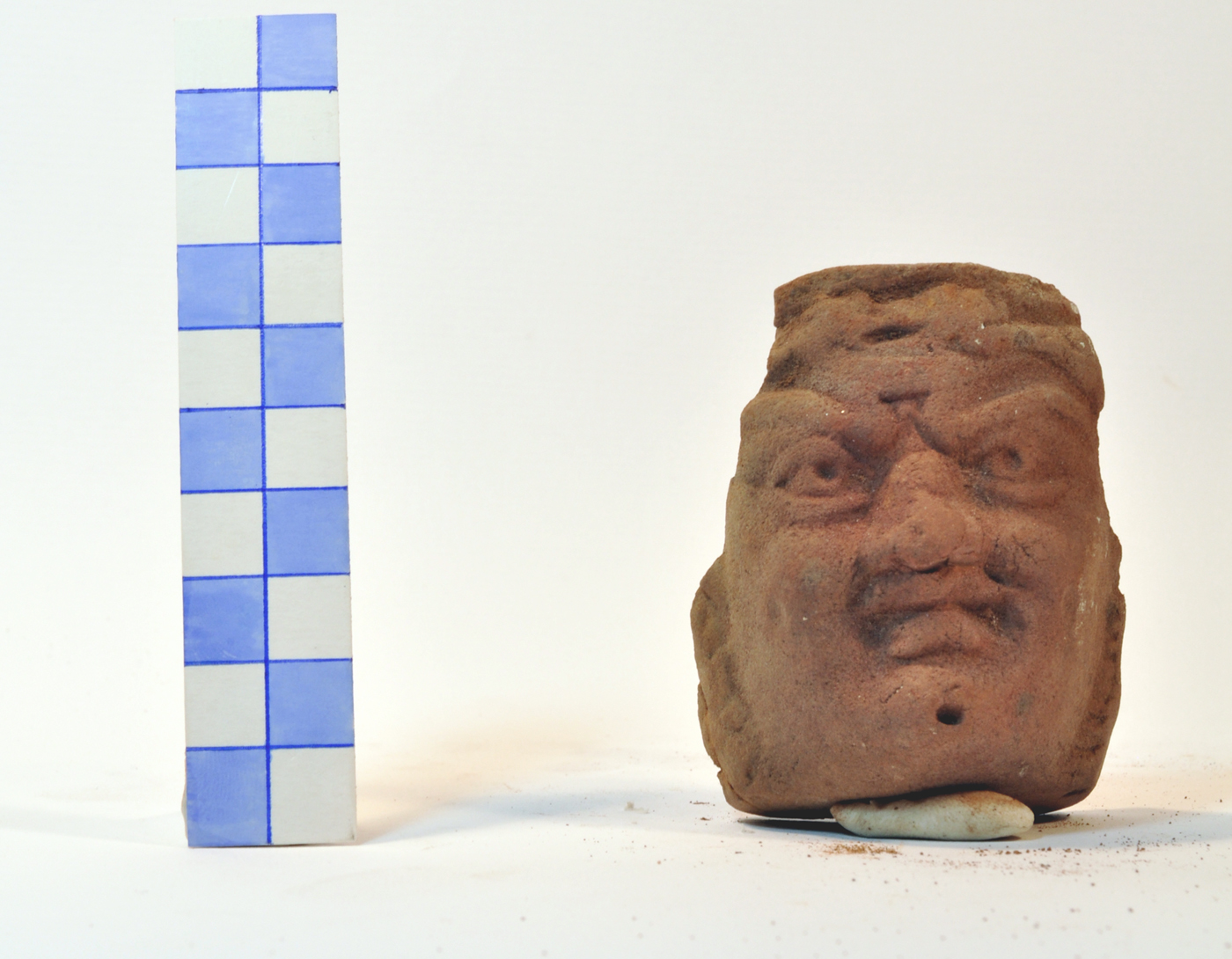
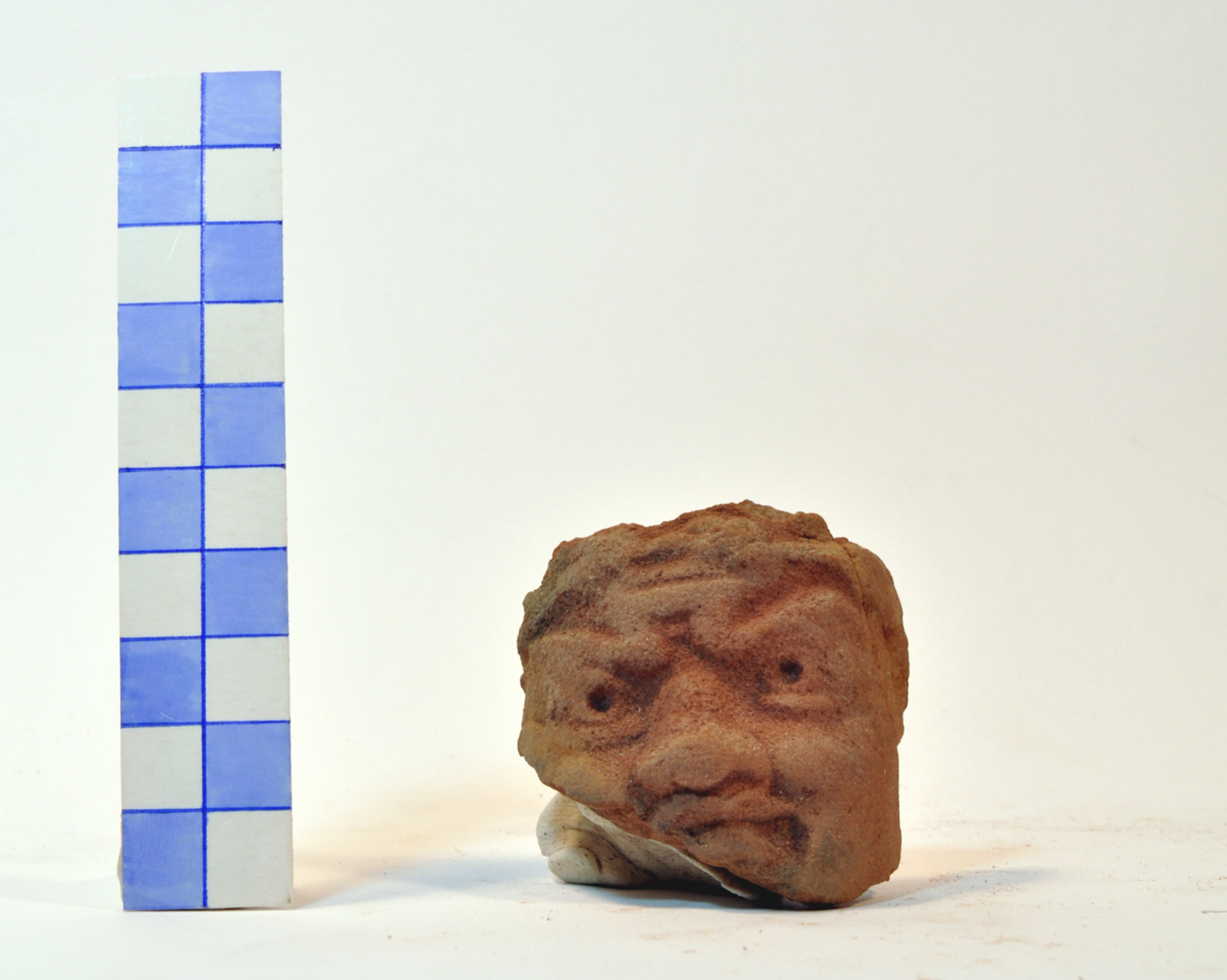
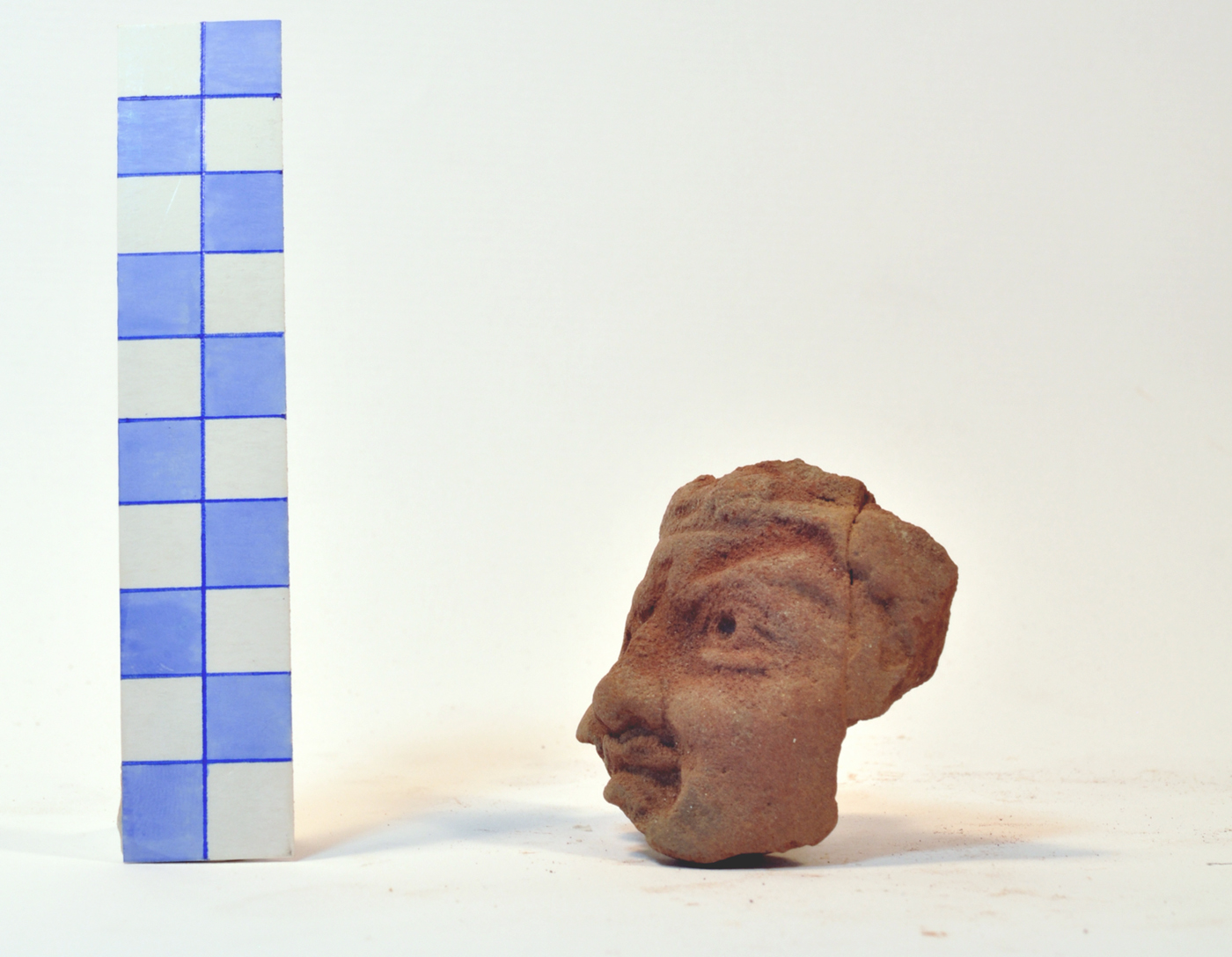
35. Masks (Figs 49–51)
A: Height: 7 cm. State: fragmentary; missing parts from both sides and top; otherwise face complete. Good quality of the mould.
B: Height: 5 cm. State: fragmentary; missing parts from both sides, tops and chin. Good quality of the mould.
C: Height: 5.2 cm. State: fragmentary; only left half preserved; missing parts of chin, hair and side. Good quality of the mould.
Clay: medium clean with inclusions. Brown Nile silt fabric. Discolouration in specimens B and C.
Date: Ptolemaic period?
Mask (no. 35A).

Mask (no. 35B).

Mask (no. 35C).

Three ‘ugly’ male portraits, said to represent masks. The features are exaggerated in order to give the impression of ‘anger’. The eyes are incised in the middle to represent the pupils. The eyebrows are depicted frowning. There are three wrinkles on the forehead. The nose is wide, and the mouth is rendered with thick lips.
Comparada: Bailey Reference Bailey2008, nos 3554–67; Naukratis DD299, 313–317 (ff variety of masks).
36. Young rider (Fig. 52)
Height: 15.7 cm
State: fragmentary; missing the animal that it used to ride; missing left leg. Cracks on the surface. Worn mould.
Clay: medium clean with a few inclusions. Brown Nile silt fabric.
Craft technique: solid. Mould-made from two moulds, front and back.
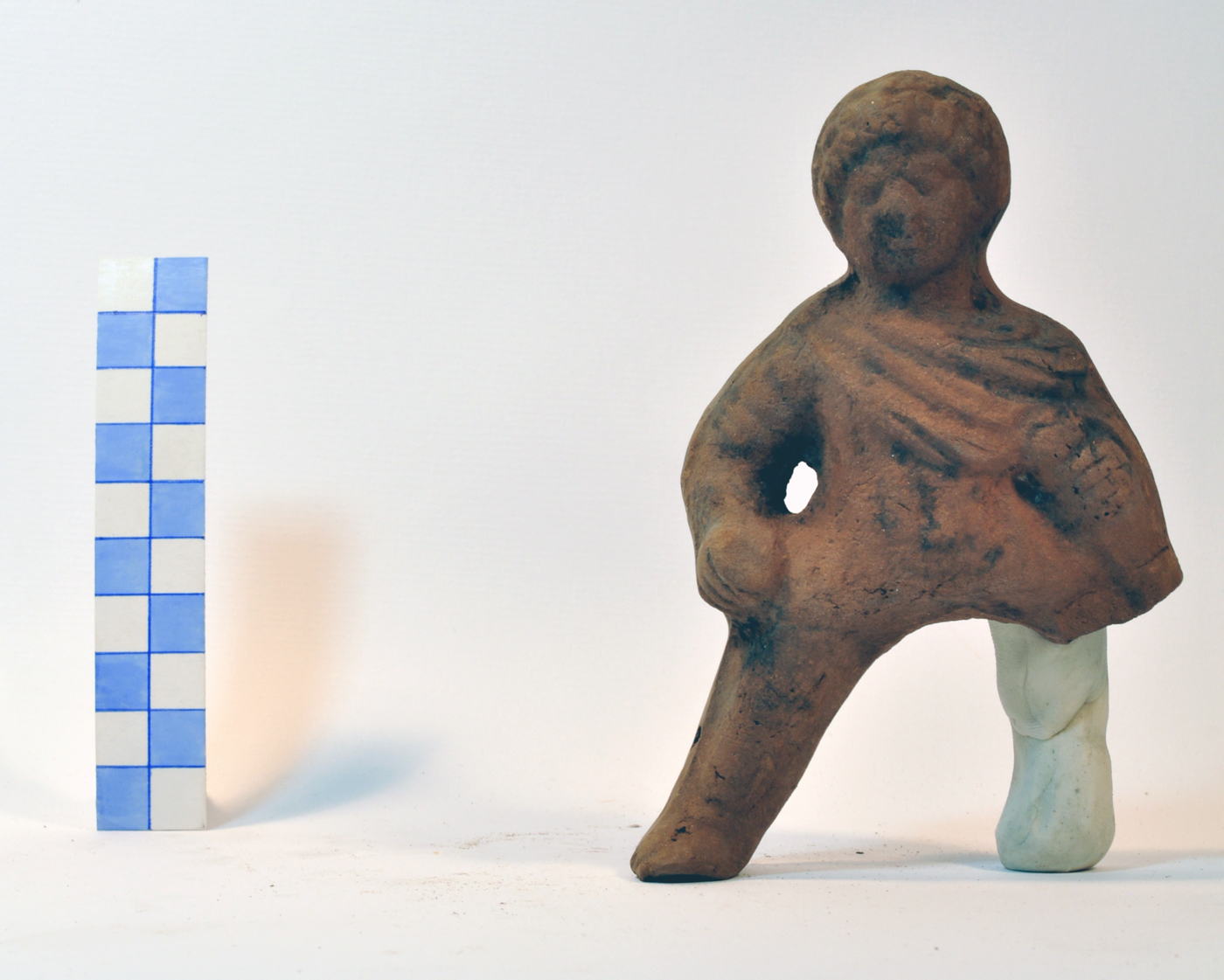
Date: Ptolemaic period
Young rider (no. 36).

Male figure with legs spread wide, enabling him to sit on the back of an animal, probably a horse. A chlamys which is pinned on his right shoulder falls diagonally across the torso covering his left shoulder, and on the rear down his back. With his left hand he holds the handle of a sword or knife. His right hand is attached to the thigh of his right leg. He has curly hair.
Comparanda: Breccia Reference Breccia1934, nos 239 and 354 (riders independent from the horse), 120–2 (Harpocrates with chlamys, riding horse); Fjeldhagen Reference Fjeldhagen1995, no. 140; Bailey Reference Bailey2008, nos 3370 and 3372.
37. Head of young male (Fig. 53)
Height: 5 cm
State: fragmentary; missing the whole body. Chips and cracks on the surface. Worn mould.
Clay: medium clean with inclusions. Brown Nile silt fabric.
Craft technique: hollow.
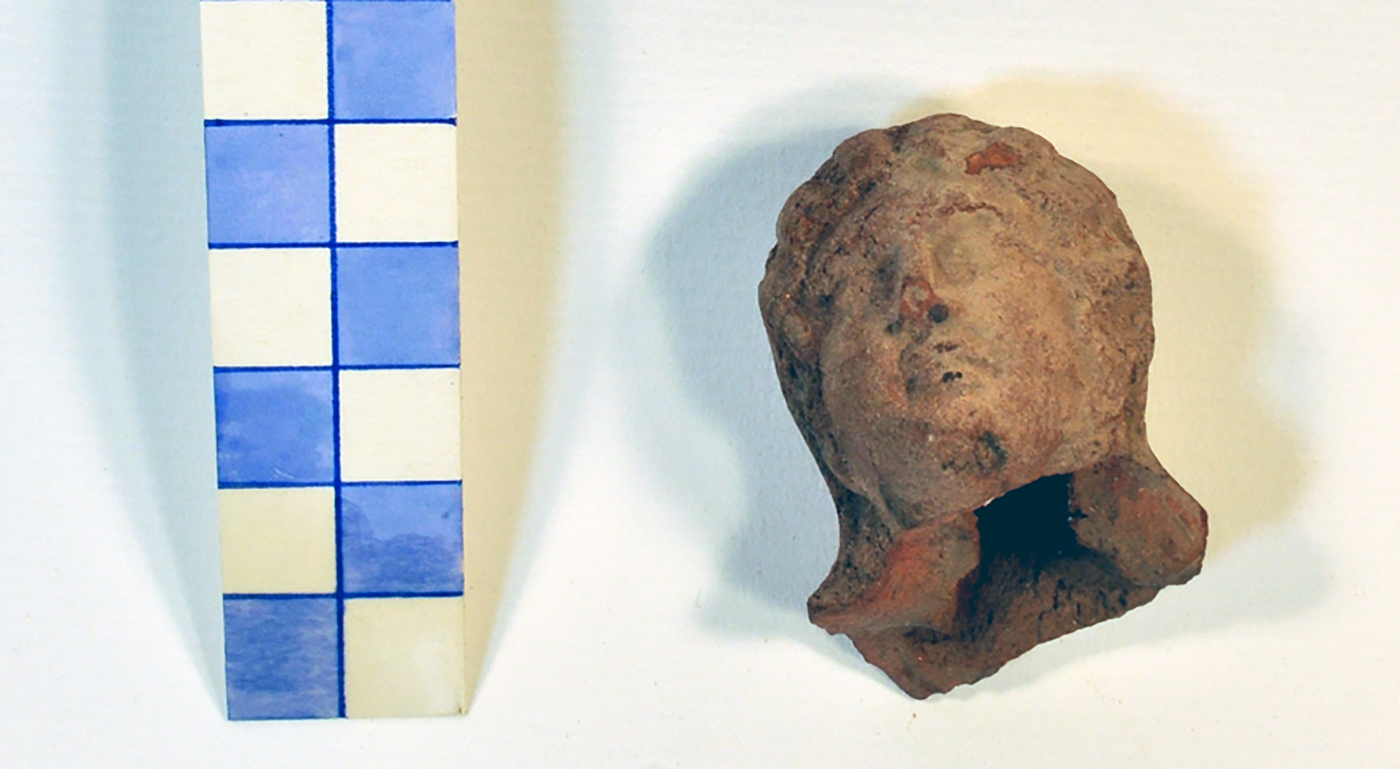
Date: Ptolemaic period
Head of young male (no. 37).

The head bears similar characteristics with 36 and was probably created with the same mould.
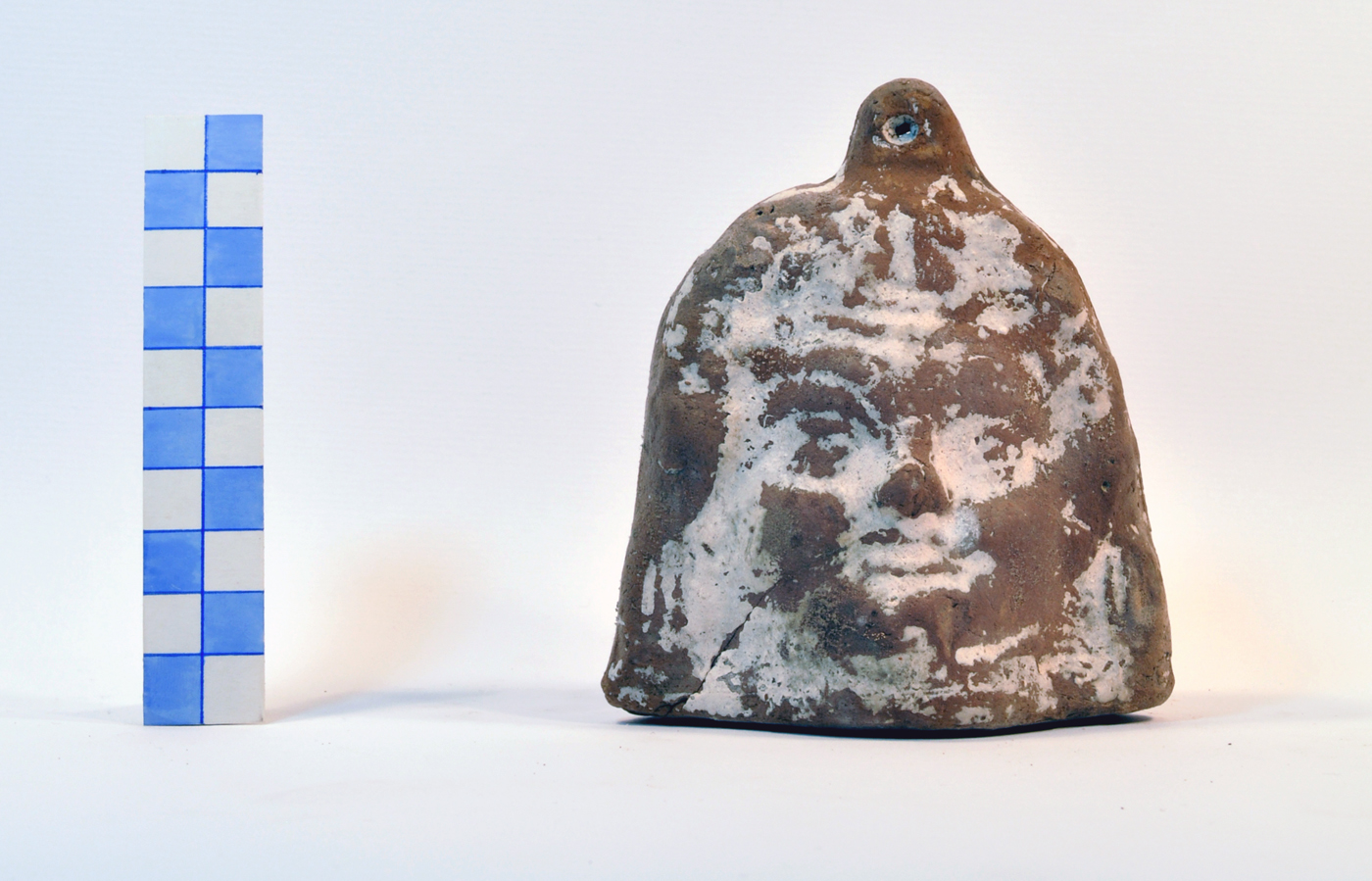
38. Lantern in the shape of the head of child (Fig. 54)
Height: 10.6 cm
State: complete; traces of gypsum layered on clay. Chips and cracks on the surface.
Clay: medium clean with a few inclusions. Brown Nile silt fabric.
Craft technique: hollow.
Date: 1st century bc to 1st century ad
Lantern in the shape of the head of child (no. 38).

Bell-shaped lantern in the form of a child's head, resembling representations of Harpocrates or Eros. At the back side there is a trapezoid opening for where the light comes out. The hole on top of the head was used for suspension.
Comparanda: Breccia Reference Breccia1934, nos 223 and 224; Bailey Reference Bailey2008, no. 2001 (Lamp); Naukratis DD024.
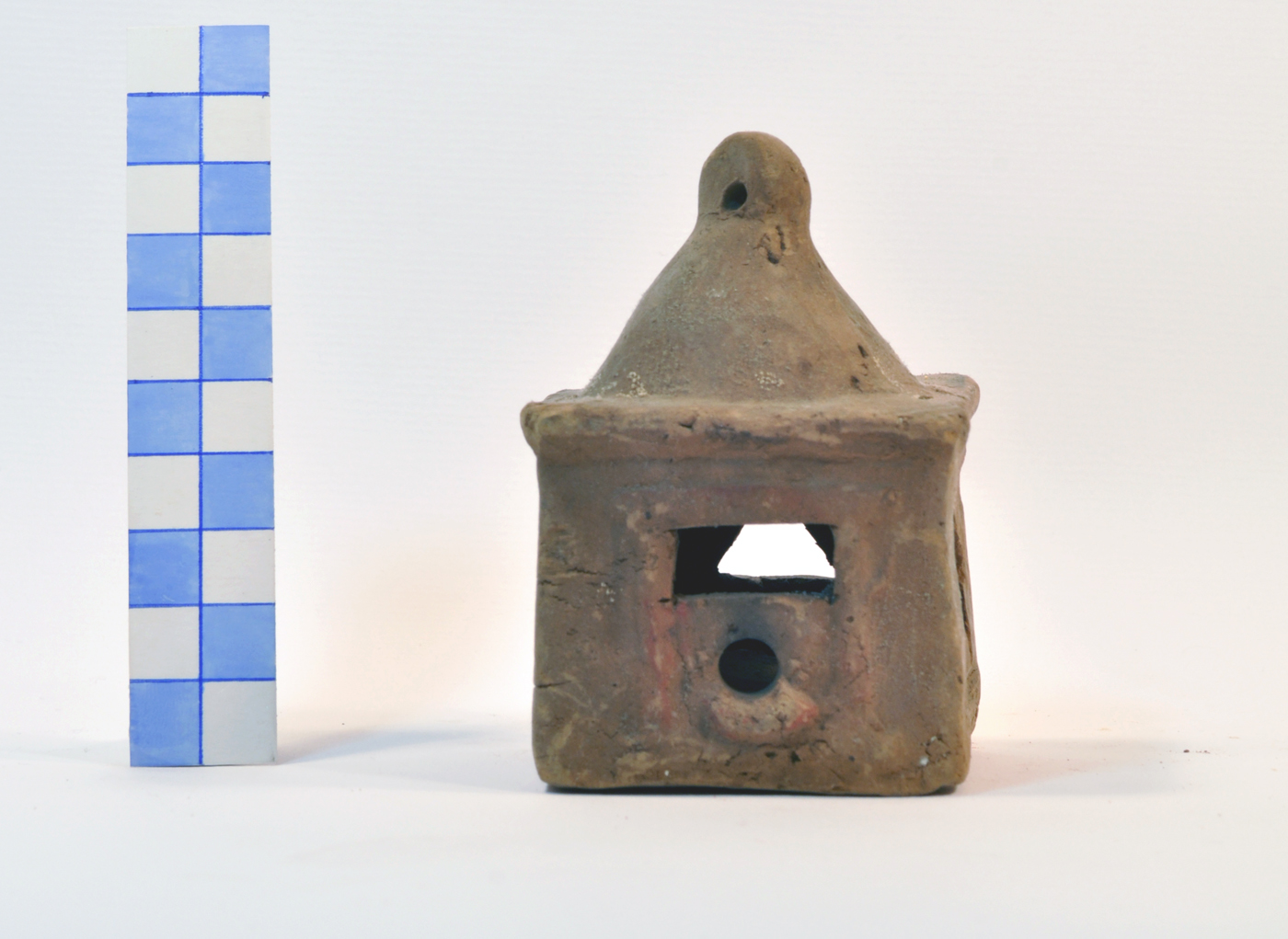
39. Lantern in the form of a shrine (Fig. 55)
Height: 9.2 cm
State: complete; chips and cracks on the surface.
Clay: medium clean with some inclusions. Brown Nile silt fabric.
Lantern in the form of shrine (no. 39).

Cubic lantern with pyramid-shaped roof and roughly made openings (windows). The front window is rectangular with a round opening. The back window is rhomboid. A hole on the top was used for suspension.
Comparanda: Török Reference Török1995, no. 291; Naukratis CF4 (Late Period example).
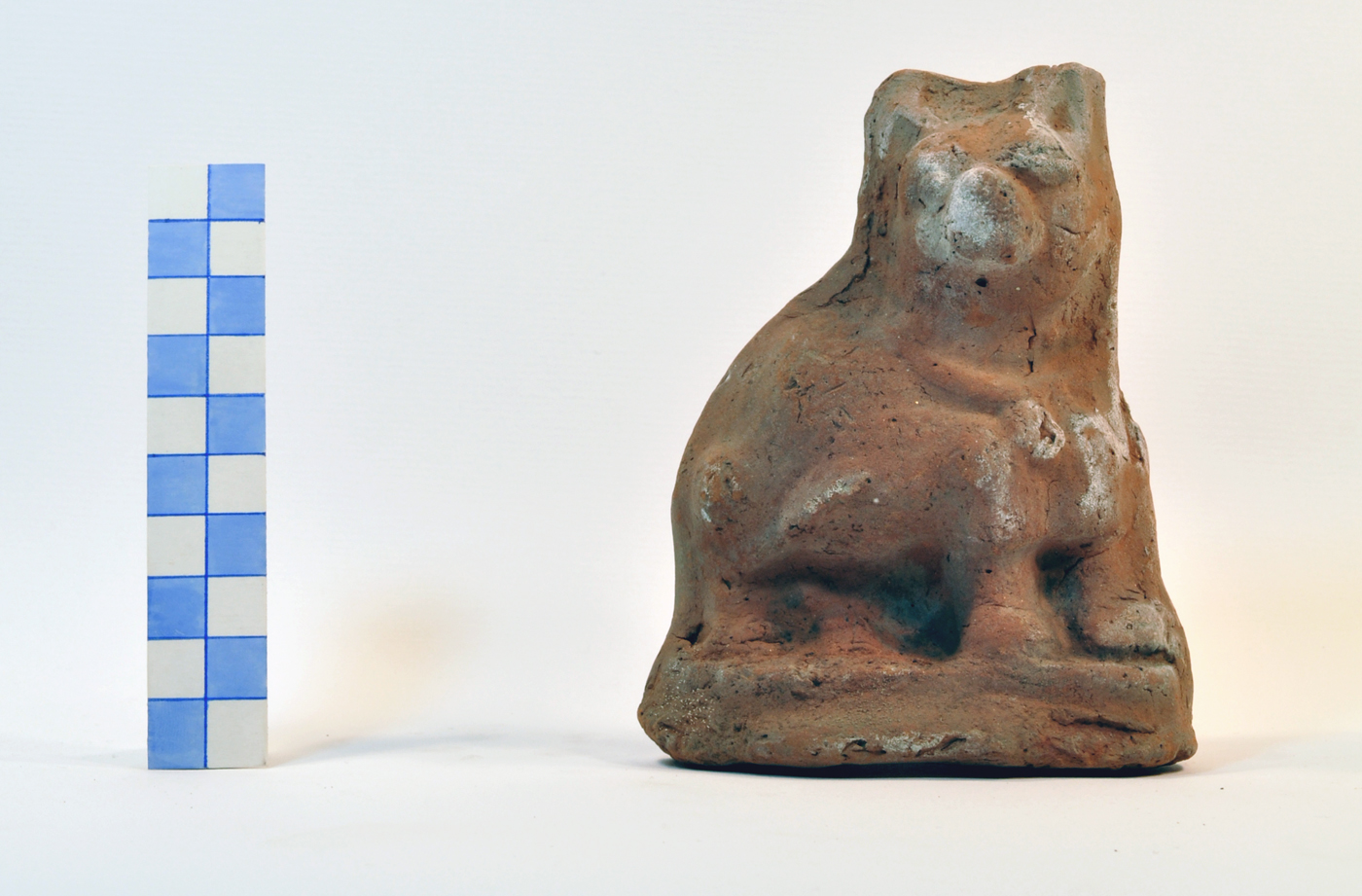
40. Dog (Fig. 56)
Height: 11.8 cm
State: complete; traces of gypsum layered on clay. Chips and cracks on the surface. Worn mould.
Clay: medium clean with some inclusions. Brown Nile silt fabric. Black core.
Craft technique: hollow. Handmade back without a vent.
Date: Roman period
Dog (no. 40).

The body of the dog is represented in three-quarter profile, with the head turned facing the viewer; it is sitting on its haunches. It wears a pendant with an amulet at its centre. Figures like this have been identified as the Sothic hound dog. The dog stands on a thin rectangular base.
Comparanda: Breccia Reference Breccia1934, nos 412–14; Dunand Reference Dunand1990, nos 859–67; Török Reference Török1995, nos 280–2; Matelly Reference Matelly and Cuvigny2003, 596 nos 68–9, fig. 286; Szymańska Reference Szymańska2005, no. 260; Bailey Reference Bailey, Maxfield and Peacock2006, 275 nos 37–9; Reference Bailey2008, nos 3704–10; Naukratis DD184–98; Petrie UC48333, UC48334.
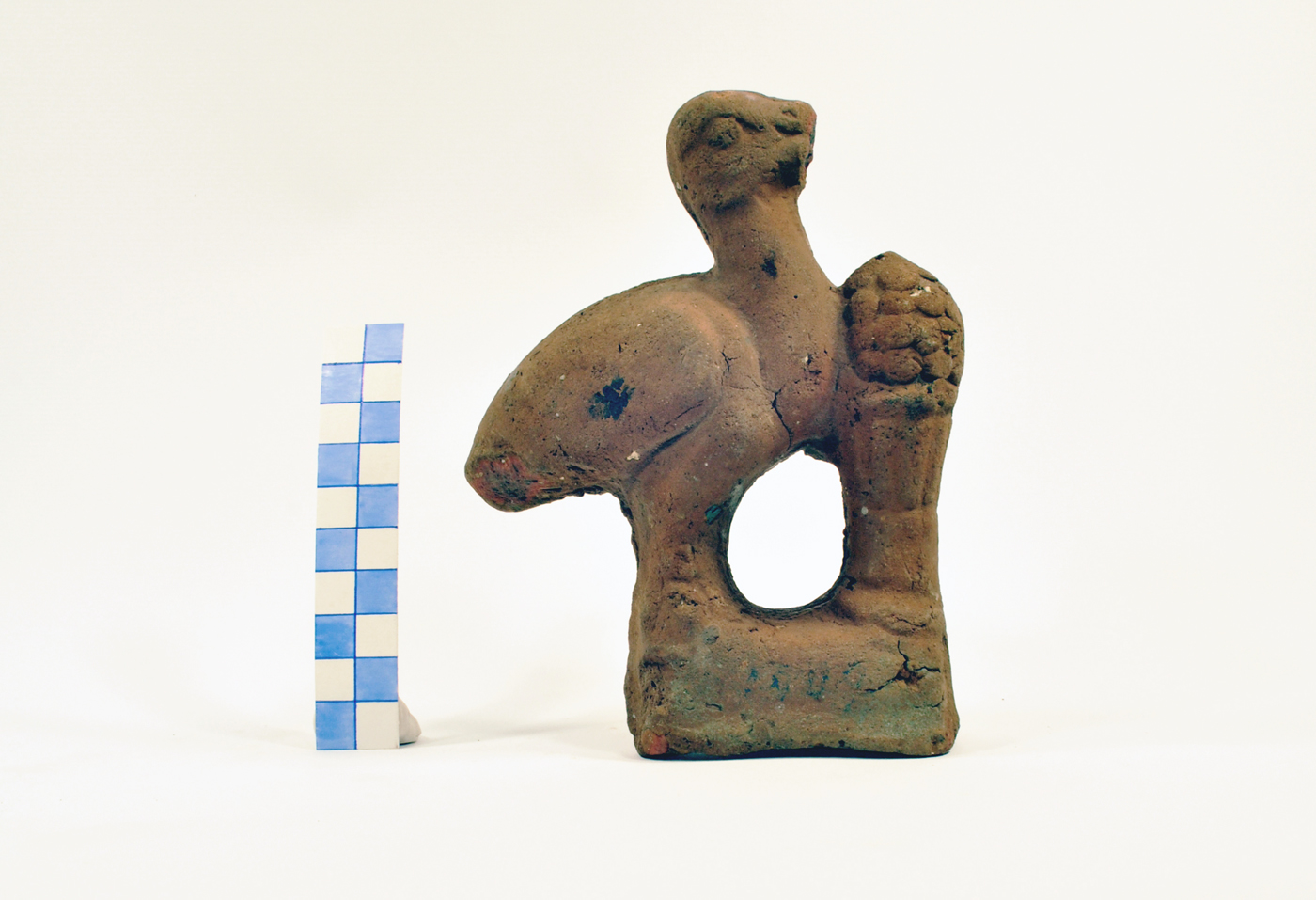
41. Bird (Fig. 57)
Height: 15.8 cm
State: nearly complete; missing part of bird's beak. Chips and cracks on the surface. Mediocre quality of the mould.
Clay: medium clean with inclusions. Brown Nile silt fabric. Discolouration at the bottom. Black spots on the surface.
Craft technique: solid.
Bird (no. 41).

Figure of a bird set on a rectangular base with a basket of fruit that is placed on a podium. Certain aspects of the body remind one of an Ibis-bird or a goose, yet the lack of preserved details on the surface as well as the broken beak do not allow any identification of this kind to be made safely.
ACKNOWLEDGEMENTS
I would like to thank his Beatitude Patriarch Theodoros II for his trust and support all these years, from the first cataloguing of the collection to the inauguration of the Museum in 2013, and in a series of subsequent studies.