INTRODUCTION
There is a large region of dryland farming in northern China, which accounts for c. 0·56 of the nation's total area. The dry semi-humid zone, with 500–600 mm annual rainfall, covers about half of the dryland area. Development of dryland farming in this zone is constrained by adverse weather, topography, water resource conditions and low fertility soils. Traditional tillage in northern China has already resulted in widespread soil degradation (Gao et al. Reference Gao, Li and Chen1999). Thus, conservation tillage systems in dryland regions of northern China were implemented by government in the 1980s with the goal of promoting long-term sustainability of agricultural ecosystems. The efficiency of conservation tillage (no-tillage (NT) or reduced tillage with residue kept) to reduce soil erosion and to improve soil quality is universally recognized. Numerous studies have shown that decreasing tillage intensity and increasing the amount of residues retained on the soil surface result in higher organic C and N and improved soil quality (Lal et al. Reference Lal, Mahboubi and Fausey1994; Soon et al. Reference Soon, Clayton and Rice2001).
Soil organic matter (SOM) plays a key role in the improvement of soil physical, chemical and biological properties (Ouedraogo et al. Reference Ouedraogo, Mando, Brussaard and Stroosnijder2007). Long-term tillage causes a rapid loss of SOM content, a decrease of soil biological activity and impairment of physical properties over time. Conservation tillage practices featuring residue cover and reduced soil disturbance have been shown to increase the SOM. Liang et al. (Reference Liang, Zhang, Fang, Yang and Drury2007) reported that NT significantly increased the concentration of soil organic C (SOC) by 5·6–5·9% in the 50–200 mm layer on clay loam soils in the humid north-eastern part of China after 3 years. Wang et al. (Reference Wang, Bai, Gao, He, Chen, Chesney, Kuhn and Li2008) showed that long-term NT increased SOM by 22% at depths of 0–100 mm compared to traditional tillage.
Soil micro-organisms are the major protagonists of organic matter decomposition and nutrient turnover in arable soil. The microbial biomass is the living component of SOM and it typically comprises 0·01–0·05 of total organic matter content. Because of its high turnover rate, microbial C content can respond rapidly to changes in soil management practice (Gregorich et al. Reference Gregorich, Carter, Doran, Pankhurst, Dwyer, Gregorich and Carter1997). Soil enzymes are important soil components involved in the dynamics of soil nutrient transformations (Ebhin Masto et al. Reference Ebhin Masto, Chhonkar, Singh and Patra2006). Enzyme activity in the soil environment is considered to be the major contributor of overall soil microbial activity and soil quality (Dick Reference Dick, Doran, Coleman, Bezdicek and Stewart1994; Melero et al. Reference Melero, Vanderlinden, Carlos Ruiz and Madejón2009).
Changes in soil physical and chemical properties associated with different tillage practices have been studied extensively in northern China (Luo et al. Reference Luo, Huang and Zhang2005; Zhou et al. Reference Zhou, Lu, Yang and Li2007). In contrast, information on the biological processes, such as soil enzymatic activities, which mediate nutrient cycling and influence their acquisition during active crop growth stages, is limited. The objective of the present study was to determine the influence of NT and conventional tillage (CT) on soil chemical properties, microbial biomass and soil enzymatic activities on a dryland farming system in northern China.
MATERIALS AND METHODS
Description of field experiment
The long-term experiment was established in 1992 and was located in Linfen County, Shanxi, China (111°05′ to 111°48′N, 35°55′ to 36°20′E, 550–600 m asl). The average annual temperature is 10·7°C, with 180 frost free days in the area. The experimental area is characterized as semi-arid sub-tropical with a mean annual precipitation of c. 555 mm, mostly falling between July and September. The soil is a Cinnamon Loess, low in organic matter and slightly alkaline. Under the USDA texture classification system, the soils are defined as silt loam and according to the FAO-UNESCO soil map (FAO-UNESCO 1974) the soil type is a chromic cambisol. The initial soil pH was 7.7, organic matter 13·0 g/kg, total N 0·50 g/kg, total P 0·15 g/kg and total K 12 g/kg.
The site was established with two different treatments: CT and NT with straw cover. CT included mouldboard ploughing without residue cover. The ploughing depth was c. 150–200 mm. NT with soil cover consisted of NT planting through the plant residue. The winter wheat was sown between 20 and 30 September and harvested between 1 and 10 June. A fallow period followed harvest until mid-September, with chemical weed control applied when necessary. The treatments were laid out in a randomized block design (RBD), with a plot size of 3×80 m and three replications. The winter wheat variety used throughout the study was Linfen 225 with a seeding rate of 225 kg/ha. Fertilizers were applied as CO(NH2)2, (NH4)2HPO4 and KCl to provide 150 kg N/ha, 140 kg P2O5/ha and 62 kg K2O/ha. In each year, all chemical fertilizers were applied in one dose to the top 200 mm before planting. Straw returned to the soil was c. 3·75 t/ha each year.
Soil sampling
Soil samples were taken in June 2006, after harvesting winter wheat, and were randomly collected from 10 locations in each plot using a 50 mm diameter coring tube. The soil was divided into layers of 0–50, 50–100, 100–200 and 200–300 mm; respective layers from within each plot were composite. After carefully removing the surface organic materials and fine roots, each mixed soil sample was divided into two parts. One part of the soil sample was air-dried for the estimation of soil chemical properties and the other part was sieved through a 2 mm wide screen and immediately transferred to the laboratory for biochemical analysis. Soil fresh samples were kept at 4°C in plastic bags for c. 1 week to stabilize the microbiological activity disturbed and then analysed within 2 weeks.
Analysis of soil chemical and biological properties
SOM was determined by wet oxidation (Black Reference Black1965) and the proportion of organic carbon was calculated by applying the Van Bemmelen factor of 1·73 (Piper Reference Piper1950). Soil total nitrogen (STN) and soil total phosphorus (STP) were measured using the method of Bao (Reference Bao2000). Soil microbial biomass of carbon (MBC) and microbial biomass of nitrogen (MBN) were estimated by fumigation–extraction (Vance et al. Reference Vance, Brookes and Jenkinson1987). Soil enzyme activities (dehydrogenase, β-glucosidase, alkaline phosphatase and arylsulphatase) were determined by the method of Wu et al. (Reference Wu, Lin, Huang and Xiao2006).
Statistical analysis
All statistical analyses were undertaken using SPSS 11.0 for Windows and results were expressed as mean values. Significant differences between management systems (NT and CT) were determined by a Student's t-test at P<0·05.
RESULTS
SOC, STN and STP
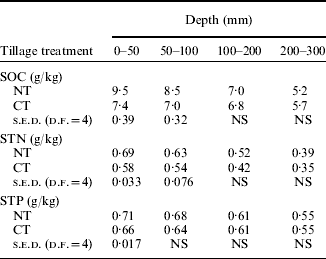
Soil tillage affected soil chemical properties greatly. SOC was higher under NT than under CT at 0–100 mm (Table 1). NT increased SOC content over CT by 29% in the 0–50 mm layer and by 21% in the 50–100 mm layer. No significant difference was found in SOC content between NT and CT treatments in the 100–200 and 200–300 mm layers. The SOC in NT treatment decreased sharply with increasing soil depth.
Soil chemical properties: mean values of soil organic carbon (SOC), soil total nitrogen (STN) and soil total phosphorus (STP) under different tillage systems at the different depths

NS, not significant P>0·05.
NT, no-tillage; CT, conventional tillage.
STN showed the same trend as SOC in relation to different tillage treatments. The amount of total N in the 0–100 mm soil layer was greater under NT than under CT (Table 1). There were no significant treatment effects on total N in the 100–300 mm depths. Total N decreased with depth in two tillage treatments.
Compared to the CT treatment, the NT treatment increased STP in the 0–50 mm layer by 7·6%. Differences in STP between CT and NT treatments were not significant at the other depths.
Soil MBC, MBN and enzymatic activities
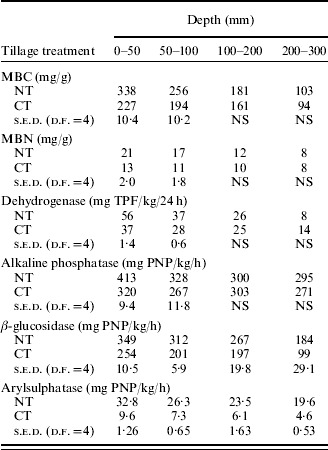
MBC and MBN, respectively, were significantly affected by both soil depth and tillage system. MBC varied with depth from 103 to 338 mg/kg under NT and from 94 to 227 mg/kg under CT (Table 2). Microbial biomass N varied from 8·3 to 21 mg/kg under NT and from 8·2 to 13·1 mg/kg under CT. In the 0–50 and 50–100 mm soil layers, MBC and MBN were significantly higher under NT than CT. In the 0–50 mm layer, MBC and MBN were 49 and 60% higher, respectively, under NT than under CT. MBC and MBN decreased with soil depth, more so under NT. There were no significant differences below 100 mm.
Soil biological properties: mean values of microbial biomass carbon (MBC), microbial biomass nitrogen (MBN) and enzymatic activities in soil under different tillage systems at the different depths

NS, not significant P>0·05.
Tillage system had significant effects on soil dehydrogenase activity (Table 2). The dehydrogenase activity varied with depth from 8·1 to 56 mg TPF/kg/24 h in the soil under NT and from 14 to 37 TPF/kg/24 h under CT. NT resulted in a significant increase in dehydrogenase activity in the 0–100 mm layer; however, in the 100–300 mm layer there was no significant difference in dehydrogenase activity between treatments NT and CT.
Tillage treatment had a significant effect on alkaline phosphatase activity (Table 2), particularly in the 0–50 and 50–100 mm layers, where NT significantly improved alkaline phosphatase activity (by at least 22% compared to CT). In the 100–300 mm layer, values for both treatments were similar, indicating that tillage effects on alkaline phosphatase activity were more pronounced in the topsoil.
The β-glucosidase activity varied from 184 to 349 mg PNP/kg/h in the soil under NT and from 99 to 254 mg PNP/kg/h under CT (Table 2). β-glucosidase activity was significantly influenced by tillage management. Averaged across the depths, β-glucosidase activity under NT was 48% higher than under CT.
Arylsulphatase activity varied from 20 to 33 mg PNP/kg/h in the soil under NT and from 4·6 to 9·6 mg PNP/kg/h under CT (Table 2). NT management resulted in a significant increase in arylsulphatase activity at all depths. In general, arylsulphatase activity under NT was at least three times higher than under CT.
Winter wheat yield
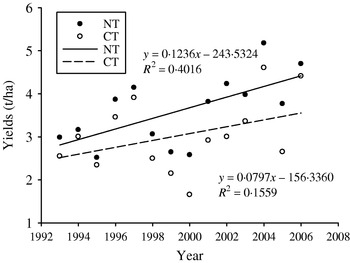
In general, yields of the winter wheat fluctuated widely from year to year. Although there were large fluctuations of yields with time, the mean yield of winter wheat under NT was 20% higher (P<0·05) than under CT during 1993–2006 (Fig. 1). Regression analysis of yield and year for NT treatment demonstrated significant correlations. The coefficients on the time variable were positive in two treatments, but were statistically significant (P<0·05) only in the NT treatment. Figure 1 also demonstrated the relatively small difference between treatments in the first 5 years, and much greater difference in the subsequent 9 years. Considering these subsequent 9 years on their own, the mean yield of NT winter wheat was 24·5% greater than that from ploughed plots.
Trends in yields of winter wheat for NT and CT treatments at Linfen in China. NT, no-tillage; CT, conventional tillage.

DISCUSSION
SOC contents provide a measurement of SOM status. In the present study, soil under NT had higher SOC content than soil under CT. This increase is particularly important in the north of China, where the levels of organic matter in the semi-arid agricultural soils are low. The greater SOC developed under NT may have been a result of the reduced contact of crop residues with soil. Surface residues tend to decompose more slowly than soil-incorporated residues, because of greater fluctuations in surface temperature and moisture and reduced availability of nutrients to microbes colonizing the surface residue (Schomberg et al. Reference Schomberg, Steiner and Unger1994). For the CT, when soils are ploughed, some standing wheat stubble is moved into deeper soil layers (100–300 mm); CT incorporates residues into a larger volume of soil and therefore increases the rates of organic matter decomposition and C mineralization (Salinas-García et al. Reference Salinas-García, Velázquez-García, Gallardo-Valdez, Díaz-Mederos, Caballero-Hernández, Tapia-Vargas and Rosales-Robles2002), by increasing the contact between soil micro-organisms and crop residues (Henriksen & Breland Reference Henriksen and Breland2002) and by disruption of SOM protected within aggregates (Six et al. Reference Six, Elliott and Paustian2000).
Differences in STN among tillage systems are in agreement with other studies (Embacher et al. Reference Embacher, Zsolnay, Gattinger and Munch2007; Wang et al. Reference Wang, Bai, Gao, He, Chen, Chesney, Kuhn and Li2008), who demonstrated that STN decreased with increasing soil depth. The higher total N found in the present study under NT was also consistent with the findings of other researchers (Torbert & Reeves Reference Torbert and Reeves1995; Thomas et al. Reference Thomas, Dalal and Standley2007). Increased total N apparently resulted from the increased accumulation of crop residues near the soil surface with NT systems. Total N is known to be enhanced by increasing SOM content (Salinas-García et al. Reference Salinas-García, Velázquez-García, Gallardo-Valdez, Díaz-Mederos, Caballero-Hernández, Tapia-Vargas and Rosales-Robles2002).
STP was higher under NT than under CT to a depth of 50 mm. Long-term NT management commonly leads to a stratification of P in soils (Zibilske et al. Reference Zibilske, Bradford and Smart2002). Phosphorus stratification in the present experiment suggests a changing status of P fertility due to tillage effects. Rhoton (Reference Rhoton2000) also found a higher amount of P in the 25 mm depth under NT. The apparent ‘mining’ of P from lower soil depths and retention in upper depths in conservation-tillage systems is probably due to immobilization of P, which promotes the organic P cycle, and to the chelation effect of organic compounds on soluble P (Zibilske et al. Reference Zibilske, Bradford and Smart2002).
The soil microbial biomass, which represents about 0·01–0·05 of total SOC, can provide an effective early warning of the improvement or deterioration of soil quality as a result of different management practices (Powlson et al. Reference Powlson, Brooks and Christensen1987). In the present study, MBC and MBN were higher under NT than under CT to a depth of 100 mm and decreased with further soil depth, more so under NT. This decrease, however, was least evident in conventional soils and probably resulted from the incorporation and mixing of crop residues within the ploughing layer. In contrast, higher surface soil microbial biomass concentrations with NT may be due to the accumulation of crop residues at the soil surface (Salinas-García et al. Reference Salinas-García, Velázquez-García, Gallardo-Valdez, Díaz-Mederos, Caballero-Hernández, Tapia-Vargas and Rosales-Robles2002). The observed increase in microbial biomass with NT is similar to that reported by Wright et al. (Reference Wright, Hons and Matocha2005), who found that microbial biomass C in the surface layer of NT soils averaged 80% higher than in ploughed soils. The present results of greater stratification of soil MBC under NT than under CT are in accordance with several other studies (Feng et al. Reference Feng, Motta, Reeves, Burmester, van Santen and Osborne2003).
Since dehydrogenase activity is only present in viable cells, it is thought to reflect the total range of oxidative activity of soil microflora and consequently may be considered to be a good indicator of microbial activity (Nannipieri et al. Reference Nannipieri, Greco, Ceccanti, Bollag and Stotzky1990). In the top soil (0–100 mm), dehydrogenase was significantly higher under NT, indicating a consistent improvement of soil quality under NT. Other authors have reported similar results under NT or CT under semi-arid conditions (Madejón et al. Reference Madejón, Moreno, Murillo and Pelegrín2007).
The phosphatases are a broad group of enzymes that hydrolyses esters and anhydrides of phosphoric acid. Alkaline phosphatase activity was mainly influenced by application of P, demonstrating that this enzyme was mainly influenced by single nutrient elements in the dryland soil. Hence, it may be used as an indicator of the status of soil P supplies, but not as an indicator of the comprehensive fertility of the soil. Long-term tillage had a significant effect on alkaline phosphatase activity, particularly in the 0–50 and 5–100 mm soil layers, where NT significantly (P<0·05) improved alkaline phosphatase by over 25% compared to CT. In the 100–300 mm layer, there was no significant difference in alkaline phosphatase between treatments NT and CT. Omidi et al. (Reference Omidi, Tahmasebi, Torabi and Miransari2008) showed that phosphatase activity in soils under NT management was greater than under conventional management. The increase in activity of hydrolase enzyme might be due to higher levels of intracellular and/or extracellular enzymes, immobilized by recalcitrant humic moieties (Nannipieri Reference Nannipieri, Pankhurst, Doube, Gupta and Grace1994).
In the 0–300 mm soil layers, β-glucosidase was significantly (P<0·05) higher under NT than under CT. β-glucosidase, an enzyme already reported as an early indicator of changes in soil properties induced by tillage systems (Ekenler & Tabatabai Reference Ekenler and Tabatabai2003), catalyses the hydrolysis of various β-glucosides during the decomposition of organic materials. This could indeed explain the increase in β-glucosidase initially observed as a result of NT with straw cover treatment.
Arylsulphatase is the enzyme that is involved in mineralization of ester sulphate in soils, and opinions on its activity have varied widely in the literature in relation to soil properties and management (Gupta & Germida Reference Gupta and Germida1988; Bandick & Dick Reference Bandick and Dick1999). The greater arylsulphatase activity under NT may reflect the increase of fungal biomass because arylsulphatase is strongly correlated with ergosterol, which is almost exclusively found in fungi (Newell et al. Reference Newell, Miller and Fallon1987). Furthermore, fungi have up to 0·42 of their S as ester sulphate, which is the substrate for arylsulphatase, while bacteria have around 0·10 ester sulphate-S (Saggar et al. Reference Saggar, Bettany and Stewart1981).
Tillage system did affect winter wheat yield. The positive yield response of winter wheat to NT was also found by Hemmat & Eskandari (Reference Hemmat and Eskandari2004). He et al. (Reference He, Kuhn, Zhang, Zhang and Li2009) and Su et al. (Reference Su, Zhang, Wu, Cai, Lv, Jiang, Huang, Gao, Hartmann and Gabriels2007) reported that NT could maintain crop productivity in northern China. This significant improvement under NT management was attributed to increased soil water storage and organic matter status. In semi-arid areas with frequent droughts, NT is of particular importance for stabilizing and improving crop yields.
The main conclusions from the present work are that NT management practices in the semi-arid area of the north China improved the quality of soil chemical properties, microbial biomass and soil enzymatic activities. SOC, STN and STP in the topsoil (0–100 mm) were greater under NT than under CT. The NT system was more effective in improving soil biochemical quality than the CT system. The beneficial effects of conservation agriculture on soil quality were more noticeable in the superficial layer (0–100 mm) than in the deeper layers (<100 mm). It is suggested that NT may be successful in maintaining sustainability and improving soil biological properties.
This study was partially supported by the National Basic Research Program of China (973 Program) (No. 2007CB109305), the 11th five-year plan of National Key Technologies R&D Program (No. 2006BAD29B01 and No. 2006BAD29B02), the Important National Science and Technology Specific Projects (No. 2008ZX07105-002) and the China Postdoctoral Science Foundation funded project (No. 20080440461). We are grateful to Professor Gao Huanwen and Li Hongwen for providing a valuable long-term NT platform for this research.