Mental health problems in children and adolescents range between 10 and 20% of the population (Dray et al., Reference Dray, Bowman, Campbell, Freund, Wolfenden, Hodder, McElwaine, Tremain, Bartlem, Bailey, Small, Palazzi, Oldmeadow and Wiggers2017; Gage & Patalay, Reference Gage and Patalay2021; Polanczyk et al., Reference Polanczyk, Salum, Sugaya, Caye and Rohde2015). In addition, emotional and behavioural problems have a worse long-term prognosis when the onset is prior to adulthood, for example during adolescence or childhood (Parés-Badell et al., Reference Parés-Badell, Barbaglia, Jerinic, Gustavsson, Salvador-Carulla and Alonso2014). In this sense, the prodromal characteristics (symptoms that precede the onset of the disorder) seem to start at an early age, specifically before the age of 25 (Fusar-Poli, Reference Fusar-Poli2019). In addition, problems in psychological adjustment have an impact at multiple levels (personal, family, school, health, economic, etc.) (Polanczyk et al., Reference Polanczyk, Salum, Sugaya, Caye and Rohde2015). Moreover, it should be emphasized that psychological problems and mental disorders are highlighted at this moment, as the new epidemic, also in the age group of 10 to 24 years (Gore et al., Reference Gore, Bloem, Patton, Ferguson, Joseph, Coffey, Sawyer and Mathers2011; Wykes et al., Reference Wykes, Haro, Belli, Obradors-Tarragó, Arango, Ayuso-Mateos, Bitter, Brunn, Chevreul, Demotes-Mainard, Elfeddali, Evans-Lacko, Fiorillo, Forsman, Hazo, Kuepper, Knappe, Leboyer, Lewis and Wittchen2015).
Likewise, different previous investigations affirm that the identification of emotional and behavioral problems during adolescence could mitigate, delay, and even prevent the appearance of a clinical disorder (Clark et al., Reference Clark, Coll-Seck, Banerjee, Peterson, Dalglish, Ameratunga, Balabanova, Bhan, Bhutta, Borrazzo, Claeson, Doherty, El-Jardali, George, Gichaga, Gram, Hipgrave, Kwamie, Meng and Costello2020; Copeland et al., Reference Copeland, Adair, Smetanin, Stiff, Briante, Colman, Fergusson, Horwood, Poulton, Jane Costello and Angold2013). As a result, public health systems are dedicating more resources to the prevention, detection, and intervention of psychological problems in adolescent populations (Arango et al., Reference Arango, Díaz-Caneja, McGorry, Rapoport, Sommer, Vorstman, McDaid, Marín, Serrano-Drozdowskyj, Freedman and Carpenter2018; Fonseca-Pedrero, Debbané et al., Reference Fonseca-Pedrero, Debbané, Rodríguez-Testal, Cohen, Docherty and Ortuño-Sierra2021).
Executive functioning encompasses the cognitive processes involved in planning, initiating, and maintaining goal-directed behavior, response inhibition, cognitive flexibility, working memory, problem solving, and emotional control (Peters, Reference Peters, Thomas, Mareschal and Dumontheil2020; Zelazo et al., Reference Zelazo, Blair and Willoughby2017). Thus, executive functions (EF) are related to positive outcomes such as social functioning (Blanco et al., Reference Blanco, Wall, He, Krueger, Olfson, Jin, Burstein and Merikangas2015; Fusar-Poli, Reference Fusar-Poli2019; Gore et al., Reference Gore, Bloem, Patton, Ferguson, Joseph, Coffey, Sawyer and Mathers2011) and academic skills (Distefano et al., Reference Distefano, Galinsky, McClelland, Zelazo and Carlson2018). On the other hand, specific neurocognitive changes during adolescence are related to an increase in vulnerability to certain mental health problems (Díez-Gómez et al., Reference Díez-Gómez, Pérezde Álbeniz, Ortuño-Sierra and Fonseca-Pedrero2020; Fonseca-Pedrero, Pérez-Álvarez et al., Reference Fonseca-Pedrero, Pérez-Álvarez, Al-Halabí, Inchausti, López-Navarro, Muñiz, Lucas-Molina, Pérez-Albéniz, Baños Rivera, Cano-Vindel, Gimeno-Peón, Prado-Abril, González-Menéndez, Valero, Priede, González-Blanch, Ruiz-Rodríguez, Moriana, Gómez, Navas and Montoya-Castilla2021; Fumero et al., Reference Fumero, Marrero, Pérez-Albéniz and Fonseca-Pedrero2021; Ortuño-Sierra et al., Reference Ortuño-Sierra, Bañuelos, Pérez de Albéniz, Lucas Molina and Fonseca-Pedrero2019). For instance, a relationship has been found between EF and anxiety disorders (Godovich et al., Reference Godovich, Senior, Degnan, Cummings, Shiffrin, Alvord and Rich2020; Mullin et al., Reference Mullin, Perks, Haraden, Snyder and Hankin2020; Ursache & Raver, Reference Ursache and Raver2014) and depression (Gotlib & Joormann, Reference Gotlib and Joormann2010; Thompson et al., Reference Thompson, Borenstein, Kircanski and Gotlib2020). Deficits in executive functioning have been related to depressive and anxiety disorders. According to Oliver et al. (Reference Oliver, Pile, Elm and Lau2019), the relationship between depressive disorder and EF in an adolescent population shows that there may be deficits in information processing, response inhibition, focus shift, selective attention, verbal working memory, and verbal fluency. In addition, alterations in EF can limit coping skills, increasing the risk of relapse and/or affecting compliance with treatment (Wagner et al., Reference Wagner, Doering, Helmreich, Lieb and Tadić2012).
Deficiencies in attention, working memory, and problem solving can have a negative impact on daily activities, especially in children and adolescents whose academic performance may depend on these skills (Aronen et al., Reference Aronen, Vuontela, Steenari, Salmi and Carlson2005; Best et al., Reference Best, Miller and Naglieri2011). Vilgis et al., (Reference Vilgis, Silk and Vance2015), after reviewing 33 studies on the possible relationship between executive functions and depressive disorders in children and adolescents, concluded that negative stimuli can affect performance in neuropsychological tasks.
Thus, both Positive Affect (PA) and Negative Affect (NA) have been shown to be relevant to cognitive performance in adolescents (Han et al., Reference Han, Helm, Iucha, Zahn-Waxler, Hastings and Klimes-Dougan2016; Sandín, Reference Sandín2003; Sandín et al., Reference Sandín, Chorot, Lostao, Joiner, Santed and Valiente1999). PA is defined as the experiencing of a positive mood, with feelings like joy, interest, enthusiasm, and alertness, whereas NA is related to emotional distress, and includes moods like fear, sadness, anger and guilt (Watson et al., Reference Watson, Clark and Tellegen1988). Recent studies have analyzed the relationship between PA, measured by the Positive and Negative Affect Schedule (PANAS; Watson et al., Reference Watson, Clark and Tellegen1988), and working memory, finding a moderate positive correlation (Figueira et al., Reference Figueira, Pacheco, Lobo, Volchan, Pereira, de Oliveira and David2018). Similarly, previous studies suggested the association between working memory and PA (Carpenter et al., Reference Carpenter, Peters, Västfjäll and Isen2013; Yang et al., Reference Yang, Yang and Isen2013). However, the relationship between PA and short-term memory was weaker (Yang et al., Reference Yang, Yang and Isen2013). In addition, it seems that a high PA is related to higher levels of social cognition, and that an increase in NA decreases the performance in this area (Sanmartín, Inglés, Gonzálvez, et al., Reference Sanmartín, Inglés, Gonzálvez, Vicent, Ruiz-Esteban and García-Fernández2018; Sanmartín, Inglés, Vicent, et al., Reference Sanmartín, Inglés, Vicent, Gonzálvez, Díaz-Herrero and García-Fernández2018). Worth noting, none of the revised studies have established cause-effect relationships. Therefore, it is not possible to conclude that problems in affectivity may lead to neurocognitive difficulties and vice versa.
Therefore, and in view of existing previous research, there seems to be a lack of studies that analyze the relationship between different neurocognitive domains and the problems related to low PA and high NA in the adolescent population. The knowledge of different neurocognitive domains and their association with psychological problems can help to facilitate the detection and prevention of these alterations (Moore et al., Reference Moore, Gur, Thomas, Brown, Nock, Savitt, Keilp, Heeringa, Ursano and Stein2017). For this reason, the main objective of this study was to analyze the neurocognitive functioning of adolescents at risk for PA and NA, and to compare it with a comparison group of adolescents at low risk. Furthermore, we studied the correlation between the neurocognitive competences. Considering the previous literature, the working hypothesis was that adolescents at high risk might show more deficits in neurocognitive functioning when compared with those adolescents at low risk for PA and NA to the comparison group. In addition, we expected a positive correlation between all the neurocognitive competences.
Method
Participants
The study was carried out through stratified random sampling, by conglomerates, at the classroom level, in an approximate population of 15,000 students belonging to La Rioja. The different layer was created according to the type of educational center (public or concerted educational centers) and the educational stage (Compulsory Secondary Education, Baccalaureate and Vocational Training). The probability of removal from the classroom was determined based on the number of students enrolled in school. 34 educational centers and 98 classrooms participated. Students with a diagnosis of psychological disorder or with a diagnosis of intellectual disability were excluded from the study. This information was previously provided by the educational centers. The initial sample consisted of a total of N = 1,881 students.
Those participants with high scores on the Oviedo Infrequency Scale (Fonseca-Pedrero et al., Reference Fonseca-Pedrero, Paíno-Piñeiro, Lemos-Giráldez, Villazón-García and Muñiz2009) (more than three points) (n = 104), who were over 19 years old (n = 170) or who did not finish the test (n = 76) were eliminated. Thus, the final sample consisted of a total of 1,509 students, 739 boys (46.5%) and 849 girls (53.5%).
The mean age was 16.13 years (SD = 1.36), the age range oscillating between 14 and 19 years (14 years, n = 213; 15 years, n = 337; 16 years, n = 400; 17 years, n = 382; 18 years, n = 180 and 19 years, n = 76).
Instruments
Positive and Negative Affect Schedule Short version (PANAS-S) (Ebesutani et al., Reference Ebesutani, Okamura, Higa-McMillan and Chorpita2011). The PANAS is made up of two factors designed to measure Positive Affect and Negative Affect. The 10 items have a Likert-type format with responses ranging from 1 (very little or not at all), up to 5 (extremely or a lot). Five items evaluate PA through adjectives such as: Cheerful, lively, happy, energetic and proud; and another five the NA: Depressed, angry, fearful, scared and sad.
The PANAS assesses how people feel during the last weeks. This instrument has shown adequate psychometric quality in previous works with Spanish adolescents (Fonseca-Pedrero, Díez-Gómez, et al., Reference Fonseca-Pedrero, Díez-Gómez, de la Barrera, Sebastián-Enesco, Ortuño-Sierra, Montoya-Castilla, Lucas-Molina, Inchausti and Pérez-Albéniz2020).
The Oviedo Infrequency Scale (INF-OV) (Fonseca-Pedrero et al., Reference Fonseca-Pedrero, Paíno-Piñeiro, Lemos-Giráldez, Villazón-García and Muñiz2009). The INF OV is an instrument developed to detect those participants who have responded haphazardly. The INF OV is a self-report type measurement instrument composed of 12 items in Likert-type format of five categories depending on the degree of adherence (1 = completely disagree; 5 = completely agree).
Participants with more than three incorrect answers were eliminated from the sample. This scale has been used in previous studies and is valid to detect participants who present a random, pseudo-random and / or dishonest response pattern (Fonseca-Pedrero et al., Reference Fonseca-Pedrero, Paíno-Piñeiro, Lemos-Giráldez, Villazón-García and Muñiz2009).
The Family Affluence Scale–II (FAS–II) (Boyce et al., Reference Boyce, Torsheim, Currie and Zambon2006). Socioeconomic status was measured using a scale composed of 4 items with scoring ranges from 0 to 9 points. Previous international studies have demonstrated its adequate psychometric properties (Boyce et al., Reference Boyce, Torsheim, Currie and Zambon2006).
The Penn Computerized Neurocognitive Battery (CNB) (Gur et al., Reference Gur, Richard, Hughett, Calkins, Macy, Bilker, Brensinger and Gur2010, Reference Gur, Richard, Calkins, Chiavacci, Hansen, Bilker, Loughead, Connolly, Qiu, Mentch, Abou-Sleiman, Hakonarson and Gur2012). The CNB is composed of test from different batteries. The PENN was administered using the system developed by the University of Pennsylvania. During one hour, the participants perform 14 tasks that include different domains: Executive functions (mental abstraction and flexibility, attention and working memory), episodic memory (words, faces and shapes), complex cognition (verbal and non-verbal reasoning and spatial processing, social cognition (identification of emotions, differentiation of expressed emotion and age differentiation), and sensorimotor speed
In the present study we used the following tasks (domain measured): Penn Conditional Exclusion Test (mental flexibility), the Penn Continuous Performance Test (attention), and Letter N-back (working memory) with the aim to assess executive functions; the Penn Word Memory Test (verbal memory), the Penn Face Memory Test (face memory), and the Visual Object Learning Test (spatial memory) in order to analyze memory; the Children’s version of the Penn Verbal Reasoning Test Language reasoning), Penn Matrix Reasoning Test (nonverbal reasoning), and the Penn Line Orientation Test (emotion identification) that intended to assess complex cognition; and finally, the Penn Emotion Identification Test (emotion identification), the Penn Emotion Differentiation Test (emotion differentiation), and the Penn Age Differentiation Test (age differentiation) were used to analyze social cognition domain. Different studies have shown adequate psychometric properties of the PEEN (Gur et al., Reference Gur, Richard, Calkins, Chiavacci, Hansen, Bilker, Loughead, Connolly, Qiu, Mentch, Abou-Sleiman, Hakonarson and Gur2012).
In addition to those tests developed to only measure speed, the other tests include measures of accuracy and speed. We simplified instructions and vocabulary for verbal stimuli from the adult CNB, in order to facilitate completion. The Motor Praxis task and Finger Tapping Test were evaluated in sensorimotor domainFootnote 1. Following previous works (Gur et al., Reference Gur, Richard, Calkins, Chiavacci, Hansen, Bilker, Loughead, Connolly, Qiu, Mentch, Abou-Sleiman, Hakonarson and Gur2012; Moore et al., Reference Moore, Reise, Gur, Hakonarson and Gur2015) the web based platform for the CNB was established with Perl CGI, HTML, a mySQL database and the Apache web server; tests were developed by means of Adobe Flash®. Scores ant tests are generated automatically with this platform.
We followed a back translation procedure in accordance with international guidelines for translation of psychological measures (Muñiz et al., Reference Muñiz, Elosua and Hambleton2013) with the aim of adapting the battery into Spanish. A panel of experts translated the American English original version of the CBN adolescent version into Spanish. Then, a bilingual researcher, familiar with American culture, translated this version into English. Finally, a third panel of researchers compared the two English versions (original and translated). All processes were supported by the Brain Behavior Laboratory, Department of Psychiatry, University of Pennsylvania Perelman School of Medicine, Philadelphia, US.
Procedure
The research was approved by the Department of Education of the Government of La Rioja and the Ethical Committee of Clinical Research of La Rioja (CEICLAR). In order to standardize the test administration process in all educational centers, all researchers were given a protocol and guidelines that had to be implemented before, during, and after the tests were carried out. The administration was carried out collectively in groups of 10 to 30 participants. Classrooms of the school, which were equipped for this purpose with individual computer equipment, were used. Administration of the test was always carried out within school hours and the confidentiality of the responses was informed at all times, as well as the voluntary nature of participation. No rewards were given for collaboration in the study. Likewise, the informed consent of the parents or legal guardians was requested for the participation of adolescents under 18 years of age in the research. The study was presented as an investigation into emotional well-being and mental health.
Data Analyses
First, the initial sample of participants was analyzed. Those participants with high scores on the Oviedo Infrequency Scale (Fonseca-Pedrero et al., Reference Fonseca-Pedrero, Paíno-Piñeiro, Lemos-Giráldez, Villazón-García and Muñiz2009) (more than three points) (n = 104), who were over 19 years old (n = 170) or who did not finish the test (n = 76) were eliminated. Thus, the final sample consisted of a total of 1,509 students, 739 boys (46.5%) and 849 girls (53.5%).
Second, direct scores for precision and speed were calculated in each of the tests and later they were transformed into z scores, considering the means and standard deviations of the total sample. In order to facilitate interpretation and make it more consistent, a higher z score was intended to reflect better performance on the task (e.g., higher accuracy and shorter responses correspond to higher z-scores). Thus, the response time z scores were multiplied by –1, in such a way that a longer response time corresponded with a lower z score.
With the aim of comparing adolescents at risk and non-risk in affect, two different groups were created. For the group termed high psychometric risk, a score equal to or greater than 29 points in NA and equal to or less than 18 in PA was established as an inclusion criterion, according to the normative values of previous research (Crawford & Henry, Reference Crawford and Henry2004; Ortuño-Sierra et al., Reference Ortuño-Sierra, Santarén-Rosell, Pérez-Albéniz and Fonseca-Pedrero2015).
Z scores on the PENN greater than 3 and less than –3 were eliminated in order to reduce the influence of out-of-range values. Therefore, a final sample of n = 92 (26 males; mean age = 16.36 years) was obtained for the high psychometric risk group. A comparison group matched for gender and agewas selected from the remainder at random (n = 92; 26 males; mean age = 16.42 years).
Descriptive statistics were calculated for the precision, speed and efficiency measures of the five neurocognitive domains of the PENN according to the risk group and the comparison group for the PA and NA.
Second, a Multivariate analysis of covariance (MANCOVA) was performed taking the five neurocognitive domains (Executive Function, Memory, Complex Cognition, Social Cognition and Sensorimotor Cognition in the case of speed) as dependent variables and the two groups derived from the scores of the brief PANAS (at risk vs. comparison) as a fixed factor.
The variable of socioeconomic level (based on FAS II) was included as a possible covariate that could affect the result. The partial eta squared (partial η2) was used as an estimate of the effect size.
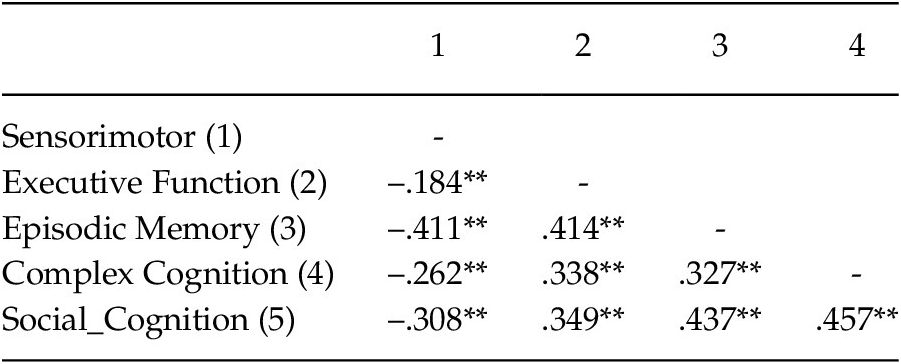
Finally, the Pearson’s correlations between the dependent variables were calculated with the aim to understand the relationship between all the neurocognitive competences. In order to facilitate understanding, we only included the correlation between the efficiency performance in Executive Function, Memory, Complex Cognition, Social Cognition (result of the accuracy minus the speed) and the Sensorimotor competence. We used SPSS 26.0 for data analysis (IBM, 2016).
Results
Descriptive Statistics for the Neurocognitive Domains
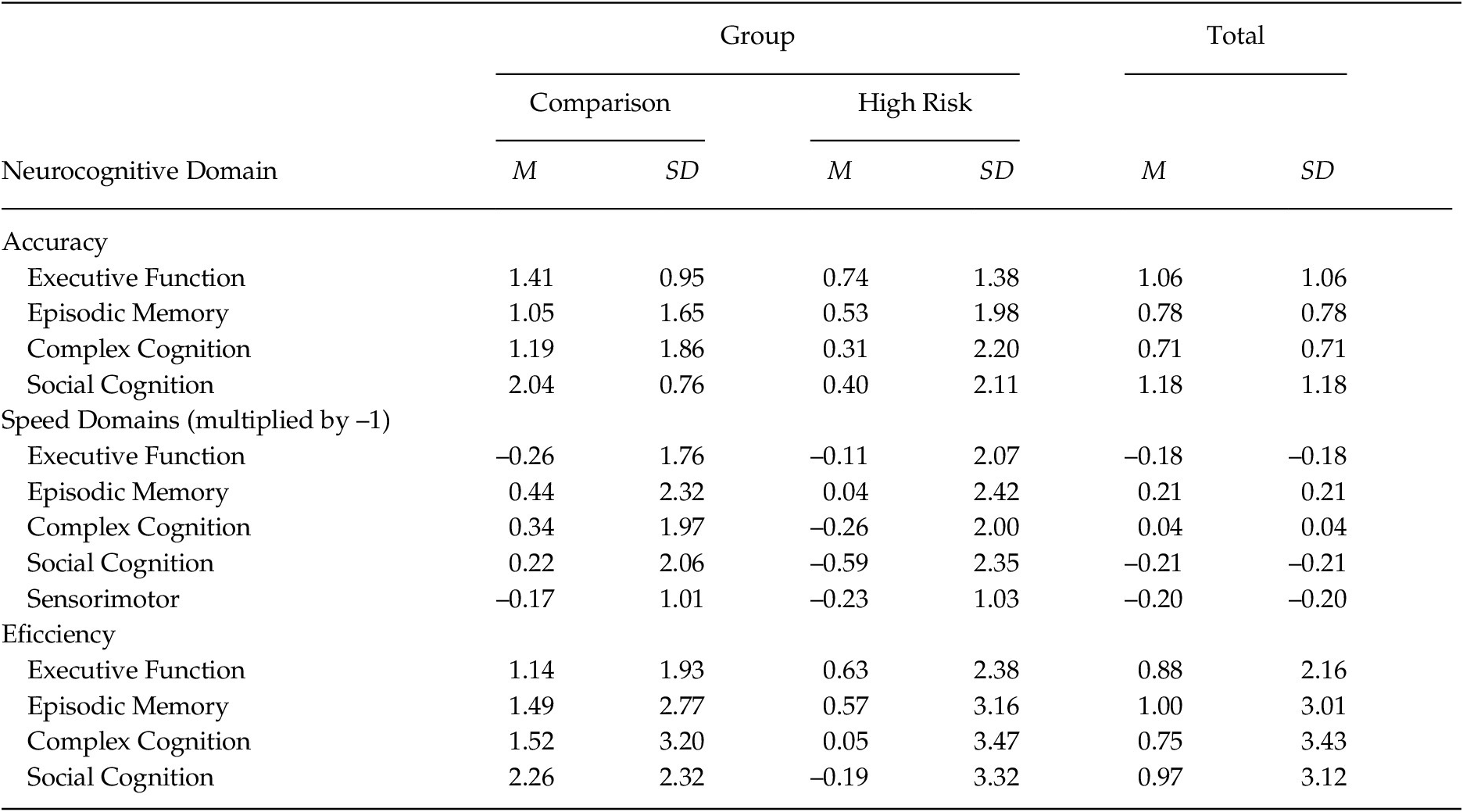
The descriptive statistics for all z scores in neurocognitive functions according to precision, speed and efficiency are shown in Table 1.
Descriptive Statistics for the Total Sample and the Risk and Non-risk Groups

Accuracy Performance across Neurocognitive Domains
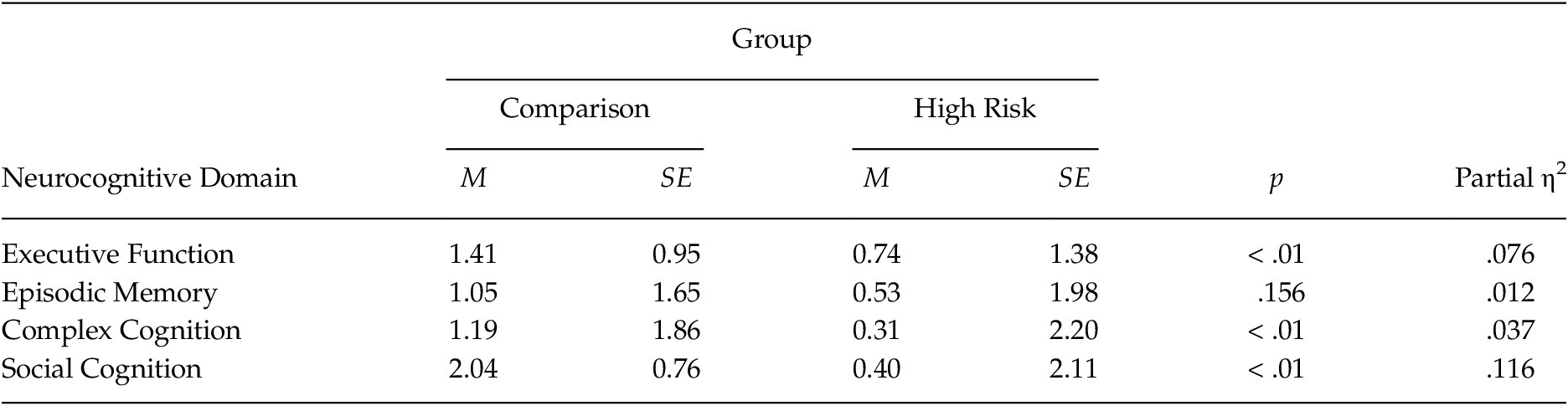
After controlling for the effect of socioeconomic status in the participants, the MANCOVA results with the precision scores of neurocognitive competencies as dependent variables and the two groups (comparison vs. high risk) as a fixed factor, showed statistically significant differences (λ = .820, F (9, 160,000) = 3.913, p = .001, partial η² = .180) (see Table 2). In particular, the ANOVAs reveal statistically signifficant differences by group in executive control, F (1, 92) = 13.820, p < .01, partial η² = .076; complex cognition, F (1, 92) = 6.505, p = .001, partial η² = .037; and social cognition, F (1, 92) = 22.015, p < .01, partial η² = .116; but not for episodic memory, F (1, 92) = 2.030, p = .156, partial η² = .012. In those that were significant, the effect size was low except for social cognition.
Accuracy Neurocognitive Performance Scores for the Comparison and the High-Risk Group

Speed Performance across Neurocognitive Domains
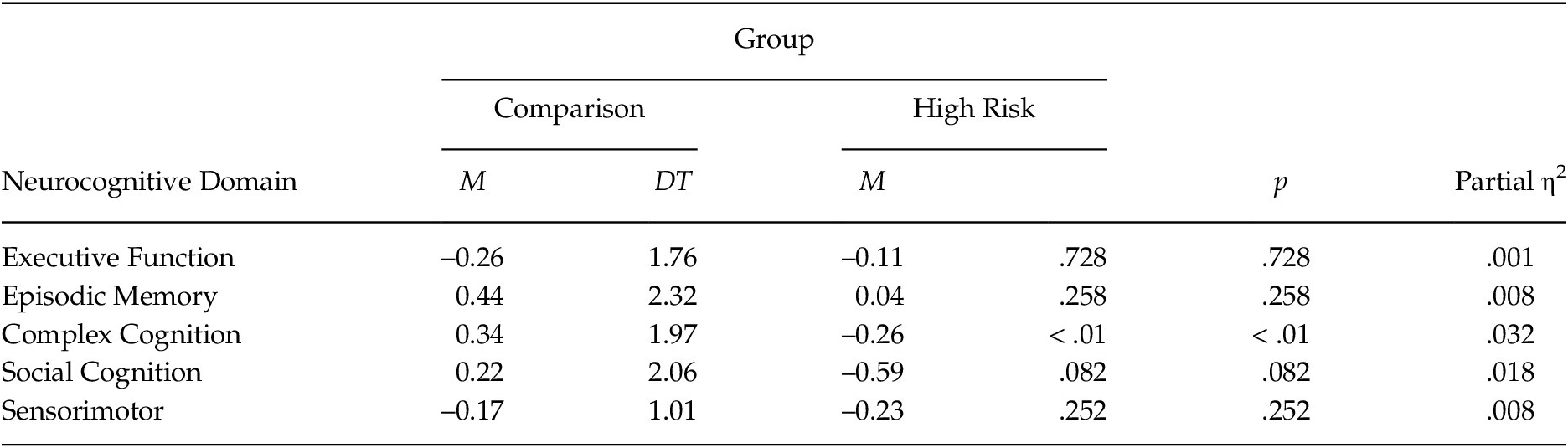
The MANCOVA for speed scores showed statistically significant differences in neurocognitive processing speed as a function of group, λ = .502, F (5, 88,000) = 17.493, p < .01, partial η² = .498. Specifically (see Table 3) the ANOVAs indicated that the speed scores in the participants varied statistically significantly depending on the group only in the domain of complex cognition, F (1, 92) = 51.395, p < .01, partial η² = .032. No statistically significant differences were found in the rest of the domains: Social cognition, F (1, 92) = 3.064, p = .082, partial η² = .018; executive control, F (1, 92) = 0.121, p = .728, partial η² = .001; episodic memory, F (1, 92) = 1.287, p = .258, partial η² = .008; sensorimotor performance, F (1, 92) = 1.323, p = .252, partial η² = .008. Adolescents at risk show a significant decrease in neurocognitive processing performance (more time needed) in complex cognition neurocognitive competence compared to those at non-risk.
Speed Neurocognitive Performance Scores for the Comparison and the High-Risk Group

Efficiency Performance across Neurocognitive Domains
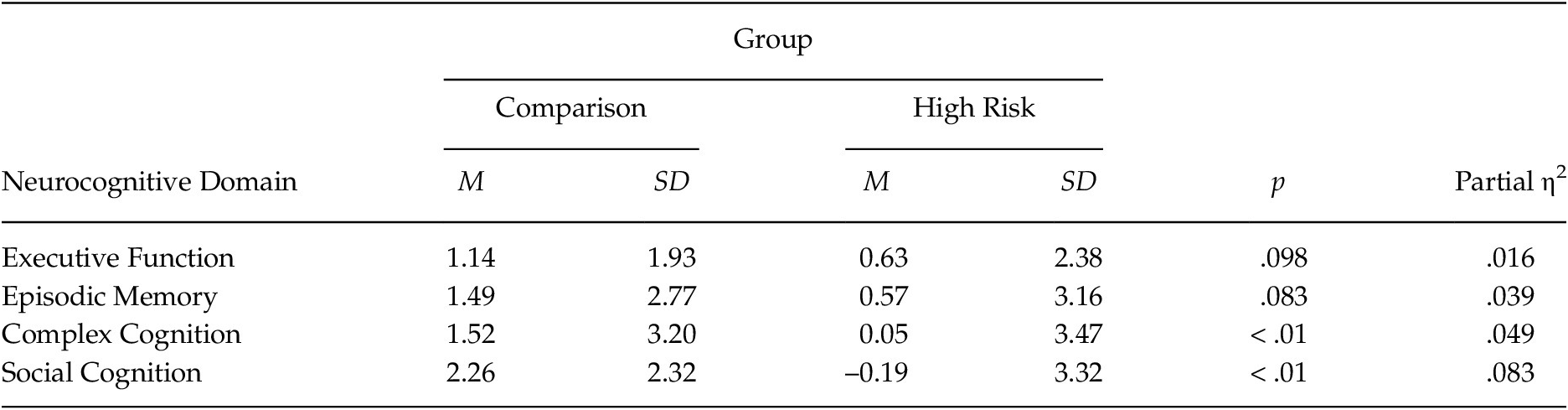
Regarding efficiency (derived from accuracy scores minus speed scores) in the four competences, the MANCOVA scores showed statistically significant differences according to the high and comparison groups in affectivity problems, λ = .485, F (4, 89,000) = 23.599, p < .01, partial η² = .515. The results of the ANOVAs are shown in Table 4. As can be seen, there are statistically significant differences in complex cognition, F (1, 92) = 8.643, p < .01, partial η² = .049; and social cognition, F (1, 92) = 15.276, p < .01, partial η² = .083. Nonetheless, no signifficant differences were found in executive control, F (1, 92) = 2.769, p = .098, partial η² = .016); nor in episodic memory, F (1, 92) = 3.036, p = .083, partial η² = .039. Adolescents with high psychometric risk show a lower performance regarding efficiency in two of the four neurocognitive competences when compared to those without risk.
Efficiency Neurocognitive Performance Scores for the Comparison Group and the High-Risk Group

Correlation between Neurocognitive Domains
Table 5 shows the Pearson’s correlations for all the neurocognitive competences. As it can seen, most of the correlations found were statistically significant.
Pearson Correlations between all the Neurocognitive Competences in Efficiency and Sensorimotor

Note. ** p < .05.
Discussion
Mental health problems in the child and adolescent population have a strong impact on personal, social, health and economic levels (Fumero et al., Reference Fumero, Marrero, Pérez-Albéniz and Fonseca-Pedrero2021; Vaingankar et al., Reference Vaingankar, Chong, Abdin, Shafie, Chua, Shahwan, Verma and Subramaniam2021). However, to date, there are still, limitations in understanding the association between positive and negative affectivity problems and neurocognitive performance during adolescence. Therefore, the objective of this research was to evaluate the neurocognitive performance in adolescents with psychometric risk of presenting problems in affectivity. The present work is one of the first studies to analyze the association between emotional measures of PA and NA, measured by the brief PANAS, and neurocognitive functioning, measured by the PENN, in an adolescent population. The results found in this study, although they do not establish cause-effect relationships, confirm that adolescents at risk of presenting affective problems (high NA or low PA) have lower neurocognitive performance than adolescents at low risk.
Specifically the results reveal statistically significant differences in all neurocognitive domains (executive control, complex cognition, and social cognition), except for episodic memory. Previous studies reveal results similar to those found in this study, relating EF to anxiety disorders (Godovich et al., Reference Godovich, Senior, Degnan, Cummings, Shiffrin, Alvord and Rich2020; Mullin et al., Reference Mullin, Perks, Haraden, Snyder and Hankin2020; Ursache & Raver, Reference Ursache and Raver2014) and depression (Gotlib & Joormann, Reference Gotlib and Joormann2010; Thompson et al., Reference Thompson, Borenstein, Kircanski and Gotlib2020). Also, different problems in neurocognitive functioning have been related to emotional problems (Vilgis et al., Reference Vilgis, Silk and Vance2015). In particular, the study of Barch et al. (Reference Barch, Harms, Tillman, Hawkey and Luby2019), indicated that emotion regulation and episodic memory were linked to depression symtoms. The results in the present study are unclear about this, as adolescents at risk for emotional problems did not show impairments in episodic memory when compared to those at low risk. Previous studies have documented that adolescents and adults with depression had impairments in episodic memory. As this study focus on emotional symptoms instead of depression, it could be that episodic memory deficits are associated to depression disorder but not to previous steps of emotional difficulties, contrary to the other neurocognitive domains studied (Ahern & Semkovska, Reference Ahern and Semkovska2017; Semkovska et al., Reference Semkovska, Quinlivan, O’Grady, Johnson, Collins, O’Connor and Knittle2019).
If the speed of processing is considered, the results showed statistically significant differences between the adolescents of low and high risk only in the domain of complex cognition. At the present time, few studies have reported data on neurocognitive performance and its relationship to mental health problems. The results of the present work converge with Vilgis et al. (Reference Vilgis, Silk and Vance2015) who found that difficulties in attention, working memory, and problem solving were related with affective disorders. Moreover, recent studies have found similar results between affective disorders and neurocognitive performance (Chaarani et al., Reference Chaarani, Hahn, Allgaier, Adise, Owens, Juliano, Yuan, Loso, Ivanciu, Albaugh, Dumas, Mackey, Laurent, Ivanova, Hagler, Cornejo, Hatton, Agrawal, Aguinaldo and Garavan2021; Godovich et al., Reference Godovich, Senior, Degnan, Cummings, Shiffrin, Alvord and Rich2020; Thompson et al., Reference Thompson, Borenstein, Kircanski and Gotlib2020). Therefore, positive and negative affect may be key to understanding the relationship between emotional difficulties measures and neurocognitive markers (Ho et al., Reference Ho, Gifuni and Gotlib2021; Mullin et al., Reference Mullin, Perks, Haraden, Snyder and Hankin2020).
The results for efficiency reveal that adolescents at risk show poorer performance in this type of task across different neurocognitive domains. Thus, high-risk adolescents obtained lower scores in complex cognition and social cognition. The differences found in this study are consistent with the hypothesis that there is a lower capacity to establish self-regulation processes in child and adolescent populations with neurocognitive deficits (Schoemaker et al., Reference Schoemaker, Bunte, Espy, Deković and Matthys2014). In this sense, different studies show the relationship between emotional regulation difficulties and school dropout, substance use, suicidal ideation or bullying, among other problems (Vaingankar et al., Reference Vaingankar, Chong, Abdin, Shafie, Chua, Shahwan, Verma and Subramaniam2021; Walker et al., Reference Walker, McGee and Druss2015). The results found in this study are consistent with the idea that adolescents with neurocognitive deficits are at higher risk for emotion dysregulation, which may lead to mental health problems (Schoemaker et al., Reference Schoemaker, Bunte, Espy, Deković and Matthys2014). It is worth mentioning that as emotional problems are more prevalent in women, the high risk group comprised of more women than men, a result that precludes generalization of the results to males.
Also, correlations between the dependent variables (the neurocognitive competences), were all positive and statistically significant. This makes sense from a neuropsychological perspective, as it is difficult to complete a complex problem if it is not possible, for instance, to keep the goal in mind (executive function) (Moore et al., Reference Moore, Reise, Gur, Hakonarson and Gur2015). Also, different authors, suggest that similar neural systems are involve in neurocognitive performance (Apšvalka et al., Reference Apšvalka, Ferreira, Schmitz, Rowe and Anderson2022; Cocuzza et al., Reference Cocuzza, Ito, Schultz, Bassett and Cole2020), what is in line with the positive correlation found between all the domains. Overall, the results presented are consistent with the hypothesis that difficulties in PA and NA are associated with limitations in neurocognitive skills (Basten et al., Reference Basten, Althoff, Tiemeier, Jaddoe, Hofman, Hudziak, Verhulst and van der Ende2013). In this regard, these results show that mental health problems, specifically those related to affective aspects, are significantly related to neurocognitive functioning in the adolescent population (Blanken et al., Reference Blanken, White, Mous, Basten, Muetzel, Jaddoe, Wals, van der Ende, Verhulst and Tiemeier2017; Hobson et al., Reference Hobson, Scott and Rubia2011). The results of this work seem to support the idea that the study of cognitive endophenotypes can be useful in order to understand the relationship between emotional difficulties and negative outcomes during adolescence. This can contribute to improve prevention and early detection strategies in the field of mental health (Abrahams et al., Reference Abrahams, Pancorbo, Primi, Santos, Kyllonen, John and De Fruyt2019; Beck et al., Reference Beck, Himelstein, Bredemeier, Silverstein and Grant2018; Oliver et al., Reference Oliver, Pile, Elm and Lau2019). Endophenotypic measures of specific neurocognitive functions could help to better understand affective problems and improve prognosis, offering a useful and relevant starting point for researchers, healthcare professionals and education professionals.
The results of this work have some limitations that should be mentioned. First, the cross-sectional nature of the study prevents the establishment of cause and effect relationships. In this way, it is not possible to determine whether the neurocognitive problem precedes, is concomitant or consequent to the problems in positive and negative affect. In the future, it would be advisable to carry out longitudinal studies that will allow stablishing cause-effect correlations. Second, to detect individuals at high risk of suffering emotional problems, the brief PANAS was used as a representative indicator. Although this measurement tool has been proven as a useful and valid screening tool, the inclusion of other measurement tools such as interviews could help to more accurately detect participants at risk of suffering from mental health problems. Furthermore, an exhaustive detection of specific learning difficulties in the sample was not carried out. Finally, no information was collected on a previous history of mental health problems at the family level, an aspect that could be relevant in subsequent research. Despite these limitations, the results found in the study show a significant relationship between problems in positive and negative affect and neurocognitive difficulties during adolescence. This study provides information that contributes to a deeper understanding of the underlying etiology of mental health problems in such a relevant stage of development as adolescence. Future research could continue with the study of the phenotypic measurement of cognitive competences with specific health problems and combined with neuroimaging data, genetic patterns and clinical evaluations.