During the final months of the 2012 presidential campaign in Ghana, members of the “kitchen cabinet” of incumbent president and National Democratic Congress presidential candidate John Mahama argued for a gender parity cabinet should their candidate win.Footnote 1 In the end, their candidate did win the election, but he was unable to form a gender parity cabinet—although the initial cabinet was 32% female, the highest percentage of women cabinet ministers ever in Ghana. Across Africa, in late 2019, five African countries had gender parity (or very close to gender parity) cabinets, according to iKNOW Politics: Rwanda, Guinea-Bissau, South Africa, Ethiopia, and Seychelles.Footnote 2 News reports about these gender parity cabinets described the new presidents and prime ministers as simply appointing or even “decreeing,” in the case of Guinea-Bissau, gender parity cabinets.Footnote 3 Unlike members of parliament (MPs) who are elected, cabinet ministers are appointed, making it possible for a president or prime minister to bring many women into the cabinet, as these African leaders, and some others around the world, have done. But why have presidents in Ghana, unlike some other African leaders, not made use of their powers of appointment to bring more women into the cabinet?
Our study is inspired by Annesley, Beckwith, and Franceschet's book Cabinets, Ministers and Gender (Reference Annesley, Beckwith and Franceschet2019), which seeks to understand why there are so few women cabinet ministers in most countries.Footnote 4 Relying on seven country cases from Europe, North America, and South America, the authors reveal that the cabinet appointment process is “gendered,” with the result that the composition of the cabinet is likely to be gendered, meaning more or fewer women cabinet ministers depending on the rules of the appointment process. The authors identify the ways in which sets of formal and informal rules guide the minister selection process in their country cases, paying close attention to those who select the cabinet ministers and those who are eligible and qualified to be cabinet ministers.
In this article, we use the model developed by Annesley, Beckwith, and Franceschet (Reference Annesley, Beckwith and Franceschet2019) to investigate the cabinet appointment process in Ghana since the transition to democracy in 1992.Footnote 5 In brief, we find that, in keeping with what we know about powerful executives across the African continent, it is largely the “president's prerogative” to appoint a cabinet of his (it has only been his) choosing in Ghana, although there are very real constraints on those choices—most importantly, the need to abide by a constitutionally recommended regional balance and a constitutional requirement that at least half the cabinet ministers come from parliament. Still, we are confident that with sufficient effort, gender parity cabinets could be appointed by presidents in Ghana, too, even taking into consideration these constraints.
In seeking to answer our question, we sought to better understand the cabinet appointment process in Ghana. In conducting our research, we relied on four data sources, which were also used by Annesley, Beckwith, and Franceschet (Reference Annesley, Beckwith and Franceschet2019, 40). First, we located various primary and secondary sources, including government of Ghana documents (e.g., the Constitution and reports of the Constitution Review Commission) and the small secondary literature on cabinets in Africa and Ghana. Second, we consulted media reports of the cabinet appointment process for five new presidential administrations beginning in 2001: President John Kufuor in 2001 and 2005, President John Atta Mills in 2009, President John Mahama in 2013, and President Nana Akufo-Addo in 2017.Footnote 6 Using the Nexis Uni database, we searched for news reports of cabinet appointments in each new administration, as Annesley, Beckwith, and Franceschet (Reference Annesley, Beckwith and Franceschet2019) did, during the “speculation phase”—the time from the election until the first cabinet ministers were named—and then the “reaction phase”—for about two weeks after the final announcement of cabinet appointments was made.Footnote 7 For these five administrations in Ghana, our searches yielded just under 10 to just under 20 stories about cabinet appointments for each new government. Third, we conducted semistructured, in-depth expert and elite interviews with a range of informants, including scholars, journalists, former ministers and cabinet ministers and others in government, and civil society actors (see Appendix 1 in the supplementary material online).Footnote 8 Like Annesley, Beckwith, and Franceschet (Reference Annesley, Beckwith and Franceschet2019, 42), we did not interview current ministers and focused our questions on “how things are done around here,” in terms of the cabinet appointment process. Finally, we consulted published accounts of political insiders—memoirs, autobiographies, and biographies as available—though in general this is not a very common genre in Ghana.Footnote 9
Before proceeding, we had to know who is a cabinet minister in Ghana— a question that is not so easily answered, it turns out (a subject to which we will return later in this article). In many countries around the world, there are cabinet ministers as well as other ministers who are not in the cabinet.Footnote 10 It may not always be readily apparent who is a cabinet minister and who is “just” a minister. In Ghana, beyond cabinet ministers, there are typically noncabinet ministers, ministers of state, and regional ministers (and deputy ministers). According to Ayee (Reference Ayee2009, 18–19), it was President Kwame Nkrumah who in 1965 appointed the first 12 “noncabinet ministers” in Ghana, bringing the total number of ministers to 32. Under the Akufo-Addo government that came to power in 2017, there were more than 120 ministers and deputy ministers, including cabinet ministers.Footnote 11 Moreover, which ministerial portfolios belong to the cabinet (or not) may change from one government to another. In Ghana, the cabinet consists of no more than 19 ministers, but which ministries are included in the cabinet has changed slightly from one administration to another.
The remainder of this article unfolds as follows: In the next section, we highlight the relevant questions from the scant secondary literature on cabinet ministers—male and female—in Africa and Ghana. Thereafter, we reveal our findings on the cabinet appointment process in Ghana and the implications for the appointment of women cabinet ministers, organized around who selects the cabinet ministers, who is eligible and qualified to be a cabinet minister, and what the formal and informal rules of appointment are, as in Annesley, Beckwith, and Franceschet's (Reference Annesley, Beckwith and Franceschet2019) model. Finally, we conclude the article with some unanswered questions generated by our research, as well as reflections on the contributions of our study to our wider understandings of gender and the cabinet appointment process.
MEN AND WOMEN CABINET MINISTERS IN AFRICA AND GHANA
Annesley, Beckwith, and Franceschet (Reference Annesley, Beckwith and Franceschet2019) were not the first to seek to understand women's access to cabinets across the globe. Bauer and Tremblay (Reference Bauer, Bauer and Tremblay2011) looked for geographic patterns in women's representation in political executives in a volume of regional case studies, noting that the growth in women's presence in cabinets has not been linear and that much more substantial access by women to cabinets is a recent phenomenon. Both books review the literature on presidential versus parliamentary political systems (with the former favoring the appointment of women ministers because ministers must not be drawn from parliament) and generalist versus specialist recruitment norms—that is, whether ministers are recruited for their political skills and experience or for their specific policy expertise (with the latter tending to favor the appointment of women). In their conclusion, Bauer and Tremblay (Reference Bauer and Tremblay2011, 181) identified a range of factors explaining women's access to the executive, according to their case studies; political factors were the most important. They found that regime changes, adherence to regional or international norms, and mobilized women's movements were the “extra-institutional political characteristics” that had a positive impact on women's access to executives (184).
Similarly, Krook and O'Brien (Reference Krook and O'Brien2012, 853), in their study of women's access to cabinets around the world (as of 2009), found that political rather than social factors had the greatest impact on gender parity in cabinets: “Perhaps the most striking finding was that in a majority of cases women's cabinet appointments were explained by the presence of more women among political elites—something that can be promoted through concrete political strategies like gender quotas—rather than by variables that are far more difficult to change, like the existence of favorable political institutions, changes in the status of ordinary women, or evolution of attitudes towards gender equality.” Jacob, Scherpereel, and Adams (Reference Jacob, Scherpereel and Adams2014, 322), looking at the years 1979 to 2009, argued that “a gender-balanced decision-making (GBDM) norm had become embedded, over the last three decades, in the world polity.” This GBDM norm “establishes expectations about appropriate levels of women in decision-making positions” and had a larger effect on increasing women's representation in cabinets than in legislatures (323).
There is scant research on women in cabinets in Africa.Footnote 12 There have been three increases in women's presence in cabinets in Africa, according to Russell and DeLancey (Reference Russell and DeLancey2002), Bauer (Reference Bauer, Bauer and Tremblay2011), and Moodley et al. (Reference Moodley, Holt, Leke and Desvaux2016): first, around 1975 in the wake of the first United Nations Conference on Women in Mexico City (after which national gender machineries were adopted across the continent); second, around 1990 when democratic political transitions were taking place across Africa after decades of single-party and military rule in many countries; and third, in the 2010s as gender parity laws for parliament started to be adopted in Africa and pressure mounted for greater women's representation in politics and decision-making overall. Bauer and Okpotor (Reference Bauer and Okpotor2013, 77) suggest that in Africa, as in other parts of the world, the specialist method of cabinet recruitment appears to have created more opportunities for women to become cabinet members than the generalist method, and that “normative influences” (the regional, continental, and international norms provided by the African Union or the United Nations Conferences on Women) have had a positive impact on women's increasing access to cabinets in some countries. In a study of the effect of a gender quota law on the election of women to parliament and the appointment of women to the cabinet in Niger, Kang (Reference Kang2013, 94) found that the effect of the quota depended on a combination of factors, including “the design of the law, the institutional context and the agency of women's activists who monitored the quota's implementation.”
Arriola and Johnson (Reference Arriola and Johnson2014, 495), using a data set of 34 African countries from 1980 to 2005, found that “women are less likely to become cabinet ministers where incumbents use such appointments to build patronage-based alliances with politicians who act as advocates for ethnic constituencies.” Further, they “show that women's share of cabinet appointments is significantly lower in countries where leaders must accommodate a larger number of politicized ethnic groups, but it rises with higher levels of democracy and greater representation of women in parliament.” Adams, Scherpereel, and Jacob (Reference Adams, Scherpereel and Jacob2016, 145) look at the relationship between legislatures and cabinets in Africa and show that “countries with high levels of women's legislative representation do not necessarily have high levels of women's cabinet representation,” while at the same time, some “legislative laggards”—with fewer women in parliament—can emerge as cabinet leaders. Ghana is one of those countries in Africa (and the world) with a higher percentage of women in the cabinet than in parliament, and this is another reason to focus on Ghana. Another reason is that, like the countries in Annesley, Beckwith, and Franceschet's (Reference Annesley, Beckwith and Franceschet2019) study, Ghana is an (emerging) democracy. Finally, it is a country in which we have already conducted significant research on women's political leadership (Bauer and Darkwah Reference Bauer, Darkwah, Muriaas, Wang and Murray2019, Reference Bauer and Darkwah2020).Footnote 13
As with cabinets in Africa in general (LeVan and Assenov Reference LeVan and Assenov2016, 663), we know relatively little from the scholarly literature about cabinets in Ghana. Similarly, we know little from the scholarly literature about women cabinet ministers in Ghana since independence. Many studies have considered individual women or women's organizations and their important roles in politics during the precolonial and colonial periods and the early years of independence under President Nkrumah (see, e.g., Aidoo Reference Aidoo1985; Allman Reference Allman2009; Boahen Reference Boahen2000; Denzer Reference Denzer and Cornwall2005; Manuh Reference Manuh and Arhin1993a; Sackeyfio-Lenoch Reference Sackeyfio-Lenoch2018; Tsikata Reference Tsikata, Hansen and Ninsin1989). Other studies have focused on the military regimes of the late 1960s, 1970s, and 1980s, when women were mostly excluded from participation in formal politics and their organizations were largely proscribed (Bauer Reference Bauer2017; Manuh Reference Manuh and Gyimah-Boadi1993b).Footnote 14 Overviews of the more recent period tend to privilege women activists and their organizations and, less often, women in parliaments, with almost nothing on women in cabinets (Allah-Mensah Reference Allah-Mensah2005, Reference Allah-Mensah and Boafo-Arthur2007; Bauer Reference Bauer, Franceschet, Krook and Tan2019; Bauer and Darkwah Reference Bauer, Darkwah, Muriaas, Wang and Murray2019, Reference Bauer and Darkwah2020; Bawa and Sanyare Reference Bawa and Sanyare2013; Darkwa Reference Darkwa and Gebe2015; Fallon Reference Fallon2008; Musah and Gariba Reference Musah and Gariba2013; Nketiah Reference Nketiah2010; Prah Reference Prah2004, Reference Prah2007; Sossou Reference Sossou2011; Tandoh-Offin Reference Tandoh-Offin2011; Tsikata Reference Tsikata2009b). Adams, Scherpereel, and Jacob's (Reference Adams, Scherpereel and Jacob2016) study is the only one to focus on women ministers in Ghana.Footnote 15
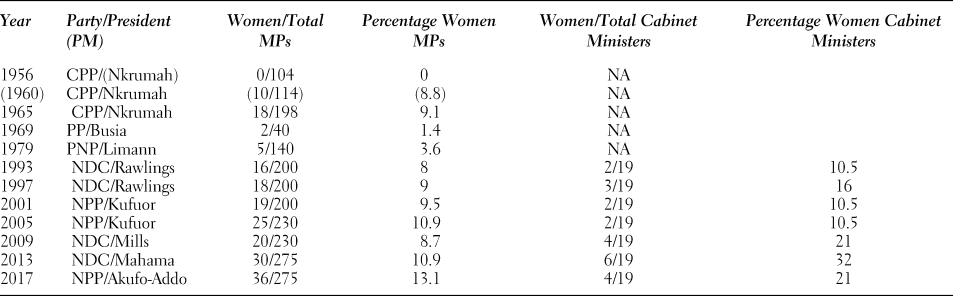
Indeed, Adams, Scherpereel, and Jacob (Reference Adams, Scherpereel and Jacob2016, 146) observe that Ghana is one of those countries in Africa with a higher percentage of women in the cabinet than in parliament. They argue that in Ghana, a conducive institutional environment, an international context stressing gender-balanced decision-making and an autonomous domestic women's movement have promoted women's incorporation into the cabinet, even when women have not had the same access to parliament (147). That said, when Adams, Scherpereel, and Jacob conducted their study, there were somewhat fewer women in the cabinet than when we conducted our study—though still a greater percentage than in parliament (see Table 1), and the administration has changed hands since then. Our study yields a different set of factors determining women's access to cabinet in Ghana than Adams, Scherpereel, and Jacob's study; we now turn to our findings.
Women in parliaments and cabinets in Ghana, 1956–2017

Note: Military regimes for 1966–69, 1972–79, and 1981–92 are excluded.
Sources: For MPs: 1956–79: Nketiah (Reference Nketiah2010, 26–59); 1992–2012: Darkwa (Reference Darkwa and Gebe2015, 250); 2016: http:// www.parliament.gh; NA: not available. There is some discrepancy among sources on some of these numbers (including with http:// www.ipu.org). For cabinet ministers: Listed with cabinets in Appendix 2. This table is meant to include only those ministers who are part of the cabinet.
FINDINGS: GHANA CASE STUDY
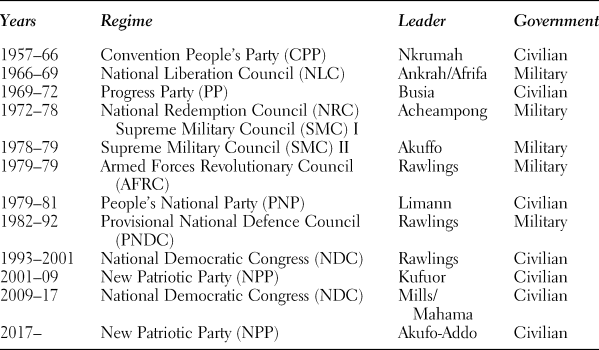
Ghana was the first country south of the Sahara to obtain independence, in 1957. Less than a decade after independence, in 1966, the nation's first leader, Kwame Nkrumah, was overthrown in a military coup. Military regimes dominated the following decades, with brief interludes of civilian rule (see Table 2). Since the democratic political transition in 1992 and the onset of Ghana's Fourth Republic, governments have alternated every eight years between the two main political parties, the National Democratic Congress (NDC) and the New Patriotic Party (NPP). The NDC governed from 1993 to 2001, followed by the NPP from 2001 to 2009, the NDC again from 2009 to 2017, and then back to an NPP-led government following the 2016 and 2020 elections.Footnote 16 We begin this study with the Fourth Republic in 1993.
Postindependence regimes in Ghana, 1957–2017

Sources: Bauer (Reference Bauer2017); Tandoh-Offin (Reference Tandoh-Offin2011, 9).
During President Jerry Rawlings's first government (1993–97), there were two women cabinet ministers out of 19, then three out of 19 during his second term. During President Kufuor's two governments (2001–09), there were again two women cabinet ministers at the beginning of each term. Since then, the number of women cabinet ministers seems to have grown steadily but very slowly, with some slight “see-saw” effect.Footnote 17 Our Nexis Uni search yielded no media reports for the two Rawlings administrations, and so they are not included, although our interviews and secondary data sources are not necessarily confined to a particular president or party.
In the remainder of this section, we focus on three main questions indicated by the model developed by Annesley, Beckwith, and Franceschet (Reference Annesley, Beckwith and Franceschet2019): Who selects cabinet ministers in Ghana? Who is considered eligible and qualified to be a cabinet minister in Ghana? And, perhaps most importantly, what are the formal and informal rules around appointment to cabinet in Ghana?
Who Selects Cabinet Ministers?
As one former cabinet minister from the first Kufuor administration noted, “The cabinet is a creature of the Constitution.”Footnote 18 Indeed, the few formal rules governing the cabinet and the selection of cabinet ministers in Ghana are contained in the 1992 Constitution.Footnote 19 According to Article 76(1) of the Constitution, the cabinet shall consist of the president, vice president, and “not less than 10 and not more than 19 ministers of state.” Article 78(1) notes that ministers of state are “appointed by the president with the prior approval of parliament from among members of parliament or persons qualified to be elected as members of parliament, except that the majority of ministers of state shall be appointed from among members of parliament”—indicating that the president must appoint cabinet ministers, they must be vetted by parliament, and at least half must be chosen from among members of parliament.
We found little evidence that presidents were unsuccessful in having their cabinet nominees approved by parliament. Mohammed (Reference Mohammed and Ayee2019, 202) reports that in his first and second governments, President Rawlings was forced to withdraw six and seven ministerial nominees, respectively, who were not approved by parliament. These were the first two presidential terms after the transition from military to democratic rule, but with the military leader turned democrat Rawlings still in power. Mohammed (Reference Mohammed and Ayee2019, 202–4) suggests that the nominees were rejected because of their “weak quality,” but also because of an assertion of power by the legislature. No nominated ministers have been rejected by parliament since then.
Indeed, we suggest that the president of Ghana is an “empowered selector”—that is, a selector who has “the ability to choose ministers autonomously, as opposed to having to consult, negotiate, or take instructions from other political actors,” as described by Annesley, Beckwith, and Franceschet (Reference Annesley, Beckwith and Franceschet2019, 61), although consultation and negotiation certainly take place in Ghana. In media reports, we found repeated references to the “prerogative” of presidents in making their ministerial appointments, with no other method for appointing ministers mentioned. In January 2005, one Kufuor nominee was quoted reminding the public that “it was the president who had the prerogative to retain or replace his ministers whom he thought would produce the results he desired” (January 24, 2005, GH Chronicle). Another article published on the same day asked, “Does the president not have the prerogative to make his own choices?” (January 24, 2005, Public Agenda).
Four years later, at the time of the incoming Mills administration, it was again noted in a news report that “it was the prerogative of the president to appoint people he could rely on and work with” (February 3, 2009, GH Chronicle). Four years later, when there were “maneuverings, lobbying, agitations and jostling for political appointments and nominations by some power seekers” for a Mahama administration, readers were reminded that “we must allow HE [his excellency] the president free hand to form his government since he has the sole prerogative to do so” (January 21, 2013, GH Chronicle). When there was outcry over the number of ministers appointed by President Akufo-Addo in early 2017, the public was again admonished “that the president has the power to appoint members of the cabinet is not in doubt” (March 22, 2017, Daily Guide), and “if the president decides to appoint many ministers that is up to him” (March 23, 2017, Daily Guide). As one former minister from the Akufo-Addo government summed up the process of cabinet appointment, it “depends on the whim and caprice of the president.” This view was confirmed by our other informants as well.
As empowered selectors, we argue, Ghanaian presidents have great freedom in making cabinet and ministerial appointments. Occasionally their decisions may be unpopular—as when President Mahama appointed a blind minister of chieftaincy and traditional affairs, or when President Akufo-Addo appointed more than 110 ministers and deputy ministers—and yet they are able to proceed with their plans largely unfettered. This suggests that they would also be free to take bold steps in appointing more women to the cabinet, even a gender parity cabinet. Moreover, our survey of news reports indicates that presidents are, by and large, praised for appointing more women to the cabinet and to ministries outside the cabinet, thus providing some incentive for them to appoint more women cabinet ministers.
Related questions might be when decisions about cabinet appointments are taken and revealed, as well as who influences presidents as they draw up their cabinets and name other ministers. For all of the five administrations that we reviewed, presidents made public their first lists of ministerial appointees soon after they were inaugurated in early January, though there was always considerable speculation about ministerial and cabinet appointments as soon as the winner of the election was declared. But it was also clear that prospective cabinet appointments were given deep consideration by candidates and election winners long before any formal announcements were made. Arriola (Reference Arriola2012, Reference Arriola2013) and Posner (Reference Posner2005) have shown how, across Africa, the promise of ministerial appointments and cabinet formation may be used to win over potential defectors and opponents by presidential candidates during their campaigns. In Ghana, too, cabinet appointments are made with an eye toward the many constituencies that need to be satisfied. As for influences on the president, one scholar informed us that the cabinet appointment process “is not a transparent process,” with many seeking to influence presidents as they select their cabinets. These influencers may include members of a “kitchen cabinet,” members of a president's transition team, a party's National Executive Committee, “financiers,” traditional leaders or chiefs, religious and faith-based leaders, and other interest groups or interested individuals (January 15, 2009, GH Chronicle; December 14, 2016, The Herald; February 15, 2017, GH Chronicle; selected interviews).
But to what extent are women likely to be among those groups or individuals—the “financiers,” the inner circle of party leaders, members of a kitchen cabinet, or among the traditional leaders or trusted networks influencing presidents-elect as they compose their cabinets? The numbers of women cabinet ministers, except under President Mahama, suggest not so likely, thereby undermining the prospects for more women cabinet ministers. In addition, unlike men, women are also far less likely to self-nominate for an office such as cabinet minister, we were told by our informants.
Awuni (Reference Awuni2019, 111), in his biography of President Mahama, states that when Mahama's kitchen cabinet sought to bring more women, particularly “professionals and technocrats who were not career politicians,” into the cabinet, some of the women who were approached “declined the offer.” In previous work (Bauer and Darkwah Reference Bauer, Darkwah, Muriaas, Wang and Murray2019), we have documented the many obstacles and disincentives facing women in Ghana who seek to stand in party primaries and the general election for parliament—including the exorbitant (financial) cost of politics, a humiliating politics of insult, and a weak legislature. Women eschew standing for political office even when political parties offer incentives like reduced filing fees. We have also shown (Bauer and Darkwah Reference Bauer and Darkwah2020) that this does not represent a lack of political ambition or a failure to meet any qualifications on the part of potential women candidates or officeholders in Ghana; rather, it is a conscious choice to avoid electoral politics and to focus more on those arenas in which they may accomplish important political and social goals (which would be unlikely in a relatively weak legislature). Lack of proximity combined with lack of interest may be keeping some women away from appointments to the cabinet.
Presidents in Ghana are apparently also free to decide which ministries will be in the cabinet and which will not, and the ministries that are a part of the cabinet have changed over the course of the Fourth Republic—at least at the margins. While Agriculture, Defense, Education, Employment, Finance, Foreign Affairs, Justice, Roads and Highways, Trade, and Industry are likely to be in the cabinet, the rest can change from one administration to another. Interestingly, President Akufo-Addo was the first since 2000 to leave the minister of gender (who has always been a woman) out of the cabinet (as well as the minister of youth). The choice of which ministries are in the cabinet, given that some are more likely to be led by a female or a male minister, may also influence the gender balance in the cabinet.
Who Is Eligible and Qualified to Be a Minister in Ghana?
In terms of who is eligible or qualified to be a minister in Ghana, at least half of the ministers must be members of parliament or qualified to be members of parliament. In all of the Fourth Republic cabinets, there has always been a 9/10 split between those ministers drawn from outside parliament and those who are “minister MPs”—with the balance tipping either way. In terms of the affiliational, representational, and experiential criteria identified by Annesley, Beckwith, and Franceschet (Reference Annesley, Beckwith and Franceschet2019), we find evidence of the importance of all three.Footnote 20 In terms of affiliational criteria, being a loyal and trusted ally of the president is critical. An early, interesting example of this was President Kufuor's 2001 appointment of his brother, a medical doctor, to be minister of defense, rather than minister of health, as was expected by most. But as observers also noted, President Kufuor's brother was his most trusted ally to head up the military as Ghana made its first transition from a former military leader and a party that had held power for more than two decades (January 11, 2001, allAfrica.com), including as a military regime for the first of the two decades. Further, we found repeated references to individuals being rewarded—with ministerial appointments—for their “loyalty,” “long service to the party,” “contributions to retaining the party in power,” “efforts of party stalwarts who fought tooth and nail,” and demonstrating “zeal, commitment, loyalty and enthusiasm towards the realization of the dreams” of their party (January 24, 2005, Public Agenda; January 14, 2009, GH Chronicle; December 14, 2012, GH Chronicle; January 12, 2013, GH Chronicle; January 7, 2017, Ghana News Agency). One observation summed up: “Many rally behind a leader to attain a goal, but only the loyal and reliable ones would be chosen to join the administrative caravan” (January 7, 2017, Ghana News Agency). Not all of these ministerial appointments would have been to the cabinet, but even for cabinet appointments, we heard from former ministers about the importance of having worked hard for the party and even having campaigned alongside the president. All of our interviews reinforced the importance of loyalty to presidents and the importance of being part of their trusted networks. We have noted earlier that women's limited presence in trusted networks may work against their appointment to cabinet.
Representational criteria—in particular region and gender—figure strongly in the selection of ministers in general and cabinet ministers in particular in Ghana. Indeed, news reports repeatedly cited the Directive Principles of State Policy, Article 35(6b) of the Constitution, that the state “shall take appropriate measures to achieve reasonable regional and gender balance in recruitment and appointment to public offices” when proposing ministerial slates.Footnote 21 But region was by far the most important representational criterion, sometimes conflated with ethnicity, with some suggestion in news reports that the minimum 10 ministers in the cabinet was meant to indicate at least one minister from each of Ghana's 10 regions (the number of regions recently increased to 16). So, for example, an article about President Kufuor's “all-inclusive team” in early 2001 noted that the appointment of one minister was meant to “satisfy Ga clamour for more Gas to be made minister,” and that another appointee would be one of two ministers “from the Volta region” (January 25, 2001, Accra Mail). During his second term, President Kufuor was accused of letting one region—the Eastern Region—dominate his administration to the potential neglect of other regions, prompting the reminder that it would be “prudent that a second look should be taken at the regional balance stipulated in the Constitution” (January 24, 2005, Public Agenda). A second article that day also warned that President Kufuor was in danger of ignoring the constitutional requirement for regional balance in appointments (January 24, 2005, GH Chronicle). Meanwhile, President Mahama was accused of a northern bias in his appointments—that there were “too many men of northern extraction in this administration” (January 23, 2013, GH Chronicle) and not enough “personalities of Ashanti descent in the crop of new ministers” (January 12, 2013, GH Chronicle).Footnote 22 In general, all presidents were accused of overrepresenting ministers from their home or nearby regions and underrepresenting ministers from other regions.
The gender balance in ministerial and cabinet appointments also received considerable scrutiny as reported by the media, beginning with the first Kufuor administration.Footnote 23 In a March 13, 2001 (Public Agenda) article, women activists were cited demanding “more women as ministers,” not just the establishment of a gender ministry. President Kufuor was criticized again at the outset of his second administration on January 24, 2005 (GH Chronicle), for not appointing enough women ministers, even though there were more women in parliament by then. A concern about the gender of ministers is not evident in news reports about President Mills's cabinet appointments (though Adams, Scherpereel, and Jacob [2016] find differently, as noted later), in contrast to his successor President Mahama, who was praised for being “a lot conscious of the fact that women empowerment largely depends on their involvement in decision making, hence the naming of eight women who many consider well qualified among the first 37 ministerial appointees” (with a final six in his cabinet of 19) (January 28, 2013, Public Agenda). President Akufo-Addo was similarly identified as fulfilling “the ruling NPP promise to allocate 30 percent of all appointments to women,” although, in fact, he did not achieve that percentage in the most important ministerial posts to the cabinet during his first administration.
As for other representational criteria, President Kufuor in his first administration sought to name a couple of ministers from beyond his own political party, the NPP, and was praised for his “all-inclusive policy” in doing so (January 25, 2001, Accra Mail). President Mahama appointed one minister with a disability (lack of sight), and in doing so, he was also praised for building an “all-inclusive government,” though some chiefs protested the minister for chieftaincy and traditional affairs appointment, arguing that a blind man is not supposed to see an Akan chief—and so how could he do his job? (February 13, 2013, GH Chronicle).
Age was another representational criterion that generated controversy in some administrations more than others. For example, one article observed that President Mills, in his deputy minister appointments, seemed to be responding to calls for “the youth” to be empowered and take charge of the nation's future, with four appointments of individuals under 40 years of age, although some others queried whether this was not just “jobs for the boys”— in other words, those who had campaigned hard for the party during the election (March 11, 2009, GH Chronicle). But age as a criterion for appointment surfaced most as an issue during President Akufo-Addo's appointments, as he was the oldest man to take office as president in Ghana.Footnote 24 When President Akufo-Addo seemed to be considering mostly “his contemporaries” for ministerial posts during his first administration, the youth were reportedly angered, feeling that “their toil, sweat and blood brought the nearly impossible [election] victory home” and yet were going unrewarded, if not unacknowledged (December 14, 2016, The Herald).
Our survey of news reports of the cabinet appointment process for all five administrations from 2000 to 2017, as well as our interviews, suggests that experiential criteria figure prominently as presidents in Ghana contemplate their future cabinets and ministerial appointments more broadly. The attributes of nominees are described in phrases such as “technocrats and established professionals with considerable experience,” “quality human resources,” “well educated . . . [with] widespread experience at senior management levels,” “very competent and well-seasoned technocrats,” and “competence and capacity.” Some news reports describe the nominees’ CVs, which reflect highly qualified and capable people appropriate to their proposed ministerial appointment.
Presidents in Ghana appoint cabinet ministers who are highly qualified for their assignments and usually have little difficulty in surviving a vetting by parliament (at least since the Kufuor administrations). There is no suggestion that female cabinet ministers are any less qualified than their male counterparts or that there are not enough qualified potential women cabinet ministers available. In her study of women in parliament in Ghana, Darkwa (Reference Darkwa and Gebe2015, 246) refers to a “directory of qualified and available women, ready to participate in the political decision making process” as a resource for her study. She further notes, “since one of the often cited reasons for the low numbers of appointment of women into key decision making processes had been the unavailability of women to participate in politics, the objective of the study was to obtain and collate information on women who were willing and available to be appointed by government should there be a need.” Adams, Scherpereel, and Jacob (Reference Adams, Scherpereel and Jacob2016, 158) report a similar finding—that “in December 2012, immediately after the elections, [one organization] WiLDAF presented a petition to [President-elect] Mahama that included the names of 65 women who could be considered for government posts and called on the parliamentary appointment committee to reject any list of appointments that did not include 40 percent women.” It is interesting to note that Mahama—the one presented with the long list of women's names from a civil society organization—is also the one to have appointed the most women cabinet ministers so far. Finding qualified women is not a barrier to more women in the cabinet in Ghana, though there is some evidence, as noted earlier, that some women may be less interested in an appointment to the cabinet.
What Are the Formal and Informal Rules of Appointment?
As described earlier, Ghana's 1992 Constitution set out certain rules for the cabinet and the appointment of ministers of state: presidents must appoint a minimum of 10 and a maximum of 19 cabinet ministers and as many additional ministers as required to accomplish their goals; at least half the ministers must be drawn from parliament (and any others must be qualified to be in parliament); all ministers must be vetted by parliament; and a regional and gender balance in all appointments to public office is a directive of state policy. But just as important as these formal rules, what are the informal rules guiding the appointment process? For example, while this is not stated anywhere, it is clear that certain groups and individuals may strongly influence the president's decisions on cabinet appointments, including a kitchen cabinet or transition team, the National Executive Committee of the party, and “financiers.” As for the criteria that are often used to consider cabinet appointments, while none is anywhere prescribed, it is clear that loyalty—to the president and the president's party—is of paramount importance, as well as some proximity (networks) to presidents themselves. While regional and gender balance are mentioned in the Constitution, we observed that regional balance is far more important than gender balance and that a strong unwritten, though closely observed, rule is that every cabinet must have at least one minister from every region. Finally, we found that as in other cabinets around the world, cabinets in Ghana are conceived of as “teams” by those who propose the appointments, those who vet them, and those who comment on them.
Annesley, Beckwith, and Franceschet (Reference Annesley, Beckwith and Franceschet2019, 59) suggest that “cabinet construction is akin to putting together a puzzle: the individual cabinet ministers are not as important on their own as they are in how they fit with each other.” In Ghana, we found the same. From our interviews with former ministers especially, but also other observers, we learned that presidential candidates typically have in mind during the campaign a set of initial cabinet appointments—the most important core appointments. But the final cabinet appointments can only be made after the election and depending on election results—how the party fared in the election, which constituencies the party won and lost, which MPs were elected, which people and places needed to be rewarded or otherwise paid attention to, and so on. Moreover, it is also with the final appointments that the required representational balance is met and that the all-important balance between MPs and those outside parliament is met. As LeVan and Assenov (Reference LeVan and Assenov2016, 666) have noted, “In Africa, cabinets are especially important because the composition of ministries is a common gauge of the inclusiveness of government.” As one member of a presidential kitchen cabinet recounted, in order to illustrate the balancing act that goes into constructing the final cabinet, “we needed the female MP from Ada,” because she was a woman, she was an MP, and she was from the region of Greater Accra, and so helped meet three important criteria.
In terms of formal rules about ministerial appointments, the requirement that at least half of ministers must be drawn from parliament—creating a “hybrid government” in Ghana—has been a hotly debated provision over the years (Boafo-Arthur Reference Boafo-Arthur and Mohammed Salih2005; Mohammed Reference Mohammed and Ayee2019; Prempeh Reference Prempeh2008). Some scholars and practitioners object to this provision because of the way in which it allows the executive to dominate the legislature, and indeed weakens the legislature, while others argue that it diverts the attention of many of the “minister MPs” from their work in parliament. This requirement was reviewed by the 2010 Constitution Review Commission (CRC), with an extensive discussion included in the documents that emerged from the CRC and the subsequent white paper.Footnote 25 The CRC (2011, 177) recommended that the executive in Ghana be given a “free hand” in appointing ministers—that the president must not be compelled to appoint the majority of ministers from parliament—a recommendation that was subsequently accepted in the government white paper response (CRC of Inquiry 2011, 16).Footnote 26 But none of the recommendations of the CRC have been adopted.Footnote 27 Additionally, the practice can distract minister MPs from their work as ministers; indeed, one former woman cabinet minister appointed from outside parliament mentioned that President Mahama specifically chose her from outside so that she could focus fully on her portfolio, meant to be one of his priority areas. Moreover, it is generally understood that in such systems, in which some or all ministers must be drawn from parliament, women may be less likely to be appointed ministers if (as in Ghana) there are few women in parliament to draw from. Adams, Scherpereel, and Jacob (Reference Adams, Scherpereel and Jacob2016, 155) report that in 2009, President Mills was unable to follow through on an NDC promise of 40% women in government because only five women from his party were elected to parliament and he was required to draw a majority of ministers from parliament. In 2013, President Mahama appointed six women cabinet ministers, but only one of them was an MP. While, in theory, a president could select all of his women ministers from outside parliament, thereby avoiding any negative impact of the “majority” requirement on the number of women cabinet ministers, such a selection could conflict with the need to appoint some other ministers from outside parliament based on very specific expertise not found in parliament or to very important ministries that would require their full attention. This formal rule seems a potential constraint to the appointment of more women cabinet ministers in Ghana, especially in conjunction with other rules.
Other formal rules reference regional and gender balance. We have noted that region and gender constitute the most important representational criteria in Ghana, most likely because they are explicitly mentioned in the Constitution with regard to “appointments to public office.” One of the few studies on cabinet ministers in Africa investigates the implications of ethnic or regional balance on gender balance in nearly three dozen African countries. Arriola and Johnson (Reference Arriola and Johnson2014) found that the quest for ethnic or regional balance may negatively impact gender balance. In Ghana, regions may serve as proxies for ethnic groups to some extent, in that certain ethnic groups predominate in certain regions, but there are many more ethnic groups than regions in the country. There is intense public pressure for presidents in Ghana to include all regions when making their cabinet appointments, based on the directive that calls for regional (and gender) balance in all appointments to public office. In news reports that we surveyed, issues of regional (im)balance were raised one and a half times more often than issues of gender (im)balance. While regional balance is almost never not achieved, all cabinets in Ghana have been far from accomplishing a gender balance, and no media reports have called out presidents for failing to achieve a gender balance in the way that they do a lack of regional balance. During 2019, six regions were added to Ghana's 10; it remains to be seen whether future cabinets will have representation from 16 regions, and if so at what cost—to the number of women ministers or perhaps to the overall size of cabinet? Overall, the imperative for regional balance seems to negatively impact the quest for gender balance. In returning to our opening vignette, it is our understanding that at least some of the advisers around President Mahama were keen for him to appoint a gender parity cabinet, but were not able to make it work given other imperatives around such rules as “minister MPs” and regional balance.
UNANTICIPATED FINDINGS AND UNANSWERED QUESTIONS
One unanticipated finding of our research was the difficulty in even compiling lists of 19 cabinet ministers for successive presidential administrations in Ghana. In late 2019, there was no government of Ghana webpage for the cabinet, for ministers, or for ministries (although individual ministries could be searched). There was a government portal for applying for passports and the like (https://www.ghana.gov.gh ), an official webpage for the parliament of Ghana (https://www.ghana.gov.gh ), and an official webpage for the president of Ghana (http://presidency.gov.gh ), but no mention anywhere of a cabinet or any other ministers beyond the cabinet. Frempong's (Reference Frempong2017) extremely detailed book on every election in Ghana since 1951 provides information on ministers appointed following each election, but it does not specify which 19 were in the cabinet. In the end, we created our own cabinet lists for the five administrations in our study from the most reliable source of information on who is a cabinet minister in Ghana, namely, media reports or secondary sources based on media reports (the lists are provided in Appendix 2). Moreover, as many former ministers and a former deputy secretary to cabinet informed us, many ministers beyond those in the cabinet attend Thursday afternoon cabinet meetings, further clouding the issue, with the cabinet members seated around a large U-shaped table and the rest around the perimeter of the room. Cover pages provided to us of cabinet meeting minutes, one from each presidential administration, show no distinction between cabinet ministers and other ministers, as well as a wide array of others, such as political party leaders, in attendance at cabinet meetings.Footnote 28 Determining which ministers belong to the cabinet is important for a number of reasons, however—for example, to accurately know the percentage of women cabinet ministers and to make meaningful comparisons across countries and across time.Footnote 29
Another unanticipated finding of our study was the astonishingly large number of ministers appointed beyond those who are members of the cabinet (alongside the earlier mentioned difficulty of knowing exactly which ministers—or ministries—belong to the cabinet). This is made possible in part by Article 78(2) of the Constitution, which stipulates that the president “shall appoint such number of ministers of state as may be necessary for the efficient running of the state” and has been followed by presidents in Ghana for years. Kroeger (Reference Kroeger2018, 79), in his article about cabinet shuffles in African autocracies, observes that “African countries have a reputation for having the largest and most unstable cabinets in the world,” by which he seems to be including in his study many of those, such as deputy and other ministers, who would not normally be members of cabinets proper.Footnote 30
In Ghana, as in other parts of Africa, these additional ministerial appointments, including noncabinet ministers, ministers of state, regional ministers, and deputy ministers—which numbered over 100 more than the 19 in the cabinet in late 2020—are also the opportunity for rewards for loyalty generally, for long service to the party, and for “party stalwarts who fought tooth and nail” in the election (January 24, 2005, Public Agenda; January 14, 2009, GH Chronicle; January 12, 2013, GH Chronicle).Footnote 31 The Center for Democratic Development in Ghana (CDD-Ghana) charged that under President Akufo-Addo, “the entire presidential and ruling party campaign team as well as a large number of NPP MPs [were] appointed as ministers” (March 17, 2017, Daily Graphic), not to mention family members! Articles in the Daily Guide suggested that while “wanting to reward supporters with appointments to high office” can be understood, “there are limits to everything and in this case the limit has been exceeded” (March 18, 2017) and asked whether “ministerial appointments were real duties or mere rewards” (March 22, 2017). The 110-plus ministers and deputy ministers appointed by President Akufo-Addo during his first administration raised a furor in the media and among civil society, in part because of the enormous cost implied. President Akufo-Addo responded that the “value” is just as important as the “cost” and did not back down from the large number of appointments (March 20, 2017, The Herald), reinforcing the idea of the presidential prerogative. In early 2019, after six new regions were created (in addition to the 10 existing regions), President Akufo-Addo appointed 13 more ministers and deputy ministers, for a total of 123.
We suggest that the ambiguity around who is actually a cabinet minister—and the extent to which ministries in the cabinet may change—as well as the astonishing number of ministers (and deputies) appointed beyond those in the cabinet may serve to obfuscate progress in bringing more women into the cabinet. If we do not know who exactly are the 19 cabinet members, we cannot accurately know the percentage of women cabinet ministers and cannot make meaningful comparisons across time and across countries. Further, if cabinet members are not made explicit, then presidents may choose any group of ministers from the many number of ministers and make claims about the percentage of women ministers in his administration, when what is most important is the most powerful appointments—namely, to the cabinet. Additionally, we suggest that both of these findings are deserving of further research by scholars of executives and cabinets as well as of gender and politics.
CONCLUDING REFLECTIONS
We conclude our study with the observation that in Ghana, too, the cabinet appointment process is gendered, with the result that, to date, there have been no gender parity cabinets. We find that there are both formal rules, around the appointment of minister MPs and the achievement of regional balance, and informal rules, such as privileging regional balance over gender balance that is also a directive of state policy, that lead to the appointment of more men than women cabinet ministers. We find that experiential criteria do not serve to limit women's access to cabinet appointments, but affiliational criteria—in the sense that women may not be sufficiently included in presidents’ and parties’ inner circles and trusted networks—may work against women's inclusion in cabinets. At the same time, we are also convinced that Ghana's “empowered presidents” could at any time appoint a gender parity cabinet, despite—and in compliance with—the formal and informal rules.
Our findings deviate somewhat from a broader cabinets in Africa literature that suggests that cabinets are often the site where representational criteria around ethnicity and affiliational criteria around rewards for friends and family are met. In Ghana, region is paramount, and there must be a cabinet minister from every or almost every region—though this does not extend to the much larger number of ethnic groups in the country (though region does serve as a proxy for some ethnic groups). While cabinet members are drawn by and large from trusted networks, experiential criteria as well as the requirements for regional (and to a lesser extent gender) balance and the presence of 9 or 10 “minister MPs” mean that cabinet appointments are less likely to serve as rewards. The dozens of other ministerial appointments—outside of the cabinet—are much more likely to be the positions doled out as rewards. It is in this sense that our findings extend the framework provided by Cabinets, Ministers and Gender, in that we have identified a whole area of ministerial appointment, beyond the cabinet, that is less visible, and potentially less inclusive, which may receive considerably less scholarly and practitioner scrutiny, and yet may also be a significant site of political power.
SUPPLEMENTARY MATERIAL
To view supplementary material for this article, please visit https://doi.org/10.1017/S1743923X21000088