Introduction
Wind erosion of poorly vegetated sand is an important factor contributing to desertification in arid, semi-arid and even some sub-humid regions in China, especially where human activities have resulted in disruption of the vegetation cover (Zhu, Reference Zhu1998; Zhao et al., Reference Zhao, Li, Li and Zhao2005; Wang et al., Reference Wang, Chen and Dong2006). Desertification in northern China mainly refers to ‘sandy’ desertification, and sand dune mobility is the dominant consequence of the loss of vegetation cover. Thus restoration of these desertified sandy lands requires the re-establishment of plants that will stabilize the sand surface.
Potential natural vegetation of much of the present-day sandy lands is grassland, and 65.4% of the total desertified land was once grassland (Jiang, 2005; Zuo et al., Reference Zuo, Zhao, Zhao, Guo, Zhang, Mao, Su and Feng2009a). Great effort has been made to control desertification and restore vegetation on sandy lands in China, and various revegetation strategies have been used with varying degrees of success. Many seeds have been sown in an attempt to help promote revegetation, and many methods of doing this have been tried, including dropping seeds from aircraft (Zheng et al., Reference Zheng, Xie, Yu, Jiang, Shimizu and Rimmington2005b). One major problem with sowing seeds for restoration, e.g. air seeding, is that stand establishment may be poor due to low germination percentages (Zheng et al., Reference Zheng, Xie, Gao, Shimizu, Jiang and Yu2003; He, Reference He2013).
Sandy lands, especially moving dunes, are invaded by the summer annual chenopod Agriophyllum squarrosum (Linnaeus) Moq. (Amaranthaceae). This pioneer plant species is the first one to become established during natural succession on sand dunes in central Asia, including northern China (Nemoto and Lu, Reference Nemoto and Lu1992; Cui et al., Reference Cui, Li, Zhao, Su and Drake2007). Agriophyllum squarrosum reproduces only by seeds, and due to its ability to initiate ecological succession on dunes it comes as no surprise that people have tried to restore vegetation in sandy desertified lands by sowing its seeds (Han, Reference Han2008). In fact, A. squarrosum is one of the species used for air seeding in Inner Mongolia. However, the efficiency of restoration from sowing seeds in the field is relatively low. Deng and Liu (Reference Deng and Liu2011) sowed A. squarrosum seeds in the Horqin Sand Land in Inner Mongolia, and seedling emergence was 12.2–34.1%. In a study by Liu et al. (Reference Liu, Ma, Zhang, Ji, Zhang and Liu2010), seedling emergence was less than 5% at five different burial depths (0.5, 1, 2, 3 and 5 cm) using seeds collected from the Tengger Desert in Gansu Province. Clearly, sowing seeds of A. squarrosum has great potential as a method of stabilizing dunes, but only if high germination percentages and thus good stand establishment can be obtained. However, although much research has been done on various aspects of the biology of A. squarrosum, we still do not know how to manage the species to ensure good population establishment by sowing seeds.
Thus we think it is time to review the literature on the ecological research done on A. squarrosum, with the aim of identifying the critical factors that may be contributing to poor stand establishment when seeds are sown in seemingly good habitats in the field. The purposes of this review are to (1) bring together information published in Chinese and English on various aspects of the seed ecology of A. squarrosum, and (2) use the combined information to construct a conceptual model of the seed/seedling dynamics of the species that will help identify research questions with regard to seeds that still need to be addressed. We have used the insight gained from this review to make recommendations on how to manage A. squarrosum seeds that are to be used in restoration of desertified sandy lands so that they are non-dormant at the time of sowing.
Geographical distribution
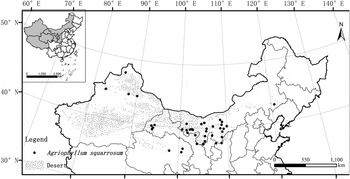
Agriophyllum squarrosum is a diploid (2n = 18) summer annual mainly distributed in eastern and central Asia, including Mongolia, China, Kazakhstan, Azerbaijan, Dagestan, Iran and southcentral Russia (Zhao et al., Reference Zhao, Capella-Gutíerrez, Shi, Zhao, Chen, Gabaldón and Ma2014; Ghaffari et al., Reference Ghaffari, Balaei, Chatrenoor and Akhani2015). In China, the species is found mostly in the cool temperate zone especially in the north, and it has a close association with sandy deserts (Fig. 1).
The distribution of Agriophyllum squarrosum and of the sandy deserts in northern China (data set provided by Environmental and Ecological Science Data Center for West China, National Natural Science Foundation of China). Each black dot represents a location of A. squarrosum reported by Zhao et al. (Reference Zhao, Capella-Gutíerrez, Shi, Zhao, Chen, Gabaldón and Ma2014). The map was created using ArcGIS software.

Habitat and succession
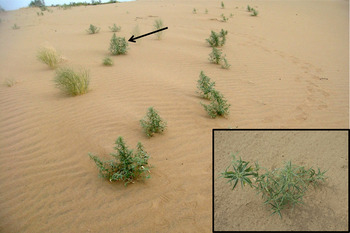
Agriophyllum squarrosum is a psammophyte (Fig. 2). Thus it occurs naturally only in sandy soil and is a dominant or co-dominant species on mobile sand dunes (Nemoto and Lu, Reference Nemoto and Lu1992; Zuo et al., Reference Zuo, Zhao, Zhao, Guo, Yun, Wang and Miyasaka2009b; Zhao et al., Reference Zhao, Capella-Gutíerrez, Shi, Zhao, Chen, Gabaldón and Ma2014). Its importance in the vegetation decreases significantly and quickly as sand dunes become semi-fixed or fixed (Liu et al., Reference Liu, Jiang, Yu, Li and Li2009; Pan et al., Reference Pan, Wang, Zhang and Hu2015; Zhou et al., Reference Zhou, Zhao, Luo and Liu2015). The sandy habitat of A. squarrosum is windy, unstable, nutrient-poor, drought-prone, cold in winter, hot in summer and subject to long daily periods of high solar irradiance during the growing season (Chen et al., Reference Chen, Zhao, Zhao, Zhao, Duan, Nevo and Ma2014; Zhao et al., Reference Zhao, Capella-Gutíerrez, Shi, Zhao, Chen, Gabaldón and Ma2014). However, the species can grow in loess if seeds are sown on loess and covered with 0.5–2 cm of sand (Fan et al., Reference Fan, Wang, Baskin, Baskin and Hu2016).
Photograph of Agriophyllum squarrosum in the sandy Gurbantunggut Desert, Xinjinag Province, China. An individual plant of A. squarrosum is shown in the inset. Eremosparton songoricum (arrow) is the other plant species in the photograph. Photographs by Jerry M. Baskin and Carol C. Baskin (inset), 28 June 2016.

Seeds of A. squarrosum can germinate on bare sand dunes in early May, which is the windy season and the beginning of the growing season. In Hunshandak Sandland, Inner Mongolia, it became the dominant species after 1 year of enclosure of a severely desertified vegetation recovery zone, but in the subsequent successional communities biomass of A. squarrosum decreased rapidly (Liu et al., Reference Liu, Jiang, Yu, Li and Li2009; Yan et al., Reference Yan, Shen, Li and Xu2015). At the Naiman Desertification Research Station, Inner Mongolia, A. squarrosum was the predominant species on mobile sand dunes and accounted for 68% of the total number of plants in the first 3 years. However, in the sixth year Setaria viridis and A. squarrosum became co-dominant species, accounting for 30 and 28%, respectively, of the total number of plants. In the tenth year, Bassia dasyphylla accounted for 32.9% of the plants and A. squarrosum only 0.7%. In the eighteenth year, Artemisia halodendron was dominant and accounted for 73% of the plants (Zhang et al., Reference Zhang, Zhao, Zhang, Zhao and Drake2005). In Inner Mongolia, China, the relative importance of A. squarrosum on mobile, semi-fixed and fixed dunes was 0.42, 0.01 and 0.00, respectively (Qiao et al., Reference Qiao, Zhao, Xie, Liu, Ye, Chu, He and Dong2012).
On unstable sand surfaces, limited soil moisture and nutrients prevent most plant species from becoming established. The quick germination response to precipitation and tolerance to burial that are characteristic of A. squarrosum allow this species to establish a pioneer community on sand. Its presence helps stabilize the sand and therefore provides favourable conditions for establishment of other species (Li et al., Reference Li, Meng, Zhao and Zhang2007). With development of the plant community, high transpiration rates of plants and low water infiltration rates caused by the soil crust lead to a decrease in number of A. squarrosum plants and an increase in drought-tolerant species such as S. viridis and A. halodendron (Li et al., Reference Li, Meng, Zhao and Zhang2007; Chen and Duan, Reference Chen and Duan2015). Chang et al. (Reference Chang, Zhao, Han and Zhong2005) found that variation in moisture content on different dune types was the main factor controlling the growth of A. squarrosum.
Plants of A. squarrosum take up and store nitrogen and thus play an important role at the ecosystem level in preventing nutrients from being leached out of the system by rainwater or being removed by wind erosion (Huang et al., Reference Huang, Zhao, Zhang, Japhet, Zuo, Luo and Huang2009). Thus A. squarrosum acts as a nutrient reservoir, taking up nutrients during the rainy season, and it provides food for some animals and microbes (Chen et al., Reference Chen, Wang and Peng2009).
Life cycle
On moving sand dunes, seeds of A. squarrosum typically germinate in May to June (Qiao et al., Reference Qiao, Zhao, Xie, Liu, Ye, Chu, He and Dong2012), and plants produce branches in early June and flower from July to August; seeds ripen from August to October (Li and Chang, Reference Li and Chang1992; Qi et al., Reference Qi, An and Ye2010). The length of the life cycle depends on habitat and year. The growth period is usually 100–140 days, but in drought years, emergence time can be delayed until July or August with the life cycle being completed in 90 days (Chen et al., Reference Chen, Zhao, Zhao, Zhao, Duan, Nevo and Ma2014). Seedlings from seeds sown in the loessland in May in Lanzhou, China, and covered with 0.5–1.0 cm of sand started to emerge after 10 days, and plants had a 140-day life cycle (Chang et al., Reference Chang, Wang and Wang2003). Seeds germinated about 5 days later on moving sand dunes than on semi-fixed sand dunes, and the plants on moving dunes had mature seeds 1–2 days later than those on fixed dunes (Qi et al., Reference Qi, An and Ye2010).
Seed dispersal
Seeds or seeds in fruits attached to plant parts are dispersed via gravity, wind and animals (Liu et al., Reference Liu, Liu and Qian2014). Delay of seed dispersal occurs in A. squarrosum with most seeds remaining attached to the mature, dead, upright plants during winter. The dry, dead plant with attached seeds can break off and be moved by the wind, thereby dispersing many seeds away from the home site (Liu and Wang, Reference Liu and Wang2009). However, many dead plants remain in place, i.e. are not broken off (Liu and Wang, Reference Liu and Wang2009). The number of canopy-stored seeds is significantly higher than the number released from September to the following March, after which large numbers of canopy-stored seeds are released (Liu and Wang, Reference Liu and Wang2009). Gutterman (Reference Gutterman1994, Reference Gutterman2002) and Liu et al. (Reference Liu, Liu and Qian2014) concluded that delayed seed dispersal is a protection strategy in extreme and unpredictable environment conditions, whereby a persistent soil seed bank is established and massive seed consumption by predators is prevented. The period of maximum seed release of A. squarrosum is in late April, when wind velocity is highest, and more than half of the seeds are released from March to May (Gao et al., Reference Gao, Yang, Yang, Wei, Huang and Walck2014). Seed dispersal declines sharply at the end of July, and a small number of seeds is released subsequently (Gao et al., Reference Gao, Yang, Yang, Wei, Huang and Walck2014).
Of the 69 species that Liu et al. (Reference Liu, Li, Li, Luo, Wang, Jiang and Nan2004) studied in the Horqin Sandy Land, A. squarrosum had an intermediate seed mass. Zhang et al. (Reference Zhang, Zhao, Zhang, Zhao and Drake2005) reported that the small, flat seeds of A. squarrosum have good resistance against movement by wind and that they have good retention on the soil. Number and species composition of seeds dispersed to bare patches in the Horqin Sandy Land, Inner Mongolia, was investigated using seed traps during the growing season. There were 71–623 A. squarrosum seeds m–2 in the seed rain, which was a much higher number than that for any of the other species in the community (Deng and Liu, Reference Deng and Liu2011). Seeds of A. squarrosum and 11 other species were collected and sown in bare patches in the Horqin Sandy Land, and seedling emergence was higher (12.2–34.1%) for A. squarrosum than for any of the other species (Deng and Liu, Reference Deng and Liu2011). Seedling emergence of A. squarrosum in the non-vegetated habitat with moving sand was higher than that on vegetation-covered patches (Deng and Liu, Reference Deng and Liu2011).
Seed dormancy and germination
Seeds of A. squarrosum are dormant at maturity in autumn. Germination of freshly matured seeds collected in the Gurbantunggut Desert (Xinjiang Province, China) was <10% at 15/5, 25/10 and 35/20°C (12/12 h) in light (30 μmol m–2 s–1) and dark (Liu et al., Reference Liu, Zhang, Yin and Zhang2013), and fresh seeds collected from Minqin, Gansu Province, China, in 2012, 2013 and 2014 germinated <10% at 30/20°C in the dark (Fan et al., Reference Fan, Wang, Baskin, Baskin and Hu2016). Fan et al. (Reference Fan, Wang, Baskin, Baskin and Hu2016) concluded that A. squarrosum seeds have physiological dormancy, which is consistent with the class of dormancy known to occur in other members of the Amaranthaceae (Baskin and Baskin, Reference Baskin and Baskin2014). Thus it is expected that gibberellic acid (GA3) would promote germination and that abscisic acid (ABA) would inhibit it (Finch-Savage and Leubner-Metzger, Reference Finch-Savage and Leubner-Metzger2006). At 30/20°C, seed germination percentage increased significantly with an increase in concentration of GA3, reaching a maximum of 60% with 300 μmol l–1 GA3 (Liu et al., Reference Liu, Ma, Zhang, Ji, Zhang and Liu2010). Fluridone, an inhibitor of ABA (Kucera et al., Reference Kucera, Cohn and Leubner-Metzger2005), breaks dormancy in A. squarrosum and thus is useful in determining seedlot germination potential (Fan et al., Reference Fan, Wang, Baskin, Baskin and Hu2016).
Since seeds of A. squarrosum mature in autumn and germinate in the field in spring, it is assumed that physiological dormancy is broken during winter. After 2 months of cold stratification at 5°C, 70% of the seeds germinated when tested in dark at 30/20°C; more than 95% of the non-germinated seeds were viable (Fan et al., Reference Fan, Wang, Baskin, Baskin and Hu2016). All viable seeds collected in the Tengger Desert germinated after 1 and 2 years storage in an open non-heated room (Wang et al., Reference Wang, Wang and Liu1998). As physiological dormancy can be broken via afterripening in dry storage at low as well as at high temperatures (Baskin and Baskin, Reference Baskin and Baskin2014), it is possible that seeds of A. squarrosum could come out of dormancy in the field during winter although they may not be imbibed. However, as discussed below, the effects of dry storage at room temperature on seed dormancy/germination of this species are not well understood. In fact, seed germination decreased from 91.6% to 39.2% at 28/16°C (light/dark) after 6 months dry storage at room temperature (Li et al., Reference Li, Jiang, Liu and Li2006). These authors suggested that storage conditions may have induced the seeds into secondary dormancy.
Among the factors that could influence seed germination, temperature and light are considered to be the most important ones and thus have been studied intensively. Several studies have shown that light has a strong inhibiting effect on germination of A. squarrosum seeds. Zheng et al. (Reference Zheng, Gao, An, Shimizu and Rimmington2004) collected mature seeds in the Mu Us Sandy Land in Inner Mongolia in August 2001 and stored them dry at 4°C for 2 months, after which they germinated to a significantly higher percentage in dark than in light at 15/5, 20/10, 25/15 and 30/20°C. At a photon irradiance of 25 μmol m–2 s–1, germination at 10/20°C decreased from >70% to <20% when the photoperiod increased from 2 to 12 h (Zheng et al., Reference Zheng, Gao, An, Shimizu and Rimmington2004). Liu et al. (Reference Liu, Zhang, Yin and Zhang2013) found that germination was <10% at a 12 h photoperiod at 15/5, 25/10 and 35/20°C; however, they did not test seeds in total darkness. Taken together, the above results indicate that light inhibits seed germination of A. squarrosum, which helps explain why seeds can germinate in moving sand dunes where they are covered by wind-blown sand.
However, several studies have reported that the seeds germinate to >90% in alternating light and dark conditions (Tobe et al., Reference Tobe, Zhang and Omasa2005; Li et al., Reference Li, Jiang, Liu and Li2006; Liu et al., Reference Liu, Song, Duan, Wang, Zhang and Yin2012). Furthermore, Tobe et al. (Reference Tobe, Zhang and Omasa2005) found interaction effects of temperature and light at certain temperature regimes. Their seeds were collected in China (Ningxia Province) in October 1995 and stored at room temperature for 2–3 months before they were transported to Japan and then stored at about 0°C. Germination was >90% at alternating temperature regimes of 25/15 and 30/20°C and at constant temperatures of 20 and 25°C in both darkness and light/dark (Tobe et al., Reference Tobe, Zhang and Omasa2005). However, Zeng (2010) obtained <30% germination at 25/15 and 35/25°C in darkness; germination in light was not tested. Two other studies showed that germination percentage was significantly higher at alternating than at constant temperature in dark and that the optimal alternating temperature regime was 30/20°C (Zheng et al., Reference Zheng, Gao, An, Shimizu and Rimmington2004; Cui et al., Reference Cui, Li, Zhao, Su and Drake2007).
After 7 months of dry storage at room temperature, germination of A. squarrosum seeds was tested at different water potentials in darkness at 30°C. Germination percentages decreased significantly with an increase in water stress, and it was 50.3, 22.4 and 1.0% at water potentials of 0, –0.2 and –0.8 MPa, respectively (Cui et al., Reference Cui, Li, Zhao, Su and Drake2007). These data imply that germination can occur only when there is no or little water stress, which helps explain the survival strategy for seedlings. That is, seeds can germinate rapidly at a high water potential from May to August during the rainy season (Tobe et al., Reference Tobe, Zhang and Omasa2005; Zeng, 2010).
In the moving-sand habitat of A. squarrosum, burial in sand is one of the factors that could influence seedling survival and establishment. Seedling emergence of A. halodendron decreased from 89.8% at 0.5 cm burial depth to 32.0% at 1 cm depth, while that of A. squarrosum was 91.2 and 77.8%, respectively (Cui et al., Reference Cui, Li, Zhao, Su and Drake2007). These results may help explain the successional sequence of different species on mobile dunes. At the beginning of sand dune succession, A. squarrosum is more tolerant to sand burial and it is replaced by A. halodendron when the moving sand dune habitat is converted into a fixed sand dune.
Seedling emergence of A. squarrosum decreased from 91.2 to 41.2% when seed burial depth increased from 0.5 to 2 cm, but a few seedlings emerged from a depth >8 cm (Cui et al., Reference Cui, Li, Zhao, Su and Drake2007). Seeds were sown at depths of 0, 1.0, 1.5, 2, 3, 4 and 6 cm in sand in a growth chamber, and seedling emergence was highest at 0.5 cm (Zheng et al., Reference Zheng, Xie, Yu, Jiang, Shimizu and Rimmington2005b). There was no significant effect on seedling growth in the field when they were buried in sand to 25% of their height (Zhao et al., Reference Zhao, Qu, Zhou, Li, Pan and Wang2013a). Seedling survival was up to 94.8% when sand burial equalled plant height, which indicates that the species has strong tolerance for being buried in sand (Zhao et al., Reference Zhao, Qu, Zhou, Li, Pan and Wang2013a). Zhao et al. (Reference Zhao, Qu, Zhou, Li, Pan and Wang2013a, Reference Zhao, Qu, Zhou, Wang, Li and Yunb) concluded that the main cause for seedling death was damage to cell membranes in the leaves due to increased malonaldehyde content. Liu et al. (Reference Liu, Ma, Zhang, Ji, Zhang and Liu2010) found that GA3 significantly increased seedling emergence from burial depths of 0.5 and 1 cm.
Seed bank
A good understanding of seed bank ecology is critical to elucidating how species, especially pioneers, survive in unstable habitats (Liu et al., Reference Liu, Yan, Baskin and Ma2006; Wang et al., Reference Wang, Ooi, Ren, Jiang, Musa, Miao, Li, Zhou, Tang and Lin2015). Agriophyllum squarrosum has both aerial (canopy-stored) and soil seed banks. A small fraction of A. squarrosum seeds fall onto the soil surface and form a soil seed bank before the peak of seed release in spring (Narita and Wada, Reference Narita and Wada1998; Gao et al., Reference Gao, Yang, Yang, Wei, Huang and Walck2014). However, a large fraction of the seeds is retained on the mother plants (aerial seed bank) until the following March (Ma et al., Reference Ma, Zhang, Chen, Li and Liu2008). The size of the aerial seed bank was about three times that of the soil seed bank in April. Only 13.2% of aerial-stored seeds and 9.3% of soil-stored seeds were left at the end of the germination season in August, and seed release was positively related to wind velocity (Gao et al., Reference Gao, Yang, Yang, Wei, Huang and Walck2014). After the growing season ended, seed release was delayed for a high number of seeds on plants covered by sand, thus keeping a large number of seeds in the home-site habitat (Liu et al., Reference Liu, Liu and Qian2014).
Agriophyllum squarrosum forms a persistent soil seed bank (Ramawat, Reference Ramawat2009; Li et al., Reference Liu, Li, Li, Luo, Wang, Jiang and Nan2004), but position on dunes and burial depth affect the number of seeds present (Bai et al., Reference Bai, Bao and Li2004; Liu et al., Reference Liu, Yan, Liu, Ma and Luo2007). Seed bank samples collected along transects across mobile sand dunes in Horqin Sandy Land in Inner Mongolia revealed that an average of 292 viable seeds of A. squarrosum m–2 were stored in the sand for more than 1 year. Across the dunes, there were more seeds on the lower leeward slope and on the middle and upper windward slopes than at other positions along the transects (Liu et al., Reference Liu, Yan, Liu, Ma and Luo2007). On the windward slope, mean seed density decreased gradually from the upper to the lower slope, while an opposite trend was found on the leeward slope (Liu et al., Reference Liu, Yan, Liu, Ma and Luo2007). Seeds tended to be concentrated at depths of 20–70 cm, and burial depth gradually increased as follows: lower windward < middle windward < upper windward < upper leeward < middle leeward < lower leeward slope (Liu et al., Reference Liu, Yan, Liu, Ma and Luo2007). In a sandy grassland enclosure in Hunshandak Sandland, the number of seeds in the soil seed bank, including those of A. squarrosum, increased with time (1, 4 and 9 years) since enclosure, and there was a high correlation with the standing vegetation density (Zheng et al., Reference Zheng, Cao, Zhao and Sun2005a).
Aerial and soil seed banks play different roles in regulating timing of seed germination in the unpredictable dune ecosystem (Gao et al., Reference Gao, Yang, Yang, Wei, Huang and Walck2014). In darkness, germination percentage of A. squarrosum seeds from the aerial seed bank was significantly higher at 20/10 and 25/15°C than that of seeds from the soil seed bank (Gao et al., Reference Gao, Yang, Yang, Wei, Huang and Walck2014). At 25/10 and 35/20°C, it was significantly lower in light/dark than in continuous darkness. Germination was about 13 and 40% for seeds from soil and aerial seed banks, respectively, at 30/20°C in the dark.
Seedlings from soil and aerial seed banks emerge at different times, and this has a great impact on seedling survival. Gao et al. (Reference Gao, Yang, Yang, Wei, Huang and Walck2014) showed that seeds in the soil seed bank emerged only in the early part of the growing season (16 April to 15 May), and lack of shallowly buried seeds helped explain the absence of seedling emergence from the soil seed bank later in the growing season. The aerial seed bank is the main contributor to late-emerged seedlings. However, 33.4% of the early-emerged seedlings died within the first month, and almost all of them had done so by the end of the growing season due to frost and drought stress before the onset of the rainy season. On the other hand, survival to reproductive maturity of intermediate- and late-emerged seedlings was 62.4 and 52%, respectively (Gao et al., Reference Gao, Yang, Yang, Wei, Huang and Walck2014). These authors speculated that the two kinds of seed banks are a bet-hedging strategy.
Remaining questions about seed germination ecology
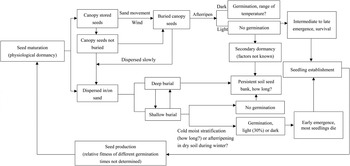
Although many studies have been conducted on A. squarrosum, a conceptual model of the seed/seedling stage of its life cycle reveals several questions that still need to be answered (Fig. 3). For example, we do not have a good understanding of the seed dormancy-breaking and germination requirements of A. squarrosum seeds in the field. As discussed above, 2 months of cold stratification (i.e. seeds imbibed at 4°C) significantly increased seed germination percentages, but more information is needed on the effects of different periods of cold stratification on dormancy break. Also, what are the temperature and light:dark requirements for germination after different periods of cold stratification? Furthermore, how much cold stratification do seeds receive in the field when buried in sand and when attached to dead mother plants during winter? Germination of dry stored A. squarrosum seeds was inhibited when tested in light; however, Fan et al. (Reference Fan, Wang, Baskin, Baskin and Hu2016) have shown that cold stratification can overcome this inhibition to a certain extent (ca 30% germination). To answer these questions, seeds need to be cold stratified for different periods of time and then tested for germination in light and in darkness over a range of temperatures.
Conceptual model of the seed/seedling dynamics of Agriophyllum squarrosum.

Seeds need to be imbibed before they can be cold stratified. We need to know if seeds of A. squarrosum buried in the field actually are cold-stratified during winter. The moisture content of seeds in their microhabitats has not been measured during winter; nor has dormancy break of seeds buried in the field during winter been monitored. To better understand changes in germination responses of A. squarrosum seeds, they need to be buried in the natural habitat and samples periodically exhumed and tested for germination in light and dark at several temperatures from maturity in autumn until the end of the next germination season. Also, canopy-stored seeds need to be collected at intervals and tested over a range of temperatures in both light and dark. In both cases, seed moisture content needs to be determined each time the seeds are collected from the field. Experiments are also needed to determine the optimum temperature and relative humidity conditions for afterripening A. squarrosum seeds, as well as the rate (speed) at which it occurs. In addition, the conditions that induce seeds into secondary dormancy and the speed at which it occurs need to be determined.
New insights and recommendations
Mobile sand dunes are not a suitable habitat for most species, but A. squarrosum can become established in bare sand at the initial stage of desert restoration and help create conditions that promote natural plant succession (Nemoto and Lu, Reference Nemoto and Lu1992). In the deserts of northern China, precipitation is limited and mainly occurs during 2 to 3 months in summer (Yatagai and Yasunari, Reference Yatagai and Yasunari1995). If seeded at the right time, seeds of A. squarrosum will be buried by wind-blown sand, which provides suitable dark conditions for germination. The best seeding time is May or June, before the onset of the rainy season and high temperatures of summer. Agriophyllum squarrosum has a quick response to water and germinates in a short period of time if seeds are non-dormant.
The challenge, then, is to learn how to manage the seeds of A. squarrosum so that they are non-dormant at the time they are sown in the field. Our literature review has revealed a major deficiency in the germination studies of A. squarrosum. That is, there has been a general lack of testing of fresh seeds, and often seeds have not been tested until they were ≥1 month old. Thus for most studies we do not know if fresh seeds were non-dormant or if they were dormant and afterripened during dry storage at (usually) room temperature. For example, fresh seeds of A. squarrosum collected in 2011 at Minqin, Gansu Province, germinated to <10% at 30/20°C in darkness, but they germinated to 95% at three conditions after 3 months of dry storage (afterripening) at room temperature (Fan et al., Reference Fan, Wang, Baskin, Baskin and Hu2016). Thus even if seeds are dormant when they are collected, dry afterripening at room temperatures results in dormancy break.
However, prolonged storage of seeds at room temperature may not necessarily mean that they will be non-dormant in early summer at planting time. In a study by Li et al. (Reference Li, Jiang, Liu and Li2006), after 6 months of dry storage at room temperature germination decreased from 92 to 39%, suggesting that secondary dormancy had been induced since the seeds were still viable. Induction of secondary dormancy during dry storage at room temperatures has been reported in only a few species. For example, freshly collected seeds of Arthropodium cirratum (Liliaceae) were dormant, but during 6 months of dry storage at room temperature germination increased to 95%. However, after another 3 months of dry storage germination had decreased to about 55%, and 95% of the non-germinated seeds were viable (Conner and Conner, Reference Conner and Conner1988). A similar pattern of dormancy break followed by dormancy induction during dry storage at room temperatures has been documented for achenes of Ericameria nauseosa (Asteraceae) (Love et al., Reference Love, Tripepi and Salaiz2014) and seeds of Amaranthus tuberculatus (Amaranthaceae) (Wu and Owen, Reference Wu and Owen2015).
The answer to the problem of how to store A. squarrosum seeds so that they will be non-dormant when sown in the field is to allow the newly collected seeds to afterripen during dry storage at room temperature and then store them dry at a low temperature. Zheng et al. (Reference Zheng, Gao, An, Shimizu and Rimmington2004) and Tobe et al. (Reference Tobe, Zhang and Omasa2005) reported that when 1- and 3-month-old dry-stored seeds of A. squarrosum were subsequently stored at 0 and 4°C, respectively, for 3 months, they germinated to near 100%. Thus we recommend that the way to ensure that seeds of A. squarrosum will be non-dormant in early summer is to store them dry at room temperatures for 2–3 months and then dry at 0–5°C until used.
Acknowledgements
The authors would like to thank Liping Xu and Chao Guan for help with the figures. This work was supported by the National Basic Research Program of China (2014CB138700) and the Fundamental Research Funds provided by the State Key Laboratory of Grassland Agro-ecosystems (Lanzhou University).