


INTRODUCTION
Long-distance plasma channels in different gases produced by high intensity laser pulses are of interest for a number of physical processes and their practical applications. Among them are the generation of X-ray-ultraviolet attosecond pulses (Agostini & DiMauro, Reference Agostini and Di Mauro2004; Krausz & Ivanov, Reference Krausz and Ivanov2009), remote sensing of the atmosphere (Penano et al., Reference Penano, Sprangle, Hafizi, Gordon, Fernsler and Scully2012), the transportation of heavy ion beams (Penache et al., Reference Penache, Niemann, Tauschwitz, Knobloch, Neff, Birkner, Geißel, Hoffman, Presura, Penache, Roth and Wahl2002; Neff et al., Reference Neff, Knobloch, Hoffman, Tauschwitz and Yu2006), and radio frequency (RF) radiation (Chateauneuf et al., Reference Chateauneuf, Payeur, Dubois and Kieffer2008; Zvorykin et al., Reference Zvorykin, Levchenko, Shutov, Solomina, Ustinovsky and Smetanin2012). An important feature of the plasma structure appearing in the field of an ultrashort laser pulse is its strong non-equilibrium. Such non-equilibrium is very important for the number of above mentioned applications.
The possibility to use high-intensity focused laser beams in order to create plasma waveguides for transportation of microwave radiation was proposed by Askaryan (Reference Askaryan1969). Progress in femtosecond laser technology of terawatt level and observation of the filamentation phenomenon of femtosecond laser pulses (Couairon & Mysyrowicz, Reference Couairon and Mysyrowicz2007) allowed to raise the question about creating a cylindrical hollow waveguide whose walls are formed by a set of plasma channels that arise during the multi-filamentation of laser radiation (Dormidontov et al., Reference Dormidontov, Valuev, Dmitriev, Shlenov and Kandidov2007). However, as the maximum value of the plasma conductivity in the filament is several orders of magnitude lower than the conductivity of the metal, such a plasma waveguide cannot provide efficient transportation of microwave radiation. For example, in the experiment (Chateauneuf et al., Reference Chateauneuf, Payeur, Dubois and Kieffer2008) for a waveguide with a diameter of 4.5 cm formed in multi-filamentation of 100-fs pulse of Ti:Sa laser radiation, the propagation length of the RF radiation with wavelength λ = 3 cm was only 16 cm.
It seems that the sliding mode regime proposed in the initial paper (Askaryan, Reference Askaryan1969) is more preferable. In this case, a hollow cylindrical plasma channel of a large radius R ≫ λ (λ is the wavelength of the propagating radiation) is suggested to be used for the transportation of RF radiation, which provides the guiding of sliding modes. Such a regime is based on the effect of total internal reflection of RF radiation at the boundary of the plasma, which is optically less dense medium than a non-ionized gas. Theoretical consideration of such a sliding-mode plasma waveguide was performed by Zvorykin et al. (Reference Zvorykin, Levchenko, Smetanin and Ustinovsky2010). The experimental realization (Zvorykin et al., Reference Zvorykin, Levchenko, Shutov, Solomina, Ustinovsky and Smetanin2012) of a 5 cm radius waveguide with an electron density of plasma walls n e ~ 1012 cm−3 created by the radiation of 70 ns KrF laser pulse provided the possibility to transport the microwave signal (λ = 8 mm) up to a length of 60 m, which is more than two orders of magnitude higher than the result obtained by Chateauneuf et al. (Reference Chateauneuf, Payeur, Dubois and Kieffer2008).
An important feature of the plasma channel produced by the intense femtosecond laser pulse is the strong non-equilibrium of the photoelectron energy spectrum. For femtosecond laser pulses, the average time interval between electron-atomic collisions is typically much less than the pulse duration. Hence, this spectrum consists of a set of peaks formed in the process of the above threshold ionization. Bogatskaya and Popov (Reference Bogatskaya and Popov2013) proposed to use such a plasma channel to enhance the electromagnetic radiation in the microwave frequency band. Indeed, in this case, the electron energy distribution function (EEDF) is characterized by inverse population in definite energy ranges that can be used for amplification of electromagnetic radiation in plasma (Bekefi et al., Reference Bekefi, Hirshfield and Brown1961; Bunkin et al., Reference Bunkin, Kazakov and Fedorov1973). Detailed analysis of the relaxation of the EEDF in the plasma channel created by a femtosecond KrF laser pulse and calculation of the gain factor in dependence on initial plasma parameters and the frequency of the RF radiation in a number of atomic and molecular gases is given by Bogatskaya et al (Reference Bogatskaya, Volkova and Popov2013). In particular, it was found that among both atomic and molecular gases that can be used for amplification of the RF radiation the xenon has some advantages. It was demonstrated that the range of frequencies of the amplified radiation in xenon plasma is wider in comparison with other gases. Also the time interval of the positive gain factor existence is the largest for xenon plasma that makes it possible to amplify the pulses of 100 ns duration.
In this paper, we note that a strong non-equilibrium of photoelectron spectrum can also cause unusual refractive properties of the plasma channel appearing in the process of multi-photon ionization of the gas by femtosecond laser pulse. In particular, the real part of the permittivity of the plasma can be a larger than unity, i.e., plasma turns out to be optically more dense medium in comparison with the surrounding non-ionized gas. Such a channel seems to be similar to the dielectric waveguide which can be used for both transportation and amplification of the microwave radiation. The process of guiding and amplification of the microwave radiation in the plasma channel formed by powerful KrF laser femtosecond pulse in xenon is studied numerically on the basis of the self-consistent solution of the Boltzmann equation for the EEDF evolution in the non-equlibrium plasma, and the wave equation for the transported through the channel RF pulse. The conditions under which the RF pulse can be guided and amplified in a non-equilibrium plasma channel are discussed.
ELECTRODYNAMIC FEATURES OF THE NON-EQUILIBRIUM PLASMA CHANNEL
The given EEDF n(ε ) in plasma provides the possibility to study the electro-dynamic features of a plasma channel. For the radiation with frequency ω, these features are determined by complex permittivity ξω = ξω′ + iξω″ or complex conductivity σω = σω′ + iσω″ which are related with each other by the expression
 $${\rm \xi} _{\rm \omega} = 1 + i\displaystyle{{4{\rm \pi} {\rm \sigma} _{\rm \omega} } \over {\rm \omega} }.$$
The general expression for complex conductivity for the relatively weak electromagnetic field when the two-term expansion for the electron distribution function is valid can be written in a form (Ginzburg & Gurevich, Reference Ginzburg and Gurevich1960; Raizer, Reference Raizer1977):
 $${\rm \sigma} _{\rm \omega} = \displaystyle{2 \over 3}\displaystyle{{e^2 n_e } \over m} \int\limits_0^\infty {\displaystyle{{{\rm \varepsilon} ^{{3 / 2}} \lpar {\rm \nu} _{tr} \lpar {\rm \varepsilon} \rpar + i{\rm \omega} \rpar } \over {{\rm \omega} ^2 + {\rm \nu} _{tr}^2 \lpar {\rm \varepsilon} \rpar }}\left({ - \displaystyle{{\partial n\lpar {\rm \varepsilon} \comma \; t\rpar } \over {\partial {\rm \varepsilon} }}} \right)d{\rm \varepsilon} }.$$
Here n e is the electron concentration and  ${\rm \nu} _{tr} \lpar {\rm \varepsilon} \rpar = N{\rm \sigma} _{tr} \lpar {\rm \varepsilon} \rpar \sqrt {{{2{\rm \varepsilon} } / m}} $ is the transport frequency of electron-atomic collisions, σ tr (ε) is the transport cross-section, and N is the gas density. We assume also that the electron-ion collisions do not contribute to the transport frequency as we restrict our consideration to the case of weakly ionized plasma only. We should also mention that the evolution of the EEDF is rather slow in time and external electromagnetic field of frequency ω can be considered as the quasi-monochromatic one. The EEDF in Eq. (2) is normalized according to the condition
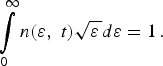 $$ \int\limits_0^\infty {n\lpar {\rm \varepsilon} \comma \; t\rpar \sqrt {{\rm \varepsilon} \, } d{\rm \varepsilon} = 1} \, .$$
From Eqs. (1) and (2) one derives
 $${\rm \xi} _{\rm \omega} = 1 - \displaystyle{2 \over 3}{\rm \omega} _p^2 \int\limits_0^\infty {\displaystyle{{{\rm \varepsilon} ^{{3 / 2}} \lpar 1 - {{i{\rm \nu} _{tr} } / {\rm \omega} }\rpar } \over {{\rm \omega} ^2 + {\rm \nu} _{tr}^2 }}\left({ - \displaystyle{{\partial n} \over {\partial {\rm \varepsilon} }}} \right)d{\rm \varepsilon} }.$$
Here ωp2 = 4πe 2n e/m is the plasma frequency squared. For the case when transport frequency do not depend on energy, the complex permittivity is the same for any EEDF and can be written in the well-known form
 $${\rm Re}\, {\rm \xi} _{\rm \omega} = 1 - {\displaystyle{{\rm \omega} _p^2 } \over {\lpar {\rm \omega} ^2 + {\rm \nu} _{tr}^2 \rpar }}\comma \; \, {\rm Im} \, {\rm \xi} _{\rm \omega} = {\displaystyle{{{\rm \omega} _p^2 \; {\rm \nu} _{tr} } \over {\lpar {\rm \omega} ^2 + {\rm \nu} _{tr}^2 \rpar {\rm \omega}} }}.$$
For weakly ionized plasma (ωp ≪ νtr, ω), which is the case for our further consideration, one obtains from Eq. (5) the complex refractive index
 $$n_{\rm \omega} = {\rm Re} \, n_{\rm \omega} + i{\rm Im} \, n_{\rm \omega} = 1 - \displaystyle{{{\rm \omega} _p^2 } \over {2\lpar {\rm \omega} ^2 + {\rm \nu} _{tr}^2 \rpar }} + i\displaystyle{{{\rm \omega} _p^2 \; {\rm \nu} _{tr} } \over {2\lpar {\rm \omega} ^2 + {\rm \nu} _{tr}^2 \rpar {\rm \omega} }}\comma \;$$
In particular, one derives from Eq. (6) that plasma is optically less dense medium in comparison with the unionized gas. Imaginary part of Eq. (6) determines the absorption coefficient of the electromagnetic radiation with frequency ω in plasma (Raizer, Reference Raizer1977):
 $${\rm \mu} _{\rm \omega} = 2\displaystyle{{\rm \omega} \over c} \times {\rm Im} \, n_{\rm \omega} = \displaystyle{{\rm \omega} \over c} \times {\rm Im} \, {\rm \xi} _{\rm \omega} = \displaystyle{{{\rm \omega} _p^2 \; {\rm \nu} _{tr} } \over {c\lpar {\rm \omega} ^2 + {\rm \nu} _{tr}^2 \rpar }}.$$
For an arbitrary dependence νtr (ε), the definite expression for the EEDF is of importance. In this case, more general expressions for refractive index and absorption coefficient should be used:
 $$\eqalign{& {\rm Re}\, n_{\rm \omega} = n_{{\rm \omega}}^{\prime} = 1 - \displaystyle{2{\rm \pi} {\rm \sigma}_{{\rm \omega}}^{\prime \prime} \over {\rm \omega}} = 1 - \displaystyle{1 \over 3}{\rm \omega}_p^2 \int\limits_0^{\infty} \displaystyle{{\rm \varepsilon}^{3 / 2} \over {\rm \omega}^2 + {\rm \nu}_{tr}^2} \left(- \displaystyle{\partial n \over \partial {\rm \varepsilon}} \right)d {\rm \varepsilon}\comma \; \cr & {\rm Im}\, n_{{\rm \omega}} = n_{{\rm \omega}}^{\prime \prime} = \displaystyle{2{\rm \pi} {\rm \sigma}_{{\rm \omega}}^{\prime} \over {\rm \omega}} = \displaystyle{1 \over 3}\displaystyle{{\rm \omega}_p^2 \over {\rm \omega}} \int\limits_0^{\infty} \displaystyle{{\rm \varepsilon}^{3 / 2} {\rm \nu}_{tr} \over {\rm \omega}^2 + {\rm \nu}_{tr}^2} \left(- \displaystyle{\partial n \over \partial {\rm \varepsilon}} \right)d {\rm \varepsilon}\comma \; }$$
 $${\rm \mu} _{\rm \omega} = \displaystyle{4{\rm \pi} {\rm \sigma} _{{\rm \omega}}^{\prime} \over c} = \displaystyle{2 \over 3}\displaystyle{{\rm \omega} _p^2 \over c}\int\limits_0^\infty {\displaystyle{{\rm \varepsilon} ^{3 / 2} v_{tr}} \over {\rm \omega}^2 + {\rm \nu} _{tr}^2}\left(- \displaystyle{\partial n \over \partial {\rm \varepsilon}} \right)d{\rm \varepsilon}.$$
Typically, EEDF decreases with the increase of energy, i.e., ∂n/∂ε is negative and both integrals in Eq. (8) are positive. Hence, for such a more general case, plasma channel also appears to be optically less dense in comparison with un-ionized media and the absorption coefficient is positive, μω > 0.
However, as the energy intervals with positive derivative ∂n/∂ε contribute negatively to the above mentioned integrals, it is possible to obtain negative absorption or amplification of electromagnetic radiation in plasma. Such a situation when the EEDF has the energy range with inverse population was studied by Bekefi et al. (Reference Bekefi, Hirshfield and Brown1961) and Bunkin et al. (1972). It was demonstrated that in order to obtain negative value of the integral (9) the condition
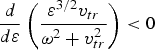 $$\displaystyle{d \over {d{\rm \varepsilon} }}\left({\displaystyle{{{\rm \varepsilon} ^{{3 / 2}} v_{tr} } \over {{\rm \omega} ^2 + v_{tr}^2 }}} \right)\lt 0 $$
should be satisfied in the energy range with the inverse population and also this energy range should contribute dominantly to the integral (9). In the low frequency limit (ω ≪ νtr), one derives from Eq. (10)  $\displaystyle{d \over {d{\rm \varepsilon} }}{{\rm \varepsilon} / {{\rm \sigma} _{tr} }} \lt 0$, i.e., transport cross-section should grow up rapidly than linear dependence. Such a situation is typical for rare gases with pronounced Ramsauer minimum. In the opposite high-frequency limit (ω ≫ νtr), one needs
 $\displaystyle{d \over {d{\rm \varepsilon} }}{\rm \varepsilon} ^2 {\rm \sigma} _{tr} \lt 0$ to be satisfied. This inequality is harder to be satisfied for a lot of gases. Nevertheless, the last inequality is fulfilled for argon atoms in rather narrow energy interval 0.12–0.23 eV. This circumstance made it possible to observe experimentally negative absorption (amplification) of the RF radiation in the argon plasma afterglow (Okada & Sugawara, Reference Okada and Sugawara2002).
Bogatskaya et al. (Reference Bogatskaya, Volkova and Popov2013) discussed in detail the possibility to obtain amplification of RF radiation in the plasma channel created by powerful femtosecond ultraviolet laser pulse in different gases. It was found that the xenon plasma has some advantages to amplify the RF radiation in sub-terahertz band in comparison with other rare and molecular gases. Also it was demonstrated that it is possible to obtain the positive value of the gain factor at a level up to 0.03–0.05 cm−1 for time durations about tens of nanoseconds.
In this paper, we would like to pay attention to the fact that the first integral in Eq. (8) can also be negative, i.e., plasma channel with the non-equilibrium distribution function with the derivative ∂n/∂ ε > 0 can be optically denser in comparison with unionized gas. We need the inequality
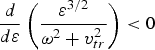 $$\displaystyle{d \over {d{\rm \varepsilon} }}\left({\displaystyle{{{\rm \varepsilon} ^{{3 / 2}} } \over {{\rm \omega} ^2 + v_{tr}^2 }}} \right)\lt 0 $$
to be satisfied. For the low frequency radiation (ω ≪ νtr), we obtain from Eq. (11) 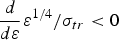 $\displaystyle{d \over {d{\rm \varepsilon} }}{{{\rm \varepsilon} ^{{1 / 4}} } / {{\rm \sigma} _{tr} }} \lt 0$. This inequality is much softer in comparison with inequality for the possibility of amplification and is fulfilled for a lot of atoms and molecules. It means that if both of inequalities (10) and (11) are satisfied, the plasma channel can be used as the waveguide for both transportation and amplification of the microwave radiation. For the xenon plasma at atmospheric pressure, such a guiding regime with amplification can be realized up to sub-terahertz frequency band.
To study the temporal evolution of the real and imaginary parts of plasma permittivity in a plasma channel, the knowledge of the EEDF is necessary. In general, this can be done on the basis of the numerical solution of the Boltzmann kinetic equation for the EEDF in the two-term expansion (Bogatskaya et al., Reference Bogatskaya, Volkova and Popov2013). In this case, the kinetic equation can be written in the form
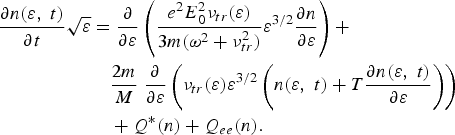 $$\eqalign{\displaystyle{{{\partial} n\lpar {\rm \varepsilon} \comma \; t\rpar } \over {{\partial} t}}\sqrt {\rm \varepsilon} & = \displaystyle{{\partial} \over {{\partial} {\rm \varepsilon} }}\left({\displaystyle{{e^2 E_0^2 {\rm \nu} _{tr} \lpar {\rm \varepsilon} \rpar } \over {3m\lpar {\rm \omega} ^2 + {\rm \nu} _{tr}^2 \rpar }}{\rm \varepsilon} ^{{3 / 2}} \displaystyle{{{\partial} n} \over {{\partial} {\rm \varepsilon} }}} \right)+ \cr & \quad \displaystyle{{2m} \over M}\; \displaystyle{{\partial} \over {{\partial} {\rm \varepsilon} }}\left({{\rm \nu} _{tr} \lpar {\rm \varepsilon} \rpar {\rm \varepsilon} ^{3 / 2} \left({n\lpar {\rm \varepsilon} \comma \; t\rpar + T\displaystyle{{{\partial} n\lpar {\rm \varepsilon} \comma \; t\rpar } \over {{\partial} {\rm \varepsilon} }}} \right)} \right)\cr & \quad + Q^{\ast} \lpar n\rpar + Q_{ee}\lpar n\rpar.}$$
Here the first term in the right part of the equation stands for the interaction of the plasma electronic component with the external RF field of frequency ω and amplitude E 0; the second term is the integral of elastic electron-atomic collisions, T ≈ 0.03 eV is the gas temperature and m and M are the electron mass and the mass of the atom, respectively. The last two terms are the integral of inelastic and electron-electron collisions and described in detail by Ginzburg and Gurevich (Reference Ginzburg and Gurevich1960). It is known that effective electron-electron collisions lead to the maxwellization of the EEDF. That is why we should restrict our consideration to the rather low degrees of ionization when electron-ion collisions do not contribute to electro-dynamic properties of a plasma channel.
For the case of multi-photon ionization of rare gases by KrF laser radiation, the term Q* (n) in Eq. (12) could be neglected as the excitation potentials exceed the value of 8.31 eV (the lowest excitation potential for a xenon atom) while the position of the lowest photoionization peak is definitely below 5 eV. If the transported RF field is weak enough and the electron-electron collisions are not taken into account, the temporal evolution of the plasma permittivity can be obtained analytically (Bogatskaya et al., Reference Bogatskaya, Popov and Smetanin2014). These analytical data as well as data obtained from the numerical solution of the Boltzmann equation for the EEDF are presented in Figure 1 and are found to be in a good agreement.
Time dependences of real (1, 2) and imaginary (3, 4) parts of plasma permittivity in xenon obtained by analytical expression (4) (dashed line) and by numerical calculations (solid line).

The results presented in Figure 1 are obtained on the assumption that electron-electron collisions do not contribute to the evolution of the EEDF. This is possible only for time interval when the diffusion spreading of the photoelectron peak due to electron-electron collisions can be neglected. It is easy to obtain the estimation for the duration of the Gaussian photoelectron peak spreading:
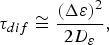 $${\rm \tau} _{dif} \cong \displaystyle{{\lpar \Delta {\rm \varepsilon} \rpar ^2 } \over {2D_{\rm \varepsilon} }} \comma \; $$
where D ε ≈ ε02 νee (ε0)/3 is the coefficient of the diffusion in the energy space, νee (ε0) is the frequency of electron-electron collisions, ε0 is the initial position of the photoelectron peak, and Δε is its width. For the electron density n e = 3 × 1012 cm−3, ε0 ≈3 eV and Δ ε ≈ 0.2 eV one derives from Eq. (13) τdif ≈ 10 ns. This estimation is found to be in a good agreement with the results of numerical simulation of the EEDF evolution in xenon taking electron-electron collisions into account (Bogatskaya et al., Reference Bogatskaya, Volkova and Popov2013). It means that for such time intervals, the distribution function keeps approximately the Gaussian shape and gradually shifts in the energy space toward lower energies due to elastic electron-atomic collisions, while the maxwellization of the EEDF caused by electron-electron collisions can be neglected. To demonstrate the influence of electron-electron collisions on the electro-dynamic features of the plasma channel, we present the calculations of temporal evolution of the gain factor per one electron and the real part of plasma permittivity for the RF frequency ω = 5 × 10¹¹ s−1 for different electronic densities (see Fig. 2). It can be seen that for rather small time intervals, the gain factor is proportional to the electronic density. Similar situation is for real part of plasma permittivity Re ξω − 1: for small time intervals this value increases even faster than electronic density (see Fig. 2b). On the other hand, the increment of the electron density leads to faster maxwellization of the EEDF, which results in the rapid decrement of the time interval when the gain factor is still positive and the real part of plasma permittivity is greater than unity.
The gain factor (a) and the real part of plasma permittivity (b) per one electron in xenon plasma for different electronic concentrations (cm−3): 1–1010, 2–1011, 3–1012, 4–1013, 5–1014. Negative values correspond to the absorption on the RF radiation in plasma.
In the two-term approximation used for analyzing of the EEDF temporal evolution, the external electromagnetic field also results in the diffusion spreading of the initial photoelectron peak. This diffusion should be taken into account for the low-frequency fields (ω ≪ νtr) if the condition
 $$\displaystyle{{e^2 E_0^2 } \over {3m{\rm \nu} _{tr} }} \ge \max \left\{{\displaystyle{{2m} \over M}T{\rm \nu} _{tr} \comma \; \, \left\langle {\rm \varepsilon} \right\rangle {\rm \nu} _{ee} } \right\}$$
is fulfilled. Here 〈ε〉 is the averaged over EEDF electron energy, and νee is the frequency of the electron-electron collisions. For example, for xenon plasma with 〈ε〉 ≈ 2 eV, gas temperature T = 0.03 eV and electronic concentration n e = 3 × 1012 cm−3 one derives that the inequality (14) is valid for RF radiation with intensity greater than 103 W/cm2.
The results obtained from the numerical integration of the Boltzmann equation are in agreement with the above estimates (see Fig. 3). Results of calculations of the gain factor for different values of radiation intensity with a frequency of ω = 5 × 10¹¹ s−1 presented in Figure 3a demonstrate that the time interval during which the gain factor is positive reduces from 20 to 2 ns with increasing of RF intensity from zero to 103 W/cm2. For RF field intensity of 10 kW/cm2, the amplification in the plasma channel is possible for very short times about 0.1 ns. From a practical point of view it means that microwave pulses of 2 ns duration can be amplified up to the intensity of about 1 kW/cm2. We also note that the amplification of RF pulse in the plasma channel results in a decrement of electron energy, i.e., the external electric field of the RF pulse leads to cooling of the plasma electron component. The data presented in Figure 3b confirm the effect of electron cooling by RF field during the time interval of the EEDF relaxation.
Time dependence of the gain factor of the electromagnetic radiation (a) and the average electron energy 〈 ε 〉 (b) for different intensities of the RF radiation: I = 0 W/cm2 (1), 10 W/cm2 (2), 100 W/cm2 (3), 103 W/cm2 (4), 104 W/cm2 (5). The data obtained for electronic density n e = 3 × 1012 cm−3 and ω = 5 × 10¹¹ s−1.
In conclusion, we should note that we take into account the effect of amplification (absorption) arising from the electronic subsystem only. That is due to the fact that RF field do not absorbed by neutral xenon atoms or xenon ions. As about the refractive index of a neutral gas, it is the same one both in and outside of the plasma and hence does not influence on the process of the propagation of the RF pulse in a channel.
PROPAGATION AND AMPLIFICATION OF THE RF PULSES IN THE PLASMA WAVEGUIDE
In this section, we will discuss the propagation of the short RF pulse in plasma channel created in xenon by femtosecond KrF laser pulse. Our analysis is based on the self-consistent solution of the wave equation for the RF pulse and the Boltzmann equation for the EEDF in the plasma channel in different spatial points. If the RF field is weak enough and do not have influence on the plasma parameters, the set of Boltzmann equations can be solved independently from the wave equation. In this case, the RF pulse propagates in the channel with given plasma properties varying in time. Much more complicated is the situation when the RF pulse is strong enough and produces significant effect on evolution of the EEDF. In this case, the self-consistent analysis of the equations is mandatory.
As it is known, propagation of the electromagnetic radiation in a medium is described by the wave equation:
 $$\nabla ^2 \vec E\lpar \vec r\comma \; t\rpar - \displaystyle{1 \over {c^2 }}\displaystyle{{{\partial} ^2 \vec E} \over {{\partial} t^2 }} = \displaystyle{{4{\rm \pi} } \over {c^2 }}\displaystyle{{{\partial} \vec j\lpar \vec r\comma \; t\rpar } \over {{\partial} t}}.$$
Here  $\vec E$ is the electric field strength and
 $\vec j$ is the density of the electric current in plasma. Further, we will suppose the field is linearly polarized. To analyze the process of microwave pulse propagation qualitatively, we used the slow-varying amplitude and phase approximation for the solution of Eq. (15) (for details see the monograph of Akhmanov and Nikitin, Reference Akhmanov and Nikitin1997). According to this approximation for the pulse propagation along z-direction electric field E should be represented as
 $$E\lpar \vec r\comma \; t\rpar = E_0 \lpar {\rm \rho} \comma z\comma t\rpar \cdot \exp \left({i\left({kz - {\rm \omega} t} \right)} \right).$$
Here E 0 is the envelope of the RF pulse, k = ω/c is the wave number and ρ is the perpendicular spatial coordinate.
In frames of the two-term expansion for the Boltzmann equation, the plasma medium is a linear one and general expression for the electric current density has the form
 $$\,j\lpar \vec r\comma \; t\rpar = \int {{\rm \sigma} \lpar \vec r\comma \; {\rm \tau} \rpar E\lpar \vec r\comma \; t - {\rm \tau} \rpar d{\rm \tau} } \comma \;$$
where  ${\rm \sigma} \lpar \vec r\comma \; {\rm \tau} \rpar = \displaystyle{1 \over {2{\rm \pi} }}\int {{\rm \sigma} _{\rm \omega} \exp \lpar - i{\rm \omega} {\rm \tau} \rpar d{\rm \omega} } $ and conductivity σω is determined through the EEDF by the Eq. (2). If we neglect the temporal dispersion, the expression (17) for the current density can be written in much more simple form
 $$\,j\lpar \vec r\comma \; t\rpar = {\rm \sigma} _{\rm \omega} E\lpar \vec r\comma \; t\rpar .$$
Assuming that  $\left\vert {{{{\partial} {\rm \sigma} _{\rm \omega} } / {{\partial} t}}} \right\vert \lt \lt {\rm \omega} \left\vert {{\rm \sigma} _{\rm \omega} } \right\vert $,
 $\left\vert {\nabla {\rm \sigma} _{\rm \omega} } \right\vert \lt \lt k\left\vert {{\rm \sigma} _{\rm \omega} } \right\vert $, i.e., plasma conductivity, is a slow-varying function in time and space, one derives from Eq. (15) the following equation for RF pulse envelope in the slow-varying amplitude and phase approximation
 $$\eqalign{ik\left({\displaystyle{{{\partial} E_0 } \over {{\partial} z}} + \displaystyle{1 \over c}\displaystyle{{{\partial} E_0 } \over {{\partial} t}}} \right)& = - \displaystyle{1 \over 2}\nabla _ \bot ^2 E_0 - i\displaystyle{{2{\rm \pi} {\rm \sigma} _{\rm \omega} } \over {\rm \omega} }k^2 E_0 + \cr & \quad \displaystyle{{2{\rm \pi} } \over {c^2 }}\left({{\rm \sigma} _{\rm \omega} \displaystyle{{\partial} {E_0 } \over {\partial t}}} \right)+ \displaystyle{{2{\rm \pi} } \over {c^2 }}\left({E_0 \displaystyle{{\partial {\rm \sigma} _{\rm \omega} } \over {\partial t}}} \right).}$$
To make the physical sense of Eq. (19) more clearly, we will re-write it in the followinng form
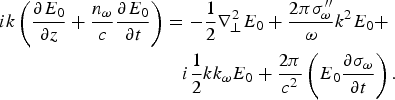 $$\eqalign{ik\left({\displaystyle{{\partial E_0 } \over {\partial z}} + \displaystyle{{n_{\rm \omega} } \over c}\displaystyle{{\partial E_0 } \over {\partial t}}} \right)& = - \displaystyle{1 \over 2}\nabla _ \bot ^2 E_0 + \displaystyle{{2{\rm \pi} {\rm \sigma} _{{\rm \omega}}^{\prime \prime}} \over {\rm \omega} }k^2 E_0 + \cr & \quad i\displaystyle{1 \over 2}kk_{{\rm \omega}} E_0 + \displaystyle{{2{\rm \pi} } \over {c^2 }}\left({E_0 \displaystyle{{\partial {\rm \sigma} _{\rm \omega} } \over {\partial t}}} \right).}$$
where k ω = − μ ω = 4π σ′ω/c is the plasma gain factor (if  $k_{\rm \omega}$
 $\lt 0$ plasma absorbs the radiation), and
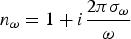 $n_{\rm \omega} = 1 + i\displaystyle{{2{\rm \pi} {\rm \sigma} _{\rm \omega} } \over {\rm \omega} }$ is the complex refractive index. The first term in the right part of Eq. (20) stands for the diffraction divergence of the electromagnetic field, the second term describes plasma focusing (defocusing) features, and the third term represents the absorption (amplification) process. The last term in the right part of Eq. (12) is small in comparison with previous ones and gives some corrections to the focusing/defocusing and amplification/absorption of the wave field.
If the RF pulse intensity is weak enough and do not contribute to the temporal evolution of the EEDF in a plasma channel the equation (20) is a linear one and should be solved for the given distribution of the plasma parameters obtained from the analysis of the Boltzmann equation for the EEDF. If the RF field contributes significantly to the temporal evolution of the EEDF the wave equation (20) should be solved self-consistently with the Boltzmann equation (12) in an each spatial point.
The case of our study is the situation when k ω > 0 and σ″ω < 0. Such a situation is of interest with respect to creation of the plasma waveguide being capable to amplify the transported radiation. Actually, the amplification duration τampl corresponds to the amplification distance of about c × τampl (τampl is the time interval of the positive gain factor existence) which equals to tens of centimeters. The same is for focusing properties of the plasma, but the guiding length is typically several times longer. So the laser pulse creates the plasma channel characterized by amplifying and guiding «trails» (see Fig. 4). If we launch the laser pulse and the RF pulse just one after another simultaneously, the last one will continually be located in the amplifying and guiding zones of the laser pulse.
Spatial structure of radio (1) and laser (2) pulses for a given instant of time. Dash curves are the spatial profiles of the gain factor and the refractive index.
It can be seen from Eq. (20) that in the case of Re n ω = 1 − 2πσ″ω/ω > 1, the plasma channel can partly suppress the diffraction divergence of the RF radiation. If the condition
 $$\lpar {\rm Re} n_{\rm \omega} - 1\rpar k^2 R^2 \gt 1 $$
(here R is the plasma channel radius) is satisfied, the channel will look like the waveguide and can transport the radiation without divergence. For ω = 5 · 1011 s−1 and k = ω/c ≈ 16.7cm−1 and Δn ω = Re n ω − 1~ 0.001 (see Fig. 2b), the guiding regime of propagation will be realized for R > 2 cm. It means the laser pulse in order to create such a plasma channel with electron density n e ~ 1012 cm−3 should have the power at least at the sub-terawatt level.
For the numerical integration of Eq. (20), we introduce new variables: ζ = z and retarded time τ = t − z/c. Taking into account that the laser pulse propagates through the gas with the speed of light and, hence, σω (ρ,z,t) = σω (ρ, t − z/c) = σω (ρ, τ ), Eq. (20) can be re-written in the following form
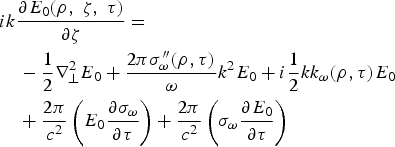 $$\eqalign{& ik\displaystyle{{\partial E_0 \lpar {\rm \rho} \comma \; {\rm \zeta} \comma \; {\rm \tau} \rpar } \over {\partial {\rm \zeta} }} = \cr & \quad - \displaystyle{1 \over 2}\nabla _ \bot ^2 E_0 + \displaystyle{{2{\rm \pi} {{\rm \sigma}} ^{\prime \prime}_{\rm \omega} \lpar {\rm \rho} \comma {\rm \tau} \rpar } \over {\rm \omega} }k^2 E_0 + i\displaystyle{1 \over 2}kk_{\rm \omega} \lpar {\rm \rho} \comma {\rm \tau} \rpar E_0 \cr & \quad + \displaystyle{{2{\rm \pi} } \over {c^2 }}\left({E_0 \displaystyle{{\partial {\rm \sigma} _{\rm \omega} } \over {\partial {\rm \tau} }}} \right)+ \displaystyle{{2{\rm \pi} } \over {c^2 }}\left({{\rm \sigma} _{\rm \omega} \displaystyle{{\partial E_0 } \over {\partial {\rm \tau} }}} \right)}$$
Here the last term in the right part of the equation results in slowing down of the RF pulse with respect to the laser one.
Numerical solution of Eq. (22) was realized by using the finite element method in the spatial domain of 0 ≤ ρ≤ ρmax = 40 cm, 0 ≤ ζ ≤ z max = 120 cm. The full time of integration did not exceed t max = z max/c ≈ 4 ns, that corresponds to the propagation distance z max . The electric field strength at remote boundaries ρ = ρmax and ζ = z max was assumed to be zero. As the initial condition at ζ = 0 the temporal profile of the RF pulse was chosen in a Gaussian form
 $$E_0 \lpar {\rm \rho} \comma \; {\rm \zeta} = 0\comma \; {\rm \tau} = t\rpar = A \times R\lpar {\rm \rho} \rpar \times \sin ^2 \displaystyle{{{\rm \pi} t} \over {{\rm \tau} _p }}$$
where A is the amplitude of the RF pulse at the axis ρ = 0, τp is its duration, and the function R(ρ ) gives the initial radial electric field distribution. Further, we assume that τp = 50T (T = 2π/ω ), which corresponds to the RF pulse duration of τp ≈ 0.628 ns for ω = 5 × 10¹¹ s−1. The initial radial distribution R(ρ) was also chosen in the Gaussian form
 $$R\lpar {\rm \rho} \rpar = \exp \left({ - {{{\rm \rho} ^2 } / {2{\rm \rho} _f^2 }}} \right)\comma \;$$
where ρf is the RF beam radius. The radial profile of the electron density created by KrF laser pulse and determining the value of the gain factor (or absorption coefficient) and the plasma refractive index was also assumed to be Gaussian:
 $$n_e \lpar {\rm \rho} \rpar = n_e \lpar {\rm \rho} = 0\rpar \times \exp \left({ - {{{\rm \rho} ^2 } / {2{\rm \rho} _e^2 }}} \right)\comma \;$$
where n e (ρ = 0) is the electron density in the center of the formed plasma channel, ρe is its width.
Integration steps in time and space domains were chosen as Δt = τp/512, Δz = cΔt, Δρ = ρ max/640. In addition, for any spatial point (ρ,ζ), the Boltzmann equation for the EEDF was solved numerically to determine the electro-dynamic features of the plasma channel.
First, we discuss the results of numerical integration of the wave equation (22) with initial and boundary conditions (23)–(25) for the case of weak field when the contribution of the amplified RF pulse to the EEDF evolution in the plasma channel can be neglected. Distributions of the electric field envelope  $\left\vert {E_0^{} \lpar {\rm \rho} \comma {\rm \zeta} \comma {\rm \tau} \rpar } \right\vert $ for the initial beam radius and the radius of the plasma channel ρf = ρe = 2cm versus the variable τ = t − z/c (for ρ = 0) and the radial variable ρ (for τ = τ p/2 that corresponds to the maximum of the envelope of the initial pulse) are presented in Figure 5. The first of these distributions can be considered as the temporal envelope of the pulse at different fixed values of z or as a distribution over z-coordinate at a fixed instant of time. The value of retarded time τ = t − z/c = 0 corresponds to the initial edge of the propagating RF pulse; coordinate τ = t − z/c = τp is its trailing edge. For the RF pulse duration τp = 50T, the spatial length of the pulse is equal to cτp ≈ 1.9 cm. For such a pulse, k ω ≈ 0.04 см−1 can be considered to be nearly constant during all propagation time (see Fig. 3). The electric field E 0 increases with propagation length approximately exponentially E 0 ~ exp (hz) with h ≈ 0.024 cm−1. This value is a little larger than k ω/2 ≈ 0.019 cm−1, this difference arises from the partial focusing effect during the propagation of the RF pulse in the plasma waveguide. As about the radial distribution (see Fig. 5b) it is nearly Gaussian one for all instants of time. We would also note that for Δn ω ~ 0.001 for the propagation length of z max = 120 cm, the deviation of the velocity of RF pulse from the speed of light is negligible and can be omitted.
Temporal (1) and radial (2) profiles of the electric field envelope of the amplifying pulse at the different propagation distances z: 1 = 0 cm, 2 = 30 cm, 3 = 60 cm, 4 = 90 cm, 5 = 120 cm. Initial peak intensity is 0.1 W/cm2.
The case of the initial RF pulse with relatively high intensity when the guiding RF field contributes significantly to the evolution of the EEDF in the plasma channel is more interesting. The results of such calculations for the initial RF intensity I 0 = 103 W/cm2 are presented in Figure 6. It can be seen for the same propagation length 120 cm there is an increase in the peak intensity of the RF pulse of about six times. The pulse shape is found to be distorted significantly, mainly because of the dominant enhancement at the leading edge of the pulse. As for the trailing edge of the pulse it can be seen in Figure 6a that for the propagation distances of 60 cm a more significant absorption of the RF intensity is observed due to dramatic reconstruction of the EEDF by the RF pulse. As a result, the shorter RF pulse with leading peak and broader spectrum is formed in such a propagation regime.
The same, as at Figure 5, but for the initial peak intensity 1 kW/cm2.
To confirm the reconstruction of the EEDF by the strong RF pulse, the spatial distribution of the gain factor (absorption coefficient) on the axis of the channel in dependence of the variable τ = t − z/c is presented (see Fig. 7). As it can be seen from the data in Figure 7, for the propagation length of 60 cm, the gain factor decreases approximately twice at the trailing edge of the RF pulse. At a distance of 90 cm, more than half of the RF pulse is found to be in the zone of absorption, while the zone of the positive value of the gain factor decreases continuously as the pulse propagates. On the other hand, this absorption is partly compensated by the temporary increment of the refractive index Re n ω − 1 in the middle part of the channel (see Fig. 8) that partly improves its guiding properties. Nevertheless, for much longer propagation lengths in such a situation, the significant reduction of the pulse duration is expected, which imposes additional restrictions on the validity of studying the RF pulse propagation in frames of the SVAP approach.
Temporal profiles of the gain factor at the different propagation distances z: 1 = 30 cm, 2 = 60 cm, 3 = 90 cm, 4 = 120 cm. Initial peak intensity is 100 W/cm2.
Temporal profiles of the refractive index Re n ω −1 at the different propagation distances z: 1 = 30 cm, 2 = 60 cm, 3 = 90 cm, 4 = 120 cm. Initial peak intensity is 100 W/cm2.
We would like to mention that at least in the weak field limit, the time delay between the laser and RF pulses of several nanoseconds will result in more effective regime of guiding and amplification as both of gain factor k ω and refractive index n′ω increase in time for initial time intervals (see Fig. 2). More effective regime of RF pulse propagation for the delays of ≤10 ns was found to exist in our simulations.
We also note that from a practical point of view, the case where the plasma channel is created not by multi-photon ionization of the gas, but by a single-photon ionization of impurities with low ionization potential can also be of an interest. In this case, the laser pulse may have reasonably low power.
CONCLUSIONS
Thus, in this paper, we demonstrated that the plasma channel appearing in the process of multi-photon ionization of the gas by a femtosecond ultraviolet laser pulse is characterized by unusual electro-dynamic properties and can be used as a dielectric waveguide for both transportation and amplification of radio frequency pulses in a sub-terahertz frequency band. Guiding and amplification of a radio frequency radiation in a plasma channel formed by the powerful KrF laser femtosecond pulse in xenon is studied numerically on the basis of the self-consistent solution of the Boltzmann equation for the EEDF evolution in the non-equilibrium plasma, and the wave equation in paraxial approximation for the transported through the channel RF pulse. It was found that there is an opportunity to reach significant amplification by simultaneous launching of a laser and RF pulses with approximately the same propagation velocity, so that the RF pulse is continually located in the guiding and amplification zones of the laser pulse.
ACKNOWLEDGMENTS
This work was supported by the Russian Foundation for Basic Research (project no. 15-02-00373). Anna Bogatskaya also thanks the Dynasty Foundation (program for support of students) and the LPI Educational Complex and Special Program of RAS Presidium for young scientist support. Numerical modeling was performed on the SKIF-MSU Chebyshev supercomputer.



